The Effect of Business Cycle Fluctuations on Import Protection in Selected Developing Countries١
Saeed Rasekhi∗ Ahmad Jafari Samimi∗∗ Mohammad Ali Ehsani∗∗∗ Elmira Zabihi Lahrami∗∗∗∗
Abstract:
In recent decades, theorists proposed the role of domestic components such as interior active groups, policies and macroeconomic indicators on determination of protection policies. In the context of recent studies, this study has investigated the effect of business cycle fluctuations on import protection for selected developing countries in 1995-2011 by using dynamic panel data method. Furthermore, for sensitivity analysis, we have estimated the effect of business cycle fluctuations on protection cycle fluctuations. The results indicate that the effect of business cycle fluctuations on import protection is negative and significant. This effect has been confirmed for protection cycle fluctuations too. Based on the results, the cyclical feature of import protection is confirmed for the selected countries. On the one side, we suggest that the Governments advocate of the protection should pay more attention to the role of the endogenous factors of import protection especially the business cycles in order to increasing the success of the protection policies. On the other side, the suggestion is that the pro economic liberalization governments may liberalize more the economy in boom periods to decrease the adjustment costs.
Keywords: Import Protection, Business Cycle Fluctuations, Dynamic Panel Data, Selected Developing Countries.
JEL Classification: F13, E32, C23.
1. Introduction
In recent years the importance and role of economic factors in determining the commercial policies are emphasized so that these factors
١ This paper is extracted from a Ph.D. thesis at University of Mazandaran
∗ Corresponding Author: Professor in International Economics, Economics Department, Faculty of Economics and administrative sciences, University of Mazandaran. Email: [email protected].
∗∗ Professor in Economics, University of Mazandaran. Email: [email protected].
are replaced by traditional political stimuli such as income distribution and lobby. In this regard, Broda et al. (2008) have suggested that one of the most important economic factors affecting the protective policies is business cycles fluctuations.
A review of the literature on business cycles reflects the increasing importance of this issue between economic discussions from the early nineteenth century. Nevertheless, a major effort was focused on two main axes namely recognizing the factors influencing the genesis recession and recovery periods and statistical indices analysis related to the cycle. But how business cycles fluctuations can influence countries' commercial policy is a question that has not been answered yet fully. It is worth mentioning, although empirical studies have mainly indicated countercyclical nature of import protection in industrialized economies; theoretical literature does not explicitly represent a model indicating countercyclical nature of import protection. Specifically, governments tend to perform policy intervention mainly because of distributional objectives that in this way, there are two logical possibilities to response to countercyclical nature of import protection: The first possibility is tariff impact on income distribution of local residents (local political economy), which tariff increase cause in recessions is increasing political pressure of import competing firms. The second possibility is tariff impact on income distribution among local residents and the rest of the world (beggar-thy-neighbor effects), so that governments can improve terms of trade by enacting import tariff.١Accordingly, countercyclical import protection occurs the revenue due to tariff increase in recession is greater than the cost of long-term trade war (Bagwell and Staiger, 2003).٢Indeed, according to the recorded facts, counter cyclicality of import protection depends on the choice of the countries studied, so that in developed countries, this relationship can be explained by stimulus models of trade relationship. In addition to distributional objectives Hansen (1990) states that in America, mainly tariffs have been income instruments.٣ Therefore, government increase tariffs at Treasury budget deficit to maintain the budget balance. In his view, the cyclic nature of budget deficit led to the countercyclical nature of import protection.
The present study examined the impact of business cycle fluctuations on tariff protection in selected developing countries during the period
١This theorem is true for large countries. ٢For more details see Bagwell& Staiger (2003).
1995-2011 by using dynamic panel data method. It is worth mentioning most performed studies about protectionism within the country have been trying to answer this question that why a particular industry or group has received protection, while others have not received that it can be pointed out to Rasekhi and Behnia (2012)١. Of course Rasekhi and Davary (2013) assessed determinants of tariff protection in Iran during the period of 1971-2010 based on protection endogenous assumption and by using their model CO-Integrating VAR method. The results suggest that foreign policies and oil incomes as macroeconomic indices are considered a major factor in business fluctuations incidence and changes in policy making. Also the external studies about the topic of the research are as follows:
Grilli (1988) examined the relationship between protectionism and the business cycle in Europe and the United States of America during the period 1969-1986 by using Two scale Least Square (2SLS) with Cochrant-Orcutt Procedure. The results show a countercyclical motion of non-tariff barriers. Bohara and Kaempfer (1991) examined the relationship between the business cycles and import protection of America during 1890 to 1970 by using their Vector Autoregressive (VAR) model. The results indicate that there is a significant Granger Causality for levels of tariffs and all other macroeconomic variables under except trade balance so that, higher unemployment and lower growth will lead to higher tariff (counter cyclicality of protection). Goande et al. (2011) examined the determinants of trade policy behavior (tariff) in 7 emerging economies, namely Argentina, Brazil, China, India, Mexico, Turkey and South Africa during the crisis by using logit Panel. The results indicate that the tariff rate during the crisis has not risen as much as expected. Rose (2012), evaluated the relationship between business cycles and import protection for 6 countries over a period of 30 years by using panel data method and 4 criteria of the cycle. The results show pre-war cyclicality and post-war counter cyclicality of the protection. Bown and Crowley (2012), estimated the impacts of macroeconomic fluctuations on protectionism by using seasonal data of 5 major industrial economies (America, Europe Union, Canada, Korea and Australia) during the period 1988-2010 and compound data method with Poisson distribution. The results indicate that the
protection, especially to America and Australia is countercyclical. Georgiadis and Grab (2013) examined the impact of internal GDP growth and trade partners on trade policies of G20 countries during the period 2009 -2012 (great recession period).For this purpose, they have used Negative Binominal Regression model. The results indicate that there was a countercyclical relationship between the business cycle and protectionism for the period before the financial crisis which has been preserved during the crisis.
Review of empirical studies clearly indicates that quantitative studies internationally on the impact of business cycle fluctuations on import protection have been done. In particular, in most performed studies, the rate of domestic gross product growth is presented as representative of cyclic fluctuation. While this paper calculated cyclical component growth of domestic gross product for fluctuations calculation. On the other hand, most studies have been conducted for developed countries. However, given the role of the state in developing countries, protection strategies in these countries have a special place. Although policymakers predict special time horizons for such policies but frequent changes of policy making and fluctuation of macroeconomic indices of countries show the need to examine protective policies formation and factors affecting on it. Accordingly, and regarding limited international studies and the lack of internal study, the importance of the present study is revealed. Also this study, along with estimating the impact of business cycle fluctuations on import protection, also estimated the impact of business cycle fluctuations on fluctuations of protection cycle and compared the results, this has not been done in any of experimental works. Regarding the descriptions provided this study in terms of topic, fluctuations calculation, countries selection and the model is different from other similar studies.
This paper organized in four sections. After the introduction in the first section, section 2 presents the theoretical background. Section 3 reports data and estimation of the model. Section 4 concludes. The end of the paper presents references.
2. Theoretical Background
accepting free trade. While the result of accepting the idea of economic nationalism is closed economy. But empirical studies have shown that the consequences of the policy making have not been coordinated with the expectations of schools of thought.١ Therefore, unfocused efforts have been taken to reform the theory, and in particular Hegemonic Stability can be justified tariff behavior. In this regard, Stephen Kranser (1976) states that power concentration and on the other words Hegemony presence (dominance) resulted in open trade relations and Hegemony absence lead to conservatism and closed business relationships. However, empirical studies add little to explanatory power of the theory.٢
From the 1970s onwards theorists of international political economy have emphasized internal elements role such as internal active groups, policies and macroeconomic indices on formation procedure of protective policies have placed great emphasis (Galaroti, 1985). In this regard, They provided causal mechanism by using endogenous tariff models that considered tariff rates as a function of the power between liberalizing coalition and protectionism, through which changes in economic environment conditions can make producers interested in protection demand.٣ Magee et al. (1989) have considered endogenous policyL as it could be explained by rational behavior and based on the maximization. In fact, complete endogenous policy model involved both lobbying and policy endogeneity. In addition, a general equilibrium in endogenous policy model is based on maximizing behavior of both elements (parties and lobby) and economy (goods and market factors).In this regard, since 1980, political behavior and influence of interest groups both in theories and in empirical section of economic researches are important that it can be referred to Dloof Studies (1998), Drazen (2000), Persson and Tabellini (2000), Grossman and Helpman (2001).M
Rodrik (1995) argues that a political economy model has four characteristics: First, it includes a set of individual preferences in the realm of political choices of policy makers. Second, it detects links to
١For instance, during the second half of the 19th century, three of the world's most prolific trading nations exhibited commercial policies that ran counter to prevailing ideologies. France, Germany, and the United States, all ideologically protectionist during the period, traded in a liberal manner at one time or another.
٢For example, Great Britain, a declining hegemony in 1880-1913, maintained free-trade policies, while the United States, a rising hegemony in 1919-39, pursued strongly protectionist policies.
٣ It is necessary to explain that the relative strength of supporting fans, thus the number of Fans Support agents changes in response to changing economic circumstances, upper and lower.
L Its roots are in the theory of public choice.
individual preferences through lobby, political parties, public movements and etc. These two elements are related to the side of trade policies demand. While two next elements are related to the side of trade policies supply; in this context, first policy makers' preferences are important.
section. The more number of members and employees of the economic sector or industry, the more protection will be also as a result of it.
According to the above, although it seems lobby is the main driving force in all political economy models, but protection can be considered as a function of a set of variables. Regarding the approach of tariff formation function, median voter and adding machine it is suggest that the tariff is a function of the number of people employed in industry so that the number of workers in industry has a direct relationship with influence power and bargaining of industry holders and leads to more demand for tariff protection (Balwin and Nicoud, 2007). However, and in large scale job opportunities and rising unemployment lead to dissatisfaction of the part of the population who are deprived of employment or cannot maintain their job opportunities in competition with industries and foreign products; this issue is accompanied with officials and policymakers' reaction to public demand and pressure of dependent groups on industries holders and unions, that are mainly seeking to increase public protection. In this regard, Costinot (2009) proposed a theory that jobs have rents that depend on the level of trade protection and tend to attract widespread protections in deadlines such recession and unemployment rate. Policy Protection Function and political protection believe that the tariff is a function of the product, import demand elasticity, industry concentration, the ratio of import and endogenous weight reflecting politicians' preferences on the welfare of industry. Although some of these factors are only examined in the industry, but some of them such as the ratio of import to production have generalization capability into the macro level. Karacaovali (2012) by using a standard trade policy model of economy shows that the protection in a small open economy inversely depends on import penetration (the ratio of import to production).While Hilman (1982) believes that countries with a higher ratio of import to domestic production need more protection.
Campaign Contribution Approach suggests that the tariff is a function of the gap between domestic and external prices and value-added of industry. According to pressure group and interest groups also protection is a function of unemployment rate and the ratio of import to production. Finally, and based on status quo bias the tariff is a function of the decisions of the previous period (Knetsch, 1989).
they may be also indirectly influenced by internal seeking protection pressures. One of cases is foreign policies of countries. In this regard it can be pointed to synchronization and relationship between foreign policy and trade systems. Corden (1994) states that trade protections and devaluations can act as two alternative policymaking instruments. Knetter and Prusa (2003) stated that the increase in the value of the domestic currency (real exchange rate decrease) by reducing the final cost of import leads to increased import demand and increased supply of foreign firm. So the government increase import protection to protect and prevent damage to domestic production.
Also in 1980s, a systematic effort was taken to rationalize tariffs behavior by using business cycle. In this regard, the business model of tariffs in a causal context is looking for the cause source in own country and links change direction of the tariff to the general levels of economic activities of the countries and does this through the market exchange (Galaroti, 1985). It should be noted, generally protection policies selection of small countries is based on protection impact on income distribution among local residents (domestic political economy) that according to this theory, tariffs are more in recessions because the pressure is further increased import competing firms. But this explanation is incomplete because ignores policy impact of other producing sectors that may be interested in reducing protection in recession. For example, a trade agreement that would reduce tariffs on imported goods may be important for issuing firms during the recession because domestic firms that use the goods as inputs benefit from reduced protection. In the light of these policy impacts, it seems the common discussion for countercyclical tariffs is not convincing so that cannot explain why policy pressures of import competing sectors are fluent in recessions to increase tariffs (Bown and Crowley, 2012). McKeown (1984) suggests a model that partially is responsive to countercyclical nature of protection.
from a process whereby changing business conditions modify the expected utilities of free trade and protection. This process, in turn, determines the relative levels of collective action achieved by high and low tariff seeking groups. Employing both rational and semi rational theories of group behavior, McKeown hypothesizes that periods of economic contraction, such as depressions, will shift the political balance over to the side of protection, while periods of expansion shift the balance in favor of free trade. The process is depicted in Figure 1.
figure 1: Mckeown model(1984)
Assume that government can increase or reduce tariffs along a continuum ranging from a rate of zero (point A-complete openness) to a completely prohibitive rate of 200(point C). At any given point along the continuum at which the national tariff is set, say point B (100), high-tariff interests (coalition 1) are the buyers of all tariff rates from zero to 100, or line AB(100 units of protection). Low-tariff interests (coalition 2) buy all tariff rates from 200 to 100, or line CB (100 units of free trade). A movement along the continuum caused by a policy change, let us say to point L, would redistribute five units from coalition 2 to coalition 1. In this sense the competition between coalitions for favorable tariff legislation is depicted as a zero-sum game, where the losses of one coalition exactly equal the gains of its competitor. Government is represented as a monopolistic firm producing both protectionist and free-trade legislation.
Figure 3 illustrate demand and supply curves for protection and free trade. The demand for each commodity, shown as AR curves, will be determined by the relative voice magnitudes of protectionist and free-trade interests. Any change in relative voice will cause the two demand curves to shift in opposite directions. The marginal cost curve for each commodity represents changes in total cost for each additional unit of tariff legislation produced. Government production costs are made up of the political support of opposing interests that is foregone and legislation costs. In regard to figure 3, Behaving as a monopolist, government will set
A 0
100
B
105
A
200
P2 P1
C
B
Q1 MC
AC
MR AR=D
Free trade k
price (P) and quantity (Q) for both commodities according to the intersection of the marginal cost and marginal revenue curves. This outcome will assure that total profits (surplus political support) accruing from the production of each commodity will be maximized, thus maximizing sum total profits from both commodities. As a supplier of free trade (diagram 1), government will produce, units at price, while incurring an average cost of B. Total profits will be , or rectangle . As a supplier of protection (diagram 2), government will produce units at price , while incurring an average cost of E. Total profits will be , or rectangle . At the equilibrium quantities Q1, and Q2, sum-total profits ππ will be maximized. The model suggests that changing economic conditions will alter the distribution of tariff legislation through both supply and demand effects.
Digram 2 Diagram 1
Figure 2: demand and supply curves of protection and free trade
(
The supply and demand effects of changing business conditions can be accounted for by way of an expected utility theory of protection. Periods of economic contraction raise the expected utility of protection over society as a whole and reduce the expected utility of free trade. This change in turn enhances the potential for collective action on the part of protectionists and reduces that potential for free traders. The cause for this is that first, entry into an industrial sector, argues McKeown, is positively
AR=D MR
MC AC
E G
correlated with that sector's rate of demand growth. Where this rate slows up or becomes negative, as in a period of economic contraction, fewer firms will enter than during a prosperous period and producer’s surplus that it creates will be bid away more slowly. Second, in a period of economic contraction, firms earning less than satisfactory profits will find it difficult to enter more remunerative sectors since such periods are less opportune for the implementation of long-term structural change. The net result will be that firms faced with such conditions will see greater utility in seeking protection from government and less utility in exiting a sector.
This argument suggests that a positive correlation exists between the amount of pressure a firm will bring to bear on government in attempting to extract protection and the costs of exiting a troubled sector. Where these costs are low, as in a period of economic expansion, the decrease in the expected utility of protection will cause firms to expend their resources entering another sector exit becomes a preferable strategy. Third, innovations and technological advances due to expansion, make domestic products more globally competitive and lead to increasing exports and decreasing of tariffs. If national economy has divided into three types of firms and assumed that all firms import a substantial proportion of their inputs, exporting firms will prefer low or no domestic tariffs because their input costs will be reduced and because low domestic tariffs might serve to induce other nations to open their markets to foreign products. Mixed-interest firms, which both export and compete against imports, will also prefer low tariffs for both reasons. They need not fear foreign competition in their domestic market since they will be the lower cost producers.
Import competing firms will be less disposed to seek protection because their input costs will also be reduced. Like mixed firms, they will not require protection to control their domestic market. Conversely, the loss in international competitiveness that accompanies contractionary periods will increase the expected utility of protection. Exporting firms will, of course, always prefer free-trade policies. However, the preferences of the other two firms will alter in favor of protection. Import competing firms, no longer able to dominate their domestic market without the aid of protection, will become strongly protectionist. Similarly, the import competing side of mixed firms will in the face of more competitive foreign producers attribute a greater value to high tariffs.
costs. Since an expanding economy raises the profits that government obtains from producing free trade legislation, it follows that the production of protection becomes more expensive. More must be given up in terms of free-trade profits, which are now greater, in order to produce each additional unit of protection(Mckeown, 1984).
In addition, Gallarotti(1985) in seminal model investigate the effects of business cycle fluctuations on changing on tariff rate. Two models only differ in their treatment of the dependent variable: where McKeown is interested in the level of tariffs, Gallarotti fix upon the direction of tariff change. The causes of Gallarott is that nominal levels, however, do not always indicate the degree to which tariffs shield an economy; where the production costs of foreign firms roughly equal those of domestic firms, a low, scientific tariff may afford a higher degree of protection than a high tariff where foreign firms are far more cost-efficient. Therefore a government responding to protectionist pressures during a depression may impose a low tariff in order to provide the high degree of protection demanded, even though a model equating protection with nominal levels would predict high tariffs. Hence the model should be better at predicting the direction of change. We can be far more certain that tariffs will rise during a depression than we can be regarding the levels they will reach.
3. Model:
This research for investigating the effect of business cycle fluctuations on import protection in selected developing countries in the period 1995-2011, have been used :
!" #$ % &*β'(%)ε(%) (1)
In which protect is protection index, BCF is business cycle fluctuations, X is control variables such as import penetration, unemployment rate, real exchange rate and deficit budget, αandβ are country and period fixed effects, respectively. According to above, the unemployment rate and import penetration are economic factors that have direct effects on tariff protection trends, other variables have been indicated the effect of political economic elements and internal pressure groups on trade strategy formation in countries, that can reflex indirect effecting ways on protection policies. For comparing to Mckeown (1984) and Gallarotti (1985) Models, this paper estimates also:
+ !+" #$ % &*β'(%)ε(%) (2)
In theoretical studies and researches conducted, researchers used various indices to measure the extent and severity of commercial protections which sometimes differ in terms of comprehensiveness and calculation. In this regard, one of the most impactive and common tools to identify protection is Weighted Applied Tariff Rate that is derived of World Integrated Trade Solution (WITS). Although the formation of organizations such as the World Trade Organization (WTO) it seems that the domain of tariff policy is limited but in recent decades and especially with accelerating global process there is more emphasis and great attention to the tariff policies use as the standard deviation of tariff rate in the studied countries during the period 1995-2011 is estimated between 0.5 and 8 which suggests changes in tariff rate of the countries.
In order to derive business cycle fluctuations, different methods are used of which can be noted Hodric and Prescott filters (HP), Band-pass (BP) and Adaptive Least Squares (ALS).HP filter is obtained by minimizing the sum of squared deviations of the given series from the process component that it can be considered as a good indicator of fit (Hodric and Prescott, 1980).With a specified value of λ in HP filter, the process component is obtained by minimizing the following equation: ,-./&*0 1 2 &*31 1" 1" 1"45 (3) Where 0is the logarithm of given variable and 1) is the process component.In fact, this filter minimizes the distance between the process and the original series and simultaneously process series curve. Exchange between the two objectives is set by the parameter λ. Failure of the filter is option selecting of λ so that Cogley and Nason (1995) stated that the cycles in filtered data are determined by HP may be due to filter impacts not because there is really a cycle in data. Ignoring structural failure and not considering instability dynamics is other weaknesses of this filter.
method is used in order to more accurately measure the fluctuations and the results are compared by HP and BP filters. Adaptive least squares technique is a special mode of Kalman filter that simply estimates the models with time-varying parameters; then estimated process is used for estimating production gap. This technique is developed by Mcculloch (2005) and allows the researcher to estimate linear process of real GDP with considering changing characteristic of the process over time.
Resulting changes in the process are determined not by the researcher, but in the model.ALS unlike band-pass is able to consider all the parameters as time-varying without causing the problem of freedom degree reduction, for only the estimation of a parameter i.e. P determines the behavior of the model. As a result, ALS has all the advantages of time-varying models with no fundamental disadvantages of them. Another advantage of this method is that all parameters are variable in time while in previous models only the stable component had the ability to change at time. ALS' superiority to a HP filter is about two issues. First, in ALS unlike HP, the need to impose an arbitrary value of the parameter is not smooth. Another issue is ALS predictability and its absence in HP (Samimi et al., 1391). In the present study, according to wide use of HP filter in studies and because of ALS filter superiority, these two filters are used to calculate the fluctuations. Please note that the data of GDP is derived from World Development Indices website (WDI).
Another variable affecting the tariff protection is import penetration which shows the ratio of import to production. Related data to the index calculation has been collected from Trade Organization World website and World Development Indices. Another factor affecting the level of tariff protection is unemployment rate. Related data to the index has been derived from the website of World Development Indices. The fourth variable affecting tariff tare is impactive tariff rate that its information is derived from the website of International Financial Statistics (IFS). The last factor affecting tariff protection in the present paper is government budget deficit that its information is derived from the website of Government Financial Statistics (GFS). Since in models studied, the dependent variable with an interval is given on the right hand of the model (Knetsch, 1989);١ OLS estimators are not consistent. In order to address
this problem and estimate these models, Arellano-Bond (1991) have presented the dynamic method based on Generalized Method of Moments (GMM).Therefore, in this study, the most appropriate method for endogenous control of variables and data analysis is GMM method. The first step for estimating the model mentioned is ensuring pattern parameters stability. For this purpose, stability test of Levin, Lu and Chow, and Im, Pesaran and Shin test are used. Stability test results show that all variables are static at confidence level of 95 percent. In other words, they have collective degree of I (0).Once coefficients estimated by using GMM method, it is necessary to perform Sargan test to examine the validity of the instrumental variables defined in the model and over determination of the equation. In fact,this test examines correlation absence between the instruments and the error terms. Failure to reject the null hypothesis indicates serial correlation absence and valid instruments.
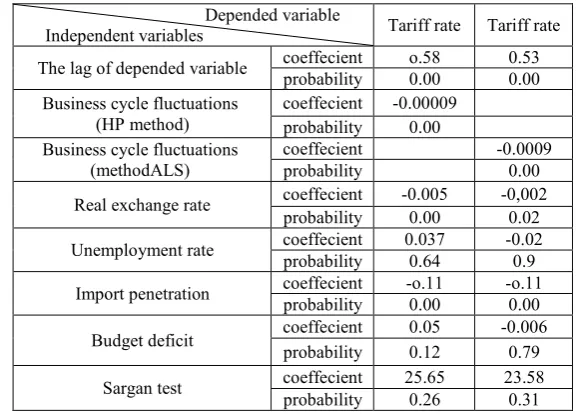
Table 1 shows the results of estimating the impact of business cycles fluctuations on import protection in selected developing countries by GMM method over the period 1995-2011.According to the results of Table 1, the impact of business cycle fluctuation variable on protection level is estimated negative and significant that is consistent with the model proposed by McKeown (1984).In other words, downward movement in the diagram that represents a cyclical negative growth leads to protection reduction, and vice versa. In other words, in periods of economic recovery with government power increase for direct subsidies payments, policymakers consider trade liberalization. Also on the demand side, with economic recovery and government direct help, industry pressure is reduced to attract the attention of policy makers and implementing protection measures. Also the effect of real exchange rate variable is negative and significant that is consistent with Knetter and Prusa study (2003). National currency value increase (the real exchange rate decrease) leads to increased demand for import by reducing the final cost of import.
Thus the need for protection tools use increases due to domestic products protection. The effect of the variable of import ratio to production is negative and significant that is consistent with Karacaovaly study (2012).١The effect of unemployment and the deficit budget is
١According to Karacaovali, the tariff obtained from the following equation:
τ 8 09
:′9
; 809 :< 9
insignificant. This result can be explained so that the society public atmosphere in developing countries is not able to impose a pressure for trade restrictions; Lack of strong trade unions in these countries can be considered one of the reasons for this result. Regarding insignificant impact of budget deficit, As Bagwell and Staiger (2003) stated, the purpose of protection policies in recent decades in not revenue for government, but they are mainly used as a distributive means.
Table 1: the results of estimating business cycle fluctuations on import protection in selected developing countries in the period 1995-2011
Tariff rate Tariff rate Depended variable Independent variables 0.53 o.58 coeffecient The lag of depended variable
0.00 0.00
probability
-0.00009 coeffecient
Business cycle fluctuations
(HP method) probability 0.00
-0.0009 coeffecient
Business cycle fluctuations ) methodALS
( probability 0.00
-0,002 -0.005
coeffecient Real exchange rate
0.02 0.00 probability -0.02 0.037 coeffecient Unemployment rate 0.9 0.64 probability -o.11 -o.11 coeffecient Import penetration 0.00 0.00 probability -0.006 0.05 coeffecient Budget deficit 0.79 0.12 probability 23.58 25.65 coeffecient Sargan test 0.31 0.26 probability
Reference: the results of present research
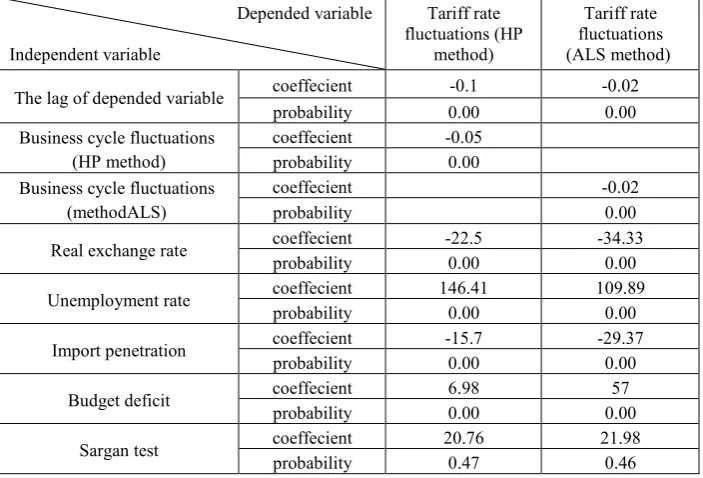
Also regarding above theoretical literature, to compare models of McKeown and Gallarotti, the impact of business cycle fluctuations on protection cycle fluctuations is also tested. Table 2 presents the results of models estimation of the impact of business cycles fluctuations on import protection fluctuations in developing countries over the period 1995-2011 by GMM method. According to the results of Table 2, the impact of business cycle fluctuations on import protection fluctuations is negative and significant. Also in comparing the variable coefficients with previous model it can be seen that the coefficients are larger in this model so that the finding is consistent with Gallarotti model (1985). Specifically, as Gallarotti states, an increase in business cycle fluctuations may raise tariff
rate a little but the impact on fluctuations is significant. Like the previous model, the impact of ratio of import to production and the real exchange rate is negative. It is worth saying that unlike the previous model here the variable of unemployment rate and budget deficit had a positive and significant impact on business cycle fluctuations. So when unemployment rate rises, the protection cyclical fluctuation is also increasing that is the confirmation of Costinot (2009), that at the time that unemployment raises, protection demand increases. Also budget deficit increase led to import protection fluctuation. That means, although, protection is not directly the state budget deficit supply means but budget deficit changes will lead to changes in the fluctuations cycle protection. The two latter results in fact are a confirmation of Galaroti model that states the tariff change orientation is influenced by economic variables more than the tariff level.
Table 2: the results of estimating business cycle fluctuations on import protection fluctuations in selected developing countries in the period 1995-2011
Tariff rate fluctuations (ALS method) Tariff rate fluctuations (HP method) Depended variable Independent variable -0.02 -0.1 coeffecient The lag of depended variable
0.00 0.00
probability
-0.05 coeffecient
Business cycle fluctuations
(HP method) probability 0.00
-0.02 coeffecient
Business cycle fluctuations ) methodALS
( probability 0.00
-34.33 -22.5
coeffecient Real exchange rate
0.00 0.00 probability 109.89 146.41 coeffecient Unemployment rate 0.00 0.00 probability -29.37 -15.7 coeffecient Import penetration 0.00 0.00 probability 57 6.98 coeffecient Budget deficit 0.00 0.00 probability 21.98 20.76 coeffecient Sargan test 0.46 0.47 probability
4. Summary and Conclusion:
The main objective of this paper is to test the impact of business cycle fluctuations on import protection in selected developing countries. For this purpose, a dynamic panel data model is estimated over the period 1995-2011. According to the results of this study, a significant and negative impact of business cycle fluctuation on import protection and import protection fluctuations has been approved. Also variable coefficient of business cycle fluctuation is obtained larger in the second model. So it seems as Galaroti states considering tariff rate changes is more important than the tariff rate. This issue due to the nature of business cycle fluctuation and the choice of free trade at the time of moving from recession to recovery is justifiable. Also, based on this study findings, it seems that tariff protection in developing countries is negatively depends on the exchange rate and the ratio of import to production that is consistent with empirical studies and mentioned theoretical foundations.
The two variables, unemployment rate and budget deficit have no significant impact on import protection that is justified according to society public atmosphere and government aim of imposing import protection. Also, similar results are obtained regarding the impact of import to production rate and real exchange rate on production cycle fluctuations. However, in this case it seems unemployment growth rate and budget deficit have a positive and significant impact on import protection fluctuations which actually means that the unemployment rate and budget deficit don't lead to tariff level change but result in cyclical fluctuation in import protection.
Totally and according the results of this study it can be seen that although the import protection in developing countries is countercyclical, but the impact of business cycle fluctuations on the protection is weak.
References:
1- Arellano, M. and Bond, S. (1991),“Some tests of specification for panel data: Monte Carlo evidence and an application to employment equations”, The review of Economic Studies, 58: 277-297.
2- Bagwell, K. and Staiger, R.W. (2003),“Protection and the Business Cycle”, Advances in Economic Analysis and Policy, 3(1): 1-43.
3- Baldwin, R.E. and Nicoud, R. (2007),“Entry and Asymmetric Lobbying: Why Governments Pick Losers”, Journal of the European Economic Association, 5(5): 1064–1093.
4- Baxter, M. and King, R.G. (1999),“Measuring Business Cycles Approximating Band – Pass Filters for Economic Time Series, Review Economics and Statistics, 8(4): 575-593.
5- Bohara, A. K. and Kaempfer, W.H. (1991a),“A Test of Tariff Endogeneity in the United States”, American Economic Review, 81(4): 952‐960.
6- Bown, C. and Crowley, M. (2012),“Import Protection, Business Cycles, and Exchange Rates: Evidence from the Great Recession”, World Bank Policy Research Working Paper, No. 6038.
7- Broda, C.H., Limao, N. and Winstein, D. (2008),“Optimal Tariffs and Market Power”, American Economic Review, 98(5): 2032-2065.
8- Caves, R. (1976), “Economic Models of Political Choice: Canada's Tariff Structure”, Canadian Journal of Economics, 2: 104-127.
9- Cogley, T. and Nason, J.M. (1995),“Effects of the Hodrick-Prescott Filter on Trend and Difference Stationary Time Series: Implications for Business Cycle Research”, Journal of Economic Dynamics and Control, 19: 253-278.
10- Corden, W.M. (1994),“Economic Policy, Exchange Rate, and the International System”. Oxford University Press.
11- Costinot, A. (2009),“Jobs, Jobs, Jobs: A “New” Perspective on Protectionism”, Journal of the European Economic Association, 7(5): 1011‐1041.
12- Findlay, R. and Wellisz, S. (1982),“Endogenous Tariffs, the Political Economy of Trade Restrictions and Welfare, Import Competition and Response, University of Chicago Press.
14- Gawande, K., Hoekman, B. and Cui, Y. (2011),“Determinants of Trade Policy Responses to the 2008 Financial Crisis”, World Bank Policy Research Working Paper, No. 5862.
15- Grilli, E. (1988), “Macro‐Economic Determinants of Trade Protection”, World Economy, 11(3): 313‐326.
16- Grossman, G.M. and Helpman, E. (1994). Protection for Sale, American Economic Review, 84: 833-850.
17- Hansen, M. (1990),“Taxation and the Political Economy of the Tariff”, International Organization, 44(4): 527-551.
18- Hillman, A. (1982),“Declining Industries and Political-Support ProtectionistMotives”, The American Economic Review, 72: 55-71. 19- Hodrick, R. and Prescott, E. (1980),“Postwar U.S. business cycles: An empirical investigation”, Discussion paper, No. 451.
20- Jafari Samimi, A., Elmim Z. and Hadizadeh, A. (2012),“The Application of Adaptive Least Squares for Estimating Product Gap in Iran”, The Applied Economic Studies, 2: 1-26.
21- Karacaovali, B. (2012),“Trade Policy Determinants and Trade Reform in a Developing Country: The Case of Colombia”, Working Paper Series, No. 12-20R.
22- Knetsch, J.L. (1989),“The Endowment Effect and Evidence of non-ReversibleIndifference Curves”, American Economic Review, 79: 1277– 84.
23- Knetter, M. and Prusa, T.J. (2003),“Macroeconomic Factors and Antidumping Filings: Evidence from Four Countries”, Journal of International Economics, 61(1): 1–17.
24- Magee, S., Brock, W. and Young, L. (1989),“Black Hole Tariffs and Endogenous Policy Theory: Political Economy in General Equilibrium”, Cambridge University Press, 8: 70-91.
25- Mayer, W. (1984),“Endogenous Tariff Formation”, The American Economic Review, 74: 970-985.
26- McCulloch, J. H. (2005),“The Kalman Foundations of Adaptive Least Squares, With Application to U.S. Inflation”, unpublished discussion paper, The Ohio State University.
27- McKeown, T. J.(1984),“Firms and Tariff Regime Change: Explaining the Demand for Protection”, World Politics, 36(2): 215‐233.
29- Rasekhi, S. and E. Behnia (2012),“Protection Endogeneous Test with Emphasizing on Various Inter Industry Trade: A Case Study for Iran”, Iranian Economic Researches, 18(55): 1-16.
30- Rodrik, D. (1995),“Political Economy of Trade Policy”, Handbook of International Economics, Vol. 3.