WEED SCIENCE
Impact of Cereal Rye Seeding Rate and Planting Method on Weed Control in Cotton
Matheus Palhano*, Jason Norsworthy, and Tom Barber
M. Palhano*, Monsanto Company, Via Dionisio Bortolotti, Santa Cruz das Palmeiras, SP, Brazil; J. Norsworth, Department of Crop, Soil, and Environmental Sciences, University of Arkansas, 1366 West Altheimer Dr., Fayetteville, AR 72704; and T. Barber, Department of Crop, Soil, and
Environmental Sciences, University of Arkansas, 102 NE Front St ., Lonoke AR 72086.
*Corresponding author: [email protected] ABSTRACT
Costs related to herbicide use have increased greatly due to evolution and proliferation of glyphosate-resistant Palmer amaranth
(Amaran-thus palmeri S.). The use of cover crops in con-servation tillage offers advantages such as weed
suppression through physical and allelopathic
effects. A field study was initiated in fall 2013 and 2014 in Fayetteville, AR to determine the impact
of cereal rye (Secale cereal L.) seeding rate and
planting method on weed control and cotton
(Gossypium hirsutum L.) yield. Cereal rye seeding
rates were 56, 112, and 168 kg ha-¹ in absence or
presence of a herbicide program. Planting methods
consisted of drilled and broadcast. No differences were observed between planting methods in any parameter evaluated. In both years, cereal rye
biomass production increased as seeding rate
increased. When herbicides were not applied, cereal rye at 56 kg ha-¹ provided the least weed control. Cereal rye at 112 and 168 kg ha-¹ provided
comparable levels of Palmer amaranth control. At
8 wk after cotton planting, all plots treated with
a commonly used herbicide program had 99% or
greater grass control, regardless of the seeding rate. Yields from plots with a standard herbicide program were greater than from plots without her
-bicide. Yield improvement was observed due to use
of cereal cover crop compared to no cover crop in
2014, whereas no differences were observed in 2015.
C
otton growers today struggle with weed management mainly because of herbicide-resistant weeds (Sosnoskie and Culpepper, 2014). The recent confirmation of protoporphyrinogen oxidase(PPO)-resistant Palmer amaranth (Amaranthus palmeri S.) in the Mid-South region of the U.S. along with widespread glyphosate-resistant (GR) Palmer amaranth have increased concerns about sustainability of weed management in cotton production systems (Salas et al., 2016). Relying only on herbicides, especially one mode of action, is no longer a sustainable option for controlling Palmer amaranth. Hence, integrating herbicide programs with cultural practices is necessary to preserve existing technologies and herbicides. The use of cover crops in conservation tillage is of interest to growers who intend to capitalize on federal conservation payments and incorporate sustainable practices into agricultural systems. Weed suppression as well as nitrogen credits are two of the most desirable short-term benefits realized by farmers when using cover crops in row crops (Snapp et al., 2005). Long-term effects, such as increased organic matter, reduced soil erosion, and carbon sequestration, are also significant; however, they are often overlooked because these benefits are cumulative and difficult to measure (Mazzoncini et al., 2011; Sainju et al., 2002).
Extensive research has been conducted to evalu-ate the impact of cover crops on weed control in sev-eral crops (Mirsky et al., 2011; Snapp, 2005). Results measuring the level of weed suppression offered by cover crops are variable (Reddy, 2001). However, most research conducted on this subject indicated that cover crops have the potential to suppress weeds and aid most weed control programs. Cover crops can provide weed suppression through several means: cover crop residues can act as a physical barrier to weed seed germination and weed growth, limit the amount of light transmitted to the soil, lead to production of allelochemical substances that are toxic to weed seed, and narrow the temperature amplitude that can reduce weed seed germination (Teasdale and Mohler, 1993).
and Norsworthy, 2015; Putman et al., 1983). Cereal rye has been used widely because it can be grown on soils having low fertility and low pH, and it has high frost and drought resistance compared to other cereal cover crops such as wheat (Triticum aestivum L.) and oats (Avena sativa L.) (Bushuk, 2001; Clark, 2008; Fowler et al., 1999). Cereal rye also can germinate in untilled soil as well as at many soil moisture and soil temperature levels (Blackshaw, 1991).
When using a cover crop to achieve weed sup-pression, maximum biomass production is preferred because there is a positive correlation between biomass production and weed suppression (Teasdale and Mohler, 2000). Based on the available literature, cereal rye can produce a wide range of biomass. Price et al. (2012) reported that in Tennessee, cereal rye biomass produc-tion ranged from 4,177 to 10,886 kg ha-¹. In South
Carolina, Bauer and Reeves (1999) reported cereal rye biomass production of 2,390 to 4,130 kg ha-¹, and in
Arkansas, Norsworthy et al. (2011) reported cereal rye biomass production of 7,880 to 8,460 kg ha-¹. Among
all fall-seeded cereal cover crops, cereal rye appears to have the greatest potential biomass production (Bauer and Reeves, 1999; Prabhakara et al., 2015). It is also important that the cover crop residue has thorough soil coverage to better suppress weed emergence. Nelson et al. (1991) stated that among several cover crops, cereal rye provided the greatest soil coverage ranging from 65 to 93% at vegetable planting.
Increasing cover crop density can improve biomass production and planting uniformity, which can enhance the weed suppression capacity of the cover crop residue. In California, Boyd et al. (2009) found that population density increased linearly as the seeding rate of cereal rye (90, 180, and 270 kg ha-¹) increased. They also
evaluated cereal rye biomass production at three differ-ent harvest dates over a two year study.At first harvest on 1 December 2003 and 29 November 2004, biomass production increased as the seeding rate increased, resulting in a significant decrease in weed biomass production at the highest seeding rate. Conversely, no differences were observed among seeding rates on the last harvest (17 February 2004 and 1 March 2005) with cereal rye biomass production both years producing an average biomass of 7,300 kg ha-¹.
Akemo et al. (2000) investigated the impact of cereal rye seeding rate (29, 57, and 114 kg ha-¹)
on biomass production and weed control in Ohio. Results also showed increased biomass production of cereal rye with higher seeding rate, resulting in weed biomass reduction.
Planting method also can affect biomass produc-tion and ground coverage of cover crops. Broadcast (commonly performed using airplanes or spreaders implements), no-till drill, and conventional tillage with drill seeding are commonly used methods to establish cover crops. Reports on the effectiveness of these planting methods have shown that drill seed-ing appears to provide superior cereal cover crop establishment due to the lack of soil coverage when broadcasting. Keisling et al. (1997) reported that us-ing a broadcast plantus-ing method reduced wheat emer-gence compared to a drill planting method. However, Wilson et al. (2013) found that broadcasting cereal rye can be effective if a rainfall event occurs within a week of broadcast seeding.
Cereal rye has become an important option for weed suppression in conservation tillage in cotton production (McCarty et al., 2003; Monks and Pat-terson, 1996). Although there are many reports on weed suppression by cereal rye residue, not many have investigated the effect of seeding rate and planting method on weed management and yield in cotton. Increasing the cereal rye biomass production through increased seeding rate should provide higher weed suppression. In addition, the level of weed suppression can differ by planting method. Hence, research was conducted to investigate the impact of cereal rye seeding rate and planting method on weed control and cotton yield.
MATERIAL AND METHODS
A field experiment was conducted on separate sites beginning in fall 2013 and 2014 at the Univer-sity of Arkansas Research and Extension Center in Fayetteville, AR. The soil series was a Leaf silt loam (fine, mixed, active, thermic Typic Albaquults) with 34% sand, 53% silt, 13% clay, 1.1% organic matter, and a pH of 6.9. The experiment was conducted under overhead irrigation system. The amounts of rainfall and irrigation supplied during the growing season are provided in Table 1.The experimental design was a two-factor factorial, randomized complete block with a strip-plot structure. One factor was the four cereal rye seeding rates (0, 56, 112, and 168 kg ha-1) and the
other was the herbicide program (presence and ab-sence of a standard herbicide program) The strip-plot factor was drill and broadcast seeding of cereal rye. Herbicide treatments were applied using a CO2
(TeeJet Technologies, Springfield, IL). Nozzles were spaced 50-cm apart and calibrated to deliver 140 L ha-¹
at 276 kPa. For the post-direct application, herbicides were applied with CO2-pressurized backpack sprayer
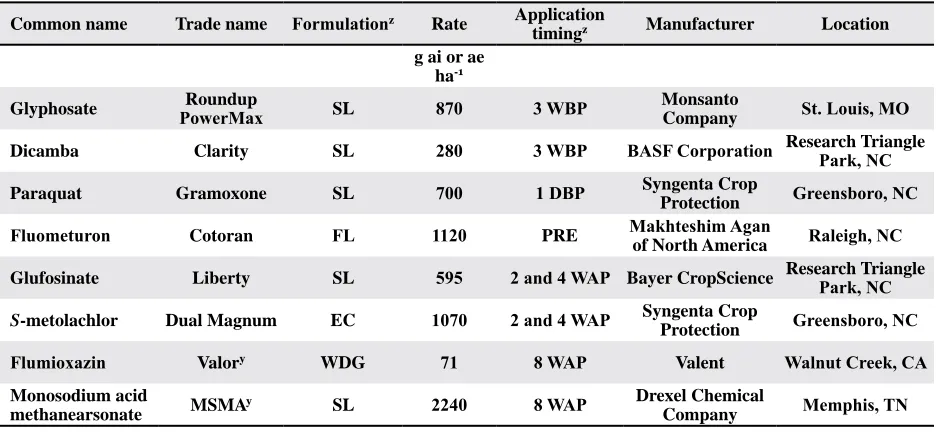
equipped with a handheld boom that contained even-fan nozzle. Herbicides used in the program are listed in Table 2. Four replications were used with plot sizes of 3.6 by 9.9 m. Cereal rye was sown on 8 October 2013 and 12 September 2014.For the drill-seeded portion of the plot, an Almaco Light-Duty Grain Drill with a single drop cone (Almaco Headquarters, Nevada, IA) was used, and for the broadcast seeded portion, the cereal rye was distributed by hand over the broadcast portion of the main plot. Prior to cereal rye sowing, the field was fertilized with 34 kg ha-1 of N, P, and K,
and tilled to an approximate 15-cm depth using a disk harrow followed by two passes of a field cultivator at a 5-cm depth to allow for a smooth seedbed.
The entire experiment was desiccated 21 d prior to cotton planting with glyphosate (potassium salt) and dicamba (diglycoamine salt) at 870 g ae ha-¹ and
280 g ae ha-¹, respectively, followed by an application
of paraquat at 480 g ai ha-¹ 1 d prior to planting. In
addition, N was applied at 34 kg ha-1 at cotton
plant-ing followed by another application of 43 kg ha-1 at
45 d after planting. Aboveground cover crop biomass was sampled from two random 1-m2 quadrats in each
main plot at planting. Biomass of desiccated natural vegetation was also collected in the no cover crop plots. Cotton (Gossypium hirsutum L.) ‘ST 4946 GLB2’ (Stoneville, Bayer Research Triangle Park, NC) was planted with a four-row planter (John Deere 6403, Deere and Company, Moline, IL) equipped with double-disk openers and coulters set to a 91-cm row spacing at a seeding rate of 123,000 seeds ha-¹. Cotton
was planted on 23 May 2014 and 3 June 2015.
Table 1. Monthly rainfall plus irrigation data for season 2013/2014 and 2014/2015
Year Oct Nov Dec Jan Feb Mar Apr May Jun Jul Aug Sep Oct
mm
2013/2014y Rain
z 33 58 89 7 3 97 87 137 104 35 65 91 184
Irrigz 0 0 0 0 0 0 0 26 0 91 26 0 0
2014/2015x Rain 184 78 75 14 1 82 81 167 172 268 67 58 48
Irrig 0 0 0 0 0 0 0 0 0 0 65 13 0
z Abbreviations: Rain, rainfall; Irrig, irrigation y Planting date: 23 May 2014
x Planting date: 3 June 2015
Table 2. Source of all herbicides used in the experiment to evaluate the impact of cereal rye on weed control in cotton
Common name Trade name Formulationz Rate Application
timingz Manufacturer Location
g ai or ae ha-¹
Glyphosate PowerMaxRoundup SL 870 3 WBP Monsanto
Company St. Louis, MO
Dicamba Clarity SL 280 3 WBP BASF Corporation Research Triangle Park, NC
Paraquat Gramoxone SL 700 1 DBP Syngenta Crop
Protection Greensboro, NC Fluometuron Cotoran FL 1120 PRE Makhteshim Agan
of North America Raleigh, NC
Glufosinate Liberty SL 595 2 and 4 WAP Bayer CropScience Research Triangle Park, NC
S-metolachlor Dual Magnum EC 1070 2 and 4 WAP Syngenta Crop
Protection Greensboro, NC Flumioxazin Valory WDG 71 8 WAP Valent Walnut Creek, CA
Monosodium acid
methanearsonate MSMAy SL 2240 8 WAP
Drexel Chemical
Company Memphis, TN
z Abbreviations: SL, soluble liquid; EC, emulsifiable concentrate; WDG, water dispersible granule; WBP, weeks before
planting; DBP, day before planting; PRE, preemergence; WAP, weeks after planting.
creased linearly as the seeding rate increased. The nonsignificant effect of planting method on biomass production is similar to that observed by Abbas et al. (2009) who observed no differences in biomass pro-duction between drill- and broadcast-seeded wheat. After cotton emergence, cotton stand was assessed
on 2 m of row randomly selected within the plot. Palmer amaranth density was measured in two 0.5-m² quadrats marked with flags randomly placed within the drill and broadcast planting side of each plot. Palmer ama-ranth emergence was monitored in the two quadrants every 2 wk until 8 wk after planting (WAP). Palmer amaranth seedlings were manually removed after each emergence assessment, and herbicide treatments were applied immediately after emergence assessment (see Table 2 for herbicide treatment information). Control of Palmer amaranth, broadleaf signalgrass [Urochloa platyphylla (Nash) RD Webster], and barnyardgrass [Echinochloa crus-galli (L.) Beauv.] was visually evaluated 2, 4, 6, and 8 WAP. Seed cotton was hand-harvested from 6.6 m of the center rows in each sub-plot. Seed cotton yields were determined by weighing the seed cotton and converting the weights to kg ha-1.
Data were subjected to ANOVA using the MIXED procedure in JMP 12 PRO (JMP, Version 12. SAS Institute Inc., Cary, NC). The significance of main effects and potential interactions were tested for bio-mass production, cotton stand, grass control (broadleaf signalgrass and barnyardgrass), cumulative Palmer amaranth emergence, and seed cotton yield at α = 0.05. Palmer amaranth emergence data were also fit with a repeated measures model using the MIXED procedure in JMP 12 PRO to describe the number of individuals emerging during an emergence period. A first-order autoregressive (AR[1]) covariance struc-ture was assumed because observations closer in time are expected to have a higher correlation than treatments further apart in time. Hence, Palmer ama-ranth emergence was analyzed by cereal rye seeding rate as well as by assessment timing and means were separated by Fisher’s protected LSD (α = 0.05).
RESULTS AND DISCUSSION
Biomass. No differences were observed in plant-ing method for cereal rye biomass production in all seeding rates evaluated. Hence, the biomass produc-tion was averaged over drill and broadcast planting method (data not shown). The effect of seeding rate on biomass production interacted with year (p
< 0.0012), with biomass production in 2014 being greater than 2015 (Table 3). In both years, cereal biomass was greater as the seeding rate increased. These results agree with those of Boyd et al. (2009) where they reported biomass production from cereal rye at seeding rates of 90, 180, and 270 kg ha-¹
in-Table 3. Biomass production and cotton density as function of cereal rye seeding rates in 2014 and 2015
Seeding rate
Biomass Cotton stand count 2014 2015 2014 2015 kg ha-¹ kg ha-¹ thousand plants ha-1
0 840z 690z 113 116
56 3,060 2,460 104 113
112 4,000 3,310 96 103
168 4,460 3,620 94 98
LSD (0.05) 390 290 7 5
z Biomass of natural vegetation occurred in the field.
Months
Oct Nov Dec Jan Feb Mar Apr May
G
D
D
(
C)
0 200 400 600 800 1000 1200 1400 1600 1800
Cereal rye biomass ranged from 3,060 to 4,460 kg ha-¹ and 2,460 to 3,620 kg ha-¹ in 2014 and
2015, respectively (Table 3). These results sharply contrast with results observed at Marianna, AR by Norsworthy et al. (2011), where there was an aver-age biomass production of 8,170 kg ha-¹ of cereal
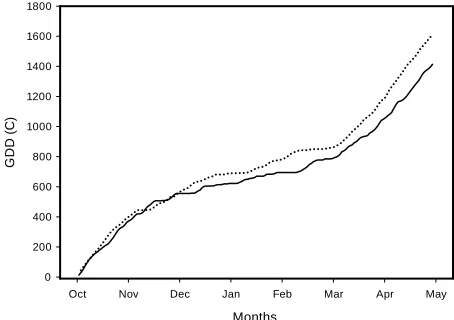
rye. Such discrepancy in biomass production could be due to differences in environmental conditions in Fayetteville and Marianna as well as cereal rye management. The performance of a winter cover crop is difficult to predict because a variety of factors, including cover crop cultivar, soil properties, and growing conditions, can interact and influence the growth of cover crops (Bushuk, 2001). Analysis of the growing degree days for both years showed that 2014 to 2015 had more growing degrees units (GDU) than 2013 to 2014 (Fig. 1). However, the amount of GDU in both years should have been sufficient for maximum biomass production (Mirsky et al., 2011).
Cotton Density. Years are presented separately because of a significant year-by-seeding rate interac-tion (Table 3). The interacinterac-tion of planting method by cereal rye seeding rate was not significant for cot-ton density, but the main effect of seeding rate was significant (p < 0.0344). Hence, cotton density was averaged over drill and broadcast planting methods. All seeding rates decreased cotton density relative to the no cover crop treatment in 2014. The 56-kg ha-¹ cereal rye seeding rate was the least
detrimental, with 8% cotton stand reduction. Both the 112- and 168-kg ha-¹ cereal rye seeding rates
provided the highest cotton density at 15 and 17%, respectively (Table 4). In 2015, the 56-kg ha-¹ cereal
rye seeding rate did not show any significant nega -tive effect compared to the no cover crop treatment. However, cereal rye at 112 and 168 kg ha-¹ reduced
the cotton stand by 11 and 14%, respectively. The slight improvement in cotton density in the cover crop plots in 2015 is likely due to the lower amount of biomass present at planting, which is similar to findings in other research (Kornecki et al., 2005). A more appropriate cotton planting method to better plant into standing cereal rye might have improved cotton stands because others have observed that it is possible to plant cotton into greater amounts of cereal rye biomass than present in this research without a negative effect on crop emergence (Mirsky et al., 2013; Raimbult et al., 1990).
Palmer Amaranth Emergence. Similar to cot-ton density, there was no effect of planting method on Palmer amaranth emergence in both years, and the effect of seeding rate on Palmer amaranth density interacted with year. However, the effect of assess -ment timing on Palmer amaranth density did not interact with year; hence, data were averaged over 2014 and 2015 (Table 4).
All seeding rates decreased Palmer amaranth emergence over the four assessment timings com-pared to the no cover crop treatment (Table 4). However, cereal rye seeded at 168 kg ha-¹ was
su-perior to 56 kg ha-¹ in suppressing Palmer amaranth
emergence. In 2015 over the four assessment timings, the 56-kg ha-1 seeding rate did not differ from the
no cover crop treatment, and emergence from the 112- and 168-kg ha-¹ seeding rates were 58 and 74%
lower than the no cover crop.
Suppression of Palmer amaranth emergence by the cereal cover crop was most effective at the earli-est evaluations. Averaged over seeding rate, Palmer amaranth emergence at the first assessment timing was lower than second and third assessment timings (Table 4). The 2 to 4 and 4 to 6 WAP period allowed the highest Palmer amaranth emergence with 3.3 and 3.1 plants m-2, respectively. These results agree
with other reports that convey cover crops are most effective in suppressing weeds early in the growing season. Reddy (2001) reported that browntop mil-let (Urochloa ramosa L.) suppression provided by cereal rye in soybean at 3 WAP averaged 77%, but by 6 WAP control had declined to 62%.
The effect of cereal rye seeding rate in combi -nation with herbicide application on total Palmer amaranth emergence is described in Table 5. In 2014, the seeding rate of 112 kg ha-1 did not show
differ-ences in Palmer amaranth emergence between plots with and without herbicide application. This was an exception because in all the remaining seeding rate treatments the combination of a cereal rye cover crop with a herbicide program resulted in lower Palmer amaranth emergence compared to plots without her-bicide application. The same effect was observed in 2015 within each cereal rye seeding rate where the herbicide application proved to be beneficial to sup -pression of Palmer amaranth emergence (Table 5). These results support the concept that the utilization of cover crops ought to be performed with a herbicide program. Hence, one of purpose of using cover crops is to diminish the weed density during growing season to decrease herbicide selection pressure on weeds. Table 4. The main effect of cereal rye seeding rate on Palmer
amaranth emergence in 2014 and 2015, and the main effect of assessment timing on Palmer amaranth emergence in absence of herbicide applicationz
Seeding rate
Density
2014 2015 Assessment
timingw Density
kg ha-¹ y plants m-² weeks after
planting plants m
-²
0 5.4 (0)x 4.3 (0) 0 – 2 1.6
56 2.8 (48) 2.9 (36) 2 – 4 3.3 112 1.6 (70) 1.8 (58) 4 – 6 3.1 168 1.1 (80) 1.1 (74) 6 – 8 2.4 LSD (0.05) 1.3 1.4 1.1
z All means within a year can be compared using Fisher’s
protected LSD at α < 0.05.
y Years presented separately due to the interaction of
seeding rate and year.
x Numbers in parentheses represent the percentage
reduction in total Palmer amaranth emergence relative to the no cover crop treatment without herbicide.
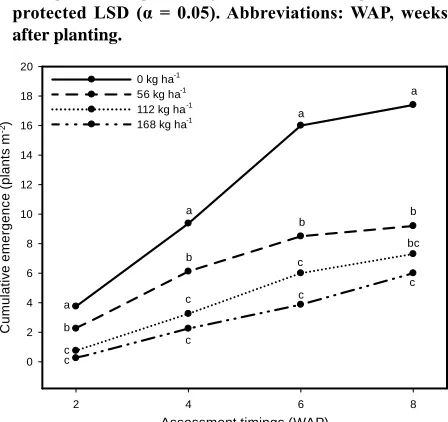
Cumulative Palmer Amaranth Emergence. In 2014, cereal rye residue from all seeding rates reduced Palmer amaranth emergence throughout the season (Fig. 2). At 2 WAP cotton, cereal rye seeded at 56, 112, and 168 kg ha-¹ decreased Palmer amaranth
emergence by 76, 86, and 90% compared to no cover crop. The highest Palmer amaranth emergence in the no cover crop plots occurred between 2 and 4 WAP averaging 8.8 plants m-². During this period, cereal
rye plots at 56-, 112-, and 168-kg ha-¹ seeding rate
reduced Palmer amaranth emergence by 49, 74, and 91%, respectively. After all assessments, cumulative Palmer amaranth emergence in the no cover crop plots was 21.7 plants m-². The greatest Palmer
ama-ranth emergence reduction occurred in the 112- and 168-kg ha-¹ seeding rates (74 and 73%, respectively)
compared to no cover crop. The reduction provided by 56-kg ha-¹ seeding rate was lower than the 112
and 168 kg ha-¹ with 48% reduction in Palmer
ama-ranth emergence. Similar results were obtained by DeVore et al. (2012) where cereal rye reduced Palmer amaranth emergence by 74% at 3 WAP, and cereal rye residue reduced Palmer amaranth emergence by 67% at 12 WAP.
In 2015, all the seeding rates reduced Palmer amaranth emergence compared to no cover crop up to 8 WAP (Fig. 3). At first assessment, the 56-kg ha-¹
seeding rate was not as effective as 112 and 168 kg ha-¹. Reductions of Palmer amaranth emergence at
the 112- and 168-kg ha-¹ seeding rates were 80 and
93%, respectively, compared to no cover crop. At 8 WAP, cumulative Palmer amaranth emergence
showed that tseeding rates of 56, 112, and 168 kg ha-¹ reduced Palmer amaranth emergence by 47, 58,
and 65%, respectively. The inferior Palmer amaranth suppression in 2015 is attributed to the overall lower biomass production of cereal rye. According to Teas-dale and Mohler (2000), the success of weed suppres-sion by cover crops is directly related to the amount of biomass produced, because higher quantities of residue would reduce the ability of weed seedlings to grow through the mulch.
Figure 2. Cumulative Palmer amaranth emergence in the no herbicide plots as a function of cereal rye seeding rate in 2014. Means with the same letter within each assessment timings are not significantly different according to Fisher’s protected LSD (α = 0.05). Abbreviations: WAP, weeks after planting.
Table 5. Total Palmer amaranth emergence as a function of seeding rate and herbicide application in 2014 and 2015z,y
Seeding rate
Total Palmer amaranth emergence 2014
Herbicide application Herbicide application2015
Yes No Yes No
kg ha-¹ plants m-²
0 2.5 (88)x 21.7 (0) 2.3 (87) 17.3 (0)
56 2.9 (87) 11.2 (48) 0.5 (97) 9.2 (47) 112 2.4 (89) 5.6 (74) 0.9 (95) 7.3 (58) 168 1.3 (94) 5.9 (73) 0.5 (97) 6.0 (65)
LSD 3.7 2.6
z All means within a year can be compared using Fisher’s
protected LSD at α < 0.05.
y See Table 2 for specific herbicides, rates, and timings
associated with each designation.
x Numbers in parentheses represent the percentage
reduction in total Palmer amaranth emergence relative to the no cover crop treatment without herbicide.
Assessment timings (WAP)
2 4 6 8
Cu m ul at iv e e m er ge nc e ( plan ts m -2) 0 2 4 6 8 10 12 14 16 18 20 22 24
0 kg ha-1 56 kg ha-1 112 kg ha-1 168 kg ha-1
a b c c a b c c a b c d a b b b
Figure 3. Cumulative Palmer amaranth emergence in the no herbicide plot as a function of cereal rye seeding rate in 2015. Means with the same letter within each assessment timings are not significantly different according to Fisher’s protected LSD (α = 0.05). Abbreviations: WAP, weeks after planting. Cu m ul at iv e e m er ge nc e ( plan ts m -2)
Assessment timings (WAP)
2 4 6 8
0 2 4 6 8 10 12 14 16 18 20
0 kg ha-1 56 kg ha-1 112 kg ha-1 168 kg ha-1
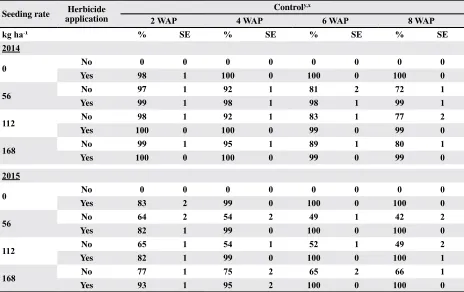
Grass Control. Broadleaf signalgrass and barn-yardgrass control were averaged due to the similar response of both weeds to the herbicide treatment and cereal rye. The density of both grass weeds was slightly higher in 2015 than in 2014. In 2014, at 8 WAP the grass density in the no herbicide and no cover crop plots averaged 12 broadleaf signalgrass and 4 barnyardgrass plants m-². At the same period in 2015, densities of
broadleaf signalgrass and barnyardgrass were 28 and 6 plants m-², respectively (data not shown).
The application of a standard herbicide program resulted in excellent grass control in all plots, regard-less of the cereal rye seeding rate in 2014 (Table 6). Plots treated with the standard herbicide program averaged at least 97% grass control for each of the four evaluations, regardless of cereal rye seeding rate. Grass control diminished over the course of the growing season in plots that had no cereal rye or cereal rye seeded at 56 kg ha-1. However, cereal
rye seeded at 112 and 168 kg ha-1 was comparable
to plots with herbicide application.
In 2015, except for the first evaluation where grass control in herbicide-treated plots was not acceptable, the overall grass control at 4, 6, and 8 WAP was excel-lent in the herbicide-treated plots (Table 6). At 2 WAP, the 168-kg ha-¹ seeding rate in combination with the
standard herbicide program provided superior grass control compared to no cover crop treatment with her-bicide. Similar results were obtained by Reeves et al. (2005) where the addition of cereal rye provided en-hanced weed control compared to a herbicide program alone. The low grass control observed at 2 WAP in the herbicide plots in 2015 is likely due to above average rainfall after PRE-herbicide application, which could have led to leaching of the herbicide out of the zone in which weed germination typically occurs (Stewart et al., 2010). Following POST herbicide applied at 2 WAP, grass control averaged 95% or higher through 8 WAP. The improved grass control with the herbi-cide program in combination with the cereal rye was evident at 8 WAP, proving again that grass control is partially attributable to the cereal rye cover crop.
Table 6. Grass control (broadleaf signalgrass and barnyardgrass) as function of cereal rye seeding rate and herbicide application in 2014 and 2015z
Seeding rate Herbicide application
Controly,x
2 WAP 4 WAP 6 WAP 8 WAP
kg ha-¹ % SE % SE % SE % SE
2014
0 No 0 0 0 0 0 0 0 0
Yes 98 1 100 0 100 0 100 0
56 No 97 1 92 1 81 2 72 1
Yes 99 1 98 1 98 1 99 1
112 No 98 1 92 1 83 1 77 2
Yes 100 0 100 0 99 0 99 0
168 No 99 1 95 1 89 1 80 1
Yes 100 0 100 0 99 0 99 0
2015
0 No 0 0 0 0 0 0 0 0
Yes 83 2 99 0 100 0 100 0
56 No 64 2 54 2 49 1 42 2
Yes 82 1 99 0 100 0 100 0
112 No 65 1 54 1 52 1 49 2
Yes 82 1 99 0 100 0 100 1
168 No 77 1 75 2 65 2 66 1
Yes 93 1 95 2 100 0 100 0
z Seeding rates that did not meet the assumptions of ANOVA are reported as means followed by the standard error (SE)
of the mean.
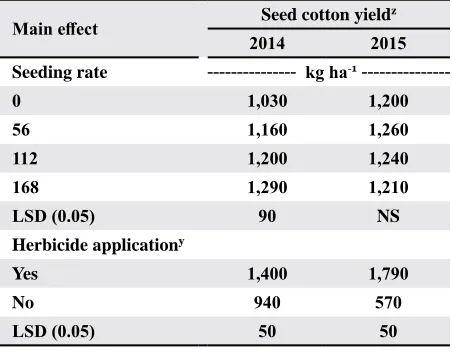
Seed Cotton Yield. Only the main effects of seeding rate and herbicide program impacted seed cotton yield in 2014. All seeding rates increased yields compared to no cover crop, with yield increas-ing as the cereal rye seedincreas-ing rate increased (Table 7). Seed cotton yield improvement due to use of cereal rye has been reported previously. Sainju et al. (2006) reported that in a no-till system, cotton plots with cereal rye had a cotton lint yield of 1,110 kg ha-¹ compared to 814 kg ha-¹ in winter fallow.
Herbicide application also had a significant effect on seed cotton yield. Plots that received the standard herbicide program had an average seed cotton yield of 1,400 kg ha-¹, whereas plots with no herbicide had
a seed cotton yield of 940 kg ha-¹. Similar results
were reported by Reeves et al. (2005) where cereal rye cover crop plots with no herbicide application resulted in reduced seed cotton yield compared to plots where herbicides were applied.
standard herbicide program produced a seed cotton yield of 1,790 kg ha-¹. In contrast, plots that lacked
an in-crop herbicide application had an average seed cotton yield of 570 kg ha-¹, likely because of the poor
grass control by cereal rye alone.
The impact of cereal rye residue on seed cotton yield has been widely investigated. However, incon-sistent results have been reported. The large array of environmental factors that can influence cotton yield in a cover crop system could be the reason for such inconsistencies. Nitrogen management has proven to be an important factor in a cereal cover crop system in cotton (Bouquet et al., 2004). Cereal rye is known to scavenge nitrogen with its extensive fibrous root system (Meisinger et al., 1991). Hence, it is likely that cereal rye might deplete inorganic nitrogen in the soil during fall and winter months. The decomposi-tion and consequently mineralizadecomposi-tion of nitrogen in cereal rye residue can take a long time because the rate of decomposition of cereal rye residue is low due to the high C:N ratio (Creamer and Baldwin, 2000; Rosecrance et al., 2000; Sainju et al., 2006). Another factor to consider is rainfall and irrigation
regime. Under well-watered or irrigated conditions, differences in cotton yield between no cover and cover crop plots are less likely. It is known that cover crops increase moisture infiltration and conservation (Unger and Vigil, 1998). Hence, the positive effect of cover crop residues on cotton yield might be more likely in areas with low summer rainfall or inad-equate irrigation management (Dabney et al., 2001). Practical Implications. Neither of the plant-ing methods evaluated in this experiment appear to have an advantage for any parameter evaluated. The similar biomass production between the two planting methods in this study compare favorably to the find-ings of Fisher et al. (2011) where they concluded that broadcast seeding is an effective planting method for cereal rye. Increasing the seeding rate appears to be a worthy option to increase biomass production of cereal rye. However, based on the Palmer amaranth emergence, the highest seeding rate might not be warranted because there were no differences in emergence between the two highest seeding rates. The application of a standard herbicide program re-sulted in superior Palmer amaranth and grass control compared to the no herbicide program, regardless of the cereal rye seeding rate. However, having a ce-real residue to give early weed suppression in cases where PRE herbicides fail to be activated would be a worthy practice and likewise reduce the number Table 7. The main effect of seeding rate and herbicide
application on seed cotton yield in 2014 and 2015
Main effect Seed cotton yieldz
2014 2015
Seeding rate kg ha-¹
0 1,030 1,200
56 1,160 1,260
112 1,200 1,240
168 1,290 1,210
LSD (0.05) 90 NS
Herbicide applicationy
Yes 1,400 1,790
No 940 570
LSD (0.05) 50 50
z All means within a year and seeding rate or herbicide
application can be compared using Fisher’s protected LSD at α = 0.05.
y See Table 2 for specific herbicides, rates, and timings
associated with the herbicide application.
The effect of cereal rye seeding rate on seed cotton yield was not significant in 2015 (Table 7). Seed cotton yield ranged from 1,200 to 1,260 kg ha-¹ among seeding rates, including the absence of
of weeds needing to be controlled with POST her-bicides. These results support the concept that, even though cover crops can provide a high level of weed suppression early in the cotton growing season, the use of herbicides is still essential for adequate control throughout the entire growing season (Price et al., 2012). Further investigations on the effect of seeding rate on biomass production in different locations and environments should be considered. Environmental effects along with different soil fertilizer regimes for cereal rye might change the response of Palmer amaranth emergence and cotton yield to seeding rate and planting methods.
ACKNOWLEDGMENTS
Supported by Cotton Incorporated and Univer-sity of Arkansas.
REFERENCES
Abbas, G., M.A. Ali, G. Abbas, M. Azam, and I. Hussain. 2009. Impact of planting methods on wheat grain yield and yield contributing parameters. J. Animal Plant Sci. 19:30–33.
Akemo, M.C., E.E. Regnier, and M.A. Bennett. 2000. Weed suppression in spring-sown rye (Secale cereale)-pea (Pisum sativum) cover crop mixes. Weed Technol.
14:545–549.
Bauer, P.J., and D.W. Reeves. 1999. A comparison of winter cereal species and planting dates as residue cover for cotton grown with conservation tillage. Crop Sci. 39:1824–1830.
Blackshaw, R.E. 1991. Soil temperature and moisture effects
on downy brome vs. winter canola, wheat and rye emer-gence. Crop Sci. 31:103–1040.
Bouquet, D.J., R.L. Hutchinson, and G.A. Breitenbeck. 2004.
Long-term tillage, cover crop, and nitrogen rate effects
on cotton. Agron. J. 96:1443–1452.
Boyd, N.S., E.B. Brennan, R.F. Smith, and R. Yokota. 2009.
Effect of seeding rate and planting arrangement on rye
cover crop and weed growth. Agron. J. 101:47–51. Bushuk, W. 2001. Rye: Production, Chemistry and
Technol-ogy, 2nd ed. American Association of Cereal Chemists, St. Paul, MN.
Clark, A. 2008. Managing Cover Crop Profitably. Sustainable
Agriculture Research and Education (SARE), Beltsville, MD.
Creamer, N.G., and K.R. Baldwin. 2000. An evaluation of summer cover crops for use in vegetable production systems in North Carolina. HortSci. 35:600–603.
Dabney, S.M., J.A. Delgado, and D.W. Reeves. 2001. Using winter cover crops to improve soil and water quality. Commun. Soil Sci. Plant Anal. 32:1221–1250.
DeVore, J.D., J.K. Norsworthy, and K.R. Brye. 2012. Influ -ence of deep tillage and a rye cover crop on glyphosate-resistant Palmer amaranth (Amaranthus palmeri) emer-gence in cotton. Weed Technol. 26:832–838.
Fisher, K.A., B. Momen, and R.J. Kratochvil. 2011. Is
broadcasting seed an effective winter cover crop planting
method? Agron. J. 103:472–478.
Fowler, D.B., A.E. Limin, and J.T. Ritchie. 1999. Low-temperature tolerance in cereals: model and genetic interpretation. Crop Sci. 39:626–633.
Keisling, T.C., C.R. Dillon, M.D, Oxner and P.A. Counce.
1997. An Economic and Agronomic evaluation of se-lected wheat planting methods in Arkansas. In: Southern Conservation Tillage Conference. June 24-26. Gaines-ville, FL., pp: 156-168.
Kornecki, T.S., R.L. Raper, F.J. Arriaga, K.S. Balkcom, and
A.J. Price. 2005. Effects of rolling/crimping rye direction and different row-cleaning attachments on cotton emer -gence and yield. p. 27–29 In Proc. Southern Conserva-tion Tillage Conf., 27th. Florence, SC.
Korres, N.E., and J.K. Norsworthy. 2015. Influence of a rye
cover crop on the critical period for weed control in cot-ton. Weed Sci. 63:346–352.
Mazzoncini, M., T.B. Sapkota, P. Barberi, D. Antichi, and
R. Risaliti. 2011. Long-term effect of tillage, nitrogen
fertilization and cover crops on soil organic carbon and total nitrogen content. S. Till Res. 114:165–174.
McCarty, W.H., A. Blaine, and J.D. Byrd. 2003. Cotton no-till production. Mississippi State University Cooperative
Extension Service Publ. P1695.
Meisinger, J.J., W.L. Hargrove, R.L. Mikkelsen, J.R.
Wil-liams, and V.W. Benson. 1991. Effects of cover crops
on groundwater quality. Cover Crops for Clean Water. 266:793–799.
Mirsky, S.B., W.S. Curran, D.M. Mortensen, M.R. Ryany, and D.L. Shumway. 2011. Timing of cover-crop management
effects on weed suppression in no-till planted soybean
using a roller-crimper. Weed Sci. 59:380–389. Mirsky, S.B., M.R. Ryan, J.R. Teasdale, W.S. Curran, C.S.
Reberg-Horton, J.T. Spargo, and J.W. Moyer. 2013. Overcoming weed management challenges in cover crop-based organic rotational no-till soybean production in the eastern United States. Weed Technol. 27:193–203. Monks, C.D., and M.G. Patterson. 1996. Conservation Tillage
Nelson, W.A., B.A. Kahn, and B.W. Roberts, 1991. Screening cover crops for use in conservation tillage systems for vegetables following spring plowing. HortSci. 26:860– 862.
Norsworthy, J.K., M. McClelland, G. Griffith, S.K. Bangarwa,
and J. Still. 2011. Evaluation of cereal and Brassicaceae cover crops in conservation-tillage, enhanced, glypho-sate-resistant cotton. Weed Technol. 25:6–13. Prabhakara, K., W.D. Hively, and G.W. McCarty. 2015.
Evaluating the relationship between biomass, percent
groundcover and remote sensing indices across six winter cover crop fields in Maryland, United States. Int.
J. Appl. Earth Obs. 39:88–102.
Price, A.J., K.S. Balkcom, L.M. Duzy, and J.A. Kelton. 2012. Herbicide and cover crop residue integration for Ama-ranthus control in conservation agriculture cotton and implications for resistance management. Weed Technol. 26:490–498.
Putnam, A.R., J. DeFrank, and J.P. Barnes. 1983. Exploitation
of allelopathy for weed control in annual and perennial cropping systems. J. Chem. Ecol. 9:1001–1010. Raimbault, B.A., T.J. Vyn, and M. Tollenaar. 1990. Corn
re-sponse to rye cover crop management and spring tillage systems. Agron. J. 82:1088–1093.
Reddy, K.N. 2001. Effects of cereal and legume cover crop
residues on weeds, yield, and net return in soybean ( Gly-cine max). Weed Technol 15: 660–668.
Reeves, D.W., A.J. Price, and M.G. Patterson. 2005. Evalua-tion of three winter cereals for weed control in con-servation-tillage nontransgenic cotton. Weed Technol. 19:731-736.
Rosecrance, R.C., G.W. McCarty, D.R. Shelton, and J.R.
Teasdale. 2000. Denitrification and N mineralization
from hairy vetch (Vicia villosa Roth) and rye (Secale ce-reale L.) cover crop monocultures and bicultures. Plant Soil. 227:283–290.
Sainju, U.M., B.P. Singh, and W.F. Whitehead. 2002.
Long-term effects of tillage, cover crops, and nitrogen
fertilization on organic carbon and nitrogen concentra-tions in sandy loam soils in Georgia, USA. S. Till Res. 63:167–179.
Sainju, U.M., W.F. Whitehead, B.P. Singh, and S. Wang. 2006.
Tillage, cover crops, and nitrogen fertilization effects
on soil nitrogen and cotton and sorghum yields. Eur. J. Agron. 25:372–382.
Salas, R.A., N.R. Burgos, P.J. Tranel, S. Singh, L. Glasgow, R.C. Scott, and R.L. Nichols. 2016 Resistance to PPO-inhibiting herbicide in Palmer amaranth from Arkansas. Pest Manag. Sci. 72:864–869.
Snapp, S.S., S.M. Swinton, R. Labarta, D. Mutch, J.R. Black, R. Leep, J. Nyiraneza, and K. O’Neil. 2005. Evaluating
cover crops for benefits, costs and performance within
cropping system niches. Agron. J. 97:322–332.
Sosnoskie, L.M., and A.S. Culpepper. 2014.Glyphosate-resis-tant Palmer amaranth (Amaranthus palmeri) increases herbicide use, tillage, and hand-weeding in Georgia cotton. Weed Sci. 62:393–402.
Stewart, C.L., R.E. Nurse, A.S. Hamill, and P.H. Sikkema.
2010. Environment and soil conditions influence pre-and postemergence herbicide efficacy in soybean. Weed
Technol. 24:234–243.
Teasdale, J.R., and C.L. Mohler. 1993. Light transmittance, soil temperature, and soil moisture under residue of hairy vetch and rye. Agron. J. 85:673–680.
Teasdale, J.R., and C.L. Mohler. 2000. The quantitative relationship between weed emergence and the physical properties of mulches. Weed Sci. 48:385–392.
Unger, P.W., and M.F. Vigil. 1998. Cover crop effects on soil
water relationships. J. Soil Water Conserv. 53:200–207. Wilson, M. L., J. M. Baker, and D. L. Allan. 2013. Factors