www.theoryofgroups.ir
ISSN (print): 2251-7650, ISSN (on-line): 2251-7669 Vol. 5 No. 1 (2016), pp. 1-10.
c
⃝2016 University of Isfahan
www.ui.ac.ir
A NOTE ON THE POWER GRAPH OF A FINITE GROUP
Z. MEHRANIAN, A. GHOLAMI AND A. R. ASHRAFI∗
Communicated by Alireza Moghaddamfar
Abstract. Suppose Γ is a graph with V(Γ) = {1,2, . . . , p} and F = {Γ1, . . . ,Γp} is a family of graphs such that nj = |V(Γj)|, 1≤j ≤p. Define Λ = Γ[Γ1, . . . ,Γp] to be a graph with vertex set
V(Λ) =∪pj=1V(Γj) and edge setE(Λ) = ( ∪p
j=1E(Γj) )
∪( ∪ij∈E(Γ){uv;u∈V(Γi), v∈V(Γj)} )
. The graph Λ is called the Γ-join ofF. The power graphP(G) of a groupGis the graph which has the group elements as vertex set and two elements are adjacent if one is a power of the other. The aim of this paper is to prove thatP(Zn) =Kϕ(n)+1+∆n[Kϕ(d1), Kϕ(d2), . . . , Kϕ(dp)], where ∆nis a graph with vertex and edge setsV(∆n) ={di|1, n̸=di|n,1≤i≤p}andE(∆n) ={didj|di|dj,1≤i < j≤p}, respectively. As a consequence it is proved that Aut(P(Zn)) ∼= Sϕ(n)+1×
∏
1,n̸=d|nSϕ(d). This proves a recent conjecture by Doostabadi et al. [A. Doostabadi, A. Erfanian and A. Jafarzadeh,Some results on the power graph of groups, The Extended Abstracts of the 44th Annual Iranian Mathematics Conference, 27–30 August 2013, Ferdowsi University of Mashhad, Iran]. Finally, we apply our results to obtain complete descriptions of the power graphs of some finite groups.
1. Introduction
All groups and graphs in this paper are assumed to be finite. Suppose G is a finite group. The
power graphP(G) is a graph in whichV(P(G)) =Gand two distinct elementsxandy are adjacent
if and only if one of them is a power of the other. The investigation of graphs related to groups as
well as other algebraic structures is very important, because such graphs have valuable applications
(see [7]) and are related to automata theory (see [8, 9]). These graphs were introduced in [6], see also
[10, 11, 12].
MSC(2010): Primary: 20D05, 20D08; Secondary: 05C10. Keywords: Power graph, generalized join, automorphism group. Received: 24 July 2014, Accepted: 7 August 2014.
∗Corresponding author.
We refer to [13] for a survey of all recent results on the power graphs. Let us include only a
brief overview of some relevant facts here. Chakrabarty et al. [4] proved that for a finite group
G, P(G) is complete if and only if G is a cyclic group of order 1 or pm, for some prime number
p and positive integer m. They also obtained a formula for the number of edges in a finite power
graph. Cameron and Ghosh [1] proved that non-isomorphic finite groups may have isomorphic power
graphs, but that finite abelian groups with isomorphic power graphs must be isomorphic. They also
show that the only finite group whose automorphism group is the same as its power graph is the
Klein group of order 4. In this paper, the authors conjectured that two finite groups with isomorphic
power graphs have the same number of elements of each order. Cameron [2] proved that in a finite
group, the undirected power graph determines the directed power graph up to isomorphism. As a
consequence, he responded affirmatively to the main conjecture of [1]. Pourgholi et al. [17], presented
counterexamples for a conjecture maid by Chakrabarty et al. [3] regarding the values of nfor which
P(Un) is Hamiltonian. They also proved some results about characterization of simple groups by
power graphs. Moghaddamfar et al. [15] considered the proper power graph P⋆(G). This graph
can be constructed from P(G) by deleting the identity element of G. They provided necessary and
sufficient conditions for a proper power graph P⋆(G) to be a strongly regular graph, a bipartite
graph or a planar graph. They also obtained some infinite families of finite groups G for which the
power graph P⋆(G) contains some cut-edges. Finally, Moghaddamfar et al. [16] found the number
of spanning trees of the power graph associated with specific finite groups. They determined, up to
isomorphism, the structure of a finite group Gwhose power graph has exactly n spanning trees, for
n <53. The author of the mentioned paper presented also a new characterization of the alternating group A5 by tree-number of its power graph.
Suppose thatGis a finite group andx∈G. IfGis a finite group then it easy to prove that the power
graph P(G) is a connected graph of diameter at most 2. Thedegree ofx inP(G) can be calculated
by deg(x) = |{g ∈G | ⟨x⟩ ≤ ⟨g⟩ or ⟨g⟩ ≤ ⟨x⟩}|. Suppose Γ is a graph with V(Γ) ={1,2, . . . , p} and F ={Γ1, . . . ,Γp}is a family of graphs such thatnj =|V(Γj)|, 1≤j≤p. Define Λ = Γ[Γ1, . . . ,Γp] to be a graph with vertex set V(Λ) =∪pj=1V(Γj) and edge set
E(Λ) =( p
∪
j=1
E(Γj))∪( ∪ ij∈E(Γ)
{uv;u∈V(Γi), v∈V(Γj)}).
The graph Λ is called the Γ-join of F [3]. The set of all positive divisors of an integern is denoted
by D(n). Our other notations are standard and can be taken from [14, 18].
2. Main Results
The aim of this section is to proveP(Zn) =Kϕ(n)+1+ ∆n[Kϕ(d1), Kϕ(d2), . . . , Kϕ(dp)], where ∆nis a graph with vertex and edge sets V(∆n) ={di |1, n̸=di|n,1≤i≤p}and E(∆n) ={didj |di|dj,1≤
i < j ≤p}, respectively. As a consequence it is proved that Aut(P(Zn))∼=Sϕ(n)+1×
∏
This proves a recent conjecture by Doostabadi et al. [5]. We start by computing the order and size of
M = ∆n[Kϕ(d1), Kϕ(d2), . . . , Kϕ(dp)].
Lemma 2.1. |V(M)|=n−ϕ(n)−1 and |E(M)|= 12∑1,n̸=d|n(2d−ϕ(d)−3)ϕ(d). Proof. Since ∑d|nϕ(d) =n,|V(M)|=∑1,n̸=d|nϕ(d) =n−ϕ(n)−1. On the other hand,
∑
(d̸=d′),d|d′
1,n̸=d,d′|n
ϕ(d)ϕ(d′) = ∑
1,n̸=d|n
∑
d′|d d′̸=1,d
ϕ(d)ϕ(d′)
= ∑
1,n̸=d|n
ϕ(d) ∑
1,d̸=d′|d
ϕ(d′)
= ∑
1,n̸=d|n
(d−ϕ(d)−1)ϕ(d).
Therefore,
2|E(M)| = ∑
1,n̸=d|n
ϕ(d)(ϕ(d)−1) + 2 ∑ dd′∈E(∆n)
ϕ(d)ϕ(d′)
= ∑
1,n̸=d|n
ϕ(d)2− ∑
1,n̸=d|n
ϕ(d) + 2 ∑
1,n̸=d|n
(d−ϕ(d)−1)ϕ(d)
= 2 ∑
1,n̸=d|n
dϕ(d)−3 ∑
1,n̸=d|n
ϕ(d)− ∑
1,n̸=d|n
ϕ(d)2
= ∑
1,n̸=d|n
(2d−ϕ(d)−3)ϕ(d),
proving the result. □
Theorem 2.2. P(Zn) =Kϕ(n)+1+ ∆n[Kϕ(d1), Kϕ(d2), . . . , Kϕ(dp)].
Proof. We first assume that the power graphP(Zn) has a subgraph isomorphic to
Kϕ(n)+1+ ∆n[Kϕ(d1), Kϕ(d2), . . . , Kϕ(dp)].
Suppose{d1, . . . , dp}=D(n)− {1, n}and x, y are vertices in P(Zn). Clearly, if x and y are adjacent then o(x)|o(y) or o(y)|o(x). Thus, P(Zn) has complete subgroups of orders ϕ(di), 1 ≤i ≤ p. If for
somei and j,di|dj, then since Zn is a cyclic group, all vertices of degree di and dj are adjacent. On
the other hand, all generators ofZn together with identity element constitute a complete subgraph of
order ϕ(n) + 1 that its vertices are adjacent to all other vertices of P(Zn). This proves that the power
graph P(Zn) has a subgraph H isomorphic to Kϕ(n)+1+ ∆n[Kϕ(d1), Kϕ(d2), . . . , Kϕ(dp)].
ϕ(n)−1) +|E(M)|. Therefore,
2|E(H)| = (2n−ϕ(n)−1)ϕ(n) + 2(n−ϕ(n)−1) + ∑
1,n̸=d|n
(2d−ϕ(d)−3)ϕ(d)
= (2n−ϕ(n)−1)ϕ(n) + 2 ∑
1,n̸=d|n
ϕ(d) + ∑
1,n̸=d|n
(2d−ϕ(d)−3)ϕ(d)
= (2n−ϕ(n)−1)ϕ(n) + ∑
1,n̸=d|n
(2d−ϕ(d)−1)ϕ(d)
= ∑
d|n
(2d−ϕ(d)−1)ϕ(d).
By [4, Corollary 4.3], 2|E(P(Zn))|=∑d|n(2d−ϕ(d)−1)ϕ(d), which shows thatH =P(Zn). Hence, P(Zn) =Kϕ(n)+1+ ∆n[Kϕ(d1), Kϕ(d2), . . . , Kϕ(dp)] which completes the proof. □ By [4, Theorem 2.12], it is clear that the mentioned conjecture made by Doostabadi et al. [5] is
incorrect, whennis prime power. In the next theorem this conjecture is proved for positive integern
such that ncannot be written as a prime power.
Theorem 2.3. If n is not a prime power then Aut(P(Zn))∼=Sϕ(n)+1×
∏
1,n̸=d|nSϕ(d).
Proof. It is well-known that for each graph Γ,Aut(Γ)∼=Aut(¯Γ). Applying Theorem 2.2, we have:
Aut(P(Zn)) = Aut(P(Zn))
= Aut(Kϕ(n)+1+M) = Aut(Kϕ(n)+1∪M)
= Aut(Kϕ(n)+1)×Aut(M).
Since Aut(Kϕ(n)+1) = Aut(Kϕ(n)+1) ∼= Sϕ(n)+1, Aut(P(Zn)) ∼= Sϕ(n)+1 ×Aut(M) ∼= Sϕ(n)+1 × Aut(M). So, it is enough to prove that Aut(M) ∼= ∏1,n̸=d|nSϕ(d). To do this, we first calculate the
degree of each vertexx∈Kϕ(d) inM. By the definition ofM, we have: degM(x) = ϕ(o(x))−1 +
∑
d|o(x) 1,n,o(x)̸=d|n
ϕ(d) + ∑ o(x)|d
1,n,o(x)̸=d|n
ϕ(d)
= ϕ(o(x))−1 +o(x)−ϕ(o(x))−1 + ∑ o(x)|d
1,n,o(x)̸=d|n
ϕ(d)
= o(x)−2 + ∑ o(x)|d|n
1,n,o(x)̸=d
ϕ(d).
Define Hd=Kϕ(d). We prove that for each automorphismα∈Aut(M),α(Hdi) =Hdi. To do this, we prove that there is no automorphismβ ∈Aut(M) such that β(Hdi) =Hdj, i̸=j. Choose x∈Hdi
that β(x) =y. If degM(x) =degM(y) then
o(x)−2 + ∑ o(x)|d|n
ϕ(d) =o(y)−2 + ∑ o(y)|d|n
ϕ(d).
(2.1)
Without loss of generality, we can assume that o(x)< o(y). So,
∑
o(x)|d|n
ϕ(d)> ∑
o(y)|d|n
ϕ(d).
(2.2)
We consider two separate cases as follows:
Case 1: o(x)|o(y). In this case, if o(y) |d then o(x) | dand so each summand in the right hand
side of (2) is a summand of the left hand side of this equation. Thus the inequality (2.2) implies that
there is a positive integer dsuch that d| n,o(x) | d and o(y) ∤d. Consider the complete subgraphs
A=Kϕ(d),B =Kϕ(o(x)) andC=Kϕ(o(y)). Then each vertex ofAis adjacent to each vertex of B, but there is no edge connecting a vertex of A and a vertex of C. Hence there is no automorphism that
sends x toy.
Case 2: o(x) ∤ o(y). Suppose there is no d such that d|n and o(x)|d. Then ∑o(x)|d|nϕ(d) = 0. Apply inequality o(x) < o(y) and Eq. (2.1) to deduce that degM(x) ̸= degM(y), which is
im-possible. Put d = ko(x) | n, where k ̸= 0,1, t o(y)
gcd(o(x), o(y)), for t ≥ 1. If o(y)|d then there
exists k′ such that ko(x) = k′o(y), that means that k o(x)
gcd(o(x), o(y)) = k
′ o(y)
gcd(o(x), o(y)). But
o(x)
gcd(o(x), o(y)) and
o(y)
gcd(o(x), o(y)) are coprime, which implies that
o(x)
gcd(o(x), o(y)) | k
′. Hence,
k=
(k′gcd(o(x), o(y)) o(x)
)( o(y)
gcd(o(x), o(y))
)
=t o(y) gcd(o(x), o(y)),
a contradiction. Again, we consider the complete subgraphsA=Kϕ(d),B=Kϕ(o(x))andC=Kϕ(o(y)). Then each vertex ofAis adjacent to each vertex ofB, but there is no edge connecting a vertex ofAand
a vertex of C. Hence there is no automorphism that sendsx toy. This completes our argument. □
Corollary 2.4. The automorphism group of the power graph D2n can be computed as follows:
Aut(P(D2n))∼=
Sn−1×Sn nis a prime power
Sn×
∏
d|nSϕ(d) otherwise
Proof. By [14, Proposition 7],P(D2n) is a union of P(Zn) andncopies of K2 that share the identity
element ofD2n. Ifnis prime power thenP(D2n)∼=Kn−1+K1+Knand soAut(P(D2n))∼=Sn−1×Sn. Otherwise, P(D2n) ∼=P(Zn∗) +K1+Kn and we haveAut(P(D2n))∼= Sn×
∏
d|nSϕ(d),proving the
result. □
To describe our result, we compute the automorphism groups ofP(G), for some special groupG.
Example 2.5. In this example the automorphism groups of P(Zpq), P(Zpqr) and P(Zp2q2) are
calculated. We first assume that n = pq, x ∈ Hp and y ∈ Hq. Then degM(x) = p −2 and
Sϕ(pq)+1 ×Sp−1 ×Sq−1. Next, we suppose that n = pqr. Then V(∆n) = {p, q, r, pq, pr, qr} and E(∆n) ={(p, pq),(p, pr),(q, pq),(q, qr),(r, pr),(r, qr)}. By Theorem 2.2,
P(Zpqr) =Kϕ(pqr)+1+ ∆n[Hp, Hq, Hr, Hpq, Hpr, Hqr]. Choose x∈Hp,y∈Hq,z∈Hr,u∈Hpq,v∈Hpr and w∈Hqr. Then,
degM(x) = p−2 +pq−p−q+ 1 +pr−p−r+ 1 =pq+pr−p−q−r,
degM(y) = q−2 +pq−p−q+ 1 +qr−q−r+ 1 =pq+qr−p−q−r,
degM(z) = r−2 +pr−p−r+ 1 +qr−q−r+ 1 =pr+qr−p−q−r,
degM(u) = pq−2, degM(v) =pr−2, degM(w) =qr−2.
Therefore by Theorem 2.3,
Aut(P(Zpqr))∼=Sϕ(pqr)+1×Sp−1×Sq−1×Sr−1×Sϕ(pq)×Sϕ(pr)×Sϕ(qr).
Finally, we consider the case thatn=p2q2. Then,
V(∆n) = {p, p2, q, q2, pq, pq2, p2q}
E(∆n) = {(p, p2),(p, pq),(p, pq2),(p, p2q),(q, q2),(q, pq),
(q, pq2),(q, p2q),(p2, p2q),(q2, pq2),(pq, pq2),(pq, p2q)}.
Again by Theorem 2.2,
P(Zp2q2) =Kϕ(p2q2)+1+ ∆n[Hp, Hp2, Hq, Hq2, Hpq, Hpq2, Hp2q]. Choose x∈Hp,y∈Hp2,z∈Hq,u∈Hq2,v∈Hpq,w∈Hpq2 and r∈Hp2q. Then,
degM(x) = pq2+p2q−pq−q2−1,
degM(y) = p2q−pq+p−2,
degM(z) = pq2+p2q−p2−pq−1,
degM(u) = pq2−pq+q−2,
degM(v) = pq2+p2q−pq−p2−q2+p+q−2,
degM(w) = pq2−2, degM(r) =p2q−2. Since degrees are different, by Theorem 2.3,
Aut(P(Zp2q2))∼=Sϕ(p2q2)+1×Sp−1×Sϕ(p2)×Sq−1×Sϕ(q2)×Sϕ(pq)×Sϕ(pq2)×Sϕ(p2q). 3. Concluding Remarks
The semidihedral group SD8n and dicyclic groupT4n can be presented as follows:
SD8n = < a, b|a4n=b2 = 1, bab=a2n−1>,
Figure 1. The Power Graph ofSD8n.
Figure 2. The Power Graph ofT4n.
Figure 4. The Power Graph ofJ1.
In this section, we apply similar methods as Theorem 2.2 to obtain the graph structure of P(G),
whereGis isomorphic toSD8n,T4n, the Mathieu groupM11or the Janko groupJ1. The automorphism
groups of these graphs can be computed in a similar way as those of the cyclic groups.
The power graphP(SD8n) is a union ofP(Z4n),ncopies ofP(Z4) that share an edge and 2ncopies
of P(Z2), all of them are connected to each other in the identity element ofSD8n, as shown in Figure
1.
The power graph P(T4n) can be constructed in a similar way as a union of P(Z2n) and n copies of P(Z4) that share an edge, all connected to each other in the identity element of T4n, as shown in
Figure 2.
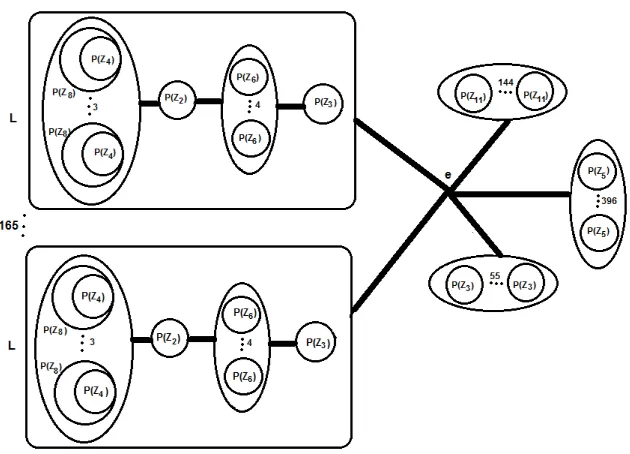
In what follows, we explain the power graph of the sporadic groupsM11, Figure 3, andJ1, Figure 4.
The power graph P(M11) has exactly 7920 vertices. It can be constructed from 165 copies of a graph L, 55 copies of P(Z3), 396 copies of P(Z5) and 144 copies of P(Z11), all connected to each other in
The Janko group J1 has exactly 175560 elements and its power graph is a union of 1463 copies of
a graph K, 1540 copies of P(Z19), 1596 copies of P(Z11) and 4180 copies of P(Z7), all connected to
each other in the identity element of J1.
We end this paper with the following open question:
Question 3.1. What is the automorphism group of P(G), where G is a sporadic group?
Acknowledgments
The authors are indebted to an anonymous referee for his/her suggestions and helpful remarks.
The research of the authors is partially supported by the University of Kashan under grant number
159020/26.
References
[1] P. J. Cameron and S. Ghosh, The power graph of a finite group,Discrete Math.,311(2011) 1220–1222. [2] P. J. Cameron, The power graph of a finite group, II,J. Group Theory,13(2010) 779–783.
[3] D. M. Cardoso, M. A. de Freitas, E. A. Martins and M. Robbiano, Spectra of graphs obtained by a generalization of the join graph operation,Discrete Math.,313(2013) 733–741.
[4] I. Chakrabarty, S. Ghosh and M. K. Sen, Undirected power graphs of semigroups, Semigroup Forum, 78 (2009) 410–426.
[5] A. Doostabadi, A. Erfanian and A. Jafarzadeh,Some results on the power graph of groups, The Extended Abstracts of the 44th Annual Iranian Mathematics Conference, 27–30 August 2013, Ferdowsi University of Mashhad, Iran. [6] A. V. Kelarev and S. J. Quinn, A combinatorial property and power graphs of groups, Contributions to General
Algebra,12Vienna, 1999, 229–235, Heyn, Klagenfurt, 2000.
[7] A. Kelarev, J. Ryan and J. Yearwood, Cayley graphs as classifiers for data mining: the influence of asymmetries,
Discrete Math.,309(2009) 5360–5369.
[8] A. V. Kelarev, Labelled Cayley graphs and minimal automata,Australas. J. Combin.,30(2004) 95–101. [9] A. V. Kelarev,Graph Algebras and Automata,257, Marcel Dekker, New York, 2003.
[10] A. V. Kelarev, S. J. Quinn and R. Smolikova, Power graphs and semigroups of matrices,Bull. Austral. Math. Soc.,
63(2001) 341–344.
[11] A. V. Kelarev and S. J. Quinn, Directed graphs and combinatorial properties of semigroups,J. Algebra,251(2002) no. 1 16–26.
[12] A. V. Kelarev and S. J. Quinn, A combinatorial property and power graphs of semigroups,Comment. Math. Univ. Carolin.,45(2004) 1–7.
[13] J. Abawajy, A. V. Kelarev and M. Chowdhury, Power graphs: a survey,Electron. J. Graph Theory Appl. (EJGTA),
1no. 2 (2013) 125–147.
[14] M. Mirzargar, A. R. Ashrafi and M. J. Nadjafi-Arani, On the power graph of a finite group, Filomat,26 (2012) 1201–1208.
[15] A. R. Moghaddamfar, S. Rahbariyan and W. J. Shi, Certain properties of the power graph associated with a finite group,J. Algebra Appl.,13no. 7 (2014) 18 pages.
[17] G. R. Pourgholi, H. Yousefi-Azari and A. R. Ashrafi, The undirected power graph of a finite group, to appear in
Bull. Malaysian Math. Sci. Soc.
[18] J. S. Rose,A Course on Group Theory, Dover Publications, Inc., New York, 1994.
Zeinab Mehranian
Department of Mathematics, University of Qom, Qom, I. R. Iran
Ahmad Gholami
Department of Mathematics, University of Qom, Qom, I. R. Iran
Ali Reza Ashrafi
Department of Pure Mathematics, Faculty of Mathematical Sciences, University of Kashan, P. O. Box 87317–51116, Kashan, I. R. Iran