Time–delay single layer artificial neural network models
for estimating shelf life of burfi
Goyal, Sumit
National Dairy Research Institute, India ([email protected])
Goyal, Gyanendra Kumar
National Dairy Research Institute, India ([email protected])
Received: 1 April 2012 Revised: 21 April 2012 Accepted: 7 May 2012
Available Online: 12 June 2012 DOI: 10.5861/ijrsc.2012.101
ISSN: 2243-772X Online ISSN: 2243-7797
OPEN ACCESS
Abstract
Time-delay single layer artificial neural network models were developed for estimating the
shelf life of burfi stored at 30ºC. Input variables for the models were moisture, titratable
acidity, free fatty acids, tyrosine, and peroxide value, while the overall acceptability score was
taken as output variable. Mean square error, root mean square error, coefficient of
determination and Nash - sutcliffo coefficient were applied in order to compare the prediction
ability of the Time-delay single layer models. The combination of 5
11
1 showed a very
high correlation between the training and validation data, establishing that the developed
models are effective in predicting the shelf life of burfi.
Time–delay single layer artificial neural network models for estimating shelf life of burfi
1. Introduction
Artificial neural networks (ANN) are inspired by the early models of sensory processing by the brain. An ANN can be created by simulating a network of model neurons in a computer. By applying algorithms that mimic the processes of real neurons, we can make the network ‘learn’ to solve many types of problems. A model neuron is referred to as a threshold unit. It receives input from a number of other units or external sources, weighs each input and adds them up. If the total input is above a threshold, the output of the unit is one; otherwise it is zero. Therefore, the output changes from 0 to 1 when the total weighted sum of inputs is equal to the threshold. The points in input space satisfying this condition define a so called hyper-plane. In two dimensions, a hyper-plane is a line, whereas in three dimensions, it is a normal plane. Points on one side of the hyper-plane are classified as 0 and those on the other side as 1. It means that a classification problem can be solved by a threshold unit if the two classes can be separated by a hyper-plane. ANN have been applied to many interesting problems in different areas of science, medicine and engineering and in some cases, they provide state-of-the-art solutions (Krogh, 2008).
The single hidden layer organization, in which all units are connected to one another, constitutes the most general case and is of more potential computational power than hierarchically structured multiple layer organizations. Time-delay neural networks are special artificial neural networks which receive input over several time steps. Time-delay neural network is an alternative neural network architecture whose primary purpose is to work on continuous data. The advantage of this architecture is to adapt the network online and hence helpful in many real time applications, like time series prediction, online spell check, continuous speech recognition, etc. The architecture has a continuous input that is delayed and sent as an input to the neural network (Commons Website; Wikipedia TDNN Website, 2011).
In Indian subcontinent burfi is very popular sweetmeat prepared from water buffalo milk. It is essentially and customarily served and consumed on all festive occasions and also during social gatherings like marriages and birthday parties. Though, several verities of burfi such as cashew nut burfi, almond burfi, pistachio burfi, cardamom burfi and plain burfi are sold in the market, but plain burfi is most popular which contains milk solids and sugar. A very thin edible metallic silver leaf is placed on the upper surface of burfi for two distinct purposes, firstly the product becomes more attractive, and secondly the silver has therapeutic value.
The increasing number of newly developed foods vie for space on supermarket shelves, the words “speed and innovation” have become the keywords for food companies seeking to become “first to market” with successful products. Market share which goes to the pioneer of each successful new product keeps that company in an excellent competitive position. The overall quality of the product is most important in present competitive era and needs to be maintained into the speed and innovation system. How the consumer perceives the product is the ultimate measure of total quality. Therefore, the quality built in during the development and production process must last through the distribution and consumption stages.
2. Prediction potential of ANNs
ANNs successfully predicted the egg production of laying hens based on investigating their age (Ghazanfari et al., 2011). ANN model estimated moisture ratio in apple drying process with a good precision (Khoshhal et al., 2010). Quality of potatoes in chips industry is estimated from the intensity of darkening during frying. This is measured by a human jury, subject to numerous factors of variation. Gray level intensities were obtained for the apex, the center, and the basal parts of each chip using image analysis of frying assays. Feed-forward ANN was designed and tested to associate these data with color categories. The developed ANN showed good performance, learning from a relatively small number of data values. The ANN model behaved better than multiple linear regression analysis. Predicted categories appear to reproduce the pattern of the experimental data issued from the jury, revealing nonlinear mapping, existence of sub regions and partial overlapping of categories. Moreover, the generalization capacities of the network allowed to simulate plausible predictions for the whole set of parameter combinations. Marique et al. (2003) were of the opinion that this work is to be considered as a 1st step toward a practical ANN model that will be used for objective, precise, and accurate online prediction of chips quality (Marique et al., 2003).
Efstathios etal., (2011) employed a series of partial least squares (PLS) models to correlate spectral data from FTIR(Fourier transform infrared spectroscopy) analysis with beef fillet spoilage during aerobic storage at different temperatures (0, 5, 10, 15, and 20ºC).The performance of the PLS models was compared with a three - layer feed-forward ANN developed using the same dataset. FTIR spectra were collected from the surface of meat samples in parallel with microbiological analyses to enumerate total viable counts. Sensory evaluation was based on a three-point hedonic scale classifying meat samples as fresh, semi-fresh, and spoiled. The purpose of the modeling approach employed in this work was to classify beef samples in the respective quality class as well as to predict their total viable counts directly from TIR spectra. The results obtained demonstrated that both approaches showed good performance in discriminating meat samples in one of the three predefined sensory classes. The PLS classification models showed performances ranging from72.0 to 98.2% using the training dataset, and from 63.1 to 94.7% using independent testing dataset. The ANN classification model performed equally well in discriminating meat samples, with correct classification rates from 98.2 to 100% and 63.1 to73.7% in the train and test sessions, respectively. PLS and ANN approaches were also applied to create models for the prediction of microbial counts. The performance of these was based on graphical plots and statistical indices (bias factor, accuracy factor and root mean square error).
Seventy samples of honey of different geographical and botanical origin were analyzed with an electronic nose. The instrument, equipped with 10 Metal Oxide Semiconductor Field Effect Transistors (MOSFET) and 12 Metal Oxide Semiconductor (MOS) sensors, was used to generate a pattern of the volatile compounds present in the honey samples. The sensor responses were evaluated by Principal Component Analysis (PCA) and ANN. Good results were obtained in the classification of honey samples by using a neural network model based on a multilayer perception that learned using a back-propagation algorithm. According to researchers methodology is simple, rapid and results proposed that the electronic nose could be a useful tool for the characterization and control of honey (Benedetti et al., 2004).
Brain based artificial intelligent scientific computing models, viz., cascade neural network (CNN) and probabilistic neural network models for shelf life detection of cakes stored at 30o C have been developed. In this study, the data pertaining to moisture, titratable acidity, free fatty acids, peroxide value, and tyrosine were taken as input variables; and overall acceptability score was output variable. Mean square error, root mean square error, coefficient of determination and Nash - sutcliffo coefficient were used for comparing the prediction performance of the developed models. The CNN model with single hidden layer having twenty five neurons gave good fit (Goyal & Goyal, 2011a).
variables; while overall acceptability score was the output variable. The network was trained with single as well as double hidden layers; transfer function for hidden layer was tangent sigmoid, while for the output layer it was pure linear function. The investigation suggested that the simulated neural networks are excellent tool for predicting the shelf life of soft cakes (Goyal & Goyal, 2011b). The efficiency of cascade single and multiple hidden layer models was tested for shelf life prediction of Kalakand, a sweetened desiccated dairy product. For developing the models, the network was trained with 100 epochs. Cascade models with two hidden layers having twenty neurons in the first layer and twenty neurons in the second layer gave best result (MSE 0.000988770; RMSE: 0.03144471; R2: 0.988125331) (Goyal & Goyal, 2011c). Radial basis artificial neural engineering and multiple linear regression models forecasted the shelf life of instant coffee drink (Goyal & Goyal, 2011d).
Cascade forward and feed-forward artificial intelligence models for predicting sensory quality of instant coffee flavored sterilized drink were proposed. Several combinations of several internal parameters, viz., data pre-processing, data partitioning, number of hidden layers, number of neurons in each hidden layer, transfer function, error goal, etc., along with back-propagation algorithm based on Levenberg–Marquardt mechanism as training function were explored by Goyal & Goyal,(2011e). The network was trained with 100 epochs. The number of neurons in each hidden layer varied from 1 to 20. The results of cascade forward and feed forward artificial intelligent models were evaluated with three types of prediction performance measures, viz., root mean square error, coefficient of determination R2 and mean square error. Feed-forward back-propagation artificial intelligence model exhibited best results (3.70% RMSE; 0.998 R2; 0.0013 MSE), followed by cascade forward artificial intelligence model (5.36% RMSE; 0.996 R2; 0.0028 MSE) for predicting the sensory quality of instant coffee flavored sterilized drink.
Artificial intelligent scientific models predicted the shelf life of instant coffee sterilized drink (Goyal & Goyal, 2011f). ANNs were implemented for predicting the shelf life of milky white dessert jeweled with pistachio (Goyal & Goyal, 2011g). Time-delay and linear layer (design) expert system models detected the shelf life of soft mouth melting milk cakes (Goyal & Goyal, 2011h). The shelf life of brown milk cakes decorated with almonds was forecasted by radial basis (exact fit) and radial basis (fewer neurons) models (Goyal & Goyal, 2011i). Radial basis (exact fit) ANN model for estimating the shelf life of burfi stored at 30º C has been developed (Goyal & Goyal, 2012). ANNs also predicted the shelf life of post-harvest roasted coffee sterilized milk drink (Goyal & Goyal, 2011j). The aim of the present investigation is to propose ANN single layer time - delay models for predicting the shelf life of burfi stored at 30ºC.The findings of this study would be very useful for food/dairy industry, wholesalers, retailers, consumers, food researchers, academicians, and regulatory authorities.
3. Method material
The experimentally obtained values of moisture, titratable acidity (TA), free fatty acids (FFA), tyrosine, and peroxide value (PV) were taken as input variables, and the overall acceptability score (OAS) as output variable (Fig.1). Mean square error: MSE (1), root mean square error: RMSE (2), coefficient of determination R2 (3) and Nash - Sutcliffo coefficient: E2 (4) were implemented in order to compare the prediction capability of the ANN models. The proposed models were developed using Neural Network Toolbox under MALTAB software.
−
=
∑
2 1 exp N caln
Q
Q
MSE
(1)
−
=
∑
2 1 exp exp1
N calQ
Q
Q
n
RMSE
(2)
−
−
=
∑
2 1 2 exp exp 21
N calQ
Q
Q
R
(3)
−
−
−
=
∑
21 exp exp
Where,
Q
exp = Observed value;Q
cal = Predicted value;Q
exp=Mean predicted value;n
= Number ofobservations in dataset.
Figure 1. Input and output variables for ANN models
For developing the ANN models, 48 datasets were included in the study for each input and output variables. Further, the dataset was randomly divided into two disjoint subsets, namely, training set having 40 observations, and validation set 8 observations.
4. Results and Discussions
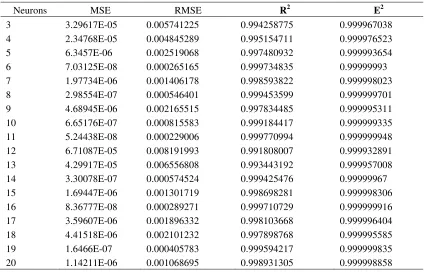
Performance matrices of the ANN models are presented in Table 1.
Table 1
Results of time-delay single layer ANN model
Neurons MSE RMSE R2 E2
3 3.29617E-05 0.005741225 0.994258775 0.999967038
4 2.34768E-05 0.004845289 0.995154711 0.999976523
5 6.3457E-06 0.002519068 0.997480932 0.999993654
6 7.03125E-08 0.000265165 0.999734835 0.99999993
7 1.97734E-06 0.001406178 0.998593822 0.999998023
8 2.98554E-07 0.000546401 0.999453599 0.999999701
9 4.68945E-06 0.002165515 0.997834485 0.999995311
10 6.65176E-07 0.000815583 0.999184417 0.999999335
11 5.24438E-08 0.000229006 0.999770994 0.999999948
12 6.71087E-05 0.008191993 0.991808007 0.999932891
13 4.29917E-05 0.006556808 0.993443192 0.999957008
14 3.30078E-07 0.000574524 0.999425476 0.99999967
15 1.69447E-06 0.001301719 0.998698281 0.999998306
16 8.36777E-08 0.000289271 0.999710729 0.999999916
17 3.59607E-06 0.001896332 0.998103668 0.999996404
18 4.41518E-06 0.002101232 0.997898768 0.999995585
19 1.6466E-07 0.000405783 0.999594217 0.999999835
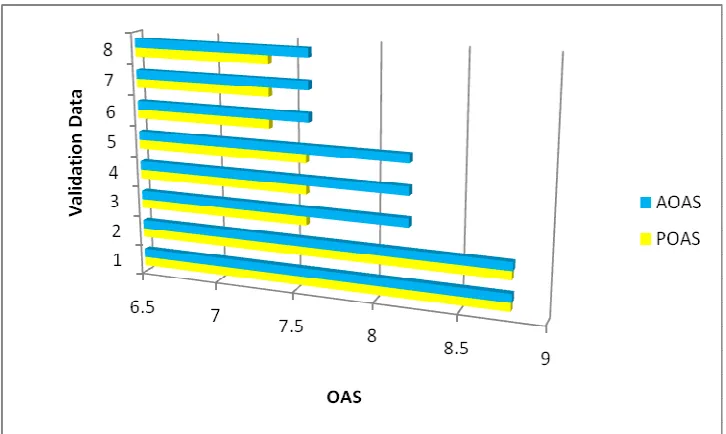
The comparison of actual overall acceptability score (AOAS) and predicted overall acceptability score (POAS) for time-delay model is illustrated in Figure 2.
Figure 2. Comparasion of AOAS and POAS for time-delay model
Time-delay model model was developed for predicting the shelf life of burfi stored at 30oC. Several experiments were carried out and from the results it was observed that the model with a 5111 topology gave the best fit, as it showed high correlation between training and validation data with high R2 (0.999770994) and E2 (0.999999948) values. The results suggested that the developed model is very effective in estimating the shelf life of burfi.
5. Conclusion
Time-delay single layer artificial neural network models were developed for estimating the shelf life of burfi stored at 30oC. Moisture, titratable acidity, free fatty acids, tyrosine, and peroxide value were taken as input variables, and the overall acceptability score as output variable. In all 48 datasets were used by randomly dividing them into two disjoint subsets, viz., training set having 40 observations and validation set 8 observations. The results of the experiments showed high correlation between training and testing datasets, confirming that the developed models are good for estimating the shelf life of burfi.
6. References:
Benedetti,S., Mannino,S., Sabatini,A.G., & Marcazzan, G. L. (2004). Electronic nose and neural network use for the classification of honey. Apidologie, 35, 1–6. <http://dx.doi.org/10.1051/apido:2004025>
Commons Website, (2011). Retrieved January 3, 2011, from
http://commons.wikimedia.org/wiki/Time_Delay_Neural_Network
Efstathios, Z.P., Fady, R. M., Argyria, A. A., Conrad, M. B., & George-John, E. N. (2011).A comparison of artificial neural networks and partial least squares modelling for the rapid detection of the microbial spoilage of beef fillets based on Fourier transform infrared spectral fingerprints. Food Microbiology,
28(4), 782–790. <http://dx.doi.org/10.1016/j.fm.2010.05.014>
Ghazanfari, S., Nobari, K., & Tahmoorespur, M. (2011). Prediction of egg production using artificial neural network. Iranian Journal of Animal Science, 1(1), 11-16.
life prediction of cakes. Canadian Journal on Artificial Intelligence, Machine Learning and Pattern Recognition, 2(6), 73-77.
Goyal, S., & Goyal, G. K. (2011b). Simulated neural network intelligent computing models for predicting shelf life of soft cakes. Global Journal of Computer Science and Technology, 11(14), 29-33.
Goyal, S., & Goyal, G. K. (2011c). Advanced computing research on cascade single and double hidden layers for detecting shelf life of kalakand: An artificial neural network approach. International Journal of Computer Science & Emerging Technologies, 2(5), 292-295.
Goyal, S., & Goyal, G. K. (2011d). Application of artificial neural engineering and regression models for forecasting shelf life of instant coffee drink. International Journal of Computer Science Issues, 8(4), 320-324.
Goyal, S., & Goyal, G. K. (2011e). Cascade and feed-forward back-propagation artificial neural networks models for prediction of sensory quality of instant coffee flavored sterilized drink. Canadian Journal on Artificial Intelligence, Machine Learning and Pattern Recognition, 2(6), 78-82.
Goyal, S., & Goyal, G. K. (2011f). Development of neuron based artificial intelligent scientific computer engineering models for estimating shelf life of instant coffee sterilized drink. International Journal of Computational Intelligence and Information Security. 2(7), 4-12.
Goyal, S., & Goyal, G. K. (2011g). A new scientific approach of intelligent artificial neural network engineering for predicting shelf life of milky white dessert jeweled with pistachio. International Journal of
Scientific and Engineering Research. 2(9), 1-4.
Goyal, S., & Goyal, G. K. (2011h). Development of intelligent computing expert system models for shelf life prediction of soft mouth melting milk cakes. International Journal of Computer Applications. 25(9), 41-44.
Goyal, S., & Goyal, G. K. (2011i). Radial basis artificial neural network computer engineering approach for predicting shelf life of brown milk cakes decorated with almonds. International Journal of Latest Trends in Computing. 2(3), 434-438.
Goyal, S., & Goyal, G. K. (2012). Radial basis (exact fit) artificial neural network technique for estimating shelf life of burfi. Advances in Computer Science and its Applications, 1(2), 93-96.
Goyal, S., & Goyal, G. K. (2011j). Computerized models for shelf life prediction of post-harvest coffee sterilized milk drink. Libyan Agriculture Research Center Journal International, 2(6), 274-278.
Khoshhal, A., Dakhel, A.A., Etemadi, A., & Zereshki,S. (2010). Artificial neural network modeling of apple drying process. Journal of Food Process Engineering, 33, 298–313.
<http://dx.doi.org/10.1111/j.1745-4530.2009.00435.x>
Krogh, A. (2008). What are artificial neural networks? Nature Biotechnology, 26(2), 195-197. <http://dx.doi.org/10.1038/nbt1386>
Marique, T., Kharoubi, A., Bauffe, P., & Ducattillon, C. (2003). Modeling of fried potato chips color classification using image analysis and artificial neural network. Journal of Food Science, 68(7), 2263-2266. <http://dx.doi.org/10.1111/j.1365-2621.2003.tb05757.x>
Medlabs Website. (2011). Retrieved January 2, 2011, from
http://www.medlabs.com/Downloads/food_product_shelf_life_web.pdf Wikipedia TDNN Website. (2011). Retrieved January 2, 2011, from