Studing The Effectiveness of Integrative
Instruction in the Executive Function, and the
Collaborative for Academic, Social and
Emotional learning on the General
Mathematical performance: A Case Study of
Female Students with Mathematical
Learning Disability
Parisa Khosrotash, PhD student
Department of Psychology Roodehen Branch, Islamic Azad
University, Roodehen, Iran.
Khadijeh Abolmaali Alhosseini, PhD*
Department of Psychology, Faculty of Psychology and Social Science, Roudehen Branch, Islamic Azad
University, Roudehen, Iran [email protected]
Doi: 10.24200/ijpb.2018.115461
The purpose of this study was to investigate the effects of integrative instruction in the executive function and the Collaborative for Academic, Social and Emotional Learning (CASEL) on improving the mathematical performance of students with Mathematical Learning Disability (MLD). Semi-experimental method with pre-test and post-test control group design was applied in the current research. After screening (according to the checklist of DSMV-V, Raven test, and Key-Mat test), fourteen students were identified and randomly assigned to experimental and control group. The experimental group was given integrative instruction in 11 sessions while the control group did not receive any treatment. The data were analyzed with MANCOVA. The results showed that the integration of the two methods (executive function and CASEL) significantly increased the concepts and the applying dimensions of mathematical performance. Based on the findings of this study, it was suggested that educational psychologists apply the integration of two methods
IPA
International Journal of Psychology Vol. 13, No. 1, Winter & Spring 2019
PP. 107-132
Iranian Psychological
Association
of executive functions and CASEL teaching, to improve the performance of students with mathematical disabilities.
Keywords: math learning disability, executive functions,
collaborative for academic social and emotional learning, mathematical performance
Learning Disability (LD) is known as a major learning problem which affects a person's daily activities. "LDs are specific patterns (subtypes) of neuropsychological assets and deficits that result in specific patterns of formal (e.g., academic) and informal (e.g., social) learning assets and deficits. LD may also lead to specific patterns of psychosocial functioning" (Rourke, 2005). According to Schulte-Korne, 2014, four sub-skills were found in the mathematics disorder, including: number sense, memorization of arithmetic facts, accurate or fluent calculation, and accurate mathematics reasoning. Other difficulties in mathematics disability are problem-solving, multi-step problems, verifying answers, recalling number facts, and borrowing/renaming errors (Bryant and Bryant, 2008). In the diagnostic and statistical manual of mental disorders (DSM 5), mathematics learning disability is defined as "the difficulties in mastering number sense, number facts, or calculation (e.g., having poor understanding of numbers, their magnitude, and relationships; counting on fingers to add single-digit numbers instead of recalling the mathematical facts as peers do; confusion in the midst of arithmetic computation and switchimg of procedures)" (American Psychiatric Association, 2013, p. 66).
metacognitive processes such as self-regulation of behavior, and the development of cognitive and social skills that are developed during child development period (Zelazo, et al., 2003).
Bull, et al. (2008) suggested that any defect in EF could lead to attention and concentration deficit, disruptions in planning to start and finish assignments, remembering assignments, retention of assignments, and even memory impairment and learning disabilities in children. Learning deficiencies are among the problems that can be significantly affected by weakness in EF.
EF is a higher cognitive function that is attributed to a set of logical abilities and is used as a term to describe cognitive processes that regulate thought and action (Friedman et al, 2006; Lezak, Howieson, Bigler & Tranel, 2012), such as; self-regulation, self-initiation, impulse control and monitoring of action, strategic planning (that is, the ability to mentally organize a set of conditions and steps to solving a problem), sequencing (that is, students’ abilities to put events in order), prioritizing, selective and sustained attention, inhibition (the ability to hold back the current responses or restraining pre-potent responses), utilization of feedback, multi-tasking and shifting mental sets (changing a response through the activation of another response) and mental flexibility, perception of time, updating working memory and ability to deal with novelty (Chan, Shum, Toulopoulou & Chen, 2008; Miyake et al., 2000; Nigg, 2006; Friedman, et al. 2006; Lezak, Howieson, Bigler & Tranel, 2012).
2010). Researchers revealed that visual short-term and working memory (especially visuospatial working memory), as well as inhibitory control can predict mathematical achievement at each time point (Bull et al., 2008; Espy et al., 2004; Bull & Scerif, 2001; St Clair-Thompson & Gathercole, 2006). For improving mathematical performance, a researcher supported the role of EF training (Mir Mahdi, Alizadeh & Saif Naraqi, 2009) and adaptive training which taxed working memory by playing computer games (Holmes, Gathercole & Dunning, 2009). Action video game playing may be used to enhance the ability to learn new tasks (Green & Bavelier, 2012). It appears that the active playing of video game may have positive effects on some executive functions (Buelow, Okdie & Cooper, 2015). Ke & Grabowski (2007), concluded that game playing was more effective than drills in promoting students’ mathematics performance; and cooperative game playing was most effective for promoting positive mathematics attitudes regardless of students’ individual differences. Furthermore, the game format had a facilitative effect on the continuing motivation of students who had low initial attitudes toward mathematics (Okolo, 1992). In addition to the role of the video game on promoting students’ mathematics performance, based on past studies, social-emotional learning (SEL) also has an important role in increasing mathematical performance (McCormick, Cappella, O’Connor, & McCrory, 2015).
to the complex demands of growth and development” (Elias, et al. 1997).
SEL can foster: healthy decision-making, problem-solving, a safe, supportive learning environment, the improvement of social, health and ethical development, academic outcomes, and the motivation to achieve (Durlak, Weissberg, Dymnicki, Taylor & Schellinger, 2011; Greenberg et al., 2003; Zins, Elias & Greenberg, 2007). Such SEL is important to students because; emotions affect how and what they learn, and caring relationships provide a foundation for deep and lasting learning (Elias, Zins, Weissberg, et al., 1997). Latifi, Amiri, Malakpour, and Molavi (2009) in their study showed that cognitive emotional regulation and instruction of social problem solving through cognitive approaches can significantly improve the performance of students with learning disability, in terms of social problem solving, reduction of undesirable behaviors such as aggression, isolation, and modification of social goals.
CASEL describes SEL in terms of five domains of competence: 1. Self-Awareness: The ability to accurately recognize one’s emotions and thoughts, and their influence on behavior. This includes accurately assessing one’s strengths and limitations and possessing a well-grounded sense of confidence and optimism.
2. Self-Management: The ability to self-regulate emotions, thoughts and behaviors in different situations.
3. Social Awareness: The development of an empathic and respectful attitude towards people from different backgrounds and cultures.
4. Relationship Skills: The development of clear relationships, active listening, and participation; resistance against adverse social pressures, and systematic conflict resolution.
5. Responsible Decision-Making: The ability to create systematic and respectful opportunities with regard to individual behavior and social interactions and with consideration of ethnic standards, norms, and realistic assessment of the impact of different functions (CASEL Guide, 2013).
Therefore, the main purpose of the present study was to evaluate the combined effect of EF training and CASEL on improving the mathematical performance of female students with MLD.
Method
The present study was a semi-experimental research with a pretest, posttest and a control group design. The population included students of an elementary school in District 5 of Tehran in 1394. The sample consisted of 14 students who were randomly divided into an experimental group and a control group. In the sample selection, the students with learning disabilities were screened and randomly assigned to two groups. The screening took place in three stages. In the first stage, learning disability criteria determined in accordance with DSMV was explained to teachers and they were asked to choose students suspected of having a learning disability. In the next stage, the Raven IQ test was carried out on them and the students with normal IQ were identified. Afterward, the Iran Key Math test was conducted on these students; and the students whose score was 5.1 standard deviations below the mean, was identified. Finally, the experimental group was subjected to 11 sessions of executive functions and social-emotional training; but the control group received no training at all. In this study, only students from the third to fifth-grade elementary school were studied.
Instruments
Iran Key Math Test
terms of scope. These sections are divided into three or four areas each which makes total of thirteen sub-tests. The overall mean and standard deviation of this test is equal to 100 and 15 respectively. Mohammad-Ismail & Hooman (2003) calculated the reliability of this test through Cronbach's alpha and got .80 to .84. Similarly, Yavari, Yaryary, and Rastegarpour (2007), reported that the reliability of this test through Cronbach's alpha is equal to .83.
Raven IQ Test
The Raven IQ Test was developed in the UK to measure the IQ of 9 to 18 years old children. The test includes 60 items (5 series of items each includes 12 sub-items). The internal consistency coefficient was obtained for .82. The Raven test’s reliability obtained through test-retest method was equal to .61 (Bildiren, 2017). The instruments used to provide independent variable include:
Rehabilitation of Attention and Memory (ARAM)
This program is used for improving attention and working memory. The program is from Nejatis rehabilitation programs (2013, equated to najarzadegan, nejati, amiri & Sharifian, 2015). This program has 3 components:
A. “Home” computer game: this game is used to develop “continuous attention”
(B) “Face” Computer game: this game is used to develop “shifting attention"
(C) “Pack” computer game: This game is used to develop "selective attention" and "inhibitory control"
Self-awareness, self-management, social awareness, relationship skills, and responsible decision-making.
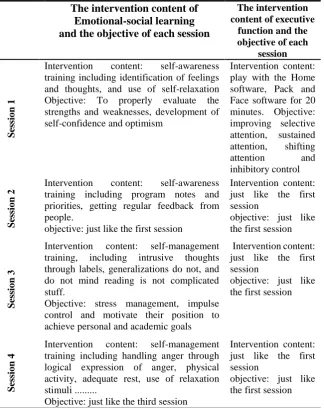
Table 1
Presentation of the Independent Variables (social-emotional Learning and Executive Functions) During 11 Sessions
The intervention content of Emotional-social learning and the objective of each session
The intervention content of executive
function and the objective of each
session
Ses
sio
n
1
Intervention content: self-awareness training including identification of feelings and thoughts, and use of self-relaxation Objective: To properly evaluate the strengths and weaknesses, development of self-confidence and optimism
Intervention content: play with the Home software, Pack and Face software for 20 minutes. Objective: improving selective attention, sustained attention, shifting attention and inhibitory control
Ses
sio
n
2
Intervention content: self-awareness training including program notes and priorities, getting regular feedback from people.
objective: just like the first session
Intervention content: just like the first session
objective: just like the first session
Ses
sio
n
3
Intervention content: self-management training, including intrusive thoughts through labels, generalizations do not, and do not mind reading is not complicated stuff.
Objective: stress management, impulse control and motivate their position to achieve personal and academic goals
Intervention content: just like the first session
objective: just like the first session
Ses
sio
n
4
Intervention content: self-management training including handling anger through logical expression of anger, physical activity, adequate rest, use of relaxation stimuli ...
Objective: just like the third session
Intervention content: just like the first session
Ses
sio
n
5
Intervention content: social awareness, including attention to emotional signs, giving appropriate and timely feedback to others.
Objective: empathy, sensitivity to the interests and feelings of others and giving value to the interpersonal differences
Intervention content: just like the first session
objective: just like the first session
Ses
sio
n
6
Intervention content: social awareness including understanding and learning the value of helping others, Understanding the value of cultural and ethnic backgrounds in communication with people.
Objective: just like the fifth session
Intervention content: just like the first session
objective: just like the first session
Ses
sio
n
7
Intervention content: social skills, including emotion control and creation of peaceful relations with others, convincing and reassuring others and development of the ability to actively listen.
Objective: ability to form and maintain healthy and rewarding relationships with individuals and groups
Intervention content: just like the first session
objective: just like the first session
Ses
sio
n
8
Intervention content: social skills including being honest in all circumstances, training Respectful criticism and timely expression of ideas
Objective: just like the seventh session
Intervention content: just like the first session
objective: just like the first session
Ses
sio
n
9
Intervention content: the ability to solve problems and make responsible decisions including education of problem defining and solution finding through brainstorming method
Objective: development of the ability to create systematic and respectful opportunities associated with social interactions
Intervention content: just like the first session
objective: just like the first session
Ses
sio
n
10
Intervention content: the problem-solving and responsible decision-making ability including decisions about choices and solutions such as, evaluation and revision of existing choices
Objective: just like the ninth session
Intervention content: just like the first session
Ses
sio
n
11
Intervention content: An overview of the five previous sessions
Objective: To ensure the achievement of the objectives mentioned before
Intervention content: just like the first session
objective: just like the first session
Results
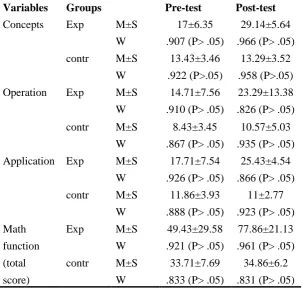
Table 2 shows the mean, and standard deviation of mathematical functions (operations, content and applications) in both experimental and control groups and in both pre-test and post-test stages.
Shapiro - Wilk test showed that the distribution of scores obtained from different mathematical performance aspects was normal in the pre-test and post-test stages. Multivariate analysis of variance showed that the hypothesis (independence of pre-test variable) was established between the data of the present study (P >.05, F(df10,3)=1.547). Moreover, the Levin test showed that there is no significant difference between the variance of error in the pretest scores of mathematical performance in the experimental and control groups.
Table 2
Mean and Standard Deviation of Mathematical Performance in both Experimental and Control Groups, and in both Pre-Test and Post-Pre-Test Stages
Post-test Pre-test Groups Variables 29.14±5.64 17±6.35 M±S Exp Concepts
.966 (P> .05) .907 (P> .05)
W 13.29±3.52 13.43±3.46 M±S contr .958 (P>.05) .922 (P>.05) W 23.29±13.38 14.71±7.56 M±S Exp Operation
.826 (P> .05) .910 (P> .05)
W
10.57±5.03 8.43±3.45
M±S contr
.935 (P> .05) .867 (P> .05)
W 25.43±4.54 17.71±7.54 M±S Exp Application
.866 (P> .05) .926 (P> .05)
W
11±2.77 11.86±3.93
M±S contr
.923 (P> .05) .888 (P> .05)
W 77.86±21.13 49.43±29.58 M±S Exp Math function (total score)
.961 (P> .05) .921 (P> .05)
W
34.86±6.2 33.71±7.69
M±S contr
.831 (P> .05) .833 (P> .05)
W
M: Mean S: standard deviation, W:Shapiro-wilk
degree of freedom of 5, at a significance level of 0.01 is equal to 13.883. This revealed that there is an acceptable level of correlation between the levels of the dependent variable. Therefore, the analysis of multivariate covariance was a good technique to compare the effects of independent variables in the present study. In general, the results of the MANCOVA showed that linear combination of dependent variables (concepts, operation, and application) was significantly different in the experimental and control groups (Wilks lambda =0.300, partial=.215, P <.01, F (df7,3) =8.506).
This means that the application of the independent variable on at least one of the levels of the dependent variable makes a significant difference in the experimental and control groups. Therefore, ANCOVA was used to evaluate the effect of independent variable on each level of the dependent variable, separately. Table 3 shows the results of ANCOVA in comparison with different aspects of mathematical function in the experimental and control groups.
Table 3
ANCOVA in Comparison of Mathematical Function in both Experimental and Control Groups
Partial2
Sig F
Mean square of error Inter-group
mean square Dependent
variable
.729 .001
24.159 20.041
484.171 Concept
.066 .445
.638 46.229
29.503 Operations
.714 .001
22.494 17.867
402.103 Application
According to the above table, the application of the independent variable (Combining training of executive functions and CASEL) affected the concept (P<.01, F (df9, 1)= 24.159) and the application (P<.01, F(df9,1)=22.494) of mathematical performance. However, independent variable did not effect on math operations. It should be noted that Table 3 shows the Eta square (η2) of each variable. Eta square means that a few percentages of the dependent variable variance is determined by the application of the independent variables. For example, the Eta square of concepts is equal to .729; this means that about 73% of the variance of students’ performance in mathematics in component of concept is determined by the independent variable. Also 71.4% of the variance of application was explained by the independent variable. Bonferroni post hoc test was subsequently used to evaluate the direction of differences. The results showed that the adjusted mean of the experimental group in the component of concept (P<.01 and SE =2.895, Δx̄ =14.231) and the application aspects of students’ mathematical performance (P<.01 and SE =12.969, Δx̄ =7.401), was significantly higher than the control group. Thus, according to the results of the analysis, it was concluded that the integration of executive function learning and CASEL could improve two components of math performance, concepts and application, in female students with mathematical disability.
Discussion
disability. However, there is no significant effect on the operation.
This finding is consistent with the findings obtained from a large number of studies, such as: Best, Miller & Naglieri (2011), Langberg, Dvorsky & Evans (2013), Bull and Screif (2001), Clark, Pritchard & Woodward, (2010),Mirmahdi, Alizadeh, Saif Naraqi, (2009), and Holmes, Gathercole & Dunning (2009).
Children should have a set of pre-requisite skills such as attention, memory, concentration, problem solving abilities, etc. in order to master their assignments. It seems that difficulties in the executive functions lead to the reduction of concentration and development of attentional span in children. These skills are intrinsic processes that children use during problem-solving, learning, self-controlling and self-monitoring. Most children use these skills automatically; but children with learning disabilities usually encounter problems when using these skills, and thus, must be trained. Children need to possess these pre-requisite skills for mathematical achievement.
The effectiveness of CASEL on students' academic performance was investigated in some studies. The results of Zins, Payton, Weisbereg & O'Brien (2007) and Narimani, Abbasi, Abolqasemi &Vahedi (2012), indicated an improvement in the academic performance of students which could be attributed to their attention to social-emotional issues. These results are consistent with those of the present study.
It can be argued that students experience a wide variety of emotions. A positive consequence of emotions facilitate learning, and negative consequences often hinder learning. In the same vein, the development of social-emotional skills and competencies plays an important role in the proper formation of behavioral patterns of interaction between people; raising awareness of one’s moods and feelings; raising awareness of teacher and classmates’ feelings and moods; management of emotions like anger; enhancement of problem-solving ability; timely and proper decision making, and contribution to maintenance of positive social relationships with peers.
In the present study, the cognitive and emotional dimensions were investigated from the perspective of the Collaborative for Academic, Social and Emotional Learning (CASEL) and executive functions. This kind of investigation provided the present study with special aspects; since the integration of executive functions and CASEL could control and improve the cognitive and emotional dimensions. Attention to socio-emotional dimensions during learning helps to strengthen the learner's motivation and explains their active role in the learning process. Based on the socio-cognitive approach of Bandura, strengthening the motivation and active role of the learner in the learning process provides a basis for the perspective of the learner's agent (Bandura, 2018). Few researchers have integrated cognition and emotion in their study; for example, Latifi et al. (2009) study is consistent with the present study; and their research studies also focused on the emotional dimension. Although it appears that the improvement of emotional and cognitive dimensions can affect each other; the current research is consistent with Latifi et al. (2009).
to engage in positive behaviors leading to self-improvement (Armenta, Fritz & Lyubomirsky, 2017).
In the same vein, in the present study, students received training on the improvement of brain performance capabilities (including attention, in its different aspects, and concentration) and on emotional–social learning (Including awareness, self-management, social awareness, relationship skills and responsible decision making); thus, it seems that the effects on their mathematical performance, are much more efficient and sustainable. Based on the findings of this study, it was suggested that the integration of two methods; executive functions, and CASEL, could cause an improvement in the performance of students with learning disabilities. In addition, it was suggested that the effectiveness of these two methods are considered on reading and writing disorders by researchers.
References
American Psychiatric Association, publisher; American Psychiatric Association. (2013). DSM-5 Task Force. Diagnostic and statistical manual of mentaldisorders: DSM-5 (Fifth edition).
Armenta, C. N., Fritz, M. M., & Lyubomirsky, S. (2017). Functions of Positive Emotions. Gratitude as a Motivator of Self-Improvement and Positive Change. In Emotion Review 9(3), 183–190. Doi: 10.1177/ 1754073916669596.
Bandura, A. (1986). A social foundation of thought and action: A social cognitivetheory. Englewood Cliff, NJ: Prentice Hall. ISBN: 978-0-13-8156 14-5.
science: a journal of the Association for Psychological Science, 13(2), 130–136. Doi: 10.1177/1745691617699280. Best, J. R., Miller, P. H., & Naglieri, J. A. (2011). Relations
between executive function and academic achievement from ages 5 to 17 in a large, representation national sample. Learning and Individual Differences, 21(4), 327-336.
Bildiren, A. (2017). Reliability and Validity Study for the Coloured Progressive Matrices Test between the Ages of 3-9 for Determining Gifted Children in the Pre-School Period.
Journal of Education and Training Studies, 5(11), 13–20. URL: http://jets.redfame.com.
Bryant, B. R., & Bryant, D. P. (2008). Introduction to the special series: Mathematics and learning disabilities. Learning Disability Quarterly, 31, 3-8.
Buelow, M. T., Okdie, B. M., & Cooper, A. B. (2015). The influence of video games on executive functions in college students. Computers in Human Behavior, 45, 228–234. https://doi.org/10.1016/j.chb.2014.12.029
Bull, R., & Scerif, G. (2001). Executive functioning as a predictor of children's mathematics ability: inhibition, switching, and working memory. Developmental Neuropsychology, 19(3),
273–293. https://doi.org/10.1207/S15326942DN1903_3 Bull, R., Espy, K. A., & Wiebe, S. A. (2008). Short-term memory,
working memory, and executive functioning in preschoolers: longitudinal predictors of mathematical achievement at age 7 years. Developmental Neuropsychology, 33(3), 205–228. https://doi.org/10.1080/87565640801982312
CASEL Guide. (2013). Effective Social and Emotional Learning Program-Preschool and Elementary School Edition .
Carillo, K. D. (2010). Social Cognitive Theory in IS Research– Literature Review, Criticism, and Research Agenda. In Sushil K. Prasad, Harrick M. Vin, Sartaj Sahni, Mahadeo P. Jaiswal, Bundit Thipakorn (Eds.): Information Systems, Technology and Management, vol. 54. Berlin, Heidelberg: Springer Berlin Heidelberg (Communications in Computer and Information Science), pp. 20–31.
Chan, R. C. K., Shum, D., Toulopoulou, T., & Chen, E. Y. H. (2008). Assessment of executive functions: review of instruments and identification of critical issues. Archives of clinical neuropsychology: the official journal of the National
Academy of Neuropsychologists, 23(2), 201–216. https:// doi.org/10.1016/j.acn.2007.08.010
Clark, C. A. C., Pritchard, V. E., & Woodward, L. J. (2010). Preschool executive functioning abilities predict early mathematics achievement. Developmental Psychology,
46(5), 1176–1191. https://doi.org/10.1037/a0019672
Durlak, J. A., Weissberg, R. P., Dymnicki, A. B., Taylor, R. D., & Schellinger, K. B. (2011). The impact of enhancing students' social and emotional learning: a meta-analysis of school-based universal interventions. Child development,
82(1), 405–432. https://doi.org/10.1111/j.1467-8624. 2010. 01564.x
Eisenberg, N., Valiente, C., & Eggum, N. D. (2010). Self-Regulation and School Readiness. Early education and development, 21(5), 681–698. https://doi.org/10.1080/ 10409289.2010.497451
Elias, M. J. (2003). Academic and social emotional learning. http://www.ibe.unesco.org.
emotional learning: Guidelines for educators. Alexandria, VA: Association for Supervision and Curriculum Development.
Espy, K. A., McDiarmid, M. M., Cwik, M. F., Stalets, M. M., Hamby, A., & Senn, T. E. (2004). The contribution of executive functions to emergent mathematic skills in preschool children. Developmental neuropsychology, 26(1),
465–486. https://doi.org/10.1207/s15326942dn2601_6 Fiske, S. T., & Taylor, S. E. (2008). Social cognition: From
brains to culture / Susan T. Fiske and Shelley E. Taylor (1st ed.). New York: McGraw-Hill Higher Education; London: McGraw-Hill [distributor]. Retrieved from http://www.loc.gov/catdir/enhancements/fy0803/200701806 2-d.html.
Freilich, R., & Shechtman, Z. (2010). The contribution of art therapy to the social, emotional, and academic adjustment of children with learning disabilities. The Arts in Psychotherapy, 37(2), 97–105. https://doi.org/10.1016/ j.aip.2010.02.003
Friedman, N. P., Miyake, A., Corley, R. P., Young, S. E., Defries, J. C., & Hewitt, J. K. (2006). Not all executive functions are related to intelligence. Psychological science, 17(2), 172– 179. https://doi.org/10.1111/j.1467-9280.2006.01681.x Green, C. S., & Bavelier, D. (2012). Learning, attentional control,
and action video games. Current biology: CB, 22(6), R197-206. https://doi.org/10.1016/j.cub.2012.02.012.
Holmes, J., Gathercole, S. E., & Dunning, D. L. (2009). Adaptive training leads to sustained enhancement of poor working memory in children. Developmental science, 12(4), 9-15. https://doi.org/10.1111/j.1467-7687.2009.00848
Jacobson, L. A., Williford, A. P., & Pianta, R. C. (2011). The role of executive function in children's competent adjustment to middle school. Child neuropsychology: a journal on normal and abnormal development in childhood and adolescence,
17(3), 255–280. https://doi.org/10.1080/09297049.2010. 535654
Ke, F., & Grabowski, B. (2007). Gameplaying for maths learning: Cooperative or not? British Journal of Educational Technology, 38(2), 249–259. https://doi.org/10.1111/j.1467-8535.2006.00593.x
Langberg, J. M., Dvorsky, M. R., & Evans, S. W. (2013). What specific facets of executive function are associated with academic functioning in youth with attention-deficit/hyperactivity disorder? Journal of abnormal child psychology, 41(7), 1145–1159. https://doi.org/10.1007/ s10802-013-9750-z
Latifi, Z., Amiri, Sh., Malakpour, M., & Moulvi, H. (2009). The
effectiveness of teaching cognitive- social problem-solving training on improving interpersonal relationships, change in social attitudes and self-efficacy perception in students with learning disabilities. Tazehaye Olum-e Shenakhti, 11(3),
70-84 (In Persian).
Lezak, M. D., Howieson, D. B., Bigler, E. D., & Tranel, D. (2012). Neuropsychological assessment (5th ed.). Oxford, New York: Oxford University Press.
Achievement. AERA Open, 1(3), 233285841560395. https://doi.org/10.1177/2332858415603959
MirMahdi, S. R., Alizadeh, H., & Saif Naraqi, M. (2009) the impact of executive functions training on math and reading performance of primary school students with special learning disabilities. Journal of Exceptional Children Studies, 9(1), 1-12. (In Persian).
Miyake, A., Friedman, N. P., Emerson, M. J., Witzki, A. H., Howerter, A., & Wager, T. D. (2000). The unity and diversity of executive functions and their contributions to complex "Frontal Lobe" tasks: a latent variable analysis. Cognitive Psychology, 41(1), 49–100. https://doi.org/10.1006/cogp. 1999.0734
Mohammad-Ismail, E., & Hooman, H. (2003). Adaptation and standardization of Iran key math test. Exceptional Children,
6, 323-332. (In Persian).
Najarzadegan, M., Nejati, V., Amiri, N., & Sharifian, M. (2015). Effect of cognitive rehabilitation on executive function (working memory and attention) in children with Attention Deficit Hyperactivity Disorder. Journal of Medical Rehabilitation,4(2), 97-108.
Narimani, M., Abbasi, M., Abolqasemi, A., & Ahadi, B. (2012). Comparison of the effectiveness of ACT training and emotion regulation training on compliance of students with mathematical disability. Journal of Learning Disabilities, 2 (4), 154.-176- (In Persian).
Nigg, J. T. (2006). What causes ADHD? : Undrestanding what Goes wrong andwhy. New York: Guilford press.
disabilities. Exceptionality, 3(4), 195–211. https://doi.org/ 10.1080 /09362839209524815
Rourke, B. P. (1995). Syndrome of Nonverbal Learning Disabilities:Neurodevelopmental Manifestations / edited by Byron P. Rourke. New York, London: Guilford Press. Rourke, B. P. (2005). Neuropsychology of Learning Disabilities:
Past and Future. Learning Disability Quarterly, 28(2), 111. https://doi.org/10.2307/1593606
Schulte-Korne, G. (2014). Spezifische lernstorungen [Specific learning disabilities - from DSM-IV to DSM-5]. Zeitschrift fur Kinder- und Jugendpsychiatrie und Psychotherapie,
42(5), 369-72; quiz 373-4. https://doi.org/10.1024/1422-4917/a000312
Sharfi, K., & Rosenblum, S. (2016). Executive Functions, Time Organization and Quality of Life among Adults with Learning Disabilities. PloS One, 11(12), e0166939. https://doi.org/10.1371/journal.pone.0166939
St Clair-Thompson, H. L., & Gathercole, S. E. (2006). Executive functions and achievements in school: Shifting, updating, inhibition, and working memory. Quarterly Journal of Experimental Psychology, 59(4), 745–759. https://doi.org/ 10.1080/17470210500162854
Tabachnick, B. G., & Fidell, L. S. (2013). Using Multivariate Statistics (6th ed.). Boston: Pearson Education.
Toll, S. W. M., Van Der, V. S. H. G., Kroesbergen, E. H., & Van Luit, J. E. H. (2011). Executive Functions as Predictors of Math Learning Disabilities. Journalof Learning Disabilities,
software on math learning of Dyscalculic students. Journal of Exceptional Children Studies, 6(3), 713- 734. (In Persian). Zelazo, P. D., Muller, U., Frye, D., Marcovitch, S., Argitis, G.,
Boseovski, J., & Sutherland, A. (2003). The development of executive function in early childhood. Monographs of the Society for Research in Child Development, 68(3), vii-137. Zelazo, P. D., & Müller, U. (2002). Executive function in typical
and atypical development. In U. Goswami (Ed.), Handbook of childhood cognitive development (pp. 445-469). Oxford, UK: Blackwell.
Zins, J. E., Elias, M. J., & Greenberg, M. (2007). School practices to build social-emotional competence as the foundation of academic and life success. In R. Bar-On, J. G. Maree, & M. J. Elias (Eds.), Educating people to be emotionally intelligent (pp. 79–94). Westport, CT: Praeger.
Zins, J. E., Weissberg, R. P., Wang, M. L., & Walberg, H. J. (Eds.). (2004). Building school success throughsocial and emotional learning: Implications for practice and research. New York: Teachers CollegePress.
Zins, J. E., Payton, J. W., Weisbereg, R. P., & O'Brien, M. U. (2007). Social andemotional learning and successful school pe.rformance.In G. Matthews, M.