Multiple Intelligences, and L2 Reading Performance
Among Iranian L2 Learners
Mahmood Hashemian1, Aliakbar Jafarpour2, & Maryam Adibpour3 1Corresponding author, Shahrekord University, [email protected]
2Shahrekord University, [email protected] 3Shahrekord University, [email protected]
Received: 03/06/2014 Accepted: 07/03/2015
Abstract
L2 learners’ individual differences are crucial factors that deserve attention in L2 education. Focusing on 2 main areas of individual differences (i.e., field (in)dependence and multiple intelligences), this study explored their relationships with L2 reading performance. Participants were 64 TEFL undergraduates and postgraduates. To assess the participats’ degree of field (in)dependence and multiple intelligences profiles, GEFT (Witkin, Oltman, Raskin, & Karp, 1971) and McKenzie’s Multiple Intelligences Inventory (1999) were administered, respectively, and their L2 reading performance was assessed through a task-based reading test (Salmani-Nodoushan, 2003), which measures performance on 5 reading tasks of true-false, sentence completion, outlining, elicitation of writer’s views, and scanning. Data were quantitatively analyzed using Pearson product-moment correlation. Results revealed significant positive relationships between field independence and performance on the 4 reading tasks of true-false, sentence completion, outlining, and scanning. Moreover, intrapersonal intelligence was found to correlate significantly and positively with the scanning performance.
Keywords: Individual Differences; Field (In)dependence; Multiple Intelligences; L2 Reading Performance
1. Introduction
the ultimate level of L2 achievement are deeply affected by individual differences among L2 learners, including cognitive differences (Ellis, 2004; Pawlak, 2012).
Concerning the realm of cognitive differences, it is long that cognitive psychologists and educators (e.g., Dörnyei & Skehan, 2003; Eggen & Kauchak, 1999; Ehrman, 1996; Jonassen & Grabowski, 1993; Kolb & Kolb, 2005; Rayner & Riding, 1997; Robinson, 2001, 2002; Skehan, 1986, 1989, 1998; Snow & Lohman, 1984) have been eager to understand individual differences in cognition and their effects on learning and instruction (Altun & Cakan, 2006). A vast body of research has been conducted exploring the interplay of various cognitive differences and L2 performance (e.g., Alptekin & Atkan, 1990; Bongaerts, van Summeren, Planken, & Schils, 1997; Ellis, 1989; Dörnyei, 2005; Genesee, 1976; Jamieson, 1992; Johnson, Prior, & Artuso, 2000; Kok, 2010; Oflaz, 2011). Among the most popular cognitive differences researched by L2 scholars are hemispheric dominance, aptitude, field (in)dependence (FI/FD), impulsivity/reflectivity, ambiguity tolerance, and intelligence, among which the concepts of FI/FD and intelligence have substantial roles in describing L2 learners’ cognitive differences and can influence L2 performance to a significant extent—in line with other cognitive characteristics.
Actually, the concept of cognitive style, which has received considerable scholarly attention during decades, refers to “characteristic self-consistencies in information processing that develop in congenial ways around underlying personality trends” (Messick, 1984, p. 61). It represents deep-seated, pervasive, and rather stable “individual differences in modes of processing, organizing, and applying information from the environment” (Abraham, 1983, p. 18). Given as such, the concept is quite logically related to the issue of learning, in general, and learning an L2, in particular. One of the most well-known areas of cognitive style studies is FI/FD research. Being proposed in 1940s, the notion of FI/FD deals with the extent to which individuals’ perception of an item depends on its surrounding field. FI individuals tend to abstract a part from its context or background field, approach problems analytically, have a good memory, and prefer situations of more solitary kind, whereas FD individuals are likely to take the big picture into account, approach problems in a more global way, have a short memory, and find social interaction easy and pleasurable (Ellis, 2004; Daniel, 1996; Witkin & Goodenough, 1977, 1981).
2001). According to Chastain (1988), L2 learners use reading materials as the primary source of comprehensible input while busy in L2 learning. Brown (2007) regards L2 reading as the key to L2 learners’ gains in linguistic competence, vocabulary, spelling, and writing. Satisfactory L2 reading performance is of paramount importance to L2 learners. This macroskill particularly plays a pivotal role in the academic context of Iran. Taking account of Iranian universities’ entrance exams, one easily realizes the crucial importance of reading. One of the main sections of such exams is aimed at evaluating the candidates’ English reading performance, mainly with regard to reading comprehension and cloze performance. Furthermore, the growing interest in higher education and, consequently, the increasing need for extensive review of English research articles and databases have caused the necessity of fostering L2 reading performance.
In the past, some L2 studies have addressed the interplay of FI/FD and L2 reading performance (e.g., Behnam & Fathi, 2009; Davey, 1990; Hite, 2004; Jamieson, 1992; McNaught, 1992; Pitts & Thompson, 1984; Rickards, Fajen, Sullivan, & Gillespie, 1997; Rosa, 1994; Khalili Sabet & Mohammadi, 2013). However, there exist some inconsistencies in the results. Besides, much earlier L2 research (e.g., Behnam & Fathi, 2009; Jamieson, 1992; McNaught, 1992) has focused on overall L2 reading performance, regardless of the fact that L2 reading performance, dealing with some L2 reading tasks of diverse types, relies on different cognitive abilities, and gaining a keen insight into the nature of the relationship requires the consideration of such an issue. Hence, focusing on certain areas of L2 reading performance, the current study assessed L2 learners’ performance on the five L2 reading tasks of true-false, sentence completion, outlining, elicitation of writer’s view, and scanning, through a task-based reading test (TBRT; Salmani-Nodoushan, 2003).
The other central theme of this study was intelligence. Intelligence has attracted a lot of interest from scholars and theorists. Considering a historical perspective, different theories have been proposed to define intelligence (e.g., Cattell, 1971; Gardner, 1983; Guilford, 1964; Spearman, 1904; Sternberg, 1985; Thurstone, 1938), from which Gardner’s (1983) multiple intelligences theory (MIT) has received special attention from contemporary L2 researchers and educators (e.g., Armstrong, 1994, 2009; Bas, 2010; Chen, 2005; Christison, 1996; Currie, 2003; Hamayan & Pfleger, 1987; Kim, 2009; Palmberg, 2002).
cognitive capacities in normal individuals, the breakdown of cognitive capacities under various kinds of organic pathology, and the results of factor-analytic studies of human cognitive capacities” (Gardner & Hatch, 1989, p. 5), Gardner (1983) proposed seven intelligences: linguistic, logical-mathematical, musical, spatial, bodily-kinesthetic, interpersonal, and intrapersonal intelligences. Later on, he added naturalist intelligence to the original list and suggested the possibility of existential intelligence in 1999; actually, he does not give a seal of approval to existential intelligence for the lack of sufficient brain evidence on its existence in the nervous system (Checkley, 1997). It is worth mentioning that he does not intend to prove the number of intelligences; rather, he mainly aims to call attention to the fact that human beings possess a multiplicity of intelligences that could be influenced by biological and cultural factors.
Potentially, MIT can have practical applications in L2 education. Consequently, in recent years, some studies have been conducted to explore the interplay of multiple intelligences (MI) and different aspects of L2 proficiency (e.g., Chen, 2005; Haley, 2001; Kim, 2009; Marefat, 2007; Saricaoğlu & Arikan, 2009; Shore, 2001; Talbot, 2004). Taking account of the macroskill of reading, which is at the central attention in this research, a few studies have been performed to investigate the relationship between MI and L2 reading performance (e.g., Hajhashemi & Eng, 2012; Hashemi, 2007). There exist some inconsistencies in the findings, and one cannot reach a conclusion on the issue. Thus, in an attempt to quell controversies and yield a clearer insight into the issue, the current study, as its second aim, sought to explore the (possible) relationship between L2 learners’ MI profile and their performance on the five L2 reading tasks of true-false, sentence completion, outlining, elicitation of writer’s view, and scanning.
2. Literature Review
As to the cognitive style of FI/FD, the initial momentum in cognitive styles research was created by its conceptualization (Dörnyei, 2005), and this construct has received the greatest amount of attention in individual differences studies ever since.
In another study, Chapelle and Robert (1984) investigated the relationship between 61 L2 learners’ cognitive style of FI/FD and L2 proficiency. After administering GEFT and five English proficiency, including TOEFL, a multiple-choice grammar test, cloze test, dictation, and an oral test of communication competence, the data were analyzed using Pearson product-moment correlation. There were significant correlations between the scores on GEFT and all of the proficiency measures indicating the outperformance of the FI learners. As a result, the researchers regarded FI as a characteristic of good L2 learner and a component of L2 aptitude.
Alptekin and Atakan (1990) addressed the interplay of FI/FD and L2 achievement. They explored the relationship in a sample of 69 Turkish L2 beginners. To measure the L2 learners’ English achievement, they used both discrete-point and integrative tests; a multiple-choice test and a cloze test were used as two separate final exams. And, GEFT was used to assess the L2 learners’ degree of FI/FD. The data were subjected to correlational analysis, the result of which indicated significant positive associations between the participants’ performance on GEFT and the two English achievement measures.
In 1992, Jamieson conducted a piece of research part of which dealt with the relationship between ESL learners’ FI/FD and their language proficiency as a part of his study. The participants were 46 adult L2 learners. As the measure of language proficiency, a TOEFL (1983) consisting of the three parts of listening, grammar, and reading was administered, and GEFT was used as the measure of FI/FD. The study results revealed that FI correlated significantly and positively with the total TOEFL scores as well as the scores of the subparts.
McNaught (1992) performed a similar piece of research on the relationship between Japanese ESL learners’ preferred cognitive style of FI/FD and their English success. The study participants were 117 university learners, and the instruments included GEFT, TOEFL, and the Comprehensive English Language Test (CELT, 1970). The results of the correlational analysis showed no significant relationship between the L2 learners’ GEFT scores and their overall scores on TOEFL and CELT; however, their GEFT performances correlated significantly with their scores on the three subparts of TOEFL and two sections of CELT. Put it in detail, concerning the TOEFL sections, there were significant negative correlations between FI and the scores on the listening and reading sections, and a significant positive correlation was found between FI and scores on the grammar section. Regarding CELT, significant negative correlations were found between the degree of FI and the scores on the two sections of structure and vocabulary.
1,743 university L2 learners, he found that 582 learners were FI individuals and 707 ones had the dominant style of FD. Then, using the 1990 version of IELTS, he identified four proficiency groups for each cognitive style. Subsequently, from each proficiency group, 36 FI and 36 FD learners were selected through a matching process. The resulting sample of 288 participants took the TBRT (Salmani-Nodoushan, 2003), intended to measure reading performance with regard to the five reading tasks of true-false, sentence completion, outlining, identifying writer’s point of view, and scanning. The collected data were subjected to independent samples t test. The results revealed that the participants’ cognitive styles resulted in a significant difference in their overall reading performance in the proficient, semiproficient, and fairly proficient groups, but not in the low proficient group. Moreover, it was found that the participants’ cognitive styles resulted in a significant difference in their performance on the five mentioned reading tasks in all proficiency groups.
Addressing the relationship between FI/FD and performance on the macroskill of reading, Behnam and Fathi (2009) examined 60 L2 learners using GEFT and three reading comprehension passages extracted from the TOEFL. Having collected the data, Pearson product-moment correlation was conducted to investigate the possible relationship between the scores on GEFT and the reading comprehension tests. The results of the analysis indicated a significant positive relationship between the two sets of scores. Accordingly, it was concluded that the FI learners had an advantage over their FD counterparts with regard to reading comprehension ability.
As to the second central theme of this study, MI, the field of SLA has devoted considerable attention to research in this domain. Numerous scholars have underscored the importance of MI theory in SLA and reminded its implications for L2 learning (e.g., Armstrong, 1994; Azar, 2006; Barrington, 2004; Chan, 2006; Christian, 2004; Tracy & Richery, 2007; Viens & Kallenbach, 2004). During recent years, many SLA researchers have undertaken research on the effectiveness of MI-based L2 instruction and the interplay of MI and different aspects of L2 learning.
of the affective outcome, the experimental and control groups’ classroom performance were not drastically different, and the researcher attributed it to the effect of extraneous factors.
In 2005, Chen, as a part of his research, addressed the effect of considering cooperative learning (CL) principles and MIT pedagogical applications on L2 learners’ performance on listening, speaking, reading, and writing tests. He taught two groups of L2 learners using different approaches. In case of the experimental group, he consolidated the principles of CL and MI-based pedagogy for designing the lesson plan and took account of the L2 learners’ dominant intelligences in teaching. But concerning the control group, he followed the principles of grammar-translation method and audio-lingual method and did not group the L2 learners based upon their MI profiles. After 16 weeks of instruction, he compared the scores of the two groups on the final and midterm exams, including listening, speaking, reading, and writing subsections. The results indicated that the experimental group outperformed the control group on the four language skills.
Razmjoo (2008) planned a study to examine the strength of the relationship between language proficiency and the nine types of intelligences. A 90-item MI questionnaire and a 100-item English proficiency questionnaire were administered to 278 Ph.D. candidates. The results of Pearson product-moment correlation indicated no significant relationship between language proficiency and MI as a whole and each of the nine intelligence types in particular. The results of multiple regression analysis revealed that none of the nine intelligence types could be considered as the predictor for language proficiency. The researcher attributed the results to possible lack of cooperation of the participants and their various age ranges and fields of study.
In another study, Saricaoğlu and Arikan (2009) investigated the relationship between L2 learners’ MI profiles and their performance on grammar, listening, and writing. Examining a sample of 144 randomly selected university L2 learners, they administered the MI Inventory for Adults developed by Armstrong (1994) and obtained the L2 learners’ scores on three previously-administered grammar, listening, and writing tests from the university administration. The results of the correlational analysis indicated significant correlations between bodily-kinesthetic, spatial, and intrapersonal intelligences and the L2 learners’ grammar performance as well as musical intelligence and writing performance. None of the intelligences correlated significantly with listening performance.
profiles and assess their reading proficiency. Having collected the data, they conducted Pearson product-moment correlation and multiple regression analysis to analyze the data. The results of the correlational analysis revealed significant negative correlation between musical intelligence and reading performance, and the result of multiple regression analysis indicated that musical, verbal-linguistic, and bodily-kinesthetic intelligences were predictive of the L2 learners’ reading proficiency.
Taking account of the published literature on the relationship between the two areas of individual differences, addressed in this study, and L2 reading performance, one could easily notice some inconsistencies in the findings (e.g., Behnam & Fathi, 2009; Hajhashemi & Eng, 2012; Jamieson, 1992; McNaught, 1992). Besides, such studies mostly have considered L2 learners’ reading performance from an overall perspective; apparently, overall L2 reading performance deals with some L2 reading tasks of distinct types; thus, performance on each depends on certain cognitive abilities. Given as such, considering certain areas of L2 reading performance, in an attempt to get a more accurate insight into the issue, this study addressed the following research questions:
1. Is there any significant relationship between Iranian L2 learners’ FI/FD and performances on the five reading tasks of true-false, sentence completion, outlining, elicitation of writer’s view, and scanning?
2. Is there any significant relationship between Iranian L2 learners’ MI profiles and performances on the five reading tasks of true-false, sentence completion, outlining, elicitation of writer’s view, and scanning?
3. Method 3.1 Participants
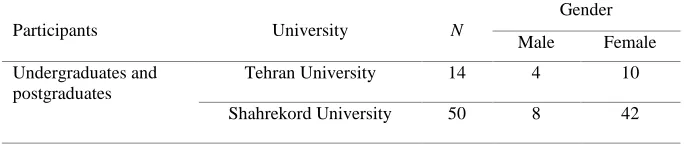
The participants were 64 students of Tehran University and Shahrekord University, including 35 senior undergraduates and 29 postgraduates majoring in TEFL and English translation. They were all native speakers of Persian, including 12 males and 52 females, within the age range of 22 to 35. The sampling procedure was nonrandom, and the participants were selected through convenience sampling. Table 1 presents the participants’ demographic information:
Table 1. Participants’ Demographic Characteristics
Participants University N
Gender Male Female Undergraduates and
postgraduates
Tehran University 14 4 10
3.2 Instruments
3.2.1. Oxford Placement Test
The first instrument was the OPT. This 100-item material was administered to the participants prior to the study in order to make sure they were homogeneous in terms of their proficiency. The reliability estimate of the test through Cronbach’s alpha was found to be .81.
3.2.2. Group Embedded Figures Test (GEFT)
The second instrument was the paper-and-pencil test of GEFT, developed by Witkin, Oltman, Raskin, and Karp (1971) to assess the participants’ cognitive style of FI/FD. Actually, GEFT requires participants to outline geometric figures, that are embedded in larger more complex designs. It consists of three sections: The first includes seven relatively simple items, that are intended for practice; the second and third sections contain nine complex items each. The scoring is based upon the number of figures correctly identified in the two sections. In this study, the reliability estimate of GEFT, using Cronbach’s alpha, was found to be .71.
3.2.3. McKenzie’s Multiple Intelligences Inventory
In order to identify the participants’ MI profiles, McKenzie’s (1999) MI Inventory was administered. The questionnaire consists of nine 10-item sections, measuring nine types of intelligences: naturalist, musical, logical-mathematical, intrapersonal, interpersonal, bodily-kinesthetic, linguistic, existential, and spatial intelligences. It is available online at: http://surfaquarium.com/MI/inventory.htm. In this study, the Cronbach’s alpha coefficient was found to be .81 for the instrument.
decide whether the propositions were given in it. Finally, in the scanning task, test takers’ job is to scan the passage for two types of information: dates and proper nouns. In the current study, the Cronbach’s alpha coefficient was found to be .80 for the instrument.
3.3 Procedure
Firstly, in order to make sure that the participants were homogeneous in terms of proficiency, the OPT was administered to a total of 83 TEFL students, studying in Tehran University and Shahrekord University. After scoring the tests, 19 participants were found to score lower than the 50% of the total score and were excluded from the study.
At the next stage, GEFT was administered to 64 remaining participants to assess their FI/FD cognitive style. After explaining the test instructions, 2 min was considered for doing the practice section. Then, the participants were supposed to continue the 2nd and 3rd sections based upon which the scoring was done. The time allocated to each of these two sections was 5 min, and each included nine items.
Then, the participants’ MI profiles were assessed through McKenzie’s MI Inventory. In order to make sure that the items were truly understood, whenever there was any ambiguity, the researcher elaborated on the item.
Finally, TBRT was administered to assess the participants’ performance on the five L2 reading tasks of true-false, sentence-completion, outlining, elicitation of writer’s view, and scanning. Forty min was considered for doing the test.
4. Results
Table 2 displays the descriptive statistics of the data, including the means, the minimum and maximum scores, the standard deviations, as well as the skewness and kurtosis values:
Table 2. Descriptive Statistics for Participants’ FI/FD Scores, MI Scores, and Scores on Five Reading Tasks of TBRT
N Min Max Mean Std. Deviation
Skewness Kurtosis
FI/FD 64 0 18 11.44 4.64 -0.44 -0.55
Linguist intelligence
64 0 10 6.23 2.25 -0.54 0.70
Logical-mathematical intelligence
64 1 10 5.86 2.05 -0.10 -0.05
Musical intelligence
Spatial intelligence 64 2 10 7.17 2.12 -0.34 -0.61 Bodily-kinesthetic
intelligence
64 2 10 6.89 2.11 -0.58 -0.18
Interpersonal intelligence
64 1 10 5.17 2.12 0.03 -0.11
Intrapersonal intelligence
64 2 10 7.38 1.86 -0.28 -0.25
Naturalist intelligence
64 1 10 5.84 2.10 0.00 -0.34
Existential intelligence
64 2 10 6.97 1.94 -0.23 -0.69
True-false performance
64 1 12 6.90 2.10 -0.37 0.18
Sentence completion performance
64 0 8 5.46 2.47 -0.68 -0.63
Outlining Performance
64 0 6 3.61 1.90 -0.19 -0.99
Elicitation performance
64 0 5 2.35 1.00 0.17 -0.14
Scanning performance
64 0 9 6.07 2.69 -0.98 -0.18
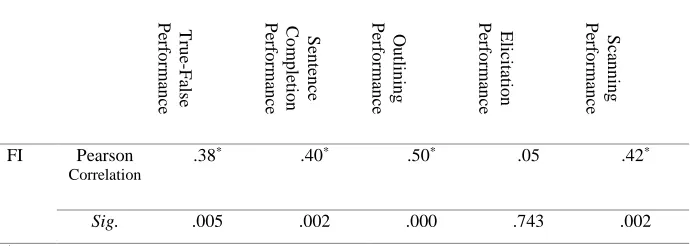
In order to explore the answer to the first research question concerning the possible relationships between the participants’ GEFT scores and their scores on the five reading tasks of true-false, sentence completion, outlining, elicitation of writer’s view, and scanning, five Pearson product-moment correlation coefficients were computed. Prior to performing the correlations, preliminary analyses were made to ensure that the assumptions of normality, linearity, and homoscedasticity were not violated. Additionally, the data were checked for outliers. The results of the correlational analysis are presented in Table 3:
Table 3. Correlations Between FI and Performance on Reading Tasks
Tru e-F alse P erfo rm an ce S en ten ce Co m p letio n P erfo rm an ce Ou tl in in g P erfo rm an ce El icitatio n P erfo rm an ce S ca n n in g P erfo rm an ce
FI Pearson
Correlation
.38* .40* .50* .05 .42*
Sig. .005 .002 .000 .743 .002
As Table 3 indicates, the scores on the GEFT correlated significantly with the scores on the true-false, sentence completion, outlining, and scanning tasks. There were moderate (according to Cohen’s guidelines, 1988, pp. 79-81) positive relationships between the participants’ performances on the GEFT and the reading tasks of true-false, r(64) = 0.38, p < 0.01, sentence completion, r(64) = 0.40, p < 0.01, and scanning, r(64) = 0.42, p < 0.01), and there was a strong positive correlation between the participants’ performances on the GEFT and the outlining task, r(64) = 0.50, p < 0.01. No significant relationship was found between the participants’ FI and their elicitation performance.
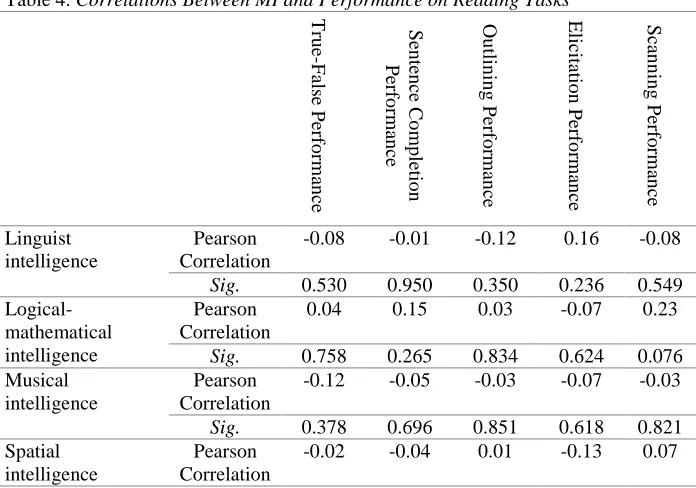
The second research question of this study concerned the possible relationship between the L2 learners’ MI scores and their scores on the five reading tasks true-false, sentence completion, outlining, elicitation of writer’s view, and scanning. To investigate this research question, five Pearson product-moment correlation coefficients were computed, after checking the assumptions of normality, linearity, and homoscedasticity. The results of the correlational analysis are displayed in Table 4:
As Table 4 shows, there was a moderate positive correlation between the participants’ intrapersonal intelligence and their performance on the scanning task, r(64) = 0.35, p < 0.01, indicating that the higher the L2 learners’ intrapersonal intelligence, the better their performance on the scanning task of the TBRT:
Table 4. Correlations Between MI and Performance on Reading Tasks
T ru e -Fals e Per fo rm an ce Sen ten ce C o m p letio n Per fo rm an ce Ou tlin in g Per fo rm an ce E licitatio n Per fo rm an ce Scan n in g Per fo rm an ce Linguist intelligence Pearson Correlation
-0.08 -0.01 -0.12 0.16 -0.08
Sig. 0.530 0.950 0.350 0.236 0.549
Logical-mathematical intelligence
Pearson Correlation
0.04 0.15 0.03 -0.07 0.23
Sig. 0.758 0.265 0.834 0.624 0.076 Musical
intelligence
Pearson Correlation
-0.12 -0.05 -0.03 -0.07 -0.03
Sig. 0.378 0.696 0.851 0.618 0.821 Spatial
intelligence
Pearson Correlation
Sig. 0.913 0.779 0.954 0.331 0.617 Bodily-kinesthetic
intelligence
Pearson Correlation
0.04 -0.01 -0.11 0.06 0.06
Sig. 0.755 0.936 0.426 0.650 0.654 Interpersonal
intelligence
Pearson Correlation
-0.122 -0.16 -0.23 -0.003 -0.19
Sig. 0.358 0.242 0.086 0.982 0.155 Intrapersonal
intelligence
Pearson Correlation
0.09 0.16 -0.02 -0.16 0.35*
Sig. 0.509 0.236 0.875 0.227 0.006 Naturalist
intelligence
Pearson Correlation
0.02 -0.06 -0.10 0.01 0.03
Sig. 0.857 0.642 0.457 0.934 0.815 Existential
intelligence
Pearson Correlation
0.03 0.07 0.03 0.24 0.09
Sig. 0.810 0.605 0.796 0.071 0.483
*p < 0.01, two-tailed.
5. Discussion and Conclusion
Regarding the relationship between the participants’ FI and performances on the five reading tasks of true-false, sentence completion, outlining, elicitation of writer’s view, and scanning, the results revealed that FI correlated significantly with performances on the true-false, sentence completion, outlining, and scanning tasks. The findings suggest that a high level of FI could be associated with high scores on the reading tasks of true-false, sentence completion, outlining, and scanning.
As for the relationship between the participants’ performances on the GEFT and the true-false task, a significant positive correlation seems logical. In the true-false task of the TBRT, the items draw attention to some detailed specific aspects of the propositions mentioned in the passages, and FI involves the ability to abstract a part from its context and the tendency to approach problems analytically (Witkin & Goodenough, 1981). Thus, the more FI the participants were, the higher their scores were on the true-false items.
Similarly, a significant positive correlation between the participants’ scores on GEFT and sentence completion tasks seems justifiable. Doing the sentence completion task, the participants encountered eight open-ended sentences that called their attention to specific propositions of the passage, and they were supposed to scan the passage and, then, choose two appropriate possible endings from the provided list to complete each item—given as such, high levels of FI could be associated with high scores on the task.
dealt with a list of main ideas, and they were required to match six of those with the total six paragraphs of the passage. As Rickards, Fajen, Sullivan, and Gillespie (1997) mention, FI is associated with the ability to detect “the important content of a text” and its “underlying structure” (p. 509). According to them, FI involves structuring skills, which affect performance on a wide range of perceptual and cognitive tasks. They believe that high levels of FI is associated with a high ability in “determining the structure of a complex array of information” (p. 509), and ascertaining the underlying structure of a text, as Alexander and Jetton (1996) argue, helps readers identify main and important ideas.
The last significant positive correlation was found between FI and the scanning performance. In the scanning task, the participants were expected to scan the passage for two types of information, namely, dates and proper nouns. Actually, the very nature of the task accounted for the pattern of the relationship. In this task, the participants were to focus on specific details, disembed the relevant parts from the nonrelevent parts, and abstract them from the context or field. Thus, the more FI the participants were, the higher their scores were on the task.
On the whole, the findings seem to suggest an association between FI and L2 reading performance; actually, they are consistent with the results obtained by some previous researchers (e.g., Behnam & Fathi, 2009; Davey, 1990; Hite, 1993, 2004; Jamieson, 1992; Pitts & Thompson, 1984; Rosa, 1991, 1994; Spiro & Tirre, 1980). Generally, in the literature, some reasons have been mentioned for the association between FI and L2 reading performance. It has been argued that FI deals with better ability in inferential interpretation of a text (Adejumo, 1983; Pitts & Thompson, 1984) and identifying text structure (Blake, 1985; Hite, 1993, 2004). FI is also believed to be associated with better use of preexisting knowledge schemata in processing a text (Hite, 2004; Spiro & Tirre, 1980), as well as more attention to relevant cues in processing (Berger & Goldberger, 1979). Additionally, it is believed that FI is associated with better use of short-term memory (Davey, 1990; Hite, 2004; Ward & Clark, 1987), in addition to better performance on tasks requiring efficient memory processes (Davey, 1990; Davis & Frank, 1979; Robinson & Bennink, 1978).
significant relationship between intrapersonal intelligence and L2 reading performance. The only significant relationship they found was between musical intelligence and L2 reading performance—the results of their study indicated a small negative correlation between these variables.
Actually, the fact that intrapersonal intelligence correlated significantly and positively with the scanning performance might indicate that intrapersonal intelligence is associated with some mental abilities, which lead to a better scanning performance.
Generally speaking, intrapersonal intelligence comprises “a complex set of knowledge and abilities pertaining to the individual self” (Shearer, 2009, p. 53). According to Gardner (2009), it involves the ability “to understand oneself, have an effective working model of oneself—including one’s own desires, feelings, and capacities—and to use such information effectively in regulating one’s own life” (p. 43). It deals with emotional maturity (Moran, 2009), and affective variables, such as self-esteem, inhibition, and anxiety are related to this intelligence (Smith, 2001). It has a self-regulatory function and acts as a guide in decision making (Mowat, 2011). Additionally, it involves the ability to control one’s feeling (Hoerr, 2000), and it is related to being motivated, patient, disciplined, (Nolen, 2003), and purposeful (Moran, 2009). Given as such, intrapersonal intelligence is potentially relevant to successful L2 performance. “Accurate self-representation” (Shearer, 2009, p. 53) or the ability to understand one’s strengths and limitations (Chen & Gardner, 2005; Saricaoglu & Arikan, 2009; Shearer, 2009) and use such information effectively (Saricaoglu & Arikan, 2009) could help the L2 learners act more efficiently in the scanning task. Moreover, the affective side of intrapersonal intelligence would positively influence the participants’ performance, as a result of the pivotal role affective factors play in L2 success (Brown, 2007).
Reflecting the importance of the individual differences under study in L2 education, the findings of this study imply the fundamental necessity of taking L2 learners’ FI/FD cognitive style and MI profile into account as a step towards boosting the quality of L2 teaching and learning in the country. Based upon the study results, it sounds perfectly reasonable that L2 teachers pay attention to L2 learners’ degree of FI as a significant factor relevant to their L2 reading performance. In fact, taking account of the relationship between FI and L2 reading performance, L2 teachers can recognize their learners’ strengths and weaknesses in L2 reading, match their teaching strategies to their cognitive profile, and devise more appropriate lesson plans to address L2 learners’ weaknesses and boost their strengths in L2 reading.
what type of learner they are, L2 learners will get a clearer picture of their learning process, find out why they feel comfortable in learning one aspect and have problems learning another, try to improve their learning (Xu, 2011), and use their learning opportunities more efficiently (Ngeow, 1999). It is advisable that L2 teachers provide L2 learners with appropriate purposeful activities that address their weaknesses in L2 reading and offer proper individualized guidance to them.
The findings also call attention to the fact that not only L2 knowledge but also the degree of FI can be significantly related to L2 reading performance. In fact, it is of considerable importance that L2 teachers pay regard to L2 learners’ degree of FI as a significant and relevant factor, do not make a judgment solely on the basis of L2 learners’ scores on a reading test, and take more care in interpreting L2 reading scores.
Along with highlighting the necessity of attention to L2 learners’ degree of FI, the findings of this study imply the need not to neglect L2 learners’ MI profile in L2 education. L2 teachers should be informed that intelligence does not only involve linguistic and logical-mathematical abilities—they should be made aware of MIT and its educational importance. They should be informed that different intelligences should be considered in L2 instruction, so that diverse L2 learners can take maximum advantage of L2 classrooms. All these require careful planning of the Ministry of Education and L2 teacher training centers across the country.
Finally, it is suggested that this study gets replicated with larger samples while controlling the effect of some extraneous variables such as gender and sociocultural background. It is noteworthy that gaining keen insight into the exact pattern of such relationships requires extensive research, sufficient replication, and careful control of extraneous variables. Furthermore, considering the possible interplay of L2 learners’ individual differences and their L2 reading performance and the significance of such relationships in L2 teaching and learning, it is suggested to explore the potential relationships between L2 learners’ other individual differences, for instance, ambiguity tolerance, impulsivity/reflectivity, and learning strategies, and their L2 reading performance.
References
Abraham, R. G. (1983). Relationship between use of the strategy of monitoring and the cognitive style. Studies in Second Language Acquisition, 6(1), 17-32. Adejumo, D. (1983). Effect of cognitive style on strategies for comprehension of
prose. Perceptual and Motor Skills, 56(3), 859-863.
Allan, D. (1992). Oxford placement test. Oxford: Oxford University Press.
Alptekin, C., & Atakan, S. (1990). Field dependence-independence and hemisphericity as variables in L2 achievement. Second Language Research, 6(2), 135-149.
Altun, A., & Cakan, M. (2006). Undergraduate students’ academic achievements, field dependent/independent cognitive styles and attitude toward computers. Educational Technology and Society, 9(1), 278-297.
Armstrong, T. (1994). Multiple intelligences in the classroom. Alexandria, VA: ASCD.
Armstrong, T. (2009). Multiple intelligences in the classroom. Alexandria, VA: ASCD.
Azar, A. (2006). Relationship of multiple intelligence profiles with area of constitution in high school and university entrance exam scores. Educational Administration: Theory & Practice, 46, 157-174.
Bachman, L. (1990). Fundamental considerations in language testing. Oxford: Oxford University Press.
Barrington, E. (2004). Teaching to student diversity in higher education: How multiple intelligence theory can help. Teaching in High Education, 9(4), 421-434.
Bas, G. (2010). Effects of multiple intelligences instruction strategy on students’ achievement levels and attitudes towards English lesson. Cypriot Journal of Educational Sciences, 5, 167-180.
Behnam, B., & Fathi, M. (2009). The relationship between reading performance and field dependence/independence cognitive styles. Journal of Teaching English as a Foreign Language and Literature, 1(1), 49-62.
Berger, E., & Goldberger, L. (1979). Field dependence and short-term memory. Perceptual and Motor Skills, 49(1), 87-96.
Blake, M. (1985). The relationship between field dependence-independence and the comprehension of expository and literary text types. Reading World, 24(4), 53-62.
Bongaerts, T., van Summeren, C., Planken, B., & Schils, E. (1997). Age and ultimate attainment in the pronunciation of a foreign language. Studies in Second Language Acquisition, 19(4), 447-465.
Brown, H. D. (2007). Principles of language learning and teaching (5th ed.). White Plains, New York: Longman.
Campbell, L., Campbell, B., & Dickinson, D. (2004). Teaching and learning through multiple intelligence. Chicago, IL: Merill Company.
Carter, E. F. (1988). The relation of field dependent-independent cognitive style to Spanish language achievement and proficiency: A preliminary report. The Modern Language Journal, 72(1), 21-30.
Cattell, R. B. (1971). Abilities: Their structure, growth, and action. Boston: Houghton Mifflin.
Celce-Murcia, M., & Larsen-Freeman, D. (1999). Grammar book: An ESL/EFL teacher’s course. Boston, MA: Heinle & Heinle.
Chan, D. W. (2006). Perceived multiple intelligences among male and female Chinese gifted students in Hong Kong: The structure of the student multiple intelligences profile. Gifted Child Quarterly, 50(4), 325-338.
Chapelle, C., & Roberts, C. (1984). Ambiguity tolerance and field independence as predictors of proficiency in English as a second language. Language Learning, 36(1), 27-45.
Chastain, K. (1988). Developing second language skills: Theory to practice. San Diego, CA: Harcourt Brace Jovanovich.
Checkley, K. (1997). The first seven . . . and the eighth: A conversation with Howard Gardner. Educational Leadership, 55(1), 8-13.
Chen, J. Q., & Gardner, H. (2012). Assessment of intellectual profile: A perspective from multiple-intelligences theory. In D. P. Flanagan & P. L. Harrison (Eds.), Contemporary intellectual assessment: Theories, tests, and issues (pp. 145-155), New York: The Guilford Press.
Chen, S. F. (2005). Cooperative learning, multiple intelligences, and proficiency: Application in college English language teaching and learning. Unpublished master’s thesis, Australian Catholic University.
Christison, M. A. (1996). Teaching and learning languages through multiple intelligence. TESOL Journal, 6(1), 10-14.
Curtin, E. (2005). Instructional styles used by regular classroom teachers while teaching. Forum, 36(2). Retrieved February 14, 2013, from the World Wide Web: http://files.eric.ed.gov/fulltext/EJ727798.pdf
Davey, B. (1990). Field dependence-independence and reading comprehension questions: Task and reader interactions. Contemporary Educational Psychology, 15(3), 241-250.
Davis, J. K., & Frank, B. M. (1979). Learning and memory of field independent-dependent individuals. Journal of Research in Personality, 13(4), 469-479. Dörnyei, Z. (2005). The psychology of the language learner: Individual differences
in second language acquisition. Mahwah, NJ: Lawrence Erlbaum Associates.
Dörnyei, Z. (2009). Individual differences: Interplay of learner characteristics and learning environment. Language Learning, 59(1), 230-248.
Dörnyei, Z., & Skehan, P. (2003). Individual differences in second language learning. In C. J. Doughty & M. H. Long (Eds.), The handbook of second language acquisition (pp. 589-630). Malden, MA: Blackwell.
Educational Testing Service. (1983). TOEFL test and score manual. Princeton, NJ: ETS.
Eggen, P. D., & Kauchak, D. P. (2012). Educational psychology: Windows on classrooms. Upper Saddle River, NJ: Pearson Education.
Ehrman, M. E. (1996). Understanding second language difficulties. Thousand Oaks, CA: Sage.
Ellis, R. (1985). Understanding second language acquisition. Oxford: Oxford University Press.
Ellis, R. (1989). Classroom learning styles and their effect on second language acquisition: A study of two learners. System, 17(2), 249-262.
Ellis, R. (2004). Individual differences in second language learning. In A. Davies & C. Elder (Eds.), The handbook of applied linguistics (pp. 525-551). Malden, MA: Blackwell.
Gardner, H. (1983). Frames of mind: The theory of multiple intelligences. New York: Basic Books.
Gardner, H., & Hatch, T. (1989). Multiple intelligences go to school: Educational implications of the theory of multiple intelligences. Educational Researcher, 18(8), 4-9.
Guilford, J. P. (1964). Zero correlations among tests of intellectual abilities. Psychological Bulletin, 61(6), 401-404.
Hajhashemi, K., & Eng, W. B. (2012). MI as a predictor of students’ performance in reading competency. English Language Teaching, 5(3), 240-251.
Haley, M. H. (2001). Understanding learner-centered instruction from the perspective of multiple intelligences. Foreign Language Annals, 34(4), 355-367.
Haley, M. H. (2004). Learner-centered instruction and the theory of multiple intelligences with second language learners. The Teachers College Record, 106(1), 163-180.
Hamayan, E., & Pfleger, M. (1987). Developing literacy in English as a second language: Guidelines for teachers of young children from nonliterate backgrounds. WA: National Clearinghouse for Bilingual Education.
Hansen, J., & Stansfield, C. (1981). The relationship between field dependence-independence cognitive styles to foreign language achievement. Language Learning, 31(2), 349-367.
Hashemi, A. (2007). On the relationship between multiple intelligences and reading comprehension tasks: An authentic MI theory-based assessment. English Language Teaching and Literature. Retrieved May 31, 2014, from the World Wide Web: http://faculty.ksu.edu.sa/aljarf/Documents/English%20Language% 20Teaching%20Confe rence%20-%20Iran%202008/Akram%20Hashemi.pdf Hite, C. (1993). The relationship of cognitive style and gender of unsuccessful
first-time examinees to performance on reading comprehension tasks as measured by a required college examination. (Doctoral dissertation, University of South Florida, 1993). Dissertation Abstracts International, 55, 1231.
Hite, C. E. (2004). Expository content area texts, cognitive style, and gender: Their effects on reading comprehension. Reading Research and Instruction, 43(4), 41-74.
Hoerr, T. R. (2000). Becoming a multiple intelligence school. Alexandria, VA: ASCD.
Jamieson, A. (1992). The cognitive style of reflection/impulsivity and field independence/dependence and ESL success. The Modern Language Journal, 76(4), 491-501.
Jonassen, D. H., & Grabowski, B. L. (2012). Handbook of individual differences, learning, and instruction. Hillsdale, New York: Lawrence Erlbaum Associates.
Khalili Sabet, M., & Mohammadi, S. (2013). Field independence/dependence styles and reading comprehension abilities of EFL readers. Theory and Practice in Language Studies, 3(11), 2141-2150.
Kim, I. S. (2009). The relevance of multiple intelligences to CALL instruction. The Reading Matrix, 9(1), 1-21.
Kok, I. (2010). The relationship between students’ reading comprehension achievement and their attitudes toward learning English and their abilities to use reading strategies with regard to hemispheric dominance. Procedia - Social and Behavioral Sciences, 3, 144-151.
Kolb, A. Y., & Kolb, D. A. (2005). Leaning styles and learning spaces: Enhancing experiential learning in higher education. Academy of Management Learning and Education, 4(2), 193-212.
Marefat, F. (2007). Multiple intelligences: Voices from an EFL writing class. Pazhuheshe-e Zabanha-ye Khareji, 32,145-162.
McKenzie, W. (1999). Multiple intelligences inventory. Retrieved July 12, 2012, from the World Wide Web: http://surfaquarium.com/MI/inventory.htm
McNaught, S. (1992). An analysis of the relationship between the preferred cognitive style of field independence/ field dependence and success in learning English as a second language among postsecondary Japanese students. Unpublished doctoral dissertation, Oregon State University, Corvallis.
Messick, S. (1984). The nature of cognitive styles: Problems and promise in educational practice. Educational Psychologist, 19(2), 59-74.
Moran, S. (2009). Purpose: Giftedness in intrapersonal intelligence. High Ability Studies, 20(2), 143-159.
Mowat, J. G. (2011). The development of intrapersonal intelligence in pupils experiencing social, emotional, and behavioral difficulties. Educational Psychology in Practice, 27(3), 227-253.
Muir, D. J. (2001, July). Adapting online education to different learning styles. Paper presented at National Educational Computing Conference: Building on the Future, Chicago, IL.
Nolen, J. L. (2003). Multiple intelligences in the classroom. Education, 124(1), 115-119.
Oflaz, M. (2011). The effect of right and left-brain dominance in language learning. Procedia - Social and Behavioral Sciences, 15, 1507-1513.
Palmberg, R. (2002). Catering for multiple intelligences in EFL course-books. Humanizing Language Teaching, 4(1). Retrieved July 12, 2012, from the World Wide Web: http://www.hltmag.co.uk/jan02/sart6.htm
Pawlak, M. (Ed.). (2012). Second language learning and teaching. New York: Springer.
Pitts, M. M., & Thompson, B. (1984). Cognitive styles as mediating variables in inferential comprehension. Reading Research Quarterly, 19(4), 426-435. Rayner, S., & Riding, R. (1997). Towards a categorization of cognitive styles and
learning styles. Educational Psychology, 17(1), 5-27.
Razmjoo, S. A. (2008). On the relationship between multiple intelligences and language proficiency. The Reading Matrix, 8(2), 155-174.
Rickards, J. P., Fajen, B. R., Sullivan, J. F., & Gillespie, G. (1997). Signaling, note taking, and field independence-dependence in text comprehension and recall. Journal of Educational Psychology, 89(3), 508-517.
Rivers, W. M. (1981). Teaching foreign language skills. Chicago: University of Chicago Press.
Robinson, J. A., & Bennink, C. D. (1978). Field articulation and working memory. Journal of Research in Personality, 12(4), 439-449.
Robinson, P. (2001). Individual differences, cognitive abilities, aptitude complexes, and learning conditions in second language acquisition. Second Language Research, 17(4), 368-392.
Robinson, P. (2002). Individual differences and instructed language learning. Amsterdam: John Benjamins.
Rosa, M. H. (1991). Relationships between cognitive styles and reading comprehension of narrative and expository prose of fourth-grade students in an urban school district. (Doctoral dissertation, Wayne State University, 1991). Dissertation Abstracts International, 52, 1275A.
Salmani-Nodoushan, M. A. (2003). Text familiarity, reading tasks, and ESP test performance: A study on Iranian LEP and non-LEP university students. Reading Matrix, 3(1), 1-14.
Salmani-Nodoushan, M. A. (2007). Is field dependence or independence a predictor of EFL reading performance? TESL Canada Journal, 24(2), 82-108.
Saricaoğlu, A., & Arikan, A. (2009). A study of multiple intelligences, foreign language success and some selected variables. Journal of Theory and Practice in Education, 5(2), 110-122.
Shearer, C. B. (1996). Multiple intelligences developmental scales. Dayton, OH: Greyden Press.
Shearer, C. B. (2009). Exploring the relationship between intrapersonal intelligence and university students’ career confusion: Implications for counseling, academic success, and school-to-career transition. Journal of Employment Counseling, 46, 52-61.
Shore, J. R. (2001). An investigation of multiple intelligences and self-efficacy in the university English as a second language classroom. Unpublished doctoral dissertation, George Washington University, Washington, Columbia.
Skehan, P. (1986). The role of foreign language aptitude in a model of school learning. Language Testing, 3(2), 188-221.
Skehan, P. (1989). Individual differences in second language learning. London: Edward Arnold.
Skehan, P. (1991). Individual differences in second language learning. Studies in second language acquisition, 13(2), 275-298.
Skehan, P. (1998). A cognitive approach to language learning. Oxford: Oxford University Press.
Smith, E. (2001). Implications of multiple intelligence theory for second language learning. Post-Script, 2(1), 32-52.
Snow, R. E., & Lohman, D. F. (1984). Toward a theory of cognitive aptitude for learning from instruction. Journal of Educational Psychology, 76(3), 347-376. Spearman, C. (1904). “General intelligence,” objectively determined and measured.
The American Journal of Psychology, 15(2), 201-292.
Sternberg, R. J. (1985). Beyond IQ: A triarchic theory of human intelligence. Cambridge: Cambridge University Press.
Talbot, A. M. (2004). A comparison of a multiple intelligences curriculum and a traditional curriculum on students’ foreign language test performance. Unpublished doctoral dissertation, Kalamazoo College, Michigan.
Thurstone, L. L. (1938). Primary mental abilities. Chicago: University of Chicago Press.
Viens, J., & Kallenbach, S. (2004). Multiple intelligence and adult literacy: A source book for practitioners. New York: Teachers College Press.
Wallace, C. (2001). Reading. In D. Nunan & R. Carter (Eds.), The Cambridge guide to teaching English to speakers of other languages (pp. 21-27). Cambridge: Cambridge University Press.
Ward, T. J., & Clark III, H. T. (1987). The effect of field dependence and outline condition on learning high and low-structure information from a lecture. Research in Higher Education, 27(3), 259-272.
Witkin, H. A., & Goodenough, D. R. (1977). Field dependence and interpersonal behavior. Psychological Bulletin, 84(4), 661-689.
Witkin, H. A., & Goodenough, D. R. (1981). Cognitive styles: Essence and origins. New York: International Universities Press.
Witkin, H. A., Oltman, P. K., Raskin, E., & Karp, S. A. (1971). A manual for the embedded figures tests. Palo Alto, CA: Consulting Psychologists Press.