Original Article
Effects of Vitamin E Addition to Chicken Semen on Sperm Quality
During in Vitro Storage of Semen
Saleh Tabatabaei1 Roozali Batavani2
Esmail Ayen2
1
Department of Animal Sciences, Faculty of Animal and Food Sciences, Ramin Agriculture and Natural Resources University, Mollasani, Ahwaz, Iran
2
Department of Clinical Sciences, Faculty of Veterinary Medicine, Urmia University, Urmia, Iran
Received: 15 January 2011, Accepted: 17 May 2011
Abstract
The purpose of this study was to evaluate the probable effects of the vitamin E addition in different levels to the extender of chicken semen on spermatozoa quality during storage of semen at 4°C for 0, 3, 6, 10 and 24 hours. Eight young Ross broiler breeder strain 308 roosters were used in this experiment. The collected semen from all roosters was mixed together and diluted with modified a Ringer’s solution. The diluted pooled semen was divided into 5 treatments (T). T1 was a control group without any vitamin E addition. For T2 to T5 groups 0.5 %, 1 %, 2 % and 3 % vitamin E (w/v), were added respectively. Treatments were evaluated for sperm motility, sperm viability and probable morphological defects after 0, 3, 6, 10 and 24 hours of incubation at 4°C. The evaluations of spermatozoa immediately after semen collection, were revealed no significant differences among values of treatment groups, whereas after incubating the treatments for different spans of time, the sperm progressive motility and viability rates for groups supplemented with vitamin E were significantly (P < 0.05) higher than that of the control group. In addition, morphological defect rates of chicken spermatozoa in the groups supplemented with different levels of vitamin E were significantly (P < 0.05) lower than that in control group. According to the results of this study we conclude that, the most excellent level of vitamin E for supplementation to the extended semen of chicken in order to improve the sperm motility and viability plus to reduce the morphological defect rates of the spermatozoa up to 24 hours storage time at 4°C is 2 % (w/v).
Key words: Chicken, Semen, Vitamin E, Sperm quality, Semen storage
*
Corresponding author: Saleh Tabatabaei, DVM, DVSc
Department of Animal Sciences, Faculty of Animal and Food Sciences, Ramin (Khoozestan) Agriculture and Natural Resources University, Mollasani, Ahwaz, Iran
Introduction
Lipids are a basic component of semen. They are present in both the spermatozoa and seminal plasma, probably playing different explicit roles. Originally, the interest in sperm lipid began because these compounds were supposed to be an energy substrate for spermatozoon metabolism.1 Currently, it is clear that, lipids are involved not only in sperm energy metabolism2 but also in all the main functions and events that lead to fertilization. Lipid composition of semen is unique in its content of long chain polyunsaturated fatty acids (LCPUFAs)
and these LC-PUFAs are essential
components of all cell membranes and also give rise to many bioactive molecules, such as eicosanoids.3 Because of their highly unsaturated lipids, spermatozoa are very susceptible to peroxidative damage resulting from the acts of free radicals and reactive oxygen species1. Oxidative stress is known to play a most important role in the etiology of defective sperm function via mechanisms involving the induction of peroxidative damage to the plasma membrane,4,5 a subsequent reduction of sperm motility6 and a decline in cell quality which results in insufficient records of viable spermatozoa and fertility.4 The use of chilled-stored semen is limited by its relatively short time fertilizing capacity.7 Oxidative damage of spermatozoa during storage is a potential cause of the decline in motility and fertility during hypothermia storage of liquid semen. The survival of ejaculated sperm in seminal plasma alone is limited to a few hours8. The antioxidants are playing important roles in avian reproduction. Vitamin E is a natural antioxidant capable of enhancing semen quality and fertilizing ability of chickens, when it is provided at a level some 500 times greater than the NRC requirements (15 IU/kg diet)9. In chicken vitamin E prevents lipid peroxidation of spermatozoa.10 The association of vitamin
E deficiency with impaired male
reproduction has been established for three decades, and usually it is called the ‘anti-sterility’ vitamin. Vitamin E ameliorates oxidative stress in spermatozoa helping to maintain optimum fertilizing ability. Recently, vitamin E supplements have been widely used in poultry diets enhancing production and reproductive performance several folds11. The principal aim of this experiment was to study the effects of vitamin E addition to the extender of chicken semen on sperm motility, viability and morphological defect rates in terms of incubation time. The results of this study provided essential knowledge of using vitamin E as an antioxidant for improving sperm quality in chicken semen and could help artificial insemination industry in chicken.
Materials and Methods
The Experiments were performed in
poultry research farm of Ramin
either side of the vent into the collecting tube. The semens discolored due to
contamination were discarded. The
collected semen from all roosters was mixed together and then diluted (1:100).
The temperature of dilution was
approximately 15°C and this temperature was maintained during the examination. The diluted pool semen was divided into 5 treatments (T) in separated tubes. For one of these groups no vitamin E was used (T1 or control group). For other samples were added 0.5 % (T1), 1 % (T2), 2 % (T3) and 3 % (T4) of vitamin E (w/v) (α-tocopherol, Sigma Chemical Co.), respectively. Treatment groups initially were evaluated for semen quality immediately after semen collection (before incubation) and then were stored in 4°C and evaluated for semen quality at 3, 6, 10 and 24 hours of incubation. The present study was performed in quadruplicate.
Semen quality assessment. The semen quality evaluations were comprised: progressive motility, viability and morphological defect rates in all of treatment samples at different incubation periods. For evaluation of motility, one drop of the diluted semen was placed on the slide and covered with a cover slide. The sperm motility was estimated by
microscopic observation (400 ×
magnification). Motility was expressed as the percentage of motile spermatozoa with moderate to rapid progressive movement. A minimum of five microscopic fields were assessed to evaluate sperm motility on at least 200 sperm for each sample (according to protocol provided by others.13, 14 Sperm viability was assessed by an eosin exclusion test. Five microliters of sperm dilution were mixed with 5 microliters of eosin solution. Immediate count of uncolored sperms was used to calculate the percentage sperm viability.15 The number of 200 spermatozoa were evaluated to determine viability (according to protocol provided by Breininger et al. 200413). A phase-contrast microscope with immersion was used for morphological
examinations. Sperm morphology was examined in smears stained with eosin and nigrosin. At each preparation 300 cells were counted and the percentage of
various defects calculated. The
morphological defects of acrosome, head, mid-piece, tail and their proportions were evaluated.14
Statistical analyses. The spermatozoa quality parameters were including, percentages of sperm motility, viability and morphological defects among various treatment groups were evaluated by using one-way ANOVA and Duncan’s Multiple Range Test to locate differences. Values were presented as Mean ± SEM and the level of significance was set at P < 0.05.16
Results
With different levels of vitamin E in extended chicken semen, the progressive sperm motility, sperm viability and
morphological defect levels were
determined at 0, 3, 6, 10 and 24 hours of the incubation periods at 4°C. These results are presented in tables 1, 2 and 3.
and T3 were higher (P < 0.05) than T1 group (Table 1).
Table 1. Effects of vitamin E addition to extender of chicken semen on sperm motility (%) at different periods of incubation
Experimental period
T1 (control) T2 (0.5%) T3 (1%) T4 (2%) T5 (3%)
0 h 3 h 6 h 10 h 24 h
74.67 ± 1.45a 62.45 ± 1.15a 49.35 ± 3.86a 36.86 ± 3.40a 16.17 ± 5.15a
72.85 ± 2.40a 71.47 ± 3.16b 61.61 ± 2.67b 47.10 ± 4.03b 35.35 ± 4.86b
75.22 ± 1.20a 73.67 ± 1.88b 69.28 ± 2.53c 60.08 ± 2.53c 37.12 ± 3.40b
76.10 ± 2.31a 72.33 ± 1.70b 71.11 ± 2.49c 67.30 ± 2.90d 65.33 ± 4.42c
76.17 ± 1.73a 74.09 ± 1.45b 69.33 ± 2.12c 68.67 ± 3.13d 66.47 ± 5.10c
Mean ± SE values with different superscripts in the same row differ significantly (P < 0.05) Spermatozoa viability. The evaluations
of spermatozoa immediately after semen collection reveal were revealed that the sperm viability percent differences were not significant among treatment groups (P
> 0.05). After 3 hours, the sperm viability of control group (T1) was significantly lower than that of T2 to T5 groups. After the incubation for 6 hours, sperm viabilities of T4 and T5 groups were significantly higher than that of other groups (P < 0.05). At this period, sperm
viability in T1 was lower (P < 0.05) than that of T2 group. At 10 hours, sperm motilities in T4 and T5 were higher (P < 0.05) than other groups. In T3 was higher (P < 0.05) than T1 and T2 groups and finally in T2 was higher (P < 0.05) than control (T1) group. At 24 hours of incubation, the sperm viabilities of T4 and T5 were higher than other groups (P < 0.05). In this incubation period, sperm viabilities of T2 and T3 were higher (P < 0.05) than that of T1 group (Table 2). Table 2. Effects of vitamin E addition to extender of chicken semen on sperm viability (%) at different periods
of incubation
Experimental period
T1 (control) T2 (0.5%) T3 (1%) T4 (2%) T5 (3%)
0 h 3 h 6 h 10 h 24 h
90.42 ± 3.72a 82.19 ± 2.26a 71.22 ± 2.84a 51.18 ± 2.89a 33.04 ± 4.29a
92.93 ± 3.54a 83.29 ± 1.85a 82.12 ± 2.86b 62.37 ± 3.44b 48.21 ± 3.24b
93.32 ± 3.86a 91.05 ± 2.30b 83.33 ± 2.11b 79.57 ± 3.60c 49.02 ± 2.81b
91.68 ±4.15a 90.27 ± 3.11b 89.20 ± 2.12c 88.46 ± 3.08d 84.21 ± 3.07c
94.07 ± 3.80a 92.08 ± 2.90b 90.13 ± 2.03c 88.17 ± 2.88d 85.44 ± 3.83c
Mean ± SE values with different superscripts in the same row differ significantly (P < 0.05)
Morphological defects of spermatozoa.
In the evaluations of spermatozoa
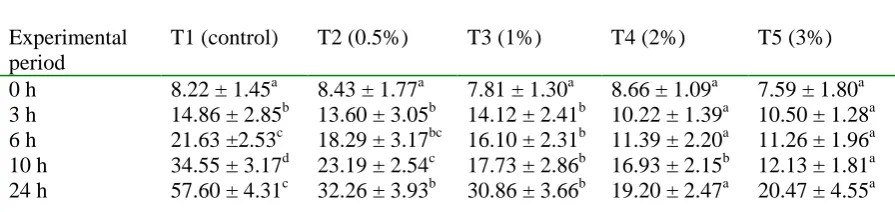
immediately after semen collection, there were no significant differences (P < 0.05) among mean values of treatment groups. After 3 hours of incubation, the sperm morphological defects percent of T4 and T5 were lower than that of T1, T2 and T3 groups (P < 0.05), and the sperm morphological defects of T2 and T3 were lower than T1 (control) group. After 6 hours, the morphological defect values of spermatozoa in T4 and T5 were lower (P < 0.05) than other groups. At this incubation time, the level of this defect in T3 was
Table 3. Effects of vitamin E addition to extender of chicken semen on sperm morphological defects (%) at different periods of incubation
Experimental period
T1 (control) T2 (0.5%) T3 (1%) T4 (2%) T5 (3%)
0 h 3 h 6 h 10 h 24 h
8.22 ± 1.45a 14.86 ± 2.85b 21.63 ±2.53c 34.55 ± 3.17d 57.60 ± 4.31c
8.43 ± 1.77a 13.60 ± 3.05b 18.29 ± 3.17bc 23.19 ± 2.54c 32.26 ± 3.93b
7.81 ± 1.30a 14.12 ± 2.41b 16.10 ± 2.31b 17.73 ± 2.86b 30.86 ± 3.66b
8.66 ± 1.09a 10.22 ± 1.39a 11.39 ± 2.20a 16.93 ± 2.15b 19.20 ± 2.47a
7.59 ± 1.80a 10.50 ± 1.28a 11.26 ± 1.96a 12.13 ± 1.81a 20.47 ± 4.55a
Mean ± SE values with different superscripts in the same row differ significantly (P < 0.05)
Discussion
The oxidative stress is one of the factors associated with decline in fertility during
semen storage. The sperm plasma
membrane contains a high amount of unsaturated fatty acids, therefore particularly is susceptible to peroxidative
damages with subsequent loss of
membrane integrity, imparted cell function and decreased motility of spermatozoa.7, 8 Vitamin E is a lipid-soluble compound with an effective membrane-stabilizing antioxidant function within the cell membrane,17 and is recognized as a natural component in male gametes. Studies on chicken, concerning the effect of vitamin E supplementation inside the extended semen on spermatozoa quality at different incubation periods of semen has not been published so far and, to our knowledge, the present report is the first one on this subject. The results of this study revealed that, supplementing of the vitamin E in semen extender of chicken improved spermatozoa quality parameters including motility, viability and morphological defect rates after incubating the semen at different periods. Rather similar results have also found in chickens,18 boars,19 humans,20 rams 21,22 and rats,23 where supplementation of food rich in Vitamin E improved semen quality. Marin-Guzman et al. (1997)24 reported Vitamin E deficiency in boars adversely affected sperm motility. The results ( Tables 1, 2 and 3) indicate that, the best concentration of vitamin E for supplementation to the extended semen of
chicken in order to improve the sperm motility and viability as well as reduce the morphological defect rates of spermatozoa after all incubation periods is 2%. The beneficial effect of vitamin E on sperm motility was previously reported by Thuwanut et al. (2008) 25 in cat and Boonsorn et al. (2010) 4 and Pena et al. (2003) 26 in swine. They supplemented vitamin E analogue in an extender and found that this vitamin could improve the motility of cat frozen-thawed epididymal sperm and boar sperm, respectively. Michael et al. (2008) 27 studied the effect of antioxidant on the motility of canine sperm and found that catalase, NAC (N-acetyl-cysteine) and vitamin E could improve the motility and rapid steady forward movement of post-thaw canine sperm, in vivo. Askari et al. (1994) 28
reported minimal improvements in
maintaining the human spermatozoa
motility when the freezing media
viability.31 Dietary supplementation of 250 or 500 mg/kg of L-carnitine (one of the antioxidants) increased the viability of the mature male Japanese quail breeder spermatozoa.32 Complementary to our results, Biswas et al. (2007) 9 reported that, the semen characteristics include sperm
motility and percentage of live
spermatozoa did not differ statistically among the different dietary treatment with vitamin E. The relatively wide difference in response to vitamin E also indicate that, the quality of sperm samples from some persons might be improved with the addition of vitamin E to extender.28 The beneficial effects of Vitamin E noted in the present study can be attributed to the antioxidant effects comparable to those reported by Sen et al. (2004).33 The high levels of antioxidants in seminal plasma carried out an important role for the spermatozoa in vitro storage. Addition of antioxidants significantly decreased the amount of spermatozoa DNA damage induced by ROS in vitro.34 Vitamin E as a lipid soluble antioxidant plays a major protective role against oxidative stress and prevents the production of lipid peroxides by scavenging free radicals (particularly strong scavenger of hydroxyl radicals) which are toxic byproducts of many
metabolic processes in biological
membranes.20,35-38 A probable
improvement in semen quality by addition of the vitamin E in semen extender is more likely related to an inhibition of lipid
peroxidation of the sperm plasma
membrane as was revealed in rats23 and fish.39 This possibility is supported by the type of sperm abnormalities that showed an improvement i.e., neck piece and tail piece defects, distal droplets. However, adding vitamin E to semen has resulted a variable success in improving the maintenance of motility. According to the study of Ball et al. (2001),8 vitamin E did not significantly alter the maintenance of motility during cold storage of equine spermatozoa for either 72 or 96 hours. Parallel to our results, Aguero et al. (1995)
40
reported that, adding vitamin E to stallion semen improves the maintenance of motility and viability during 24 hours cold storage. The adding of vitamin E on ram semen improves the maintenance of motility in stored semen.22 Vitamin E and Se act as antioxidants which in turn may provide direct protection of sperm cells from morphological damage by preventing free radical oxygen from damaging sperms. The vitamin E helps protecting the sperms cell membranes from damage.19 Furthermore, the morphology and the motility of sperm cells would be preserved by the binding of Vitamin E to endoperoxides.41 Our findings are in conformity with those of other authors reports, who stated that, Vitamin E
supplementation leads to improved
motility and percentage of normal sperm.42 The positive effect of vitamin E on prevention of occurrence of abnormal spermatozoa which revealed by our study is in accordance with a previous report by Behne et al. (1996) 43, Köhrle et al. (2005)
44
and Olson (2005) 45.
Conclusions. 1) Semen obtained from
Ross-308 broiler breeder roosters
supplemented with vitamin E was
characterized better resistance to storage at 4°C. This was reflected by better motility
and viability as well as lower
morphological defects of spermatozoa after semen storage for 24 hours. 2) The appropriate level of vitamin E advised for supplementation to the extended semen of chicken in order to improve the sperm motility and viability as well as reduce the morphological defect rates of the spermatozoa up to 24 hours during storage at 4°C was 2 % (w/v).
Aknowledgments
The authors gratefully acknowledge Ramin Agriculture and Natural Resources University for research funds.
1. Zaniboni L, Rizzi R, Cerolini S. Combined effect of DHA and a-tocopherol enrichment on sperm quality and fertility in the turkey. Theriogenology 2006; 65:1813–1827.
2. Resseguie WD, Hughes BL.
Phospholipids and cholesterol profiles from chicken seminal components during in vivo storage at 5°C. Poult Sci 1984; 63:1438–1443.
3. Sardesai VM. Biochemical and
nutritional aspects of eicosanoids. J Nutr Biochem 1992; 3:562–79.
4. Boonsorn T, Kongbuntad W, Narkkong NA, et al. Effects of catechin addition to extender on sperm quality and lipid peroxidation in boar semen. American-Eurasian J Agric Environ Sci 2010; 7:283-288.
5. Purdy PH, Ericsson SA, Dodson RE, et al. Effects of the flavonoids, silibinin, and catechin, on the motility of extended cooled caprine sperm. Small Rumin Res 2004; 55:239-243.
6. Griveau JF, Dumont E, Renard P, et al. Reactive oxygen species, lipid peroxidation and enzymatic defense systems in human spermatozoa. J Reprod Fertil 1995; 103:17-26.
7. Aurich JE, Schonherr U, Hoppe H, et al. Effects of antioxidants on motility and membrane integrity of chilled stored stallion semen. Theriogenology 1997; 48:185-192.
8. Ball BA, Medina V, Gravance CG, et al. Effect of antioxidants on preservation of motility, viability and acrosomal integrity of equine spermatozoa during storage at 5°C. Theriogenology 2001; 56:577-589.
9. Biswas A, Mohan J, Sastry KVH, et al. Effect of dietary vitamin E on the cloacal gland, foam and semen characteristics of male Japanese quail. Theriogenology 2007; 67:259–263. 10. Surai PF. Nutritional and biochemical
aspects of vitamins in poultry. DSc Thesis. Ukrainian Poultry Research Institute, 1991.
11. Surai PF. Vitamin E in avian reproduction. Poult Avi Biol Rev 1999; 10:1–60.
12. Lake PE. The male reproductive tract the fowl. J Anat 1957; 91:116-129. 13. Breininger E, Beorlegui NB, OFlaherty
CM, et al. Alpha-tocopherol improves biochemical and dynamic parameters
in cryopreserved boar semen.
Theriogenology 2004; 63:2126-2135. 14. Tabatabaei S, Batavani RA, Talebi
AR. Comparison of Semen Quality in Indigenous and Ross Broiler Breeder Roosters. J Anin Vet Adv 2009; 8(1):90-93.
15. Cheminade C, Gautier V, Hichami A, et al. 1-O-alkylglycerols improve boar sperm motility and fertility. Biol Reprod 2002; 66:421-428.
16. Petrie A, Watson P. Statistics for veterinary and animal sciences, 2nd edn Blackwell, London 2006; 97-130. 17. Bjorveboe A, Bjorveboe BEA, Drevon
CA. Absorption, transportation and distribution of Vitamin E. J Nutr 1990; 120:233–42.
18. Cerolini S, Zaniboni L, Maldjian A, et al. Effect of docosahexaenoic acid and α-tocopherol enrichment in chicken sperm on semen quality, sperm lipid composition and susceptibility to peroxidation. Theriogenology 2006; 66:877–886.
19. Brezezinska-Slebodzinska E,
Slebodzinski AB, Pietras B, et al. Antioxidant effect of vitamin E and glutathione on lipid peroxidation in boar semen plasma. Biol Trace Elem Res 1995; 47:69–74.
20. Akiyama M. In vivo scavenging effect of ethylcysteine on reactive oxygen species in human semen. Nippon
Hinyokika Gakkai Zasshi 1999;
90:421–428.
21. Luo HL, Jia ZH, Zhu SE, et al. Effect of vitamin E on the qualities of fresh and frozen thawed ram semen. China Herbivores 2004; 24:14–16.
semen quality of goat. Chin J Anim Sci 2005; 10:12–14.
23. Sönmez M, Tűrk G, Yűce A. The effect of ascorbic acid supplementation on sperm quality, lipid peroxidation and testosterone levels of Wistar rats. Theriogenology 2005; 63:2063–2072. 24. Marin-Guzman J, Mahan DC, Chung
YK, et al. Effects of dietary selenium and vitamin E on boar performance and tissue response, semen quality and subsequent fertilization rates in mature gilts. J Anim Sci 1997; 75:2994-3003.
25. Thuwanut P, Chatdarong K,
Techakumphu M, et al. The effect of antioxidants on motility, viability, acrosome integrity and DNA integrity of frozen-thawed epididymal cat spermatozoa. Theriogenology 2008; 70:233-240.
26. Pena FJ, Johannisson A, Wallgren M, et al. Antioxidunt supplementation in vitro improves boar sperm motility and and mitochondrial membrane potential after cryopreservation of different fractions of the ejaculate. Anim Reprod Sci 2003; 78:85-98.
27. Michael AL, Alexopoulos C, Pontiki EA, et al. Effect of antioxidant supplementation on semen quality and reactive oxygen species of
frozen-thawed canine spermatozoa.
Theriogenology 2008; 68:204-212. 28. Askari HA, Check JH, Peymer N, et al.
Effect of natural antioxidants tocopherol and ascorbic acids in maintenance of sperm activity during freez-thaw process. Archiv Androl 1994; 33:11-15.
29. Bucak MN, Atessahin A, Vas O, et al. The influence of trehalose, taurine, cysteamine and hyaluronan on ram semen, microscopic and oxidative stress parameters after freeze-thawing
process. Theriogenology 2008;
67:1060-1067.
30. Cerolini S, Maldjian A, Surai P, et al. Viability, susceptibility to peroxidation and fatty acid composition of boar
semen during liquid storage. Anim Reprod Sci 2000; 58:99-111.
31. Franchini A, Bergonzoni ML, Melotti C, et al. The effect of dietary supplementation with high doses of vitamin E and C on the quality traits of chicken semen. Arch Geflugelkd 2001; 65:76-81.
32. Sarica S, Corduk M, Suicmez M, Cedden et al. The effects of dietary L-carnitine supplementation on semen traits, reproductive parameters, and testicular histology of Japanese Quail breeders. J Appl Poult Res 2007; 16:178-186.
33. Sen GR, Sen GE, Dhakal BK, et al. Vitamin C and Vitamin E protect the rat testes from cadmium-induced reactive oxygen species. Mol Cells 2004; 17:132139.
34. Lopes S, Jurisicova A, Sun JG, et al. Reactive oxygen species: potential cause for DNA fragmentation in human spermatozoa. Human Reprod 1998; 134:896-900.
35. Smith OB, Akinbamijo OO.
Micronutrients and reproduction in farm animals. Anim Reprod Sci 2000; 60-61:549-560.
36. Takanami Y, Iwane H, Kawai Y, et al.
Vitamin E supplementation and
endurance exercise: are there benefits. Sports Med 2000; 29:73–83.
37. Verma RJ, Nair A. Ameliorative effect of vitamin E on aflatoxininduced lipid peroxidation in the testis of mice. Asian J Androl 2001; 3:217–221. 38. Sundararaian R, Haja NA, Venkatesan
K, et al. Cytisus scoparius link a natural antioxidant. BMC Complement Alter Med 2006; 6:8.
39. Mansour N, McNiven MA, Richardson
GF. The effect of dietary
supplementation with blueberry, alpha-tocopherol or astaxanthin on oxidative stability of Arctic char (Salvelinus alpinus) semen. Theriogenology 2006; 66:373–82.
equine sperm preservation. Comun Biol 1995; 13:343-356.
41. Marin-Guzman J, Mahan DC, Pate JL. Effect of dietary selenium and vitamin E on spermatogenic development in boars. J Anim Sci 2000; 78:1537-1543. 42. Yousef MI, Abdallah GA, Kamel KI. Effect of ascorbic acid and vitamin E supplementation on semen quality and biochemical parameters of male rabbits. Anim Reprod Sci 2003; 76:99-111.
43. Behne D, Weiler H, Kyriakopoulos A. Effects of selenium deficiency on testicular morphology and function in rats. J Reprod Fertil 1996; 106:291-297.
44. Köhrle J, Jakob F, Contempré B, et al. Selenium, the thyroid and the endocrine system. Endocr Rev 2005; 26:944-984.