Moussa Ahmadian
Assistant professor of TEFL, English Department, Faculty of Literature & Humanities, Arak University, Arak, Iran
&
Hamid Reza Yadegari
MA in TEFL
Abstract
This study investigates the relationship between
extraversion/introversion personality dimension and the use of strategic competence (SC) in written referential communication by Iranian EFL learners. Referential communication refers to a kind of guided communication in which the referents (or topics) are given to the subjects (here, writers) to convey their meanings to the interactants (here, readers). 50 sophomore English students of Arak University were selected from among 70 ones to participate in this study. Using the Persian restandardized version of the adult EPQ (Eysenck Personality Questionnaire, 1975) the subjects were divided into two groups of extravert and introvert. The homogeneity of the participants was determined by the Michigan test (1997) at the upper-intermediate level of proficiency. Each individual in the groups was given the communicative tasks to communicate in writing with a partner. Then, the performance of the extravert group was analyzed and compared with that of the introvert group in using compensatory strategies (CSs) in terms of type and frequency as identified by a taxonomy. The results revealed that, as far as total performance is concerned, introvert participants used conceptual strategies more than the extravert ones, while extravert participants used a sub-type of interactional strategies i.e. confirmation strategies, and the two sub-types of linguistic strategies
*E-mail address: [email protected]
i.e. synonymy and transliteration strategies, more than introvert ones. Thus, it can be concluded that personality trait of extraversion/ introversion is associated with L2 learners’ preference in using, at least, some types of CSs in written referential communication. The theoretical and pedagogical significance of the findings will be discussed.
Keywords: Extraversion/Introversion; Strategic Competence (SC);
Compensatory Strategies (CSs); Referential Communication;
Communicative Tasks; Strategic Writing
Introduction
Researchers have specified three general sets of factors which contribute to individual differences in L2 learning: cognitive, affective, and social (Skehan, 1989). Among the affective factors, “personality traits” comprise a particular dimension called Extraversion/Introversion (hereafter EXT/INT) which has received the greatest attention in L2 learning. According to Brown (2000, p.155), extraversion is “the extent to which a person has a deep-seated need to receive ego enhancement, self-esteem, and a sense of wholeness from other people (italic original) as opposed to receiving that affirmation within oneself”. By contrast, introversion is “the extent to which a person derives a sense of wholeness and fulfillment apart from a reflection of this self from other people” (ibid).
Studies on communication strategies go back to Selinker (1972) who considered “communication strategies” as one of the five central psychological processes of interlanguage (IL) in second language acquisition (SLA). After Hymes (1972) introduced her notion of “communicative competence” as a result of the inadequacies of Chomsky’s (1965) “linguistic competence”, Canale and Swain (1980, pp. 29-30) regarded Hymes’s theory as being too broad to be investigated and applied to language teaching. They proposed a model for studying communicative competence including four sub-competencies: (1) linguistic competence (the knowledge of linguistic codes), (2) sociolinguistic competence (the knowledge of the social
adequacy of rules of language use), (3) discourse competence (the knowledge of combining grammatical forms and meanings to achieve a unified text in different genres), and (4) strategic competence (the knowledge and/or ability to use verbal and non-verbal communication strategies to cope with communication problems).
It is becoming increasingly evident that a more practical approach to developing learners’ communicative competence is probably to develop their strategic competence and their ability to use compensatory strategies (CSs) in order to solve their communication problems both in oral and written communication (Widdowson, 1990; Ahmadian, 1995). In second /foreign language teaching, if we, as teachers, want to develop the learners’ communicative abilities, obviously, we must consider those factors which influence the learners’ use of communication and compensatory strategies. One of the significant factors which has been claimed to influence the learners’ use of communication/compensatory strategies is the personality trait of EXT/INT (McDonough, 1986; Ehrman et al., 2003; Littlemore, 2003; Yadegari, 2007).
It is generally claimed that extravert learners are probably more successful and fluent than introvert ones in oral communication (Dewaele and Furnham, 1999; Ellis, 2004). But as far as written communication is concerned, there are still areas which have not been touched upon very much up to date. To our best knowledge, so far, only few attempts have been made to investigate the possible effects of EXT/INT on the use of strategic competence in written (referential) communication. Thus, the present study attempts to shed some light on this issue.
The Background
Studies on Extraversion/Introversion in Language Learning Studies on EXT/INT dimension of personality factors were initially introduced by Carl G. Jung (1933). EXT/INT is often thought of as being bipolar, but in reality, it occurs along a continuum which shows
one's degree of outgoingness; people who fall at the extremes of the continuum have clear preferences. Eysenck and Eysenck (1992) characterize a typical extravert as a person who tends to be sociable, needs people to talk to, craves excitement, takes chances, is easy-going, and optimistic. By contrast, a typical introvert is quiet, retiring, reserved, plans ahead, and dislikes excitement. Based on the existing literature, psychologists have proposed the general characteristics of extraverts and introverts as follows (Taylor, 1998, p.10):
General Characteristics of Extraverts:
Talk more and tend to take actions with less reflection.
Good at interpreting body language and facial expressions.
Good at tasks involving short-term memory.
Prefer quicker, less accurate approach.
General Characteristics of Introverts:
Talk less and reflect more before acting.
Better at reflective problem-solving tasks and tasks involving
long-term memory.
Like to work independently or with one or two other people.
May have problems in establishing relationships with others.
It is generally agreed, however, that a problem occurs in language education when the learners fall at the extremes of the continuum and the learning environments which are stimulating “enough” for extraverts are “too” stimulating for introverts, and vice versa (Dornyei and Skehan, 2003). In applied linguistics studies, the personality trait of EXT/INT has attracted the attention of many researchers and also it has raised a great deal of controversy among them in the past decades, the sketch of which is reviewed in the following lines.
Ely (1986) explored the impact of extraversion on 75 students learning Spanish. An interview was conducted to measure oral fluency and accuracy. Extraversion showed no correlation with any indices of Spanish proficiency. Astika et al, (1996) examined the relationship between personality types and English proficiency of 76 English majors
in an Indonesian EFL context. They found a very weak negative relationship between extraversion and vocabulary learning, but they did not find any relationship with other measures of English proficiency. In a study on the relationship between EXT/INT and language learning strategies of 222 Japanese EFL learners Wakamoto (2000) found that functional practice strategies and social-affective strategies significantly correlate with extravert learners. But with introverts, he could see no preferred language learning strategies.
Kiany (2001) found a relatively negative relationship between extraversion and performance of Iranian English majors and non-English majors on TOEFL and MCHE tests. But he observed a relatively positive relationship and a highly positive relationship between the performance of the same groups on IELTS and IELTS-based oral interview, respectively. Gill & Oberland (2002) also carried out a project to see if EXT/INT influences English native speakers' written production. They gathered a corpus of e-mail texts from 105 university students who were categorized as extravert and introvert via Eysenck’s EPQ-R personality test. They found that extraverts produce texts with more words and use more social and positive emotion words, while introverts use more negations and negative emotion words.
Finally, Ellis (2004, p. 541) in a review of some 30 articles on speaking and writing skills concluded that “in oral communication, extraverts were found to be generally more fluent than introverts both in L1 and L2, but on other aspects of L2 proficiency there exists a weak relationship with extraversion”. Dornyei and Skehan (2003, p. 590) also concluded that “progress in this area has been slow, in terms of both methodology and systematic patterns of results …. and further research is needed in order to come to sound conclusions”.
Studies on Strategic Competence (SC)
As mentioned earlier, studies on communication strategies go back to Selinker (1972). Later on, Varadi (1973) and Tarone (1980) elaborated
on Selinker’s notion of communication strategies. Corder (1983, pp.16-17), in his primary taxonomy of communication strategies, put the strategies into two categories: (i) reduction or avoidance strategies, which are message abandonment strategies and (ii) achievement strategies, which are, in fact, those that the learner uses when s/he cannot gain access to the linguistic resources required to communicate the intended meaning, e.g. using mime, circumlocution, asking for help, etc. The taxonomy was then elaborated and used by other researchers (see Paribakht, 1985, 1986; Scholfield, 1987; Tarone and Yule, 1989). Later on, achievement strategies became the major concerns of studies on communication strategies and were referred to as compensatory strategies (Faerch & Kasper, 1984, 1986; Poulisse, 1990).
In the second half of the 1980s and the beginning of the 1990s, the Nijmegen University researchers criticized traditional taxonomies as being product-oriented and focusing on the corpus; alternatively, they proposed a new process-oriented taxonomy focusing on the underlying psychological processes of compensatory strategies (CSs). This taxonomy consists of two categories of strategies, each having some sub-categories, as follows (see Bongaerts & Poulisse, 1989; Poulisse, 1990):
1. Linguistic strategies: a. morphological creativity b. transfer
2. Conceptual strategies: a. holistic strategies
b. analytic strategies, consisting of three subcategories: (i) partitive strategies
(ii) linear strategies
(iii) analytic componential strategies
Although the Nijmegen taxonomy is one of the most comprehensive “process-based” taxonomies (Cook, 1993), it has received some major criticisms. For example, Ahmadian (1995, pp.74-76) argues that the
taxonomy ignores “interactional strategies” which are crucial in activating strategic competence in communication, and are of the requirements of referential communication. In addition, he claims if strategic competence (SC) is one of the components of communicative competence as suggested by Tarone and Yule (1989) and Bialystok (1990), then L1 speakers have also SC, and they use compensatory strategies when they come to solve communication problems. Accordingly, elaborating the Nijmegen taxonomy, Ahmadian (2001) suggests a more comprehensive taxonomy of both L1 (native) and IL (non-native) speakers' SC. The taxonomy consists of three archistrategies: linguistic, conceptual, and interactional. Each archistrategy consists of several types of strategies as follows (pp.157-159):
A. Linguistic Strategies:
(I) General Compensatory Linguistic Strategies:
1. Metalanguage: The speaker provides metalinguistic information of the referents.
2. Superordination: The speaker provides semantically related superordinante terms or descriptions of the concepts.
3. Synonymy: The speaker gives a word or a short phrase that is semantically related to the referents.
4. Antonym: The speaker uses a word or a short phrase which has the opposite meaning of the concept.
(II) IL-based Linguistic Strategies:
1. Transfer: The IL speaker transfers some (socio)linguistic and/or cultural features of his/her own L1 in activating IL SC.
2. Transliteration: The IL speaker literally translates the L1 lexical items into the target language (TL) to convey the intended meaning.
3. Overgeneralization: The IL speaker overgeneralizes the lexical items or other linguistic features of the TL to the situations which are not appropriate.
B. Conceptual Strategies:
(I) General Conceptual Strategies:
1. Holistic Strategies: The speaker uses a similar or reminiscent name for the concept or referent, seeing it as a “whole” regardless of its parts.
2. Analytic Strategies: The speaker selects and describes the particular properties of the referents or concepts. These strategies include the following:
(i) Partitive strategies: The speaker describes some parts or features of the referent separately but connects each part to the whole structure of the referent.
(ii)Linear strategies: These strategies are used when a shape is broken up into its ultimate components such as lines, angles, spatial relations, etc. and the speaker describes them accordingly.
(iii) Analytic componential strategies: The speaker divides the referent or concept into its components or semantic features and describes each relevant component separately or in relation to the other components.
(II) IL- based Conceptual Strategies
Word-coinage: The IL speaker creates, coins a word out of his/her L2 linguistic knowledge and uses it to stand for the target referent.
C. Interactional/Conversational Strategies:
1. Comprehension check: The speaker uses strategies such as “understand? ... got it? ...is that clear?, etc”, to be sure that the interlocutor has comprehended the message.
2. Self-repetition/Clarification: The speaker uses strategies such as“...I mean,...sorry...uh sorry, I say it again, I repeat it” to help the interlocutor to get the message.
3. Confirmation check: The speaker confirms that the referent has been identified and the interlocutor has got it correctly.
Using this taxonomy to study the use of CSs by two groups of Persian learners of English, Ahmadian (2001) found that more proficient
L2 learners use more conceptual, metalinguistic, and superordination strategies, while less proficient L2 learners use more linguistic (antonyms and synonyms), and linear strategies. Following the psycholinguistic perspectives of CSs use, Kellerman and Bialystok (1997) offered a taxonomy of CSs based on the psychological processes of analysis and control which treats CSs as the outcome of cognitive activity. On the basis of the same perspectives, Poulisse (1997) suggested a new process-based taxonomy to study the underlying psychological processes of CSs use, learners’ cognitive activities, and their problem-solving behavior.
The sociolinguistic perspectives which have recently emerged in the field have tried to locate CSs in the context of social interaction. Within this framework, researchers have identified different roles for CSs in social interactions and have defined CSs as "the adjustments speakers make to the expression of their message in order to achieve communication" (Anani Sarab, 2004, p.2). Accordingly, studies on the use of CSs are seen to be central for two main reasons: as a support to facilitate the understanding of the L2 learners and as a resource to help the L2 speaking teachers. In other words, these perspectives give CSs an interactive role which changes the concept of CSs from an intra-personal phenomenon into an inter-personal one (Rampton, 1997; Williams et al., 1997).
On the basis of these perspectives, Anani Sarab (2003) introduced a typology of CSs in which distinctions are made between two types of problems. First, are the "own-performance problems", which are solved by using CSs in production and comprehension. Second, are the "other-performance problems" caused by the limited proficiency of one’s interlocutor requiring devices for adaptation to these needs (For a detailed review see Anani Sarab, 2004, pp 10-12).
An alternative approach to CSs research is to concentrate on individual differences between CSs users and to look for areas where
these individual differences relate to differences in the patterns of communication strategy use (Littlemore, 2001). For example, Littlemore (2001) demonstrated that L2 learners' cognitive styles (holistic and analytic) are associated with their tendency to use different types of CSs. As well as their L1 and cognitive style, it is highly likely that L2 learners’ personality characteristics (i.e. EXT/INT) would lead them to adopt certain types of CSs (Skehan, 1989; Littlemore, 2003). It has also been proposed that L2 learners’ personality characteristics (i.e. EXT/INT) would lead them to use different types of learning styles and strategies (O'Malley & Chamot, 1990; Oxford, 1990; Kiany, 2001; Ehrman et al, 2003). Advantages of this approach to the study of SC are that it would give some insight into the psychological processes that underlie the use of CSs, and it might also help researchers to determine why different learners tend to use particular CSs (Littlemore, 2001). Thus, following this approach and using Ahmadian's (2001) taxonomy, Yadegari (2007) observed that in oral communication, extravert EFL learners use more interactional and linguistic strategies than introvert ones, whereas introvert EFL learners employ more conceptual strategies than extravert ones.
It is believed that by teaching communicative/compensatory strategies in writing, students' writing abilities (proficiency) will increase (Omaggio Hadley, 2003). Moreover, from psycholinguistic perspectives, writing is more complex than oral speech, primarily because it is usually acquired and developed through instruction, even in FLA (Lantolf and Thorne, 2006). Providing and planning appropriate syllabus and writing activities for learners such as free writing, mapping up a story, picture description, etc. will lead to both "cognitive and strategic development"(Munoz, 2007, p. 218). Furthermore, to develop learners' strategic writing, “we should teach writing through using appropriate problem-solving tasks to make their written communication as meaningful as possible" (see Lantolf, 2006, pp.21-23).
Thus, a better understanding of the variables which affect the use of SC may have clear implications for second/foreign language teaching. If
it becomes clear that personality trait of EXT/INT is associated with L2 learners’ preference for using various types of CSs in written (referential) communication, then the findings of this study can have theoretical and pedagogical significance: Theoretically, they provide some evidence for a more comprehensive theory of SLA which embraces both the processes of language acquisition and language use, particularly in the acquisition and development of L2 writing skills. Pedagogically, the findings can also suggest some information and guidelines for providing appropriate communicative tasks and helping L2 learners develop their strategic writing skills.
The Study
The present study attempts to investigate the possible effects of the personality trait of EXT/INT on the use of SC- manifestations of which are CSs- in written referential communication by two groups of Iranian EFL learners. Thus, our research question is as follows:
Is EXT/INT related with the use of strategic competence i.e. using
various types of compensatory strategies (CSs), in written referential communication? In other words, do extravert EFL learners use CSs differently from introvert ones?
Following the question and due to the exploratory nature of this study, a null hypothesis was made and investigated as follows:
There is no significant relationship between extravert / introvert
learners and the use of CSs in written referential communication.
Participants
Two groups of 25 extravert and introvert Persian speaking EFL learners majoring English Translation and/or Literature at Arak University were selected among a pool of 70 ones to take part in this study. Each group contained both male and female students, aged between19 to 24. For each group, 25 other students who were almost at the same level of proficiency were selected as partners.
Instrumentation
Three instruments were employed in this study: EPQ, the Michigan test of proficiency, and communicative tasks. EPQ was used to measure the degree of EXT/INT of the subjects; the Michigan test was used to ensure the homogeneity of the participants' level of L2 proficiency. Communicative tasks were also used to create communication problems for the subjects and to elicit their SC in written communication.
EPQ
With a little adaptation from English EPQ, the Persian EPQ is considered as one of the most reliable and valid instruments for measuring the personality traits of the subjects (Kiany, 1997, 2001). As in many countries, EPQ has been restandardized in Iran. Nikjoo (1982) in cooperation with Eysenck restandadized EPQ and administered it to a large sample of normal Iranian adults. The scale of extraversion (E) with normal samples showed a reliability of 0.74 for males and 0.80 for females (Nikjoo, 1982, cited in Kiany, 1997, p.7). As a result, the Persian EPQ was found a reliable and valid instrument for measuring the degree of EXT/INT of Iranian learners. However, there are some differences between the English EPQ and the Persian EPQ. The Persian version of EPQ (version, 1975) measures three psychological traits of extraversion/introversion (E scale), neuroticism (N scale) and lie (L scale). The questionnaire comprises 57 Yes/No questions: twenty-four items are related to EXT/INT. Therefore, an Iranian adult could score between zero to twenty four on extraversion (E scale) so that zero indicates the extreme introvert and twenty four indicates the extreme extravert. Twenty-four items also measure neuroticism (N scale) and the rest of the nine items in the lie (L scale) examine the social desirability or lie of the participants. These items are randomly distributed throughout the questionnaire for its internal and external validity. Therefore, we cannot separate the twenty-four items relating to EXT/INT from the questionnaire and administer them individually. The cut-off point of the scores was 12 and 13, thus, the students who scored either 12 or 13 on the test were excluded from the experiment since they were ambivert (neither extravert nor introvert). The mean scores of
extravert group and introvert group on the test were 16.32 and 9.2, respectively.
The Michigan Test of Proficiency (1997)
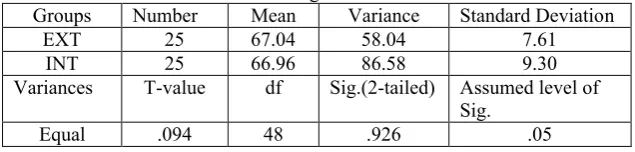
As mentioned before, the Michigan test was used to make sure of the homogeneity of the participants' proficiency at the upper-intermediate level. As table 1 shows, a t-test revealed no significant difference between both groups as far as their proficiency level is concerned.
Table 1
Independent sample t- test comparing the mean scores of the two groups on the Michigan test
Groups Number Mean Variance Standard Deviation
EXT 25 67.04 58.04 7.61
INT 25 66.96 86.58 9.30
Variances T-value df Sig.(2-tailed) Assumed level of Sig.
Equal .094 48 .926 .05
Communicative Tasks
In order to explore the effects of EXT/INT on the use of SC in written referential communication, tasks of elicitation should be so designed that they can create appropriate communication problems for the participants (directors) in communicating with their partners (matchers). In fact, since SC is task-based and so is referential communication (Ahmadian, 2001; Ellis, 2003), thus tasks of elicitation are needed to impose communication problems and to activate subjects' SC. Referential communication is also a task-based process by which we can elicit the individuals’ use of SC to solve communication problems via appropriate strategies (Poulisse, 1997). Therefore, three types of communicative tasks were used in this study to elicit the performance of participants’ SC. The tasks were adapted from Poulisse (1990) and Ahmadian (1995, 2001) who used them for similar purposes (see appendix). They are as follows:
(i)Task one consisted of eight unconventional shapes/referents. In fact, this task was picture description-identification. (ii) The second task was concept description-identification consisting of eight words, each conveying an abstract concept. (iii) The third task was a story-telling activity comprising a short narrative of eight referents as communicative goals. Unconventional shapes and abstract concepts were used because they were supposed to create the same communication problems for all the participants and provide them with similar input. Narratives are believed to be more capable to create meaningful situations for the speakers of all languages, because they contain heavy semantic and conceptual burdens; therefore, they are more controllable for actual observations (Ahmadian, 2001). Also, narratives are believed to be "good means of motivating individuals to express experiences (events), and by these means, make meaning of what people know or do" (Lantolf, 2006, pp.171-2), and help us "understand the inner perspectives on the meaning of actions being studied"(Borge,1998, p.11).
Procedures: Data Collection and Analyses
The experiment had been designed for mutual interactions: each subject, as the director/writer, had a partner, as the matcher/reader. They were seated face to face at a booth in the language laboratory of the university in separate sessions designed for each pair. The director, writer, was to describe each picture/concept in writing so that the matcher, reader, could identify it from among a set of alternative pictures/concepts. The director was told to do all things in writing (such as having a chat through the internet) without any signs of oral or face to face communication e.g. speaking, gestures, mime, body movement, etc. so that the matcher could identify the intended concepts through reading the former's writing, only. Almost all of them finished their tasks within a 30-minute time limit.
Regarding the pros and cons of the existing taxonomies (Yule and Tarone, 1997), and with respect to the psycholinguistic perspectives to communication strategies, Ahmadian’s (2001) taxonomy was applied to
identify and classify CSs used by the groups. This taxonomy was used because it is a more comprehensive process-based taxonomy than the Nijmegen taxonomy for the reasons discussed above. Furthermore, it is a learner-based taxonomy (focusing on learners) and thus more relevant to the purposes of this study, not a teacher-based one (focusing on teacher talk) like Anani Sarab's (2004) taxonomy and other newly developed
ones, which are rather sociolinguistic-based.It became clear that all CSs
had been used by the participants but word-coinage, which is an
IL-based conceptual strategy, so we excluded this strategy from the study.
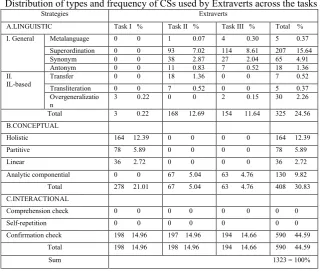
Next, the distribution of the types and frequency of CSs along with the total number of the strategies used by each group across different tasks
were identified and calculated. The proportion of times each group had
used each type of strategy was then calculated (see tables 2a & 2b below).
Table 2a
Distribution of types and frequency of CSs used by Extraverts across the tasks
Strategies Extraverts
A.LINGUISTIC Task I % Task II % Task III % Total % Metalanguage 0 0 1 0.07 4 0.30 5 0.37 Superordination 0 0 93 7.02 114 8.61 207 15.64 Synonym 0 0 38 2.87 27 2.04 65 4.91 I. General
Antonym 0 0 11 0.83 7 0.52 18 1.36 Transfer 0 0 18 1.36 0 0 7 0.52 Transliteration 0 0 7 0.52 0 0 5 0.37 II.
IL-based
Overgeneralizatio
n 3 0.22 0 0 2 0.15 30 2.26 Total 3 0.22 168 12.69 154 11.64 325 24.56 B.CONCEPTUAL
Holistic 164 12.39 0 0 0 0 164 12.39 Partitive 78 5.89 0 0 0 0 78 5.89 Linear 36 2.72 0 0 0 0 36 2.72 Analytic componential 0 0 67 5.04 63 4.76 130 9.82 Total 278 21.01 67 5.04 63 4.76 408 30.83 C.INTERACTIONAL
Comprehension check 0 0 0 0 0 0 0 0 Self-repetition 0 0 0 0 0 0 0 Confirmation check 198 14.96 197 14.96 194 14.66 590 44.59
Total 198 14.96 198 14.96 194 14.66 590 44.59 Sum 1323 = 100%
Table 2b
Distribution of types and frequency of CSs used by Introverts across the tasks
Strategies Introverts
A.LINGUISTIC Task I % Task II % Task III % Total % Metalanguage 0 0 9 0.64 7 0.50 16 1.14 Superordination 0 0 104 7.46 127 9.11 231 16.58 Synonym 0 0 27 1.93 19 1.36 46 3.30 I. General
Antonym 1 0.07 11 0.78 5 0.35 17 1.22 Transfer 1 0.07 21 1.50 0 0 22 1.57 Transliteration 0 0 0 0 0 0 0 0 II.
IL-based
Overgeneralization 0 0 0 0 4 0.28 4 0.28 Total 2 0.14 172 12.34 162 11.62 336 24.12 B.CONCEPTUAL
Holistic 193 13.85 0 0 0 0 193 3.85 Partitive 120 8.61 0 0 0 0 120 8.61 Linear 41 2.94 0 0 0 0 41 2.94 Analytic componential 0 0 85 6.10 69 4.95 154 6.46 Total 354 24.41 85 6.10 69 4.95 478 36.46 C.INTERACTIONAL
Comprehension check 0 0 0 0 0 0 0 0 Self-repetition 0 0 0 0 0 0 0 0 Confirmation check 196 4.07 197 14.14 186 13.35 579 41.56
Total 196 14.07 197 14.14 186 13.35 579 41.56 Sum 1393= 100%
Concerning the hypothesis of the study, it was therefore thought to be more appropriate to use a statistical technique which allows for the
comparison of the two groups in the use of each strategy; this technique
has also been used by Littlemore (2001). Two sets of comparisons were carried out: (i) between-group comparisons in terms of the total CSs used for all the given tasks, and (ii) between-group comparisons in terms of CSs used for each individual task.
For each between-group comparison, first of all, we should use NPar Tests. Here, if the significance value (Asymp. Sig 2-tailed) of both
groups is higher than the value of selected significance which is 0.05, then we can safely assert that test distribution for both groups is normal and we can compare the mean scores of the two groups by T-Test. But, if NPar Test indicates that the significance value of either one of the extravert group or introvert group is lower than the value of selected significance i.e. 0.05, then it shows that test distribution for that group is not normal. In this case, we should use Mann-Whitney Test instead of T-Test to compare the mean ranks of the two groups. For the reason of space, among a large number of comparisons, only those which showed significant differences are provided here, tables 3 and 4.
Results of Measurements
Between-group Comparisons in the Use of Total CSs
The results of various comparisons revealed no significant differences between extravert and introvert groups in terms of the total linguistic, conceptual, and interactional strategies used to perform all the given tasks. But in the case of the two sub-types of linguistic strategies, namely, synonymy and transliteration, a sub-type of interactional strategies, i.e. confirmation check, and the two sub-types of conceptual strategies, namely, holistic and partitive strategies, there were significant differences between both groups. That is, as table 3 indicates, the extravert group used synonymy, transliteration, and confirmation check strategies more than the introvert group, and the introvert group used holistic and partitive strategies more than the extravert group in performing all the tasks.
Table 3
Summary of between-group comparisons in the use of total CSs
Compensatory Strategies Group Differences Asymp. Sig
(2-tailed)
(1) Synonymy………..……..Introvert < Extravert ………...….0.005** (2) Transliteration………….…….Introvert < Extravert………..…..0.010* (3) Holistic……….……Extravert < Introvert………..…..0.005** (4) Partitive……….…...Extravert < Introvert………...…….…....0.016* (5) Confirmation check...Introvert < Extravert………….…....…...0.004**
* P<0.05 ** P<0.01
Between-group Comparisons in the Use of CSs for Each Task (I) Task One
As mentioned earlier, task one included unconventional/abstract shapes. The results of various comparisons carried out for this task revealed no significant differences between extravert and introvert groups in terms of the total linguistic, conceptual and interactional strategies. But regarding the two sub-types of conceptual strategies, namely, holistic and partitive strategies, there were significant differences between the two groups; that is, the introvert group applied those strategies more than the extravert one (see table 4 below).
(II) Task Two
The second task consisted of words of abstract concepts. Similarly, the results of various comparisons carried out for this task revealed no significant differences between extravert and introvert groups in terms of the total linguistic, conceptual and interactional strategies. But in the case of the two sub-types of linguistic strategies, namely, synonymy and transliteration, we found that the extravert group used those strategies significantly more than the introvert one. On the other hand, the introvert group used a sub-type of conceptual strategies i.e. analytic componential, significantly more than the extravert one (see table 4 below).
(III) Task Three
The third task was a short narrative containing eight referents. The results of various comparisons performed for task three indicated no significant differences between extravert and introvert groups in terms of the total linguistic, conceptual, and interactional strategies. However, as far as confirmation check, as a sub-type of interactional strategies, is concerned, it was found that the extravert group applied that strategy significantly more than the introvert one (see table 4 below).
Table 4
Summary of between-group comparisons in the use of CSs for each task
Task CSs Group Differences Asymp. Sig (2-tailed)
(1) Holistic...Extravert < Introvert...0.005** I
(2) Partitive...Extravert < Introvert...0.016* (1) Synonymy...Introvert < Extravert ...0.016* (2) Transliteration...Introvert < Extravert...0.010* II
(3) Analytic Componential...Extravert < Introvert...0.040* III (1) Confirmation check……...Introvert < Extravert...0.022* * P<0.05 ** P<0.01
Discussion
The results of various between-group comparisons indicate that there is a relationship between EXT/INT personality dimension and the choice/use of CSs in “written referential communication”. In order to arrive at a better understanding of the findings, let’s consider the strategies used for each task.
As mentioned before, task one comprised abstract/unconventional shapes. Therefore, conceptual strategies were very frequently needed to solve communication problems which were raised from the referents of this task. In performing task one, introvert participants used significantly more conceptual strategies (holistic and partitive strategies) than extravert participants. This finding may be due to the fact that since introvert learners have better “long-term memory”, more concentration ability, and are less easily subject to mental inhibition (Eysenck & Eysenck, 1985), thus it is likely that they have better lexical knowledge and ability in applying analogies and/or similes to use holistic strategies and to break the shape into its component parts and to describe each component separately via partitive strategies. In other words, it may have been so because introvert learners have more rapid access to holistic and analytic thinking processes than extravert participants (Eysenck & Eysenck, 1985); therefore, they may use more conceptual strategies (holistic and partitive strategies) than extravert participants.
With regard to task two, abstract concepts, extravert participants used synonymy and transliteration, as two sub-types of linguistic strategies, significantly more than introvert ones. It should be noted that synonymy is a general linguistic strategy and transliteration is an IL-based linguistic strategy. The use of transliteration strategy might be explained on the ground that since extravert participants prefer quicker and less accurate approaches (Taylor, 1998), hence they apply more transliteration strategies than introvert participants in performing this task. Concerning synonymy, it seems that extravert participants could communicate the concepts through linguistic strategies and did not need to use conceptual strategies.
However, introvert participants used analytic componential strategies, as a sub-type of conceptual strategies, significantly more than extravert ones in performing task two. As mentioned earlier, it seems that in doing this task the participants first used linguistic strategies, and if these strategies did not work, they continued problem-solving processes through conceptual strategies by referring to the semantic features, or functions of the concepts. Consequently, when introvert participants could not communicate the concepts through linguistic strategies, they resorted to conceptual strategies by analyzing the concepts into its parts and semantic features, and then they explained each part. In fact, introvert participants due to their psychological characteristics that they are better at reflective problem-solving tasks (Taylor, 1998), they could tackle their conceptual problems in conveying the concepts via conceptual strategies, whereas extravert participants could not do such a thing as much as introvert participants could.
In performing task three, which was a narrative, extravert participants only used confirmation check, as a sub-type of interactional strategies, significantly more than introvert ones. As mentioned earlier, since “task three” (narrative) creates more meaningful and communicative situations for the speakers of L1 and L2 than other contexts (Ahmadian,
1995) and motivates individuals to express their experiences (Lantolf, 2006), thus, it may have been that it draws more on interactional strategies than other strategies, and consequently, extravert participants, due to their higher interpersonal communication ability, used more interactional strategies (confirmation check) than introvert participants in performing this task. This finding is in line with the findings of researchers such as Bialystok (1990) and Dewaele et al., (1999), who noted a similar point in oral communication.
To sum up, within the domain of linguistic strategies (synonymy and transliteration) and interactional strategies (confirmation strategies), the results would suggest evidence against the hypothesis in that extravert participants employed such strategies significantly more than introvert ones in written referential communication. Furthermore, as far as conceptual strategies (holistic, partitive and analytic componential strategies) are concerned, the hypothesis again is rejected in that introvert participants used those strategies significantly more than extravert ones.
Conclusion and Implications
It has been claimed that the personality trait of EXT/INT is associated with the use of communication and CSs (Dewaele & Furnham, 1999; Littlemore, 2003). It was the aim of this study to examine such a claim. The findings would suggest some evidence for such a claim as discussed above.
The findings of this study can have pedagogical implications. It was discussed that a more practical approach to second /foreign language teaching is to develop the L2 learners’ SC and their ability to use CSs in order to solve their communication problems (Widdowson, 1990; Kasper and Kellerman, 1997). Furthermore, if language teachers want to be successful and productive in helping L2 learners develop their SC, obviously, they should take personality trait of EXT/INT into consideration as one of the effective factors which influence the use of
communication and CSs (Corder, 1983; McDonough, 1986; Ehrman et al., 2003; Littlemore, 2003).
According to the recent trends in second /foreign language teaching, there has been an increasing interest in “learner-based” approaches to second /foreign language teaching in which learners are seen to be the center of teaching activities (Auerbach, 1999; Ellis, 2003). Thus, teachers are no longer regarded as the (only) sources of knowledge and learners as the only receivers of knowledge; rather, teachers are considered as problem-imposers and learners as problem-solvers (Ellis, 1994, 2003; Shor, 1999). It is believed that this will help learners develop their “interactional competence” (Richards and Lockhart, 2005, p. 141) in L2 classrooms to enable them to use their communicative and strategic competence for social interactions. To develop their SC, L2 learners are supposed to learn to use various strategies to solve the communicative problems imposed by the teachers and to achieve their intended goals.
There is a general consensus that SC of L2 learners is likely to be improved through genuine communication situations (Bialystok, 1990; Dornyei, 1995; Adams, 2007). Dornyei et al. (1997) also pointed out that the teachability of SC, both in oral and written communication, is completely justifiable and possible, and it can be started early even at a pre-intermediate level.
Specifically, the findings of this study revealed that extravert learners tend to use more “interactional” strategies and introvert learners tend to use more “conceptual strategies” to solve their communication problems. Considering the characteristics of extravert and introvert learners and the findings of this study, textbook writers and EFL/ESL teachers can help to develop the SC of each group of learners in a number of ways. For example, regarding the fact that extravert learners like group-work and introvert learners like to work independently or in smaller groups of two or three members, textbook writers can include
appropriate materials for each group in their textbooks so that there will be more opportunities for introvert learners to use “interactional” strategies, and for extravert learners to use more “conceptual strategies” to solve their communication problems, and thereby to develop their overall communicative abilities/ SC in general, and their strategic
writing abilities in particular. Moreover, using appropriate
communicative tasks in actual classroom teaching, EFL/ESL teachers can teach extravert and introvert learners how to use different strategies in written communication in order to achieve their communicative goals, and thereby to develop their writing skills.
As far as the theoretical implications of the study are concerned, the findings of this study may be insightful for researchers to develop a more comprehensive theory of SLA. A comprehensive theory of SLA is the one which simultaneously embraces both language “learning” and “use”. Achieving such a theory requires understanding what psychological processes happen in the mind of learners when they come to learn and to use an L2 (Ellis, 1994; Kroll and Sundama, 2005). In fact, studies on communicative aspects of language, more specifically on SC, may help us achieve such a theory and model. However, further research on both psycholinguistic and sociolinguistic aspects of SC in both oral and written communication will provide more evidence for this goal.
Acknowledgements
We wish to express our sincere appreciation to Professor T. S. Paribakht, of Ottawa University, Canada, for reading this paper and giving valuable and insightful comments.
Received 2 January, 2009
Accepted 23 September, 2009
References
Adams, R. (2007). Does second language learners benefit from
interacting with each other? In A. Mackey (Eds.), Conversational
Interaction in Second Language Acquisition (pp. 29-51). Oxford: Oxford University Press.
Ahmadian, M. (1995). Interlanguage Conformity in Strategic
Competence: Ability to Use Compensatory Strategies by Second Language Learners in Referential Communication. Unpublished Ph.D. Thesis, Sheffield University, UK.
---. (2001). Interlanguage Conformity and the Use of Strategic
Competence. Paper presented at "The First Conference on Issues in
English Language Teaching in Iran", May 9-10, 2001, Faculty of Foreign Languages, University of Tehran, Proceedings: pp. 139-158.
Anani Sarab, M. R. (2003). Communication strategies in second
language teacher talk with special reference to Iranian teachers of English. Unpublished PhD thesis, University of Leeds. Leeds, WY.
---. (2004). The Study of Communication Strategies in Teacher
Talk,Iranian Journal of Applied Linguistics, 7(2), 1- 43.
Astika, G., Carrell, P., & Prince, M. (1996). Personality Types and
Language Learning in an EFL Context, Language Learning, 46(1),
75-99.
Auerbach, E. (1999). Teacher, Tell Me What to Do. In I. Sure and C.
Pari (Eds.), Critical Literacy in Action (pp. 31-52). Boynton/Cook
Publishers: USA.
Bialystok, E. (1990). Communication Strategies: A Psychological
Analysis of Second Language Use. Oxford: Oxford University Press.
Bongaerts, T. & Poulisse, N. (1989). Communication Strategies in L1
and L2: Same or Different? Applied Linguistics, 10, 253-268.
Borge, S. (1998). Teacher's Pedagogical Systems and Grammar
Teaching: A Generative Study, TESOL Quarterly, 32, a-38.
Brown, D. H. (2000). Principles of Language Learning and Teaching
(4th ed.). Englewood Cliffs, Prentice Hall.
Canale, M. & Swain, M. (1980). Theoretical Bases of Communicative
Approaches to Second Language Teaching and Testing, Applied
Linguistics,1, 1-47.
Chomsky, N. (1965). Aspects of the Theory of Syntax. Cambridge: MIT
Press.
Cook, V. (1993). Linguistics and Second Language Acquisition. New
York: St. Martin's Press.
Corder, S. P. (1983). Strategies of Communication. In C. Faerch & G.
Kasper (Eds.), Strategies in Interlanguage Communication
(pp.15-19). Harlow, England: Longman.
Dewaele, J. M. & Furnham, A. (1999). Extroversion: The unloved
variable in applied linguistic research, Language Learning, 49(3),
509-544.
Dornyei, Z. (1995). On the Teachability of Communication Strategies, TESOL Quarterly, 29, 55-85.
--- & Scott, M. L. (1997). Review article: Communication strategies
in a second language, definitions and taxonomies, Language
Learning, 47(1), 173-210.
--- & Skehan, P. (2003). Individual Differences in Second
Language Learning. In C. J. Doughty and M. H. Long (Eds.), The
Handbook of Second Language Acquisition (pp. 589-630). Oxford: Oxford University Press.
Ehrman, M., Leaver, B., & Oxford, R. (2003). A Brief Overview of
Individual Differences in Second Language Learning, System, 31,
313-330.
Ellis, R. (1994). The Study of Second Language Acquisition. Oxford:
Oxford University Press.
--- (2003). Task-based Language Learning and Teaching. Oxford:
Oxford University Press.
--- (2004). Individual Differences in Second Language Learning. In
A. Davies & C. Elder (Eds.), The Handbook of Applied Linguistics
(pp. 525-551). Oxford: Oxford University Press.
Ely, C. (1986). An Analysis of Discomfort, Risk-taking, Sociability and
Motivation in the L2 Classroom, Language Learning,36 (1), 1-25.
Eysenck, H. & Eysenck, S. (1975). Persian Version of the Manual of
Eysenck Personality Questionnaire. London: Hodder & Stoughton.
--- & Eysenck, M. (1985). Personality and Individual Differences: A
Natural Science Approach. London: Plenum Press.
--- & Eysenck, S. (1992). Eysenck Personality Inventory. London:
Hodder & Stoughton.
Faerch, C. & Kasper, G. (1983). Plans and Strategies in Foreign Language Communication. In C. Faerch & G. Kasper (Eds.),
Strategies in Interlanguage Communication (pp.20-60). London: Longman .
--- (1984). Two Ways of Defining Communication Strategies, Language Learning, 34, 45-63.
--- (1986). Strategic Competence in Foreign Language Teaching. In
G. Kasper (Eds.),Learning, Teaching and Communication (pp.
179-197). Netherland: Aarhus University Press
Gill, A. & Oberland, J. (2002). Taking Care of the Linguistic Features of Extraversion, January 6, 2002.
Retrieved from http://www.d.umn.edu/tpederse/code-html.
Hymes, D. (1972). On Communicative Competence. In J. Pride & J.
Holmes (Eds.), Sociolinguistics (pp.269-293), Penguim,
Harmondsworth.
Jung, C. G. (1933). Psychological Types. New York: Harcourt, Brace.
Kaper, G. and Kellerman, E. (1997). Introduction: approaches to communication strategies. In G. Kasper and E. Kellerman (Eds.), Communication Strategies: Psycholinguistic and Sociolinguistic Perspectives (pp.1-13). London: Longman.
Kellerman, E. & Bialystok, E. (1997). On psychological plausibility in the study of communication strategies. In G. Kasper and E.
Kellerman (Eds.), Communication Strategies: Psycholinguistic and
Sociolinguistic Perspectives (pp.163-178). London: Longman.
Kiany, G. R. (1997). Exposure, Instruction and Extraversion in Relation
to Different Aspects of English Proficiency. Unpublished Ph.D. Thesis, University of Essex, UK.
--- (2001) Exposure, Instruction and Extraversion in Relation to
Different Aspects of English Proficiency. Paper presented at "The
First Conference on Issues in English Language Teaching in Iran", May 9-10, 2001, Faculty of Foreign Languages, University of Tehran, Proceedings: pp. 180-195.
Kroll, J. F. & Sundama, G. (2005). Cognitive Processes in Second Language Learning and Bilinguals: The Development of Lexical and Conceptual Representations. In C. Doughty & M. L. Long (Eds.), The Handbook of Second Language Acquisition (pp. 104-129). London: Blackwell Publishing Ltd. UK.
Lantolf, J. P. (2006). Sociocultural Theory and Second Language
Learning. Oxford: Oxford University Press.
--- & Thorne, S. L. (2006). Sociocultural Theory and Geneses of
Second Language Development. Oxford: Oxford University Press.
Littlemore, J. (2001). An Empirical Study of the Relationship between
Cognitive Style and the Use of Communication Strategies, Applied
Linguistics, 22(2), 241-265.
--- (2003). The Communicative Effectiveness of Different Types
of Communication Strategy,System,31, 331-347.
McDonough, S. (1986). Personality in Foreign Language Teaching.
London: George Allen & Unwin.
Munoz, C. (2007). Studying Abroad as Foreign Language Practice. In
R. Dekeyser (Eds.), Practice in a Second Language Perspectives
from Applied Linguistics and Cognitive Psychology (pp. 208-226). Cambridge: Cambridge University Press.
Nikjoo, N. (1982). Factorial Structure of the EPQ in Iran. Unpublished Ph.D. dissertation, University of Ulster.
Omaggio Hadley, A. (2003). Teaching Language in Context (3rd ed.).
Heinle & Heinle Publishers, Massachusetts, Boston, USA.
O'Malley, J. M. & Chamot, A.U. (1990). Learning Strategies in Second
Language Acquisition. Cambridge: Cambridge University Press.
Oxford, R. L. (1990). Language Learning Strategies: What every
teacher should know. Boston: Heinle & Heinle.
Paribakht, T. (1985). Strategic Competence and Language Proficiency, Applied Linguistics, 6, 132-146.
--- (1986). On the Pedagogical Relevance of Strategic Competence, TESL Canada Journal, 3, 53-66.
Poulisse, N. (1990). The Use of Compensatory Strategies by Dutch
Learners of English. Berlin: Mouton de Gruyter.
Poulisse, N. (1997). Compensatory strategies and the principles of clarity and economy. In G. Kasper and E. Kellerman (Eds.), Communication Strategies: Psycholinguistic and Sociolinguistic Perspectives(pp.49-64). London: Longman.
Rampton, B. (1997). A sociolinguistic perspective on L2 communication
strategies. In G. Kasper and E. Kellerman (Eds.), Communication
Strategies: Psycholinguistic and Sociolinguistic Perspectives (pp.179-202). London: Longman.
Richards, J. C. and Lockhart, C. (2005). Reflective Teaching in Second
Language Classroom. Cambridge: Cambridge University Press (13th ed.).
Selinker, L. (1972). Interlanguage, International Review of Applied Linguistics, 10(3), 209-231.
Scholfield, P. (1987). Communication Strategies-the Researcher
Outmaneuvered? Applied Linguistics, 8(3), 219-232.
Shor, I. (1999). What Is Critical Literacy? In I. Sure and C. Pari (Eds), Critical Literacy in Action (pp. 1-30). Boynton/Cook Publishers, USA.
Skehan, P. (1989). Individual Differences in Second Language
Learning. London: Adward Arnold.
Tarone, E. (1980). Communication Strategies, Foreigner Talk and
Repair in Interlanguage, Language Learning, 30, 417-431.
--- (1984). Teaching Strategic Competence in the Foreign Language Classroom. In S. J. Savignon & M. S. Berns (Eds.), Initiatives in Communicative Language Teaching (pp.128-136). Reading: Addison-Wesley.
--- & Yule, G. (1989). Focus on Language Learner. Oxford: Oxford
University Press.
Taylor, J. (1998). Using asynchronous computer conferencing to encourage interaction in seminar discussions, June 24, 2006.
Retrieved fromhttp://www.virtualschool.edu/mon.html.
Varadi, T. (1973). Strategies of Target Language Learner
Communication: Message-adjustment, International Review of
Applied Linguistics, 18, 59-71.
Wakamoto, N. (2000). Language Learning Strategy and Personality
Variables,International Review of Applied Linguistics, 38(1), 71-81.
Widdowson, H. (1990). Aspects of Language Teaching. Oxford: Oxford University Press.
Williams, J., Inscoe, R., & Tasker, T. (1997). Communication strategies in an Interactional context: the mutual achievement of comprehension. In G. Kasper and E. Kellerman (Eds.), Communication Strategies: Psycholinguistic and Sociolinguistic Perspectives (pp.304-322). London: Longman.
Yadegari, H. R. (2007). The Effects of Extraversion/Introversion on the
Use of Strategic Competence in Oral and Written Referential Communication by Iranian EFL Learners. Unpublished MA Thesis, Arak University, Iran.
Yule, G. & Tarone, E. (1997). Investigating communication strategies in L2 reference: pros and cons. In G. Kasper and E. Kellerman
(Eds.), Communication Strategies: Psycholinguistic and
Sociolinguistic Perspectives(pp.17-30). London: Longman.
Appendix
Communicative Tasks (1, 2 & 3)
I. An example of task one-Unconventional Shapes:
II. Task two-Abstract Concepts:
1. Jealous 5. Sympathy 2. Justice 6.Optimism 3. Flattery 7. Salvation 4. Pessimism 8. Beauty
III. Task three-Narrative:
There once was a man who was going to visit a distant cousin with his wife. While they were waiting on ---(1)---for their train, the man saw a ---(2)----. It was one of those apparatuses which give ---(3)---- on which one’s future is printed as well as one’s weight. The man decided to weigh himself so he stepped on ----(4)----, put ---(5) --- in, and waited for --(6)- to come out. Since he was not wearing his ---(7) ---, he asked his wife --- (8)---it out to him. On ---(9)-- -- was written “You are a special man, you have great ---(10)---, willpower and ---(11)---. You are to have golden future”. After she had read this out, the man's wife turned it over, looked at the back for a moment and sneer “Huh, and it's got your weight wrong too”.