in the population sciences published by the Max Planck Institute for Demographic Research Konrad-Zuse Str. 1, D-18057 Rostock · GERMANY www.demographic-research.org
DEMOGRAPHIC RESEARCH
VOLUME 19, ARTICLE 17, PAGES 557-598
PUBLISHED 01 JULY 2008
http://www.demographic-research.org/Volumes/Vol19/17/ DOI: 10.4054/DemRes.2008.19.17
Research Article
Germany:
Family diversity with low actual
and desired fertility
Jürgen Dorbritz
This publication is part of Special Collection 7: Childbearing Trends and Policies in Europe (http://www.demographic-research.org/special/7/)
© 2008 Dorbritz.
1 Introduction: The demographic situation in Germany 558
2 Long-term trends in family formation in Germany 561
2.1 Period and cohort fertility 561
2.2 Excursus: Experience of the demographic impact of population policy – The example of the former GDR
567
2.3 Childlessness 569
2.4 Age patterns and extramarital births 571
2.5 Marriage and divorce 567
3 The change in living arrangements and family forms 578
4 Desired number of children and reasons for not wanting a(nother) child – Results of the Population Policy Acceptance Study
583
4.1 Desired fertility 583
4.2 Arguments for not having children 584
5 Paradigm shift – a family policy with demographically desirable effects?
587
6 Discussion of results: Nine causes of low fertility 589
6.1 Individualisation trends 589
6.2 Childlessness 590
6.3 The concept of family policy 590
6.4 The reconciliation conditions 591
6.5 The gender problem 591
6.6 The change in the forms of cohabitation in partnerships – de-institutionalisation
592
6.7 The economic situation of the family and the high appreciation of children
592
6.8 The situation in Eastern Germany 593
6.9 Low desired fertility 593
7 Consequences 594
Germany:
Family diversity with low actual and desired fertility
Jürgen Dorbritz 12
Abstract
Germany is a low-fertility country with a rapidly ageing population, and will remain so for the foreseeable future. There are several reasons for this trend. Germany is among the countries with the highest rates of childlessness in the world, and childlessness has become widely accepted. This is illustrated by changes in living arrangements. A broad range of living arrangements has been added to the basic model of marriage with children; namely, single living, non-marital cohabitation, lone parenthood, patchwork families and living apart together. A culture of individualism has spread in Germany which forms the basis for widespread decisions against family formation. The desired number of children has become low and family policy is considered to be a failure in terms of its influence on fertility. German family policy has had a traditional orientation centred on monetary support to families and on the promotion of the male breadwinner model. Women have been largely forced to choose between family and work, and leave the labour market when a child is born. The still prevailing concept of family policy does not help to reduce the pressure to choose between work and family life, and thus makes it easier to decide not to have children, especially for highly educated women. A change in family policy is needed which will enable couples to choose between the breadwinner-housewife and the reconciliation model. Gradually, this change is starting to take place.
1 with the assistance of Cordula Zabel
1. Introduction: The demographic situation in Germany
Germany is the second most populous European country (after Russia), with a population of 82.32 million on 1 January 2007. It is also among the 20 countries with the lowest Total Fertility Rates worldwide (Population Reference Bureau 2007), something which has been typical of at least Western Germany since the mid-1970s. An intensive debate has developed recently on this topic. It was instigated by the ageing of the population, and by the risk this poses to the social security systems. It is, above all, the childless who have become the subject of observation, and who are accused of investing in private old-age pensions since they do not have to pay for children, whilst parents are investing in tomorrow’s contributors. “No children – no pension, one child – half pension” is only one of the catch-phrases used in this discussion. One of the main aims of this chapter is to analyse and explain the low-fertility situation which has arisen in Germany. Before analysing fertility and family changes in the country, I first provide an outline of demographic trends in Germany.
The population of Germany reached a maximum of 82.54 million in 2003, and started to diminish thereafter as a result of declining immigration and persistent low fertility rates. During the year 2006, the population declined by 123,000, i.e., by 0.1%, which was the largest absolute and relative decline since 1984 (Council of Europe 2006, Eurostat 2008). The population of Germany has a rather unique position in Europe; it has recorded a negative rate of natural increase for more than three decades. The number of deaths has exceeded the number of births every year since 1972. This ‘birth deficit,’ which reached 149,000 in 2006, had been more than counterbalanced by high immigration rates in the period 1986-2002, partly driven by a high rate of immigration
of ethnic Germans (so-called Aussiedler or Spätaussiedler), especially from the former
Soviet Union, Poland, and Romania. As this migration stream started to evaporate in the early 2000s, the overall migration balance became much less significant for population change, and, between 2001 and 2006, the net migration increase fell from a high of 274,800 to a mere 23,000 (preliminary data released by the Federal Statistical Office). Since 1989, population decline and a negative migration balance have been most pronounced in the Eastern part of Germany (former GDR, frequently referred to as
Neue Länder), which lost 108,000 persons (0.8% of the total population) in 2006, and, overall, some two million persons (12% of the initial population) since 1988 (this statistic also includes the territory of the former West Berlin).
population in the world after Japan in 2005, which recorded a median age of 42.9 years (United Nations 2006, Table A.11). Because of the low marriage rate and the high divorce rate, the number of married couples continues to decline, and the share of people who are married exceeds the share of those who have never married only at relatively advanced childbearing ages; i.e., among men over age 35 and women over age 30 (Statistisches Jahrbuch 2007).
There were 7.29 million foreigners living in Germany in 2006, representing 8.8% of the population. The number, as well as the share, of foreigners in the total population rose in the 1980s (from 5.6% in 1986) and the early 1990s, but have stabilised since the late 1990s (Eurostat 2008). The number of foreigners has remained relatively stable owing to naturalisations, with the number of naturalisations coming close to the number of new foreign-nationality migrants. In 2006, 124,830 non-German nationals living in Germany received German citizenship (Federal Statistical Office 2007). Overall, 15.3 million inhabitants of Germany—18.6% of the total—were estimated to have a migration background, i.e., were immigrants or descendants of immigrants, in 2005. Of those, 10.4 million people had immigrated since 1950 (Federal Statistical Office 2007). Children of foreign parents are able to acquire German nationality by birth if at least one parent has had his or her lawful place of habitual residence in Germany for at least eight years, and has a right of unlimited residence or has had a permanent residence permit for at least three years.
In 2006, the number of marriages reached a trough of 373,681, the lowest number recorded in the period 1950-2006 (Eurostat 2008). In 1991, the total first marriage rate for women fell below 0.6 and, since 2001, it has hovered around 0.55, reaching 0.54 in 2006. According to the results of first marriage tables, roughly one-third of men and one-quarter of women still remain single when attaining age 50.
After reaching a post-war peak of 213,975 in 2003, the number of divorces subsequently fell by more than one tenth in 2004-2006, to 190,928 in 2006 (Eurostat 2008). The total divorce rate showed an upward trend between the mid-1990s and 2003, when it reached 0.42; subsequently it declined below 0.4 in 2006. Seen by the duration of marriage, the largest number of marriages is dissolved in the sixth year of marriage. The duration of marriage until divorce is increasing. Divorce took place after an average of 13.1 years of marriage. About one half of divorced couples have at least one child below age 18; this number has been stable since the late 1990s (Federal Statistical Office 2007)
small changes since the second half of the 1990s, and reached 1.33 in 2006 (Federal Statistical Office 2007). In the 1990s, the territory of the former GDR had a markedly lower total fertility rate than the Western parts of Germany, but this gap has been closing since the second half of the 1990s, and had almost disappeared by 2006, when the TFR was 1.30 in Eastern Germany and 1.34 in Western Germany.
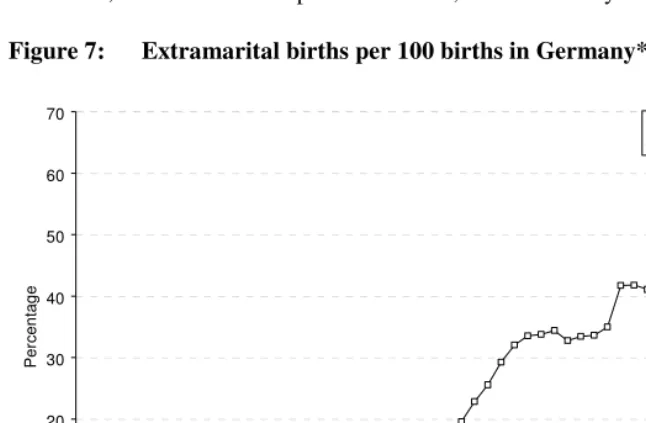
Three children out of ten were born to unmarried women in 2006. The share of extramarital children has doubled since the start of the 1990s. Here too, we find noticeable differences between the two regions of Germany. In the former GDR, 60% of all children are born to unmarried mothers, compared with 24% in Western Germany. The trend towards starting the family formation phase late has continued for more than three decades. In 2006 mothers were 29.6 years old on average when their child was born, up from 26.2 in the mid-1970s.
As in other developed countries, life expectancy has increased continuously since the 1970s. According to the most recent mortality tables for 2004-2006, life expectancy of newborn girls was 82.1 years, and was 76.6 years for newborn boys. The gap between Western and Eastern Germany, which was most pronounced around 1990, has continued to close (Rostocker Zentrum 2005).
2. Long-term trends in family formation in Germany
2.1 Period and cohort fertility
As in many other European countries, the long-term fertility trend in Germany is typified by a pronounced increase after World War II (and, prior to that, during most of the 1930s), followed by a similarly steep decline in the late 1960s and during the 1970s. But this trend also entails several characteristics which are typical of Germany, resulting from the special situation in the former GDR and from German reunification. In the course of the first demographic transition, which took place around 1900, the Total Fertility Rate (TFR) fell from almost five to roughly two (Fig. 1). The TFR was 4.7 between 1871 and 1880, whilst in 1930 it was only 1.96. The TFR values are typified in the first years of the 20th century by considerable fluctuations caused by the crisis situations of the First and Second World Wars, as well as by the world economic crisis. The lows in period fertility these crises caused were followed by highs which were as short-lived as they were intense. For instance, the TFR reached a value of 1.95 in 1917, and then increased to 3.38 in 1920. The lowest value is then reached in 1945, at 1.36.
Figure 1: Total Period Fertility Rates 1871/80 up to 2004 in Germany
0.0 0.5 1.0 1.5 2.0 2.5 3.0 3.5 4.0 4.5 5.0
1871/80 1891/00 1915 1935 1955 1975 1995
Calendar years
T
o
ta
l
p
e
ri
o
d
f
e
rt
ili
ty
r
a
te
Germany Western Germany Eastern Germany
In the period after the Second World War, the TFR increased once more. The development in both parts of Germany was almost identical between 1960 and 1965. The rise in fertility in East and West Germany is most likely a result of economic recovery, a climate of confidence in both regions of the country, and the fact that almost the entire generation was married. This period is referred to as the “Golden Age of Marriage”. The replacement of the parents’ generations was exceeded by a wide margin, with TFR values of 2.51 in the West and 2.48 in the East. Eventually, the TFR then began to fall again between the mid-1960s and the 1970s in both Western and Eastern Germany. The trends were identical, but the causes were completely different. Western Germany went through the time of “Europe’s Second Demographic Transition”, about which van de Kaa (1987: 5) said: “Two keywords characterize the norms and attitudes behind the first and second demographic transitions and highlight
the contrasts between them: altruistic and individualistic. The first transition to low
fertility was dominated by concerns for family and offspring, but the second emphasizes the rights and self-fulfilment of individuals”. Lesthaeghe and Neels (2002) link the fall in fertility to the emphasis placed on individual autonomy in ethical, moral and political terms; with the rejection of all forms of institutional control and authority and the increasing spread of expressive values, connected to the so-called higher-order needs of self-realisation. Such a development was out of the question in a state socialist regime such as the former GDR. Abortion was legalised there in 1971, which accelerated the ongoing fall in the TFR (Fig. 1). In 1975, the TFR was 1.45 in Western Germany and 1.54 in Eastern Germany. Induced abortion became widely used as a method of family ‘planning’ and thus it played a role in accelerating fertility decline.
Fertility trends in the two regions of Germany diverged after 1975. Fertility remained at its constantly low level in Western Germany. The patterns of family formation nonetheless continued to change in this period (cf. on this Section 3: The change in living arrangements and family forms). Fertility increased once more in the former GDR in the second half of the 1970s as a result of pronatalist population policy (cf. on this Section 2.2). This trend continued until 1976, after which the TFR gradually fell. Nevertheless, the TFR in Western and Eastern Germany differed considerably between the mid-1970s and the mid-1980s.
living conditions which they could individually influence in the face of the rapid changes that were going on in society. It was, however, revealed relatively rapidly that such an across-the-board hypothesis could not be maintained. The drop in divorce rates was the result of the new divorce law, and the separation year prior to divorce which it introduced. The concurrent rapid fall in the marriage rate could be explained by the fact that the central motive for marriage, namely, the birth of children, had ceased to apply. People in Eastern Germany reacted strongly to the end of the GDR with a fall in fertility. This was caused by being unexpectedly released from the old circumstances and by the need to reorient oneself in a society about which not enough was known, and which therefore entailed insecurity about the future.
The German-German differences pertaining from the mid-1970s up until the demise of the former GDR can be explained with the following arguments (Philipov, Dorbritz 2003 153 ff.). First, the totalitarian regimes indirectly retained the tradition of family formation from the 1960s. Ideational changes which supported “Europe’s Second Demographic Transition”, such as individual autonomy or tolerance of individualistic behavioural patterns, are virtually impossible in state socialist societies with a uniform ideology, strong subjugation of the individual to society and considerable intolerance towards deviation. A change of values, as had taken place in Western Europe, was impossible under such circumstances.
Second, a strongly pronatalistic population policy was developed, in which instruments such as child allowances, maternity leave, birth assistance, loans or preferential housing provision were prominent. This sent out positive signals for family formation, to which people reacted. And even though there was no sustained increase in fertility, childlessness at least was kept low.
Third, economic and social trends supported the peculiar patterns of early family formation which are typical of Central and Eastern Europe. This included increasing female employment as one of the main policy goals. The concomitant role conflicts for women were alleviated by the state through a widely-available, affordable childcare system. All in all, the social and economic conditions promoted early family formation with a limited number of children, but a low level of childlessness.
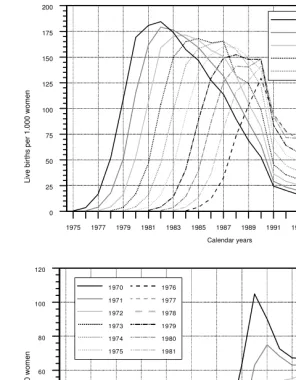
Figure 2: Age-specific birth rates of birth cohorts 1960 - 1981 in Eastern Germany L iv e b ir th s p e r 1 .0 0 0 w o m e n 0 25 50 75 100 125 150 175 200
1975 1977 1979 1981 1983 1985 1987 1989 1991 1993 1995 1997 1999 1960 1961 1962 1963 1964 1965 1966 1967 1968 1969 Calendar years L iv e b ir th s p e r 1 .0 0 0 w o m e n 0 20 40 60 80 100 120
1975 1977 1979 1981 1983 1985 1987 1989 1991 1993 1995 1997 1999 1970 1971 1972 1973 1974 1975 1976 1977 1978 1979 1980 1981 Calendar years
The Eastern German birth cohorts reacted very differently to the change in these circumstances since 1989. In order to illustrate this, the age-specific behavioural patterns of the 1960 to 1981 birth cohorts are plotted in the period 1975 to 1999. It is possible to distinguish three specific reaction patterns (Figure 2):
Birth cohorts 1960 – 1966: These cohorts ceased childbearing almost completely after 1989 without much recuperation later on. The youngest of these birth cohorts (1966) was 22 or 23 years old when the Berlin Wall fell at the end of 1989. The generally low age at birth in the former GDR had led to a situation in which a large number of the desired children had already been born. This is likely to have contributed to a situation in which family formation which had been initially interrupted in 1989 was not taken up again later.
Birth cohorts 1967 – 1972: Pronounced timing effects can be observed for these cohorts. Fertility began to rise sharply at very young ages just as in previous cohorts. In 1990, though, they abruptly interrupted their birth biographies. Then, after 1994, these cohorts became the first to recuperate, at least in part, births at higher ages. The result is an age-specific birth curve with two peaks.
Birth cohorts 1973 – 1981: An age pattern transformation can already be observed in the younger birth cohorts, which is also reflected in the increase in the average age of women at the birth of their children. The age-specific birth curves no longer show the rapid increase at very young ages found for older birth cohorts, but instead rise more gradually across women’s early twenties.
The TFR in Eastern Germany started to rise once again from 1995 onwards, an increase which was relatively slow since only limited recuperation took place after the break in fertility in 1991. The East German TFR bounced back above 1.3 in 2004 and remained stable in 2005-2006. A Total Fertility Rate of 1.34 has been calculated for Western Germany in 2004. Thus, the TFR in both parts of Germany has converged. Looking beyond period fertility, however, it will be shown below that family formation patterns still differ considerably in some cases in the two regions of Germany.
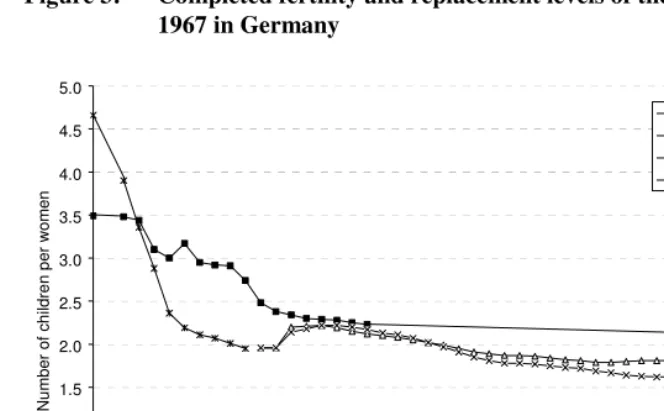
through their family formation phase in the “Golden Age of Marriage”, but even these cohorts did not achieve simple reproduction.
Figure 3: Completed fertility and replacement levels of the cohorts 1865 up to 1967 in Germany
0.0 0.5 1.0 1.5 2.0 2.5 3.0 3.5 4.0 4.5 5.0
1865 1895 1920 1933 1938 1943 1948 1953 1958 1963
Cohorts
N
u
m
b
e
r
o
f
c
h
ild
re
n
p
e
r
w
o
m
e
n
Replacement level Eastern Germany Western Germany Germany
Source: Federal Statistical Office, Germany; Federal Institute of Population Research.
2.2 Excursus: Experience of the demographic impact of population policy – The example of the former GDR
Since there is no pronatalist policy, Germany has virtually no experience of political influence on fertility. The only example available comes from the experience of the former GDR in the 1970s and 1980s. The background of the development is that the former GDR had set itself unambiguous population policy goals, although no clear birth rate targets had been formulated. The objective was to ensure the simple reproduction of the population in the long term. The two-to-three-child family was regarded as a social requirement at the family level.
Figure 4: Total Fertility Rate 1963 up to 1983 and age-specific fertility rates of the cohorts 1948 up to 1958 in East Germany
0 50 100 150 200 250
1963 1965 1967 1969 1971 1973 1975 1977 1979 1981 1983
Calendar years F e rt ili ty r a te ( p e r th o u s a n d w o m e n ) 0.00 0.50 1.00 1.50 2.00 2.50 P e ri o d T F R
1948 1949 1950 1951
1952 1953 1954 1955
1956 1957 1958 TFR
TFR (right-y axis)
The TFR started to fall faster in 1972, after abortion had been legalised (Figure 4). This was the reason why a whole series of population policy measures were enacted in 1976, some of which were unambiguously pronatalist in nature. This set of measures included an expansion of maternity leave before and after birth, a one-off birth assistance payment, the introduction of a so-called “baby year”, the granting of interest-free loans, release from work if children became ill, and special assistance for single mothers and mothers attending university. The marriage loan constitutes a good example of the pronatalist nature of population measures – it was contingent on marriage and could be paid off by the birth of children.
Once these measures had been enacted, the Total Fertility Rate started to increase from 1.54 in 1975 to 1.94 in 1980. This trend led to a great deal of discussion on the birth-promoting impact of population policy measures (Büttner and Lutz 1990). The analysis of the period and cohort data shows that the impact was limited. The increase in the TFR from 1976 onwards was only made possible because, by legalising abortion, the TFR had previously fallen. What we see are primarily timing effects, which had led to the impression of an increase in fertility in the period view. In the cohort view, one can see that an increase in fertility is observed only for a small number of birth cohorts, namely those who were born in the first half of the 1950s. Typical of the situation which had occurred is the course of age-specific fertility in the cohort of 1952. At first age-specific fertility rates increased steeply, starting in 1967 and following the pattern that was typical of the GDR. The increase ceases in 1972 with the possibility of abortion, and a drop occurs. A renewed increase takes place in 1976 and 1977 – delayed births are caught up on. The age-specific fertility rates of the subsequent younger cohorts then no longer show the spread with two birth peaks, but once more the old pattern with a steep left-hand increase. The rise in the TFR hence took place by virtue of the fact that the process of catching up on births in the birth cohorts 1951 to 1954 coincided with the “normal” age pattern, which was restored in the ensuing birth cohorts (Figure 4). If one examines the final number of children, these fluctuations can no longer be observed. The birth cohort 1952 reaches a similar final number of children as the birth cohort 1960. Completed fertility of all birth cohorts from 1950 to 1960 was essentially identical, namely 1.8 births per woman (Figure 3).
2.3 Childlessness
Childlessness is one of the demographic topics enjoying growing attention in Germany. Nevertheless, it must be initially stated that many questions regarding childlessness in Germany remain open. As Michaela Kreyenfeld and Dirk Konietzka have pointed out, "Childlessness is a theme which has recently aroused a lot of public attention, but the debate, which is led in the media and politics, is based on shaky grounds. The figures quoted to describe the extent of childlessness of men and women in our society diverge greatly and the assumed causes of the high childlessness in Germany are contradictory” (Kreyenfeld and Konietzka 2007: 11). The most serious problem is probably that the precise degree of childlessness is unknown. There are only estimates. The statistics of the natural population movement and of the Microcensus are available as data sources. Both data sets are, however, less than ideal. In the case of the statistics of the natural population movement, this is a result of the fact that the parity of live births is only recorded within present marriages. The parity spread of those children who are born to unmarried women must therefore be estimated. This is a problem in Eastern Germany in particular, since around 60% of children are born to unmarried women there. The number of children born is not surveyed in the Microcensus, but only the number of children living in the household. However, other questions, such as the relationship between wanted and unwanted childlessness, paths to childlessness, or childlessness among men and the highly-qualified, are also open.
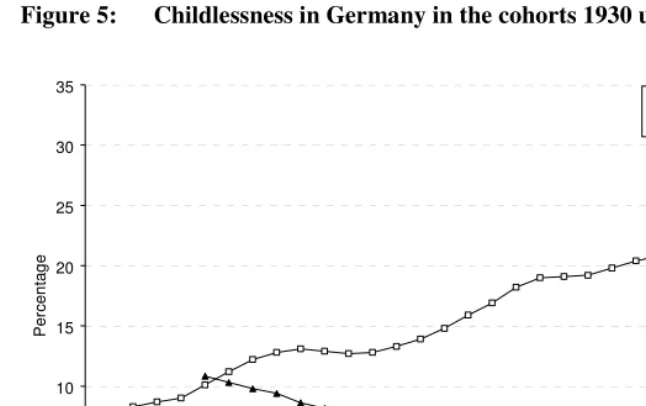
The estimated results show that childlessness in Germany, and in Western Germany in particular, is widespread and is rising rapidly. Only 7.1% of the Western German birth cohort 1935 remained childless (Fig. 5). This cohort underwent its family formation phase in the post-war period in the so-called “Golden Age of Marriage”, which was typified not only by high fertility, but also by low levels of childlessness. This period is, nevertheless, regarded as exceptional since today’s childlessness is not historically new. Twenty-six percent of women in the birth cohorts 1901-05 were childless. However, this degree of childlessness came about under special social circumstances. The high degree of childlessness among women born around 1900 was a result of the First World War and of the number of men lost (Dorbritz and Schwarz, 1996: 238). The same applies to women in the birth cohorts up to 1925 as a result of the Second World War.
hence refers to the fact that this increase is not linked to social crisis situations, but results from a voluntary decision not to have children.
Figure 5: Childlessness in Germany in the cohorts 1930 up to 1966 (in %)
0 5 10 15 20 25 30 35
1935 1939 1943 1947 1951 1955 1959 1963
Calendar years
P
e
rc
e
n
ta
g
e
Western Germany Eastern Germany
Source: Federal Institute for Population Research, own calculations.
The data for the birth cohorts 1940 to 1960 in Eastern Germany show that childlessness remained low there (Figure 5). The share of childless women in the birth cohort 1960 is 7.8%. Different behavioural patterns had hence become established in the two regions of Germany. The low rate of childlessness in the former GDR is a result of the conserving impact of the social circumstances in socialist societies, supporting the continuation of the behavioural patterns from the 1960s, as well as of the impact of the policy of reconciliation of work and parenthood. It was only in the birth cohorts after 1960 that childlessness also started to increase. A 13% share of childless women is anticipated for the 1966 birth cohort. This demonstrates the fact that different patterns of family formation still exist in both regions of Germany (cf. Section 4).
2005). Childlessness in the birth cohorts 1955 to roughly 1960 fluctuates around the already high value of approximately 30%. Childlessness then increases once more among women with a higher-education qualification born after 1960, reaching a value of 35.3% in the birth cohort 1964, and 38.5% in 1965. This trend is explained by the choice women in Germany have to make between work and family, a decision which is prejudiced against children even more frequently among the highly-qualified who are oriented towards gainful employment.
The high level of childlessness in Western Germany is the manifestation of the so-called polarisation phenomenon. The population is accordingly broken down into a family sector (those who live with children) and a non-family sector (those who live without children). The increase in childlessness in Western Germany was linked to a fall in the share of women who had only one child. Many individuals make a decision not to have children, or, if they decide in favour of family formation, usually two or more children are born. The emergence of this situation is traced to the concept of German family policy and the concomitant unfavourable conditions for reconciliation
of family and work (cf. Sections 6 and 7).
2.4 Age patterns and extramarital births
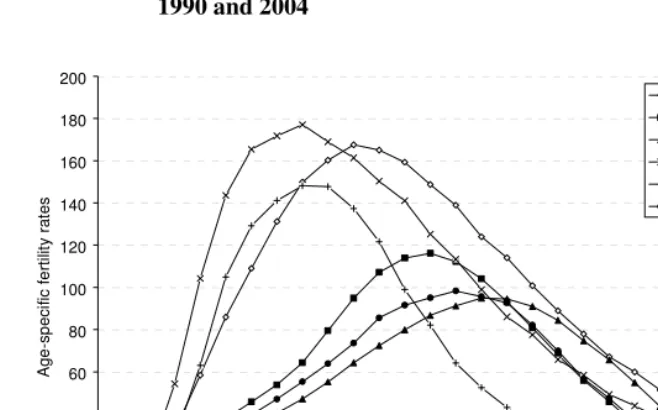
If one looks at the distribution of live births by the age of the mother and the development of the shares of extramarital live births, the German situation can be described in terms of both convergence and divergence.
Figure 6: Age-specific fertility rates in Western and Eastern Germany, 1960, 1990 and 2004
0 20 40 60 80 100 120 140 160 180 200
15 19 23 27 31 35 39 43
Age
A
g
e
-s
p
e
c
if
ic
f
e
rt
ili
ty
r
a
te
s
Western Germany 1960 Western Germany1990 Western Germany 2006 Eastern Germany 1960 Eastern Germany 1990 Eastern Germany 2006
Source: Federal Statistical Office, Germany.
women at the birth of their children was 28.8 years old, while the average age among Western German women was 29.9 years old. The link between low fertility and high age at motherhood is referred to repeatedly. In the view of the author, this link is also a result of the partner situation. Roughly 20% of women in the age group of 30-39 years olds do not have a partner. Particularly in this group, the lack of a partner is a highly important argument against the birth of a(nother) child. If, therefore, family formation is commenced at a relatively high age, the biological time window is only open for a short time, and if no suitable partner is found, desired fertility is not achieved.
Figure 7: Extramarital births per 100 births in Germany*, 1960 up to 2004
0 10 20 30 40 50 60 70
1950 1955 1960 1965 1970 1975 1980 1985 1990 1995 2000 2005
Years
P
e
rc
e
n
ta
g
e
Eastern Germany Western Germany
Source: Federal Statistical Office, Germany.
* Since 2001: Western Germany not incl. West Berlin, Eastern Germany not incl. East Berlin.
extramarital births already started to increase in the 1970s, which can be regarded as an effect of population policy in the former GDR. The share of extramarital live births already reached a value of almost 35% back in 1985. This does not mean that living together with children and being married were decoupled in the former GDR. The relatively high level can be explained by delaying effects on the age at marriage caused by family policy. Single mothers were particularly supported by family policy, received preferential treatment in housing and crèche places, and were able to claim paid release from work if the child was ill. In order to receive this support, people only married on expiration of the claim period (when the child turned one). This did not have an influence on the marriage rate, which was higher in the former GDR than in Western Germany. When these conditions ceased to apply, a drop in the extramarital rate was also anticipated in the 1990s. This presumption has, however, not been confirmed, and the upward trend continued. In recent years , roughly 60% of children were born to mothers who were not married at the time of birth. The differences in the German-German behaviour patterns have tended rather to widen than to converge, and the impression is created that, if at all, there could be a greater convergence of the Western German to the Eastern German behavioural patterns.
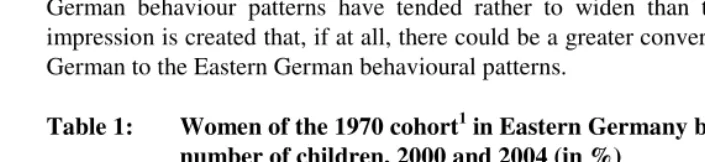
Table 1: Women of the 1970 cohort1 in Eastern Germany by marital status and number of children, 2000 and 2004 (in %)
Years Married Not married Total
Without children
With child(ren)
Without children
With child(ren)
2000 8.2 38.1 26.9 26.8 100.0
2004 3.8 48.9 19.0 28.3 100.0
Source: Federal Statistical Office, Germany, Micro census.
Note: 1 Without women still living in the parents’ household.
The high share of extramarital live births of necessity highlights the question of whether the parents marry after the birth of the children, or whether there has been an increase in the share of non-marital cohabitation with children. To examine the question, data from the Microcensus are evaluated. Here, the birth cohort 1970 is viewed in 2000 and 2004 in the classification of civil status and living together with children (Table 1). Women still living in the parental household are not included in the data.
This distribution shown in the table is an expression, first, of the early birth of
children, which was still typical of the situation in the new federal Länder when the
were unmarried at the time of the birth of their children. This spread changed somewhat by 2004. The share of women who live unmarried with child(ren) in a household has fallen, and the share of married women with child(ren) has risen to almost one half (49%). This shows that the decoupling of marriage and children has not advanced as far as might, at first glance, appear to be the case. Furthermore, the increase in the share of those who are married with children indicates that a large share of Eastern Germans do not marry until after the birth of children. Having said that, the share of those who are unmarried with child(ren), at 28%, remains relatively high, which indicates the continuation of the behavioural pattern of “children yes, marriage no”.
In order to explain the West-East differences, various hypotheses have been very recently developed which consider influences on both extramarital births and on the tendency to marry (Huinink, Konietzka 2003 68 ff). The various approaches are summarised below:
Better institutional childcare in combination with a widespread work orientation
leads to higher female employment in the new federal Länder. Women are hence more
economically independent, and are less likely to marry for reasons of economic security. In Western Germany, by contrast, child-oriented marriage with the goal of economic security plays a more significant role.
Single parents in Germany receive childcare places preferentially. Supply has
become scarcer in the new federal Länder, although the situation is more favourable
than in the West. Therefore, again because many women intend to keep working after having children, family policies have created incentives not to marry, or to postpone marriage.
Extramarital parenthood is more of a social norm in the new federal Länder. The
so-called extramarital rate was already very high in the former GDR in the 1980s, whilst in the West the norm of child-oriented marriage is still very widespread.
The changed character of the social institution of marriage and family after the end of the GDR leads to reticence towards marriage. Although the marriage rate was very high, marriage and family were de-institutionalised to a greater degree, particularly by the liberal divorce law (Salles 2005). The introduction of Western German divorce law has made the cost of divorce higher, making it easier to decide against marriage.
Konietzka and Kreyenfeld (2005, 56) used data of the Microcensus to examine the socio-structural differentiations of the process: "The analyses have shown that a low educational attainment in East and West Germany increases the probability that a woman remains single after the birth of a child. However, the determinants of unmarried partnerships are different. In the West, women with educational attainments
qualifying for university entrance ("Abitur") are a bit more likely to live in
certificate qualifying for university entrance ("Abitur") do not cohabit more frequently than women with a medium or low educational attainment. The persons most likely to live in unmarried partnerships are mothers without or with only a low educational attainment. This result contradicts the expectation that a higher formal education – as an indicator of increased orientation toward economic independence – positively influences a person's decision in favour of an unmarried partnership as the preferred form of family life."
2.5 Marriage3 and divorce
The low-fertility situation in Germany is accompanied by a very low marriage level. The trends in the Total First Marriage Rate hardly differ from those of the Total Fertility Rate. In Western Germany, the tendency to marry has decreased alongside the TFR from the second fall in the TFR onward. Given the age-specific first marriage patterns for 1971, 93.4% of women and 86.8% of men would enter into a first marriage in the course of their lives. The value for 1980 was, however, only 84.1% for women and 76.5% for men. The inclination to marry has fallen gradually to the present day. Only 76.8% of women, and as few as 66.6% of men, would ever enter into a first marriage given the age-specific first marriage patterns for 2004.
As was also the case with fertility, the originally high inclination to marry was maintained in Eastern Germany until the end of the former GDR. The Total First Marriage Rate (TFMR) for 1971, at around 96% for both women and men, implied that almost the entire population would marry at least once in their lives. Although this very high level did not hold up, in the second half of the 1980s the Total First Marriage Rate was still 90.0% for women and 85.1% for men. The inclination to marry was hence much higher than in Western Germany. With the end of the GDR, and the collapse in fertility, the marriage rates also fell sharply. The pattern of the universality of marriage dissolved. Since then, the TFMR has been lower than in Western Germany. In 2004, it was only 69% for women and 57% for men in Eastern Germany.
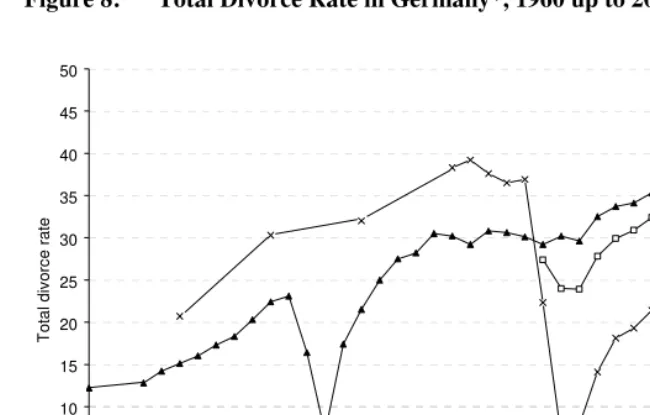
Since the 1960s, the Total Divorce Rate (TDR) in Germany has been characterised by a continuous upward trend, which was interrupted once in Western and Eastern Germany, respectively (Figure 8). In Germany as a whole, the Total Divorce Rate reached a value of 42.5% in 2004. It was 43.6% in Western Germany and 37.4% in Eastern Germany (calculated up to a duration of marriage of 25 years). The data shown
in Figure 8 reveal two divorce rate lows; namely, in 1978 in Western Germany, and in 1991 in Eastern Germany. Both were caused by amendments to the divorce law. The divorce law was amended in Western Germany in 1977, when the fault principle was replaced by the principle of irreconcilability. The vital aspect here was that the divorce procedure no longer sought to identify the guilty party in the separation, but only to determine a state of irreconcilability, and that a separation year was prescribed prior to divorce. This caused a delay in the finalizing of divorces when the law first went into effect. Exactly the same thing then happened in 1991 in the former GDR. The transfer of Western German divorce law to Eastern Germany, with the prescribed separation year, led to a short-term delay in the completion of pending divorces.
Since the divorce rates increased from a substantially lower level across the observation period, divorce rates for marriage cohorts do not yet reach the high values of recent period TDRs. The highest value of 32.9% was reached by the marriage cohort 1980 after 24 years of marriage. Lower values are found for the older and younger marriage cohorts. The older cohorts were not yet exposed to such high divorce risks in the first years of marriage. For instance, 27.1% of the marriage cohort 1969 had divorced by 2004, after a 35-year marriage duration. The younger cohorts record lower values since they have not yet been exposed to the risk of divorce for as long. However, 28.7% of the marriage cohort 1989 is already divorced after 15 years of marriage. The cohort divorce rate for these marriage cohorts will reach the 40% mark if the period TDR remains at its current level.
Figure 8: Total Divorce Rate in Germany*, 1960 up to 2004
0 5 10 15 20 25 30 35 40 45 50
1965 1969 1973 1977 1981 1985 1989 1993 1997 2001 2005
Years
T
o
ta
l
d
iv
o
rc
e
r
a
te
Germany Western Germany Eastern Germany
Source: Federal Statistical Office, Germany.
*Since 2001, Eastern Germany, not incl. East Berlin, Western Germany, incl. Berlin.
3. The change in living arrangements and family forms
course of the process of family formation and dissolution is observed. To this end, the situation in 2004 in Germany is analysed, differentiated by five-year age groups.
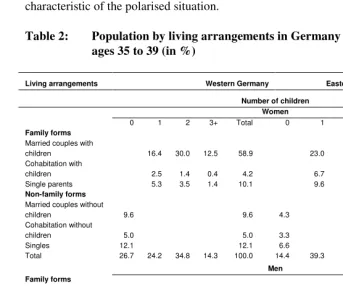
It can be determined at the start that the traditional family (married parents with at least one child) is the living arrangement most frequently selected. Having said that, only slightly more than half of the population in the age group of 35–39 lives in this arrangement. Among Eastern German men, it is, in fact, less than half of the population, at 47.7%. This is one of the major trends in the changes in living arrangements. Although the majority of the population continues to live in core families, the absolute dominance of this living arrangement has declined. Also, no new living arrangements have come about, but only the shares have changed in favour of extramarital living arrangements.
A close link between marriage and having children is typical of Germany. If one takes a detailed view, the intact two-child family is the most widespread living arrangement. Thirty percent of Western German women and 25.8% of Western German men are married and have two children. In Eastern Germany, it is 26.6% of women and 22.4% of men. This living arrangement no longer represents the largest share among Eastern German men, with this position being taken by those who live alone and have no children, at 26.9%. The shares of married couples with one child or with three and more children are relatively small.
Single parenthood is not uncommon among women – this living arrangement was experienced by 10.1% of women in Western Germany and 16.3% of women in Eastern Germany. This is above all a consequence of the high divorce rate, and is mainly to be regarded as a transitional living arrangement until a new partnership is formed. There are hardly any single male parents in Germany. In the observed age group, it is only 1.1% in the West, and 1.8% in the East. The rate of non-marital cohabitation with children is also low. It is especially low in the West, at around 4%, and somewhat higher in the East, at roughly 13%.
Finally, a polarisation in the living arrangements has occurred in Germany. This is represented in the high shares of childless living arrangements: 26.7% of Western German and 14.4 % of Eastern German women do not live with children. This share is again much higher among men, at 42.1% in the West and 36.8% in the East. The largest group among the childless is formed by those who live as single persons in a one-person household.
also be found among Eastern German men. Second, the one-child family is much more commonplace in Eastern Germany: 39.3% of women in Eastern Germany and 24.2% in Western Germany live with one child in the household. Third, the share of families with three and more children is higher in the West than in the East: 14.3% in Western Germany, but 9.7% in Eastern Germany. These three characteristics give rise to different patterns of family formation, which, however, lead to very similar fertility rates. A low TFR can be observed in Western Germany because childlessness is very high. The TFR is very low in Eastern Germany because one-child families are frequent. The high childlessness is compensated for in Western Germany by a larger share of families with three or more children. This can be regarded as an additional characteristic of the polarised situation.
Table 2: Population by living arrangements in Germany 2004,
ages 35 to 39 (in %)
Living arrangements Western Germany Eastern Germany Number of children
Women
0 1 2 3+ Total 0 1 2 3+ Total
Family forms
Married couples with
children 16.4 30.0 12.5 58.9 23.0 26.6 6.9 56.6
Cohabitation with
children 2.5 1.4 0.4 4.2 6.7 4.5 1.4 12.6
Single parents 5.3 3.5 1.4 10.1 9.6 5.4 1.3 16.3
Non-family forms
Married couples without
children 9.6 9.6 4.3 4.3
Cohabitation without
children 5.0 5.0 3.3 3.3
Singles 12.1 12.1 6.6 6.6
Total 26.7 24.2 34.8 14.3 100.0 14.4 39.3 36.5 9.7 100.0
Men Family forms
Married couples with
children 16.5 25.8 10.1 52.5 19.9 22.4 5.4 47.7
Cohabitation with
children 2.6 1.3 0.4 4.3 8.1 4.5 1.0 13.6
Single parents 0.7 0.3 0.1 1.1 1.3 0.4 0.1 1.8
Non-family forms
Married couples without
children 10.3 10.3 4.6 4.6
Cohabitation without
children 7.0 7.0 5.3 5.3
Singles 24.9 24.9 26.9 26.9
Total 42.1 19.8 27.5 10.6 100.0 36.8 29.3 27.3 6.5 100.0
The data for Germany as a whole in Table 3 show how living arrangements change over a person’s lifetime. To this end, the 2004 Microcensus listed the living arrangement concepts in five age groups between the ages of 20 and 44. Singles are the dominant group among 20- to 24-year-olds, at 51.8%. These are individuals who either live in a one-person household, or who still live in their parents’ homes, and who do not have a partner. The second-largest group, at 22.3%, are women and men who are in non-marital cohabitation without children. Both living arrangements rapidly lose significance with advancing age and the start of family formation. The share of singles remains comparatively high; it is 18.1% in the age group 35–39, and 15.9% in the age group 40–44. Singles form the second-largest group in the age group 35–39, constituting a higher share of the population than families with one child or three or more children. The very rapid drop in shares of non-marital cohabitation without children indicates that this living arrangement constitutes a preliminary stage for transition to other forms. The share of childless married couples fluctuates at around one-tenth in all groups. This is a result which was already found in a number of analyses. It can be presumed that this is an effect of German family policy, which links high transfer payments to marriage. The shares of non-marital cohabitation with children remain very low in all age groups. This is illustrated by the saying, “if children, then marriage”. The share of single parents also remains low, but reaches its highest level in the age group 40–44. As previously discussed, this is an effect of the high and rising divorce rate. With advancing age, married couples with children represent the largest shares of the population. Married people with children still constitute a narrow majority among the population, although the loss of significance of this living arrangement is clearly indicated in the data.
higher degree of freedom of choice also with regard to family formation (Huinink and Konietzka, 2007: 104f.).
Table 3: Population by living arrangements and age groups
in Germany 2004 (in %)
Living arrangements/Number of children Age groups (years)
20–24 25–29 30–34 35–39 40–44 Married couples with
children
1 6.8 13.6 17.7 17.3 18.4
2 2.3 9.4 19.8 27.5 28.8
3+ 0.4 2.4 6.3 10.5 11.1
Cohabitation with children 1 3.6 4.2 4.2 3.3 2.4
2 0.7 1.1 1.8 1.8 1.4
3+ 0.1 0.3 0.5 0.5 0.5
Single parents 1 3.3 2.9 3.0 3.4 4.2
2 0.5 1.0 1.5 2.1 2.3
3+ 0.0 0.2 0.5 0.7 0.7
Married couples without children
8.2 11.7 10.7 9.1 10.1
Cohabitation without children
22.3 18.4 10.5 5.7 4.2
Singles 51.8 34.8 23.5 18.1 15.9
Total 100.0 100.0 100.0 100.0 100.0
4. Desired number of children and reasons for not wanting a(nother)
child – Results of the Population Policy Acceptance Study
4.1 Desired fertility
Having repeatedly discussed the issue of increasing childlessness, it appears relevant to investigate whether the desire to remain childless can be found in the attitudes of the population. To do so, the data of the international Population Policy Acceptance Study
(PPAS) are to be evaluated (age range of respondents: 20-39 years).4
Table 4: Desired number of children in Germany, 2004 (%, average)
Number of children Western Germany Eastern Germany
Female Male Female Male
No children 16.6 27.2 5.8 21.1
One child 14.5 13.0 28.7 24.2
Two children 53.7 40.0 50.6 45.0
Three children 11.6 16.2 11.6 7.6
Four children or more 3.7 3.5 3.3 2.0
Average 1.73 1.59 1.78 1.46
Source: German Population Policy Acceptance Study.
The investigations carried out by Fahey and Speder (2004: 19 et seq.) have already revealed very low desired fertility in Germany. This is confirmed by the results of the PPAS (Tab. 4). Women in Western Germany desire on average 1.73 children, and those in Eastern Germany, 1.78. This is the lowest calculated value in the comparative group of PPAS countries. Desired fertility among men is once again much lower than among women. Western German men would like to have on average 1.59 children, and Eastern German men as few as 1.46. Desired fertility is low in Germany because the share of those who would like to remain childless is very high. This is particularly common
among men: 27.2 % of Western German and 21.1% of Eastern German men would like to remain childless. The share of those who wish to remain childless is lower among women, but it is still as high as 16.6% in the West. Eastern German women constitute an exception here: only 5.8% do not want to have children. Despite the lower desired fertility, the two-child family is still the family size most frequently aspired to. Among women, 69.0% (West) and 65.5% (East) want to have two or more children. Among men, these shares are 59.7% (West) and 54.6% (East). The main conclusion of these observations is that the special demographic situations are also reflected in desired fertility. This applies from a dual point of view. First, the high level of childlessness in Western Germany is an element of low desired fertility. The new German childlessness is thus likely to take on the nature of voluntary childlessness. This is to be further observed in the section below using the desired fertility of women and men who do not (yet) have children. Second, desired fertility shows the course of the different family formation patterns in Western and Eastern Germany. This is noticeable in particular among women. When it comes to the desired fertility of Western German women, the polarisation described above in the context of living arrangements can be seen here as well. The desire not to have any children is widespread, at 16.6%. Only a small number want to have only one child, at 14.5%. The desire for two children is then relatively common once more, at 53.7%. Remaining childless or founding a family with two or more children are behavioural alternatives in desired fertility. This virtually never occurs in Eastern Germany. The share of women with zero desired fertility is only 5.8%. By contrast, the desire for only one child, at 28.7%, is highly commonplace.
Differentiation by age groups provides further information on the change in desired fertility. It appears to be important here that there is evidently no change in desired fertility among younger respondents. Among young men, indeed, the effect occurs that the under-twenties desire even fewer children than the average (e.g., 1.74 in the age group 25 to 29). This puts in place a condition that supports the presumption of long-term low fertility in Germany.
4.2 Arguments for not having children
and that its limit is, therefore, reached quickly. What is more, those who do not want to have children are also included, and these respondents then state that they already have all the children they want. Of almost equal significance in the decision against having another child are concerns about the future and the desire to retain one’s current standard of living. For those who live without a partner, not having a suitable partner is also a highly relevant argument.
Table 5: Reasons for not wanting a(nother) child in Germany (very important and important / %)
Reasons for not wanting a (nother) child Without children With child(ren)
(Scale points very important and important) Female Male Female Male
I already have all the children I want 62.8 55.2 81.8 74.7
My state of health does not allow it 22.3 15.1 24.4 12.5 My job and professional activities would not allow it 42.0 39.2 33.4 23.7 I would have to give up leisure time interests 55.4 47.9 16.1 18.1 I want to maintain my present standard of living 67.1 61.0 47.8 45.4 A(nother) child would cost too much 39.2 49.8 44.4 44.7 I am too concerned about the future my children
will have 56.1 54.9 55.4 54.4
I would not be able to enjoy life as I have so far 59.5 51.9 23.0 25.6 I am/ my partner is too old 25.5 20.2 36.3 30.7 I live alone and I don’t have a steady partner 67.1 71.2 68.2 58.1 My partner does not want a(nother) child 30.0 21.0 30.4 30.6 My partnership does not work the way I would like
it to 22.4 14.8 18.0 20.0
Source: German Population Policy Acceptance Study.
as I have so far”. Among respondents with children, this reason was rated as important by 23% of women and 26% of men. Similar differences can be found in the responses to the reason, “I would have to give up leisure time interests”: 55% (women) and 48% (men) of the childless respondents rated this as important, compared with 16% (women) and 18% (men) of respondents with children. Noticeable differences can also be found in attitudes towards gainful employment. Among the childless, 42% of women and 39% of men judged the reason, “My job and professional activities would not allow it”, to be important or very important. Among those with children, this share was only 33% and 24%, respectively. By contrast, no clear deviations in response patterns were found when it came to other reasons (worried about the future, health, dysfunctional marriage, partner is against it, cost of having children).
In this context, a strategy that may prove promising is the erosion of the traditional life cycle. The classical life cycle, which is still popular today, must be extricated from the trichotomy of phases child/partner/pensioner. By breaking it down into discrete phases, not necessarily in chronological succession, it would be possible to relieve the presently enormous stress in a person's "rush hour of life" caused by the concomitance of family formation and career start. In this context, the German Family Report Commission in its seventh family report (2005) suggested the introduction of so-called ‘option times’, which would be similar to parental leave. It seems important that option times do not appear to be of inferior value when compared with a person's professional career and a rise in salary, because otherwise option times would again be used by women only. Consequently, it is very important to develop a model that is gender-neutral. Scientific research on this subject shows that the related biographic options are at present hardly accepted. "The first biographic option, namely early motherhood combining education and family formation, seems to hardly exist in Germany. …The second biographic option, timing motherhood after the achievement of a career position, is overshadowed by the artificial ‘horror threshold 35’. After that age, doctors automatically speak of late births and high-risk pregnancies. Mother and child are supposed to be subject to a higher health risk” (Allmendiger and Dressel, 2005, 27f.).
5. Paradigm shift – a family policy with demographically desirable
effects?
The concept which has evolved in this context is that of a sustainable family policy. "Sustainable family policy aims at increasing the birth rate and promoting women's employment. That is the basic concept that differentiates it from a more conservatively defined family policy, which associates the goal of increasing the birth rate with a reduction in women's employment. Sustainable family policy aims to improve mothers' involvement in working life in order to alleviate the poverty of families and children. In contrast, the approach in line with the traditional position would be to alleviate the poverty of families by extending financial transfers. What plays an important role in a sustainable family policy is the improvement of the conditions which allow women and men to reconcile work and family life" (Rürup and Gruescu 2005, 3).
role. And, assuming that women manage to attain gainful employment, it was up to them in most cases to solve the reconciliation problem, whilst men remained in the full-time breadwinner role. However, in addition to accomplishing a large number of tasks, the model of change to come needs to perform two main functions: namely, it must improve the ability of women to reconcile parenthood and gainful employment, and it must break up the traditional gender-specific role attributions. Such a paradigm shift in family policy is now beginning to occur, and also has a demographic foundation. That family policy means shaping society has, at least, been recognized. “Families need a coordinated web of deliberate measures in the areas infrastructure, time and money. What is therefore needed is a policy mix which aims to expand childcare, provide families with effective financial support and loosen the tight time constraints to which young families are subjected by improving the reconciliation of family and work”, according to a conclusion on the homepage of the Federal Ministry for Family Affairs, Senior Citizens, Women and Youth (2006). Over and above this, an urgent pro-family mentality change in all areas of society appears to be indicated.
6. Discussion of results: Nine causes of low fertility
Low fertility in Germany is naturally not related solely to the traditional, outdated concept of family policy. The causes of a specific trend in fertility development are always linked with a multi-structured and differentiated social development. The German demographic reference material frequently mentions the concept, developed by Franz-Xaver Kaufmann (1995), of the structural lack of consideration on the part of society towards the interests of families. This means, for example, a lack of childcare options, inflexible working hours, or too little and too expensive family-friendly housing. In line with this concept, the author considers it necessary to list the nine causes of low fertility he considers as most important, some of which closely overlap:
6.1 Individualisation trends
the decision not to have children; namely, giving up leisure time interests, doing without a career, and loss of prosperity. Social prejudice against people who have children is, from a cultural point of view, a result of individualist life views in which children and related expenditures are regarded as a private matter.
6.2 Childlessness
At least in Western Germany, childlessness is an important element of the pattern of family formation. We can therefore speak about an emergence of a culture of childlessness. It became so widespread because of the necessity to choose between family and gainful employment that was implied by the prevailing circumstances. Unfavourable conditions for reconciling family and work, particularly the insufficient number of childcare places for the under-threes, force women to choose between work and children. Having children is almost equivalent to leaving work. For this reason, particularly among younger women, and, again significantly more so among highly-qualified younger women, the decision against having children is taken more and more frequently. These originally rational decisions have now become a generative, culturally-independent pattern. Desired childlessness has today become a part of the lifestyle. This still small group in the population does not regard children as an enrichment to life; children do not fit in with their own identity. This attitude also entails a disinterest in family policy. The decision not to have children is deeply-rooted, and also cannot be changed by re-thinking family policy. This has consequences for fertility rates. A simple example to make this clear: If – allowing for childlessness of 26% - the simple replacement of the parents’ generation (average of 2.08 children) is to be achieved, 65% of women would have to have at least three children. Such a severe change in the pattern of reproductive behaviour appears to be outright utopian.
6.3 The concept of family policy
concept is called for which makes it possible to choose between the breadwinner-housewife model and the reconciliation model.
6.4 The reconciliation conditions
In the availability of childcare facilities, Germany ranks among the poorest in EU comparison. Women, however, no longer consider becoming housewives and mothers
their main raison d’être. This purpose-giving area of life has remained, but has been
supplemented by the idea of self-realisation through gainful employment. Since reconciliation of the two areas remains difficult, and given that women cannot look to family policy for help, corners have to be cut in one or both areas. A reaction to this is to shift births to a later age. Young women are, as a rule, very highly-educated, and want to use and refine this capital on the labour market. The postponement of family formation which this makes necessary is one path that can lead to childlessness. The realisation of desired fertility is delayed for so long that a childless lifestyle has become a habit, or no suitable partner can be found for family formation. A second option is to do without children among the highly-qualified or career-orientated who are unwilling to forego a high income or qualified vocational position because of children.
6.5 The gender problem
focus on non-domestic gainful employment. Women, by contrast, have fallen into the reconciliation trap because of the change in the gender roles, and regard themselves as being forced to overcome the tension between non-domestic gainful employment, or, indeed, career opportunities, and the traditional role allocation within the family. This means that opting for a child in Germany has become a decisive competitive disadvantage for women. Despite rapid social change, very little has happened, particularly in the area of the traditional allocation of the gender roles.
6.6 The change in the forms of cohabitation in partnerships – de-institutionalisation
Germany has become a plural society in which living arrangements have become diversified. This also means that there is no longer a standard biography of family formation. In particular, the formerly typical female biography of school – training – starting work – marriage – children – leaving work is no longer considered to be the only way of doing things even in the conservative corporatist welfare state of Germany. The analyses of the Microcensus have shown that marriage with children is still the dominant life model, but that it has lost its unchallenged dominance. The basic model of marriage with children has been supplemented by a broader range of living arrangements, including singles, non-marital cohabitation, lone parents, patchwork families or living apart together. From a sociological point of view, this process is referred to as de-institutionalisation. This does not mean that no one is marrying any more or having children, but that standardisation of conduct along the lines of the institution of marriage/family has become weaker. Classical and if-then links such as, “if love, then marriage”; or, “if marriage, then children”, have become loosened. This is a social precondition for pluralisation of the living arrangements to take place, and hence also for living arrangements to have become commonplace in which far fewer children are born.
6.7 The economic situation of the family and the high appreciation of children
child-rich families and single parents. In this context, a particular problem arises for the middle classes, in which only small numbers of children are born since the financial risk emanating from the birth of children is considered to be particularly threatening. This is caused by the fact that, given that the woman as a rule has to leave work, one income is missing, which has a negative effect on the family’s per capita income. Parental benefits and child benefits do not make up for this loss. The economic situation of childless households is much more favourable than that of those who live with children. This is enhanced by the high appreciation of children. The decision to have children is, as a rule, made deliberately. It is stressed here that the children should enjoy favourable conditions to get a good start in life. If this cannot be guaranteed because of the financial situation, the decision is made not to have children.
6.8 The situation in Eastern Germany
Fertility in Western and Eastern Germany is now, once again, approximately equal. An increase appears to be unlikely in Eastern Germany. Eastern Germany is regarded as a problem region because of the economic situation, where incomes are lower but the cost of having a child is the same. High unemployment, manifest xenophobia, and the ongoing loss of sections of the population through emigration and the rapid ageing of the population, are only a few of the symptoms of the crisis this region is experiencing. Hence, a social climate has been created which is not favourable to realising desired fertility.
6.9 Low desired fertility