The home environment as a predictor of mathematics
achievement in Ghana
Butakor, Paul Kwame
University of Ghana, Ghana ([email protected])
Nyarko, Kingsley
University of Ghana, Ghana ([email protected])
Received: 30 September 2016 Revised: 23 November 2016 Accepted: 18 January 2017
Available Online: 25 January 2017 DOI: 10.5861/ijrse.2017.1653
ISSN: 2243-7703 Online ISSN: 2243-7711
OPEN ACCESS
Abstract
This paper examined the significant role of the learner’s home environment in Ghanaian grade
8 students’ performance in mathematics in the 2007 Trends in International Mathematics and
Science Study (TIMSS). Applying multiple linear regression analyses on the TIMSS 2007
data from Ghana revealed a positive association between father’s educational level, watching
of TV or videos regularly at home, reading books for enjoyment at home regularly, and doing
homework regularly at home and mathematics achievement. On the contrary, a negative
relationship was found between mathematics achievement and the number of books at home,
home possessions, and the playing of computer games at home regularly. The paper
concluded with the recommendation that the learner’s home background should be considered
when designing policies and interventions aimed at improving students’ mathematics
performance.
The home environment as a predictor of mathematics achievement in Ghana
1. Introduction
The importance of mathematics in one’s education and in the socio-economic development of any nation has been emphasized in the literature. Mathematics is considered the foundation for success in many aspects of life because there will not be meaningful development without substantial knowledge of mathematics (MoESS, 2007). Moses and Cobb (2001) suggested that the knowledge of mathematics will play a vital role in the 21st century because it will serve as the path to political and cultural power. Educators, trainers, and researchers are in constant search of policies and programs aimed at improving mathematics teaching and learning in Ghana. Examples of such policies and programs are Ghana’s participation in TIMSS; the development and implementation of a new mathematics curriculum; and the re-structuring of teacher education (Butakor, 2015).
Unfortunately, the performance of Ghanaian students on both international large scale and national assessments has consistently been below satisfaction. For instance, Ghana ranked 45th out of 46 countries in 2003 (MoE, 2004), 58th out of 59 countries in 2007 (MoE, 2008), and last out of 63 countries in 2011 on TIMSS (Mullis, Martin, Foy, & Arora, 2012). Similarly, the Chief examiners of the University of Cape Coast, Institute of Education report indicated that mathematics recorded the lowest performance in the 2013/2014 first semester examinations for the Colleges of Education (Enu, Agyman, & Nkum, 2015). Therefore, a critical examination of factors influencing mathematics achievement is a major concern for mathematics educators and researchers in Ghana. However, studies on factors that influence mathematics achievement of Ghanaian students are limited in number and scope.
Further, a few of the studies conducted in this area didn’t include the home environment as a predictor of mathematics achievement. For instance, Butakor (2016) focused on attitudinal and instructional variables; students’ personal and school based factors were the focus of Enu et al. (2015). However, research has shown that the home environment has significant effects on students’ educational achievement (Mahanta, 2014; Visser, Juan, & Feza, 2015). The home is the first environment every child comes into contact with in the learning process. It is therefore imperative to consider its importance in terms of the influence it has on the students’ cognitive growth and academic achievement, more especially on mathematics achievement. Consequently the purpose of this study is to contribute to this area of research by examining the relationship between the home environment and students’ mathematics achievement in Ghana.
1.1 Factors that Influence Mathematics Achievement
Following the findings of the Coleman et al. (1966) report that suggested that the most influential factor on students’ learning achievement is the students’ family background, several studies have been conducted to examine the factors that impact mathematics achievement (Azina & Halimah, 2012; Chepete, 2008; Mohammadpour, 2012; Pangeni, 2014; Skouras, 2014). Studies have identified the following students’ level factors as predictors of mathematics achievement: gender, socio-economic status, attitudes towards mathematics, and parental education (Else-Quest, Hyde, & Linn, 2010; Pangeni, 2014; Phan, 2008; Yang, 2003; Goforth, Noltemeyer, Patton, Bush, & Bergen, 2014).
analyzing the TIMSS 2007 data from Malaysian sample, Azina and Halimah (2012) found that girls performed significantly higher than boys in mathematics. Following these gender differences in mathematics performance between boys and girls, studies have attempted to investigate the reasons associated with these differences. For instance, female students are reported to exhibit less confidence in their mathematical abilities than males (Leder, 1996; Norton & Rennie, 1998). Further, the stereotyping of mathematics as a male subject can affect mathematics performance and cause anxiety on the part of females, thereby affecting their interest in mathematics (Else-Quest et al., 2010; Ethington, 1992; Norton & Rennie, 1998).
Socio-economic status (SES) - Studies have also shown that the student home background-related factors contribute significantly to students’ learning outcome (Baker, Goesling, & LeTendre, 2002; Crane, 2001; O’Dwyer, 2005; Veenstra & Kuyper, 2004; White, 1982; Yang, 2003; Nyarko, 2010). Specifically, it has been demonstrated in the literature that there is a positive relationship between socio-economic status (SES) and students’ academic achievement (White, 1982; Yang, 2003). However, the variable SES has been measured differently by different researchers and the strength of this positive relationship between SES and academic achievement can be weakened depending on the indicators used for SES. In a meta-analysis of 101 studies that investigated the relationship between academic achievement and SES, White (1982) found that more than 70 different indicators were used as measures of SES. Also, Yang (2003) examined the effect of different dimensions of SES on students’ achievement by analyzing the effect of home possessions on students’ achievement in mathematics and science from 17 countries that participated in the TIMSS 1999 study. The results of this study noted that SES was multidimensional and he found two distinct dimensions of SES. These dimensions are a general economic factor, which includes indicators such as parents’ occupation and income, and a cultural capital factor, which included indicators such as parents’ education and home educational resources. Both factors were strongly related to academic achievement. Similarly, O’Dwyer (2005) investigated the variation in mathematics performance and its correlates by using the 8th graders data of TIMSS 1995 and 1999 from 20 participating countries. She employed the two-level HLM technique to analyze the relationship between students’ background variables and mathematics achievement. Her results showed that in 15 out of the 20 countries in 1995 and 14 out of 20 countries in 1999, there was a statistically significant relationship between mathematics achievement and the students’ home background index.
Parents’ educational level - Other studies also investigated the influence of parental level of education on students learning outcomes (Crane, 2001; Campbell, Hombo, & Mazzeo, 2001; Strutchens, Lubienki, McGraw, & Westbrook, 2004; Yang, 2003). According to Crane (2001), parents’ level of education can influence their children’s mathematics achievement scores by providing them the opportunity to learn, such as paying for tutoring and creating a conducive learning environment at home that can aid the development of mathematical thinking and skills. Pangeni (2014) suggested that parents who are educated to a higher level have greater access to a combination of economic and social resources that can be used to help their children succeed in schools. Analyzing the TIMSS data for Turkish grade eight students, Yayan and Berberoglu (2004) found a positive relationship between parental educational level and number of books at home and student achievement in mathematics. Schreiber (2002) using HLM techniques to analyze the TIMSS 1995 data from the USA concluded that students whose parents had higher levels of formal education scored higher on the mathematics achievement test than students whose parents had lower levels of formal education. Yoshino (2012) used the TIMSS 2007 data for USA and Japan to examine the relationship between students’ self-concept, mothers’ and fathers’ educational level, the quantity of books at home, and their mathematics achievement. The findings of Yoshino (2012) showed that mothers’ and fathers’ educational levels were positively correlated with students’ mathematics achievement.
indicated that the most successful students in the mathematics test were students who have highly educated parents.
Speaking of language of instruction at home - Research findings have suggested that when students frequently speak the language of instruction at home, they performed better on tests than their peers who speak the language of instruction less frequently at home (Abedi & Lord, 2001; Darling-Hammond, 2000; Howie, 2004; Howie & Plomp, 2001; Lamb & Fullarton, 2002; Mullis et al., 2012). Specifically when the official language of instruction is different from the language spoken at home, students learning achievement is affected inversely. However, in a study to investigate the association between students’ background factors and mathematics achievement using the 2007 TIMSS data for Malaysia, Azina, and Halimah (2012) found that not speaking the language of instruction at home was significantly associated with high achievement in mathematics. They suggested that this finding indicated that the performance of Malaysian students in mathematics is not influenced by the language used but may be due to the fact that non-Malaysian students outperformed their Malaysian counterparts. They also indicated that the students who did not speak the language of instruction at home were mostly Chinese and Indians. In Ghana, the language of instruction from Grade four onwards is English but students continue to study the local language of the community where the school is located. According to the Ministry of Education report (MoE, 2004; 2008), about 68% of Ghanaian Grade 8 students never spoke English or did so sparingly at home. The report also indicated that students coming from homes where English Language is always or almost always spoken outperformed students who never or spoke less English at home.
Attitudes towards mathematics - A number of studies have also investigated the relationships between students’ attitudes toward mathematics and mathematics achievement (Broeck, Opdenakker, & Damme, 2005; House, 2003 & 2005; Ma & Kishor, 1997; Ma & Wilkins, 2003; Shavelson, McDonnell, & Oakes, 1989). Most of these studies reported that students’ attitudes toward mathematics were positively correlated with mathematics achievement and continued study of mathematics. To support these findings, Broeck, Opdenakker, and Damme (2005) suggested that attitude strongly influences “the amount of time and intensity of the effort one spends on learning activities in the specific domain and eventually the learning results itself” (p. 109). Hammouri (2004) studied the relation between attitudinal and motivational variables and mathematics achievement in Jordan by using structural equation modeling techniques to analyze the TIMSS 1999 data. The findings of his study showed a positive relation between mathematics achievement and students’ educational aspiration, attitudes toward mathematics, confidence in ability, and self-perception of the importance of mathematics. House (2003) studied the relationship between students’ self-beliefs and mathematics achievement among middle schools students in Hong Kong by using the TIMSS mathematics data. By adopting a two-stage clustering design, House (2003) found that students who reported that they enjoyed learning mathematics and value the importance of mathematics in their daily lives tended to score higher on the mathematics test, whereas those who reported that mathematics was a difficult and boring subject obtained lower scores.
When House (2005) replicated his study by analyzing the 1999 TIMSS data for grade 8 students from Japan, he obtained results that confirmed the earlier findings that indicated a significantly positive correlation between students’ self-beliefs and mathematics achievement. Yoshino (2012) used the 2007 TIMSS data from the USA and Japan to examine the relationship between students’ self-concept of mathematics and mathematics achievement and found a positive relationship between students’ mathematics self-concept and mathematics achievement in both countries. However, the American students’ mathematics self-concept was found to be significantly higher than that of Japanese students at the same level of performance.
achievement in both reading and mathematics. Goldhaber and Brewer (1997) found that teachers who were certified in mathematics produced students with higher achievements in mathematics as compared to those with no certification in mathematics. Nye, Konstantopoulos, and Hedges (2004) supported this finding when they suggested that teachers’ certification has real and positive effects on students’ achievement. Chidolue (1996) and Fetler (2001) noted a positive correlation between teacher’s experience and students’ achievement. According to Kupari (2003), teachers who held the belief that mathematics was an abstract subject depended on procedural methods in their instruction that used rules and algorithms, whereas teachers who held a constructive beliefs of mathematics took more time to understand the strength and weakness of their students and adopt suitable methods to address their concerns. A similar suggestion was made by Staub and Stern (2002) when they said that the way teachers present their instructional materials is influenced by their beliefs. Wilson and Cooney (2002) also opined that what is taught in the classroom is greatly influenced by teachers’ beliefs.
Another classroom characteristic that has received attention in the literature is the instructional quality. According to Shavelson et al. (1989), the quality of instruction in the classroom is concerned with the performance of teachers, the characteristics of textbooks, and other teaching and learning materials used. The quality of instruction and the instructional activities students engaged in influence the quality of mathematics learned in the classroom (Hiebert & Grouws, 2007). Hiebert and Grouws (2007) reviewed the literature on the influences of classroom mathematics instructional activities on students’ learning and achievement and suggested that when instruction emphasized conceptual developments, both mathematical skills and conceptual understandings were promoted. It is therefore not surprising that current reforms in mathematics education across countries are seeking to replace traditional teaching methods that viewed students as passive learners with modern methods that view learning as a means of knowledge construction (Hiebert & Grouws, 2007). Stevenson, Lee, and Stigler (1986) suggested that when students are exposed to rigorous mathematics content material, their learning improves. Additionally, the types of tasks students are engaged with in the classroom provide the context in which students learn to think about the subject matter, and different tasks may provide students with different cognitive opportunities (Henningsen & Stein, 1997). Thus, teachers should provide students with tasks that have the potential to influence and structure their thinking and broaden their views of the subject matter they are engaged in.
Following Ghana’s low performance in mathematics achievement at the eighth grade in the TIMSS since 2003, gaining an understanding of factors that are related to mathematics achievement has become an important educational goal in the country. Several researchers have conducted studies over the years across different countries to examine the effects of contextual variables on students’ mathematics achievement. Some of these contextual variables included students’ background, teacher and classroom characteristics, and school related factors. The purpose of this study is to examine the significant role of the learner’s home environment in Ghanaian grade 8 students’ performance in mathematics on the 2007 Trends in International Mathematics and Science Study (TIMSS).
2. Methods and Materials
2.1 Data source and Sample
Consequently the sample for the present study consisted of 5, 294 grade 8 students of which 54% were boys that were selected following a random selection of one intact class from each of the selected schools in Ghana.
2.2 Measurement of Mathematics Achievement
In TIMSS 2007, test items were designed to address four content domains in mathematics: number, algebra, geometry, and data and chance. The TIMSS assessment framework is such that 30% of the test items covered the number content domain, 30% on algebra, 20% on geometry, and 20% on data and chance. The TIMSS assessment items were also designed to address different cognitive levels, namely, knowing, applying, and reasoning. As for the content areas, 35% of the items measured knowing, 40% measured applying, and 25% measured reasoning. Given the large number of test items for mathematics and a nearly equal number of science items, TIMSS employs a matrix sampling design such that each student is administered a sample of the items. In this procedure, each item is assigned to one of the unique 14 item blocks. Student test booklets are then assembled using different combinations of the item blocks in order to ensure subject content coverage. To report on students achievement scores, TIMSS employed item response theory (IRT) scaling methods to link individual student responses to items from previous administrations so as to track their progress in mathematics achievement.
In this case, a three-parameter IRT model is used in the case of dichotomously scored multiple-choice and short constructed-response items (Martins & Mullis, 2012). The generalized partial credit model (Martins & Mullis, 2012) is used for the extended constructed-response items. Since each student responds only to items in one booklet, and not the entire assessment, TIMSS employs a complex psychometric scaling method to obtain the estimate of the score each student would have obtained had the student attempted all the items on the test. This complex scaling technique, known as item response theory scaling with conditioning and multiple imputations, is used to generate imputed scores for the items that were not administered to a student, conditional on the student background characteristics and their responses to the attempted items (Gonzalez, Galia, & Li, 2004; Martin, 2005). To counter the effect of errors inherent in this imputation method, TIMSS computes five different plausible values for each student for the full assessment and each of the four content domains and the cognitive levels. The plausible values are standardized to have a mean and standard deviation of 500 and 100 respectively, which make them comparable across test administrations. In this study, only one of the five plausible values represented the total score for mathematics which was used as the dependent variable.
2.3 Independent Variables
factor. Consequently, the second factor was dropped and the eight possessions under factor 1 were summed to represent the home possessions variable. However, the results for the nine out-of-school activities didn’t yield any simple and interpretable structure; hence the individual items were considered separately in the analysis. Consequently, the effects of 14 home environment variables on mathematics were examined. These variables included; home possession, number of books at home, speaking of testing language at home, mother’s educational level, father’s educational level, watch TV/videos, play computer games, do jobs at home, work at paid jobs, talk/play with friends, play sports, read book for enjoyment, use the internet, and do my homework.
2.4 Data Analysis
For this study, multiple linear regression analyses procedures were employed to effectively examine the relative influence or contribution of each of the home environment variables on students’ mathematics achievement on the 2007 TIMSS. The analyses were performed using SPSS version 21.
3. Results
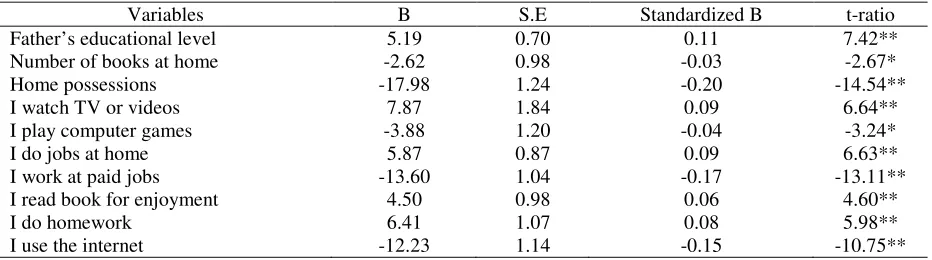
The results of the multiple regression analyses are presented in Table 1 below. The results indicate that ten out of the 14 home environment variables were significantly related to mathematics achievement and accounted for 17% of the variance in student’s mathematics achievement (R2 = 0.166, Adjusted R2 = 0.165, p<0.05).
Table 1
Multiple regression analysis results
Variables B S.E Standardized B t-ratio
Father’s educational level 5.19 0.70 0.11 7.42**
Number of books at home -2.62 0.98 -0.03 -2.67*
Home possessions -17.98 1.24 -0.20 -14.54**
I watch TV or videos 7.87 1.84 0.09 6.64**
I play computer games -3.88 1.20 -0.04 -3.24*
I do jobs at home 5.87 0.87 0.09 6.63**
I work at paid jobs -13.60 1.04 -0.17 -13.11**
I read book for enjoyment 4.50 0.98 0.06 4.60**
I do homework 6.41 1.07 0.08 5.98**
I use the internet -12.23 1.14 -0.15 -10.75**
Note. *p<0.05, **p<0.001
As shown in Table 1 above, the coefficient for father’s educational level was 5.19, which indicates that students with highly educated fathers outperformed students with less educated fathers. Similarly, students who spend most times watching TV/videos, do jobs at home, read book for enjoyment, and do their homework (b = 7.87, b = 5.87, b = 4.50, and b = 6.41). In contrast, students who come from homes with high number of books, and a lot of the home possessions (b = -2.62, b = -17.98) obtained mathematics scores lower than students who have less number of books and home possessions at home. Further, students who spend more time outside the school working at paid jobs as well using the internet (b = -13.60, and b = -12.23) performed less in mathematics than students who spend less time on these activities.
4. Discussion and Recommendations
findings of this study in relations with previous studies are discussed briefly below.
Both the number of books and the possessions in a student’s home were negatively related to mathematics achievement. This finding is in contrast to the results of previous studies (e.g., Mullis et al., 2004; Chepete, 2008). Analyzing the TIMSS 2003 eight grade mathematics data to investigate the association between student mathematics achievement and home resources across the countries that participated, Mullis et al. (2004) found that in many countries there was a positive relationship between mathematics achievement and students from homes with a range of resources such as computers, calculators, study desks, and dictionary. Chepete (2008) found in his analysis of the TIMSS 2003 data at Grade eight in Botswana that the number of books and the possessions in the students’ home were positively related to mathematics achievement. One possible explanation for the negative relationship between the number of books and mathematics achievement could be due to the purpose of the ownership of books. In Ghana, it is a common practice to see many households using books that were hardly opened for decoration purposes. Further, the books in the home could actually be for the parents or elderly siblings and, therefore, not suitable for grade eight students to use for learning or as source of information.
The results of this study revealed that the more time students spent outside of the school working at paid jobs or using the internet, the poorer their performance in mathematics. Similarly, Post and Pong (2000) found a negative association between adolescent employment and mathematics achievement, especially for boys, in their investigation of students’ employment on academic achievement during the middle school years by analyzing the NELS 1988 and the TIMSS 1995 data from the US and 22 other countries. Similarly, House and Telese (2012) found that, the more time students’ spent outside the school playing computer games or browsing the internet, the lower their mathematics achievement scores. It is a common practice nowadays to see the youth in Ghana and nearby African countries using the internet for fraud activities instead of learning purposes.
Whereas Schreiber (2002) and Yoshino (2012) found a positive association between fathers’ and mothers’ educational level and mathematics achievement, the findings were partially replicated in the present study. While father’s educational level was positively related to mathematics achievement, mother’s educational level was not significantly related to mathematics achievement. This could mean that parents are not investing uniform time and interest in the children’s mathematics learning. It is common to see this in most Ghanaian homes; while fathers’ are be helping their children with their homework, mothers will be busy elsewhere in the house.
4.1 Implications for practice
The findings of this study highlight the significant role of the home environment in predicting Ghanaian grade 8 students’ performance on the TIMSS 2007 mathematics test. The finding that about 17% of the variability in mathematics achievement was explained by the significant home environment variables has far-reaching implications for mathematics teachers and policy makers. The students’ home environment should be considered when designing interventions and policies aimed at improving students’ mathematics achievement. In particular, teachers must select their teaching methods and strategies carefully taking into accounts the home background of their students such that the teaching methods and strategies can be compensated for any deficiencies in the learner’s home background.
interest in the education of their children by providing them with enabling home environment and also encouraging their children to learn at home. Parents should also monitor the children use of computers and its related online activities. Measures should also be put in place to students to use the internet for educational and learning purposes. Attempts should also be made to eradicate all forms of child labour.
5. References
Abedi, J., & Lord, C. (2001). The language factor in mathematics tests. Applied measurement in Education, 14, 219-234. https://doi.org/10.1207/S15324818AME1403_2
Akiba, M., Letendre, G. K., & Scribner, J. P. (2007). Teacher quality, opportunity gap, and national achievement in 46 countries. Educational Researcher, 36, 369-387. https://doi.org/10.3102/0013189X07308739 Alkhateeb, H. M. (2001). Gender differences in mathematics achievement among high school students in United
Arab Emirates, 1991-2000. School Science and Mathematics, 101(1), 5-9. https://doi.org/10.1111/j.1949-8594.2001.tb18184.x
Azina, I. N., & Halimah, A. (2012). Student factors and mathematics achievement: Evidence from TIMSS 2007. EURASIA Journal of Mathematics, Science & Technology Education, 8(4), 249-255.
https://doi.org/10.12973/eurasia.2012.843a
Baker, D. P., Goesling, B., & Letendre, G. K. (2002). Socioeconomic status, school quality, and national economic development: A cross-national analysis of the "Heyneman-Loxley Effect" on mathematics and science achievement. Comparative Education Review, 46(3), 291-312.
Bassey, S. W., Joshua, M. T., & Asim, A. E. (2011). Gender differences and mathematics achievement of rural secondary students in Cross River State, Nigeria. Mathematics Connection, 10. Retrieved from http://www.ajol.info/index.php/mc/article/view/72784
Broeck, A. Van Den., Opdenakker, M., & Damme, J. V. (2005). The effects of student characteristics on mathematics achievement in Flemish TIMSS 1999 data. Educational Research and Evaluation, 11(2), 107-121. https://doi.org/10.1080/13803610500110745
Butakor, P. K. (2015). Multilevel modeling of factors that influence mathematics achievement in Ghana: A secondary analysis of TIMSS 2007 and 2011 (Doctoral Dissertation). University of Alberta. Retrieved from https://era.library.ualberta.ca/files/37720g36v
Butakor, P. K. (2016). Hierarchical linear modeling of the relationship between attitudinal and instructional variables and mathematics achievement. International Journal of Research in Education Methodology, 7(5), 1328- 1336.
Campbell, J. R.., Hombo, C. M.; & Mazzeo, J. (2001). NAEP 1999 trends in academic process: Three decades of student performance. Education Statistics Quarterly, 2(4). Retrieved from
http://nces.ed.gov/programs/quarterly/Vol_2/2_4/e_section2.asp#sec5
Cattell, R. B. (1966). The scree test for the number of factors. Multivariate Behavioral Research, 1(2), 245-276. https://doi.org/10.1207/s15327906mbr0102_10
Chepete, P. (2008). Modeling of the factors affecting mathematical achievement of Form 1 students in Botswana based on the2003 Trends in International Mathematics and Science Study (Unpublished doctoral dissertation). Indiana University. Retrieved from
http://pqdtopen.proquest.com/doc/304607066.html?FMT=AI
Chidolue, M. E. (1996). The relationship between teacher characteristics, learning environment and student achievement and attitude. Studies in educational Evaluation, 22, 263-274.
https://doi.org/10.1016/0191-491X(96)00015-6
Chowa, G. A., Masa, R. D., Ramos, Y., & Ansong, D. (2015). How do student and school characteristics influence youth academic performance in Ghana? A hierarchical linear modeling of Ghana youth save baseline data. International Journal of Educational Development, 45, 129-140.
https://doi.org/10.1016/j.ijedudev.2015.09.009
Office of Education.
Crane, J. (2001). Effects of home environment, SES, and maternal test scores on mathematics achievement. The Journal of Educational Research, 89(5), 305-314. https://doi.org/10.1080/00220671.1996.9941332 Darling-Hammond, L. (2000). Teacher quality and student achievement: A review of state policy evidence.
Educational Policy Analysis Archives, 8(1), 1-47. https://doi.org/10.14507/epaa.v8n1.2000 Darling-Hammond, L., & Youngs, P. (2002). Defining" highly qualified teachers": What does"
scientifically-based research" actually tell us? Educational Researcher, 31(9), 13-25. https://doi.org/10.3102/0013189X031009013
Else-Quest, N. M., Hyde, J. S., & Linn, M. C. (2010). Cross national patterns of gender differences in mathematics: A meta-analysis. Psychological Bulletin, 136(1), 103-127.
https://doi.org/10.1037/a0018053
Enu, J., Agyeman, O. K., & Nkum, D. (2015). Factors influencing students’ mathematics performance in some selected Colleges of Education in Ghana. International Journal of Education Learning and
Development, 3(3), 68-74.
Ethington, C. A. (1992). Gender differences in a psychological model of mathematics achievement. Journal for Research in Mathematics Education, 23, 166-181. ttps://doi.org/10.2307/749499
Fetler, M. (2001). Student mathematics achievement test scores, dropout rates and teacher characteristics. Teacher Education Quarterly, 28, 151-168.
Foy, P., & Joncas, M. (2003). TIMSS 2003 sampling design. In M. O. Mullis, I. V. S. Martin, & S. J.
Chrostowski (Eds.), TIMSS 2003 technical report (pp. 108-122). MA: TIMSS and PIRLS International Study Center, Boston College.
Foy, P., Arora, A., & Stanco, G. M. (2013). TIMSS 2011 user guide for the international database. Supplement 1: International version of the TIMSS 2011 Background and curriculum questionnaires. International Association for the Evaluation of Educational Achievement. Retrieved from
http://timssandpirls.bc.edu/timss2011/downloads/T11_UG_Supplement1.pdf
Frempong, G. (2010). Equity and quality mathematics education within schools: findings from TIMSS data for Ghana. African Journal of Research in Mathematics, Science and Technology Education, 14(3), 50-62. https://doi.org/10.1080/10288457.2010.10740691
Goforth, K., Noltemeyer, A., Patton, J., Bush, K. R., & Bergen, D. (2014). Understanding mathematics achievement: an analysis of the effects of student and family factors. Educational Studies, 40(2), 196-214. https://doi.org/10.1080/03055698.2013.866890
Goldhaber, D., & Brewer, D. (1997). Evaluating the effect of teacher degree level on educational performance. In W. Fowler (Ed.), Developments in School Finance, 1996 (pp. 197-210). Washington, DC: NCES. Gonzalez, E. J., Galia, J., & Li, I. (2004). Scaling methods and procedures for the TIMSS 2003 mathematics and
science scales. In M. O. Martin, I. V. S. Mullis, & S. J. Chrostowski (Eds.), TIMSS 2003 technical report (pp. 252–273). Chestnut Hill, MA: International Study Center, Boston College.
Guttman, L. (1954). Some necessary conditions for common-factor analysis. Psychometrika, 19(2), 149-161. https://doi.org/10.1007/BF02289162
Hammouri, H. (2004). Attitudinal and motivational variables related to mathematics achievement in Jordan: Findings from the third international mathematics and science study (TIMSS). Educational Research, 46, 241-257. https://doi.org/10.1080/0013188042000277313
Henningsen, M., & Stein, M. K. (1997). Mathematical tasks and students cognition: Classroom-based factors that support and inhibit high-level mathematics thinking and reasoning. Journal of Research in Mathematics Education, 28(5), 524-549. https://doi.org/10.2307/749690
Hiebert, J., & Grouws, D. A. (2007). The effect of classroom mathematics teaching on students' learning. In F. K. J. Lester (Ed.), Second handbook of research on mathematics teaching and learning (pp. 371 - 404). Charlotte, NC: Information Age Publishers.
House, J. (2005). Mathematics beliefs and achievement of adolescent students in Japan: Results from the TIMSS 1999 assessment. Psychological Reports, 97, 717-720. https://doi.org/10.2466/pr0.97.7.717-720 House, J., & Telese, J. (2012). Effects of mathematics lesson activities and computer use on algebra achievement
of eighth-grade students in the United States and Japan: Findings from the TIMSS 2007 assessment. International Journal of Instructional Media, 39, 69-81.
Howie, S. (2004). A national assessment in mathematics within an international comparative assessment. Perspectives in Education, 22(2), 149-162.
Howie, S. J., & Plomp, T. (2001) English language proficiency and other factors influencing mathematics achievement at junior secondary level in South Africa. Paper presented at the annual meeting of the American education research Association, Seattle, USA. (ERIC Document Reproduction Service No. Ed 455250).
Kaplan, D., & George, R. (1998). A structural model of parent and teacher influences on science attitudes of eighth graders: Evidence From NELS: 88. Science Education, 82(1), 93-110.
https://doi.org/10.1002/(SICI)1098-237X(199801)82:1<93::AID-SCE5>3.0.CO;2-W
Kupari, P. (2003). Instructional practices and teachers’ beliefs in Finnish mathematics education. Studies in Educational Evaluation, 29, 243–257. https://doi.org/10.1016/S0191-491X(03)90012-5
Lamb, S., & Fullarton. S. (2002). Classroom and school factors affecting mathematics achievement: A comparative study of Australia and the United States using TIMSS. Australian Journal of Education, 46(2), 154-171. https://doi.org/10.1177/000494410204600205
Leder, G. C. (1996). Mathematics and gender: Changing perspectives. In D. A. Grouws (Ed.), Handbook of research on mathematics teaching and learning (pp. 597-622). New York: Macmillan.
Ma, X., & Wilkins, J. L. M. (2003). Modeling change in student attitude toward and beliefs about mathematics. The Journal of Educational Research, 97(1), 52-63. https://doi.org/10.1080/00220670309596628 Mahanta, D. (2014). The role of home environment and mathematics achievement for students of secondary
schools in Nagaon district. Asian Journal of Advanced Basic Science, 2(1), 105-115.
Martin, O. M. (2005). TIMSS 2003 user guide for international database. Boston College, MA: PIRLS International Study Center.
Martin, M. O., & Mullis, I. V. S. (2012). Methods and procedures in TIMSS and PIRLS 2011. Chestnut Hill, MA: TIMSS & PIRLS International Study Center, Boston College.
Ministry of Education (2004). Results from Ghanaian Junior High 2 students’ participation in TIMSS -2007 in Mathematics and Science. Accra.
Ministry of Education [MOE]. (2008). Results from Ghanaian junior high 2 students’ participation in TIMSS 2007 in Mathematics and Science. Accra.
Ministry of Education, Science and Sports (MoESS). (2007). Teaching syllabus for mathematics. Accra: Ministry of Education.
Mohammadpour, E. (2012). Factors accounting for mathematics achievement of Singaporean eighth-graders. Asia-Pacific Education Researcher, 21(3), 507-518.
Moses, R. P., & Cobb, C. E. (2001). Radical equations: Math literacy and civil rights. Boston: Beacon Press. Mullis, I. V., Martin, M. O., Minnich, C. A., Stanco, G. M., Arora, A., Centurino, V. A., & Castle, C. E. (2012).
TIMSS 2011 encyclopedia: Education policy and curriculum in mathematics and science (vol. 1). Amsterdam, the Netherlands: International Association for the Evaluation of Educational Achievement. Mullis, I. V., Martin, M. O., Foy, P., & Arora, A. (2012). TIMSS 2011 international results in mathematics.
Amsterdam, the Netherlands: International Association for the Evaluation of Educational Achievement. Mullis, I. V. S., Martin, M. O., Gonzalez, E. J., & Chrostowki, S. J. (2004). TIMSS 2003. International
Mathematics Report. Boston College.
Neuschmidt, O., Barth, J., & Hastedt, D. (2008). Trends in gender differences in mathematics and science (TIMSS 1995-2003). Studies in Educational Evaluation, 34(2), 56-72.
https://doi.org/10.1016/j.stueduc.2008.04.002
Nyarko, K. (2010). Parental home involvement: The missing link in adolescents’ academic achievement. Educational Research, 1(9), 340-344.
Nye, B., Konstantopoulos, S., & Hedges, L. V. (2004). How large are teacher effects? Educational Evaluation and Policy Analysis, 26(3), 237–257. https://doi.org/10.3102/01623737026003237
O'Dwyer, L. M. (2005). Examining the variability of mathematics performance and its correlates using data from TIMSS '95 and TIMSS '99. Educational Research and Evaluation, 11(2), 155-177.
https://doi.org/10.1080/13803610500110802
Pangeni, K. P. (2014). Factors determining educational quality: Student mathematics achievement in Nepal. International Journal of Educational Development, 34, 30-41.
https://doi.org/10.1016/j.ijedudev.2013.03.001
Phan, H. (2008). Correlates of mathematics achievement in developed and developing countries: An HLM analysis of TIMSS 2003 eighth-grade mathematics scores (Unpublished doctoral dissertation). University Of South Florida, Florida.
Post, D., & Pong, S. (2000). Employment during middle school: The effects on academic achievement in the U.S. and abroad. Educational Evaluation & Policy Analysis, 22, 273-298. https://doi.org/10.2307/1164244 Rice, J. K. (2003). Teacher quality: Understanding the effectiveness of teacher attributes. Washington, DC:
Economic Policy Institute.
Schreiber, J. (2002). Institutional and student factors and their influence on advanced mathematics achievements. The Journal of Educational Research, 95, 274-286. https://doi.org/10.1080/00220670209596601 Shavelson, J. R., McDonnell, M. L., & Oakes, J. (1989). Indicators for monitoring mathematics and science
education. CA: The RAND Corporation.
Skouras, A. S. (2014). Factors associated with middle-school mathematics achievement in Greece: the case of algebra. International Journal of Mathematical Education in Science & Technology, 45(1), 12-34. https://doi.org/10.1080/0020739X.2013.790500
Staub, F. C., & Stern, E. (2002). The nature of teachers' pedagogical content beliefs matters for students'
achievement gains: Quasi-experimental evidence from elementary mathematics. Journal of Educational Psychology, 94(2), 344-355. https://doi.org/10.1037/0022-0663.94.2.344
Strutchens, M. E., Lubienski, S. T., McGraw, R., & Westbrook, S. K. (2004). NAEP findings regarding race and ethnicity: Students' performance, school experiences, attitudes and beliefs, and family influences. In P. Kloosterman & F. K. J. Lester (Eds.), Results and interpretations of the 1990-2000 Mathematics assessments of the national assessment of educational progress (pp. 269-304). Reston, VA: The National Council of Teachers of Mathematics.
Veenstra, R., & Kuyper, H. (2004). Effective students and families: The importance of individual characteristics for achievement in high schools. Educational Research and Evaluation, 10(1) 41- 70.
https://doi.org/10.1076/edre.10.1.41.26302
Visser, M., Juan, A., & Feza, N. (2015). Home and school resources as predictors of mathematics performance in South Africa. South African Journal of Education, 35(1), 1- 9. https://doi.org/10.15700/201503062354 Wayne, A. J., & Youngs, P. (2003). Teacher characteristics and student achievement gains: A review. Review of
Educational research, 73(1), 89-122. https://doi.org/10.3102/00346543073001089
White, K. R. (1982). The relation between socioeconomic status and academic achievement. Psychological Bulletin, 91(3), 461–481. https://doi.org/10.1037/0033-2909.91.3.461
Wilson, M. S., & Cooney, T. (2002). Mathematics teacher change and development. In G. C. Leder, E. Pehkonen, & G. Torner (Eds.), Beliefs: A hidden variable in mathematics education? (pp. 127-147). Boston, USA: Kluwer Academic Publishers.
Wilson, S., Floden, R., & Ferrini-Mundy, J. (2002). Teacher preparation research: An insider’s view from the outside. Journal of Teacher Education, 53, 190- 204. https://doi.org/10.1177/0022487102053003002 Yang, Y. (2003). Dimensions of socio-economic status and their relationship to mathematics and science
achievement at individual and collective levels. Scandinavian Journal of Educational Research, 47(1), 21-41. https://doi.org/10.1080/00313830308609
Turkish students. Studies in Educational Evaluation, 30(1), 87-104. https://doi.org/10.1016/S0191-491X(04)90005-3