Patron: Her Majesty The Queen Rothamsted Research Harpenden, Herts, AL5 2JQ
Telephone: +44 (0)1582 763133 Web: http://www.rothamsted.ac.uk/
Rothamsted Research is a Company Limited by Guarantee Registered Office: as above. Registered in England No. 2393175. Registered Charity No. 802038. VAT No. 197 4201 51. Founded in 1843 by John Bennet Lawes.
Rothamsted Repository Download
A - Papers appearing in refereed journals
Beringer, J. E. and Hirsch, P. R. 1984. Genetic-engineering and
nitrogen-fixation. Biotechnology & Genetic Engineering Reviews. 1 (1), pp. 65-88.
The publisher's version can be accessed at:
•
https://dx.doi.org/10.1080/02648725.1984.10647781
The output can be accessed at:
https://repository.rothamsted.ac.uk/item/8vqyw
.
© 15 April 2013, TAYLOR & FRANCIS LTD.
Full Terms & Conditions of access and use can be found at
https://www.tandfonline.com/action/journalInformation?journalCode=tbgr20
Biotechnology and Genetic Engineering Reviews
ISSN: 0264-8725 (Print) 2046-5556 (Online) Journal homepage: https://www.tandfonline.com/loi/tbgr20
Genetic Engineering and Nitrogen Fixation
J. E. Beringer & P. R. Hirsch
To cite this article: J. E. Beringer & P. R. Hirsch (1984) Genetic Engineering and Nitrogen Fixation, Biotechnology and Genetic Engineering Reviews, 1:1, 65-88, DOI: 10.1080/02648725.1984.10647781
To link to this article: https://doi.org/10.1080/02648725.1984.10647781
Published online: 15 Apr 2013.
Submit your article to this journal
Article views: 1547
3
Genetic Engineering and Nitrogen Fixation
J. E. BERINGER ANDP. R. HIRSCH
Soil Microbiology Departnzent, Rothamsted Experimenlal Station,Harpenden,
Hertjordshire AL5 2JQ, UK
Introduction
Nitrogen is extremely important in agriculture because it is a constituent of proteins, nucleic acids and other essential molecules in all organisms. Most of this nitrogen is derived from reduced or oxidized forms of N in the soil by growingplants, because plants and animalsare unable to utilize N2, which is
abundant in the atmosphere. Under most cropping conditions N is limitingfor growth and is provided in fertilizers, usually at rates of between 50 and 300 kg of N per ha per year (Anonymous, 1979). The only other sources available to plants are from decomposing organic matter, soil reserves, biological nitrogen fixation, the little that is deposited in rainfall and from other sources such as automobile exhausts.
Biological nitrogen fixation, the enzymic conversion of N2 gas to ammonia, is much the most important source of fixed nitrogen entering those soils which receive less than about 5 kg N per ha per year from fertilizers. The reduction of N2is catalysed by the nitrogenase system, which is very similar in composition
and function in all prokaryotes which produceitIndeed, subunits of nitrogenase obtained from different nitrogen-fixing species can often be mixed to produce a functional system (Emerich and Burris, 1978). In addition, DNA coding for the structural proteins is so highlyconserved in sequence that this coding has been used in hybridization experiments to demonstrate the presence of these genes in all nitrogen-fixing species of prokaryotes tested (Mazur, Rice and Haselkorn, 1980; Ruvkun and Ausubel, 1980). Nitrogenase is found only in prokaryotic micro-organisms and thus eukaryotes, such as plants!» can benefit from N2 fixation onlyjfthey interact withN2-fixing species of micro-organism
or obtain the fixed N after the death of the organisms.
Nitrogenase functionsonlyunder anaerobic conditions becauseitis
irreversi-blyinactivatedbyoxygen. The fixation ofN2requires large amounts of energy,
about 30 moles of ATP per mole N2 reduced (Hill, 1976;Schubert and Wolk,
1982), and thus can act as a major drain for energy produced by N2-fixing
micro-organisnls. The requirement for an anaerobic environment and large amounts of energy presents problems to the micro-organisms that fix N2 and Biolc·c'lmollJK.10tlml GelietitOEnKilu!('r;llgRcri(·J'Os··· Vol. I. Fcbruiiry 1984
0264·..8725/84/0 1/65···24S1 0.00+SO.OO©[nterceplLtd
66 J. E. BERINGER AND P. R. HIRSCH
to the geneticists who wish to extend the range of N2 ..fixing organisms. Many micro..organisms fix N2 anaerobically and thus avoid the oxygen problem. However, energy production from organic compounds is usually much more efficient when they are metabolized by oxidative phosphorylation. Thus, in general, nitrogen fixation under aerobic or microaerobic conditions should be more efficient, unless too much
energy
is lost in protecting the enzyme from oxygen or replacingoxygen-damagedproteins.An important consequence of the large energy cost for biological nitrogen fixation is that the activity of nitrogenase needs to be regulated very carefully to ensure that only the required amount of fixed N is produced. We discuss the regulation of N2 fixation in Klebsiella pneumoniae in some detail in this
chapter because a full understanding of how nitrogenase is regulated will be necessary ifthe transfer of N2 fixation genes(nij') into other species, or even
plants, is to be beneficial to the recipient organism.
The preceding remarks about the energy requirement and oxygen stability of nitrogenase point to two of the most important problems that will be faced in transferring nij"genes to new hosts. In this review we will discuss other potential problems and show how our knowledge of the genetics of nitrogen fixation might be exploited infuture.
N2-fixing organisms and associations
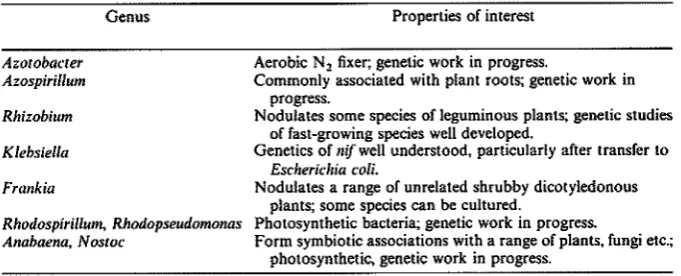
The ability to fix N2 is found in a wide range of prokaryotic micro-organisms, some of which are listed in Table 1. Genetic studies showing that the structural genes are highly conserved in all known N2-fixing species (Mazur, Rice and
Haselkorn, 1980; Ruvkun and Ausubel, 1980) suggest that the nifgenes must have evolved and then spread throughout virtually all groups of prokaryotic micro-organisms. The very great similarities in DNA sequence imply that nitrogenase probably evolved after most of the major groups of prokaryotes diverged and thus that the distribution of the genes occurred as a result of gene transfer. If the evolution had been convergent, one might expect to see similar proteins, but much less similarity in DNA sequence. If this evolutionary argument is correct there is good historical precedence for the potential for
Table 1. Nitrogen-fixing prokaryotes of particular interest for genetic manipulation.
Genus Properlies of interest
Azotobacter
Azospirillum
Rhizobium Klebsiella
FrClnkia
Rhodospirillum,RhodopseudomolJQs Anabae'la~Nostoi.'
Aerobic N;2fixer; geneticwork in progress.
Commonly associated with plant roots; genetic work in progress.
Nodulates some species of leguminous plants; genetic studies
orfast-growing species well developed.
Genetics ofnilweU understood, particularly after transfer to EsclJeric1liacoli.
Nodulates a range of unrelated shrubby dicotyledonous plants; some species can be cultured.
Photosynthetic bacteria; genetic work in progress.
Genetic engineeringand nitrogen fixation 67
expanding the range of N2-fixing organisms in the future. However,itshould
be pointed out that no eukaryotic organism has yet been shown to code for nitrogenase and thus the barriers to transfer discussed in this chapter may
indeed present very real obstacles to geneticists, who even now are mere amateurs in relation to the processes that havedirected evolution.
It should be made clear alsothat the amount of N2 fixed bymicro-organisms in nature is related almost directly to their access to available sources of
energy.
Thus for free-living micro-organisms levels of N2fixation seldom approach 5 kgN per ha per year(see Beringer, 1983), although free-living blue-green algae (cyanobacteria) can fix larger amounts when adequate moisture is available because they are photosynthetic and thus are able to meet their own needs for photosynthetically produced organic compounds. In general, with the possible exceptionofblue...green algae in rice paddiestitis unlikelythatgene manipulation
to improve N2fixation in agriculture will be worth contemplating forfree-living
micro-organisms.
Anumber of N2..fixing micro-organisms grow in the rhizosphere ofa range
of crop plants, particularly grasses (Dobereiner and Boddey, 1981) and, under these conditions where rootexudatesarefairly abundant, have the potential to fix quite large amounts ofN2 •Indeed, rates as high as lOO kg N per
ha
per year have been reported (von Bulowand Dobereiner, 1975). Unfortunately, experi~encehasshownthat theamounts ofN2fixedare relatively low (probably around lQ-20kgN per ha per year;seeBeringer, 1983) and that only a small part of this is available directly to the plant. While the potential sources of energy in the rhizosphere are greaterthanthoseinthebulk ofthe soil it must beremembered that many other micro...organisms are attracted to the exudates and will also compete with the plant for fixed N releasedby the N2-fixing species. Whether such associations can be exploited in the future to improve nutrient exchange, and hence the benefit to the plant, remains to be determined. Until we know much more about these associations it is difficult to see how important gene manipulation could be in improvingassociative N2fixation for crop production.
Much the most important N2-fixing associations that occur in nature, both
in terms of the amounts of N2fixed and the benefits to particular crops, involve
symbiotic associations in which plants provide specific structures in which the micro...organisms are contained. The best-known examples are root nodules which are induced by species of Rhizobium on leguminous plants, by the actinomyceteFrankiaon a range of woody dicotyledonous plants, by the blue-green alga Nostoc on cycads, and the special pockets in the leaves of the water fern Azolla containing the blue...green alga Anabaena.
In all of these symbioses the micro-organisms live inside the plant as monocultures. They receive carbon compounds directly from the host and the fixed N is made available directly to the host. Indeed,it is becoming clear now that the micro-organisms are modified in the host so that when nitrogenase is functioning they are no longer able to assimilate the fixed N and thus they release NH4+directly tobeassimilated by the plant (O'Gara and Shanmugam, 1976; Peters et al., 1982)~ Furthermore, the plant can regulate N2 fixation by
68 J. E. BERINGER AND
P.
R. HIRSCHIn relation to the comments made earlier in this chapterabout the efficient use of carbon compounds~it is clear (particularly for Rhizobium, which is an aerobe) that N2 fixationwill be most efficient in a micro-aerobicenvironment.
In the legume root nodulethis is facilitated by producing haemoglobin which ensures that O2 is transported to the centre of the nodule, which otherwise
could become anaerobic, because of the large number of bacteria present (probably about 106-10' per nodule), at a sufficiently low Po to prevent
in-activation ofnitrogenase. 2
Thus in our estimation the symbioses provide an example of the extent to which plants andmicrobes havehad to adaptthemselves in order for nitrogenase to function in a way to provide the maximum benefit to the host. We feel that it is important to bear this sophistication in mind when considering possible approaches towards the production of novel N2-fixing organisms.
Genetics of free-living nitrogen fixation
Some of the earlieststudieson the biochemistry of nitrogenase were made using enzyme isolated from the anaerobe Clostridium pasteurianum, and there has been much interest in aerobic nitrogen-fixing bacteria
such
as Azotobacter. However, the greatest advances in our understanding of biological nitrogen fixation have involved Klebsiella pneumoniae~ which is closely related to the non-nitrogen-fixing bacterium Escherichiacoli
t the standard organism for bacterial geneticists. Methods for geneticanalysis in E. coli could be applied to K. pneumoniaeand genes could be transferred between the two species and expressed in either of the two organisms. 'Classical' genetics with mutants defective in nitrogen fixation (NiC-)showed thenifgenes ofK. pneumoniaeto be located on the chromosome, between genes for histidine biosynthesis (his)and shikimic acid uptake (shiA). The proximity of thehis and nifregions was used by Dixon and Postgate (1972) to transfer these regionsentirefrom a strain ofK. pneumoniae,
carrying
a conjugative gene..mobilizing plasmid, to an E. colistrain which required histidine. E.
coli
recipients no longer requiring histidine for growth were found to have acquired the ability to fix nitrogen. Subsequently, a conjugative plasmid, pRDI, with a wide host-range and which had picked upthe
K. pneumolliae n~land
hisgenes~was selected
andtransferred to several
different bacterial genera (Dixon, Cannon and Kondorosi~1976).Complementation analysis of differentn~rmutations,transductional and other
forms of genetic mapping, and the physical purification of DNA fragments by
cloning into small plasmids have led to the construction of a physical map over a region of about 24kb which is the nij·DNA (Cannon, Riedel and Ausubel, 1979; Riedel~ Ausubel and Cannon, 1979) and to the recognition and mapping of 17 separate genes within the nifcluster. Mutagenesis using DNA elements such as transposons andbacteriophage Mualso facilitated the identification of eight operons (groups of genes transcribed as a block from one promotor) within the nij·gene cluster (Dixon et al., 1977; Kennedy, 1977; MacNeil etat.,
1978;Merricketat.) 1980;Piihler and Klipp, 1981).
More recently, RNA transcripts have been mapped and the promotor regions from the nifgene cluster have been cloned and sequenced so thattheinitiation
68 J. E. BERINGER AND
P.
R. HIRSCHIn relation to the comments made earlier in this chapterabout the efficient use of carbon compounds~it is clear (particularly for Rhizobium, which is an aerobe) that N2 fixationwill be most efficient in a micro-aerobicenvironment.
In the legume root nodulethis is facilitated by producing haemoglobin which ensures that O2 is transported to the centre of the nodule, which otherwise
could become anaerobic, because of the large number of bacteria present (probably about 106-10' per nodule), at a sufficiently low Po to prevent
in-activation ofnitrogenase. 2
Thus in our estimation the symbioses provide an example of the extent to which plants andmicrobes havehad to adaptthemselves in order for nitrogenase to function in a way to provide the maximum benefit to the host. We feel that it is important to bear this sophistication in mind when considering possible approaches towards the production of novel N2-fixing organisms.
Genetics of free-living nitrogen fixation
Some of the earlieststudieson the biochemistry of nitrogenase were made using enzyme isolated from the anaerobe Clostridium pasteurianum, and there has been much interest in aerobic nitrogen-fixing bacteria
such
as Azotobacter. However, the greatest advances in our understanding of biological nitrogen fixation have involved Klebsiella pneumoniae~ which is closely related to the non-nitrogen-fixing bacterium Escherichiacoli
t the standard organism for bacterial geneticists. Methods for geneticanalysis in E. coli could be applied to K. pneumoniaeand genes could be transferred between the two species and expressed in either of the two organisms. 'Classical' genetics with mutants defective in nitrogen fixation (NiC-)showed thenifgenes ofK. pneumoniaeto be located on the chromosome, between genes for histidine biosynthesis (his)and shikimic acid uptake (shiA). The proximity of thehis and nifregions was used by Dixon and Postgate (1972) to transfer these regionsentirefrom a strain ofK. pneumoniae,
carrying
a conjugative gene..mobilizing plasmid, to an E. colistrain which required histidine. E.
coli
recipients no longer requiring histidine for growth were found to have acquired the ability to fix nitrogen. Subsequently, a conjugative plasmid, pRDI, with a wide host-range and which had picked upthe
K. pneumolliae n~land
hisgenes~was selected
andtransferred to several
different bacterial genera (Dixon, Cannon and Kondorosi~1976).Complementation analysis of differentn~rmutations,transductional and other
forms of genetic mapping, and the physical purification of DNA fragments by
cloning into small plasmids have led to the construction of a physical map over a region of about 24kb which is the nij·DNA (Cannon, Riedel and Ausubel, 1979; Riedel~ Ausubel and Cannon, 1979) and to the recognition and mapping of 17 separate genes within the nifcluster. Mutagenesis using DNA elements such as transposons andbacteriophage Mualso facilitated the identification of eight operons (groups of genes transcribed as a block from one promotor) within the nij·gene cluster (Dixon et al., 1977; Kennedy, 1977; MacNeil etat.,
1978;Merricketat.) 1980;Piihler and Klipp, 1981).
More recently, RNA transcripts have been mapped and the promotor regions from the nifgene cluster have been cloned and sequenced so thattheinitiation
68 J. E. BERINGER AND P. R. HIRSCH
In relation to the comments made earlier in this chapter about the efficient use of carbon compounds, it is clear (particularly for Rhizobium, which is an aerobe) that N, fixation will be most efficient in a micro-aerobic environment. In the legume root nodule this is facilitated by producing haemoglobin which ensures that 02 is transported to the centre of the nodule, which otherwise could become anaerobic, because of the large number of bacteria present (probably about 106-107 per nodule), at a sufficiently low P02 to prevent in-activation of nitrogenase.
Thus in our estimation the symbioses provide an example of the extent to which plants and microbes have had to adapt themselves in order for nitrogenase to function in a way to provide the maximum benefit to the host. We feel that it is important to bear this sophistication in mind when considering possible approaches towards the production of novel N2-fixing organisms.
Genetics of free-living nitrogen fixation
Some of the earliest studies on the biochemistry of nitrogenase were made using enzyme isolated from the anaerobe Clostridium pasteurianum, and there has been much interest in aerobic nitrogen-fixing bacteria such as Azotobacter. However, the greatest advances in our understanding of biological nitrogen fixation have involved Klebsiella pneumoniae, which is closely related to the non-nitrogen-fixing bacterium Escherichia coli, the standard organism for bacterial geneticists. Methods for genetic analysis in E. coli could be applied to K. pneumoniae and genes could be transferred between the two species and expressed in either of the two organisms. ’Classical’ genetics with mutants defective in nitrogen fixation (Nil) showed the nif genes of K. pneumoniae to be located on the chromosome, between genes for histidine biosynthesis (his) and shikimic acid uptake (shiA). The proximity of the his and nil regions was used by Dixon and Postgate (1972) to transfer these regions entire from a strain of K. pneumoniae, carrying a conjugative gene-mobilizing plasmid, to an E. coli strain which required histidine. E. coli recipients no longer requiring histidine for growth were found to have acquired the ability to fix nitrogen. Subsequently, a conjugative plasmid, pRDI, with a wide host-range and which had picked up the K. pneumoniae nil and his genes, was selected and transferred to several different bacterial genera (Dixon, Cannon and Kondorosi, 1976).
Complementation analysis of different nifmutations, transductional and other forms of genetic mapping, and the physical purification of DNA fragments by cloning into small plasmids have led to the construction of a physical map over a region of about 24 kb which is the nil DNA (Cannon, Riedel and Ausubel, 1979; Riedel, Ausubel and Cannon, 1979) and to the recognition and mapping of 17 separate genes within the nil cluster. Mutagenesis using DNA elements such as transposons and bacteriophage Mu also facilitated the identification of eight operons (groups of genes transcribed as a block from one promotor) within
the nil gene cluster (Dixon et al., 1977; Kennedy, 1977; MacNeil et al., 1978; Merrick et al., 1980; Piihler and Klipp, 1981).
Genetic engineeringand nitrogen .{ixation 69
point for each operon is now known (Beynon et aI., 1983; Drummond et
at.,
1983; Sundaresanet aI.,1983).Onemethod used to identify promotorsisto fuse a fragment lackinga
promotor but carrying the structural gene forp.
galactosidase{lacZ},to putative promotorregions. Promotor activity can then be measured by assaying p-galactosidase activity, and this has contributed towards understanding the control ofexpression ofthe nifoperons (Dixon el aI., 1980; Hill et ai., 1981; MacNeil, Zhu and Brill~1981; Merrick et ttl.t 1982;Drummondet ai.,1983; OwandAusubeI, 1983). Thegeneticmap,gene functions, organization and regulation are summarized inFigures1-3 and discussed below. Nitrogenase has t\VO soluble protein components, Jand II. Component I
consists of two copies of two subunits leX and
Ip,
which are encoded by nifK andnifD respectively. It contains both Mo and Fe atoms and is often referred to as the iron-molybdenum protein. Component II has two identical subunits encoded by nifH. Because it contains Fe atoms it is sometimes referred to as the Fe protein. These three genes, together with nifY (the function of the gene product is not yet known), are arranged in one operon. It is suggested thatnifF encodes a flavodoxin which transfers electrons to nitrogenase, and that
nil
Jencodesapyruvate oxidoreductasewhichtransfers electronsfrom pyruvate to the flavodoxin. Products of two other genes,nifMand nijS,are required for processing thenifHgeneproduct, component IIofnitrogenase (Roberts et al.,1978).Functional nitrogenase requiresaninorganic cofactor containing Fe and Mo atomst known as FeMoCo and four genest nif13, nijN, nifE and nifV, are
involved in its synthesis and maturation (Robertset al.)1978). Nitrogen fixation requires transfer of an electron from component II to component I with con-comitant hydrolysis by component II of MgATP to MgADP. The main reductant for in t'ioo nitrogen fixation by K. pneumoniae is probably pyruvatet
and nifFand nifJ gene products are required for transport of electrons from pyruvate via a ftavodoxin to component II (Hill and Kavanagh, 1980). The functions ofthree othernifgenes(nifQ, nifU,nifX)are not yet known.
All then~foperons (shown inFigure1) are regulated byproducts ofnifAand
nifL. The 11ifA gene product is required for expression of all the nifoperons except nifLA, and the nifL gene product represses expression, probably by inactivating thenifA gene product.
Nitrogenase is expressed only under certain physiological conditions: the enzyme is rapidly and irreversibly inactivated by exposure to oxygen and K.
pneunJoniae fixes nitrogen only in anaerobic or extremely micro...aerobic conditions. It is a facultative aerobe and when exposed to 02' nifexpression rapidly ceases(Eadyet
at.,
1978),probably because of nifL-mediated repression (Hillet al., 1981). Nitrogen fixation uses energy, and when fixed nitrogen (nitrate, ammonia or amino acids) is available nifAexpression is repressed, as are other genes involved in nitrogen metabolism. The regulation of genes under~nitrogencontrol' is therefore of critical importance to expression ofnif.
Early models for regulation of genes under nitrogen control inK.pneulnoniae
proposed that glutamine synthetase (GS) was responsible, but recent work with
II
promotors transcripts gene
product size Nitrogenase components
...
~G-b--
60 S6 36~o
~--'--1 Transrer of electrons from pyruvate to nifF gene product --Fe Mo Co_._}=
-synt~esiSlpr~~~~~g -__ .O.::.-=.==-_ maturation ·4 <..;
_..
__
~.L_ F M V S U X N E 26 28· 42· 42 32-1S· SO 40---_...
_._-Processing nifH product Flavodoxin Figure I. Summary of nif gene cluster organization, transcription ,tnd gene products. Transcripts and promotors according to Beynon el al. (1983) and M. Cannon (personal communication. uifM can also be transcribed off its own less efficient promotor~ Gene product size: molecular weight x 10-3. • Ausubel and Cannon (1980), Roberts and Brill (1980).Genetic engineering and nitrogen fixation 71
nifJ
nifF
ni"{(M.S)
n!fK.D
"{(B. N. E. V Fe Mo("o
r-ATP
~"DP
~
Glulamatc Glutamine
'----/
F\
OI"1m.le
2.0xoglularateAmino acids
Figure 2. Functions ofnifgeneproductsin nitrogen fixation.
Activalcs
~ ~--> n~rpromolors
Activates promolors under N·control
Represses promotors
under Ncontrol
Figure3. Nitrogencontrolandnifexpression inK. pneumotliae.
Kir
nifIRM
nifK. 0
nifB, N, F. 1’
Genetic engineering and nitrogen fixation 71
NI-1:
Glutamate Glutamine
GOGAT Glutamate 2-0xoglutarate
Amino acids
Figure 2. Functions of nif gene products in nitrogen fixation.
mr A
Activates promotors under N-control
Activator
Rep essor
Represses promotors under N control
Activator
nifL I nifA
[rtactivatcs rtifA gene product
Figure 3. Nitrogen control and nif expression in K. pneumoniae.
Activates
72 J. E. BERINGER AND P. R. HIRSCH
been found to be the first in a transcriptional unit. The second gene, ntrB (formerlyglnL)and the third,l1trC(glnG)are implicated in nitrogen control in conjunction with a separate gene,ntrA (gin F). Genes ntrB and ntrC also have their own weak promotor within theginAoperon. TheginAoperon is transcribed constitutively at a low level~ and the lltrB and ntrC gene products together' repress operons under nitrogen control includingginAbut not the internal ntrB
promotor. This allows the constitutive expression of the ntrB and ntrC gene products. However, when the ntrA gene product is expressed, itassociates with the nu·Cgene product to form an activator for theginA promotor and others under nitrogen control. It is proposed thatntrCencodes a DNA-binding protein which activates transcription in conjunction with the nlrA gene product, and that the ntrB gene product is either a competitor for DNA-binding sites with thentrC-ntrA activator or inactivates it. In this model, (summarized in Figure
3), lltrA expression is essential for derepression of genes under nitrogen control (including thenifregulator nifLA) and must therefore be expressed when fixed nitrogen becomes deficient, in effect switching on the appropriate genes.
It has recently been reported (Drummondet
at.,
1983; Ow and Ausubelt 1983)that the nifA gene productcan substitute for ntrC in activating operons under nitrogen control in conjunction with the ntrA gene product. In addition, the
ntrC or nifA gene products are necessary for transcription of the nifLA operon (Drummond et td., 1983; Ow and Ausubel, 1983). The similarity between the nifA and ntrC gene products and thenifLA and ntrBC operons has led to the suggestion thatnifAevolved from ntrC (Merricket ai" 1982; Drummondetal., 1983; Ow and Ausubel, 1983). Howevertthey have diverged sufficiently to prevent ntrCfrom replacing nifA in activating the nifHpromotor, The DNA sequences for all the nij'operon promotors have recently been published (Beynon et al.,
1983; Drummond et
at.,
1983)and have been shown to differ from other promotor sequences known in enteric bacteria.Beynonand co-workers(1983)report that the nij'promotors contain similar DNA sequences arranged in two conserved regions, One of the regions is suggested to be specific for nifA protein binding, and the 11if
LA promotor alone has a slightly different sequence which may bebecause the primary activator is the ntrC rather than the nijA gene product. The other conserved region was found in all the nifpromotors and may be specific to promotors expressed under conditions of nitrogen starvation. It is possible that thetltrA gene product interacts with RNA polymerase toproduce a form which recognizes promotors of genes to be switched on under these conditions.
In
summary,
the nifLA operon is not transcribed when high levels of fixed nitrogen are presentt but when this drops the ntrA gene product is active andin conjunction with the ntrC gene product de-represses transcription of nij'LA. However,thenifLgene product preventsthe nij'A productfrom activating other nifpromotors until the fixed-nitrogen level drops and nitrogen starvation begins. The nijA gene product is then active (the nifL product inactive) and, in association with the ntrC gene product, allows the nif operons to be expressed. Mutants with constitutive expression ofnifA and no llifL gene products can transcribe thenifoperons in the presence of fixed Nand O2 (Buchanan-Wollaston et aI.,
Genetic engineering and nitrogen fixation 73
NH;, N03 ,amino acids
andother fixed nitrogen levels in cell
high
(>14mM NH;)
ntrBC transcribed at low
level; gene products
together repress promotors under nitrogen control
includingnifLA
ntrA inactive
temp. 37°C
O2
NH; etc
nifLgene productactive..
repressesnifA product
(possibly bybinding toit)
low
« 14 mM NHt e.g.3roM NHt)
ntrAexpressed/activated:
combines withntrCgene
product to activate promotorsunder nitrogen
controlincludingginA operonandnifLA
temp.30aC
(no0~orNH;etc)
"i/A
product active ( - not repressedbynifL product) in conjunction with"IrA geneproduct.. activatesnifpromotors (andcanalso activate other nitrogen·regulated promotors.. replacingtitre)Figure 4. Regulation of nifexpression inK.pnellnlolliae(after Merrick, 1982; Merricketal., 1982; Ow and Ausubel, 1983; Drummond et al., 1983).
active form at high temperature or in the presence of fixed N and oxygen, but inactive at
lower
temperatures or in the absence of O2 and fixed N(Figure 4).Transfer ofnifgenes from K. pneumoniaeto other organisms
The description of the K.pneumoniae nifgenes and their regulation illuminates some of the problems which will be encountered when attempting to transfer
nifto organisms other than the closely related enteric bacteria. Repression of
nifexpressionby temperature,O2 or fixed N can be overcomebydeleting the 11.ifLgene, which allows constitutive expression of thenifpromotors mediated bythenifA and ntrC gene products. However, recognition of the nifpromotors
.by
DNA-dependentRNA
polymerase is also required, and the ability of the host totranslatethenifRNA correctly: ribosome..binding sites and codon usage Genetic engineering and nitrogen fixation 73NH;, N03 ,amino acids
andother fixed nitrogen levels in cell
high
(>14mM NH;)
ntrBC transcribed at low
level; gene products
together repress promotors under nitrogen control
includingnifLA
ntrA inactive
temp. 37°C
O2
NH; etc
nifLgene productactive..
repressesnifA product
(possibly bybinding toit)
low
« 14 mM NHt e.g.3roM NHt)
ntrAexpressed/activated:
combines withntrCgene
product to activate promotorsunder nitrogen
controlincludingginA operonandnifLA
temp.30aC
(no0~orNH;etc)
"i/A
product active ( - not repressedbynifL product) in conjunction with"IrA geneproduct.. activatesnifpromotors (andcanalso activate other nitrogen·regulated promotors.. replacingtitre)Figure 4. Regulation of nifexpression inK.pnellnlolliae(after Merrick, 1982; Merricketal., 1982; Ow and Ausubel, 1983; Drummond et al., 1983).
active form at high temperature or in the presence of fixed N and oxygen, but inactive at
lower
temperatures or in the absence of O2 and fixed N(Figure 4).Transfer ofnifgenes from K. pneumoniaeto other organisms
The description of the K.pneumoniae nifgenes and their regulation illuminates some of the problems which will be encountered when attempting to transfer
nifto organisms other than the closely related enteric bacteria. Repression of
nifexpressionby temperature,O2 or fixed N can be overcomebydeleting the 11.ifLgene, which allows constitutive expression of thenifpromotors mediated bythenifA and ntrC gene products. However, recognition of the nifpromotors
.by
DNA-dependentRNA
polymerase is also required, and the ability of the host totranslatethenifRNA correctly: ribosome..binding sites and codon usageGenetic engineering and nitrogen fixation 73
NH:, NO3, amino acids and other fixed nitrogen
levels in cell
high
(> 14 mM NI-1;)
ntrI3C transcribed at low level; gene products together repress promotors under nitrogen control including nifLA ntrA inactive temp. 37C 02 NH: etc low
(<14 mM NH: e.g. 3 mM NH:)
ntrA expressed/activated; combines with ntrC gene product to activate promotors under nitrogen control including OA operon and nifLA
nifL gene product active, represses nifA product (possibly by binding to it)
temp. 30C
(no 02 or NH: etc)
nifA product active ( not repressed by nifL product) in conjunction with ntrA gene product, activates nif promotors
(and can also activate other nitrogen-regulated promotors, replacing ntrC)
Figure 4. Regulation of nif expression in K. pneunionicie (after Merrick, 1982; Merrick et at., 1982; Ow and Ausubel, 1983; Drummond et al., 1983).
active form at high temperature or in the presence of fixed N and oxygen, but inactive at lower temperatures or in the absence of 02 and fixed N (Figure 4).
Transfer of nif genes from K. pneumoniae to other organisms
74 J. E. BERINGER ANI) P. R. HIRSCH
(i.e. which of the several possible triplet codons is generally used to code for a particular amino acid) must be compatible. For functional expression, still more factors are required. The nitrogenase must be protected from oxygen, but an energy source must be available to provide MgATP, a reductant (such as
pyruvate) and a suitable electron-transfer system, for nitrogenase activity (although thenifland Fgene products are implicated in electron transfer, other cellular components are certainly required). In addition, fixed Nmust be removed fronl the vicinity of the nitrogenase either by incorporation into amino acids or byexcretion.
Nitrogenase activity in E" coli carrying the nifplasmid pRDI was found to be equivalent to that in the parentK.pneumoniaestrain under suitable conditions (Dixon, Cannon andKondorosi~1976). Nitrogen fixation has also been reported in Salmonella typhinzuriutn carrying K. pneumoniae nifgenes (Cannon, Dixon and Postgate, 1976; Postgate and Krishnapillai, 1977). These enteric bacteria are all closely related and thusitis not surprising that expression was observed. Transferof pRO! to Agrobacteriumlumejaciensdid not result in nitrogen..fixing recombinants. This species, which is an obligateaerobe, is not closely related toKlebsiellaalthough it is a close relative ofRhizobiumspp. which are symbiotic nitrogen..fixing bacteria. However, when A. tumefllciens carrying pRD! were grown with
very low
levels of O2 and combined N, the presence of a proteincross-reacting antigenically to K. pneutnoniae nitrogenase component I was detected (Dixon, Cannon and Kondorosi, 1976). These authors found no evidence for the expression ofnitrogenase in R. meliloti carrying pRDI under similar conditions, but this species also has its own
ni/
genes which are known to be repressed in free-living cultures. Mutants ofAzotobacter vinelandiilacking either nitrogenase component I or II regained these activities when pRDI was transferred to them (Cannon and Postgate, 1976). This is significant becauseAzotobactersp. are obligate aerobes whichfixnitrogen in the presence of
oxygen.
The nitrogenase is thought to be protected from O2 byintracellular compart-mentalization and a very high respiration rate. A secondary mechanism to protect nitrogenase from oxygen inactivation is a protein which binds to the enzyme complex, first described by Shethna, Dervartanian and Beinert (1968) in A. vinelandii.Subsequently, purified protein was added to extracts fromAzotobacter and shown to protect nitrogenase from oxidation. The 02-protective proteins have been shown to contain Fe and S atoms and to bind to nitrogenase in the presence of 02' preventing both N2 fixation and irreversible 02-inactivation(Robson, 1979). The 02-protective protein of A. vinelandii has a molecular weight of 23000 (Shethna, Dervartanian and Beinert, 1968) and that of A.
chroococcum is 14000 (Robson, 1979). It would be of great interest to isolate the genes which encode them, since it might be possible to transfer the O2
protection to other nitrogen-fixing systems, and to new hosts together with the
K. pneumoniae nifgenes. However,it should be recognized that these proteins protect nitrogenasebybinding toit and that the enzyme bound to these proteins is inactive. Thus N2 fixation can re...start only when the oyxgen tension is
sufficiently low to enable the proteins to be released without the enzyme becoming inactivated by oxygen.
Genetic engineering and nitrogen fixation 75 cannot be overcome
by
altering the proteins: the irreversible O2 inactivationis due to the oxidation of non-haem Fe-S groups in both nitrogenase components (Robson, 1979). Another property of nitrogen fixationappearsto be the evolution of hydrogen. Nitrogenase acts as a powerful reducing agent, reducing N2 to NH4+,and the protons (H+)which are abundant in living cells, to H2 •In the
absence of N2' H2 is still evolved, with concomitant ATP hydrolysis. The
proportion of N2 fixed to H2 evolved can vary (Andersen and Shanmugan,
1977). Theprocess ofN2fixationwouldrequirelessenergyifnonewerettwasted'
on H2 evolution, but the two functions may be inseparable. However, some energy can be saved by recycling H2 to H20, releasing electrons, and many N2-fixing bacteria have 'uptake hydrogenases~(Evans et al., 1981). It would
therefore seem to be an advantage to introduce an uptake hydrogenase together with nif genes into new hosts which do not possessthisfunction.
Any attempts to get n~fgenes expressed in eukaryotic cells will have to overcome considerable problems. There are basic differences in the organization, transcription and translation of genes in prokaryotes (Le. bacteria) and the nuclei of eukaryotes (higher organisms). For instance, the promotor sequences recognized by the DNA-dependent RNA polymerases are different, as are the sites on the mRNA to which ribosomes bind and where translation is initiated. Furthermore, many bacteria have several genes transcribed fromonepromotor (as in the nifoperons) resulting in polycistronic mRNA which has internal ribosome-binding sites for each gene, whereas eukaryotes almost invariably have monocistronic mRNAs with a binding site at the 5' end. No internal ribosome-bindingorre-initiation of protein synthesis occurs, unlikeprokaryotes which can re-initiate translation within the mRNA (Kozak, 1983). Therefore,if nifwere to be expressedas nuclear genes in a eukaryote, it would benecessary to fuse the coding sequence of each gene to eukaryotic promotors in such a way as to produce a suitable ribosome-binding site at the 5' end of the transcript. Another potential problem with eukaryotic DNA is the 'switching off' of gene expression due to methylation ofthe DNA. This has been observed in some plant tumour tissues carrying integrated T-DNA from A. tumefaciens (Clarke~
Pearson and Hepburn, 1983; Hepburn et al., 1983).
It is perhaps surprising that expression of some prokaryotic genes has been reported in a eukaryote, the yeast Saccharomyces cerevisiae. These were antibiotic resistance genes derived from bacterial plasmids which are expressed in a wide variety of prokaryotic backgrounds. However,itwas not proved that the genes (p~lactamase(Hollenberg, 1982); chloramphenicol acetyltransferase (CAT) (Cohen et ai.., 1980); and neomycin phosphotransferase (NPT) (Jiminez and Davies, 1980) were transcribed from their own promotors. Some
fJ-lactamase has also been detected in the fungus Podospora anserinacarrying a plasmid with a
p..
lactamase gene (Stahlet al., 1982). No expression of CAT or NPTwas detected in the fungus Neurospora crassa (Hughes et al., 1983). To get expression of CAT and NPT in plant cells using the T ..DNA as a vector, it was necessary to fuse the coding sequence to a ellkaryotic promotor (Bevan, Flavell and Chilton, 1983; Herrera-Estrella et al., 1983).76 J. E. BERINGER AND P. R. HIRSCH
not been reported~and it is highly unlikely that they could be transcribed correctly.
The organization of thenifgenes in operons with a common regulator inK.
pneun10lliae is probably important. This will result in the required amount of each product being synthesized at the correct time~ There may be slight differences between the amount of the products from the first and last gene in an operon; the extrapromotor observed in front ofnifM,the lastgene in the
nijUSVM operon (Beynon et aI., 1983)t
may
be relevant in this respect. Co-ordinated regulation ofnifexpression would benecessary
in a new host. For instance, the nifMand nifS productsarerequired to process the nifHproduct, and equal amounts of nitrogenase components I and II must be present for efficient N2 fixation. For examplet an excess of component I results in moreATP hydrolysed by component II for each electron transferred to I (Ljones and Burris, 1972). Normally two ATP molecules are hydrolysed for each electron transferred, and in K. pneumoniae 29 ATP molecules (i.e. 58 electrons) are required for each moleculeof N2 fixed (Hill, 1976); excesscomponent I would
therefore lead to ATP (and energy) being wasted during N2 fixation.
Cloning, in the field of molecular biology, has come to mean the isolation and propagation of individual DNA fragments (often encoding a specific gene) by insertionin vitro into small plasmid vectors which can be transformed into, and selected fOf, in E. coli. For successful transformation certain factors are required. First, the organisms in question must be able to take up DNA: many animal cells can take up exogenous DNA, and this has been achieved with somefungi and plants by incubating protoplasts with DNA and then allowing regeneration of the cell wall. Fusion of protoplasts with artificial liposomes containing DNA has also been successful (Fraley and Papahadjopoulos, 1982). Other methods include micro..injection, which has been used to introduce DNA into Drosophila embryos (Germeraad, 1976) and the potential use of naturally infectious molecules such as the cauliflower mosaic virus (Hohnt Richards and
Lebeuriert 1982). The phytopathogenic bacterium A.tumefacienscarries a large
Ti (tumour inducing) plasmid, part of which becomes integrated in infected plant cells, and is known as the T -DNA. Themechanism of transformation is not yet understood and normally involves an interaction between the bacterium and plant cell; purified Ti plasmid DNA is also infective (Davey et al., 1980;
Genetic engineering and nitrogen fixation 77
the gene replaces a defective one in host auxotrophic mutants, or specifies a new property such as antibiotic resistance. In such systems the presence of the vector can be maintained by constant selection for the genetic marker. The third requirement is the ability ofthe vector either to replicateautonomously in the hostcellor to integrate into the host genomic DNA. In the former case it
may
be possibleto havemany
copiesof
the vector; inthe
latter, only one or two (unless integration intoa multiple-copy target site is possible).Integration can be directed into specific sites if the vector carries a chromosomal DNA segment giving a region of homology. Such vectors can be made readily by introducing cloned host DNA into the vector. Ifthe cloned
DNA is for a known gene the site of integration of DNA cloned on the vector
will be in or beside that gene in the host genome. To maintain genes carried on an autonomously replicating vectorit
is necessary to have a selectable marker. In the absence of selection, autonomously replicating plasmids maybelost rapidly as the host cells divide, and especially during meiosis. This problem maybe overcome bycloning a chromosomal centromere into the plasmid: in
s.
cerevisiaesuch meiotically stable vectors have been constructed (Clarke and Carbon, 1980).The organelles ofeukaryotes are possible sites for the integration of foreign DNA. They resemble prokaryotes
in some respects of
their DNA organization: they contain their own RNA and protein-synthetic systems and their DNA genomes are circular~ like bacterial chromosomes and plasrnids. Plant mitochondrial genomes investigated so far are larger and more complex than those of animals (which are about 15 kb), ranging from 330 kb to 2400 kb(Ward~Anderson and Bendich, 1981) and smaller circular DNA molecules have been observed in some species. The ribosomes in plant mitochondria have features in common with both prokaryotic and eukaryotic cytoplasmic ribosomes (Levings, 1983). No promotor sequences for plant mitochondrial genes have beendescribed, to our knowledge. The
genome sizes
ofchloroplasts which have been reported ranged from 120 to 180kb (Palmer, Singh and Pillay, 1983;Spielman, Oritz and Stutz,t983) and all have an unusual structure with inverted repeats that can recombine to form two alternative orientations of the unique regions (Palmer, 1983).
The chloroplast genes for the large subunit of ribulose biphosphate carboxylase from maize and wheat have been shown to be transcribed and translated inE. coliand have prokaryotic-type promotor sequences (Gatenby, Castleton and Saul, 1981). It is therefore possible that the chloroplast transcription and translation system could allow the expression of prokaryotic DNA in plants4To expore this possibility it would be necessary to develop a transformation system to incorporate foreign DNA sequences into the chloroplast..
Transformation systems used successfully in S. cerevisiae, N. crassa and P. anSeril1Qcould be relevant. The S.cerevisiae2-micron DNA, a high copy number (50 copies per haploid genome) autonomously replicating circular plasmid, is the basis for many 'shuttle' vectors which can replicate in bothS.cerevisiaeand
78 JrE. BERINGER AND P. R. HIRSCH
which recombines at specific sequences (a function in which a 2..micron DNA encoded product is involved), and shuttle vectors carrying one inverted repeat and transformed into S. cerevisiaer·are often observed to recombine with the 2-micron DNA plasmid (Broach, 1982). This interaction is much nlore frequent than that attributable to normal homologous recombination. The inter-conversion ofchloroplast DN A mediatedbyinverted repeats (reportedbyPalmer, 1983) could be caused by a similar mechanismt and it would facilitate the
integrationof foreign geneson vectors carrying one repeat into the chloroplast genome. An N.crassa,E. colishuttle vector carrying part of anN. crassa mito-chondrial plasmid which could replicate autonomously in both the mitochondria and cytoplasm of the fungus was observed to integrate into the mitochondria: DNA (Stohl and Lambowiz, 1983). Similarly, ahybridplasmid carrying a mito-chondrial replicon from Podospora anserina could replicate autonomously in
P. llnserina (Stahl et aI., 1982).
If mitochondrial replication origins support replication of hybrid plasmids in the cytoplasm or mitochondria of fungi, it is feasible that organelle DNA origins could support replication of hybrid plasmids in plant cells. Since transformation systems for fungi (described above) and dicotyledonous plants using T-DNA (see next section) are now available, the feasibility of directed integration into organelle DNA or autonomous replicating vectors located within organelles could be tested. However, it is necessary to recall the constraints on nij·expression:even ifthe promotors could be transcribed and the RNA translated, the enzymes would not function unless the physiological requirements were met. One problem with chloroplasts is that during photo-synthesis, oxygen is evolved which would inactivate the nitrogenase~so no N fixation would be possible in the light~even ifan 02-protection systenl were provided (such as the Azotobacter protein described previously). However, duringdarkness the conditions would be more suitable.
Symbiotic N2 fixation(rhizobiumand legumes)
The most important N241fixing symbiosis is that ofRhizobizl111 and leguminous plants, in which the bacteria fix nitrogen in root nodules. The association is rather specific: onlycertain Rhizobiunl strains can nodulate a particular host plant, and this has led to the definition ofRhizobium~species' according to the host plants which they can nodulate. For
example,
R. trifoliinodulatesTrifoliumsp.; R. phaseolinodulates Phaseolus
sp.;
R. nlelilotinodulates
Melilotussp.;
R. leguminosarutn nodulates several legume spp. including Pisum, Lathyrus, Lensand Vicia,
and
R. japonicum nodulates Glycine.The rhizobia include two distinct subgroups which can be classified according to their behaviour in culture as 'fast' or 'slow' growers. The slow-growing rhizobia have
been
shown to be able to fix N2 in vitro under micro..aerobicconditionsGenetic engineering and nitrogen fixation 79
however~no conditions under which theycan fix N2 outside the host have been
found, although recently a relatively fast-growing strain of Rhizobium that nodulatesSesbaniahas been shown to fix N2in pure culture (Dreyfus, Elmerich
and Dommergues, 1983)4
Although nitrogenase is O2sensitive, rhizobia are obligate aerobes and require
some O2 to fix N2 - Nodules containing N2-fixing bacteroids contain large
amounts of haemoglobinwhich, likeanimal haemoglobins, is involved in oxygen transport. The globin moiety is encodedbyplant genes (Dilworth, 1969; Sullivan
et al., 1981) and synthesis appears to be regulated by the rhizobia~since it is induced only when rhizobia are present (Verma and Long, 1983). The haem moiety is probably synthesizedbythe rhizobia and exported into the cytoplasm (Cutting and Schulman, 1969; Dilworth, 1969).
The formation ofthe N2-fixingsymbiosis is complex and many genesfrom both plant and bacterium must be involved. Only a few plant genes involved in the establishmentofthe symbiosis have been identified and the functions of these are not clear (see Vermaand Long, 1983).
RHIZOBIUJ\{ GENETICS
Auxotrophic and antibiotic-resistant mutants were isolated inR.legulninosarum
and wide host-rangeantibiotic~resistantplasmids of the IncPl group were found to be able to mobilize genes between different strains (Beringer and Hopwood, 1974) and species of Rhizobium (Johnston and Beringer, 1977). Subsequently similar circular linkage maps of chromosomal genes in R. meliloti (Kondorosi
el at.., 1977; Meade and Signer, 1977) andR.
legu1ninosaruln
(Beringer, Hoggan and Johnston, 1978) have been constructed. Chromosomal genes in R. legunzinosarul1t, R~ lrifolii and R. phaseoli were found to be interchangeable (Johnston and Beringert 1977) implying that nodulation specificity might beextrachromosomal~ although mutations resulting in no nodulation (Nod -) or
no N2 fixation(Fix-)have been mapped to the chromosome (Beringer, Brewin and Johnston, 1980; Forrai et aL, 1983).
The host specificity of nodulation is now known to be plasmid-determined in R. leguminosarunJ, R. phaseoli and R. trifoIii. A conjugative plasmid was identified in R.legulninosarum(Hirsch, 1979) and subsequently shown to carry genes specifying both nodulation of Pisum, and nitrogen fixation (Johnston et
al., 1978). This plasmid, pRLIJI, is about 200kb in size (Hirsch et al., 1980). A kanamycin..resistant derivative, pJB5JI, has been made by introducing the transposon Tn5 into pRL 111 (Johnston et aI., 1978). It has facilitated transfer to many different Rhizobium sp.., converting Fix - R.legulninosarum mutants to Fix+ and enabling R. trifolii and R. phaseoli to nodulate Pisum (Johnston et
al., 1978). A conjugative plasmid carrying Trifolium nodulation and N2-fixation
genes has been found in anR. trifoliistrain which on transfer toAgrobacterium tumefaciens conferred the ability to nodulate clovers, although no N2 fixation
80 J. E. BERINGER ANI) P. R. HIRSCH
genes on plasmids has been obtained from Nod~mutants found to have plasmid deletions or to have lost plasmids (e.g. Beynon, Beringer and Johnston, 1980; Hirsch et al., 1980; Zurkowski, 1982).
Thehomologyobserved between nitrogenase genes from different specieshas been used to look for nifgenes in Rhizobiunl. They have been reported to be plasmid-borne inR.leguminosarutn,R. phaseoliand R. trifolii(Nutietal., 1979;
H om brecher, Brewin and Johnston, 1981; Prakash, Schilperoort and N uti, 1981),
R. meliloti(Banfalviet al.,1981) and some fast..growing rhizobia which nodulate soybeans (Masterson, Russell and Atherly, 1982). In some cases the plasmids were very large, greater than 500kb (Banfalvi et aI., 1981; Rosenberg et al., 1982), and could be detected physically onlybylysing bacteriain situon agarose gels, separating plasmid DNA from the cellular debris and linear fragmented chromosomal DNA by electrophoresis. When transferred from the gel to a nitrocellulose filter,by 'Southern blotting', homologous DNA sequences on the plasmid can be detected by hybridization to a radioactive DNA probe. It is possible that in cases where nifhomology could be detected in total DNA but not in the plasmid fractions, e.g. some R. japoniculn strains described by Masterson, Russell and Atberly (1982), a very large plasmid was involved, or that these genes are carried in the chromosome of some species and
strains.
Identification and mapping of genes involved in both nodulation and N2 fixation has been facilitated by the technique of transposon mutagenesis using the transposon Tn5~which specifies kanamycin resistance, a convenient select-able marker for most Rhizobium strains. An unstable "suicide' vector, pJB4JI, has been constructed to transfer Tn5 to Rhizobiumfrom E.coli(Beringeretal.,
1978): it consists of an
InePt
plasmid, Tn5, and the bacteriophage Mu which renders InePt plasmid replication unstable in many Rhizobium strains. Rlzizo-biunlexconjugants selected for kanamycin resistance are stable when Tn5 has transposed from the unstable vector to chromosomal or plasmid DNA, and since Tn5 appears to transpose randomly to Rhizobium DNA a great number of different mutants can be obtained. The Tn5 mutations can be mapped genetically, bytransduction, conjugation (Beringeret aI.,
1978) and physically~using Tn5..ON A probes (Dhaeseet al., 1979).AnyTn5mutations can be isolated in E. coliby digesting DNA with a restrictionendonuclease that does not cut internal
sites
in Tn5, cloning into a small plasmid, and selecting E. coliGenetic engineering and nitrogen fixation 81
Using such methods, the organization of the plasmid regions carrying Nod and Fix genes in R. meliloti (Ruvkun, Sundaresan and Ausubel, 1982) and R.
legulninosarunl (Ma et al., 1982; Downie et
at.,
1983) have been shown to be similar. Two regions in which Fix - mutations map are separated by a relatively long section, within which Nod - mutations map. In R.legunlinosarumta region withllifHDhomology(inwhich Fix - mutants map) is separated by20 kb from the region in which Nod - mutants map; a further 6 kb from this is the second Fix region, which has homology withK.pneulnoniaenifA DNA (Downieetal.,1983). This was similar to the arrangement inR. meliloti(Long, Buikemaand Ausubel, 1982). Site-directed mutagenesis in the nifHDK region of R. meliloti has sho\vn thatthedirectionoftranscription is the same as that inK.pneumoniae
and that the three genes are transcribed from one promotor (Ruvkun, Sundaresan and Ausubel, 1982). This implies that some aspects of the organiza-tion of the two nif regions are conserved (although the nifK gene in Rhizobium is sufficiently different from its K. pneumoniaecounterpart not to show DNA sequence homology). The nifHDK genes from a slow-growing R. japolticum
strain have been cloned (Hennecke, 1981) and shown to be arranged and transcribedinthe same direction as a single unit, as inK.pneumoniae(Fuhrmann and Hennecke, 1982).
The report that the nifHDK promotor from R. meliloti is activated in K.
pl1eulnoniae by the nifA gene product (Sundaresan el al.~ 1983) is especially interesting, since little is understood about the regulation of nif in Rhizobium. Itdoesnot seem to be inhibited in bacteroids exposed to 7·5 mM NH4+(Scott,
Hennecke and Lim, 1979), a level which would repress K. pneumoniae nif(due to activation of the repressor, the nifL gene product). This may imply that although a nifA..like product is involved in activation oftranscription~it is itself not controlled bya nifL-like gene.
The methodologies ofmolecularbiologyhave greatly increased our knowledge of the number and location of some of the bacterial genes involved in the Rhizobium-legume symbiosis~but there are still many unknown factors. The recognition between compatible bacteria and host plant, the steps leading to infection and bacteroid formation, and the induction of nitrogenase synthesis in the bacteroid and leghaemoglobin in the host, are not understood. Bacterial exopolysaccharides may be important in the first step (Chakravorty et al., 1982)~
and hormone synthesis by rhizobia in the infection process and induction of meristematic activity in the root cortex (see Beringer et al., 1979). Since nitrogenase synthesis does not appear to be repressed by fixed N2tunderstanding
the mechanisms bywhich it is induced is important.
The potential for transferring the ability to be nodulated from legumes to other plant groups is extremely limited, because we understand very little of the plant factors involved. Some improvements may be made to the rhizobia, but this may be limited to recognizing strains which are particularly good at fixing N2 in a certain host, and inoculating the seed before planting. Provided
that conditions are suitable for infection, and the inoculant strain can out-compete native rhizobia in the soil, great improvements in crop yield and seed quality are possible. It is possible to manipulate the rhizobia genetically, although \vhat improvements could be made are not clear~The onlyfactor so Genetic engineering and nitrogen fixation 81
Using such methods, the organization of the plasmid regions carrying Nod and Fix genes in R. meliloti (Ruvkun, Sundaresan and Ausubel, 1982) and R.
legulninosarunl (Ma et al., 1982; Downie et
at.,
1983) have been shown to be similar. Two regions in which Fix - mutations map are separated by a relatively long section, within which Nod - mutations map. In R.legunlinosarumta region withllifHDhomology(inwhich Fix - mutants map) is separated by20 kb from the region in which Nod - mutants map; a further 6 kb from this is the second Fix region, which has homology withK.pneulnoniaenifA DNA (Downieetal.,1983). This was similar to the arrangement inR. meliloti(Long, Buikemaand Ausubel, 1982). Site-directed mutagenesis in the nifHDK region of R. meliloti has sho\vn thatthedirectionoftranscription is the same as that inK.pneumoniae
and that the three genes are transcribed from one promotor (Ruvkun, Sundaresan and Ausubel, 1982). This implies that some aspects of the organiza-tion of the two nif regions are conserved (although the nijK gene in Rhizobium is sufficiently different from its K. pneumoniaecounterpart not to show DNA sequence homology). The nifHDK genes from a slow-growing R. japolticum
strain have been cloned (Hennecke, 1981) and shown to be arranged and transcribedinthe same direction as a single unit, as inK.pneumoniae(Fuhrmann and Hennecke, 1982).
The report that the nifHDK promotor from R. meliloti is activated in K.
pl1eulnoniae by the nifA gene product (Sundaresan el al.~ 1983) is especially interesting, since little is understood about the regulation of nif in Rhizobium. Itdoesnot seem to be inhibited in bacteroids exposed to 7·5 mM NH4+(Scott,
Hennecke and Lim, 1979), a level which would repress K. pneumoniae nif(due to activation of the repressor, the nifL gene product). This may imply that although a nifA..like product is involved in activation oftranscription~it is itself not controlled bya nifL-like gene.
The methodologies ofmolecularbiologyhave greatly increased our knowledge of the number and location of some of the bacterial genes involved in the Rhizobium-legume symbiosis~but there are still many unknown factors. The recognition between compatible bacteria and host plant, the steps leading to infection and bacteroid formation, and the induction of nitrogenase synthesis in the bacteroid and leghaemoglobin in the host, are not understood. Bacterial exopolysaccharides may be important in the first step (Chakravorty et al., 1982)~
and hormone synthesis by rhizobia in the infection process and induction of meristematic activity in the root cortex (see Beringer et al., 1979). Since nitrogenase synthesis does not appear to be repressed by fixed N2tunderstanding
the mechanisms bywhich it is induced is important.
The potential for transferring the ability to be nodulated from legumes to other plant groups is extremely limited, because we understand very little of the plant factors involved. Some improvements may be made to the rhizobia, but this may be limited to recognizing strains which are particularly good at fixing N2 in a certain host, and inoculating the seed before planting. Provided
82
J.
E. BERINGER AND P. R. HIRSCHfar which appears to vary among strains is the presence of, or absence of, an uptake hydrogenase (Evans et
at.,
1981, 1982) and genes for this have been transferred to strains which lack it (Brewin etal.~1980) butitis notclear
whether the efficiency (Le. amount of fixed carbon consumed per moleculeofN2 fixed)is improved.
Future research with Rhizobium will reveal more information about the processes involved~and will certainly present new opportunities for genetic manipulation ofstrains~
once
the techniques for cloning and transfer of genes between strains have been fullydeveloped.Conclusions
Our knowledge of biological nitrogen fixation has advanced rapidly over the last few years, partly because of the amount of time and money invested in research, but largely because of the rapid advances in genetic methodology that have occurred in this time. For example, our understanding of the number, function and regulation ofthe nil genes of Klebsiella pneumoniae~ which is described in this review, has depended largely upon the use of procedures to clone DNA.,to moveit into genetically different hosts and to study it and gene expression in vitro. That so much remains to be learnt is not so much a criticism of the research being done as a reflection of the great complexity involved in the production, functioning and especially the regulation of nitrogenase.
We have discussed briefly the conceptofmoving nij'genes into new hosts to widen the range of nitrogen-fixing species in agriculture, That it will be possible to move these genes into plants which are susceptible to Agrobacterium is not in doubt; indeed it will probably be done during 1984. However, as stated
previously~for expression to occur, promotor and otherregulatoryregions for
these genes will need to be replaced with appropriate eukaryotic DNA sequences; in addition, some methods will be needed to regulate the nif genes to prevent the hosts being damaged or killedbyexcess ammonia and to ensure that energy is used efficiently. Whether sites can be exploited in which
oxygen
damage can be avoided remains to be demonstrated. While we feel that efficient nitrogen-fixing plants are unlikely to be produced in the near future, it is a tribute to modern genetics that we can consider their production as a rational goal in research on biological nitrogen fixation.Genetic engineering andnitrogen.fixation 83
References
ANDERSEN, K.AND SHANMUGAM,K.T. (1977). Energetics of biological nitrogen fixation: determinationorthe ratioofformation of H2to NH4+ catalysedby nitrogenase of Klebsiella pneunJolJiaeitz vit'o. Journal ofGe'JeralMicrobiology 103, 107-122. ANONYMOUS (1979). Fertiliser Recomlnendatiolls. Her Majesty's Stationery Office,
London.
AUSUBEL, F.M. AND CANNON, F.C. (1980). Molecular genetic analysis of Klebsiella pnel.l1110niae nitrogen fixation (nif) genes. Cold Spring H arbour Symposia on
Quantilatit,e Biology Volume X LV: MovableGeneticElements,pp. 487-492. BAN"~ALVI,Z.,SAKANYAN,V.,KONCZ,C.,KISS,A.,DUSHA,I.AND KONDOROSI,A.(1981).
Location ornodulation and nitrogen fixation genes on a high molecular weight
plasmid ofRhizobillm meli10ti. Molecular and GefJeralGelJetics184,318-325. BERINGER,J.E. (1983). The significance of nitrogen fixation in plant production.
eRe
Ret,ielvs in Pla,zt Sciences, in press.
BERINGER,J.E.AND HOPWOOD,D.A. (1976). Chromosomal recombination and mapping
in Rhizobiumlegunzinosarunz. Nature 264, 291-293.
BERINGER, JE., BREWIN, N.J. AND JOHNSTON, A.W.B. (1980). The genetic analysis of
RhizobiunJ in relation to symbiotic nitrogen fixation. Heredity45, 161-186. BERINGER, IE., HOGGAN, S.A. AND JOHNSTON, A.W.B. (1978). Linkage mapping in
Rlzizobiul1JlefJu,ninosaru,nby means of R plasmid-mediated recombination.Jollrnal of Ge1zeral Microbiology104, 201-207.
BERINGER,J.E.,BEYNON,J.L., BUCHANAN-WOLLASTON,A.V.AND JOHNSTON,A.W.B.(1978).
Transfer of the drug resistance transposon Tn5 toRhizobium.Nature276,633-634.
BERINGER,J.E.,BREWIN,N.J.,JOHNSTON,A.W.B.,SCHULMAN,H.M.ANDHOPWOOD,D.A. (1979). The Rhizobium-legume symbiosis. Proceetling.f) o.fthe Royal Society8204,
219-233.
BEVAN,M.W.,FLAVELL,R.B.AND CHILTON,M.D.(t983). A chimaeric antibiotic resistance
gene as a selectable marker for plant cell transrormation. Nature304, 184-187.
BEYNON,J.L.,BERINGER,J.E.AND JOHNSTON,A.W.B. (1980). Plasmidsand host range in
Rhizobiunl le{jUnlinosarunlandRhizobiul1ZphaseoUt Jourl1al ofGeneral Microbiology
120, 421-429.
BEYNON,J., CANNON, M., BUCHANAN-WOLLASTON,V. AND CANNON., F.(1983). The IJ{{
promotors ofKleb.,;iella p'Jeumoniaehave a characteristic primary structure. Cell,
34, 665···671.
BREWIN.,N.J.,DFJONG,T.M.,PHILLIPS,D.A.AND JOHNSTON,A.W.B. (1980). Co-transfer
of determinants for hydrogenase activity and nodulation ability in Rhizobium
legllminosarunJ.Nature288,77-79.
BROACH,lR. (1982). The yeast plasmid 2p. circle. Cell 28, 203-204.
BUCHANAN-WOLLASTON~ V.~ CANNON, M.C., BEYNON., J.L. AND CANNON, F.C. (1981).
Role of the IZi!A gene product in the regulation of Ilifexpression in K lebsieUa
pl1eumoniae.Nalilre294, 176-778.
CANNON~F.C. AND POSTGATE, J.R. (1976). Expression of Klebsiella nitrogen fixation
genes(nij) inAzotobacter.Nature 260, 271-272.
CANNON, F.e., DJXON~R.A.AND POSTGATE, l.R. (1976). Derivation and properties of
F...prime factors in Escherichia coli carrying nitrogen fixation genes from Klebsiella
pneul1foniae.Journal ofGePJeralMicrobiology93, 111-125.
CANNON,F.C.,RIEDEL,O.E.ANDAUSUBEL,F. (1979). Overlapping sequences ofKlebsiella pneumOlziae 12if DNA cloned and sequenced. Molecldar and Ge'Jeral Genetics 174,
59-66.
CHAKRAVORTY, A.K., ZURKOWSKI, W.'J SHINE, J. AND ROLFE, B.G. (1982). Symbiotic
nitrogen fixation: molecular cloning of Rhizobium genes involved in
exopoly-saccharides synthesis and effective nodulation. JourlJal ofMolecular alld Applied
GeneticsI, 585-596.
CHILTON,M.-D. (1983). A vector for introducing new genes into plants.Sciel1t!ficAmerican