D E B A T E
Open Access
Efficacy, effectiveness, and behavior change trials
in exercise research
Kerry S Courneya
Abstract
Background:The widespread incorporation of behavioral support interventions into exercise trials has sometimes caused confusion concerning the primary purpose of a trial. The purpose of the present paper is to offer some conceptual and methodological distinctions among three types of exercise trials with a view towards improving their design, conduct, reporting, and interpretation.
Discussion:Exercise trials can be divided into“health outcome trials” or“behavior change trials” based on their primary outcome. Health outcome trials can be further divided into efficacy and effectiveness trials based on their potential for dissemination into practice. Exercise efficacy trials may achieve high levels of exercise adherence by supervising the exercise over a short intervention period ("traditional”exercise efficacy trials) or by the adoption of an extensive behavioral support intervention designed to accommodate unsupervised exercise and/or an extended intervention period ("contemporary”exercise efficacy trials). Exercise effectiveness trials may emanate from the desire to test exercise interventions with proven efficacy ("traditional”exercise effectiveness trials) or the desire to test behavioral support interventions with proven feasibility ("contemporary”exercise effectiveness trials). Efficacy, effectiveness, and behavior change trials often differ in terms of their primary and secondary outcomes, theoretical models adopted, selection of participants, nature of the exercise and comparison interventions, nature of the behavioral support intervention, sample size calculation, and interpretation of trial results.
Summary:Exercise researchers are encouraged to clarify the primary purpose of their trial to facilitate its design, conduct, and interpretation.
Randomized controlled trials (RCTs) are a common design for testing many health interventions including exercise. In recent years, exercise RCTs have become more complex and challenging because of a greater focus on methodological rigor and the desire to test longer exercise interventions, unsupervised exercise interventions, and higher volume exercise interventions. These changes have necessitated a greater focus on exercise adherence in these trials and have stimulated the incorporation of behavioral support interventions into many exercise trials for which behavior change was not the primary purpose. Behavioral support interven-tions consist of strategies to improve exercise adherence such as incentives, print materials, telephone counsel-ling, group sessions, websites, and other behavior modi-fication techniques. The incorporation of behavioral
support interventions into exercise RCTs has been a major methodological advance in exercise research, however, it has sometimes caused confusion concerning the primary purpose of a trial. Was the trial designed to improve a health outcome or to understand exercise behavior change? Was the trial designed to demonstrate efficacy or effectiveness? This confusion may lead to improperly designed trials and/or the misinterpretation of trial results. The purpose of the present paper is to offer some conceptual and methodological distinctions among different types of exercise trials with a view towards improving their design, conduct, reporting, and interpretation.
Health Outcome Trials Versus Behavior Change Trials
In simplest terms, exercise RCTs can be divided into “health outcome trials” or “behavior change trials” (Figure 1). Health outcome trials are those trials in Correspondence: [email protected]
Faculty of Physical Education and Recreation, University of Alberta, Edmonton, Alberta, Canada
which the primary purpose is to examine the effects of an exercise intervention on some health outcome such as cardiorespiratory fitness, body composition, psychoso-cial functioning, biomarkers, or disease states. Behavior change trials, on the other hand, are those trials in which the primary purpose is to examine the effects of a behavioral support intervention on some aspect of exer-cise behavior itself such as the type, volume, intensity, or maintenance of exercise. In the past, these two types of exercise trials largely led separate lives and were viewed as independent but related steps towards improving health through exercise. In recent years, how-ever, several major changes in the exercise field have brought these two types of trials together.
The Rise of Behavioral Support Interventions in Health Outcome Trials
Several key changes have occurred in the exercise field over the past two decades that have prompted the inclu-sion of behavioral support interventions into many health outcome trials: (a) the adoption of the Consoli-dated Standards of Reporting Trials (CONSORT) [1], (b) longer exercise intervention trials, (c) unsupervised exercise intervention trials, and (d) higher volume exer-cise intervention trials. Prior to the CONSORT guide-lines [1], exercise health outcome trials rarely incorporated behavioral support interventions into their methodology, probably because of the exclusively super-vised exercise protocols, the relatively short exercise interventions (e.g., 12-24 weeks), and methodological practices that were accepted at the time. In pre-CONSORT exercise health outcome trials, participants who did not adhere to the exercise intervention were often removed from the analyses and/or not reported in the trial. The solution to nonadherence in these trials was to recruit more participants until the desired sample size of “adherers” was achieved. The acceptability of this practice was brought into question with the adoption of the CONSORT guidelines [1] by most medical, health,
and behavioral journals, including one of the leading exercise science journals, Medicine & Science in Sports & Exercise. Among its many recommendations for improving the quality of RCTs, the CONSORT guide-lines stated that all trial participants must be analyzed according to their assigned condition regardless of their level of adherence to the trial protocol. Consequently, nonadherence became a potentially important issue even in health outcome trials with supervised exercise proto-cols and shorter length interventions.
At the same time, researchers began conducting longer exercise interventions (e.g., 1-2 years) to deter-mine the sustained effects of exercise over time and also to examine more distal effects of exercise such as disease endpoints. The expansion of health outcome trials to one year, two years, and even longer provided further impetus for the inclusion of behavioral support interventions as it was obvious that sustained exercise adherence would be a challenge even with motivated participants and supervised exercise protocols. More-over, other researchers began testing unsupervised exer-cise interventions with the goal of improving the potential for translation of exercise research into prac-tice. In these trials, it was also clear that adherence to unsupervised exercise would require some level of beha-vioral support, even for shorter length interventions. Finally, researchers became interested in testing higher volumes of exercise that were hypothesized to be neces-sary for addressing some of the more intractable health outcomes (e.g., obesity, disease endpoints). Again, it was clear that the testing of these higher exercise volumes (e.g., 150-300 minutes per week) would require signifi-cant behavioral support. These four factors-adoption of the CONSORT guidelines [1], longer exercise interven-tions, unsupervised exercise interveninterven-tions, and higher volume exercise interventions-prompted the incorpora-tion of behavioral support intervenincorpora-tions into many health outcome trials for which behavior change was not the primary purpose.
Efficacy (Explanatory) Versus Effectiveness (Pragmatic) Trials
Complicating the matter further is the growing impor-tance of the distinction between efficacy and effective-ness trials [2]. Efficacy trials (also called explanatory trials) determine whether an intervention produces the intended effect under ideal circumstances whereas effec-tiveness trials (also called pragmatic trials) determine whether an intervention produces the intended effect under“real-world”conditions [3]. Most RCTs, including exercise, contain a mix of efficacy and effectiveness ele-ments [4]. In this sense, efficacy and effectiveness trials exist along a continuum and their designation is a matter of degree. Moreover, there are many individual features of an RCT and each can vary along the effi-cacy-effectiveness continuum; not just the overall RCT [2,5-8]. One of the key differences between efficacy and effectiveness trials from this paper’s perspective is the anticipated level of adherence to the intervention. Reflecting this key issue, efficacy refers to whether an intervention works in people who receive it (i.e., who adhered to the protocol) whereas effectiveness refers to whether an intervention works in people to whom it has been offered (i.e., it assumes at least some level of non-adherence) [4]. The incorporation of behavioral support interventions into many exercise health outcome trials has further clouded the complex distinction between efficacy and effectiveness trials in exercise research.
Traditional and Contemporary Efficacy Trials in Exercise Research
In exercise research, a distinction might be made between “traditional” exercise efficacy trials and “ con-temporary” exercise efficacy trials. In traditional exercise efficacy trials, exercise adherence was typically assured by a completely supervised exercise intervention testing a relatively modest exercise volume (e.g., 3 days per week for 30 minutes) over a relatively short intervention (e.g., 12-24 weeks). In one sense, the supervised exercise itself was the “behavioral support intervention” that ensured the high level of exercise adherence over the short intervention period (i.e., optimal conditions). As such, there was relatively little need to incorporate any modern behavioral support techniques into traditional exercise efficacy trials. As noted earlier, the adoption of the CONSORT guidelines [1] may make behavioral sup-port interventions potentially imsup-portant even for these traditional exercise efficacy trials.
Contemporary exercise efficacy trials, on the other hand, typically include one or more of the following fea-tures: (a) an unsupervised or partially supervised exer-cise intervention, (b) an extended exerexer-cise intervention (e.g., 1-2+ years), and/or (c) a relatively large volume of exercise (e.g., 150-300 minutes of exercise per week).
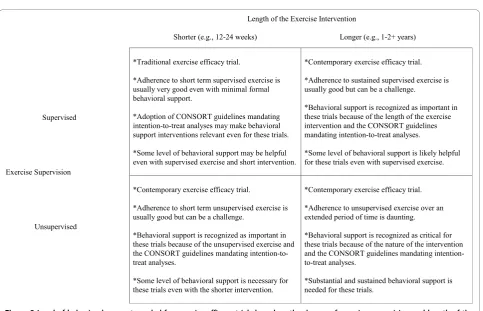
The nature of these trials makes it unlikely that they are able achieve a high level of adherence sufficient to test the efficacy of the exercise intervention without includ-ing some level of behavioral support. In contemporary exercise efficacy trials, the goal of the behavioral support intervention is to obtain a high level of exercise adher-ence over an extended period of time so that the pri-mary question concerning the particular health outcome can be answered. The behavioral support intervention, in essence, is viewed as the primary mechanism for ensuring a high level exercise adherence in the absence of completely supervised exercise over a short interven-tion period. The level of behavioral support needed in contemporary exercise efficacy trials likely varies by the degree of exercise supervision, the length of the exercise intervention, and the volume of the exercise interven-tion (Figure 2).
Traditional and Contemporary Effectiveness Trials in Exercise Research
Exercise efficacy trials and effectiveness trials are both health outcome trials with the primary purpose of deter-mining the effects of an exercise intervention on a health outcome. Contemporary exercise efficacy trials and effectiveness trials also both include modern beha-vioral support interventions to help answer the primary health outcome question. Consequently, the distinguish-ing feature between contemporary exercise efficacy trials and effectiveness trials appears to be the nature of the behavioral support intervention. In contemporary exer-cise efficacy trials, researchers typically develop or adopt a behavioral support intervention that is intensive enough to achieve a high level of adherence to the exer-cise intervention over an extended period of time so that the primary health outcome question can be answered. Efficacy trials, by definition, are less con-cerned about whether the behavioral support interven-tion is feasible in practice. Conversely, an exercise effectiveness trial typically adopts a behavioral support intervention that is consistent with practice or at least deemed potentially feasible to put into practice. The goal is then to determine whether the exercise tion achieved by a feasible behavioral support interven-tion is sufficient for improving some important health outcome.
There also appears to be two approaches to
effective-ness trials in exercise research. The “traditional”
approach to an effectiveness trial is usually one that pro-ceeds from a successful efficacy trial demonstrating the benefits of an exercise intervention under optimal con-ditions. The purpose of the traditional effectiveness trial is then to determine if the benefits of the exercise inter-vention are still evident under “real-world”conditions (i.
effectiveness trial, on the other hand, is usually one that proceeds from a successful behavior change trial demonstrating that a feasible behavioral support inter-vention is able to increase exercise behavior to a
poten-tially meaningful level. The purpose of the
contemporary effectiveness trial is then to determine if the exercise intervention achieved by the feasible beha-vioral support intervention is sufficient for improving some health outcome in practice.
Efficacy, Effectiveness, and Behavior Change Trials in Exercise Research
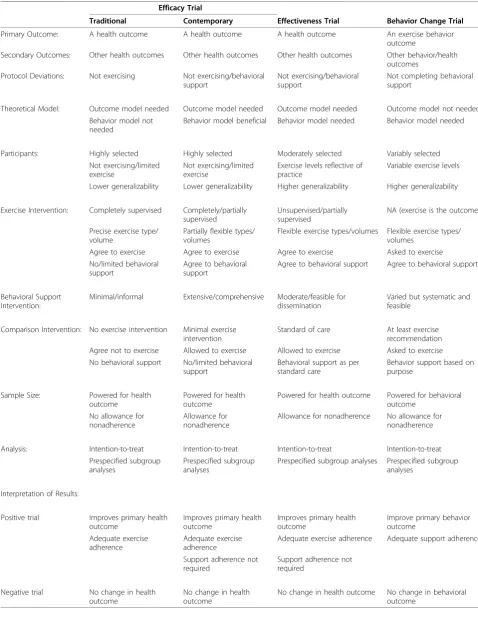
As noted earlier, the widespread adoption of behavioral support interventions into many exercise RCTs has sometimes caused confusion concerning the primary intent of the trial. At the simplest level, it is sometimes unclear if the intent was to conduct a health outcome trial with behavioral support or a behavior change trial with secondary health outcomes. At a more complex level, it is sometimes unclear if the intent was to con-duct an efficacy trial but an inadequate level of beha-vioral support resulted in modest adherence and gave the impression of an effectiveness trial. In other cases, it is unclear if the intent was to conduct an effectiveness trial but an inadequate level of behavioral support resulted in no improvements in health outcomes and gave the impression of a behavior change trial. Still, in other cases, it is unclear if the intent was to conduct a behavior change trial but improvements in some health outcomes gave the impression of an effectiveness trial. In the following sections, some potentially distinguishing features among efficacy, effectiveness, and behavior change trials are discussed under the headings of selec-tion of primary and secondary outcomes, adopselec-tion of theoretical models, selection of participants, nature of the exercise intervention, nature of the behavioral sup-port intervention, nature of the comparison interven-tion, sample size calculation and analysis, and interpretation of trial results (Table 1).
Selection of Primary and Secondary Outcomes Perhaps the most obvious and important distinction between health outcome trials and behavior change trials is the identification of the primary outcome. In efficacy and effectiveness trials, the primary outcome is a health outcome (e.g., aerobic fitness, biomarkers, qual-ity of life, disease outcomes). In behavior change trials, the primary outcome is an aspect of exercise behavior (e.g., type, dose, attendance, number of steps). Although this distinction may appear simple and straight forward, confusion can arise in exercise trials when both behavior and health variables are identified as outcomes, and especially when both are identified as primary outcomes. Behavior change does not appear to be an appropriate
primary or secondary outcome in efficacy or effective-ness trials because outcomes in an RCT are defined as events that are present after the participants receive the intervention [4]. Given that exercise is the actual inter-vention in a health outcome trial, adherence to the intervention itself cannot be an outcome of the inter-vention. Failure to exercise in a health outcome trial is not a negative effect on a primary or secondary out-come, it is a protocol deviation. The fact that the exer-cise may be unsupervised does not make it an outcome in an efficacy or effectiveness trial.
Conversely, it does seem acceptable, and even meritor-ious, to identify health outcomes as secondary outcomes in behavior change trials because these are potential outcomes that may follow from the behavioral support intervention and the ensuing exercise behavior change. If improved, these health outcomes may indicate a parti-cularly meaningful level of behavior change. In this con-text, the goal is to determine whether the exercise behavior that results from such a behavioral support intervention is sufficient for improving some important health outcome. For the same reasons as above, how-ever, it does not seem appropriate to identify adherence to the behavioral support intervention (e.g., telephone calls completed, attendance at group sessions, visits to the website) as a primary or secondary outcome in a behavior change trial. Failure to complete the behavioral support intervention in a behavior change trial is a pro-tocol deviation.
Adoption of Theoretical Models
Another important distinction among efficacy, effective-ness, and behavior change trials is the nature of the the-ories that inform the research. In simplest terms, there are two types of theories or models: theories that explain the outcomes of a behavior and theories that explain the determinants of a behavior (see Figure 1). Outcome theories attempt to explain how the exercise intervention (e.g., type, dose, intensity, frequency) improves a health outcome. These theories or models often include biological or physiological variables but might also include health-related fitness or psychosocial variables depending on the nature of the health out-come. Behavioral theories, on the other hand, attempt to explain how a behavioral support intervention (e.g., goal setting, physician recommendation, telephone counselling) might improve exercise behavior. These theories often focus on social cognitive variables such as attitude, self-efficacy, and social support but might also include a wider range of variables such as physiological and environmental factors.
efficacy trials involving minimal behavioral support would not normally need to adopt a behavioral theory. Contemporary efficacy trials, however, would likely ben-efit from following a behavioral theory because of the substantial behavioral support intervention that is often included and the greater risk of nonadherence. In effec-tiveness trials, it would seem that researchers should adopt both an outcome theory to guide the exercise intervention and a behavioral theory to guide the beha-vioral support intervention. In behavior change trials, researchers typically need only to adopt a behavioral theory. Confusion can arise in exercise trials when there
is a “mismatch” between the type of theory and the
reported outcomes. That is, exercise trials should not cite behavioral theories to claim they are “theory-based” when reporting health outcomes and, conversely, they should not cite outcome theories to claim they are“ the-ory-based” if they report on the determinants of exercise adherence.
Selection of Participants
The selection of participants may also vary across cacy, effectiveness, and behavior change trials. In effi-cacy trials, participants are typically selected based on their motivation and ability to complete and respond
to the particular intervention [6,8]. In exercise efficacy trials, this usually means selecting participants not cur-rently performing the particular exercise intervention yet capable of performing the exercise intervention. In effectiveness trials, participants are only moderately selected based on their motivation and ability because of the desire to reflect “real-world” conditions that broaden eligibility criteria [6,8]. In exercise effective-ness trials, this may mean including participants cur-rently performing some or even all of the intended exercise intervention if this reflects the target group in clinical or public health practice. In behavior change trials, participants may have various levels of motiva-tion and ability depending on the focus of the trial. Because the goal is not to improve a health outcome per se, a behavior change trial might target people with no interest in exercise, some interest in exercise, or a strong interest in exercise. Moreover, it may include participants currently performing no exer-cise, some exerexer-cise, or already meeting the exercise prescription with the goal of maintaining exercise behavior. Given the differences in participant selection, the generalizability of findings is usually lower in effi-cacy trials and higher in effectiveness and behavior change trials [6].
Table 1 Summary of some distinguishing features among efficacy, effectiveness, and behavior change exercise trials
Efficacy Trial
Traditional Contemporary Effectiveness Trial Behavior Change Trial
Primary Outcome: A health outcome A health outcome A health outcome An exercise behavior
outcome
Secondary Outcomes: Other health outcomes Other health outcomes Other health outcomes Other behavior/health outcomes
Protocol Deviations: Not exercising Not exercising/behavioral support
Not exercising/behavioral support
Not completing behavioral support
Theoretical Model: Outcome model needed Outcome model needed Outcome model needed Outcome model not needed Behavior model not
needed
Behavior model beneficial Behavior model needed Behavior model needed
Participants: Highly selected Highly selected Moderately selected Variably selected
Not exercising/limited exercise
Not exercising/limited exercise
Exercise levels reflective of practice
Variable exercise levels
Lower generalizability Lower generalizability Higher generalizability Higher generalizability
Exercise Intervention: Completely supervised Completely/partially supervised
Unsupervised/partially supervised
NA (exercise is the outcome)
Precise exercise type/ volume
Partially flexible types/ volumes
Flexible exercise types/volumes Flexible exercise types/ volumes
Agree to exercise Agree to exercise Agree to exercise Asked to exercise No/limited behavioral
support
Agree to behavioral support
Agree to behavioral support Agree to behavioral support
Behavioral Support Intervention:
Minimal/informal Extensive/comprehensive Moderate/feasible for dissemination
Varied but systematic and feasible
Comparison Intervention: No exercise intervention Minimal exercise intervention
Standard of care At least exercise recommendation Agree not to exercise Allowed to exercise Allowed to exercise Asked to exercise No behavioral support No/limited behavioral
support
Behavioral support as per standard care
Behavior support based on purpose
Sample Size: Powered for health outcome
Powered for health outcome
Powered for health outcome Powered for behavioral outcome
No allowance for nonadherence
Allowance for nonadherence
Allowance for nonadherence No allowance for nonadherence
Analysis: Intention-to-treat Intention-to-treat Intention-to-treat Intention-to-treat
Prespecified subgroup analyses
Prespecified subgroup analyses
Prespecified subgroup analyses Prespecified subgroup analyses
Interpretation of Results:
Positive trial Improves primary health outcome
Improves primary health outcome
Improves primary health outcome
Improve primary behavior outcome
Adequate exercise adherence
Adequate exercise adherence
Adequate exercise adherence Adequate support adherence
Support adherence not required
Support adherence not required
Negative trial No change in health outcome
No change in health outcome
Moreover, participants in exercise RCTs should gener-ally be asked to agree to the trial protocol prior to ran-domization. In traditional efficacy trials, the trial protocol includes supervised exercise. In contemporary efficacy and effectiveness trials, the trial protocol might include supervised and unsupervised exercise as well as the behavioral support intervention. Consequently, parti-cipants in health outcome trials should be asked to agree to do (or try to do) the exercise intervention as well as the behavioral support intervention as a method of supporting their exercise adherence. In behavior change trials, the trial protocol includes the behavioral support intervention but not the exercise itself because that is the outcome. Consequently, intervention partici-pants in a behavior change trial should be asked to agree to follow the behavioral support intervention but not to agree to do the exercise because that is the pri-mary outcome of the trial.
Nature of the Exercise Intervention
The nature of the exercise intervention may also vary among exercise trials [8]. In efficacy trials, there is often a precise exercise intervention for participants to follow that includes the type, frequency, intensity, duration, and progression of exercise. For example, participants may be asked to exercise on a cycle ergometer three times per week for 30 minutes at 70-85% of their maxi-mum capacity. Typically, there is limited flexibility in how participants achieve the exercise intervention. In effectiveness trials, there is often a general exercise intervention for participants to follow (e.g., a desired
volume) and there may be considerable flexibility in how participants are allowed to achieve the exercise intervention. For example, participants may be asked to exercise for 10 metabolic equivalent task (MET) hours per week but be allowed to choose any type, frequency, intensity, or duration of exercise that meets this general prescription. Alternatively, participants may receive pre-specified ranges of exercise from which to chose (e.g., several types of aerobic exercise, moderate-to-vigorous exercise, 3-5 days/week, 20-60 minutes in duration). Moreover, effectiveness trials often establish only a minimum exercise goal, not a maximum goal (e.g., parti-cipants may be asked to perform at least 150 minutes of exercise/week but be allowed to exceed this goal). In behavior change trials, there is no exercise intervention per se because exercise is the outcome. Nevertheless, there is often an exercise behavioral goal that partici-pants are asked to achieve as part of the behavioral sup-port intervention.
Nature of the Behavioral Support Intervention Another major distinction among exercise trials is the nature of the behavior support intervention. As noted earlier, in traditional exercise efficacy trials, there is typi-cally no formalized behavioral support intervention. Exercise adherence is usually achieved by highly select participants, the shorter length of the intervention, and the supervised exercise that likely entails at least some positive social support and accountability. In contem-porary efficacy trials involving unsupervised exercise or an extended intervention, the behavioral support
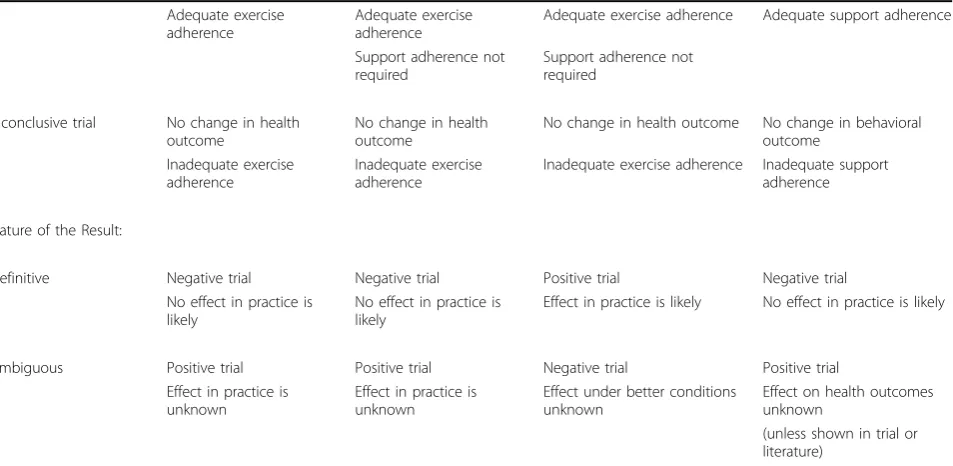
Table 1 Summary of some distinguishing features among efficacy, effectiveness, and behavior change exercise trials (Continued)
Adequate exercise adherence
Adequate exercise adherence
Adequate exercise adherence Adequate support adherence
Support adherence not required
Support adherence not required
Inconclusive trial No change in health outcome
No change in health outcome
No change in health outcome No change in behavioral outcome
Inadequate exercise adherence
Inadequate exercise adherence
Inadequate exercise adherence Inadequate support adherence
Nature of the Result:
Definitive Negative trial Negative trial Positive trial Negative trial
No effect in practice is likely
No effect in practice is likely
Effect in practice is likely No effect in practice is likely
Ambiguous Positive trial Positive trial Negative trial Positive trial
Effect in practice is unknown
Effect in practice is unknown
Effect under better conditions unknown
Effect on health outcomes unknown
intervention is usually sophisticated and comprehensive, but it is typically a “kitchen sink” approach. That is, contemporary efficacy trials usually incorporate as many behavioral support techniques and motivational strate-gies as necessary because behavior change is a means to an end and not an end in itself. The goal of these trials is to determine if a particular exercise intervention improves an important health outcome under optimal conditions, not to systematically disentangle what com-ponents of the behavioral support intervention might be helpful or to be concerned about the feasibility of the intervention. In efficacy trials, close monitoring of exer-cise adherence and behavioral support adherence is required during the trial to ensure corrective action is taken if adherence falters [8].
In effectiveness trials, the behavioral support interven-tion is usually one that reflects practice or at least has the potential for being translated into practice. Similar to efficacy trials, however, the goal of effectiveness trials is to determine if a particular exercise intervention improves some health outcome, not to systematically disentangle what components of the behavioral support intervention worked. Any monitoring and corrective action for exercise adherence and/or behavioral support adherence in effectiveness trials should be consistent with the intended practice context [8]. Conversely, in behavior change trials, the behavioral support interven-tion may be simple or sophisticated depending on the question; however, the focus is on systematically evalu-ating the individual or packaged behavioral support intervention to determine its effects on exercise vior. There is no ongoing monitoring of exercise beha-vior in behabeha-vior change trials because exercise behabeha-vior is the primary outcome. Monitoring and corrective action for the behavioral support intervention may be considered depending on the nature of the trial.
Nature of the Comparison Intervention
The comparison intervention also differs among effi-cacy, effectiveness, and behavior change trials. In tradi-tional efficacy trials, participants in the comparison group are often asked not to exercise or not to increase their exercise from baseline and to agree to these instructions prior to randomization. These instructions are optimal for efficacy trials because contamination in the comparison group is as problematic as nonadher-ence in the intervention group. In efficacy trials, the goal is to determine if the exercise intervention improves a health outcome under optimal conditions. The optimal condition includes 100% adherence in the intervention group and 0% contamination in the com-parison group. Asking comcom-parison participants not to exercise is often accepted by research ethics boards depending on the purpose of the study, the length of
the intervention, and the risk to participants of not exercising.
The comparison group intervention in contemporary efficacy trials and effectiveness trials is much more com-plex for methodological and ethical reasons. Asking comparison participants not to exercise or not to increase their exercise may not be considered ethical if it is for an extended period of time or if the population is considered at-risk. It may not be scientifically justifi-able in effectiveness trials where the goal is to replicate
“real-world” environments where comparison
partici-pants are free to exercise if they want. This complexity has led to a great deal of variability in what comparison participants are asked to do in contemporary efficacy and effectiveness trials. In some trials, comparison parti-cipants are not asked anything but are given standard health materials that often include information on exer-cise (e.g., public health exerexer-cise guidelines). In other trials, they are explicitly recommended to exercise but are not provided with any of the behavioral support intervention or only a limited version of the intervention (e.g., printed materials only, one behavioral support ses-sion, a few telephone calls). Still, in other trials, they are given a more extensive health intervention that may be important for general health or for their specific disease condition but it may or may not include exercise. The lack of clear exercise instructions to the comparison group in contemporary efficacy trials is probably an attempt to balance the ethical concern of having com-parison participants not exercise, with the scientific con-cern of maximizing differences in exercise behavior between the intervention and comparison groups.
In effectiveness trials, participants should receive the current standard of care for exercise if one already exists in the particular practice setting [8]. If not, the lack of clear exercise instructions to comparison participants is probably the correct approach ethically and scientifically because the goal is to determine the effects of exercise in a “real world” setting in which comparison partici-pants are allowed to exercise on their own but may not receive any support.
change trials, at a minimum, should be recommended the same level of exercise as the intervention group. Any additional behavioral support provided to the com-parison group in a behavior change trial (including any contact control) would depend on the nature and pur-pose of the trial and what the researchers wanted to be able to say about the intervention.
Sample Size Calculation and Analysis
In traditional efficacy trials, the trial is powered for the primary health outcome and, given that nonadherence or contamination are not anticipated, they are typically not factored into the power calculation. Allowance may be made for loss-to-follow-up, but this is a different issue. In contemporary efficacy and effectiveness trials, the trial is also powered for the primary health outcome,
however, ana priori allowance for some prespecified
level of nonadherence and contamination may be fac-tored into the power calculation. In behavior change trials, the trial should be powered for the primary beha-vioral outcome and typically no allowance is made for any nonadherence or contamination with the behavioral support intervention. The primary analysis in all trials should follow the intention-to-treat principle [1]. Any secondary analysis that deviate from intention-to-treat should be prespecified [1].
Interpretation of Trial Results
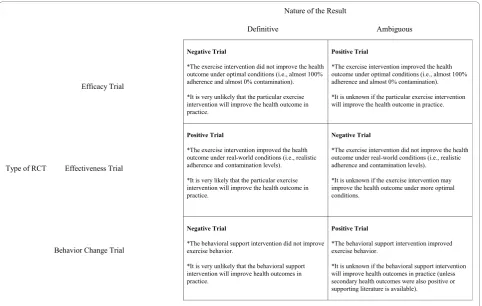
Accurate interpretation of trial results is important but not always provided [9]. In an efficacy trial, failure to improve the primary health outcome in the face of ade-quate exercise adherence (however defined) is inter-preted as a negative trial (i.e., the exercise intervention does not work for that health outcome). Improvements in important secondary health outcomes may be note-worthy but do not change the overall interpretation of the trial. Poor exercise adherence in an efficacy trial is a major protocol deviation. Failure to improve the primary health outcome in the face of inadequate exercise adher-ence in an efficacy trial results in an inconclusive trial. An inconclusive trial is one in which the primary ques-tion could not be answered because of some substantial methodological problem such as poor protocol adher-ence. Researchers conducting efficacy trials should resist the temptation of interpreting an inconclusive efficacy trial as a negative effectiveness trial or a positive beha-vior change trial.
In an effectiveness trial, interpretation of the results is the same as for an efficacy trial. In addition, poor adherence to the behavioral support intervention in an effectiveness trial or contemporary efficacy trial is also a protocol deviation. Nevertheless, even if poor adher-ence to the behavioral support intervention was the likely cause of the poor exercise adherence, it is the
lack of exercise adherence that renders the trial incon-clusive, not the poor adherence to the behavioral
sup-port intervention. Researchers conducting
contemporary efficacy trials or effectiveness trials should resist the temptation of interpreting a negative or inconclusive health outcome trial as a positive beha-vior change trial.
In a behavior change trial, failure to improve the pri-mary behavioral outcome in the face of adequate adher-ence to the behavioral support intervention (however defined) is interpreted as a negative trial (i.e., the beha-vioral support intervention does not work). Even if sec-ondary health outcomes improve, the trial would still be considered negative as these outcomes are unlikely to be attributable to the exercise behavior change itself (assuming accurate measurement of exercise) and, in any case, were not the primary outcome [9]. Conversely, a positive change in the primary behavioral outcome is interpreted as a positive trial even if secondary health outcomes do not improve. Certainly, improvements in secondary health outcomes would further substantiate the importance of the behavior change achieved in the trial, but they were not the primary focus. In a behavior change trial, failure to improve the primary behavioral outcome in the face of inadequate adherence to the behavioral support intervention is a major protocol deviation that results in an inconclusive trial. Research-ers conducting behavior change trials should resist the temptation of interpreting a positive, negative, or incon-clusive behavior change trial that improved secondary health outcomes as a positive effectiveness trial.
the effect of such behavior change from previous studies).
Discussion
The purpose of this paper was to offer some conceptual and methodological distinctions between health out-come trials (efficacy and effectiveness) and behavior change trials. It was argued that these trials differ in terms of many important attributes and design issues. Several issues raised in this paper warrant further discussion.
One important issue is whether it is possible to con-duct both a behavior change trial and a health outcome trial as part of the same trial. The difficulty with this approach is that it requires multiple primary outcomes, which is not recommended by CONSORT [1]. Multiple primary outcomes may lead to internally inconsistent decisions because the selection of a primary outcome drives all other methodological decisions in the trial [1,7,8]. For example, an exercise RCT may select exer-cise behavior, weight loss, and depression as its primary outcomes. In this trial, would the eligibility criteria include only nonexercisers who are obese and depressed? Or would it allow current exercisers who are obese and depressed, or obese people who are not
depressed and depressed people who are not obese? What exercise intervention would be selected? Perhaps a very high volume of exercise might be best for weight loss but not for depression. Perhaps yoga would be great for depression but not for weight loss. What about the selection of gold standard measures given limited resources? Should the researchers spend significant money on the gold standard measures of exercise beha-vior (e.g., direct observation, accelerometers) or obesity (e.g., DEXA scans, CT scans) or depression (e.g., clinical interviews)? Will the sample size be determined by expected changes in exercise, obesity, or depression? What will the comparison group receive? Should the comparison group be asked not to exercise? How will the intervention be interpreted? Will it be successful if people exercise but are still obese and depressed? Is it successful if they lose weight but are still depressed, or are less depressed but still obese? Trial design issues are often difficult to resolve when there are competing pri-mary outcomes.
It seems reasonable for a behavior change trial to have a secondary purpose of documenting changes in health outcomes but the trial would still have been conceptua-lized and designed as a behavior change trial with all the important trial decisions based on this purpose. It
does not seem reasonable, however, for a health out-come trial to have a secondary purpose of testing a behavior support intervention because the former is actually contingent on the latter. That is, the health out-come trial is unable to answer its primary question if behavior change does not occur (i.e., it becomes an inconclusive trial). If behavior change is uncertain in a health outcome trial, it seems the best approach would be to conduct a feasibility study demonstrating that behavior change is highly likely before moving to the health outcome trial.
Another interesting issue is whether it is possible to make the same conceptual distinction between efficacy and effectiveness for behavior change trials as it is for health outcome trials. In the present paper, behavior change trials have been largely conceptualized as effec-tiveness trials by default. Perhaps it would have been more prudent to develop a 2 × 2 typology of trial out-come (behavior change versus health outout-come) by trial attitude (efficacy versus effectiveness). In considering this option, it does not seem helpful to conduct efficacy-oriented behavior change trials because the primary pur-pose of such trials is usually to translate health outcome research into practice. Moreover, it does not seem to make sense for behavior change trials to only select highly motivated participants or to use a behavioral sup-port intervention that is not feasible for practice when the goal is to disseminate the exercise research to as many people as possible in the target population. It would seem that the only reason for incorporating a behavioral support intervention that is not feasible in practice is because the goal of the trial is to establish the efficacy of the health intervention. Having said that, the utility of distinguishing between efficacy and effec-tiveness behavior change trials may warrant further discussion.
It is also critical to note that what is feasible to be put into practice varies dramatically from context to context [7,8]. For example, supervised exercise proto-cols delivered by highly qualified personnel may indeed be readily transferable into practice in certain clinical settings with dedicated space, sophisticated equipment, and highly qualified personnel (e.g., cardiac rehabilita-tion unit). Similarly, supervised exercise protocols may even be feasible to deliver in many community-based settings such as public and private fitness and recrea-tional centers that possess the necessary equipment and qualified staff. Conversely, supervised exercise pro-tocols may not be readily transferable into practice in rural communities or in public health settings because of the lack of facilities, personnel, and limited funding. The key point is that what is considered feasible to be translated into exercise practice varies with the prac-tice setting. Consequently, exercise researchers
conducting effectiveness trials should make explicit the intended practice setting for their intervention and design their trial accordingly [8].
Another important issue is the order of conducting the different types of exercise RCTs. As noted earlier, it is generally argued that efficacy trials should precede effectiveness trials [4]. That is, once the efficacy of an intervention is proven, then it needs to be tested for its effectiveness. In exercise research, efficacy trials followed by an attempt to put the positive results into practice without the demonstration of effectiveness may fail in settings that cannot deliver supervised exercise tions or provide extensive behavioral support interven-tions (e.g., rural, public health). One might reasonably argue that, in practice settings where supervised exercise or extensive behavioral support interventions are not likely feasible, it may be more productive to begin with contemporary effectiveness trials that test exercise inter-ventions that are feasible even though they may not have proven efficacy. Thus, in exercise research, effec-tiveness trials might also emanate from positive behavior change trials with proven feasibility in a given practice setting.
This paper provides a first attempt to highlight some conceptual and methodological issues that have arisen with the incorporation of modern behavioral support interventions into many exercise trials. It was a difficult paper to write because of the complexity of this topic and the diversity of exercise research. There are signifi-cant limitations in this paper. One limitation is that the paper does not attempt to integrate the distinction between health outcome trials and behavior change trials into other existing research typologies beyond the common efficacy-effectiveness distinction (e.g., Phase I-IV trials, translational trials, dissemination trials, com-parative effectiveness trials, research phases, etc.). A sec-ond limitation is that every exercise trial is unique and some of the general observations made in this paper may not apply to individual exercise trials. A third lim-itation is that there does not appear to be a clear dis-tinction between efficacy and effectiveness trials because it is the individual elements of a trial that vary along the efficacy-effectiveness continuum and researchers might intentionally, and appropriately, mix efficacy and effec-tiveness attributes [8]. Another limitation is that the paper does not address research designs beyond the tra-ditional RCT. Finally, it is unclear if the issues raised in this paper apply to other health behavior interventions (e.g., nutrition) or to interventions that target multiple health behaviors.
complexities have led to the incorporation of behavioral support interventions into many exercise RCTs and has sometimes confused the primary purpose of the trial. Researchers conducting exercise RCTs are encouraged to consider the nature of their trial in terms of its health outcome versus behavior change focus and its position on the efficacy versus effectiveness continuum. Clarity in the goals of the trial may improve the trial methods and result in better quality trials more likely to inform clinical, community, and public health exercise interventions.
Acknowledgements
Kerry S. Courneya is supported by the Canada Research Chairs Program. I would like to thank Christine M. Friedenreich, PhD, Edward McAuley, PhD, Ronald C. Plotnikoff, PhD, and Laura Q. Rogers, MD for their review and feedback on an earlier version of this manuscript. This acknowledgement does not indicate their endorsement of the arguments in this paper.
Competing interests
The authors declare that they have no competing interests.
Received: 18 May 2010 Accepted: 12 November 2010 Published: 12 November 2010
References
1. Moher D, Hopewell S, Schulz KF, Montori V, Gotzsche PC, Devereaux PJ, Elbourne D, Egger M, Altman DG:CONSORT 2010 Explanation and Elaboration: updated guidelines for reporting parallel group randomised trials.BMJ2010,340:c869.
2. Flay BR, Biglan A, Boruch RF, Castro FG, Gottfredson D, Kellam S, Moscicki EK, Schinke S, Valentine JC, Jil P:Standards of Evidence: Criteria for Efficacy, Effectiveness and Dissemination.Prevention Science2005,
6:151-175.
3. Cochrane AL:Effectiveness and efficiency: random reflection on health services.London: Nuffield Provincial Hospitals Trust; 1972, 423. 4. Jadad AR, Enkin MW:Randomized controlled trials: Questions, answers, and
musings.2 edition. Oxford, UK: Blackwell Publishing; 2007, 311. 5. Alford L:On differences between explanatory and pragmatic clinical
trials.NZ Journal of Physiotherapy2007,35:12-16.
6. Gartlehner G, Hansen RA, Nissman D, Lohr KN, Carey TS:Criteria for distinguishing effectiveness from efficacy trials in systematic reviews.In Technical Review 12 (Prepared by the RTI-International-University of North Carolina Evidence-based Practice Center under Contract No. 290-02-0016.) AHRQ Publication No. 06-0046. Volume 227.Rockville, MD: Agency for Healthcare Research and Quality; 2006.
7. Karanicolas PJ, Montori VM, Devereaux PJ, Schunemann H, Guyatt GH:A new‘’Mechanistic-Practical’’Framework for designing and interpreting randomized trials.J Clin Epidemiol2009,62:479-484.
8. Thorpe KE, Zwarenstein M, Oxman AD, Treweek S, Furberg CD, Altman DG, Tunis S, Bergel E, Harvey I, Magid DJ, Chalkidou K:A pragmatic-explanatory continuum indicator summary (PRECIS): a tool to help trial designers.J Clin Epidemiol2009,62:464-475.
9. Boutron I, Dutton S, Ravaud P, Altman DG:Reporting and Interpretation of Randomized Controlled Trials With Statistically Nonsignificant Results for Primary Outcomes.JAMA2010,303:2058-2064.
doi:10.1186/1479-5868-7-81
Cite this article as:Courneya:Efficacy, effectiveness, and behavior change trials in exercise research.International Journal of Behavioral Nutrition and Physical Activity20107:81.
Submit your next manuscript to BioMed Central and take full advantage of:
• Convenient online submission
• Thorough peer review
• No space constraints or color figure charges
• Immediate publication on acceptance
• Inclusion in PubMed, CAS, Scopus and Google Scholar
• Research which is freely available for redistribution