Notes on
Brachymenium
in Guyana with a new species
from Mt. Ayanganna
Harold Robinson1, G. Karen Golinski1,2
1 Department of Botany, MRC 166, Museum of Natural History, P.O. Box 37012, Smithsonian Institution, Washington, DC, USA 2 Department of Botany, The University of British Columbia, Room 3200-6270 Uni-versity Boulevard, Vancouver, BC, Canada
Corresponding author: Harold Robinson ([email protected])
Academic editor: Peter de Lange | Received 14 August 2019 | Accepted 30 June 2020 | Published 3 August 2020
Citation: Robinson H, Golinski GK (2020) Notes on Brachymenium in Guyana with a new species from Mt. Ayanganna. PhytoKeys 154: 11–17. https://doi.org/10.3897/phytokeys.154.39105
Abstract
A relative of the African species described by Brotherus as Bryum perspinidens, has been discovered in Guy-ana with erect capsules and a short inner peristome. The GuyGuy-ana material is recognized as a new species, and both species are placed in the genus Brachymenium. The characteristics that distinquish the genus are discussed with reference to the Guyana specimens of Brachymenium speciosum.
Keywords
African relationship, Bryaceae, peristome, rostrate operculum
Introduction
Study of bryophyte collections obtained during the Smithsonian Biological Diversity of the Guianas project, has revealed a number of interesting species. Among these are two two collections of a bryaceous moss with capsules identifiable as a
Brachy-menium Schwaegr., Spec. Musc. Suppl. 2(1): 131. 1824, with a leaf that superficially
matches the illustration of Bryum perspinidens Broth. in the Brotherus treatments in the two editions (1904 and 1925) of Engler and Prantl. The only problems were that the Brotherus illustration was of an African species named as a Bryum. The spiniform teeth of the leaf margins were nevertheless similar, and a relationship seemed to be involved. As for the generic placement, the Brotherus (1897) species was described from sterile material so that the placement in Bryum Hedw. lacked any real evidence.
http://phytokeys.pensoft.net
Copyright H. Robinson, G. K. Golinski. This is an open access article distributed under the terms of the Creative Commons Attribution License (CC BY 4.0), which permits unrestricted use, distribution, and reproduction in any medium, provided the original author and source are credited.
H. Robinson & G. K. Golinski / PhytoKeys 154: 11–17 (2020)
12
The relationship of Guyana Highland species to African species fits a pattern noted by Robinson (1965). In addition, there is ample material from Guyana of another species
of Brachymenium, B. speciosum that is newly discussed and illustrated.
Methods
Specimens in this study were obtained during the Smithsonian Biological Diversity of the Guianas Program conducted over a period of years from 1985 to 2014 (Kelloff et al. 2019). The particular specimens of the new species involved in this study were col-lected during a separately funded trip conducted by M.D. Clark in 2001 that colcol-lected on Mt. Ayanganna. The bryophytes were deposited at the US National Herbarium awaiting identification. They have been in storage since that time.
A note with the specimens indicates that when they arrived in the US they were irradiated during the Anthrax scare of 2001.
Results
The South American material includes one species that seems to be distinct from oth-ers from the Western Hemisphere (see for example Allen 2002) and from the related African species.
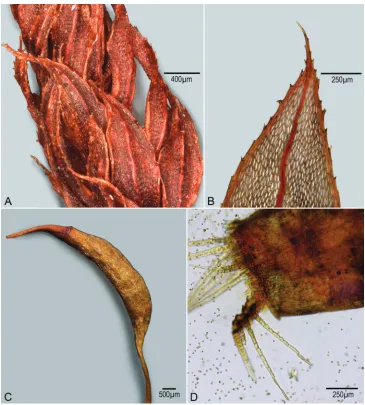
Brachymenium ayangannensis H.Rob. & G.K.Golinski, sp. nov. Figure 1
Type. Guyana. Region: Potaro–Siparuni. Mt. Ayanganna, east face, plateau above sec-ond of four escarpments. 1380 m, 05°22.550'N, 059°58.350'W. Scrub forest on sand-stone and peat, with Clusia, Pagamea and Sphagnum. Epiphyte; sporophytes green. 17 June 2001. H.D. Clarke 9299, with R. Williams, C. Perry, E. Tripp & J. Kelly (US).
Description. Stems up to 3 cm tall, leaves not closely spaced, rather firm in structure but contorted when dry and resistant to wetting. Costa percurrent into a long slender acumination, median cells narrowly oval, with firm walls showing slight porosity, mostly 80–100 μm long and ca. 30 μm wide, without shorter quadrate cells at base, margin with numerous rows of linear pale cells forming a strong border, border with numerous cells projecting as spiniform teeth, such spiniform teeth extending onto apical acumination. Synoicous? Seta pale yellowish-red, ca. 17 mm long, smooth. Capsules erect, ca. 2 mm long, with short hypophysis, operculum short-rostrate, higher than wide. Outer peristome teeth reddish, rudimentary, ca. 80 μm long, inner peristome a low pale membrane ca. 70 μm without projecting segments or cilia. Calyptra not seen. Spores ca. 10 μm in size.
H. Robinson & G. K. Golinski / PhytoKeys 154: 11–17 (2020)
14
Brocchinia. Sporophytes green. On tree limb. H.D. Clarke 9551 with R. Williams, C.
Perry, E. Tripp & J. Kelly (US).
The peristome teeth of the new species have proven extremely fragile, possibly because of the radiation treatment.
The spiniform teeth of the leaf margin are distinctive, but the manner in which they occur on the acuminate apical extension is reminiscent of the illustration by Brotherus (1904: 557 fig. C; 1925: 367, figs C, D). This illustration has led to the comparison, but it proves to be somewhat inaccurate compared to the more recent illustration made from the type by Ochi (1972)
The African species is well illustrated by Ochi (1972), but the type from Helsinki has been borrowed not because of doubts of relationship so much as to insure that the two species are not the same. The principle difference is the absence of spinose teeth extend-ing on to the apical acumination of the leaf. Nevertheless, there is no doubt the two are close, and the African species was placed in Bryum only because there was no sporophyte to indicate otherwise. A important point derived from the Ochi study is that none of the species in typical Bryum have spinose marginal teeth, all with such teeth are in what is now in the Brachymenium, Rhodobryum relationship. On the basis of the evident rela-tionship between the African and Guyana species, the following transfer of the African species is provided.
Brachymenium perspinidens (Broth.) H.Rob. & G.K.Golinski, comb. nov. Figure 1D
Bryum perspinidens Broth., Bot. Jahrb. Syst. 24: 246. 1897. Britische Ostafrika,
Seenge-biet: Ru– Nssóro, 3300–3600 m (Uganda: Ruwenzori, heather forest 10–12000’),
Scott Elliot 266, Sterile. Rhodobryum perspinidens (Broth.) Pócs, in Bizot & Pócs,
Acta Bot. Acad. Sci. Hungaricae 25: 257. 1979 [1980]. With record of species from Tanzania, also sterile. Ochi (1972) indicated the species was rather an oddity
in Bryum Hedw. subgenus Rhodobryum Schimp. in which he placed it.
Brachymenium speciosum (Hook. & Wils.) Steere. Figure 2
Notes. The latter species has been collected on a mountain near Ayanganna as indicated below.
Mt. Wokomung, Little Ayanganna, upper slopes of highest point of Mount Woko-munga massif. 5°5'8"N, 59°50'32"W. elev. 1525 m. Tepui scrub forest on sandstone
H. Robinson & G. K. Golinski / PhytoKeys 154: 11–17 (2020)
16
and peat, with Schefflera, Clusia and Guadua. 5 July 2003, H.D. Clarke 10550, with
R. Williams, C. Perry, J. Kelly, D. Gittens, S. Stern; Guiana. Mt. Wokomung, Little
Ayanganna, upper slopes of highest point of Mount Wokomung massif. 5°5'8"N, 59°50'32"W. elev. 1525 m. Tepui scrub forest on sandstone and peat, with Schefflera,
Clusia and Guadua, elev. 1525 m. 5 July 2003, H.D. Clarke 10575, with R. Williams,
C. Perry, J. Kelly, D. Gittens, S. Stern. Guiana. Mt. Wokomung, Little Ayanganna,
up-per slopes of highest point of Mount Wokomung massif. 5°4'53.1"N, 59°50'26.1"W. elev. 1525 m. Tepui bog on sandstone and peat, with Brocchinia, Bonnetia and Rapatea, elev. 1660 m. 6 July 2003, H.D. Clarke 10576, with R. Williams, C. Perry, J. Kelly, D.
Gittens, S. Stern. Mt. Wokomung, area above third of four escarpments, 1 km NE of
Mt. Wokomung, 5°4'30"N, 59°51'15"W. elev. 1490 m. dense forest on laterite, with
Clusia, Euterpe and Licania, elev. 1490 m. 8 July 2003, H.D. Clarke 10802, with R.
Williams, C. Perry, J. Kelly, D. Gittens, S. Stern. The material shows the additional
fea-ture of the species, the multistratose leaf margin with teeth on the margin and upper and lower surfaces. The species is otherwise reported from Suriname, Ecuador, and supposedly described from Jamaica (Maracaibo, Venezuela?)(Allen 2013; Steere 1948).
Acknowledgements
We thank Eric Schuettpelz, Chair of the Department of Botany, NMNH, for gener-ously allowing us to use his lab and for providing ongoing support of our work on the bryophytes. H. David Clarke collected the specimens of Brachymenium ayanganna and
B. speciosum while exploring the mountaintops of Guyana, funded by grants from
Na-tional Geographic (Grant #6622-990) and the Smithsonian Institution’s Biodiversity of the Guiana Shield Program under the direction of Vicki Funk and Carol Kelloff. We appreciate the help of Sanna Laaka-Lindberg, Collection Coordinator of H Bryophyte Herbarium (Helsinki), for providing the type specimen of Brachymenium perspinidens, and Alice Tangerini, resident artist in the Department of Botany, NMNH, for expertly constructing the plates. Our manuscript greatly benefited from a thorough review by Blanka Aguero and an anonymous reviewer.
References
Allen B (2002) Moss Flora of Central America, Part 2. Encalyptaceae–Orthotrichaceae. Mis-souri Botanical Garden Press, St. Louis, MisMis-souri.
Allen B (2013) Brachymenium regnellii and Bryum leptotorquescens (Bryaceae) new to Suri-name. Polish Botanical Journal 58(1): 237–243. https://doi.org/10.2478/pbj-2013-0024 Brotherus VF (1897) Musci africani. II. In: Engler A (Ed.) Beiträge zur Flora von Africa. XIV.
Brotherus VF (1904) 219 Lieferung, Bryaceae, Leptostomaceae, Mniaceae, Rhizogoniaceae und Aulacomniaceae. In: Engler A, Prantl K (Eds) Die natürlichen Pflanzenfamilien. I. TEIL, 3, Abteilung, Bogen 37 bis 39. Verlag von Wilhelm Engelmann, Leipzig, 577–624. Brotherus VF (1925) Musci (Laubmoose) 1 Hafte. In: Engler A, Prantl (Eds) Die natürlichen
Pflanzenfamilien, ed. 2. 10, 478 pp.
Cox CJ, Hedderson AJ (2003) Phylogenetic relationships within the moss family Bryaceae based on chloroplast DNA evidence. Journal of Bryology 25(1): 31–40. https://doi. org/10.1179/037366803125002635
Kelloff CL, Funk VA, Alexander SN (2019) Smithsonian Plant collections, Guiana Shield. 1985–2014, Biological Diversity of the Guiana Shield Collections. Smithsonian Scholarly Press, Washington, DC. https://doi.org/10.5479/si.1938-2812.110
Ochi H (1972) A revision of African Bryoideae, Musci (First Part). J. Faculty of Educ. Tottori University 23(1): 1–126.
Ochyra R, Plášek V, Bednarek-Ochyra H (2018) Osculatia–an earlier name for a segregate of Bryum (Bryaceae, Bryophyta). Acta Musei Silesiae. Scientiae Naturales 67(1): 71–79. https://doi.org/10.2478/cszma-2018-0006
Pedersen N, Hedenas L (2005) Taxonomic and Nomenclatural Implications of Phylogenetic Studies of the Bryaceae Based on Molecular Data and Morphology. The Bryologist 108(1): 123–128. https://doi.org/10.1639/0007-2745(2005)108[123:TANIOP]2.0.CO;2 Pedersen N, Cox CJ, Hedenas L (2003) Phylogeny of the Moss Family Bryaceae Inferred from
Chloroplast DNA Sequences and Morphology. Systematic Botany 28(3): 471–482. Robinson H (1965) Venezuelan bryophytes collected by Julian Steyermark. Acta Botanica
Ven-ezuelica 1(1): 73–83. https://www.jstor.org/stable/41740407 [D.]