Taxonomic revision of the Mesoamerican genus
Spathacanthus (Justicieae, Acanthoideae, Acanthaceae)
Mireya Burgos-Hernández1, Gonzalo Castillo-Campos2
1 Programa de Botánica. Colegio de Postgraduados. Carretera México-Texcoco km 36.5, Montecillo, Texcoco 53230, Estado de México, México 2 Red de Biodiversidad y Sistemática. Instituto de Ecología, A.C. Carretera antigua a Coatepec 351, Xalapa 91073, Veracruz, México
Corresponding author:Mireya Burgos-Hernández ([email protected])
Academic editor:Alan Paton | Received 28 September 2019 | Accepted 25 January 2020 | Published 17 March 2020
Citation: Burgos-Hernández M, Castillo-Campos G (2020) Taxonomic revision of the Mesoamerican genus Spathacanthus
(Justicieae, Acanthoideae, Acanthaceae). PhytoKeys 144: 31–55. https://doi.org/10.3897/phytokeys.144.46929
Abstract
Spathacanthus is a Mesoamerican genus that occurs in tropical and temperate regions from southern Mexico to Costa Rica; its taxonomy has not been updated for two decades. In view of the fact that a new species has been discovered and that the interspecific affinities in this genus have not been addressed to date, the present study aims to revise the genus Spathacanthus. Specimens of plants of this genus collected from across the distribution range and deposited in herbaria and digital databases were reviewed. In paral-lel, a cladistic analysis was carried out, based on morphological characters in order to examine relation-ships between species. Four species of Spathacanthus were recognised: one endemic to Costa Rica, another micro-endemic to Veracruz in Mexico, one more restricted to the forests of Mexico and Guatemala and the last one more widely distributed. Reflecting the previously limited knowledge of the group, many of the specimens that we studied had been misidentified. A key to differentiate these species is provided, supplemented with photographs, drawings and other illustrations, morphological descriptions, synonymy and ecological data. Results, presented here, extend the distribution range of some taxa and a distribution map is presented. The cladistic analysis recovered the genus as monophyletic, showing that S. hoffmannii and S. hahnianus are sister taxa and S. magdalenae was found to be more closely related to S. parviflorus. These plants are vulnerable to degradation and habitat loss.
Keywords
conservation, distribution, endemism, phylogeny
http://phytokeys.pensoft.net
distributed throughout the world. They mostly thrive in tropical and subtropical areas, with the Indo-Malay, African (including Madagascar), South American and Mexican-Cen-tral American regions as primary diversity centres. The species of this family thrive in virtu-ally all intertropical habitats, except for high-mountain areas (above 3,000 metres a.s.l.).
Mesoamerica is one of the seven American biodiversity hotpots where species face a high risk of extinction, associated with accelerated deforestation and global warming (Myers et al. 2000; Malcolm et al. 2006). Consequently, an enormous portion of the Mesoamerican flora may well become extinct before species can be described, much less characterised taxonomically and in terms of evolutionary relationships.
Mexico is a major centre of species richness, diversity and endemism for the family Acanthaceae (Daniel 2007), which ranks fifteenth in terms of floristic diversity in the country. Acanthaceae represent 1.6% of the total floristic richness of Mexico (Villaseñor 2016), with around 400 species (47 genera) of herbs, shrubs and trees; of these, 58.8% are endemic to Mexico (Villaseñor and Ortiz 2014), while seven of the 38 native genera docu-mented in Mexico are also endemic to this country. Due to high species richness, no study has covered the entire family and new species are still being discovered (Daniel 2007).
Spathacanthus Baill. is a small genus of shrubs and trees; plants are distinctive amongst Mesoamerican Acanthaceae by having very large capsules and seeds, both of which are amongst the largest known in the family. The genus comprises four species distributed in moist to wet forests of Mexico and Central America. In Mexico, the genus is represented by three native species. Two of them were treated by Daniel (1995) – Spathacanthus hah-nianus Baill. and S. parviflorus Leonard – and also inhabit Guatemala, with S. hahnianus
reaching Honduras. Spathacanthus magdalenae Cast.-Campos was recently discovered in a riparian forest in Veracruz (Castillo-Campos et al. 2013). Meanwhile, Spathacanthus hoffmannii Lindau is restricted to Costa Rica (Lindau 1895a). Although currently it is accepted that the genus belongs to subfamily Acanthoideae, tribe Justicieae, Pseuderan-themum lineage (McDade et al. 2000), its generic relationships have not been resolved yet and the correct placement of the genus Spathacanthus has not been thoroughly assessed.
In addition to issues at the generic level, there is only one previous taxonomic treat-ment of the entire genus (Daniel 1999). The discovery of a fourth species (Castillo-Cam-pos et al. 2013) clearly calls for re-assessment of the genus; also, interspecific affinities have yet to be addressed. Therefore, the present study aims to provide an updated taxonomic re-vision of the genus Spathacanthus, particularly in Mexico, where three of our species occur.
Methods
were examined. Digital specimens from the herbaria at CAS, DS, DUKE, F, K, MO, NY, TEX, US and UT were also consulted, all of them available via the TROPICOS (http://www.tropicos.org) and JSTOR Global Plants ( https://plants.jstor.org/collec-tion/TYPSPE) websites. Herbarium acronyms follow Thiers (2019). Protologues and type material of all species and synonyms involved were consulted. This allowed verify-ing or, where appropriate, re-identifyverify-ing specimens from morphological features. We used a stereomicroscope (Stemi 2000-C, Carl Zeiss, Cd. Mx., Mexico) to study mor-phological variations amongst plants of all four species. New descriptions prepared for each species reflect the careful comparative work undertaken.
Specimens were reviewed using the dichotomous keys, descriptions and images provided by Daniel (1995, 1999) and Castillo-Campos et al. (2013). Additionally, all of the major floristic works for Mexico, Guatemala, Honduras and Costa Rica were reviewed (Baillon 1891; Lindau 1895a,b; Leonard 1937; Standley 1938; Standley and Steyermark 1974; Gibson 1974; Durkee 1986; Daniel 1993, 2010; Daniel et al. 2012).
The descriptions, newly presented here, include taxonomic and nomenclatural synonyms of each taxon, along with phenological information, habitat, distribution, elevation and vegetation types. The names of the species were verified on TROPICOS, The International Plant Name Index (https://www.ipni.org/) and Catalogue of Life 2020 Annual Checklist (http://www.catalogueoflife.org/col). Endemism was deter-mined according to the descriptions in specialised studies, floristic listings, distribution data as reported in international databases (IPNI, TROPICOS, Global Biodiversity Information Facility (https://www.gbif.org/)) and information from herbarium speci-mens. A species was considered endemic if its distribution range is restricted to a given territory and as micro-endemic if exclusive to a limited site within a country. Distribu-tion maps were prepared using geographic data via ARCGIS v.10.2.2 (ESRI 2014), based on the collection data compiled from herbarium specimens.
We also conducted a cladistic analysis, based on morphological characters as a first ap-proach to explore relationships amongst species. We examined all four species of Spatha-canthus as the in-group, plus Odontonema callistachyum Kuntze and Odontonema cuspida-tum (Nees) Kuntze, as out-groups. Both genera – Odontonema and Spathacanthus – have been recognised as being the closest American relatives within the Pseuderanthemum line-age, in the tribe Justicieae (McDade et al. 2000). Based on the work of Daniel (1999) and after a detailed review of herbarium specimens, morphological characters derived from traditional external morphology were selected to build a matrix of morphological traits for cladistic analysis. A total of 15 binary and multistate characters were scored; the character by taxon matrix was built in MESQUITE v.3.2 (Maddison and Maddison 2017).
boot-branch-swapping algorithm. Finally, the tree was visualised with FIGTREE v.1.4.
Results
Taxonomic treatment
Spathacanthus Baill. Hist. pl. 10: 444. 1891
Type.Spathacanthus hahnianus Baill.
Description. Small trees or shrubs, highly branched. Stems sometimes with
con-spicuous lenticels. Leaves opposite, sessile, subsessile to petiolate, entire, blade usually elongated, oblong or elliptical, membranous. Inflorescence terminal, cymose in the form of a thyrse, with opposite branches, consisting of dichasia or monochasia when one of the buds aborts, sometimes axillary, sessile to pedunculate, subtended by a bract; bracts opposite, small, green, entire. Flowers large, few, subsessile to pedicellate, pedi-cels usually enlarged in fruit; 2 homomorphic bracteoles; calyx green or yellowish, spathaceous, bilabiate equally or unequally divided into 2 segments; anterior segment with 2 fused lobes, apically entire to bifid; the posterior segment with 3 fused lobes, api-cally entire to trifid; corolla white or yellow, externally glabrous; tube expanded distally into a distinct throat; corolla with upper lip deeply bilobed, lower lip deeply trilobed; corolla lobes imbricate in bud. Stamens 4, didynamous, adnate at base of corolla throat; anthers monothecous or dithecous, if dithecous, then thecae equal in size, parallel, equally inserted, lacking basal appendages; anterior pair dehiscing towards upper lip, posterior pair dehiscing towards lower lip; staminodes lacking. Style glabrous, included in corolla tube; stigma bilobed, lobes equal. Capsule stipitate, large, glabrous, woody, green when immature, brown when dry. Seeds 4, homomorphic, flattened, glabrous.
The genus Spathacanthus consists of four species occurring in humid tropical forests to temperate forests of south-eastern Mexico and Central America (Fig. 1A, B). The genus is easily differentiated from other Acanthaceae genera by the spathaceous calyx divided into 2 segments. The extremely large fruits are also distinctive amongst Neotropical Acanthaceae.
Key to Spathacanthus species
1 Calyx divided into 2 equal segments at anthesis ...2
– Calyx divided into 2 unequal segments at anthesis ...3
2 Leaves subsessile, rarely shortly petiolate; calyx green before fruiting; restrict-ed to Costa Rica...Spathacanthus hoffmannii
3 Corolla white, 25–30 mm long, throat 2–6 mm in diameter near midpoint; calyx yellowish before fruiting; distributed in Mexico and Guatemala ... ...Spathacanthus parviflorus
– Corolla yellow, 31–80 mm long, throat 5–20 mm in diameter near midpoint; calyx green before fruiting; distributed in Mexico, Guatemala and Honduras ... ...Spathacanthus hahnianus
Spathacanthus hahnianus Baill., Hist. pl. 10: 444. Jan-Feb 1981
Figs 2, 3
Macfadyena simplicifolia Donn. Sm., Bot. Gaz. 16:198 (1891). Type: Guatemala. Alta Verapaz: borders of forest in Pasamalá, 3800 ft a.s.l., Aug 1886, von Tuerckheim 1030 (holotype: US!; isotypes: GH!, K!, M!, US!).
Spathacanthus donnell-smithii Lindau ex Donn. Sm., Bot. Gaz., 20: 293 (1895), nom. nov. superfl.
Spathacanthus donnell-smithianus Lindau, Bull. Herb. Bossier 3: 371 (1895), nom. superfl.
Spathacanthus simplicifolius (Donn. Sm.) Lindau ex Bureau & K. Schum. In C. Mar-tius, Fl. Bras. 8: 294 (1897), basionym M. simplicifolia.
Type. Mexico. Veracruz: Misantla, forêt de montagne, Santa Rita, 3 Jul 1866, L.
Hahn 349 (holotype: P!).
Description. Small trees or shrubs, up to 10 m height, branched, internodes
c
e
f
d
a
b
lobes from0.4-2 mm long
lobes from 0.4-4 mm long
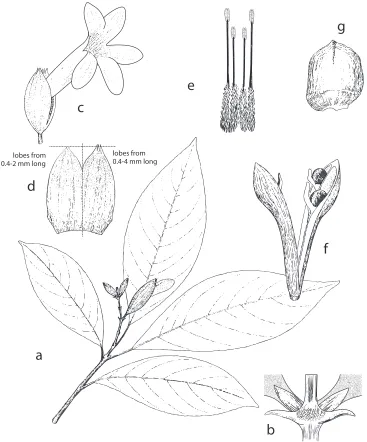
Figure 3.Spathacantus hahnianus Baillon. Image and legend modified from Daniel (1995) Flora of Chiapas, Part 4, page 131 a habit, × 0.5 b inflorescence node, × 3.5 c flower, × 1.1 d calyx split, × 1.3
e androecium showing didynamous stamens, × 1.8 f capsule, × 1 g seed, × 3.9. Illustration: Ellen del Valle.
Distribution, habitat and phenology.Spathacanthus hahnianus occurs in southern
Specimens examined. Mexico. Chiapas: Mpio. Berriozábal, 13 km N of
Berri-ozábal near pozo Turipache and finca El Suspiro, 1000 m a.s.l., 02 Nov 1971, D.E. Breedlove & A. Smith 21618 (DS, DUKE, F, MEXU, MO, NY, TEX); 900 m a.s.l., 25 Dec 1972, D.E. Breedlove & R. Thome 30868 (ENCB, MO); a 12 km N de Berri-ozábal, 600 m a.s.l., 16 May 1989, E. Martínez & M. Soto 24241 (MEXU); La Aduana, cerca de rancho Flor de Corazón, hacia El Cairo, 800 m a.s.l., 06 Sep 1990, E. Palacios E. 1726 (IBUG, MEXU); a 13 km al N de Berriozábal, 29 Mar 1984, O. Téllez V. et al. 7598 (MEXU); Mpio. La Concordia, camino de El Triunfo para la Finca Prusia, 1940 m a.s.l., 14 May 1982, J.I. Calzada 8935 (IBUG, MEXU, XAL); Mpio. Ángel Albino Corzo, sendero Palo Gordo, Reserva de la Biosfera El Triunfo, 2000 m a.s.l., 14 May 2004, F. González-García s.n. (XAL). Oaxaca: Mpio. San Felipe Usila, campamento cerro Verde, carr. para arroyo Tambor, 450 m a.s.l., 02 Nov 1990, J.I. Calzada et al. 16596 (MEXU); Mpio. Santiago Lachiguiri, Distr. Tehuantepec, cerro de Buenavista, 2 km SO de crucero Buenavista, 27 Oct 1991, A. Campos V. & R. Torres 4103 (CHAPA, MEXU); Mpio. Santa María Chimalapa, Uxpanapa region, between Esmeralda (17 km E of Sarabia) and Río Verde, 1.1 mi S of Esmeralda, 100 m a.s.l., 10 Jan 1987, T.B. Croat & D.P. Jhmnon 63303 (BM, ENCB, MO, TEX); Mpio. Sta. María Chimalapa, arroyo Matzpac, N de Sta. María por la vereda al Río Verde, 250 m a.s.l., 29 Oct 1985, H. Hernández G. & C. González L. 1777 (MEXU, MO, TEX); Río Verde por la vereda a la cabecera, ca. 7 km N de Sta. María, 280 m a.s.l., 21 Nov 1985, H. Hernández G. & C. González L. 1855 (CAS, MEXU, MO, TEX); Mpio. San Felipe Usila, Nuevo Santa Flora, 22 Nov 1993, R. de Santiago & A.M. Hanan 247 (MEXU); Mpio. Guevea de Humboldt, Distr. Tehuantepec, recorrido La Cumbre-arroyo Seco, 13.4 km N de Guevea de Humboldt, 29 Mar 1991, R. Torres C. & A. Campos V. 13897 (CHAPA, MEXU); Mpio. Matías Romero Avendaño, en la estación del río Azul a 16.6 km al E de la Colonia Cuahutémoc, 1500 m a.s.l., 23 Jan 2003, E. Martínez 36091 (MEXU).
Puebla: Mpio. Ahuacatlán, 4.5 km al SE de Ahuacatlán, brecha a Zapotitlán, 1250 m
(CHAPA, MEXU, MO, TEX); 4.5 km O de Uxpanapa, sobre terracería a La Laguna, 120 m a.s.l., 17 Oct 1983, T. Wendt & I. Almaraz G. 4194 (CHAPA, MEXU, MO, NY, TEX, XAL); 1.5 km N del Poblado Dos, ejido F.J. Mina, 180 m a.s.l., 02 Feb 1983, O. Zambrano C. 1184 (CHAPA); Mpio. Yecuatla, entre La Unión y Roca de Oro, 900 m a.s.l., 21 Aug 1989 C. Gutiérrez B. 3584 (IEB, MEXU, XAL). GuateMala. Alta
Ve-rapaz: Pasmala, 1159 m a.s.l., Aug 1886, H. Von Tuerckheim 1030 (MEXU); Quiché:
Chajul, La Perla, E. Tribouillier & I. Pedro 409 (BIGU); Chajul, La Perla, E. Tribouillier & I. Pedro 436 (BIGU); Chajul, aldea Chel, E. Tribouillier & I. Pedro 469 (BIGU).
Honduras. Cortés: 2 km NW de la quebrada de Cantiles, 1700 m a.s.l., 26 Sep 1993,
C. Nelson et al. 16631 (MO, TEFH). Lempira: Parque Nacional Montaña de Celaque, cerro Aguacatal. Las Chimis, San Manuel Colohete, P. House et al. 185 (EAP). Yoro: ca. 16 km from Yaruca on Quebrada de Oro to cerro Búfalo, W. Holmes 4392 (NY, TEX).
Spathacanthus hoffmannii Lindau, Bull. Herb. Boissier 3: 370. 1895
Figs 4, 5
Type. Costa Rica. Alajuela: prope Aguacate, Aug 1857, C. Hoffmann 842 (holotype:
B destroyed, photos F!, GH!, US!).
Description. Small trees or shrubs, up to 8 m height, highly branched, internodes
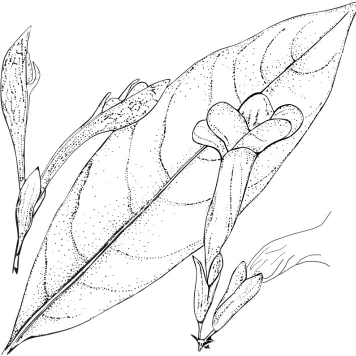
Figure 5.Spathacanthus hoffmannii Lindau. Image modified from Durkee (1986) Flora Costaricensis, No. 18, page 19. The image shows an elliptic leaf of S. hoffmannii, flowers with a five-lobed corolla and the 2-segments of calyx equally or subequally divided, with its large woody fruit.
Distribution, habitat and phenology. Spathacanthus hoffmannii is known only
from Costa Rica where it has been reported from all provinces (Fig. 1A). It occurs along the banks of watercourses and on cliffs in humid forests, rain forests and cloud forests at 350 to 1750 m a.s.l. Flowering takes place from January to October, fruiting from December to September.
Specimens examined. costa rica. Alajuela: Est. Biol. Reserva Forestal de San
Lorencito on Caribbean slope, J. Gómez-Laurito & K. Swangel 12439 (CR); Reserva Forestal de San Ramón, río San Lorencito, 800–1000 m a.s.l., 05 Dec 1983, G. Her-rera 362 (CR, MEXU, MO, US); Buena Vista de San Carlos, L. Holdridge 6790 (CR); Quebrada Lajas, finca Los Ensayos, Buena Vista de San Carlos, A. Jiménez M. 2319 (CR, F, MO, NY); near road to Laguna Hule, R. Lent 3243 (CR, F, MO); Cor-dillera de Tilarán, río La Balsa, 500 m a.s.l., 07 Mar 1994, V. Ramírez & Q. Jiménez 273 (CR, MO, NY); road to Colonia Virgen del Socorro, barranca of río Sarapiquí, 700–800 m a.s.l., 08 Aug 1979, W. Stevens 13547 (DUKE, F, MEXU, MO).
Car-tago: carretera entre Turrialba y Siquirres, a la vera del río Chitaría, J. Gómez-Laurito
6801 (CR, USJ); cerros de La Carpintera, 1600 m a.s.l., 14 Oct 1973, R, Lent 3657 (CR, F, MO); 13 km E of Turrialba on hwy to Limón, canyon of Río Chitaría, R. 750–800 m a.s.l., 10 May 1983, Liesner et al. 15444 (CR, DUKE, MEXU, MO); above Turrialtica restaurant, 36.5 km from Turrialba, R. Read & G. Daniels 74–63 (US); vicinity of Pejivalle, P. Standley & J. Valerio 46759 (F, US); 9.5 mi E of Tur-rialba, on rocky banks of río Chitaría, 762 m a.s.l., 12 Aug 1977, G. Webster 22253 (DUKE, F, MEXU). Guanacaste: El Silencio, near Tilarán, P. Standley & J. Valeria 44745 (F, US). Heredia: Virgen del Socorro, río Sarapiquí, Cariblanco, 600–800 m a.s.l., 31 Aug 1983, I. Chacón & G. Herrera 1211 (CAS, CR, DUKE, MO); barranca del río Sarapiquí, Colonia Virgen del Socorro, J. Gómez-Laurito 9868 (CR, F); canyon of río Sarapiquí, just upstream from bridge on rd to La Virgen del Socorro, 05 Aug 1983, B. Hammel 13304 (CR, DUKE, F, MO); camino a la Colonia de la Virgen del Socorro, rumbo a Pto. Viejo, L. Poveda 985 (CR); Vara Blanca de Sarapiquí, N slope of Central Cordillera, 1500–1750 m a.s.l., Jul 1937, A. Skutch 3325 (K, MO, NY, US). Limón: La Florida, voie ferrée atlantique, H. Pittier 11286 (US); río Hondo, H. Pitiier 16641 (K). Puntarenas: Miramar, Quebrada seca, cerro Zapotal, 18 Sep 1985, L.D. Gómez et al. 23990 (CAS, CR, DUKE, MEXU, MO). San José: Terrazú, Pérez Zeledón. estribaciones del cerro Diamante, 500–600 m a.s.l., 22 Sep 1998, A. Estrada et al. 1730 (MEXU); zona protectora La Cangreja, Santa Rosa de Puriscal, Q. Jiménez 482 (CR, K); zona protectora cerro Turrubares, Q. Jiménez 543 (CR).
Spathacanthus magdalenae Castillo-Campos, Nordic J. Bot. 31: 449. 2013.
Figs 6, 7
Type. Mexico. Veracruz: San Andrés Tlalnelhuayocan (previously Coatepec as a
pub-lication error), Piedras Blancas, eastern slopes of the volcano Cofre de Perote, riparian vegetation, 1666 m a.s.l., 7 Mar 2012. G. Castillo-Campos et al. 27235 (holotype XAL!; isotypes ENCB!, MEXU!).
Description. Small trees or shrubs, up to 12 m height, highly branched, internodes
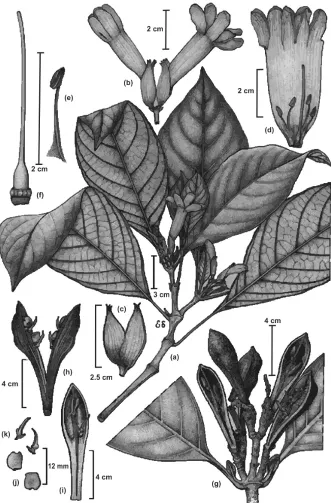
Figure 7.Spathacanthus magdalenae Castillo-Campos. Image and legend modified from Castillo-Cam-pos et al. (2013), page 450. a Branch showing insertion of the leaves and position on the branch, inflo-rescences with flowers and buds b flowers, c calyx d open flower with stamens and style e stamen f style
g branch with open capsules h open capsule with retinacula subtending seeds in both valves of fruit
6 mm long, glabrous; calyx yellowish before fruiting, turning green in ripe fruit, 18– 25 mm × 13 mm, equally divided into 2 prominent elliptic to ovate segments; anterior segment bilobed, the posterior segment trilobed; lobes triangular, 15 mm long, apically acute to apiculate; corolla white, 58–100 mm long × 38–44 mm wide, externally glabrous and internally pubescent, throat 10–12 mm long × 3–6 mm in diameter near midpoint, upper lip bilobed, oblong, lower lip trilobed, both lobes 10–17 mm long, glabrous. Stamens whitish, longer pair about 16 mm long from the base to the apex of the thecae, shorter pair about 10 mm long; anthers monothecate, 3.5 mm long; style glabrous, 26 mm long, stigma lobes 0.3–0.7 mm long. Capsule 65–89 mm long; stipe 35–49 mm long, head 30–40 mm long. Seeds subcircular to subcordate, 8 mm × 9 mm long, surface roughened.
Distribution, habitat and phenology. Spathacanthus magdalenae is endemic to
southern Mexico where it is restricted to the riparian vegetation of central Veracruz (Fig. 1B). It is frequent near rivers or humid canyons in cloud forests and oak forests in tropical to temperate zones, at 1300 to 1700 m a.s.l. Flowering takes place from November to March; mature fruits can be found from January to March.
Specimens examined.Mexico. Veracruz: Mpio. San Andrés Tlalnelhuayocan,
Pie-dras Blancas, Eastern slope of the volcano Cofre de Perote, 1666 m a.s.l., 7 Mar 2012, G. Castillo-Campos et al. 27189 (XAL, MEXU, ENCB); Piedras Blancas, Eastern slope of the volcano Cofre de Perote, 1666 m a.s.l., 30 Apr 2012, G. Castillo-Campos et al. 27377 (XAL, MEXU, ENCB); San Antonio, 1350 m a.s.l., 06 Feb 1982, F. Ventura A. 19361 (ENCB, IEB, XAL); Mpio. Jacomulco, barranca de Actopan, road to Buena Vista, 1 km after Jalcomulco, 646 m a.s.l., 12 Jun 1991, G. Castillo-Campos et al. 8206 (XAL).
Spathacanthus parviflorus Leonard, Proc. Biol. Soc. Washinton 50: 15–16. 1937.
Figs 8, 9
Type. Guatemala. Quetzaltenango: in heavy forest of volcán Zunil, 1750 m a.s.l., 7
Aug 1934. A. Skutch 961 (holotype US!; isotypes A!, BM!, L!, NY!, US!).
Description. Small trees or shrubs, up to 8 m tall, branched, internodes glabrous
terior segment bilobed, lobes triangular, 0.3–0.7 mm long; the posterior segment tri-lobed, triangular lobes, 0.6–0.8 mm long; corolla white, 25–30 mm long × 15–25 mm wide, externally glabrous and internally pubescent, throat 12–18 mm long × 2–6 mm in diameter near midpoint, upper lip 2–3 mm long, lobes rounded, 1.5–3 mm × 1.5–2 mm, lower lip 2.5–3.5 mm long, lobes rounded, 1.3 mm × 1.5–2.5 mm. Sta-mens whitish, longer pair 11–15 mm long from the base to the apex of the thecae, shorter pair 8–12 mm long; anthers dithecous, thecae 3–4.5 mm long; style glabrous 10–17 mm long; stigma lobes, 0.4–0.9 mm long. Capsule 37–60 mm long, stipe 20– 35 mm long, head 17–25 mm long. Seeds subcircular to subcordate, 6–10 mm long, 6–8 mm wide, surface roughened.
Distribution, habitat and phenology.Spathacanthus parviflorus occurs in Mexico
(Veracruz, Chiapas) and Guatemala (Chimaltenango, Quetzaltenango, San Marcos, So-lolá and Suchitepéquez) (Fig. 1B), along streams and flooded areas, mainly in cloud for-est, less frequently in other humid forests. It has been collected at 1000 to 2300 m a.s.l. Flowering takes place throughout the year, with ripe fruits from September to February.
Specimens examined.Mexico. Chiapas: Mpio. Mapastepec, El Triunfo Biosphere
Reserve, along trail from El Paval to camp. El Triunfo, 1940–2030 m a.s.l., 10 Nov 1996, T. Daniel et al. 8403 (ENCB, K, MEXU, MO, NY, US); Mpio. Mapastepec, El Triunfo Reserve. Trail NNW from El Triunfo camp toward Palo Gordo Camp., 1–3 km from El Triunfo camp. El Triunfo Reserve, 2000 m a.s.l., 21 Feb 1990, R.J. Hampshire et al. 522 (MEXU); Reserva El Triunfo (campamento/HQ), near campamento El Tri-unfo, 2000 m a.s.l., Sep 1989, M. Heath & A. Long MA84 (CHIP, MEXU); Reserva El Triunfo, polígono 1, campamento /HQ - finca Prusia, 1900 m a.s.l., 11 Dec 1989, M. Heath & A. Long 491 (CHAPA, MEXU); between Cañada Honda and El Triunfo, slopes of sierra de Soconusco, 1300–2100 m a.s.l., 06 Nov 1945, E. Xolocotzi & A. Sharp 338 (DS, MEXU); Reserva de la Biosfera El Triunfo, polígono zona núcleo I, 1800 m a.s.l., 06 Aug 2005, N. Martínez 1149 (MEXU); Reserva El Triunfo, Palo Gordo-finca Catarrinas, M. Heath et al. 738 (CHIP); Mpio. La Concordia, camino en-tre finca Custepec and San Antonio Miramar (pass), M. Heath & A. Long 834 (CHIP); Reserva de la Biosfera El Triunfo, N. 1850 m a.s.l., 16 Jun 1994, Ramírez-Marcial & P. Quintana-Ascencio 507 (CAS, MEXU); Mpio. Undetermined, Mt. Pistar, 03 Aug 1937, E. Matuda 1696 (F, MO, NY, UT, US). Veracruz: Mpio. Uxpanapa, Arroyo Zarco, 15 km al S de La Laguna, 200 m a.s.l., 24 Nov 2012, G. Castillo-Campos & L. Aragón A. 27651 (XAL). GuateMala. Chimaltenango: SW slope of volcán Fuego
Figure 9.Spathacanthus parviflorus Leonard. Image and legend modified from Gibson (1974) Flora of Guatemala 24, part X, page 446. A Habit, × ½ B flower with bracts and bracteoles, × 1 ½ C corolla opened, with pistil removed, to show didynamous stamens, × 1 ½ D opened calyx, × 1 ½ E capsules with calyces, one opened to show retinacula and seeds, × 1.
Phylogenetic relationships
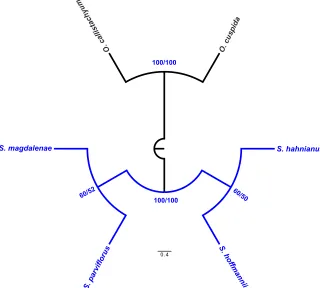
A total of 15 characters were analysed, 14 (93.3%) of which were parsimony-informa-tive. The MP analysis resulted in five most parsimonious trees of 24 steps, a consistency index (CI) of 0.88 (excluding uninformative characters) and a retention index (RI) of 0.80. The majority rule consensus tree is shown in Fig. 10.
The monophyly of the genus Spathacanthus was strongly supported (BS and JK = 100%). Within the genus, two clades were recovered, the first one includes the species S. hahnianus and S. hoffmannii as more closely related, with moderate support (BS = 60% and JK = 50%) (Fig.10). In the second clade, two of the white flower species, S. parviflorus, and
S. magdalenae were recovered as sister taxa, with support values of BS = 60% and JK = 52%.
S. hahnianus S. magdalenae
S. hoffmanni
i S. parviflorus
O. cuspida
O. callistachyu m
100/100
60/50 60/52
100/100
Discussion
Spathacanthus is composed of four recognised species, all of which are restricted to Mesoamerica. Spathacanthus hahnianus is the most widely distributed species, span-ning from southern Mexico and Guatemala to Honduras. Spathacanthus parviflorus
occurs only in southern Mexico and Guatemala; S. magdalenae and S. hoffmannii are geographically restricted, the first as micro-endemic to the centre of Veracruz, Mexico and the second as endemic to Costa Rica, where it is widely distributed through-out that country. Narrowly distributed species like S. magdalenae are of conservation concern as they may be threatened by the effects of environmental deterioration and habitat loss (Castillo-Campos et al. 2005; Mooers and Redding 2009). Despite this, none of these species has been formally assessed using the IUCN Red List standard. This highlights the need for more studies on each of the species in the group that allow us to know if it is necessary to take measures for conservation.
Plants of Spathacanthus occur mainly in tropical rainforests and cloud forests and at elevations between 100 and 2,300 m a.s.l. Of the four species, S. hahnianus and S. hoffmannii thrive in areas below 1,000 m a.s.l. Plants occur less commonly in higher elevation temperate forests. Particularly, S. parviflorus is restricted to cloud forests, S. hoffmannii inhabits humid tropical forests and S. magdalenae is usually found in cloud forests and oak forests. Meanwhile, S. hahnianus occurs in all of these environments. This information is relevant because, globally, montane cloud forests and tropical rain-forests are threatened ecosystems. Particularly, the first is considered rare due to its re-stricted extent of coverage. A mere 2.5% of the total area of the tropical forests world-wide is cloud forest (Bruijnzeel et al. 2010; Sánchez-Ramos and Dirzo 2014). Three of the four species occur naturally in Mexico where tropical forests occupy only 1% of the territory; nevertheless, these ecosystems harbour a large number of species, rep-resenting 27% of the floristic richness of the country (Gual-Díaz and Rendón-Correa 2014). Worldwide, Central America is one of the regions most affected by deforesta-tion. An important issue is that no collections of Spathacanthus have been made from Nicaragua or El Salvador. It is not clear whether these countries remain inadequately known botanically or whether plants of Spathacanthus are genuinely absent from these countries. Based on proximity and shared climate and vegetation types, further botani-cal exploration is warranted.
The detailed taxonomic review of the four species revealed a number of specimens that were misidentified. For example, Daniel (1999) noted that a white corolla had been reported for S. hahnianus by Ventura A. 19361 (XAL, IEB). However, this speci-men corresponds to S. magdalenae (revised and corrected in this study). Other records of plants with white corollas, such as L.D. Gómez et al. 23990 (MEXU) and A. Estrada et al. 1730 (MEXU) from Costa Rica, correspond to S. hoffmannii. Specimens of S. hahnianus (e.g. C. Gutiérrez B. 3584 (IEB, MEXU, XAL); J. Dorantes 3766 (XAL),
find labels with scientific names that are no longer valid today. In addition, our study found that only S. magdalenae has monothecate anthers, an autapomorphy for the spe-cies. Therefore, this and other slight modifications were made in the description of the genus, since it was originally described as having dithecate anthers only. These results highlight the importance of taxonomic research as we report here.
Until recently, S. hahnianus was known only from Mexico and Honduras. Daniel (1999) reported a single specimen of Spathacanthus from Guatemala but the condition of the specimen did not allow it to be identified. A decade later, Daniel (2010) sug-gested that the species was either rare or extirpated in Guatemala. In 2012, in a report on new distribution records of Acanthaceae in Guatemala, the same author noted the presence of the species in the montane cloud forests of Quiché. Similarly, in Honduras, the species was only known from Yoro, but is here reported also from the provinces of Cortés and Lempira. Thus, this species is now known to range more widely in Guate-mala and Honduras than had been previously recognised.
Phylogenetic analysis
The parsimony phylogenetic analysis retrieved Spathacanthus as a monophyletic group, which is consistent with the results of Daniel (1999). In his previous cladistic analysis, S. hoffmannii was more closely related to S. hahnianus because both species have long corollas and the lower lip ends in relatively long lobes. On the other hand, based on similarities and differences according to the morphological key proposed by Castillo-Campos et al. (2013), it is suggested that S. magdalenae was closest to S. parviflorus, although the former has longer flowers, fruits and seeds, as well as wider leaves, relative to S. parviflorus.
Our results are concordant with those suggested from both of these works. How-ever, the basal position of S. parviflorus, resulting from Daniels’s analysis, changes when
S. magdalenae is included, supporting the hypothesis, proposed by Castillo-Campos et al. (2013), that S. magdalenae and S. parviflorus are closely related species; both share white corollas (as does their sister taxon, S. hoffmannii) and leaves petiolate. The plants of these species are mainly distributed in the cloud forest of the Pacific regions, only above 1000 m a.s.l. For their part, S. hahnianus and S. hoffmannii share long corol-las and they are the most widely distributed species in terms of habitats and altitude.
Conclusions
Our analysis yielded a more in-depth insight into the distribution, characters and ecological features of plants of the Mesoamerican genus Spathacanthus; however, this genus remains poorly known in Mexico and Central America. Future research should specifically seek to collect plants of Spathacanthus species in suitable habitats across the Mesoamerican region. We expect that extensive fieldwork will reveal new areas of distribution and perhaps new species of Spathacanthus. Molecular data should be gathered to test the phylogenetic hypothesis presented here; notably, strategic sampling within species would shed light on the processes of speciation.
Acknowledgements
We thank Sarahi Barrientos Villalobos for support with editing the images, María Ele-na MediEle-na Abreo and Rosario Langrave for comments on the manuscript and prepar-ing the map and José Luis Colin Badillo and Sergio Avendaño Reyes for photographs of the herbarium specimens. We also appreciate the curators of the following herbaria for permitting access to their collections and digital images: BIGU, CAS, CHAPA, CR, DS, DUKE, ENCB, F, IEB, K, MEXU, MO, NY, TEFH, TEX, US, USJ, UT and XAL. We are also very grateful to Alan Paton and Lucinda McDade for their criti-cal comments and helpful suggestions to improve the manuscript.
This study was supported by Colegio de Postgraduados (MBH E01-53-00) and Instituto de Ecología, A.C. (GCC 20030-10134).
References
Baillon HE (1891) Spathacanthus hahnianus. Histoire des Plantes 10: 444.
Bruijnzeel LA, Kappelle M, Mulligan M, Scatena FN (2010) Tropical Montane Cloud For-ests: State of Knowledge and Sustainability Perspectives in a Changing World. In: Brui-jnzeel AL, Scatena NF, Hamilton L (Eds) Tropical Montane Cloud Forests: Science for Conservation and Management. Cambridge University Press, UK, 691–740. https://doi. org/10.1017/CBO9780511778384.074
Castillo-Campos G, Medina-Abreo M, Dávila-Aranda P, Zavala-Hurtado J (2005) Con-tribución al conocimiento del endemismo de la flora vascular en Veracruz, México. Acta Botánica Mexicana 73(73): 19–57. https://doi.org/10.21829/abm73.2005.1004
Castillo-Campos G, García-Franco JG, Martínez ML (2013) Spathacanthus magdalenae sp.
nov. (Acanthaceae), a riparian forest species from Veracruz, Mexico. Nordic Journal of Botany 31(4): 449–452. https://doi.org/10.1111/j.1756-1051.2013.00118.x
Daniel TF (1993) Taxonomic and geographic notes on Central American Acanthaceae. Proceeding
of the California Academy of Science, 4th series 48: 119–130. https://doi.org/10.2307/4115754
13–22. http://ibugana.cucba.udg.mx/pdf/Ibugana_15(1–2).pdf
Daniel TF (2010) Catalog of Guatemalan Acanthaceae: Taxonomy, ecology, and conservation. Proceedings of the California Academy of Science, ser. 4 61: 291–379.
Daniel TF, Véliz PEM, Kriebel HR (2012) New distribution records of Acanthaceae in Guatemala. Phytoneuron 79: 1–5. http://www.phytoneuron.net/79PhytoN-GuatemalanAdditions.pdf Durkee HL (1986) Acanthaceae. Family 200. Flora Costaricensis. Fieldiana Botany series 18, 97 pp. ESRI (2014) ArcGIS, version 10.2.2. Environmental Systems Research Institute. Redlands,
USA. https://support.esri.com/es/products/desktop/arcgis-desktop/arcmap/10-2-2 Gibson ND (1974) Flora of Guatemala: Acanthaceae. Fieldiana. Botany 24: 328–461. Gual-Díaz M, Rendón-Correa A (2014) Bosques mesófilos de montaña de México: diversidad,
ecología y manejo. Comisión Nacional para el Conocimiento y uso de la Biodiversidad, México, 352 pp.
Leonard CE (1937) A new species of Spathacanthus from Guatemala. Proceedings of the
Bio-logical Society of Washington 50: 15–16. https://archive.org/details/biostor-82605 Lindau G (1895a) Spathacanthus hoffmannii. Bulletin de I’Herbier Boissier 3: 370.
Lindau G (1895b) Acanthaceae. In: Engler HGA, Prantl KAE (Eds) Die Naüirlichen Pflanzen-familien, IV (3b), Wilhclm Engelmann, Leipzig, 274–354.
Maddison WP, Maddison DR (2017) Mesquite, a modular system for evolutionary analysis Version 3.2. http://mesquiteproject.org
Malcolm JR, Liu C, Neilson RP, Hansen L, Hannah L (2006) Global warming and extinctions of endemic species from biodiversity hotspots. Conservation Biology 20(2): 538–548. https://doi.org/10.1111/j.1523-1739.2006.00364.x
McDade LA, Daniel TF, Masta SE, Riley KM (2000) Phylogenetic relationships within the Tribe Justicieae (Acanthaceae): Evidence from molecular sequences, morphology, and cytology. An-nals of the Missouri Botanical Garden 87(4): 435–458. https://doi.org/10.2307/2666140 Mooers AO, Redding WD (2009) Where the rare species are. Molecular Ecology 18(19):
3955–3957. https://doi.org/10.1111/j.1365-294X.2009.04312.x
Myers N, Mittermeier RA, Mittermeier CG, Fonseca GAB, Kent J (2000) Biodiversity hotspots for conservation priorities. Nature 403(6772): 853–858. https://doi.org/10.1038/35002501 Sánchez-Ramos G, Dirzo R (2014) El bosque mesófilo de montaña: Un ecosistema prioritario
amenazado. In: Gual-Díaz M, Rendón-Correa A (Eds) Bosques mesófilos de montaña de México: diversidad, ecología y manejo. CONABIO. México, 109–139.
Standley PC (1938) Flora of Costa Rica. Part IV. Field Museum of Natural History, Chicago. Botanica Serbica 18: 1137–1616.
Standley P, Steyermark J (1974) Flora of Guatemala. Series Fieldiana. Botany 24: 328–461. Swofford DL (2002) PAUP*. Phylogenetic Analysis Using Parsimony (*and Other Methods)
Version 4. Sinauer Associates, Sunderland, Massachusetts. https://paup.phylosolutions.com/ Thiers B (2019) Index herbariorum: A global directory of public herbaria and associated staff.
Villaseñor JL (2016) Checklist of the native vascular plants of Mexico. Revista Mexicana de Biodiversidad 87(3): 559–902. https://doi.org/10.1016/j.rmb.2016.06.017
Villaseñor JL, Ortiz E (2014) Biodiversidad de las plantas con flores (División Magnoliophyta) en México. Revista Mexicana de Biodiversidad 85: 134–142. https://doi.org/10.7550/rmb.31987
Appendix 1
Morphological characters and character states used in this study.
Characters Character states
0 1 2 3
Calyx color Yellowish Green Purple Reddish
Shape of divisions of the calyx Homomorphic Heteromorphic
Pubescence in calyx Glabrous Pubescent
Calyx length 1–9mm 13–40mm
Type of calyx Spathaceous Pentamer
Apex of calyx segments Entire Bifid Trifid
Corolla color Yellow-yellowish White Pinkish-purple Red
Corolla length 17–30mm 31–110mm
Outer corolla surface Glabrous Pubescent
Number of stamens 2 4
Type of stamens Homogeneous Didynamous
Style length 5–17mm 21–38mm 44–59mm
Margin of leaves Entire Undulate
Pedicel type Pedicellate Subsessile
Capsule length 9–27mm 40–89
Appendix 2
Matrix of morphological characters of Spathacanthus and out-groups used for the cladistic analysis.
Characters S. hahnianus S. hoffmannii S. parviflorus S. magdalenae O. callistachyum O. cuspidatum
Calyx color 1 1 0 0 2 3
Shape of divisions of
the calyx 1 1 1 1 0 0
Pubescence in calyx 0 0 0 0 1 1
Calyx length 1 1 1 1 0 0
Number of segments
in calyx 0 0 0 0 1 1
Apex of calyx
segments 2 1 2 2 0 0
Corolla color 0 1 1 1 2 3
Corolla length 1 1 1 0 0 0
Outer corolla surface 1 1 1 1 0 0
Number of stamens 1 1 1 1 0 0
Type of stamens 1 1 1 1 0 0
Style length 1 2 0 1 0 0
Margin of leaves 0 1 0 1 0 0
Pedicel type 1 0 0 1 1 1