Aristolochia yachangensis
, a new species of
Aristolochiaceae from limestone areas
in Guangxi, China
Ya Jin Luo1, Shi Dong Ni1, Qiang Jiang1, Bo Gao Huang1, Yan Liu2, Yu Song Huang2
1 Management Center of Yachang Orchid National Nature Reserve, Baise, Guangxi, 533209, China 2 Guangxi Key Laboratory of Functional Phytochemicals Research and Utilization, Guangxi Institute of Botany, Guangxi Zhuang Autonomous Region and the Chinese Academy of Sciences, Guilin, Guangxi, 541006, China
Corresponding author: Yu Song Huang ([email protected]); Yan Liu ([email protected])
Academic editor: Elton John de Lirio | Received 1 April 2020 | Accepted 11 June 2020 | Published 16 July 2020
Citation: Luo YJ, Ni SD, Jiang Q, Huang BG, Liu Y, Huang YS (2020) Aristolochia yachangensis, a new species of Aristolochiaceae from limestone areas in Guangxi, China. PhytoKeys 153: 49–61. https://doi.org/10.3897/ phytokeys.153.52796
Abstract
Aristolochia yachangensis B.G.Huang, Yan Liu & Y.S.Huang, a new species from limestone areas in Guangxi, China, is described and illustrated. It is morphologically most similar to A. fangchi Y.C.Wu ex L.D.Chow & S.M.Hwang, A. petelotii O.C. Schmidt and A. championii Merr. & Chun in shape of leaf blade, anther, gynostemium and inflorescence on old woody stems. However, it can be easily distinguished from the latter by shape of inflorescence, length of upper and lower portions of perianth tube, colour of the limb and throat. A table and a key to distinguish the new species from other morphologically similar
Aristolochia species are also provided.
Keywords
Aristolochia, limestone flora, new taxa, north-western Guangxi, taxonomy
Introduction
The genus Aristolochia L. (s. l.) contains 600 species and widely distributes in tropical, subtropical and temperate regions of the world (González 2012; Zhu et al. 2019c). Based on recent studies on molecular phylogeny, chromosome and morphology of
Aristolochia, some researchers have suggested that an old genus Isotrema Raf. should be
http://phytokeys.pensoft.net
Copyright Ya Jin Luo et al. This is an open access article distributed under the terms of the Creative Commons Attribution License (CC BY 4.0), which permits unrestricted use, distribution, and reproduction in any medium, provided the original author and source are credited.
reinstated to accommodate species of Endodeca Raf. and Aristolochia subgen. Siphisia
(Duch.) O.C.Schmidt (Zhu et al. 2019a). However, many researchers still advise to use the name Aristolochia rather than Isotrema (Do et al. 2019; Peng et al. 2019; Cai et al. 2020). In this paper, we use the name Aristolochia to describe a new species, because the genus name Isotrema is still controversial.
Currently, there are more than 70 species of Aristolochia known from China, in-cluding many new species that have been described from Yunnan, Guangxi, Guang-dong, Zhejiang and Hainan in recent years (Gong et al. 2018; Zhu et al. 2018, 2019b, 2019d; Li et al. 2019; Peng et al. 2019; Zhou et al. 2019). As one of the most biodi-verse regions of China, Guangxi has 22 Aristolochia species (Peng et al. 2019; Zhu et al. 2019c), including A. bambusifolia C.F.Liang ex H.Q.Wen, A. longlinensis Yan Liu & L.Wu and A. gongchengensis,Y.S.Huang, Y.D.Peng & C.R.Lin, which are endemic in the region (Qin and Liu 2010; Huang et al. 2015; Wu et al. 2015)
During a fieldwork in Yachang Orchid National Nature Reserve of north-western Guangxi, China in April 2019, we discovered a special flowering plant of Aristolochi-aceae and speculated that it might be a new species of Aristolochia, based on its flower structure. We investigated this species at the same location again and collected speci-mens of young capsules in May 2019. In order to obtain more detailed morphological data, we came back to the same location once again and collected specimens of mature capsules in July 2019. After consulting Flora of China (Hwang et al. 2003) and other relevant literature (Merrill and Chun 1940; Liang 1975; Chow and Huang 1975; Hwang 1981; Cheng et al. 1988; Ma 1989a, 1989b; Ma and Cheng 1989; Wen 1992; Liu and Deng 2009; Xu et al. 2011; Huang et al. 2013, 2015; Wu et al. 2013, 2015; Do et al. 2014, 2015a, 2015b, 2016, 2017, 2019; Huong et al. 2014; Zhu et al. 2015, 2016, 2017a, 2017b, 2018, 2019b, 2019d; Do and Nghiem 2017; Gong et al. 2018; Li et al. 2019; Peng et al. 2019; Zhou et al. 2019; Cai et al. 2020), as well as compari-sons amongst this unknown species and its morphologically most similar species, we confirmed that this species was clearly different from the known Aristolochia species. Hence, it is here described and illustrated as a new species.
Material and methods
Field observations have been conducted in flowering and fruiting phases at the type locality more than once. Measurements and assessments of morphological characters of the new species were based on living plants in the wild and specimens gathered from the type locality. All specimens were deposited in the herbarium of Guangxi Institute of Botany (IBK), as well as the herbarium of Guangxi Botanical Garden of Medici-nal Plants (GXMG). The comparisons amongst Aristolochia yachengensis B.G. Huang, Yan Liu & Y.S.Huang, A. fangchi Y.C.Wu ex L.D.Chow & S.M.Hwang, A. petelotii
(Schmidt 1933; Merrill and Chun 1940; Liang 1975). Images of type specimens and dried herbarium specimens were gathered from JSTOR Global Plants (http://plants. jstor.org), Chinese Virtual Herbarium Website (http://www.cvh.ac.cn/) and Sharing Platform of IBK (http://www.gxib.cn/spIBK/). The materials about current habitat sta-tus and threatened factors were recorded in field observations. The assessment of risk of extinction of the new species was based on the IUCN Red List of Threatened Species Categories and Criteria and Guidelines for Using the IUCN Red List Categories and Criteria (IUCN 2001; IUCN Standards and Petitions Committee 2019).
Taxonomic treatment
Aristolochia yachangensis B.G.Huang, Yan Liu & Y.S.Huang, sp. nov.
urn:lsid:ipni.org:names:77210596-1 Figures 1–3, 4A–D
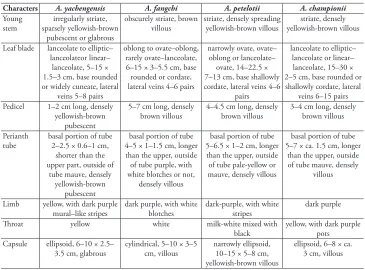
Diagnosis.Aristolochia yachangensis is morphologically similar to A. fangchi Y.C.Wu ex L.D.Chow & S.M.Hwang, A. petelotii O.C.Schmidt and A. championii Merr. & Chun, but can be distinguished from them by stems irregularly striate, sparsely yel-lowish-brown pubescent or glabrous; leaf blade 1.5–3 cm wide; cymes on old woody stems; basal portion of perianth tube 2–3 cm long, shorter than the upper; limb yellow, with dark purple mural–like stripes; throat yellow; capsule ellipsoid. Detailed mor-phological comparisons amongst the four species of A. yachangensis, A. championii, A. petelotii and A. fangchi are summarised in Table 1.
Type. China. Guangxi Zhuang Autonomous Region: Baise City, Leye County, Huaping Town, Zhongjing (Yachang Orchid National Nature Reserve), 24°49.367'N, 106°24.029'E, 1341 m a.s.l., 29 July 2019, Z. C. Lu et al. 20190729YC4141 (holo-type: IBK!; isotypes: IBK!, GXMG!).
suborbicu-Table 1. Morphological comparisons of key characters amongst Aristolochia yachengensis, A. fangchi, A. petelotii and A. championii.
Characters A. yachengensis A. fangchi A. petelotii A. championii
Young
stem sparsely yellowish-brown irregularly striate, pubescent or glabrous
obscurely striate, brown
villous striate, densely spreading yellowish-brown villous yellowish-brown villousstriate, densely
Leaf blade lanceolate to elliptic– lanceolateor linear–
lanceolate, 5–15 × 1.5–3 cm, base rounded or widely cuneate, lateral
veins 5–8 pairs
oblong to ovate–oblong, rarely ovate–lanceolate, 6–15 × 3–5.5 cm, base rounded or cordate, lateral veins 4–6 pairs
narrowly ovate, ovate– oblong or lanceolate– ovate, 14–22.5 × 7–13 cm, base shallowly cordate, lateral veins 4–6
pairs
lanceolate to elliptic– lanceolate or linear– lanceolate, 15–30 × 2–5 cm, base rounded or shallowly cordate, lateral
veins 6–15 pairs Pedicel 1–2 cm long, densely
yellowish-brown pubescent
5–7 cm long, densely
brown villous 4–4.5 cm long, densely brown villous 3–4 cm long, densely brown villous
Perianth
tube basal portion of tube 2–2.5 × 0.6–1 cm, shorter than the upper part, outside of
tube mauve, densely yellowish-brown
pubescent
basal portion of tube 4–5 × 1–1.5 cm, longer than the upper, outside of tube purple, with white blotches or not,
densely villous
basal portion of tube 5–6.5 × 1–2 cm, longer than the upper, outside of tube pale-yellow or mauve, densely villous
basal portion of tube 5–7 × ca. 1.5 cm, longer
than the upper, outside of tube mauve, densely
villous
Limb yellow, with dark purple
mural–like stripes dark purple, with white blotches dark-purple, with white stripes dark purple
Throat yellow white milk-white mixed with
black yellow, with dark purple pots Capsule ellipsoid, 6–10 × 2.5–
3.5 cm, glabrous cylindrical, 5–10 × 3–5 cm, villous narrowly ellipsoid, 10–15 × 5–8 cm, yellowish-brown villous
ellipsoid, 6–8 × ca. 3 cm, villous
lar, 0.5–1 cm in diam., yellow; anthers oblong, 2–4 × 1 mm, adnate to the gynoste-mium base, opposite to the lobes; ovary terete, ca. 1.5 × 0.3–0.5 cm, 6–angled, densely brown pubescent; gynostemium 3–lobed, margin glabrous and papillary. Capsule el-lipsoid, 6–10 × 2.5–3.5 cm, 6–angled, glabrous.
Phenology. The new species was observed flowering from March to May and fruit-ing from June to August.
Etymology. The specific epithet is derived from the type locality, Yachang Orchid National Nature Reserve, Guangxi, China. The Chinese name is given as “雅长马兜铃”.
Distribution and habitat. At present, Aristolochia yachangensis was found only in Yachang Orchid National Nature Reserve of north-western Guangxi, China. It grows on limestone hillside at an elevation of ca. 1340 m. The slope direction is to the south-west, the slope is up to 40°, the tree layer is up to 15 m tall, the canopy cover is 70%, the shrub layer cover is 80% and the herb layer cover is 45%. Its associated species include Quercus variabilis Blume (Fagaceae), Celtis sinensis Pers. (Ulmaceae), Plat-ycarya longipes Wu (Juglandaceae), Toxicodendron succedaneum (L.) Kuntze (Anacardi-aceae), Yua thomsonii (Laws.) C.L.Li (Vitaceae), Pteridium aquilinum (L.) Kuhn var.
Figure 1. Aristolochia yachangensis B.G.Huang, Yan Liu & Y.S.Huang, sp. nov. A habit B flowering branch C flower (front view) D longitudinally dissected flower (showing the inside structure) E anthers and gynoste-mium (lateral view) F old phase of gynostegynoste-mium (vertical view) G capsule. Drawn by Wenhong Lin (IBK).
Figure 3. Holotype of Aristolochia yachangensis B.G.Huang, Yan Liu & Y.S.Huang, sp. nov. Z. C. Lu et al. 20190729YC4141(IBK).
Occurrence (EOO) is less than 100 km2 and the known Area of Occupancy (AOO) is
less than 0.5 km2. According to Guidelines for Using the IUCN Red List Categories
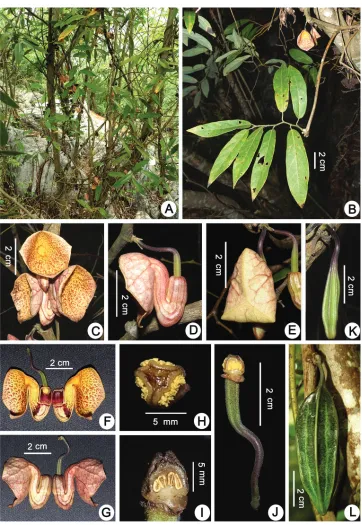
Figure 4.A–D Aristolochia yachangensis B.G.Huang, Yan Liu & Y.S.Huang, sp. nov. A habitat B inflo-rescence and flowers (lateral view) C flower (front view) D anthers and gynostemium E–H A. championii
be given a Vulnerable (VU) status, based on the criteria D2 of IUCN. As a newly-found species, however, it is probable that more subpopulations of A. yachangensis
could be found in similar habitats of limestone areas of north-western Guangxi and southern Guizhou, China in the future.
Additional specimens examined (paratypes). China. Guangxi Zhuang Autono-mous Region: Baise City, Leye County, Huaping Town, Zhongjing (Yachang Orchid National Nature Reserve), 24°49.367'N, 106°24.029'E, 1341 m a.s.l., 21 April 2019,
Y. J. Luo & S. W. Li 20190421001 (IBK); the same location, 17 May 2019, Y. J. Luo et al. YC4439 (IBK).
Discussion
Aristolochia yachangensis is unique in morphology. It is mostly similar to A. fangchi, A. petelotii and A. championii, but can be distinguished from all other Aristolochia species mainly based on the morphological characters of inflorescence, perianth tube, limb and throat. A. yachangensis can be further distinguished from morphologically-close species with the following key.
Key to Aristolochia yachangensis and morphologically-close species 1 Limb adaxially papillate or upper papillate, lower smooth ...2
– Limb adaxially smooth ...3
2 Basal portion of tube shorter than the upper; limb adaxially yellow, with dark purple stripes ...4
– Basal portion of tube longer than the upper; limb adaxially dark purple ... ...A. championii
3 Limb adaxially yellow ...5
– Limb adaxially dark purple or reddish-purple, sometimes with yellow or white blotches ...6
4 Leaf blade narrowly ovate to ovate–oblong, base cordate; petiole 4–5 cm long; limb 3–4 cm in diam ...A. huanjiangensis
– Leaf blade lanceolate to elliptic–lanceolate or linear–lanceolate, base rounded or broadly cuneate; petiole 1–1.5 cm long; limb 4–6 cm in diam ... ...A. yachangensis
5 Leaf blade ovate to narrowly ovate; limb ca. 2.5 cm in diam.; lobes of gynoste-mium pubescent ...A. pilosistyla
– Leaf blade oblanceolate to lanceolate–elliptic; limb 4–6 cm in diam.; lobes of gynostemium glabrous ...A. versicolor
6 Limb small, ca. 3 cm × 1.5–2 cm, adaxially without blotches ....A. fulvicoma
7 Leaf blade lanceolate–oblong or narrowly oblong, base narrowly auriculate, lateral veins 8–12; limb 8–13 cm in diam ...A. westlandii
– Leaf blade ovate, oblong or ovate-oblong, rarely ovate-lanceolate, base cor-date or rounded; limb no more than 8 cm in diam ...8
8 Leaf blade base rounded, rarely cordate; limb dark purple, with pale yellowish blotches ...A. fangchi
– Leaf blade base cordate; limb dark purple or reddish-purple, with white blotches or pale yellowish, without blotches ...A. petelotii
Acknowledgements
The authors are very grateful to Mr. Wen-Hong Lin for preparing the illustration. We are also grateful to Mr. Shu-Wan Li, Mr. Ying Qin, Miss Hai-Ling Chen and Miss Zhao-Cen Lu for their assistance in fieldwork. This study was supported by the Na-tional Natural Science Foundation of China (grant no. 41661012), Special Funds for Local Science and Technology Development Guided by the Central Committee (grant no. ZY1949013), the Science & Technology Basic Resources Investigation Program of China (Grant No. 2017FY100100) and the Traditional Chinese medicine pub-lic health special project-The project of investigating and monitoring on the Chinese materia medica raw materials resources for national essential drugs ([2011]76) and Traditional Chinese Medicine industry research special project-Characteristic Chinese materia medica resources protection and utilization in representative regions of China (201207002).
References
Cai L, He DM, Huang YS, Dao ZL (2020) Aristolochia wenshanensis, a new species of Aris-tolochiaceae from karst region in southeastern Yunnan, China. Taiwania 65: 41–46. Cheng CY, Yang CS, Hwang SM (1988) Aristolochia Linnaeus. In: Kiu HS, Ling YR (Eds)
Flora Reipublicae Popularis Sinicae. Science Press, Beijing, 199–245.
Chow LD, Huang SM (1975) Aristolochia fangchi, a new species of Aristolochia (Aristolochi-aceae). Zhiwu Fenlei Xuebao 13: 108–110.
Do TV, Nghiem TD (2017) Taxonomic notes on some Aristolochia species in Vietnam. Tai-wania 62: 216–218.
Do TV, Nghiem TD, Wanke S, Neinhuis C (2014) Aristolochia quangbinhensis (Aristolochiace-ae), a new species from Central Vietnam. PhytoKeys 33: 51–59. https://doi.org/10.3897/ phytokeys.33.6094
Do TV, Luu TH, Wanke S, Neinhuis C (2015a) Three new species and three new records of
Do TV, Neinhuis C, Wanke S (2015b) A new species of Aristolochia subgenus Siphisia (Aris-tolochiaceae) from central Vietnam. Phytotaxa 220(1): 69–76. https://doi.org/10.11646/ phytotaxa.220.1.6
Do TV, Wanke S, Neinhuis C (2016) Aristolochia bidoupensis sp. nov. from southern Vietnam. Nordic Journal of Botany 34(5): 513–516. https://doi.org/10.1111/njb.01066
Do TV, Truong CQ, Huynh HTT (2017) Aristolochia neinhuisii (Aristolochiaceae), a new species from Vietnam. Annales Botanici Fennici 54(4–6): 203–208. https://doi. org/10.5735/085.054.0602
Do TV, Vu TTH, Luu HT, Nguyen TT (2019) Aristolochia nuichuaensis (subg. Siphisia, Aris-tolochiaceae), a new species, an updated key and a checklist to the species of Siphisia in Viet-nam. Annales Botanici Fennici 56(1–3): 107–113. https://doi.org/10.5735/085.056.0116
Gong QB, Landrein S, Xi HC, Ma XD, Yang ZH, He KW, Shen JY (2018) Aristolochia tongbi-guanensis, a new species of Aristolochiaceae from Yunnan, China. Taiwania 63: 183–187. González F (2012) Floristica y sistemática filogenética innecesariamente disyuntas: El caso de
Aristolochia, Euglypha y Holostylis (Aristolochiaceae). Revista de la Academia Colombiana de Ciencias Exactas, Físicas y Naturales 36: 193–202.
Huang YS, Peng RC, Tan WN, Wei GF, Liu Y (2013) Aristolochia mulunensis (Aristolochi-aceae), a new species from limestone areas in Guangxi, China. Annales Botanici Fennici 50(3): 175–178. https://doi.org/10.5735/085.050.0308
Huang YS, Peng YD, Huang BY, Lv HZ, Lin CR (2015) Aristolochia gongchengensis (Aris-tolochiaceae), a new species from the limestone areas in Guangxi, China. Annales Botanici Fennici 52: 396–400. https://doi.org/10.5735/085.052.0522
Huong NTT, Hai DV, Quang BH, Cuong NT, Kuang NS, Vu DQ, Ma JS (2014) Aristolochia xuanlienensis, a new species of Aristolochiaceae from Vietnam. Phytotaxa 188(3): 176– 180. https://doi.org/10.11646/phytotaxa.188.3.7
Hwang SM (1981) Materials for Chinese Aristolochia. Zhiwu Fenlei Xuebao 19: 222–231. Hwang SM, Kelly LM, Gilbert MG (2003) Aristolochia Linnaeus. In: Wu ZY, Raven PH, Hong
DY (Eds) Flora of China, Vol. 5. Science Press, Beijing & Missouri Botanical Garden Press, St. Louis, 258–269.
IUCN (2001) IUCN Red List Categories and Criteria, Version 3.1. Gland Switzerland and Cambridge, 18–20.
Li RT, Wang ZW, Wang J, Zhu XX, Xu H (2019) Isotrema sanyaense, a new species of Aristolochiaceae from Hainan, China. PhytoKeys 128: 85–96. https://doi.org/10.3897/phytokeys.128.35042
Liang CF (1975) The Aristolochiaceae of Kwangsi Flora. Zhiwu Fenlei Xuebao 13: 10–28. Liu ZW, Deng YF (2009) Aristolochia wuana, a new name in Chinese Aristolochia
(Aristolochi-aceae). Novon 19(3): 370–371. https://doi.org/10.3417/2007151
Ma JS (1989a) A revision of Aristolochia Linn. from E. & S. Asia. Zhiwu Fenlei Xuebao 27: 321–364.
Ma JS (1989b) A revision of Aristolochia from Yunnan. Yunnan Zhi Wu Yan Jiu 11: 321–323. Ma JS, Cheng JR (1989) New taxa of Chinese Aristolochia L. Zhiwu Fenlei Xuebao 27: 293–297. Merrill ED, Chun WY (1940) Additions to our knowledge of the Hainan flora. Sunyatsenia
Peng YD, Gadagkar SR, Li J, Xie YY, Huang XY, Lu HZ, Huang BY, Yu LY (2019) Aristolochia kechangensis sp. nov. (Aristolochiaceae) from Guangxi, China. Nordic Journal of Botany 37(9): 1–7. https://doi.org/10.1111/njb.02456
Qin HN, Liu Y (2010) A checklist of vascular plants of Guangxi. Science Press, Beijing, 82–83. Schmidt OC (1933) Beiträge zur Kenntnis der Aristolochiaceen IV. Repertorium Specierum
Novarum Regni Vegetabilis 32(1–8): 95–96. https://doi.org/10.1002/fedr.19330320104
Standards IUCN, Petitions Committee (2019) Guidelines for Using the IUCN Red List Cat-egories and Criteria. Version 14. Prepared by the Standards and Petitions Committee.
http://www.iucnredlist.org/documents/RedListGuidelines.pdf
Wen HQ (1992) Species of Aristolochia of Guangxi. Gaihaia 12: 217–218.
Wu L, Xu WB, Wei GF, Liu Y (2013) Aristolochia huanjiangensis (Aristolochiaceae), a new species from Guangxi, China. Annales Botanici Fennici 50(6): 413–416. https://doi. org/10.5735/085.050.0608
Wu L, Xu WB, Huang YS, Liu Y (2015) Aristolochia longlinensis (Aristolochiaceae), a new species from Western Guangxi, China. Novon 23(4): 490–493. https://doi.org/10.3417/2011105
Xu H, Li YD, Yang HJ, Chen HQ (2011) Two new species of Aristolochia (Aristolochiaceae) from Hainan Island, China. Novon 21(2): 285–289. https://doi.org/10.3417/2009116
Zhou XX, Jiang GB, Zhu XX, Liu ZY, Huang Y, Wang GT, Wang RJ (2019) Isotrema plagiosto-mum (Aristolochiaceae), a new species from Guangdong, South China. Phytotaxa 405(4): 221–225. https://doi.org/10.11646/phytotaxa.405.4.7
Zhu XX, Zhang L, Hua ZX, Chen GF, Liao S, Ma JS (2015) Aristolochia weixiensis, a new species of Aristolochiaceae from Yunnan, China. Phytotaxa 230(1): 54–60. https://doi. org/10.11646/phytotaxa.230.1.4
Zhu XX, Liao S, Zhang L, Wang ZH, Du C, Ma JS (2016) The taxonomic revision of Asian
Aristolochia (Aristolochiaceae) I: Confirmation and illustration of A. austroszechuanica, A. faucimaculata and A. yunnanensis var. meionantha from China. Phytotaxa 261(2): 137– 146. https://doi.org/10.11646/phytotaxa.261.2.3
Zhu XX, Liao S, Ma ZX, Xu B, Wang ZH, Wang Y, Ma JS (2017a) The taxonomic revision of Asian Aristolochia (Aristolochiaceae) III: Two new taxa of Aristolochia and morphologi-cal revision for the flower character of A. obliqua from Yunnan, China. Phytotaxa 332(3): 269–279. https://doi.org/10.11646/phytotaxa.332.3.3
Zhu XX, Liao S, Sun ZP, Zhen AG, Ma JS (2017b) The taxonomic revision of Asian Aristolochia
(Aristolochiaceae) II: Identities of Aristolochia austroyunnanensis and A. dabieshanensis, and
A. hyperxantha-a new species from Zhejiang, China. Phytotaxa 313(1): 61–76. https://doi. org/10.11646/phytotaxa.313.1.4
Zhu XX, Liao S, Liu JN, Zhang C, Ma JS (2018) The taxonomic revision of Asian Aristolochia
(Aristolochiaceae) IV: Lectotypification of A. caulialata, with a new species from Yunnan, China – A. pseudocaulialata. Phytotaxa 364(1): 49–60. https://doi.org/10.11646/phyto-taxa.364.1.2
Zhu XX, Li XQ, Liao S, Li GD, Ma JS (2019b) The taxonomic revision of Asian Aristolochia
(Aristolochiaceae) V: Two new species from Yunnan, China. PhytoKeys 130: 93–106.
https://doi.org/10.3897/phytokeys.130.33933
Zhu XX, Wang J, Liao S, Ma JS (2019c) Synopsis of Aristolochia L. and Isotrema Raf. (Aris-tolochiaceae) in China. Shengwu Duoyangxing 27(10): 1143–1146. https://doi. org/10.17520/biods.2019183