Do species differ in their ability to coexist with the
dominant alien
Lupinus polyphyllus
? A comparison
between two distinct invaded ranges and a native range
Martin Hejda1
1 Department of Invasion Ecology, Botanical Institute of the Czech Academy of Sciences, Zámek 1, Průhonice 252 43, Czech Republic
Corresponding author:Martin Hejda ([email protected])
Academic editor:L.C. Foxcroft | Received 15 November 2012 | Accepted 14 March 2013 | Published 28 June 2013
Citation: Hejda M (2013) Do species differ in their ability to coexist with the dominant alien Lupinus polyphyllus? A comparison between two distinct invaded ranges and a native range. NeoBiota 17: 39–55. doi: 10.3897/neobiota.17.4317
Abstract
The community-level impacts of invasive plants are likely to vary depending on the character of native species of the target communities and their ability to thrive within the stands of the dominant alien invader. Therefore, I examined the response of native species richness to the cover of the dominant alien
Lupinus polyphyllus in two distinct invaded ranges: Czech Republic (Central Europe) and New Zealand. I compared the relation between native species richness and the cover of the dominant alien L. polyphyllus
with that in its native range, Pacific Northwest, USA.
In the native range, I found no response of native species richness to the cover of L. polyphyllus. In the Czech Republic (central Europe), the richness of native species related to it negativelly, but the relation was only marginally significant. Contrary to that, the richness of species native to New Zealand related to the cover of L. polyphyllus strongly negatively and the negative relation was significantly stronger than that of species native to Europe.
Of the two invaded ranges, species native to New Zealand have been documented to be much more vulnerable to the conditions associated with the invasion and dominance of L. polyphyllus, compared to species native to central Europe. This principle has been shown both across these two invaded ranges and in New Zealand, where the aliens of european origin successfully coexist with the dominant invasive alien
L. polyphyllus. Similarly, species in the native range of L. polyphyllus showed no relation to its cover, indi-cating their ability to thrive even in dense stands of this dominant species.
Keywords
Lupinus polyphyllus, invasive alien species, native range, invaded range, coexistence of species, diversity, dominance
introduction
Invasions of alien plant species have become widely recognized as one of the major hu-man-induced changes, affecting the whole biosphere at the global scale (Tilman 1999, Manchester and Bullock 2000). In the last decade, the attention has been focused on testing, documenting and quantifying the impacts of alien invasive species upon the res-ident communities (Mack et al. 2000, Davis 2003, Hejda et al. 2009, Vilà et al. 2010). It has been documented that the character of the recipient community co-deter-mines the magnitude of the alien´s impact on diversity and, therefore, a single invasive species can have different impacts in different types of invaded communities (Mason and French 2008). Hejda et al. (2009) suggested that the impact on diversity of native species is especially strong, if the invader represents a novel and distinctive dominant to the community that has been lacking such dominants before the invasion. Some al-ien species, like Impatiens glandulifera or Helianthus tuberosus, have been documented to compete with native dominants without actually changing the site conditions for other native species, which results in relatively mild impacts on diversity, especially when considering these aliens´ robust stature and tendency to grow in high densities. On the contrary, other invaders (Fallopia sp. div., Heracleum mantegazzianum, Rumex alpinus) have been documented to represent distinctive and novel dominants to the invaded communities and also to impact both diversity and composition of native spe-cies substantially (Hejda et al. 2009).
Aliens can alter conditions on large areas, such as when a tree species invades a formally treeless environment, as documented on Galápagos by Järger et al. (2007). At the same time, invasive aliens are often strong competitors and are able to exclude native species at fine scales, due to e. g. competition by roots, allellopathic compounds or by production of large amounts of above-ground biomass.
This paper aims to test the ability of native species to coexist with the dominant alien Lupinus polyphyllus and attempts to test the following hypotheses:
Do species of native and invaded ranges differ in their ability to thrive on sites with high dominance of L. polyphyllus?
Do native species of different invaded ranges (Czech Republic, central Europe; New Zealand) differ in their ability to coexist with the dominant invasive alien L. polyphyllus?
Methods
Study species
Lupinus polyphyllus is a 0.7 – 1.2 m tall, robust, rhizomatous perennial native to the Pa-cific Northwest of USA. In its native range, L. polyphyllus has been reported to grow in wet montane meadows, along streams, but also as a viatic weed. Despite L. polyphyllus
For ornamental and landscape purposes, L. polyphyllus was intentionally intro-duced to many regions of the world and has become invasive in central and northern Europe, Southern island of New Zealand and Tasmania. In the Czech Republic, Lupi-nus polyphyllus invades wet montane and submontane meadows, river banks and forest edges (Slavík et al. 1995). Both in its native and invaded ranges, the occurrence of L. polyphyllus seems to respond to human-induced disturbance positivelly and it often grows along roads and in other anthropogenically impacted places (see for example Valtonen et al. 2003). At the same time, L. polyphyllus is apparently able to colonize even rather extreme sites, with rocky and unstable substrates, periods of stress and / or low nutrient levels. This can be seen in New Zealand especially, where L. polyphyllus
often colonizes frequently disturbed and rocky terraces of montane and submontane rivers (Holdaway and Sparrow 2006). The ability of L. polyphyllus to grow on low-nutrient substrates is associated with its ability to utilize nitrogen from the air, which gives it a competitive advantage over nitrogen non-fixing species and makes it able to gain dominance even in oligotrophic conditions (Scott 2007).
The community-level impacts of Lupinus polyphyllus as an invasive alien have been studied in both Europe (Valtonen et al. 2006, Hejda et al. 2009) and New Zealand (Holdaway and Sparrow 2006). In SE Finland, L. polyphyllus was found to reduce road verge communities and the loss of diversity was documented on vascular plants and butterflies (Valtonen et al. 2006). In New Zealand, L. polyphyllus was documented to affect the succession series on river terraces by accumulating silt material and stabilising the riparian terraces (Holdaway and Sparrow 2006). In the native range, the ability of lupins to stabilize unstable soil and raise nutrient levels was documented on a related species L. lepidus on bare soils around Mt. St. Helen´s (Del Moral and Rozzell 2005). In this case, lupins were found to facilitate conditions for the colonisation of other species.
The invasion of lupins is apparently promoted by the intentional introduction of generalist pollinators, such as bees or bumble-bees (Lye et al. 2010). In Tasmania, a related alien species L. arboreus was reported to be almost exclusively pollinated by introduced pollinators (Stout et al. 2002).
Study area
I carried out this comparative study in the native range of L. polyphyllus, which is the Pacific Northwest of USA, and two distinct invaded ranges (Southern Island of New Zealand and Czech Republic, central Europe).
the town of Průhonice (central Bohemia). In all of these three ranges, I collected the data in mesic to wet meadows. All areas revealed relatively high precipitation and were not prone to summer drought periods.
It was not possible to locate the vegetation plots randomly, mainly because of spa-tially autocorrelated distribution of L. polyphyllus in the invaded ranges. In the Czech Republic and especialy in New Zealand, L. polyphyllus was found to be excessively abundant in some areas, whereas it was absent in other areas. This type of strongly autocorrelated spatial distribution leads to the plots being clustered in the areas, where
L. polyphyllus was abundant and where it was observed to massively invade near-natural communities and compete with native species. The aim was to sample vegetation with a wide scale of L. polyphyllus´ cover (dominance) in each area of its occurence. The GPS coordinates of plots are available in Appendix I.
Sampling design and data analysis
In all of the three ranges, I collected a dataset of 40 plots of an area of 2 × 2m with varying cover of L. polyphyllus. I used the fine-scale plots because the aim of the project was to test the ability of species to thrive within the dense and homogenous stands of L. polyphyllus. On larger scales, the stands of L. polyphyllus tend to be patchy rather than homogenous, so the results would be biased by native species´ growing in these empty patches rather than within the stands of L. polyphyllus. I recorded the present species and estimated their relative abundances on a percentage scale. Altogether, I sampled 120 plots of communities with L. polyphyllus from the three ranges together, plus 40 plots with the alien dominant
Hieracium pilosella agg. and 40 plots with the alien dominant Anthoxantum odoratum in New Zealand, which makes 200 plots altogether. I estimated the dominance of lupins (and other alien dominants in New Zealand) as its percentage cover, which can be assumed to be a quick and easy to get proxy for biomass. At fine spatial scale, I selected sites with com-parable conditions (light, stability and moisture of substrate, degree of ruderalization), in order to minimize the likelihood that the cover of lupins would be confounded with other basic environmental factors, biasing the results. I found the taxonomy of Lupins to be very complicated in the native range (Pacific Northwest, USA) and I had to exclude several plots from the dataset, leading to merely 22 plots from the native range. Lupins on the excluded plots were probably hybrids between L. polyphyllus and other related spe-cies, such as L. latifolius and L. burkei. Although these hybrids between L. polyphyllus and closelly related species were of similar appearance with robust stature and rhizomatous growth, they could have impacted the coexisting species differently, due to differences in e. g. nitrogen fixation rate or production of allellopathic compounds. For these reasons, I decided to keep the taxonomic delimitation of L. polyphyllus as consistent as possible across the ranges where the plots were sampled, however, leading to just 102 plots with L. polyphyllus used in the data analysis, compared to the originally intended 120.
Pear-son correlations and the linearity of these relations using regression models. Further, I tested the differences in the response between various subsets of species (native to USA, native to Europe and native to New Zealand) by the mixed-effect analysis of covariance (Crawley 2007). In this model, the identity of spatial cluster (area within each range - see Appendix I) was the random effect, while the cover of L. polyphyllus
(continuous variable) and the type of range (native range - USA, Czech Republic, New Zealand – factor variables) were the fixed effects. The interactions between the continuous term (cover of L. polyphyllus) and the category variables (native range, in-vaded ranges) was of the most interest, since it would reveal possible differences in the response of various subsets of species.
I used the ratios in the numbers of species between each plot and the most diverse plot sampled within the category of plots (USA, Czech Republic, New Zealand) as response variables. The plot with the maximum species richness within a particular category had an importance value of 1, while the other plots from this subgroup had importance values between 0 – 1, when the zero value says no species were recorded besides L. polyphyllus and the value of 1 says the plot harboured the same number of species as the plot with maximum species richness within that category. I did this be-cause plots from the three ranges differed in native species richness substantially, with the invaded stands from New Zealand harbouring much less native species compared to the stands in either the Czech Republic or in the native range, USA. In other words, the difference of 5 native species between the least and most invaded stands represents a very different portion of native species richness recorded in New Zealand and in the Czech Republic. Therefore, I considered these ratios, representing portions of species thriving on a particular plot from the maximum sampled within each category of plots, as more relevant than simple numbers of species.
A separate mixed-effect regression model was created to test the response of na-tive vs. alien species (of european origin exclusively) to the cover of L. polyphyllus in New Zealand. In this regression model, the identity of sampling areas in New Zealand (Arthur Pass, Eglington River Valley) was the random effect, while the cover of L. polyphyllus was the fixed effect. The ratios between the numbers of native / alien species were used as the response variable in this model in order to reflect the autocorrelation between the alien and native species richness, recorded on a single vegetation plot.
I tested the significance of particular terms via deletion tests, when the growth of unexplained variance following the removal of a particular term (main effect or inter-action) was tested using F-tests in case of regression models and Chi2 tests in case of the
mixed - effect models. I performed all univariate analyses in R software (R Develop-ment Core Team, 2011).
all models (both univariate and multivariate), since I did not consider tall woody spe-cies likely to be impacted by the dominance of lupins, which I also excluded from all the analyses. I performed all of the multivariate ordination analyses in the CANOCO software (Ter Braak and Šmilauer 1998). I standardized the nomenclature according to Kubát et al. 2002 (Czech Republic), Wilson 1996 (New Zealand) and Turner & Gustafson 2006 (Pacific Northwest, USA).
Results
In all of the three ranges (USA, Czech Republic, New Zealand), I sampled plots with the cover of L. polyphyllus of up to 90% (Appendix II).
In the native range (Pacific NW USA), I recorded 112 native species and 52 al-iens of European origin exclusively in the vegetation with L. polyphyllus. In the Czech Republic, 120 native species were recored in the vegetation invaded by L. polyphyllus
along with 6 aliens, with origins in Europe or SW Asia. In New Zealand, I recorded only 33 native species within the stands of L. polyphyllus, but also 52 alien species, exclusively of european origin (Appendix I and II).
In the Czech Republic, native species´ richness responded to the cover of L. polyphyllus negativelly (r = -0.294 – Table 1, Fig 1), but the relationship was only marginally significant (p = 0.065 – Table 1, Fig 1). In New Zealand, native species responded to the cover of L. polyphyllus negativelly (r = -0.757, p < 0.001 Table 1, Fig. 1). Species of european origin growing as aliens in New Zealand did not re-spond to the cover of L. polyphyllus (r = -0.160, p = 0.324 – Table 1), nor did species native to New Zealand respond to the cover of other invaders of the target commu-nities (Hieracium pillosella agg. – r = -0.104, p = 0.523, Anthoxantum odoratum – r = 0.070, p = 0.666 – Table1). I detected no relation between species richness and the cover of L. polyphyllus in its native range, Pacific Northwest, USA (r = 0.308, p = 0.163 – Table 1).
table 1. Response of species richness to the cover of dominant. Only species native to New Zealand revealed a significantly negative response to the cover of the alien L. polyphyllus. The response of native species in Europe was negative, but only marginally significant.
Predictor Response variable Correlation coefficient P – value
cover of L. polyphyllus native species in its native range (NW USA) 0.308 0.163 cover of L. polyphyllus native species in the Czech Republic (central Europe) -0.294 0.065 cover of L. polyphyllus native species in New Zealand -0.757 < 0.001 cover of L. polyphyllus alien species (of European origin) in New Zealand -0.160 0.324 cover of Hieracium pilosella agg. native species in New Zealand -0.104 0.523 cover of Anthoxantum
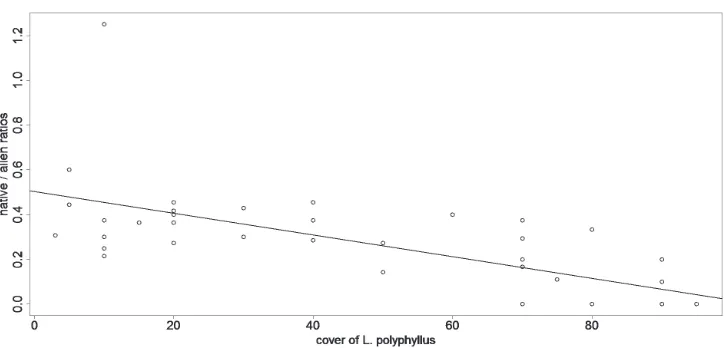
The response of species richness to the cover of L. polyphyllus differed between the na-tive and invaded ranges (p < 0.001, Chi = 32.15, DF = 2 / 94). In New Zealand, the ratios between the native / alien (of european origin) species richness responded to the cover of
L. polyphyllus negativelly (p = < 0.001, Chi = 23.547, DF = 1 / 36), indicating that alien species were more successful in the heavily invaded stands compared to native species.
The cover of L. polyphyllus proved to be a significant predictor of species composi-tion in all ranges (USA: p = 0.0220; Czech Republic: p = 0.0460; New Zealand: p = 0.0200 – Table 2).
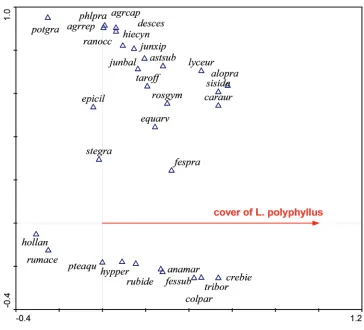
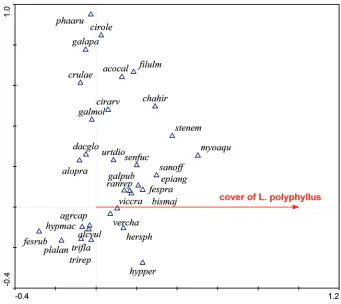
In the USA (native range – Fig. 3) and Czech Republic (Fig. 4), some native spe-cies revealed negative response to the cover of L. polyphyllus, while others were more
Figure 1. Relation between richness of native species (vertical axis) and cover of L. polyphyllus (horizontal axis) in all of the three ranges (USA, Czech Republic, New Zealand). Species richness is expressed as ratios between the richness in a particular plot and maximum richness recorded in the sampled invaded plots in that particular range. Richness of native species on New Zealand reveals a negative relation to the cover of the alien L. polyphyllus (full line, y = 0.783 - 0.074x, R2 = 0.573) with the most invaded plots (90% of
co-ver of L. polyphyllus, n = 7) harbouring on average only 4.8% of native species richness found in the most diverse plot sampled on New Zealand. Native species in the Czech Republic revealed negative relation to the cover of the alien L. polyphyllus (dashed line, y = 0.644 - 0.017x, R2 = 0.087), but the relation was
only marginally significant (p = 0.065, t = -1.8972, cor = -0.294, df = 1/38). In the native range of L. po-lyphyllus (USA), richness of native species revealed no relation to the cover of L. polyphyllus (dotted line).
table 2. The cover of L. polyphyllus as a predictor of species composition. The table shows results of or-dination models, where the cover of L. polyphyllus was a predictor variable, while abundances of recorded species were the response variables. In all three ranges, the cover of L. polyphyllus was found out to be a significant predictor of species composition – communities with low cover of L. polyphyllus qualitatively differed from those with large covers of L. polyphyllus.
Range F-ratio p-value Trace
Native range (USA) 1.462 0.022 0.293
Invaded range (New Zealand) 1.597 0.02 0.21
abundant in plots with high cover of it. Contrary to this, all species native to New Zealand (Fig. 5) revealed negative response to the cover of the alien L. polyphyllus, with the exception of Muehlenbeckia axillaris, which actually revealed a slight preference for the invaded stands.
Discussion
All these results need to be interpreted with caution, mainly given by the comparative way the data were sampled. It is possible that the factor of the alien´s dominance is confounded with other environmental factors, such as anthropogenic disturbance or increased nutrient levels, which may suppress native species and enhance the alien´s dominance. It is not really possible to say if the invasion (expressed as the alien´s domi-nance on a given small spatial scale in this study) is promoted by these changes, or if the alien species transforms the sites actively. Alien invasive species have been documented to change site conditions massively, mainly due to substrate stabilisation (L. polyphyl-lus – Holdaway and Sparrow 2006), litter accumulation (Fraxinus uhdei - Rothstein et al. 2004), nutrient uptake efficiency (Acacia saligna – Odat et al. 2011), water uptake efficiency (Tamarix sp. div. – Di Tomaso 1998) or light deficiency (Cinchona pube-scens – Järger et al. 2007). Therefore, it is difficult to say in which way the causality between the occurrence of aliens and altered site conditions goes – does L. polyphyllus
alter the site conditions by itself, due to nitrification, substrate stabilisation and limited insolation, or does it just benefit from human-induced ruderalization? Both of these mechanisms are likely to work in concert, and either of them can prevail in a particular situation. This makes it very difficult to find a general answer to the question of the Figure 2. Relation between the ratios of native / alien species richness and the cover of L. polyphyllus, as recored in New Zealand. A negative response (y = 0.503 - 0.049x, R2 = 0.445) shows that native species
Figure 3. Ordination diagram (CCA) showing the response of species composition to the cover of L. polyphyllus in its native range, USA. The first ordination axis (constrained or canonical axis) represents the predictor variable – the cover of L. polyphyllus. Native species like Potentilla gracilis or Epilobium ciliatum
reveal negative response to the cover of L. polyphyllus, while others, like Anaphallis margaritacea, reveal a positive response. The second axis is unconstrained and represents some other environmental gradient, which is difficult to interpret in this case.
agrcap = Agrostis capillaris, agrrep = Agropyron repens, alopra = Alopecurus pratensis, anamar = Anaphallis margaritacea, astsub = Aster subspicatus, caraur = Carex aurea, colpar = Collinsia parviflora, crebie = Crepis biennis, desces = Deschampsia cespitosa, epicil = Epilobium ciliatum, equarv = Equisetum arvense, fespra =
Festuca pratensis, hiecyn = Hieracium cynoglossoides,hollan = Holcus lanatus, hypper = Hypericum perforatum,
junbal = Juncus balticus, junxip = Juncus xiphioides, lyceur = Lycopus europaeus, phlpra = Phleum pratense,
potgra = Potentilla gracilis, pteaqu = Pteridium aquilinum, rosgym = Rosa gymnocarpa, rumace = Rumex acetosa, rubide = Rubus idaeus, stegra = Stellaria graminea, Sisyrrhynchium idahoense, taroff = Taraxacum officinale, tribor = Trientalis borealis
hand, this factor can be presumed to play only a marginal role in regularly disturbed communities, where the succession series is blocked by flooding, grazing or mowing.
Be that as it may, the results show that in the invaded ranges, the dominance of L. polyphyllus is associated with site conditions that do not favor native species, Figure 4. Ordination diagram (CCA) showing the response of species composition to the cover of L. poly-phyllus in the Czech Republic. The first ordination axis (constrained or canonical axis) represents the predictor variable – the cover of L. polyphyllus. Same as in its native range, USA, some native species (Myosoton aquaticum, Stellaria nemorum, Bistorta major) reveal a positive relation to the cover of L. polyphyllus, while others (Festuca rubra) reveal a strongly negative relation. The second axis is unconstrained and very likely represents some en-vironmental gradient related to moisture, with species like Hypericum perforatum, Festuca rubra and Plantago lanceolata in the lower part and Phalaris arundinacea and Cirsium oleraceum in the upper part of the diagram.
acocal = Aconitum callibotryon, agrcap = Agrostis capillaris, alcvul = Alchemilla vulgaris agg., alopra = Alope-curus pratensis, bismaj = Bistorta major, chahir = Chaerophyllum hirsutum, cirarv = Cirsium arvense, cirole
= Cirsium oleraceum, crulae = Cruciata laevipes, dacglo = Dactylis glomerata, epiang = Epilobium angusti-folium, fespra = Festuca pratensis, fesrub = Festuca rubra, filulm = Filipendula ulmaria, galapa = Galium aparine, galmol = Galium mollugo, galpub = Galeopsis pubescens, hersph = Heracleum sphondilium, hypmac =
Hypericum maculatum, hypper = hypericum perforatum, myoaqu = Myosoton aquaticum, phaaru = Phalaris arundinacea, plalan = plantago lanceolata, ranrep = Ranucnulus repens, sanoff = Sanguisorba officinalis, sen-fuc = Senecio fuchsi agg., stenem = Stellaria nemorum, trifla = Trisetum flavescens, trirep = Trifolium repens,
which is especially apparent in New Zealand. Contrary to that, species from the na-tive range were successful when growing with L. polyphyllus, more than species from both invaded ranges (Czech Republic and New Zealand). This is likely to be due to these species´ being well apapted to the conditions of sites distinctively dominated by
L. polyphyllus, which may be caused by the long-term coevolution of communities and species´ filtering in the dominant species´ native range. Due to the long-term presence Figure 5. Ordination diagram (CCA) showing the response of species composition to the cover of L. polyphyllus in New Zealand. The first ordination axis is constrained and represents the predictor variable – the cover of L. polyphyllus.
All species native to New Zealand revealed a negative relation (Discaria toumatou, Acaena inermis, Gono-carpus aggregatus, Rhytidosperma gracilis), with the exception of Muehlenbeckia axillaris, which reveals a positive relation to the cover of L. polyphyllus. The second ordination axis (vertical) is unconstrained and difficult to interpret in this case. acaine = Acaena inermis, achmil = Achillea millefolium agg., agrsto = Agros-tis stolonifera, aircar = Aira caryophyllea, antodo = Anthoxantum odoratum, arreal = Arrhenatherum elatius,
avefat = Avenula fatua, blemon = Blechnum montanum, blepen = Blechnum penna – marina, cerhol = Ceras-tium holosteoides, cirarv = Cirsium arvense, cirvul = Cirsium vulgare, corsar = Coriaria sarmentosa, crecap
= - Crepis capillaris, desces = Deschampsia cespitosa, distou = Discaria toumatou, fesaru = Festuca arundinacea,
fesovi = Festuca ovina, gonocr = Gonocarpus aggregatus, hiepil = Hieracium pilosella agg., hollan = Holcus lanatus, luzcam = Luzula campestris, mueaxi = Muehlenbeckia axillaris, phypus = Phymatosorus pustulatus,
poapra = Poa pratensis, poatri = Poa trivialis, rhygra = Rhytidosperma gracilis, sagpro = Sagina procumbens,
of the dominant species L. polyphyllus, species in the native range have been selected to coexist with it, otherwise they would have been eliminated from communities where
L. polyphyllus is a dominant species.
Contrary to that, L. polyphyllus is a newly imported dominant species to the com-munities in the invaded ranges. In Europe, the invasion of L. polyphyllus is associated with some loss of native species richness (see for example Valtonen et al. 2006), but around 70% of present species are capable of growing in dense stands of this alien, as documented earlier by Hejda et al. (2009). Obviously, most of the species in the invaded communities in the Czech Republic are strong competitors that are not easilly supressed by the alien L. polyphyllus and majority of them can thrive even in the stands with a high cover of L. polyphyllus. This ability may have evolved as a result of long-term presence of distinctive dominant species native to the Czech Republic, such as
Aegopodium podagraria, Cirsium heterophyllum, Dactylis glomerata, Senecio hercynicus
or Trisetum flavescens (see primary data in Appendix II). In other words, the long-term evolution of these communities have resulted in a state, when only species that success-fuly compete with native dominants are present. In Europe, many native species utilize a similar niche as invasive aliens and prefer human disturbed places, or, on the con-trary, places where the regular disturbance or management regime has ceased (Hobbs and Huenneke 1992, Davis and Pelsor 2001). In these communities, the competitive effect of the alien L. polyphyllus may not differ substantially from competitive effects of native dominants.
Species native to New Zealand were found to be least successful when growing in the stands of L. polyphyllus in this study, with the most invaded plots (with the cover of L. polyphyllus of 90%) being almost free of species native to New Zealand. This can be partly related to the fact that, in New Zealand, L. polyphyllus often invades relatively unstable and regularly disturbed riparian terraces where the vegetation is not really dense, so the level of interspecific competition can be expected to be low. Therefore, heliophilous species of these communities (Coriaria plumosa, Epilobium melanocau-lon, Parahebe decora, Raoullia subsericera, R. hookeri, Wahlenbergia albomarginata) are weak competitors when confronted with the distinctive alien dominant and this can be caused mainly by the differences in the type of invaded habitats between these two distinct invaded ranges (Czech Republic and New Zealand). On the other hand, L. polyphyllus also invades more stable and less frequently disturbed riparian meadows in New Zealand, with species like Acaena inermis, Carex geminata, Gonocarpus aggregatus
or Prasophyllum colensoi on wet places and Brachyglottis bellidioides, Celmisia gracil-lenta, Discaria toumatou or Leucopogon fraseri on dryer sites. In these communities, the vegetation is dense and the level of interspecific competition can be expected to be rather high, but native species still fail to coexist with the dominant invasive alien
be expected to be phylogenetically rather homogenous, originating from a few clades originally colonizing the islands. Such communities have been documented to be more easily invaded (Gerhold et al. 2011). The habitat-based and geography-based explana-tions of the low abilities of species native to New Zealand to thrive within the stands of
L. polyphyllus are definitelly not exclusive and it is very likely that they work together. The only species native to New Zealand that revealed a positive relation to the cover of the alien L. polyphyllus was Muehlenbeckia axillaris, as shown by the multivariate ordination analysis – Fig. 5.
In New Zealand, L. polyphyllus has been documented to accumulate silt material and therefore accelerate the stabilization of riparian terraces (Holdaway and Sparrow 2006). This effect may facilitate the site for some species, a similar pattern was observed in the native range, where a related species L. lepidus was observed to accelerate the suc-cession by remediating site conditions on pumice fields, which are unstable and experi-ence periods of thermic and hydric stress during the vegetation season (Del Moral and Rozzell 2005). A similar principle can be expected to work on the unstable riparian terraces in New Zealand, but this process is more likely to promote aliens of European origin rather than competitivelly weak species native to New Zealand.
The target communities in New Zealand were also heavilly invaded by other aliens, like Anthoxantum odoratum and Hieracium pilosella agg., so the potential impact of the invasive alien L. polyphyllus was heavily confounded with possible impacts of other invasive species. Anthoxantum odoratum forms dense and homogenous stands, while
H. pilosella agg. forms dense 'pillows' of leaf rosettes. But richness of species native to New Zealand was not found to be related to the cover of either of these aliens of european origin, when sampled and tested in the same way as the relation to the cover of L. polyphyllus. Some native species, like Brachyglottis bellidioides, Coprosma atropur-purea or Celmisia gracillenta were actually found to prefer places with large covers of
H. pilosella´s rosettes. For these reasons, it is highly likely that the site conditions that depauperate the diversity of communities in New Zealand are associated with the in-vasion by L. polyphyllus, rather than with other abundant aliens, such as Anthoxantum odoratum and Hieracium pilosella agg.
up from tiny vegetation plots to larger units in New Zealand. The results show that at the fine scale, the invasion is associated with a severe degradation of communities, so it is likely that its potential impacts are apparent even at larger scales, due to, for example, reduction of populations of native species. In the extreme cases, this can lead to local extinctions in areas with large stands of L. polyphyllus, such as the valley of Waimakariri river in the Arthur Pass National Park, NZ. Moreover, this alien invades pristine areas with many rare species and its invasion therefore represents a serious threat to native plant diversity at the fine scale and a threat to landscape character at larger scales. High local abundances observed in the invaded ranges suggest that L. polyphyllus has the potential to spread further, well beyond the boundaries of its current distribution.
Acknowledgements
The work on this manuscript was funded by grants no. P505/11/1112 and 206/070668 from the Grant Agency of the Czech Republic, an International Collaboration Support no. M200050971 from the Czech Academy of Sciences and by an institutional long-term research plan no. AV0Z60050516. A great thanks goes to Petr Pyšek for supervis-ing the project and helpsupervis-ing me find my research focus and to my wife Hana Hejdová for being generous and forgiving. Another great thanks goes to my uncle Joe Mullen for careful language revision of the manuscript and to my colleague Honza Pergl for his assisstance with processing the figures.
References
Aniszewski T (1993) Nutritive Quality of the Alkaloid Poor Washington Lupin (Lupinus poly-phyllus) Lindl var SF TA as a Potentional Protein Crop. Journal of the Science of Food and Agriculture 61 (4): 409–421. doi: 10.1002/jsfa.2740610406
Crawley MJ (2007) The „R“ Book. - John Wiley & Sons Ltd., Chichester, West Sussex, Eng-land. 942 p. doi: 10.1002/9780470515075
Davis MA (2003) Biotic globalization: Does competition from introduced species threaten bio-diversity? Bioscience 53 (5): 481–489. doi: 10.1641/0006-3568(2003)053[0481:BGD-CFI]2.0.CO;2
Davis MA, Pelsor M (2001) Experimental support for a resource-based mechanistic model of invasibility. Ecology Letters 4 (5): 421–428. doi: 10.1046/j.1461-0248.2001.00246.x del Moral R, Rozzell LR (2005) Long-term effects of Lupinus lepidus on vegetation dynamics
at Mount St. Helens. Plant Ecology 181 (2) 203–215. doi: 10.1007/s11258-005-6627-4
Di Tomaso JM (1998) Impact, biology, and ecology of Saltcedar (Tamarix spp.) in the
Southwestern United States. Weed Technology 12: 326–336. IDS Number: 104GE, ISSN: 0890-037X
Alien Species, Which More Easily Coexist with Natives. Američan Naturalist 177 (5): 668–680. doi: 10.1086/659059
Hejda M, Pyšek P, Jarošík V (2009) Impact of invasive plants on the species richness, di-versity and composition of invaded communities. Journal of Ecology 97: 393–403. doi: 10.1111/j.1365-2745.2009.01480.x
Hobbs RJ, Huenneke LF (1992) Disturbance, Diversity, and Invasion: Implications for Conserva-tion. – Conservation Biology 6 (3): 324–337. doi: 10.1046/j.1523-1739.1992.06030324.x Holdaway RJ, Sparrow AD (2006) Assembly rules operating along a primary riverbed–grass-land successional sequence. Journal of Ecology 94: 1092–1102. doi: 10.1111/j.1365-2745.2006.01170.x
Järger H, Tye A, Kowarik I (2007) Tree invasion in naturally treeless environments: Impacts of quinine (Cinchona pubescens) trees on native vegetation in Galápagos. Biological Conserva-tion 140: 297–307. doi: 10.1016/j.biocon.2007.08.014
Kubát K, Hrouda L, Chrtek J jun., Kaplan Z, Kirschner J, Štěpánek J (Eds) (2002) Key to the Flora of the Czech Republic. Academia, Prague.
Lye GC, Kaden JC, Park KJ (2010) Forage use and niche partitioning by non-native bum-blebees in New Zealand: implications for the conservation of their populations of origin. Journal of Insect Conservation 14: 607–615. doi: 10.1007/s10841-010-9287-1
Mack RN, Simberloff D, Lonsdale WM, Evans H, Clout M, Bazzaz FA (2000) Biotic inva-sions: Causes, epidemiology, global consequences, and control. Ecological Applications 10 (3): 689–710. doi: 10.2307/2641039
Manchester SJ, Bullock JM (2000) The impacts of non-native species on UK biodiver-sity and the effectiveness of control. Journal of Applied Ecology 37 (5): 845–864. doi: 10.1046/j.1365-2664.2000.00538.x
Mason TJ, French K (2008) Impacts of a woody invader vary in different vegetation communi-ties. Diversity and Distributions 14: 829–838. doi: 10.1111/j.1472-4642.2008.00493.x Odat N, Al Khateeb W, Muhaidat R, Al´udatt M, Irshiad L (2011) The effect of exotic Acacia
saligna tree on plant biodiversity of Northern Jordan. International Journal of Agriculture and Biology 13: 823–826. IDS Number: 835VB ISSN: 1560-8530.
Payne WA, Chen C, Ball DA (2004) Agronomic potential of narrow-leafed and white lupins in the inland Pacific Northwest. Agronomy Journal 96 (6): 1501–1508. IDS Number: 876YV ISSN: 0002-1962
R Development Core Team (2011) R: A language and environment for statistical computing. Vienna, Austria: R Foundation for Statistical Computing. ISBN 3-900051-07-0, URL http://www.R-project.org/.
Rothstein DE, Vitousek PM, Simmons BL (2004) An exotic tree alters decomposition and nutrient cycling in a Hawaiian montane forest. Ecosystems 7: 805–814. doi: 10.1007/ s10021-004-0009-y
Scott D (2007) Sustainability of high-country pastures under contrasting development inputs. 9. Vegetation dynamics. New Zeal Journal of Agricultural Research 50 (3): 393–406. IDS Number: 224VI ISSN: 0028-8233
Stout JC, Kells AR, Goulson D (2002) Pollination of the invasive exotic shrub Lupinus arboreus (Fabaceae) by introduced bees in Tasmania. Biological Conservation 106: 425–434. doi: 10.1016/S0006-3207(02)00046-0
Ter Braak CJF, Šmilauer P (1998) CANOCO Reference Manual and User´s Guide to Canoco for Windows – Software for Canonical Community Ordination 4th. edn. - Wageningen, Netherlands: Centre for Biometry.
Tilman D (1999) The ecological consequences of changes in biodiversity: A search for general principles. Ecology 80 (5): 1455–1474. doi: 10.1890/0012-9658(1999)080[1455:TECO-CI]2.0.CO;2
Turner M, Gustafson P (2006) Wildflowers of the Pacific Northwest. Timber Press, Portland, Oregon , USA.
Valtonen A, Jantunen J, Saarinen K (2006) Flora and lepidoptera fauna adversely affected by invasive Lupinus polyphyllus along road verges. Biological Conservation 133: 389–396. doi: 10.1016/j.biocon.2006.06.015
Vilà M, Basnou C, Pyšek P, Josefsson M, Genovesi P, Gollasch S, Nentwig W, Olenin S, Roques A, Roy D, Hulme PE, DAISIE partners (2010) How well do we understand the impacts of alien species on ecosystem services? A pan-European, cross-taxa assessment. Frontiers in Ecology and The Environment 8 (3): 135–144. doi: 10.1890/080083
Appendix 1
Entry data for the univariate models with species richness as a response variable. (doi: 10.3897/neobiota.17.4317.app1) File format: Micrisoft Excell document (xls).
Explanation note: The file presents the entry data for i) the mixed effect model testing the differences between all three ranges and ii) data with native / alien species richness ratios used for testing the response of native species versus aliens of european origin on New Zealand.
Copyright notice: This dataset is made available under the Open Database License (http://opendatacommons.org/licenses/odbl/1.0/). The Open Database License (ODbL) is a license agreement intended to allow users to freely share, modify, and use this Dataset while maintaining this same freedom for others, provided that the original source and author(s) are credited.
Citation: Hejda M (2013) Do species differ in their ability to coexist with the dominant alien Lupinus polyphyllus? A comparison between two distinct invaded ranges and a native range. NeoBiota 17: 39–55. doi: 10.3897/neobiota.17.4317 Entry data for the univariate models with species richness as a response variable. doi: 10.3897/neobiota.17.4317.app1
Appendix 2
Raw data on species composition and abundances, expressed as the percentage cov-ers of recorded species. (doi: 10.3897/neobiota.17.4317.app2) File format: Micrisoft Excell document (xls).
Explanation note: The data with species composition were used for the multivariate ordination models, testing the response of individual species to the gradient of the cover of L. polyphyllus.
Copyright notice: This dataset is made available under the Open Database License (http://opendatacommons.org/licenses/odbl/1.0/). The Open Database License (ODbL) is a license agreement intended to allow users to freely share, modify, and use this Dataset while maintaining this same freedom for others, provided that the original source and author(s) are credited.