Doctor of Psychology (PsyD) Theses and Dissertations
5-1-2017
The Influence of Self-Compassion on Conflict
Resolution Processes in Marriages
Joyce Cha
This research is a product of the Doctor of Psychology (PsyD) program at George Fox University.Find out moreabout the program.
This Dissertation is brought to you for free and open access by the Theses and Dissertations at Digital Commons @ George Fox University. It has been accepted for inclusion in Doctor of Psychology (PsyD) by an authorized administrator of Digital Commons @ George Fox University. For more information, please [email protected].
Recommended Citation
Cha, Joyce, "The Influence of Self-Compassion on Conflict Resolution Processes in Marriages" (2017).Doctor of Psychology (PsyD). 237.
by Joyce Cha
Presented to the Faculty of the Graduate Department of Clinical Psychology
George Fox University in partial fulfillment
of the requirements for the degree of Doctor of Psychology
in Clinical Psychology
The Influence of Self-Compassion on Conflict Resolution Processes in Marriages by
Joyce E. Cha
has been approved
at the
Graduate Student of Clinical Psychology
George Fox University
as a Dissertation for the PsyD degree
Signatures:
d�
Celeste Flachsbart, PsyD, ABPP, Chair
Members:
Brooke Kuhnhausen, PhD
The Influence of Self-Compassion on Conflict Resolution Processes in Marriages
Joyce Cha
Graduate Department of Clinical Psychology George Fox University
Newberg, Oregon
Abstract
Increasing attention is given to third-wave cognitive-behavioral concepts such as self-compassion. This study seeks to explore the impact of self-compassion on conflict resolution in marital relationships. While recent research highlights the influence of self-compassion on relationship satisfaction as a whole, little exploration has been done on the impact of
self-compassion on relational conflict, a significant component of marital relationships or the impact of the bi-directional impact relationship satisfaction has on levels of self-compassion.
Table of Contents
Approval Page ... ii
Abstract ... iii
List of Tables ... vii
List of Figures ... viii
Chapter 1: Introduction ...1
Defining Self-Compassion ...1
Self-Compassion, Identity Formation, and Relational Connection ...2
Relational Conflict ...3
Importance of conflict in relationships ...3
Couples in distress ...4
Perception of partner in conflict ...4
Physiological arousal in conflict ...5
Emotional reactivity in conflict ...5
Communication and relational conflict ...6
Positive and negative emotional expression in conflict ...6
Impact of Self-Compassion on Relational Conflict ...7
Impact of self-compassion on individual characteristics relevant in relational conflict ...7
Impact of self-compassion on relationships ...7
Impact of self-compassion on compromise ...8
Self-compassion as protective against negative conflict behaviors ...8
Chapter 2: Methods ...10
Design ...10
Participants ...10
Self-compassion ...11
Perception of partner’s self-compassion ...11
Relationship and marital conflict ...12
Procedure ...12
Proposed Data Analysis ...12
Chapter 3: Results ...14
Descriptives...14
Correlations ...15
Main Effects and Interactions ...16
Chapter 4: Discussion ...19
Study Limitations and Implications ...23
Future Research ...24
References ...25
Appendix A Self-Compassion Scale Partner-Report ...30
Appendix B Self-Compassion Scale ...33
Appendix C Kansas Marital Conflict Scale ...35
List of Tables
Table 1 Participant Age Demographics Distribution ...10
Table 2 Descriptive Statistics ...14
Table 3 Correlations Among Key Study Variables ...15
List of Figures
Chapter 1
Introduction
Self-compassion as a psychological concept has been around for many decades, garnering more attention recently with other third-wave cognitive-behavioral concepts such as mindfulness. Self-compassion is the psychological concept of showing oneself kindness in the face of
adversity or pain. Culturally, Western society tends to place an emphasis on having compassion for others, perhaps underemphasizing the importance of one’s ability to be generous and
forgiving toward oneself. In turn, self-compassion creates avenues for deeper connection in relationship with others, a paramount component of overall wellbeing and quality of life. This study seeks to explore how one’s use of self-compassion relates to one’s approach to relational
conflict in marriage.
Defining Self-Compassion
In the field of psychology, self-compassion is found to be an increasingly adaptive way of understanding and taking care of oneself (Neff, 2011). Self-compassion involves the same concepts of compassion for others, but contrary to societal norms, applied to oneself. According to Neff (2011), self-compassion is composed of three main components: self-kindness, common humanity, and mindfulness.Self-kindness is frequently offset by a common phenomenon in Western culture, self-judgment. Neff (2011) defines self-kindness as “the tendency to be nurturing and understanding toward oneself rather than harshly judgmental” (p. 146). Common
commonly feels as if they do not meet certain standards. In times of deep emotion or hurt, it can be helpful to recognize that others have experienced the same feelings. The last element of self-compassion is mindfulness, an ever-growing concept in psychology that involves paying attention to the experience at the present moment, acknowledging both ongoing negative and positive processes with a balanced perspective of accepting what is.
Self-Compassion, Identity Formation, and Relational Connection
According to Tara Brach (2003), people “yearn for an unquestioned experience of belonging, to feel at home with ourselves and others, at ease and fully accepted” (p. 7). In order
to experience this feeling of belonging and connectedness that is innately part of the human experience, one must first develop an inner sense of worth and belonging, a process that is supported by the practice of self-compassion. The practice of self-compassion is an important part of identity formation, facilitating acceptance and patience with one’s areas of weakness. In this way, self-compassion and the process of identity formation is foundational to forming meaningful relationships with others, yielding richer relationship quality and relational satisfaction.
The concept of authenticity has also been used to describe the amount that one acts according to one’s true inwardly experienced desires, values and emotions (Harter, 1999, 2002).
individuals who practiced self-compassion were also more likely to practice authenticity, both concepts leading to better relational outcomes.
Sue Johnson (2017) regards that secure attachments protect from despair and increases an individual’s capacity to be vulnerable and honest with others. Further, Wiebe and Johnson
(2016), cite that Emotionally Focused Therapy for Couples (EFT) provides a space in which partners can explore and share their personal emotional experiences in an effort to be vulnerable, authentic, and honest. This strengthens the bond between partners when connecting on an
emotionally vulnerable level such as this (Wiebe & Johnson, 2016). Similarly, Mckinnon and Greenberg (2017) found that vulnerability is likely to evoke an expression of compassion and “diffusion of anger” (p. 198) from one partner to another. This also contributes to stronger bonds
and an allowance for partners to listen to their partner’s perspective from an “open and non-defensive stance” (p. 198). Helping couples who are in distress express and respond to their
partners with support is found to bring about more positive emotions in the relationship in addition to increasing intimacy and connection (Wiebe & Johnson, 2016, p. 199).
Relational Conflict
Importance of conflict in relationships. Self-compassion is a promising practice that is likely to influence one’s approach to relational conflict. However, before discussing the impacts
of self-compassion in more detail, the importance of conflict in relationships is discussed, followed by a review of research on specific characteristics of marital conflict. Because
to foster this growth and move toward repair is through practices of apology and forgiveness, both of which are influenced by self-compassion (Neff & Costigan, 2014). Additional research has shown that individuals who had apologized for previous relationship ruptures were more likely to also practice self-compassion (Breines & Chen, 2012; Howell, Dopko, Turowski, & Buro, 2011).
Couples in distress. Previous research by Gottman and Notarius (2000) found that couples who are more distressed make more global attributions to relational conflict and use this perspective for each isolated conflict. Further, couples who are more distressed inaccurately remembered positive events and focused more on negative events (Gottman & Notarius, 2000). In addition to this, more recent research found that in couples who are distressed, simply having one partner report increased psychological distress has an impact on their partner, regardless of gender (Villeneuve, et al., 2014). Lastly, Villaneuve et al.’s research found that having one partner’s perception of the relational distress decreases the marital functioning.
Perception of partner in conflict. Attachment is a construct that influences both one’s perception of their partner and relational conflict (Kobak & Hazan, 1991). In general, it was found that spouses were accurate in their perception of their partner’s conflict styles (Segrin,
couples, females’ relationship satisfaction is associated with their perception of their partner’s conflict resolution behaviors (Liu, Wang, & Jackson, 2017).
Physiological arousal in conflict. To best understand approaches to relational conflict, one must take into account individual differences in levels of stress experienced in conflict and individual differences in approaches to coping with this stress. It has been well-established that one’s stress arousal influences their cognitive process and ability to navigate through conflict
effectively. Gifford et al. (2013) found a correlation between high blood pressure and global cognition, episodic memory, language, attention, and executive functioning, all of which are involved in conflict resolution. This correlation demonstrates the impact of the fight or flight
response and autonomic nervous system regulation, through which blood pressure and heart rate are increased in times of stress. As described, a person’s cognitive processes are also negatively
impacted in times of stress, making it more difficult to think clearly to problem-solve effectively. Thus, it is likely that in periods of high stress during conflict, individuals have less ability to engage in the practices necessary for effective repair and growth.
Emotional reactivity in conflict. In addition to the body’s physiological response, previous research has shown that emotional reactivity can be an indicator of relational distress (Gottman, 1994). Individuals with high levels of emotional reactivity are thought to have a lower tolerance for distress and negative emotion, both which occur in relational conflict. In a study looking at the association between couples’ family of origin and emotional reactivity in conflicts,
findings indicated that men who perceived their partner to have a high level of emotional
conflict is a predictor of the reporting spouse’s relational satisfaction. In marriages, women
typically lead the discussion on conflict (Ball, Cowan, and Cowan, 1995) and have a more affiliative style while men have a more coercive style (Raush, Barry, Hertl, and Swain, 1974). In addition to this research, couples tended to perceived the wife to be more impactful in moving through conflict (Ball, Cowan, & Cowan, 1995).
Communication and relational conflict. A breadth of marital research has pertained to communication styles and adaptive or maladaptive communication patterns. According to Papp, Goeke-Morey, and Cummings (2007), individuals who are married reported that marital conflict occurred in conjunction with maladaptive conflict tactics. In Western society, challenges with communication and problem solving are some of the leading reasons why couples seek marital therapy (Geiss & O’Leary, 1981). Communication is an integral component of meaningful relationships, of particular importance when attempting to resolve conflict. However whether a couple is in conflict or not, communication styles can predict whether a couple is distressed or non-distressed (Baucom & Adams, 1987) or satisfied or dissatisfied (Rogge, Bradbury, Hahlweg, Engl, & Thurmaier, 2006). Gottman and Notarius (2000) found that certain communication patterns and practices within a relationship are crucial influencers in contributing to healthy, long-lasting relationships (as cited by Strosahl, Robinson, & Gustavsson, 2012).
Positive and negative emotional expression in conflict. To further explore emotional regulation in conflict, Gottman (2015), identified four maladaptive conflict behaviors that were predictors of unhealthy relationships. The four predictors were contempt (statements that are made from a “superior place,”), criticism (pointing out faults), defensiveness (a response to a
Other maladaptive conflict behaviors have also been identified and linked to unhealthy relationships. For example, verbal defensiveness, “responses to potentially threatening experiences,” has been identified as a negative predictor of relationship health (Lakey et al.,
2008). Positive indicators of relational health have also been identified. Gottman (2015) has demonstrated that any expression of positive emotion during an argument (i.e., a laugh, a smile, an apology) is a promising indicator of a lasting relationship. Attention is now turned toward how the practice of self-compassion can promote these positive indicators and decrease maladaptive conflict behaviors.
Impact of Self-Compassion on Relational Conflict
Impact of self-compassion on individual characteristics relevant in relational
conflict. Individual characteristics of improved coping have been demonstrated in individuals who practice self-compassion. Neff, Kirkpatrick, and Rude (2007) outlined how the practice of self-compassion buffered against anxiety. Further, Neff (2011) found that individuals with higher levels of self-compassion had more perspectives regarding their problems (such as fighting with a romantic partner) and felt less isolated as a result. In addition, individuals with higher levels of self-compassion had decreased levels of cortisol, the stress hormone. This suggests that
individuals who are self-compassionate have a better ability to cope emotionally (Rockliff, Gilbert, McEwan, Lightman, & Glover, 2008).
autonomy (Strosahl et al., 2012). Higher levels of relational satisfaction have also been noted for individuals that practice self-compassion (Neff, 2011). While recent research highlights the influence of self-compassion on relationship satisfaction as a whole, little exploration has been done on the impact of self-compassion on relational conflict, a significant component of marital relationships.
Impact of self-compassion on compromise. Regarding relational conflict, self-compassion has been found to promote positive indicators for relational satisfaction. Specifically, Neff (2011) found that men who practiced self-compassion were more likely to compromise in relationship. In turn, use of compromise in conflict is correlated with an increase in closeness, communication, and overall relational satisfaction (Gottman, 2004). Having the ability to compromise in relationships is important for resolving interpersonal conflict, as both partners’
needs require consideration. In this same vein, self-compassion promotes one’s ability to hold a person’s needs and the needs of the other in balance (Yarnell & Neff, 2013). They describe that a “balanced integration of autonomy and connectedness” (p. 147) is crucial in the functioning of
romantic relationships where mutual support and intimate connections are present. People who have lower levels of self-compassion have been found to put other’s needs before their own (Yarnell & Neff, 2013), which can lead to poor boundaries and resentment.
internal and external stimuli without judgment or bias (Brown, Ryan, & Cresswell, 2003) is a mediating factor that contributes to less verbal defensiveness. Further, Neff & Beretvas (2013) found that people who use compassion were less verbally aggressive. The practice of self-compassion promotes positive emotional expression rather than negative emotional expression, especially during conflict (Neff, 2011), demonstrating a positive impact on relational conflicts. More broadly, self-compassion likely leads to decreased emotional intensity and improved emotional regulation that can lead to a healthier relationship.
Hypotheses
Given the previous research supporting the relationships between self-compassion, interpersonal relationships, and interpersonal conflict, it is this researcher’s hypothesis that self-report and partner-self-report measures of self-compassion will yield similar results. In addition, an individual’s level of self-compassion will be related to their conflict resolution process and
Chapter 2
Methods
Design
This study used a cross-sectional design to explore self-compassion and relational conflict processes for 53 married couples. Retrospective questionnaires were used to measure these concepts, with both self- and observer-report components.
Participants
In this study, a total of 54 couples were surveyed (108 individuals). The majority of participants (57%) were in the age range of 25-34 years. See Table 1.
Table 1
Participant Age Demographics Distribution
18-24 25-34 35-44 45-54 55-64 65-74
Age 5.8% 57.2% 18.1% 8.7% 7.2% 2.9%
Notes. Age was collected by range.
mailing lists. Ads stipulated that the study was looking for married couples who were together for at least one year or more and that both partners need to complete the survey to participate in the study and receive the incentive. For this study, 54 married couples were recruited. All couples that completed the surveys were given a $10 gift certificate.
Self-compassion. Participants were given the 26-item Self-Compassion Scale (SCS; Neff, 2003), which includes six subscales: Self-Kindness, Self-Judgment, Common Humanity,
Isolation, Mindfulness, and Over-Identification. The first was a 5-item Self-Kindness subscale (e.g., I try to be understanding and patient toward the aspects of my personality I don’t like). The second was a 5-item Self-Judgment subscale (e.g., I’m disapproving and judgmental about my own flaws and inadequacies). Then there was a 4-item Common Humanity subscale (e.g., I try to see my failings as part of the human condition). The next subscale was Isolation (4-items; e.g., When I think about my inadequacies it tends to make me feel more separate and cut off from the rest of the world). The 4-item Mindfulness subscale was next (e.g., When something painful happens I try to take a balanced view of the situation). Lastly, the 4-item Over-Identification subscale was given (e.g., When I’m feeling down I tend to obsess and fixate on everything that’s wrong). Each item was scored on a 5-point scale (almost never to almost always). Because of the SCS was more recently developed, norms have not been established for this measure.
Perception of partner’s self-compassion. Participants were asked to fill out a partner
Similar to the SCS, the norms for the partner version of the SCS have not been established or collected.
Relationship and marital conflict. Participants filled out the Kansas Marital Conflict Scale (KMCS), which measured conflict processes in relationships (Eggeman, Moxley, & Schumm, 1985). This 27-item questionnaire included three sections regarding the beginning of a conflict (Do you both begin to understand each other’s feelings reasonably quickly?), the middle of a conflict (e.g., Are you both able to identify clearly the specific things about which you do agree?), and the ending of a conflict (e.g., Are you both willing to give and take in order to settle the disagreements?). Items were rated on a 5-point Likert scale.
Procedure
Participants were asked to sign an informed consent and then complete the demographics survey, SCS, perceived SCS, and KMCS. Each partner was asked to fill in a codename (e.g., HappyCouple1234) to pair their responses with their partner and maintain anonymity. After both partners completed the survey, participants had the option to enter the lottery for the incentive. Responses were de-identified and scored.
Proposed Data Analysis
Chapter 3
Results
Descriptives
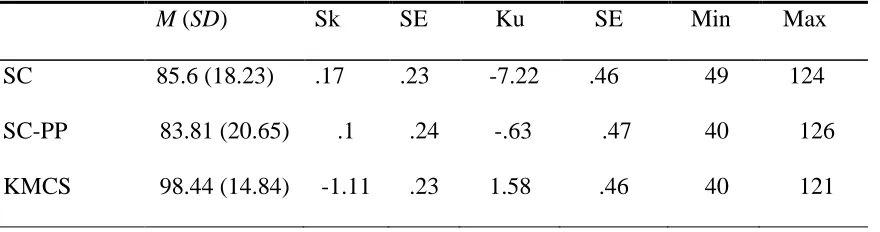
The Self-Compassion Scale (SCS) was administered to all 108 participants (M = 85.6, SD
= 18.23) and the scores ranged from 49 to 124. The SCS scores were non-normally distributed with skewness of .167 (SE = .233) and kurtosis of -7.22 (SE = .461). The partner perception SCS scores (M = 83.81, SD = 20.65) ranged from 40 to 126 and was similarly non-normally
distributed with skewness of .099 (SE = .236) and kurtosis of -.625 (SE = .467). The results for the Kansas Marital Conflict Scale (KMCS) indicated a range between 40 and 121 (M = 98.44,
SD = 14.84) with a normal distribution with skewness of -1.107 (SE = .233) and kurtosis of 1.58 (SE = .461). See Table 2.
Table 2
Descriptive Statistics
M (SD) Sk SE Ku SE Min Max SC 85.6 (18.23) .17 .23 -7.22 .46 49 124
SC-PP 83.81 (20.65) .1 .24 -.63 .47 40 126
KMCS 98.44 (14.84) -1.11 .23 1.58 .46 40 121
𝑆𝑘 𝑎
Correlations
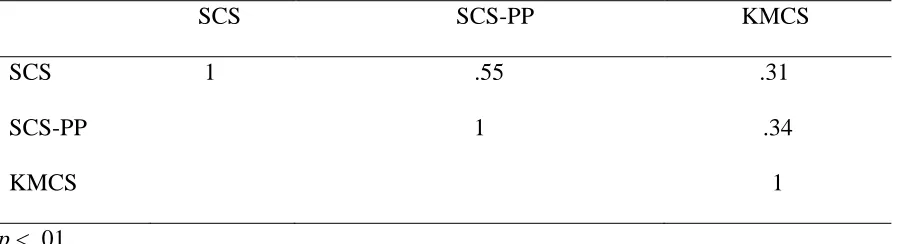
A Pearson correlation coefficient was used to compute the relationship between self-compassion and partner-report of self-self-compassion. There was a large positive correlation
between the two variables (r = .550, n = 105, p = .000, R2 = .30). Therefore, the results support a significant possibility that partners who believe their partner is more self-compassionate are also more self-compassionate themselves. See Table 3.
Table 3
Correlations Among Key Study Variables
SCS SCS-PP KMCS SCS 1 .55 .31
SCS-PP 1 .34
KMCS 1
p < .01.
Similarly, a Pearson correlation coefficient was used to understand the relationship between partner-report of self-compassion and marital conflict processes (KMCS). There was a positive correlation and very strong significance between the two variables (r = .344, n = 105, p
= .000, R2 = .12). These results show that there is a marginal positive correlation between marital conflict processes and partner-report of self-compassion. See Table 3.
variables (r = .309, n = 108, p = .001, R2 = .095), which provides evidence that the relationship between marital conflict processes and self-compassion has great significance, but has a weak positive correlation. See Table 3.
Main Effects and Interactions
It was hypothesized that an individual’s level of self-compassion would be related to their
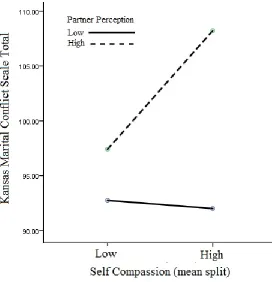
relational conflict resolution process and conflict outcomes. Further, self-compassion was measured by both self- and partner-report, and it was hypothesized that results of these measures would correspond. Regarding self-compassion and conflict, the participants were divided into two groups for each measure (high-scoring and low-scoring, divided by group mean score). Main effects of self-compassion and partner-report of self-compassion were explored, as well as the interaction effect. To do this comparison, a two-way analysis of variance was used. Results indicated that the relationship conflict means for high- versus low-scoring self-compassion were not significant (F(1,101) = 0.74, p = .39, η2 = .01). However, there was a significant difference on relationship conflict scores between high- and low-scoring self-compassion groups when partner-report was used (F(1,101) = 7.85, p < .01, η2 = .08). In addition, the interaction between self-compassion and relationship conflict was significant (F(1,101) = 4.00, p < .05, η2 = .04). See Table 4 and Figure 1.
Table 4
ANOVA Statistics
F Sig. KMCS η2 Power
SCS 0.74 .39 .39 .01 .14
SCS-PP 7.85 .01 .01 .08 .80
SCS x SCS-PP
4.00 .05 .05 .04 .51
Chapter 4
Discussion
Previous research has illustrated that self-compassion has the capacity to create avenues for deeper connection in relationship with others, an important component of overall wellbeing and quality of life (Neff, 2011). The existing research foundationally supports the notion that self-compassion has lasting positive impacts in interpersonal relationships (Yarnell & Neff, 2013) and being authentic contributed to healthy conflict in relationships (Lakey, Kernis,
Heppner, and Lance, 2008). Individuals who are more self-compassionate were found to be more authentic (Neff & Costigan, 2014). In addition to authenticity, vulnerability in relationships likely evokes a more compassionate response from one partner to another (Mckinnon and Greenberg, 2017), which also allows for stronger bonds and safety in sharing perspectives.
In regards to perspective taking, recent research found that in couples who are distressed, simply having one partner report increased psychological distress has an impact on their partner, regardless of gender (Villeneuve, et. al., 2014). In general, spouses were accurate in their
perception of their partner’s conflict styles (Segrin, Hanzal, & Domschke, 2009). Interestingly,
this same study provided support that spouses who perceived their partners in a more positive tone were associated to increased marital satisfaction, regardless of whether they were accurate or not.
higher levels of self-compassion were perceived to be more emotionally-connected and accepting, less controlling and detached (Neff & Beretvas, 2013), more caring, affectionate, intimate, open to discussion, and more open to partner freedom and autonomy (Strosahl, Robinson, & Gustavsson, 2012).
This study sought to explore the lasting impacts that self-compassion has on married couples’ ability to repair and work through conflict. As stated previously, conflict is inevitable and necessary in relationships (Ostenson & Zhang, 2014), and the results of the present study provided foundational support to the notion that self-compassion has an impact on conflict resolution processes in married couples. This builds upon Neff’s (2011) research citing that self-compassionate individuals have an increased ability to have more perspective in conflict and thus feel less isolated during conflict.
The researcher of this study hypothesized that levels of self-compassion were related to approaches to conflict, that self- and partner-report self-compassion are related, and that there were differences in approaches to conflict for individuals with low versus high levels of self-compassion. This study provided support to the researcher’s initial hypothesis that self- and partner-report of self-compassion are related. There was a significantly strong positive relationship between levels of self-compassion and perceived levels of self-compassion in partners (r = .550). This serves to explain that individuals with higher levels of self-compassion were also perceived to have higher levels of self-compassion by their partners. This finding contributes to Segrin, Hanzal, and Domschke (2009)’s research showing that spouses are able to accurately perceive their partner’s conflict styles. Furthermore, the measures in this study are
between the two measures is both promising (r = .550) and comparable to existing data of self and observer report of other abstract relational constructs (Lorenz, Melby, Conger, & Surjadi, 2012, & Furler, Gomez, & Grub, 2014).
In reference to reports of self-compassion, there was more variance in partner-reports of self-compassion in comparison to self-partner-reports of self-compassion. This suggests that individuals were more likely to report themselves as having more self-compassion than when rating their partner’s level of self-compassion. These findings connect to prior research
supporting that observer report perceptions are more correlated with relational satisfaction, regardless of self-report results (Liu, Cui, Han, 2014). Regardless of how people might perceive themselves, the present study provides additional support in providing evidence for the efficacy and many ways partner-perceptions can impact relationships. Namely, partners who are aware of their partners’ psychological distress are impacted by this knowledge (Villeneuve, et. al., 2014). Further, partners who perceive their partners in a more positive tone were found to have
increased marital satisfaction, whether or not their perceptions were accurate.
Next, in order to explore the hypothesis that self-report and partner-report measures of self-compassion will be related to their conflict resolution process mean differences between groups were explored. This includes the main effect of self-report self-compassion and partner-report of self-compassion, along with the interaction effect between self-partner-report and partner-partner-report of self-compassion and the interaction between these two variables and conflict resolution
contrary, partner-perceived self-compassion had a large main effect with marital conflict
processes. That is, partners who were perceived to have high levels of self-compassion also had better marital conflict processing. Those partners who were perceived to have lower levels of self-compassion had decreased abilities to process marital conflict. This finding is consistent with the existing research contributing to self-compassion fostering cognitive flexibility and perspective taking, thus having a large impact on processing of marital conflict (Yarnell & Neff, 2013).
Findings of the present study suggest that if an individual’s partner perceives them to have more self-compassion, than the marital conflict is likely going to be processed in a healthier manner, in comparison to the inverse. This finding supports previous foundational findings by Segrin, Hanzal, and Domschke (2009), indicating the impact that perception of conflict style has a positive effect on marital satisfaction. However, the mechanism explaining how and whether partner-perception of conflict processes influences conflict behaviors in the individual or partner specifically is currently unclear.
Based on the present data analysis and results, there is a strong interaction effect between self-compassion, partner-report of self-compassion, and marital conflict. This interaction
more connecting for the couple during a time in which it is easy to pull away from one another (Neff, 2011; Neff & Beretvas, 2013; Neff & Costigan, 2014). For the high-scorers, recognizing that a person’s difficult experience is shared by their partner fosters a sense of comfort and connection rather than exacerbating the conflict through judgment and self-judgment (Neff, 2011). Further, apologies and forgiveness are two concepts that are necessary for relational repair (Yarnell & Neff, 2013), and more importantly are influenced by self-compassion (Neff & Costigan, 2013). Thus, simply believing that one’s partner is self-compassionate may increase the likelihood of an apology and forgiveness between partners during conflict.
As previously mentioned, these findings are strongly consistent with Neff’s (2011) research, which found that individuals with higher levels of self-compassion were able to see a relational conflict from various perspectives. Findings from the current study serve to build on Neff’s findings, suggesting that if one’s partner has a perceived higher level of self-compassion
and increased cognitive flexibility in seeing a variety of perspectives, than the existing conflict is more effectively worked through and repaired.
Study Limitations and Implications
Additionally, how an individual reports on themselves, with consideration of relational variables that would account for an individual rating their partner around times of conflict or repair, will have impacted the score for each participant. Lastly, the results of this study represent a more self-compassionate sample. Given that the recruitment method called for voluntary participants who knowingly volunteered to be a part of a research study involving self-compassion, this may have also had an impact on the more self-compassionate findings.
Future Research
References
Ball, E. L. J., Cowan, E., & Cowan, C. E. (1995). Who's got the power? Gender differences in partner's perception of influence during marital problem-solving discussions. Family Process, 34, 303-321.
Baucom, D., & Adams, A. (1987). Assessing communication in marital interaction. In K. D. O’Leary (Ed.), Assessment of Marital Discord (pp. 139-182). Hillsdale, NJ: Erlbaum. Brach, T. (2004). Radical acceptance: Embracing your life with the heart of a Buddha. New York: Bantam Books.
Breines, J. G., & Chen, S. (2012). Self-compassion increases improvement motivation. Personality and Social Psychology Bulletin, 38(9), 1133-1143
Brown, K. W., Ryan, R. M., & Cresswell, C. D. (2003). The benefits of being present:
Mindfulness and its role in psychological well-being. Journal of Personality and Social Psychology, 84, 822-848.
Eggeman, K., Moxley, V., & Schumm, W. R. (1985). Assessing spouses' perceptions of Gottman's temporal form in marital conflict. Psychological Reports, 57(1), 171-181. doi:10.2466/pr0.1985.57.1.171
Geiss, S. K., & O'Leary, D. K. (1981). Therapist ratings of frequency and severity of marital problems: Implications for research. Journal of Marital and Family Therapy 7, 515-520. Gifford, K. A., Badaracco, M., Liu, D., Tripodis, Y., Gentile, A., Lu, Z., ... Jefferson, A. L.
(2013). Blood pressure and cognition among older adults: A meta-analysis. Archives of Clinical Neuropsychology, 28(7), 649-664.
Gottman, J.M., (1994). An agenda for marital therapy. In S. Johnson and L. Greenberg (Eds.), The heart of the matter: Perspectives on emotion in marital therapy, pp. 256-293 Gottman, J.S., (2004). The marriage clinic. New York, NY: W. W. Norton & Company. Gottman, J. M. (2015). Principia amoris: The new science of love. New York, NY: Routledge/Taylor & Francis Group.
Gottman, J. M. and Notarius, C. I. (2000), Decade Review: Observing Marital Interaction.
Journal of Marriage and Family, 62: 927–947. doi:10.1111/j.1741-3737.2000.00927.x
Gottman, J. M., & Notarius, C. I. (2002). Marital research in the 20th century and a research
agenda for the 21st century. Family Process, 41(2), 159-197. doi:10.1111/j.1545-
5300.2002.41203.x
Harter, S. (1999). Symbolic interactionism revisited: Potential liabilities for the self constructed in the crucible of interpersonal relationships. Merril-Palmer Quarterly, 45, 677-703. Harter S. (2002). Authenticity. In C. R. Snyder & S. J. Lopez (Eds.), Handbook of positive psychology (pp. 382-394). New York, NY: Oxford University Press.
Johnson, S. (2017). The new era of couple therapy – Innovation indeed. Person-Centered and Experiential Psychotherapies, 16(1), 29-49. doi:10.1080/14779757.2017.1298050 Kabat-Zinn, J. (2003). Mindfulness-based intervention in context: Past, present, and future. Clinical Psychology: Science & Practice, 10, 144-156.
Kobak, R. R., & Hazan, C. (1991). Attachment in marriage: Effects of security and accuracy of
working models. Journal of Personality and Social Psychology, 60, 861-869.
Lakey, C. E., Kernis, M. H., Heppner, W. L., & Lance, C. E. (2008). Individual differences in authenticity and mindfulness as predictors of verbal defensiveness. Journal of Research in Personality, 42(1), 230-238. doi:10.1016/j.jrp.2007.05.002
LaMotte, A. D., Khalifian, C. E., & Barry, R. A. (2017). Newlyweds perceptions of partner conflict behaviors and change in intimate safety over time. Journal of Family Psychology, 31(1). 123-128. doi:10.1037/fam0000244
Liu, J., Wang, Y., & Jackson, T. (2017). Towards explaining relationship dissatisfaction in Chinese dating couples: Relationship disillusionment, emergent distress, or insecure attachment style?. Personality And Individual Differences, 11242-48.
doi:10.1016/j.paid.2017.02.041
Lorenz, F. O., Melby, J. N., Conger, R. D., & Surjadi, F. F. (2012). Linking questionnaire reports and observer ratings of young couples’ hostility and support. Journal of Family
Psychology, 26(3), 316-327. http://doi.org/10.1037/a0028319
Neff, K. D. (2003). Development and validation of a scale to measure self-compassion. Self and Identity, 2, 223-250.
Neff, K. D. (2011). Self-compassion: The proven power of being kind to yourself. New York, NY: Harper Collins.
Neff, K. D., & Beretvas, S. N. (2013). The role of self-compassion in romantic relationships. Self and Identity, 12(1), 78-98. doi:10.1080/15298868.2011.639548
Neff, K. D., & Costigan, A. P. (2014). Self-compassion, wellbeing, and happiness. Psychologie in Österreich, 114-117.
Neff, K. D., Kirkpatrick, K. L., & Rude, S. S. (2007). Self-compassion and adaptive psychological functioning. Journal Of Research In Personality, 41(1). 139-154. doi:10.1016/j.jrp.2006.03.004
Neff, K. D., & Suizzo, M. (2006). Culture, power, authenticity and psychological well-being within romantic relationships: A comparison of European American and Mexican Americans. Cognitive Development, 21(4), 441-457. doi:10.1016/j.cogdev.2006.06.008 Ostenson, J. A., & Zhang, M. (2014). Reconceptualizing marital conflict. A relational
perspective. Journal of Theoretical and Philosophical Psychology, 23(4), 229-242. doi:10.1037/a0034517
Papp, L. M., Goeke-Morey, M. C., & Cummings, E. M. (2007). Linkages between spouses' psychological distress and marital conflict in the home. Journal of Family Psychology, 21(3), 533-537. doi:10.1037/0893-3200.21.3.533
Rockliff, H., Gilbert, P., McEwan, K., Lightman, S., & Glover, D. (2008). A pilot exploration of heart rate variability and salivary cortisol responses to compassion-focused imagery. Clinical Neuropsychiatry: Journal of Treatment Evaluation, 5(3), 132-139.
Rogge, R. D., Bradbury, T. N., Hahlweg, K., Engl, J., & Thurmaier, F. (2006). Predicting marital distress and dissolution: Refining the two-factor hypothesis. Journal of Family
Psychology, 20(1), 156-159. doi:10.1037/0893-3200.20.1.156
Segrin, C., Hanzal, A., & Domschke, T. J. (2009). Accuracy and bias in newlywed couples’
perceptions of conflict styles and the association with marital satisfaction. Communication Monographs, 76(2), 207-233. doi:10.1080/0363775092828404
Strosahl, K.D., Robinson, P. J., & Gustavsson, T. (2015). Inside this moment: A clinician’s guide
to promoting radical change using acceptance and commitment therapy. Oakland, CA, US: Context Press/New Harbinger Publications.
Villeneuve, L., Trudel, G., Dargis, L., Preville, M., Boyer, R., & Begin, J. (2014). Marital functioning and psychological distress among older couples over an 18-month period. Journal of Sex & Marital Therapy, 40(3), 193-208. doi:10.1080/0092623X.2012.736919 Wiebe, S. A., & Johnson, S. M. (2016). A review of the research in emotionally focused therapy for couples. Family Process, 55(3), 390-407. doi:10.1111/famp.12229
Appendix A
Self-Compassion Scale Partner-Report
The statements below describe various feelings that people sometimes have towards themselves. To the left of each statement, indicate how often you feel your partner engages in each behavior using the following scale:
Almost Almost
never always
1 2 3 4 5
____1. My partner is disapproving and judgmental about his/her own flaws and inadequacies. ____2. When my partner is feeling down he/she tends to obsess and fixate on everything that’s wrong.
____3. When things are going badly for my partner, he/she sees the difficulties as part of life that everyone goes through.
____4. When my partner thinks about his/her inadequacies, it tends to make him/her feel more separate and cut off from the rest of the world.
____5. My partner tries to be loving towards him/herself when he/she feels emotional pain. ____6. When my partner fails at something important to him/her, he/she becomes consumed by feelings of inadequacy.
____7. When my partner is down, he/she reminds him/herself that there are lots of other people in the world feeling like he/she does.
____8. When times are really difficult, my partner tends to be tough on him/herself.
____10. When my partner feels inadequate in some way, he/she tries to remind him/herself that feelings of inadequacy are shared by most people.
____11. My partner is intolerant and impatient towards those aspects of his or her personality he or she doesn’t like.
____12. When my partner is going through a very hard time, he or she gives him/herself the caring and tenderness he or she needs.
____13. When my partner is feeling down, he or she tends to feel like most other people are probably happier than he or she is.
____14. When something painful happens, my partner tries to take a balanced view of the situation.
____15. My partner tries to see his/her failings as part of the human condition.
____16. When my partner sees aspects of him/herself that he/she doesn’t like, he/she gets down on him/herself.
____17. When my partner fails at something important to him/her, he/she tries to keep things in perspective.
____18. When my partner is really struggling, he/she tends to feel like other people must be having an easier time of it.
____19. My partner is kind to him/herself when he/she experiences suffering.
____20. When something upsets my partner, he/she gets carried away with his/her feelings. ____21. My partner can be a bit cold-hearted towards him/herself when he/she experiences suffering.
____23. My partner is tolerant of his/her own flaws and inadequacies.
____24. When something painful happens, my partner tends to blow the incident out of proportion.
____25. When my partner fails at something that’s important to him/her, he/she tends to feel alone in his/her failure.
Appendix B
Self-Compassion Scale
The statements below describe various feelings that people sometimes have towards themselves. To the left of each statement, indicate how often you behave in the stated manner using the following scale:
Almost Almost
never always
1 2 3 4 5
____1. I am disapproving and judgmental about his/her own flaws and inadequacies.
____2. When I am feeling down he/she tends to obsess and fixate on everything that’s wrong. ____3. When things are going badly for me, I see the difficulties as part of life that everyone goes through.
____4. When I think about my inadequacies, it tends to make me feel more separate and cut off from the rest of the world.
____5. I try to be loving towards myself when I feels emotional pain. ____6. When I fail at something important to me, I become consumed by feelings of inadequacy.
____7. When I’m down, I remind myself that there are lots of other people in the world feeling like I do.
____10. When I feel inadequate in some way, I try to remind myself that feelings of inadequacy are shared by most people.
____11. I am intolerant and impatient towards those aspects of my personality I don’t like. ____12. When I am going through a very hard time, I give myself the caring and tenderness I need.
____13. When I am feeling down, I tend to feel like most other people are probably happier than me.
____14. When something painful happens, I try to take a balanced view of the situation. ____15. I try to see my failings as part of the human condition.
____16. When I see aspects of myself that I don’t like, I get down on myself.
____17. When I fail at something important to me, I try to keep things in perspective.
____18. When I am struggling, I tend to feel like other people must be having an easier time of it. ____19. I am kind to myself when I experience suffering.
____20. When something upsets me, I get carried away with my feelings. ____21. I can be a bit cold-hearted towards myself when I experience suffering. ____22. When I feel down, I try to approach my feelings with curiosity and openness. ____23. I am tolerant of my own flaws and inadequacies.
____24. When something painful happens, I tend to blow the incident out of proportion. ____25. When I fail at something that’s important to me, I tend to feel alone in my failure.
Appendix C
Kansas Marital Conflict Scale
Please use the following scale and indicate how often you and your spouse engage in the activities mentioned in each question. Please indicate how often by recording the number in the space to the left of each item.
1 = Never 2 = Once in a while
3 = Sometimes 4 = Frequently 5 = Almost Always
When you and your spouse are beginning to discuss a disagreement over an important issue, how
often:
____ Do you both begin to understand each other's feelings reasonably quickly? ____ Do you both get your points across to each other without too much trouble?
____ Do you both begin to appreciate each other's points of view on the matter fairly soon? ____ Does your spouse seem to be supportive of your feelings about your disagreement? ____ Does your spouse tell you that you shouldn't feel the way you do about the issue? ____ Is your spouse willing to really hear what you want to communicate?
____ Does your spouse make you feel that your views, even if different from his or hers, are really important to them?
____ Does your spouse let you feel upset or angry without putting you down for it?
____ Does your spouse blame you for any of your feelings of frustration or irritation as if they were mostly your own fault and none of his or hers?
After you and your spouse have been discussing a disagreement over an important issue for a
while, how often:
____ Are you able to clearly identify the specific things about which you disagree? ____ Are you able to identify clearly the specific things about which you do agree? ____ Are you both able to express how the other feels about the issue?
____ Are you both able to express the other's viewpoint nearly as well as you could your own viewpoint?
Does your spouse's facial expression and tone of voice convey a sense of: Yes/No
____ Discouragement ____ Anger
____ Disgust
____ Bitterness
____ Self-Pity (for your spouse’s self) ____ Cynicism
____ Respect towards you
About the time you and your spouse feel you are close to a solution to your disagreement over an
important issue, how often:
____ Are you able to completely resolve it with some sort of compromise that is OK with both of you?
____ Do you end up with very little resolved after all?
____ Do you quickly bring the matter to a conclusion that is satisfactory for both of you? ____ Do you realize that the matter will have to be re-argued in the near future?
____ Do you find that just as soon as you think you have gotten things resolved, your spouse comes up with a new idea for resolving the issue?
____ Does your spouse keep on trying to propose things that are not mutually acceptable ways of resolving the matter at hand?
____ Does it seem that no matter what you suggest, your spouse keeps on finding new, supposedly better solutions?
____ Are you both willing to give and take in order to settle the disagreement?
____ Are you and your spouse able to give up some of what you wanted in order to bring an issue to a close?
Appendix D
J O Y C E C H A , M A
Curriculum Vitae2210 Hassell Rd. #110 Hoffman Estates, IL, 60169
951-205-9310
EDUCATION
8/2013 to Present Doctor of Psychology, Clinical Psychology, (Completion Spring 2018)
Expected 8/2018 George Fox University, Newberg, Oregon
Graduate Department of Clinical Psychology (APA Accredited)
Dissertation Title: The Influence of Self-Compassion on Conflict Resolution Processes in Marriages
Emphasis: Child and Adolescent Clinical Psychology
8/2013 to 5/2015 Masters of Arts, Clinical Psychology
George Fox University, Newberg, Oregon
Graduate Department of Clinical Psychology (APA Accredited)
9/2010 to 3/2013 Bachelor of Arts, Psychology
La Sierra University, Riverside California
Department of Psychology
9/2009 to 4/2010 Bachelor of Arts, Psychology
Canadian University College (presently Burman University), Lacombe, Alberta, Canada
SUPERVISED CLINICAL EXPERIENCE
9/2017 to Present Internship
SITE: Village of Hoffman Estates Department of Health and Human Services LOCATION: Hoffman Estates, IL
SETTING: Community Mental Health
SUPERVISOR: Audra Marks, Psy.D., Monica Saavedra. Psy.D., Lauren Nichols, Psy.D., Ed Dunkelblau, Ph.D.
POPULATION: All Ages
DESCRIPTION: Provided individual, couples therapy, group therapy, intake coordination, suicide assessments, and supervision of practicum students. Case consultation and management with health service providers and community resources as needed. Weekly individual supervision, group supervision, didactic trainings, psychotherapy seminars, employee wellness committee meetings, community service, multicultural and community psychology training.
8/2016 to 8/2017 Pre-Internship
SITE: Portland Mental Health and Wellness LOCATION: Portland, Oregon
SETTING: Private Practice/Community Mental Health
SUPERVISOR: Brad Larsen-Sanchez, Psy.D., Camille Curry, Psy.D. POPULATION: Adults (18+)
DESCRIPTION: Provided individual, couples therapy, group therapy, intakes, and suicide assessments using Gestalt therapy. Case consultation and management with other health service providers as needed. Weekly individual supervision, group supervision, didactic trainings.
8/2016 to 5/2017 Supervision of Practicum I Student
SITE: George Fox University LOCATION: Newberg, Oregon SETTING: Psy.D. Department
SUPERVISOR: Joel Gregor, MFT, Psy.D. POPULATION: Practicum I Psy.D. student
DESCRIPTION: Provided clinical and professional development supervision and oversight to a Practicum I graduate student.
5/2016-9/2016 Supplemental Assessment Practicum
SITE: Samaritan Health Services: Oregon State University Concussion Clinic LOCATION: Albany, Oregon
SETTING: University
DESCRIPTION: Completed administration of neuropsychology assessment batteries at a state university for the purpose of baseline testing for college athletes (football, basketball, baseball, gymnastics, track and field).
2/2016-5/2016 Supplemental Assessment Practicum
SITE: George Fox University Behavioral Health Clinic, Newberg, Oregon LOCATION: Newberg, Oregon
SETTING: Community Mental Health SUPERVISOR: Joel Gregor, Psy.D.
POPULATION: Adults seeking assessments in various capacities.
DESCRIPTION: Completed administration and interpretation of integrated assessment batteries using a breadth of empirically validated assessment tools. Consultation with a licensed psychologist, feedback sessions, and general recommendations were included.
9/2014 to 8/2015 Practicum II
SITE: Chehalem Counseling Center/Chehalem Youth & Family Services LOCATION: Newberg, Oregon
SETTING: Outpatient community mental health center & residential treatment facility for youth
SUPERVISOR: Holly Hetrick, Psy.D.
POPULATION: Individual ages 5-67 and modalities of community outpatient clients, diagnoses range from mild to severe pathology, including adolescents in community residential care with Borderline IQ and/or DD diagnoses and
significant trauma histories.
DESCRIPTION: Provided individual, family, couples, group therapy, intakes, monthly symptom screeners, and brief initial screeners using cognitive- behavioral, systems, humanistic, interpersonal, Gestalt, and emotion-focused approaches. Weekly individual and group supervision as well as county- mandated trainings.
9/2014 to 6/2015 Practicum I
SITE: Archer Glen Elementary LOCATION: Sherwood, Oregon SETTING: Public School
SUPERVISOR: Hannah Stere, Psy.D.
1/2013 to 5/2013 Pre-practicum
SITE: George Fox University, Newberg, Oregon LOCATION: Newberg, Oregon
SETTING: College Counseling
SUPERVISORS: Carlos Taloyo, Psy.D, Trinity Parker, Psy.D.
POPULATION: Two adult university students, one male and one female DESCRIPTION: Provide 10-session outpatient, individual, client-centered Rogerian psychotherapy from initial assessment to termination. Sessions are videotaped, reviewed, and discussed in individual and group supervision. Weekly group and occasional individual supervision conceptualizing and discussing client cases.
RELEVANT EMPLOYMENT EXPERIENCE
8/2016-12/2016 Cognitive Behavioral Therapy Class Graduate Assistant
SITE: George Fox University, LOCATION: Newberg, OR
SETTING: Graduate Department of Clinical Psychology SUPERVISOR: Mark McMinn, Ph.D.
POPULATION: Practicum I graduate students
DESCRIPTION: Supervising and assisting Practicum I graduate students in clinical 1st, 2nd, and 3rd wave cognitive behavioral skills and interventions.
9/2011 to 3/2013 Learning Assistant
SITE: La Sierra University Office of Student Disabilities LOCATION: Riverside, California
SETTING: College
SUPERVISOR: Tammy Tucker-Green, MA POPULATION: University students
DESCRIPTION: Provided short-term academic planning for students with disabilities, connected students to resources providing immediate case management, weekly group supervision, weekly training, developed study plans and time management schedules for students.
6/2011 to 8/2011 Youth Center Program Leader
SITE: Collingwood Neighborhood House
LOCATION:Vancouver, British Columbia, Canada SUPERVISOR: Sanjeev Karwal
POPULATION: Inner-city youth, ages 12-19
6/2010 to 8/2010 Live-InFull Time Counselor
SITE: Foothills Summer Camp LOCATION:Bowden, Alberta, Canada SUPERVISOR: Derek Richter, MA POPULATION: Individuals age 5-65
DESCRIPTION:Girls counselor, teacher (sports, archery, crafts), assisted blind campers through camp events and activities of daily living.
SELECTED PROFESSIONAL EXPERIENCE
1/2014 to 1/2016 Student Interviewer
SITE: George Fox University, Newberg, Oregon
DESCRIPTION: Co-interviewed applicants for admissions to GFU clinical psychology Psy.D. program alongside faculty professors.
9/2014 to 5/2016 Peer Mentor
SITE: George Fox University, Newberg, Oregon
DESCRIPTION: Provided mentoring to incoming GDCP graduate students.
9/2013 to 5/2017 Clinical Team
SITE: George Fox University, Newberg, Oregon
SUPERVISOR: Carlos Taloyo, Psy.D, Rodger Bufford, Ph.D.,
Joel Gregor, Psy.D.
DESCRIPTION: Presented and discussed clinical cases and psychological assessments from various clinical perspectives. Provided feedback and support to team members from other cohorts and varying levels of training.
9/2013 to 5/2017 Research Vertical Team
SITE: George Fox University, Newberg, Oregon
SELECTED RESEARCH EXPERIENCE
Cha, J. (2017, May). The influence of self-compassion on conflict resolution processes in marriages. (Unpublished doctoral dissertation). George Fox University, Newberg, Oregon.
Winterrowd, M., Dean, C., Cha, J, & Flachsbart, C. (2016, August). Participant-perception of process group therapy for young adults with autism spectrum disorder. Poster presented at annual meeting of the American Psychological Association, Denver, IL.
Cha, J., Flachsbart, C., Psy.D., Stere, H., & Winterrowd, M. (2015, May). Outcomes of a school-based self-regulation skills program on first grade students. Poster presented at annual meeting of the Oregon Psychological Association, Eugene, OR.
VOLUNTEER SERVICE EXPERIENCE
3/2012 to 6/2012 Anti-Bullying Workshop
SITE: La Sierra Academy
LOCATION:Riverside, California SUPERVISOR: Suzanne Mallery, Ph.D POPULATION: 6th grade
DESCRIPTION:Facilitate weekly anti-bullying group workshops with 6th grade students in a milieu setting.
1/2012 to 3/2012 Student Volunteer: Children with Moderate-Severe Autism
SITE: Collett Elementary
LOCATION:Riverside, California SUPERVISOR: Alex Collins, Ph.D. POPULATION: 1st grade students
DESCRIPTION:Helped students with day-to-day activities, academic work, using behavior modification techniques.
1/2011 Independent Living Program
SITE: College of the Desert LOCATION:Indio, California
SUPERVISOR: Kathryn Matthews, MSW POPULATION: Foster youth age 16-18
6/2011 to 7/2011 Student Missionary
SITE: Canadian University College, Adventist Development Relief Agency LOCATION:La Vega, Dominican Republic
FACULTY SPONSOR: Reuben Lorenson, Ph.D
DESCRIPTION:Participated in construction of a non-profit dental clinic: Sonrisas Dental Clinic.
CERTIFICATIONS, TRAININGS, & CONFERENCES
December 2016 Emotion Focused Couples Therapy: Core Skills Training
Two Rivers Psychotherapy Portland, Oregon
PRESENTERS:Debi Scimeca-Diaz, LMFT, LCADC, Kathryn De Bruin, MFT, Sharon Chatkupt Lee, Psy.D.
October 2016 Integration Symposium
George Fox University
PRESENTER:Brooke Kuhnhausen, Ph.D.
July 2016 Emotion Focused Couples Therapy Externship
Vancouver Couples and Family Institute Vancouver, BC, Canada
PRESENTERS:Yolanda von Hockauf, M.A., RMFT, Veronica Kallos-Lilly, Ph.D, R.Psych.
May 2016 Applied Suicide Interventions Skills Training
Living Works Hillsboro, OR
March 2016 Managing With Diverse Clients
Pacific University
PRESENTER:Sandra Jenkins, Ph.D.
February 2016 Neuropsychology: What Do We Know 15 Years After the Decade of the Brain?
Oregon Health Sciences University
PRESENTERS:Trevor Hall, Psy.D. & Darren Janzen, Psy.D.
January 2016 DLA 20 Training
October 2015 Let’s Talk About Sex: Sex and Sexuality With Clinical Application Childhood Health Associates of Salem
PRESENTER:Joy Mauldin, Psy.D.
September 2015 Relational Psychoanalysis and Christian Faith
PRESENTER:Marie Hoffman, Ph.D.
July 2015 Trauma Focused Cognitive Behavioral Therapy (TF-CBT)
Medical University of South Carolina: National Crime Victims Research and Treatment Center
Chehalem Counseling Center: Newberg, OR
June 2015 American Family Therapy Academy Annual Meeting & Conference
AFTA, Vancouver, WA
May 2015 Oregon Psychological Association Annual Conference
Poster Presenter Hilton Eugene, OR
November 2014 Face Time in an Age of Technological Attachment
PRESENTER:Dorren Dodgen-McGee, Psy.D.
June 2014 NW Psychological Assessment Conference (WISC-V, WJ-IV)
George Fox University: Newberg, OR
June 2014 - Present CPR Certification (3 year renewal)
George Fox University: Newberg, OR
March 2014 Evidence Based Treatment for PTSD in Veteran Populations: Clinical and Integrative Perspectives
PRESENTERS:David Beil-Adaskin, Psy.D.
January 2014 DSM-5
George Fox University
PRESENTERS:Jeri Turgesen, Psy.D., and Mary Peterson, Ph.D.
September 2013 Primary Care Behavioral Health
Salud Medical Center
PRESENTERS:Brian Sandoval, Psy.D., and Juliette Cutts, Psy.D.
November 2013 African American History, Culture, and Addition and Mental Health Treatment
PROFESSIONAL AFFILIATIONS
2013 to Present American Psychological Association
Student Affiliate
2013 to Present Multicultural Committee
George Fox University
Student Member
2013 to Present Gender and Sexuality Committee
George Fox University
Student Member
ASSESSMENT TRAINING
• 16 Personality Factor Questionnaire • Activities of Daily Living Scale
• Alcohol Use Disorders Identification Test
• Behavior Assessment System for Children – 2 Parent & Teacher Rating Scale • Brief Visuospatial Memory Test – Revised
• Columbia Suicide Severity Rating Scale • Conners Continuous Performance Test III • Conners Adult ADHD Rating Scales
• Car, Relax, Alone, Forget, Friends, Trouble – CRAFFT Screening Test • Delis Kaplan Executive Functioning System: Trail Making
• Drug Screening Questionnaire • FAS Test of Phonemic Fluency • General Anxiety Disorder – 7
• Hopkins Verbal Learning Test-Revised • Millon Adolescent Clinical Inventory • Millon Clinical Multiaxial Inventory III
• Minnesota Multiphasic Personality Inventory 2 & Restructured Forms • Outcome Rating Scale
• Outcome Questionnaire 45.2
• Partner Perception Self Compassion Scale • Patient Health Questionnaire 9
• Personality Assessment Inventory
• Roberts Apperception Test for Children – 2 • Ruff 2 & 7 Selective Attention Test
• Stanford-Binet Intelligence Test – 5 • Stroop Color and Word Test • Symbol Digit Modalities Test
• Test of Memory Malingering (TOMM) • Wechsler Adult Intelligence Scale IV • Wechsler Individual Achievement Tests III • Wide Range Achievement Test IV
• Wide Range Intelligence Test
• Wechsler Intelligence Scale for Children IV
• Wide Range Assessment of Memory and Learning 2 • WHO Disability Assessment Schedule 2.0
• Woodcock-Johnson III Tests of Achievement • Yale-Brown Obsessive Compulsive
• Youth Outcomes Questionnaire
REFERENCES
Audra Marks, Psy.D.
Assistant Director of Health and Human Services Director of Clinical Training
Village of Hoffman Estates [email protected]
Monica Saavedra, Psy.D.
Director of Health and Human Services Village of Hoffman Estates
Brad Larsen Sanchez, Psy.D. Licensed Clinical Psychologist Portland, Oregon
Portland Mental Health and Wellness [email protected]
Carlos Taloyo, Ph.D Adjunct Professor
Celeste Jones, Psy.D., ABPP Associate Professor
George Fox University, Newberg, Oregon Graduate Department of Clinical Psychology [email protected]
Hannah Stere, Psy.D. Clinical Psychologist
Sherwood School District, Sherwood, OR Archer Glen Elementary