Analysis Of User Acceptance Of F-Learning System Using
UTAUT2 And HOT Fit ModelMethods
(Case Study SMK Fadilah)
Nirwan Salim
1, Nadi
2, Tjahjanto
3 1(Department of Information Technology, Budi LuhurUniversity, Jakarta) 2
(Department of Information Technology, Budi LuhurUniversity, Jakarta) 3
(Department of Information Technology, Budi LuhurUniversity, Jakarta)
---
************************
---Abstract:
The use of E-Learning system in learning can increase students' interest in understanding teaching materials and support Kurikulum 2013 which has a purpose for students to be able to learn actively when in class or outside the classroom. The successful implementation of the E-Learning information system will affect the improvement of the quality and competence of students and teachers which can then improve the performance of employees and organizations. However, the E-Learning system in SMK Fadilah does not run optimally and it is still difficult to implement E-Learning systems in SMK Fadilahs. Implementation failure occurs not because of the low quality and capacity of the system, but because of the low level of user acceptance. This study aims to evaluate the level of acceptance of the E-Learning system by using the UTAUT2 acceptance model and the HOT Fit Model Suitability model. The data used are primary data obtained through a questionnaire survey that has been designed to measure responsiveness of Management, Teachers and Students who have used the E-Learning system in the learning process with a sample of 138 people. The data analysis method used is Structural Equation Modeling (SEM) using smartPLS software. Overall this model accounts for 57.8% of the intention variants of Management, Teachers and Students to use the E-Learning system in their learning process.
Keywords —E-Learning, Kurikulum 2013, UTAUT2, HOT Fit Model, SEM, SmartPLS.
---
************************
---I. INTRODUCTION
The very rapid development of Information Technology (IT) makes changes to the global community, namely towards the formation of knowledge society. Where this peracing requires
the world community to master 21st century skills
that is able to understand and utilize information and communication technology (ICT Literacy Skills). This policy itself contains the use of ICT in learning, including the implementation of the kurikulum 2013 also encourages ICT-based learning processes, so that the penetration of new media in the world of education is increasingly
intensive and extensive. ICT technology, especially the internet which is able to build information network capabilities, can improve access through distance learning, so that teaching and learning activities are not only done face-to-face but can be done anywhere and anytime.
The Law of the Republic of Indonesia Number 20 of 2003 concerning the National Education System states the use of ICT in education through Distance Education that "(1) Distance education is organized in all lanes, levels and types of education, (2) Distance education functions to provide educational services to groups of people who cannot attend education face-to-face or regularly, (3) Distance
IJCT
education is organized in the form, mode and scope that is supported by learning facilities and services as well as an assessment system that ensures the quality of graduates in accordance with national education standards.
In order to improve the quality and competence of students and teachers as stated in the laws and government regulations as described above, SMK Fadilah always improves quality management and
education services by utilizing information
technology in the teaching and learning process through the system. E-learning.
E-Learning is a form of application that can be used in the field of Education and training. At present many institutions, especially educational institutions that use E-Learning because E-Learning can be used as a support for the teaching-learning process or for various other educational and learning activities with computer or internet media so that teaching and learning activities can not only be done face-to-face face alone or the usual process is said to be a distance learning process. E-Learning is applied not only based on learning and technology alone, but based on the needs and requests of users.
Based on the description above, the successful implementation of the E-Learning information system will affect the improvement of the quality and competence of students and employees which can then improve the performance of employees and organizations. The success and failure of system implementation depends heavily on user acceptance of the system. Although technology provides benefits to the organization, sometimes implementation failures occur not because of the low quality and capacity of the system, but because of the low level of user acceptance.
There are several research models suitable for researching user acceptance of a technology. In this study the author uses a model developed by reference [Venkantesh. et al, 2012] and is named Unified Theory of Acceptance and Use of Technology (UTAUT2) and Human-Organization-Technology (HOT) Fit Models proposed by References [MaryatiMohd.Yusof, 2006].
Merging the UTAUT2 Model with the Human Organization Technology (HOT) Fit suitability model produces an integrated model that can
provide better representation to assess user acceptance of the use of information systems and the successful implementation of information systems, as well as assessing the suitability between human-organization-technology factors in the implementation of information systems.
II.RELATEDSTUDIES
A. Structural Equation Model (SEM)
According to reference [JonathanSarwono,
2018]Structural equation modeling (SEM) is a statistical modeling technique that is very cross-sectional, linear and general. Included in this SEM are factor analysis (factor analysis), path analysis
(path analysis) and regression (regression).
Whereas SEM is more likely to be used to determine whether a particular model is valid or not from using it to find a particular model or not, even though SEM analysis often includes elements that are used to explain.
B. Partial Least Square (PLS)
According to references [Monecke, A. dan Leish, F, 2012] Partial Least Square (PLS) was first developed by Herman Wold in 1982. PLS was developed as an alternative structural equation model (SEM) which requires relatively large data so that it is not suitable for small size models.
According to reference [Imam Ghozali, 2011] PLS-SEM aims to examine the predictive relationship between constructs by looking at whether there is dependency or influence between the constructs, the accuracy parameter of the predictive model is seen from the coefficient of determination (R-Square). Therefore, PLS-SEM is very appropriate for use in research aimed at developing theory and predictive.
C. Metode Unified Teory of Acceptance and Use of
Technology2 (UTAUT2)
IJCT
(TRA), Technology Acceptance Model (TAM), Motivational Model (MM), Theory of Planned Behavior (TPB), Combined TAM and TPB, Model of PC Utilization (MPCU), Innovation Diffusion Theory (IDT) and Social Cognitive Theory (SCT). The UTAUT2 model has seven main constructs or variables that play an important role as a factor that has a significant influence on the UTAUT2 model where the seven main constructs or variables show that behavioral intention and behavior to use a technology are influenced by expectation of performance (performance expectancy), business expectation (effort expectancy), social influence, facilitating conditions, Hedonis Motivation, Price Value, Experience and Habits (Experience and Habit). The seven factors are moderated by factors of gender (gender), age (age), experience (voluntariness of use) and experience. Where the seven factors are positioned to moderate the impact of constructs on behavioral intention and use behavior. The advantages of the UTAUT 2 model are the substantial increase in behavioral intention variables by 56-74% and use behavior by 40-52% based on the results of research conducted on 1512 mobile internet customers by Venkatesh et.al (2012). In the context of consumer use of technology, the influence of hedonic motivation, price value, and habit is very complex.
D. Human-Organization-Technology (HOT) Fit Model
According to reference [MaryatiMohd.Yusof, 2006] this model places important components in
the information system namely Human,
Organization and Technology and the suitability of the relationship between them. The Human Component assesses information systems in terms of system use on the frequency and extent of functions and investigation of information systems. System use also relates to who uses it, the level of user, training, knowledge, expectations and acceptance of the system. This component also assesses the system from the aspect of user satisfaction. User satisfaction is the overall evaluation of the user's experience in using the information system and the potential impact of the information system. User satisfaction can be related to the perception of the usefulness and attitudes of users to information systems that are influenced by
personal characteristics. Leadership, support from top management and staff support are important parts of measuring system success. While the organizational environment consists of sources of
financing, governance, politics, competition,
interorganizational relations and communication.
III. HYPOTHESIS
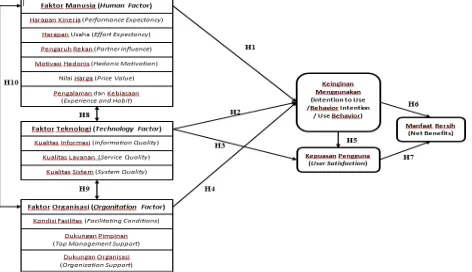
The evaluation model of success and acceptance of the E-Learning information system in the proposed SMK Fadilah refers to the use of the UTAUT2 model integration model and the HOT Fit model model that is modified to analyze the success and acceptance of the implementation of the E-Learning information system in SMK Fadilah. In this study the moderator variable consisting of gender, age, voluntaryof use and experience is not used, because these variables do not have too much effect because the object of the study tends to be homogeneous in the four moderator variables and that the research is cross-sectional. So that the research model can be described as follows.
Fig 1: Model for Evaluating Success and Acceptance of E-Learning Information Systems.
The hypothesis in this study there are 10 where in this hypothesis is used to find the relationship between variables such as the picture above.
IV. RESEARCH METHODOLOY
A. Research Methods
IJCT
and Human-Organization-Technology (HOT) Fit Models to determine the level of user acceptance and the factors that support the successful implementation of E-Learning, so that it is useful for system development. E-Learning later.
B. Sampling / Sample Selection Method
The sample selection process used in this study uses Non-Random Sampling using Purposive Sampling method, with the criteria of respondents taken in this study namely the experience of respondents in using the system for 6 months or one semester. The data used in this study is the data of
students in the academic year 2017/2018
Department of Informatics, namely RPL, TKJ, Multimedia (class X, and XI), Teachers and School Management. By using Slovin formula to determine the number of samples based on a 5% error rate. After using Slovin formula, there were 138 respondents from a total population of 210 people.The number of respondents used in this study were 138 people with male respondents (59%) and women (41%).
C. ResearchIndikator
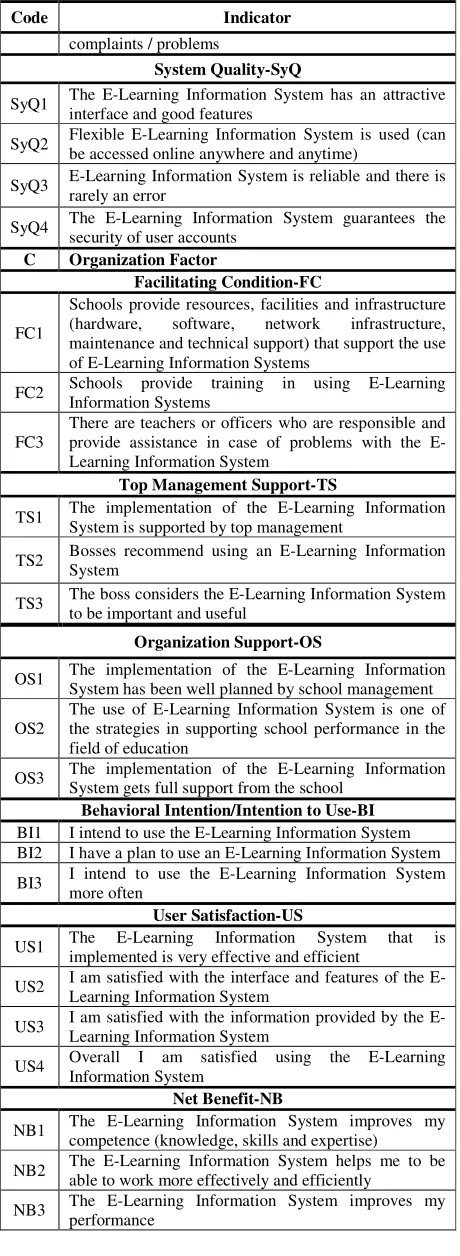
The indicators used in this research questionnaire were made based on variables from the UTAUT 2 method and HOT FIT Model. The following are the indicators used in this study.
TABLE3:INDICATORSOFSUCCESSANDACCEPTANCEOF E-LEARNINGINFORMATIONSYSTEMS
Code Indicator A Human Factor
Performance Expectancy-PE:
PE1 E-Learning Information Systems are useful in my daily life
PE2 E-Learning Information System is useful in improving my competence (Skills and Knowledge)
PE3 Using the E-Learning information system allows me to complete learning material faster.
PE4 Using the E-Learning information system increases my chances of getting good grades.
PE5 Using the E-Learning information system at school will improve the quality of learning.
PE6
Using the E-Learning information system will allow me to choose more effectively among my learning methods
Effort Expectancy-EE:
EE1 E-Learning Information System is easy to use
EE2 My interaction with the E-Learning Information System is clear and understandable
EE3 Operationalizing the E-Learning Information System is
Code Indicator
easy to learn
EE4 It's easy for me to become proficient in using E-Learning Information Systems
Social Influence-SI
SI1 People who are important to me think that I have to use an E-Learning Information System
SI2 My people who influence my behavior think that I have to use an E-Learning Information System
SI3 The person who is important to me considers E-Learning Information System important and useful.
SI4 The people whose opinions I respect are more like when I use the E-Learning Information System
SI5
In general, schools encourage and support the use of E-Learning Information Systems in providing education services.
Hedonic Motivation-HM
HM1 Using the E-Learning Information System in learning activities is very enjoyable
HM2 I enjoy using the E-Learning Information System in my learning activities
HM3 Using an E-Learning Information System is very entertaining
Price Value-PV
PV1
The E-Learning Information System is not expensive by considering its contribution to the quality of learning in school
PV2 With current prices, the E-Learning Information System provides the latest good material
PV3
My willingness to use the E-Learning Information System will depend on perceived personal costs (time or money)
Habit-HB
HB1 The use of E-Learning Information Systems has become a habit for me
HB2 I am addicted to using the E-Learning Information System for my learning activities
HB3 I have to use the E-Learning Information System
HB4 Using an E-Learning Information System to learn has become a natural thing for me
B Technology Factor
Information Quality-IQ
IQ1
The management and availability of information on E-Learning Information Systems is timely and well organized
IQ2 The E-Learning Information System provides information relevant to teaching and learning activities
IQ3 The E-Learning Information System provides complete and accurate information
IQ4 Information provided by the E-Learning Information System can be accounted for
Service Quality-SQ
SQ1 The E-Learning Information System provides instructions for use, making it easier for me
SQ2 Use of E-Learning Information System with help services (helpdesk and via telephone / HOTline)
IJCT
Code Indicator
complaints / problems
System Quality-SyQ
SyQ1 The E-Learning Information System has an attractive interface and good features
SyQ2 Flexible E-Learning Information System is used (can be accessed online anywhere and anytime)
SyQ3 E-Learning Information System is reliable and there is rarely an error
SyQ4 The E-Learning Information System guarantees the security of user accounts
C Organization Factor
Facilitating Condition-FC
FC1
Schools provide resources, facilities and infrastructure (hardware, software, network infrastructure, maintenance and technical support) that support the use of E-Learning Information Systems
FC2 Schools provide training in using E-Learning Information Systems
FC3
There are teachers or officers who are responsible and provide assistance in case of problems with the E-Learning Information System
Top Management Support-TS
TS1 The implementation of the E-Learning Information System is supported by top management
TS2 Bosses recommend using an E-Learning Information System
TS3 The boss considers the E-Learning Information System to be important and useful
Organization Support-OS
OS1 The implementation of the E-Learning Information System has been well planned by school management
OS2
The use of E-Learning Information System is one of the strategies in supporting school performance in the field of education
OS3 The implementation of the E-Learning Information System gets full support from the school
Behavioral Intention/Intention to Use-BI
BI1 I intend to use the E-Learning Information System BI2 I have a plan to use an E-Learning Information System
BI3 I intend to use the E-Learning Information System more often
User Satisfaction-US
US1 The E-Learning Information System that is implemented is very effective and efficient
US2 I am satisfied with the interface and features of the E-Learning Information System
US3 I am satisfied with the information provided by the E-Learning Information System
US4 Overall I am satisfied using the E-Learning Information System
Net Benefit-NB
NB1 The E-Learning Information System improves my competence (knowledge, skills and expertise)
NB2 The E-Learning Information System helps me to be able to work more effectively and efficiently
NB3 The E-Learning Information System improves my performance
Code Indicator
NB4 E-Learning Information Systems can improve school performance
D. Instrument Validity and Reliability Testing Phase
In this study, the reliability test used cronbanch alpha method. A data is said to be accurate if the minimum cronbanch alpha coefficient is 0,70 based on reference [Malhotra, N.K., Imad B.B and Nada N.B, 2010]. Reliability testing in this study uses the Statistical Product and Service Solution (SPSS) program. Instrument Validity Testing using Analyst Correlate Bivariate to find the correlation coefficient of product Moment Pearson with SPSS.
Then compared to the value rtable for α = 0.05 with
degrees of freedom (dk = n-2) so it's got rtable. For
questions with correlation coefficient values (rhitung) >rtable then the item is declared valid. Based on the instrument validity test results in this study all the statement items used in this study are
declared valid because they have values rhitung
greater than rtabel. So that all statement items in the
research questionnaire are used all for the following data analysis.
TABLE4:INSTRUMENTRELIABILITYTESTRESULTS
Case Processing Summary
N %
Cases Valid 30 100.0
Excludeda
0 .0
Total 30 100.0
a. Listwise deletion based on all variables in the procedure.
Reliability Statistics
Cronbach's Alpha N of Items
.989 56
IJCT
because the measurement results can be trusted based on the correlation value obtained.
V.DISCUSSIONANDRESULTS
A. Results of Structural Model Analysis (Inner Model)
Inner model is evaluated by looking at the percentage of variance that is explained by looking at the magnitude of the structural path coefficient obtained through a bootstrapping procedure. Testing on the inner model is done to find out whether the hypothesis is accepted or rejected. Testing of the inner model is done by looking at R-Square which is a goodness of fit model test. From table IV it can be seen that this research model provides R-Square of 0.578, 0.411, 0.566, 0.387 and 0.398.
TABEL5:NILAIRSQUARE
Variabel Independen Variabel Dependen R Square
Human
Behavioral Intention 0.578 Organization
Technology Behavioral Intention
Net Benefit 0.411 User Satisfaction
Human Organization 0.566
Organization Technology 0.387 Technology
User Satisfaction 0.398 Behavioral Intention
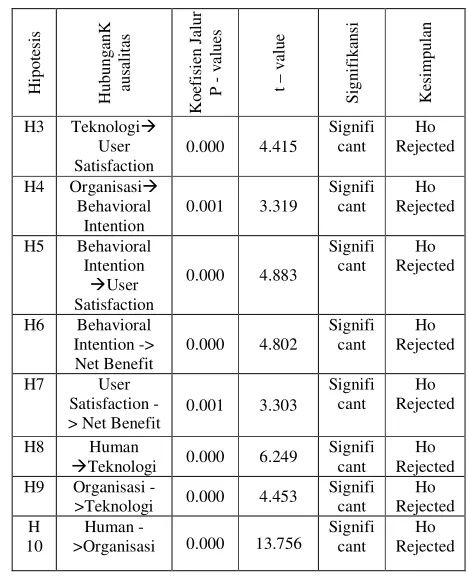
The next test is the significance of the influence of variables. Testing of this research evaluation model is done by bootstrapping.
According to reference [Malhotra, N.K., Imad B.B and Nada N.B, 2010] To conclude the hypothesis is accepted or rejected, t value is used where Ho's research hypothesis is rejected if the influence between variables has a t value smaller than 1.96 for testing the two-tailed hypothesis which can be seen in table 9.
TABLE 6:RESULTS OF THE HYPOTHESIS
H ip o te si s H u b u n g an K au sa li ta s K o ef is ie n J al u r P v al u es t – v al u e S ig n if ik an si K es im p u la n
H1 Human Behavioral Intention
0.000 12.140
Signifi cant Ho
Rejected
H2 Teknologi Behavioral
Intention
0.402 0.838
Signifi cant Ho
accepted H ip o te si s H u b u n g an K au sa li ta s K o ef is ie n J al u r P v a lu es t – v al u e S ig n if ik an si K es im p u la n
H3 Teknologi User Satisfaction
0.000 4.415
Signifi cant
Ho Rejected
H4 Organisasi Behavioral
Intention
0.001 3.319
Signifi cant
Ho Rejected
H5 Behavioral Intention
User Satisfaction
0.000 4.883
Signifi cant
Ho Rejected
H6 Behavioral Intention -> Net Benefit
0.000 4.802
Signifi cant
Ho Rejected
H7 User Satisfaction -> Net Benefit
0.001 3.303
Signifi cant
Ho Rejected
H8 Human
Teknologi 0.000 6.249
Signifi cant
Ho Rejected H9 Organisasi
->Teknologi 0.000 4.453
Signifi cant Ho Rejected H 10 Human
->Organisasi 0.000 13.756
Signifi cant
Ho Rejected
B. Hypothesis Discussion
From the results of hypothesis testing that has been done, there is one hypothesis that is rejected because it has a t value smaller than 1.96 and 9 other hypotheses are accepted because it has a value of t greater than 1.96. The following is a discussion of the results of hypothesis testing.
Hypothesis 1 can be concluded that human factors, namely performance expectations, business expectations, the influence of coworkers, hedonic motivation, price value, and experience and habits have a significant effect on the intention to use the E-Learning information system.
Hypothesis 2 can be concluded that the technological factors namely information quality, service quality and system quality have no significant effect on the intention to use the E-Learning information system.
Hypothesis 3 can be concluded that the technological factors namely information quality, service quality and system quality have a significant effect on the satisfaction of the use of E-Learning information systems.
Hypothesis 4 can be concluded that
IJCT
leadership support and organizational support have a significant effect on the intention to use the E-Learning information system.
Hypothesis 5 can be concluded that the intention of using E-Learning information system has a significant effect on the satisfaction of E-Learning information system users.
Hypothesis 6 can be concluded that the intention of using the E-Learning information system has a significant effect on net benefits.
Hypothesis 7 can be concluded that the user satisfaction of the E-Learning information system has a significant effect on net benefits.
Hypothesis 8 can be concluded that there is a significant relationship between human and technological factors.
Hypothesis 9 can be concluded that there is a significant relationship between technological and organizational factors.
Hypothesis 10 can be concluded that there is a significant relationship between human and organizational factors.
VI. CONCLUSION
Acceptance and use of E-Learning is influenced by Human Factors (Performance Expectancy, effort expectancy, Social Influence, Hedonic Motivation,
Price Value, Habit), Organizational Factors
(Facilitating Condition, Top Management Support, Organization Support), Behavioral Intention, User Satisfaction and Net Benefit. While the Technology (Information Quality, Service Quality) system does not have a significant influence on the use of E-Learning but has a significant influence on the satisfaction of the use of E-Learning in Fadilah Vocational Schools.
Human Factors (Performance Expectancy, effort expectancy, Social Influence, Hedonic Motivation,
Price Value, Habit), Organizational Factors
(Facilitating Condition, Top Management Support, Organization Support) and Technology Factors (Information Quality, Service Quality, Quality System) have an influence 57.8% of the BehavioralIntention variable while the rest is explained by other variables outside the one studied. While Behavioral Intention, and User Satisfaction has an effect of 41.1% on Net Benefit, while the rest is explained by other variables outside the one
studied. While Human Factors (Performance Expectancy, effort expectancy, Social Influence, Hedonic Motivation, Price Value, Habit) have a suitability relationship of 56.6% to Organizational Factors (Facilitating Condition, Top Management Support, Organization Support) while the rest is explained by other variables outside the researched. Likewisewith Organizational Factors (Facilitating Condition, Top Management Support, Organization Support) has a suitability relationship of 38.7% to Technology Factors (Information Quality, Service Quality, System Quality) while the rest is explained by other variables outside the researched. while the Technology Factor (Information Quality, Service Quality, System Quality) and Behavioral Intention has an effect of 39.8% on User Satisfaction while the rest is explained by other variables outside the research. So that it can be said that the UTAUT2 and HOT Fit Model models can explain well the acceptance and use of E-Learning.
REFERENCES
[1] Hair, Joseph F. Jr., William C.B., Barry J.B., and Rolph E.A, Multivariate Data Analysis, 7th Edition, Pearson Education Limited, New Jersey, 2010.
[2] Ghozali, Imam. 2011, Structural Equation Modelling MetodeAlternatifdengan Partial Least Square (PLS), edisi 3, Badan PenerbitUniversitasDiponegoro cit. Prakosa, Fajar. “Pengembangan Model E-Learning denganmetode Prototype: studikasus di SMK Al Huda KebonJeruk Jakarta”, Tesis, Jakarta: Universitas Budi Luhur, 2018. [3] Malhotra, N.K., Imad B.B and Nada N.B., Marketing Research (Book
Style). Pearson Education Limited, New Jersey, 2010.
[4] Monecke, A. dan Leish, F., semPLS: Sructural Equational Modeling Using Partial Least Squares, Journal of Statistical Software, Vol.48, issue 3, 2012.
[5] Sarwono, Jonathan. 2008, ‘Pengertian Dasar Structural Equation Modeling (SEM)’, KomputasiStatistik, accessed on July 5, 2018, http://www.jonathansarwono.info/
[6] Sekaran, U. dan Bougie, R, Research Method ForBussiness: A Skill Building Approach 5ed. John Wiley Sons. New York, 2010
[7] Venkantesh, V, Thong. J.Y dan Xu .X, Consumer Acceptance and Use of Information Technology: Extending The Unified Theory of Acceptance and Use of Technology, MIS Quarterly, vol. 36 No.1 pp. 157-178, 2012. [8] Yusof. M, Towards a Framework for Health Information Systems