SUMMER TEMPERATURE EXTREMES AND THEIR INFLUENCE ON
THE SOUTH-EAST DEVELOPMENT REGION
Cătălina Mărculeţ1, Dinu Mărăşoiu2
1 Senior researcher, Institute of Geography of the Romanian Academy, Bucharest, Romania 2 Senior researcher, National Meteorological Administration, Bucharest, Romania
Abstract
The particularly complex natural background of the South-East Development Region accounts for the varied climate influences, with excessive or maritime shades. The description of the positive thermal regime with its temperature extremes, based on characteristic summer thresholds (tropical and canicular days) is aimed at highlighting the frequency, duration and intensity of exceptional situations. We processed the daily maximum temperature data-rows recorded by the region’s weather stations (Buzău, Galaţi, Călăraşi, Tulcea and Constanţa) over a period of 54 years (1961-2014). The finality of our endeavour has been to present some examples for these extreme phenomena, their synoptic causes, and specific elements of exceptional manifestation, the effect of longer canicular periods finally impacting the whole social-economic life.
Key words: temperature extremes, canicular days, case-study, consequences.
Introduction
The present study discusses the manifestation of some extreme temperature thresholds specific to the summer season, as well as the negative effects of these special situations and their possible threats to people’s health, to the environment and to socio-economic activities.
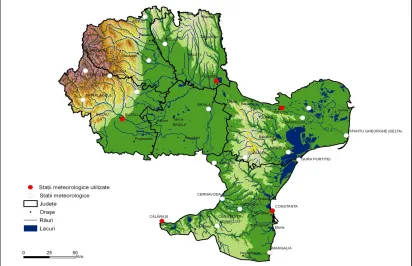
Figure 1. Physical-geographical background of the South-East Development Region.
Data and methods
A description of the positive thermal regime with its temperature extremes, based on characteristic summer thresholds (tropical and canicular days) is aimed at highlighting the frequency, duration and intensity of exceptional situations.
A first step in this was the processing of the daily maximum temperature data-rows recorded by the region’s weather stations (Buzău, Galaţi, Călăraşi, Tulcea and Constanţa) over a period of 54 years (1961-2014), registered by the National Meteorological Administration (NMA) and included in the international data-flow (ECAD, http:\\knmi.eca.nl).
Our analysis pointed out the annual values of specific temperature days and the intervals of consecutive days for the respective thresholds, as well as evolution trends. By highlighting some cases of exceptional temperature frequency, duration and intensity, we intended to outline a few thermal hazard situations in the South-East Development Region.
The finality of our endeavour was to present some examples for these extreme phenomena, their synoptic causes, and specific elements of exceptional manifestation.
Results
The characteristic summer temperature thresholds presented in this paper regard at least two successive tropical days (max. temp. ≥30˚C), and two successive canicular days (max. temp. ≥35˚C).
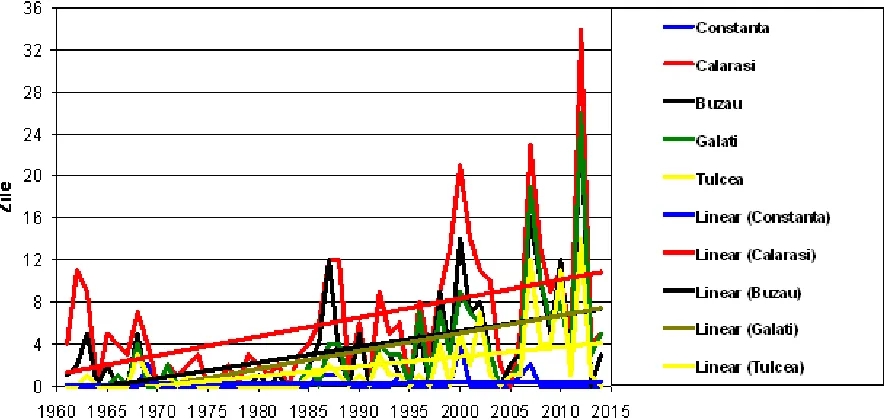
Figure 2. The annual number of tropical days (max. temp. ≥30˚C).
The linear evolution trend of this variable at all the five stations suggests rather more moderate increases at Constanţa and Buzău, and somewhat higher at Călăraşi, Galaţi and Tulcea (Figure 2).
Major implications for human life, and the environment in general, have temperatures of 35˚C and higher, which the longer they last, the greater their threat and impact. In view of their particular dangerous effects, the exceptionally hot-weather cases were studied in detail, e.g. the calculation of the total number of canicular days/year, their evolutions by the year, the periods of successive canicular days and their lengths, and frequency over the studied period, the identification of maximum length of intervals/year and evolution trends.
The annual numerical variability of canicular days (max. temp. ≥35°C) (Figure 3) shows the highest values in the last years of the studied period (2000, 2007 and 2012), with absolute maxima over the 1961-2014 interval, the year 2012 being a record high at almost all the weather stations taken into consideration: Călăraşi 34 days/year, Galaţi and Buzău 26 days/year, Tulcea 14 days/year.
These values were twice and even thrice those summated in other extremely hot years (1987, 1998) of the last 20th-century decades, an indication of the accelerated linear increase trends of this variable, particularly at Călăraşi and Galaţi stations.
At Constanţa station, canicular days were a rarity, being registered only occasionally in some years (4 days in 2000, 2 days in 2007, etc.), due to the more moderate littoral climate (Figure 3).
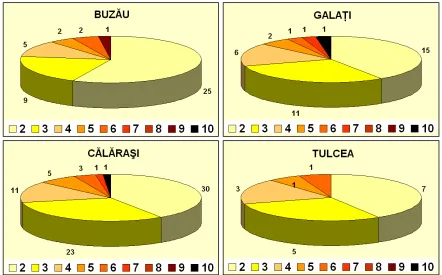
The absolute frequency of the length of intervals with canicular temperatures by value classes (Fig. 4) shows this variable in the lower classes, all the stations having recorded only two or three consecutive canicular days, that is, two-thirds of the total. The lowest succession of canicular days was registered at Tulcea station (15 cases throughout the studied period) and no such cases in the upper classes at all. The explanation could be the climatic regime with Black Sea influences. Galaţi station records contain 26 cases of 2-3 cannicular days in a row; one or two cases in the moderate value classes, and an extreme case alone of 10 consecutive days with canicular temperatures. A higher incidence of this variable was found at Buzău station, where climatic influences contain excessive shades, and although the cumulated share of the first two lower classes represents about three quarters of all cases, their absolute value-sum is of over 34 cases, and only incidentally nine days in a row with canicular temperatures. Exceptionally hot days, especially at Călăraşi station, appear also on the graph, their values being the highest absolute ones not only for the two lower value classes (53 cases), but also for the moderate classes, and one single case of 10 successive canicular days on the last value threshold (Figure 4).
Figure 4. The absolute frequency of the length of intervals with canicular temperatures by value classes.
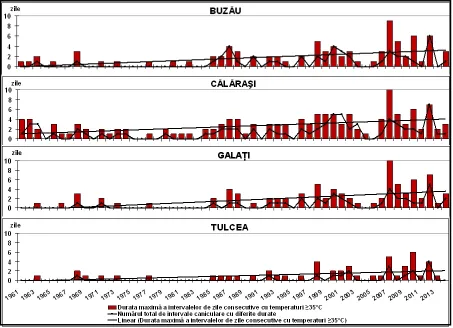
(highest at Călăraşi and lowest at Tulcea), as far as the years with a maximum value record are concerned, all the four stations display similitudes. Along the 54 years analysed, 2007 stands out by record long intervals of consecutive canicular days: 10 at Călăraşi and Galaţi, and 9 at Buzău station, the hottest year being 2012 in terms of record sums of canicular intervals (Figure 5). The warming process registered in the last years of the studied period is also indicated by the aspect of linear evolution trends of maximum canicular intervals duration, the highest increasing tendencies being registered at Galaţi and Buzău stations.
Figure 5. Variation interval of consecutive canicular days.
Record high canicular episodes. The succession of canicular episodes in 2007 and 2012 are actual climate records that indicate climate change in temperate-continental regions manifest against the background of climate warming with excessive shades and a higher frequency of extreme phenomena.
Positive temperature extremes have rather a greater incidence in the South-East Development Region, where the low-altitude relief favours the penetration of the hot tropical air from the south and east, followed by enhanced insolation-induced local warming associated with the Föehn effects felt at the periphery of the Curvature Subcarpathians (Bogdan, 1980, Bogdan; Niculescu, 1990).
Massive advections of very warm air over vast territories at temperate latitude are driven by continental anticyclones originating from South-East Europe, South-East Asia, the Black Sea Basin, the Balkan Peninsula, North-West Africa, etc. (Milea et al., 1971).
Against the synoptic background of a high-pressure ridge coming from Asia Minor and the east of the Mediterranean Sea, most of Europe is affected, but especially its eastern and south-eastern parts, where, as tropical-continental air advections develop, they generate a warm weather, canicular in summer, and generally without precipitation.
A rare situation occurred in July 2007, when the North-African upper-level ridge went beyond the Baltic Sea. At soil level, what mattered in this configuration was not so much the latitudinal extension of the Azore Anticyclone, as the position of the secondary maximum pressure field from the north-west of the Black Sea which would be maintained active by the Arabian low (Mărăşoiu, 2008).
The extremely elevated temperatures registered in the Extracarpathian regions were triggered by a south-west high-altitude circulation and a high pressure field on soil (1015-1020 hPa), facilitating, the advection of a hot Saharian air. The high pressure field on soil, and throughout the tropospheric column, occurred on the geopotential surfaces as a high pressure ridge, advancing from the north of Africa towards the Mediterranean Sea, the Balkan Peninsula and the neighbouring countries (Figure 6, 7). Hovering for days in the plains and lower hills, and associated with the intensification of local insolation processes, it produced excessive and persistent canicular weather.
Figure 6. Atmospheric pressure field on the Figure 7. Temperature (°C) at 850 hPa ground and a geopotential field at 500 hPa, July 24, 2007, 00 hr GMT July 24, 2007,00 hr GMT (Karten Archive, (Karten Archive, Germany).
Germany).
The whole summer of 2007 was extremely hot, the average temperature in the country (22.6°C) being comparable with that of summer 1946, this time, however, with new monthly absolute maxima registered at 53 weather stations in June, 94 in July and 17 in August, with a record high number of cases (149) in July, and daily maxima of over 40°C, as well as daily records of consecutive canicular days, among which the 10 days previously mentioned at Călăraşi station (Mărăşoiu, 2015).
In the studied region, it was July 2007 when maximum intervals of successive canicular days were registered: 9 at Buzău (17-25 interval), 10 at Călăraşi and Galaţi (16-25 interval) and a secondary maximum of 5 days at Tulcea station (21-25 interval). Overheatings during that canicular episode topped 40°C on July 23 at Călăraşi (42.1°C) and 40.3°C at Buzău stations, but only 39.9°C at Tulcea station; on July 22, Galaţi station registered 40.5°C.
persistence with over 40°C; there were 124 new record days with maximum values and 74 new records of highest minima throughout the observation series for the respective dates.
Thus, July 2012 was a record month, the hottest July since 1961, with an average temperature of 23.8°C. Although temperatures did not reach the July 2007 level, there were more time-intervals of over 35°C, the highest number of canicular days in the 1961-2014 period being also registered at the stations in the studied region: Călăraşi 20, Buzău 15 and Galaţi 14.
Consequences of the positive temperature extremes. The impact of consecutive days with extreme air temperatures are detrimental to people’s health in the first place, but they also have major consequences for the environment and the economy.
The impact of excessively hot periods of time is particularly severe for the townspeople of big cities, where green areas have been drastically reduced to the benefit of a highly anthropized environment. Temperatures of over 35°C are a threat to human health, and if they persisted for several days, society as large would be in real difficulty. People’s depleted capacity to work eventually impacts the economy by diminishing the outputs (WMO, 2006). In cases of excessive canicular weather, pre-school children, the elderly, people with chronic and neurological diseases, or the homeless, as well as those who fail to protect themselves when working in the open, run high risks, even loss of life (Patz et al., 2005; Teodoreanu, 2007; Bogdan, 2008).
Among the threats to human and animal health we would recall that the highest temperatures are propitious to the spread of infections, by reproducing some pathogens both inside one’s body and outside it. Global warming facilitates the dissemination of tropical diseases through various factors (West Nile virus, tick-borne encephalitis virus, etc.). For example, a greater risk of the Lyme disease is caused by the tick Ixodes scapularis expanding its area, and transmitting the disease through the agency of Borrelia burgeroferi, the process being accelerated by climate warming (Ogden et al., 2009).
In Romania, the higher incidence of confirmed cases is an indication of the dissemination of this tick to new geographical areas, among which some localities in Tulcea and Constanţa counties (Paşcalău et al., 2012).
Temperature extremes prove particularly detrimental to agriculture, jeopardising crops, which are partially or totally compromised, also affecting the animals. A negative effect on the transport sector, mostly the railway transport, is the danger of derailment through expansion of the rails, which increases the risk of accidents. The energy sector is directly affected, greater use of air-conditioned devices may produce fault of current in urban agglomerations (Constanţa, Galaţi, etc.) (Bojariu et al., 2015). The indirect effect of the longer canicular periods are the severe droughts which diminish the water amounts of rivers, lakes and the phreatic level, finally impacting the whole social-economic life.
Conclusion
We would say that the warming trend is particularly visible in the studied region, irrespective of the climatic influences and shades locally felt.
Bibliography
1. Bogdan, C. (2015), Patologia de canicula - o problemă actuală de sănătate publică, Revista Medicală Română 53. 2-3 (2006): 79-83. Web. 27 Nov.
2. Bogdan, Octavia (1980), Potenţialul climatic al Bărăganului, Editura Academiei Române, Bucureşti.
3. Bogdan, Octavia (1998), Fréquence de réfroidissements et des réchauffements masiffs pendant le dernier siècle en Roumanie, RRGéogr. 42, 69-80.
4. Bogdan, Octavia, Niculescu, Elena (1990), Un caz tipic de foehn în România, SCGGG Geogr. XXXVII, 95-103.
5. Bogdan, Octavia, Niculescu, Elena (1999), Riscurile climatice din România, Institutul de Geografie, Bucureşti.
6. Bojariu, Roxana et al. (2015), Schimbările climatice – de la bazele fizice la riscuri şi adaptare, Printech Bucureşti.
7. Clima României (2008), Editura Academiei Române, Bucureşti.
8. Dragomirescu, Elena, Enache, L. (1998), Agrometeorologie, Editura Didactică şi Pedagogică, Bucureşti.
9. Geografia României, I. Geografie fizică. (1983), Editura Academiei Române, Bucureşti.
10. Mărăşoiu, D. (2008), Factorii dinamici ai riscurilor hazardelor termice în emisfera nordică, Revista Geografică XIV-XV, 2007-2008, 37-45.
11. Mărăşoiu, D. (2015), Fenomene climatice extreme. Valuri de frig şi de căldură în regiunile extracarpatice româneşti. Institutul de Geografie, Bucureşti (Manuscript PhD thesis, in romanian).
12. Mărculeţ, Cătălina (2014), Major summer-induced thermal risks in the Alba Iulia – Turda Depression, Riscuri şi Catastrofe XIV (113), 1/2014, 99-108. Web. 27 Nov. 2015.
13. Milea, Elena, et al. (1971), Unele corelaţii între singularităţile termice în R.S. România în perioada 1920-1960 şi tipurile de circulaţie atmosferică. Cul. lucr. IMH/1968, 56-77.
14. Ogden, N. H. et al. (2009), The emergence of Lyme disease in Canada.” CMAJ 180 (12), 1221-1224. Web. 27 Nov. 2015.
15. Paşcalău, Nicoleta, Domuţa, Maria, Mariş, C. (2012), Lyme disease-certainty and contradictions. Analele Universităţii din Oradea, Fascicula Ecotoxicologie, Zootehnie şi Tehnologii de Industrie Alimentară. XI-A. 11, 107-114. Web. 17 Oct. 2015.
16. Patz, Jonathan A. et al. (2005), Impact of regional climate change on human health, Nature,438, 310-317. Web. 27 Nov. 2015.
17. Teodoreanu, Elena (2007), Se schimbă clima? O întrebare la început de mileniu, Editura Paideia, Bucureşti.
18. World Meteorological Organization (WMO). Comprehensive Risk Assessment for Natural Hazards, Geneva: WMO/TD No 955 (2006). Web. 28 Nov. 2015.
19. www. wetterzentrale.de 20. http:\\knmi.eca.nl