Research Journal
Volume 12, No. 2, June 2018, pages 206–213
DOI: 10.12913/22998624/91892 Research Article
ANALYSIS OF POSSIBILITIES TO IMPROVE ENVIRONMENTAL OPERATING
PARAMETERS OF MODERN COMPRESSION – IGNITION ENGINES
Tomasz Osipowicz1, Karol Franciszek Abramek1, Dalibor Barta2, Paweł Droździel3, Maciej Lisowski1
1 West Pomeranian University of Technology Szczecin, al. Piastów 19, 70-310 Szczecin, Poland, e-mail:
[email protected], [email protected], [email protected].
2 University of Žilina, Faculty of mechanical engineering, Univerzitná 1, 010 26 Žilina, Slovak Republic, e-mail:
3 Lublin University of Technology, Faculty of Mechanical Engineering, Institute of Transport, Internal
Combus-tion Engines and Ecology, 36 Nadbystrzycka Street, 20-618 Lublin, Poland, e-mail: [email protected]
ABSTRACT
The aim of this study was to analyse the possibilities of improving the ecological parameters of compression – ignition CI engines. During the analysis of exhaust gas, attention was mainly paid to the emission of nitrogen oxides and carbon black soot. A method was proposed to reduce the above chemical elements in CI – engine exhaust fumes by using the annular channels on the non-working part of the fuel injector needle and applying a platinum catalyst on them. The task of these annular channels is to mix and agitate the fuel before injection to the combustion chamber and to enlarge the contact surface area of catalyst. The task of catalytic coating is
to initiate the reaction of dehydrogenation of paraffinic hydrocarbons to olefinic
ones with a free hydrogen molecule. Hydrogen, owing to its properties, can shorten the period of delay of spontaneous ignition of combustible mixture in the engine
combustion chamber, which affects the entire combustion process and improves the
ecological parameters of a CI engine.
Keywords: fuel injector, compression-ignition engine, diesel fuel, dehydrogenation of hydrocarbons.
INTRODUCTION
Compression – ignition engines are being slowly withdrawn from modern motor cars due to the presence of harmful compounds in exhaust gas. The most toxic constituents of exhaust gas are carbon black soot, soaked up with hydrocar-bons, nitrogen oxides, unburned hydrocarbons and carbon oxides. To reduce the concentration of toxins in exhaust fumes, newer and newer fuel injection systems, catalytic converters, diesel
par-ticulate filters and various fuel additives are used
[2]. Research is also conducted in using catalysts in the engine combustion chamber and on fuel
in-jection system elements [6]. Environmental stan-dards and ecological fees as well as development of electric propulsion systems make use of motor cars equipped with CI engine as urban vehicles to
be less and less cost effective. However, these en -gines are a primary source of propulsion in road, water and rail transport.
There is a possibility of reducing the emis-sion of toxic substances in exhaust fumes to the atmosphere by using fuel spray nozzles with the channels in the form of annuli being cut on the non-working part of the fuel injector needle proposed by the authors. In addition, a catalytic coating is being applied on the annular channels Received: 2018.04.19
which could have substantial influence by hy -drogen powered [3]. The purpose of applied fuel
spray nozzle design modifications is to improve
the course of combustion process in CI – com-pression engines. The process of fuel-air mix-ture combustion consists of several stages. The
first and the foremost one is the period of spon -taneous ignition delay. It is the time between the
appearance of first fuel drops in the combustion
chamber and the occurrence of spontaneous
ig-nition centres. It affects directly the second stage
(kinetic combustion) because a shorter delay means less fuel in the cylinder and, as a result, the second stage takes place less rapidly. The so-lution in the form of annular channels proposed by the authors aims to atomise fuel particles shortly before injection to the combustion cham-ber in order to improve its mixing with air and to enlarge the contact surface area of catalyst on the non-working part of the fuel injector nozzle. The task of catalytic coating is to initiate the reac-tion of hydrocarbons dehydrogenareac-tion. Fuel for CI – compression engines is mainly composed
of paraffin hydrocarbons (CnH2n+2). Due to the
catalytic reaction, it is possible to dehydrogenate
these hydrocarbons to the olefinic form (CnH2n) with hydrogen molecule separation. The
prop-erties of hydrogen, such as broad flammability limits, high diffusion coefficient in air, ability to
spontaneous ignition and combustion rate, can shorten the period of ignition delay [11]. Essen-tial meaning gains appear turbulent and cavita-tion phenomena by using channel rings [9]. The
offered solution modification of fuel injector
nozzle could be used in Common Rail system CI – engines [13]. The solution presented in the
paper could have influence in LCA vehicle life cycle [4, 10], whereas don’t influence it on di -agnose technology technical conditions of fuel
injector [14]. It acquires significance at present
using varies sort of fuel to power engines and
their influence on stability and reliability [8]. This solution does not have influence on work -ing fuel injectors accord-ing to authors.
When analysing the relevant literature, the period of spontaneous ignition delay can be cal-culated according to J. B. Heywood from the fol-lowing relationship [7]:
(1)
cm – piston speed [m/s] Ea – activation energy [J]
R – universal gas constant [ J/(mol ∙ K)]
T2–temperature in combustion chamber [K]
P2 – pressure in combustion chamber [MPa]
Analysing the relationship that determines the period of spontaneous ignition delay, it is possible to state that it is conditioned by such factors as: pressure and temperature the combustion chamber, rota-tional frequency and engine piston-crank system kinematics, as well as activation energy value. Engine parameters, such as pressure, temperature and basic design components, could not be changed. There is a possibility to improve the ecological parameters of compression – ignition engines through shortening the spontaneous ignition delay by reducing the value of activation energy [1, 2]. The solution proposed
by the authors will affect the values being discussed and consequently will improve the ecological pa -rameters of compression – ignition engines.
STUDY OBJECTIVE AND SCHEME
The research objective of this paper is to analyse the possibilities of improving the ecological operating parameters of CI engines by using the annular channels with a catalytic material on the non-working part of the fuel injector needle. The solution being proposed by the authors can be applied in any type of fuel injec-tion system (mechanical injectors, unit injectors, and CR injectors) in passenger cars and goods vehicles, vessels, various machines, as well as in propulsion systems of locomotives being powered by CI engines.
The tests described below were prepared according to the following scheme:
• analysis of the effect of annular channels and catalysts on the physicochemical processes of fuel
• selection of the type of fuel injector,
• development of the object of physical re-search model,
• performance of laboratory tests,
• performance of engine tests.
PRESENTATION OF TEST OBJECTS AND
TEST BEDS
The test objects are Common Rail fuel injec-tors manufactured by Bosch, serial number 0445 110 083. In the fuel injectors, fuel spray nozzles
were modified (Figure 1) [12].
Fuel under high pressure gets from a fuel injector to a spray nozzle through the fuel
sup-ply channel (2) to the needle space (10). Next, it flows over the non-working part of the fuel injector needle and, as a result of fuel injector operation, is being injected into the combus-tion chamber of CI compression engine. The annular channels made on the not-working part of the fuel injector needle induce atomisation and agitation of fuel particles and enlarge the contact surface of catalytic coating. In addi-tion, a catalytic coating in the form of platinum is applied on the non-working part of the fuel injector needle. The purpose of applying the catalytic coating is to activate the reaction of dehydrogenation of paraffinic hydrocarbons to olefinic ones with separation of free hydrogen molecule. The modified spray nozzles can be used in any type of fuel supply system of CI compression engine.
Figure 3 presents a CR fuel injector standard
and modified spray nozzles [12]. Fig. 1. Unmodified fuel spray nozzle:1 – fuel spray
nozzle, 2 – fuel supply channel, 3 – spray nozzle needle, 4 – barrel and plunger assembly of the needle,
5 – non-working part of the needle, 6 – conical valve opening and closing the spray nozzle, 7 – holes sup-plying the fuel from the spray nozzle to the combus-tion chamber, 8 – catalytic material applied on the non-working part of the needle, 9 – annular channels
on the non-working part of the needle, 10 – needle space
Fig. 2. Common Rail fuel injector nozzle: a) – standard,
b) – modified
a) b)
Fig. 3. a) Test bench STPiW-3 (Fuel Injection Pump and Fuel Injector Test Bench), b) Engine test bench
Fiat 1,3 JTD MULTIJET 16V with dynamometer
EMX 100/100 a)
Laboratory tests were performed using a test
bench for CR fuel injector testing – STPiW-3 (Figure 2). Engine tests were performed using the test bench Fiat 1,3 JTD MultiJet with dynamom-eter EMX 100/1000 (Figure 3).
RESULTS OF LABORATORY AND ENGINE
TESTS
The first stage of researches was the anal -yse operation parameters CR fuel injectors on the STPiW 3 test bench. The aim was to check
if the fuel injector with a modified spray nozzle
works properly. Fuel injection and return doses
were researched next to different adjustment of
fuel injector. Two fuel injectors were subjected to
testing – the first one with a factory-made spray
nozzle, and the second one with a spray nozzle
with annular channels and a catalytic coating be-ing applied (Table 1, Table 2).
The measurement results are presented in graphical form (Figure 4, Figure 5).
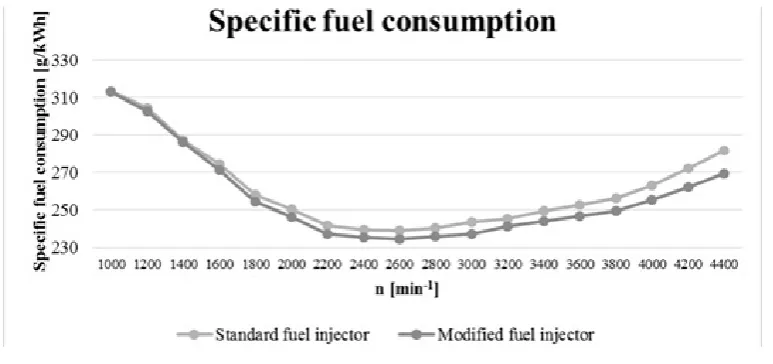
In the next stage, bench tests were performed on Fiat 1,3 JTD with Common Rail fuel injection systems (Figure 6, Figure 7, Figure 8, Figure 9, Figure 10, Figure 11).
ANALYSIS OF EXPERIMENT METHOD
The objective of this study was to examine the possibilities of using the system of annular channels with platinum catalytic coating on the non-working part of the fuel injector needle in compression – ignition engines.
The process of combustion, otherwise known as heat release, is a complex, rapidly occurring
Table 1. Results of injection and return dose testing for a factory-made fuel injector
Fuel injector, serial number 0445110083, with a modified spray nozzle
Test number Test parameters Fuelinjectiondose Fuel return dose
Set value Actualvalue Set value Actualvalue
1 145 MPa, 60 s 0 0 0.00–72.00 34.1
2 135 MPa, 780 μs 34.71–49.69 46.6 16.00–58.00 32.3
3 30 MPa, 420 μs 0.31–3.89 1.9 0.00–72.00 7.1
4 80MPa, 260μs 0.31–4.09 2.4 0.00–72.00 9.0
Table 2.Results of injection and return dose testing for a modified fuel injector
Fuel injector, serial number 0445110083, with a factory – made spray nozzle
Test number Test parameters Fuelinjectiondose Fuel returndose
Set value Actualvalue Set value Actualvalue
1 145 MPa, 60 s 0 0 0.00–72.00 21.32
2 135 MPa, 780 μs 34.71–49.69 44.1 16.00–58.00 27.53
3 30 MPa, 420 μs 0.31–3.89 2.65 0.00–72.00 6.45
4 80MPa, 260μs 0.31–4.09 1.34 0.00–72.00 7.14
Fig. 6. The researches results on 1,3 JTD CR engine. Engine power
Fig. 7. The researches results on 1,3 JTD CR engine. Engine torque
Fig. 9. The researches results on 1,3 JTD CR engine. Emission of nitrogen oxidise
Fig. 10. The researches results on 1,3 JTD CR engine. Emission of carbon monoxide
chemical reaction involving the combination of substances with oxygen, called oxidation. This reaction starts as the result of the collision of molecules, the energy of which is greater than
the specific value of energy for each reaction and sufficient to break the existing intra-molecular
bonds and replace them with new bonds inside the molecule. Such a limit value of energy is called the activation energy, while the molecules entering into the reaction are called chemically active molecules [11].
In the combustion process in compression – ignition engine, the following periods can be
specified [6]:
• auto-ignition lag (delay) period, lasting from the beginning of fuel injection (usually it is determined based on the recording of fuel in-jector needle elevation time) until the start of combustion process, which is accompanied by a pressure curve bend (point of departure of the combustion curve from the
compres-sion curve).Factors affecting the auto-ignition
delay period: ability to spontaneous combus-tion, fuel load temperature and pressure at the beginning of fuel injection, combustion chamber type, intensity of directed fuel load, fuel injection and atomisation characteris-tics, engine load changes, increase in engine crankshaft rotational speed.
• combustion period called the kinetic com-bustion phase corresponding on the diagram of ideal cycle to combustion at constant volume; it is characterised by a dynamic in-crease in heat release rate and lasts until the maximum value of this parameter has been achieved; pressure increase in this period is
also very dynamic. Factor affecting the ki -netic combustion phase: quantity and quality of fuel being supplied to the cylinder during the auto-ignition delay period and during ki-netic combustion, rate of in-cylinder fuel load movement, combustion chamber type, engine load, engine crankshaft rotational speed.
• combustion period called the diffusion com -bustion phase corresponding on the diagram of ideal cycle to combustion at constant pres-sure, occurring near the TDC; the pressure curve bends due to a decrease in the rate of
heat release dQ/dα and an increase in the combustion chamber volume. Factors affect
-ing the diffusion combustion phase: quantity
and quality of the atomisation of fuel being injected after starting the combustion
pro-cess, rate of in-cylinder fuel load movement, engine boost, increase in engine crankshaft rotational speed.
• after-burning combustion period, lasting from the time of clear pressure drop being in-duced by already low rate of heat release and a clear increase in the combustion chamber
volume. Factors affecting the after-burning
combustion phase: turbulent pulsation of fuel load, quality of the atomisation of fuel being injected at the end of the injection process, fuel falling on cold surfaces of the cylinder space, engine boost.
CONCLUSION
The first stage of the study was to analyse the
operation of Common Rail fuel injectors on a test bench. During the test, fuel injection doses and fuel return doses were examined. Examination on the test bench was a very important test because in the CR systems it is the fuel injector that is re-sponsible for the volume of fuel injection doses.
Modifications that were made on the non-work
-ing part of the fuel injector needle could affect them or overflow volumes. The overflow dose is a discharge of working fluid during the operation
of fuel injector. Every CR fuel injector must have
the overflow dose within the specific range. If it
is too high, the system leaks and the regulator that controls the pressure will not be able to adjust its
appropriate volume in the system. The overflow
dose depends on many factors, among other on the state of barrel and plunger assemblies in the
fuel injector. Modifications that were made on the
not-working part of the fuel injector needle could
affect the tightness of fuel spray nozzle, thus labo
-ratory tests were very important. Labo-ratory tests
showed that the use of annular channels did not
affect the volume of fuel injection and fuel return
doses in CR fuel injectors. It is very important because the research objective of this project is not to change the volume of fuel injection doses.
The analysis of laboratory and engine test re-sults referring to the use of an innovative method of annular channel application on the spraying nozzle of modern compression ignition engine allows the following conclusions to be drawn: laboratory tests showed that application of
an-nular channels does not affect the size of injec -tion and return doses in the engine or the delay of
better mixing of fuel with air in the combustion
chamber, owing to the modifications being made,
an increase in engine power at medium and maxi-mum rotational speeds, in torque at minimaxi-mum and medium rotational speeds and a decrease in
spe-cific fuel consumption in the whole range of ro -tational speeds were observed. Also, an improve-ment in ecological parameters of the tested engine was noted. The largest decrease was observed in the emission of nitrogen oxides by average and maximum rotational engine speed.
When analysing the obtained results, it can be concluded that it is possible to improve the ecolog-ical parameters of CI – engines by using the annu-lar channels with a platinum catalyst on the surface of the non-working part of the fuel injector needle.
Additional studies on the application of engine indication sensor should be conducted to illustrate the phenomena taking place in the combustion chamber when using annular channels. The next stage of examination will be to analyse the operation
of engine with a modified fuel injector fuelled by
biofuels and their mixtures with conventional fuel.
REFERENCES
1. Ambrozik A., Ambrozik T., Łagowski P. :
Fuel impact of emissions of harmful com-ponents of the exhaust gas from the CI en-gines during cold start up. Eksploatacja i Niezawodnosc – Maintenance and Reliability, 17(1), 2015, 95–99.
2. Ambrozik A., Ambrozik T., Kurczyński D.: The influence of injection advance angle on fuel spray
parameters and nitrogen oxide emissions for a self – ignition engine fed with Diesel oil and FAME. Pol. J. Environ. Stud, 23 (6), 2014, 1917–1923. 3. Balyts’kyi O. I., Kolesnikov V. O., Eliasz, J.: Study
of the wear resistance of high – nitrogen steels un-der dry sliding friction. Materials Sciences, 48(5), 2013, 642–646.
4. Danilecki K., Mrozik M., Smurawski P.: Changes of the environmental profile of a popular passenger car over the last 30 years – Results of a simplified
LCA study. Journal of Cleaner Production, 141,
2017, 208–218.
5. Droździel P., Krzywonos L.: The estimation of the
reliability of the first daily diesel engine start-up
during its operation in the vehicle. Eksploatacja i Niezawodnosc – Maintenance and Reliability, 1. 2009, 4–10.
6. Heywood J.B.: Internal Combustion Engine Fun-damentals, McGraw – Hill Inc. New York, United States of America, 1988, 498–551.
7. Janicka A., Walkowiak W.: The discursive attitude of emission vs. air-fuel mixture ignition delay in
Diesel engine. Journal of Kones Powertrain and
Transport, 13(4), 2006, 223–228,
8. Karczewski M., Szczęch L.: Influence of the F – 34 unified battlefield fuel with bio components on
useable parameters of the IC engines. Eksploatacja
i Niezawodność – Maintenance and Reliability,
18(3) 2016, 358–366.
9. Molina S., Salvador F. J., Carreres M., Jaramillo
D.: A computational investigation on the influence of the use of elliptical orifices on the inner nozzle flow and cavitation development in diesel injector
nozzles. Energy Conversion And Management, 79, 2014, 114–127.
10. Mrozik M., Eliasz J., Trelak-Tymczyna A.: Mate-rial – energy model of motor vehicle life cycle. Strojarstvo, 55(2), 2013, 161–168.
11. Osipowicz T., Abramek K. F.: Catalytic treat -ment in Diesel engine injectors. Eksploatacja i
Niezawodność – Maintenance and Reliability,
16(1), 2014, 22–28.
12. Osipowicz T.: Patent Application, No. 407545, 2015.
13. Payri R., Salvador F. J., Aldaravi, P.,
Marti-nez-Lopez J.: Using one-dimensional modeling to analyse the influence of the use of biodiesels on the
dynamic behavior of solenoid – operated injectors in common rail systems: Detailed injection sys-tem model. Energy Conversion And Management, 54(1), 2012, 90–99.
14. Stoeck T., Osipowicz T.; Abramek K. F.:Methodology
for the repair of Denso Common Rail solenoid
injec-tors. Eksploatacja i Niezawodność – Maintenance
![Figure 3 presents a CR fuel injector standard and modified spray nozzles [12].](https://thumb-us.123doks.com/thumbv2/123dok_us/8806486.1774840/3.595.100.261.71.273/figure-presents-fuel-injector-standard-modified-spray-nozzles.webp)