INTRODUCTION
The study of surface topography can give quantitative information about friction surfaces. Usually the surface topography parameters are calculated after form removal: error of shape and/ or waviness (as an imperfection of manufactur-ing process) [1]. Plenty of articles and research items deals with extraction of surface topography features (STF) by application of various digital processing techniques [2]. There are many algo-rithms and/or procedures dedicated for surface topography measurements and/or analysis [3–5]. However, only few of treats about measurement errors [6–8], dimple distortions [9] or problems in surface topography parameter calculations [10]. It was recommended to propose the procedure of STF according to the type of measured detail [11].
For surface topography measurement inaccu-racy – including the properties of measured sur-face, measuring equipment and techniques – the digital filtering and interpretation of the received results are also crucial [12]. Improper selection of procedure for extraction of functional features
of surfaces is of great importance. Plateau-honed cylinder liner surface is a much-quoted example of this type of surfaces [13]; falsely estimation of algorithm can cause the classification of properly made parts as a lack and its rejection.
STF were performed by many procedures [14–21]; measurement and/or analysis of two-process surface is particularly significant when dimples are edge-located [22–24]. In this paper the influence of valley distribution on extraction of STF of cylinder liners from car engines was studied and performed.
MATERIALS AND METHODS
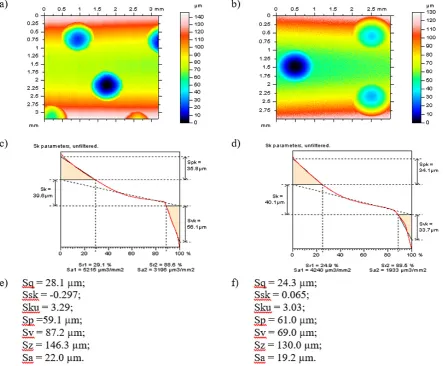
Plateau-honed cylinder liners with additional-ly added oil pockets from car engines were stud-ied. The depth of dimples was between 20 µm and 130 µm; width between 0.4 mm and 1.2 mm. Examples of studied surfaces: measured (a), sur-faces with modelled dimples (b) and material ratio curves (c, d), selected parameters (e, f) were presented in Figure 1.
The Effect of Valley Location in Two-Process Surface Topography
Analysis
Przemysław Podulka
11 Rzeszow University of Technology, al. Powstańców Warszawy 12, 35-959 Rzeszów, Poland
e-mail: [email protected]
ABSTRACT
In this paper the influence of oil pockets location on extraction of surface topography features was taken into account. Plateau-honed cylinder liners with additionally added dimples were taken in consideration. The effect of dimples location on the application of various procedures (cylinder fitting procedure, polynomial approximation) for areal
form removal was taken into account. It was noticed that application of 3rd (or greater) degree of the polynomials can caused false estimation of reference plane; extraction of surface topography features by polynomial approximation cannot provide good results when the distance between dimples is too small. For two-process surfaces (plateau-honed
cylindrical elements containing wide and deep valleys) the digital filtering was proposed. Application of robust tech
-niques (robust Gaussian regression filter) allowed for areal form removal improvement. However, some of the wide dimples were distorted when the dimple-to-edge distance was too small (smaller than filter bandwidth value).
Keywords: surface topography, dimples, cylinder liners, measurement, measurement errors
Volume 12, Issue 4, December 2018, pages 97–102
https://doi.org/10.12913/22998624/100343
Research Journal
Accepted: 2018.11.05The effect of extraction of STF on parame -ter calculations (from ISO 25178 standard) was taken into account. The measuring equipment was: white light interferometer Talysurf CCI Lite (height resolution 0.1 nm) and/or Talyscan 150 stylus equipment (nominal tip radius about 2 μm, height resolution about 10 nm). More than 40 measured and 40 with modelled (digitally added) dimples surfaces were taken into consideration. The maximum size of surface was 5 mm by 5 mm (some of the elements were studied in detail and/or profile extractions), the spacing was from 3.27 µm (optical measurement) to 5 µm (stylus method).
Extraction of STF was proposed by: least-square fitted cylindrical element (CLSM),
polyno-mials from 2ND (P2ND) to 4TH (P4TH) degrees and
digital schemes (robust Gaussian regression filter – FRGR). The effect of application of procedures
was studied with particular attention to: dimple-to-dimple distance (DDD), dimple-to-edge dis-tance (DDE), width (size) of the dimple (DW); the
distortions of dimple-to-dimple (ADD) and dim-ple-to-edge (ADE) areas were also taken into ac-count. The filter bandwidth (cut-off) value (FBDW) was also defined.
The effect of dimple location was studied for the following parameters: root mean square height Sq, skewness Ssk, kurtosis Sku, maximum surface peak height Sp, maximum valley depth Sv, maxi-mum height Sz, arithmetic mean height Sa; Sk group parameters: reduced summit height Spk, re-duced valley depth Svk, core roughness depth Sk, upper bearing area Sr1 and lower bearing area Sr2.
RESULTS AND DISCUSSIONS
Application of CLSM fitting did not allow to
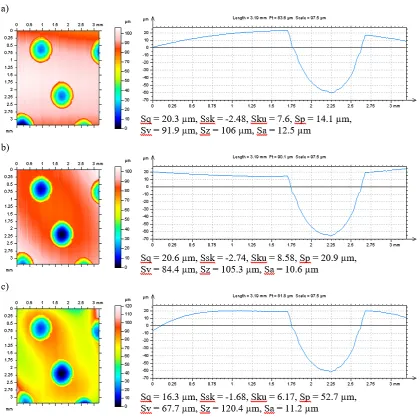
remove form correctly (a) – the isometric view analysis from figure 2 – the reference plane was also incorrectly defined when P2ND (c) or P4TH
(e) were applied; the form was incompletely
moved. Falsely estimated reference plane can be also noticed with profile exploration (figure 2). The increase of polynomial degree can cause the increment of the dimples distortion.
When DDD < 1 mm and/or DDE < 0.5 mm then application of polynomials (even the 2ND degree)
can caused the reference plane as well as oil pockets distortion.
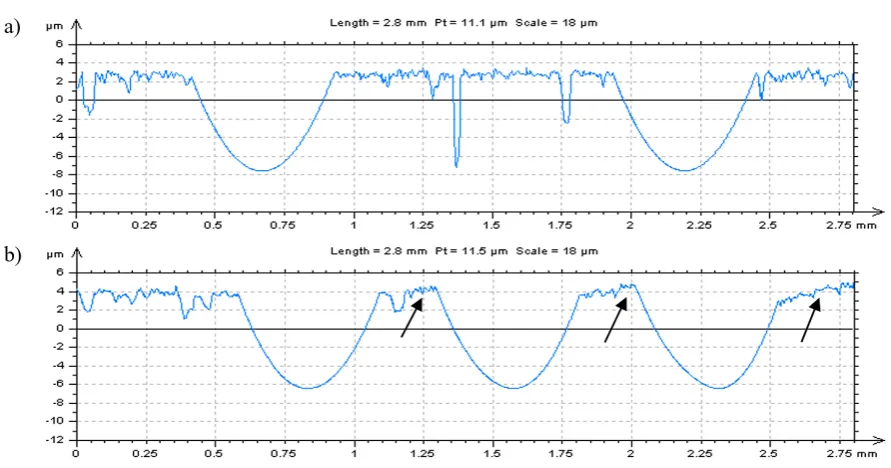
STF distinguishing of functional surface was often proposed by application of robust Gauss-ian regression filter. This type of digital filter -ing is characterized that they are robust for all the freaky values and/or outliers (such as spikes or dimples). When DDE < FBDW then distortion of dimples (as well as ADD in analysed detail) increased; position of reference plane was de-fined incorrectly. In some cases the ADE have a tendency to distort despite of oil pockets not;
when dimples were located near/on the edge of measured surface, the distortion was the biggest (figure 3-a). Some changes were also noticeable on the near-dimple areas (and located relatively away from the edge – DDE > 1 mm) of the stud-ied surface (it was indicated by the arrows in figure 4 a-c). Distortion of dimples has a nega -tive impact on the values of surface topography parameters: Sp was overestimated around 20%; Sz increased around 30%; Spk increased twice; Svk decreased more than 50%; parameters were shown in Figure 3.
When DDD < DW then distortion of area between dimples increased even FBDW > DW (figure 5-b). However when DW < DDD and DW < FBDW then dis-tortion of dimples and the near-dimple areas (as well as ADD and/or ADE) did not exist (or appeared to be insignificant) – Figure 5-a.
Fig. 2. Cylinder surface plots after STF distinguishing by: CLSM (a), P2ND (b) and P4TH (c); and selected
Fig. 4. Extracted profiles of surface after application of FRGR, FBDW = 0.8 mm
Fig. 5.. Extracted profiles from surface after digital filtering; DDD = 1 mm (a) and DDD = 0.2 mm (
b) approximately
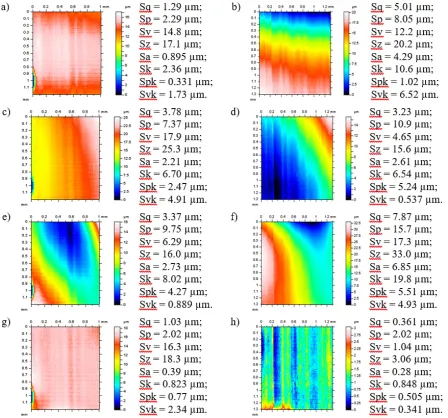
After the analysis of the extracted details (figure 6) from surface (after shape/waviness elimination) the following conclusions were no-ticed. Application of P2ND, P3RD or P4TH caused false
estimation of reference plane when DDD < 1 mm; usually distortion increased when the dependence DDE < 0.5 mm was also accomplished.
Application of FRGR caused the minimization
of surface topography height parameters, which were taken into account. The value of Sq was twice smaller after application of digital filtering compared with polynomials (from 2ND to 4TH
de-grees); the values of Sp, Sz and Spk parameters decreased more than 100% (in some cases).
When DW > 0.5 mm then the application of dig-ital filtering (FRGR) is necessary instead of CLSM or
polynomial approximation (2ND or higher degree).
CONCLUSIONS
Application of CLSM did not allow to extract
STF correctly when DW > 0.5 mm; it is recom-mended to select the reference plane by polyno-mial or digital filters appliance.
The STF were properly selected after appli-cation of P2ND when D
W < 0.5 mm, DDD > 1 mm
and DDE > 0.5 mm; otherwise the distortions of oil pockets and ADD and ADE of the studied detail increased – digital filtering is suggested.
Application of FRGR caused the
distor-tion of dimples (as well as ADD and ADE) when DDE < FBDW. Irregularities in STF extraction were also noticeable on the near-dimple areas, located further than 1 mm from the edge of analysed sur-face (DDE > 1 mm).
Fig. 6. Near-dimple (a, c, e, g) and free-of-dimple (b, d, f, h) details (and their parameters respectively) extracted
When digital filtering was applied, if DDD < DW then distortions of ADD increased (even the cut-off value FBDW > DW). When DW < DDD and DW < FBDW then distortion of oil pockets and nedimple ar-eas (as well as arar-eas between oil pockets and/or areas between dimples and edges of studied de-tails) did not occurred or it was negligible.
For STF distinguishing of cylindrical surfaces containing oil dimples (where DW > 0.5 mm) it is recommended of digital filtering application in -stead of procedure of cylinder fitting by the least squared method or polynomials (likewise 2ND
de-gree). For minimization of dimples distortion the procedure of surface bearing area filtration or al -gorithm with valley digital fulfilling method can be applied as an alternative.
REFERENCES
1. Leach R. (red.): Characterisation of areal surface texture. Berlin: Springer-Verlag 2013.
2. Podulka P.: Proposal of edge-area form removal of cylindrical surfaces containing wide dimples by application of various robust processing tech-niques. 22nd World Congress on the International
Measurement Confederation (IMEKO), 3rd-6th
Sep-tember 2018, Belfast, UK (to be published) 3. Raja J., Muralikrishnan B., Fu S.: Recent advances
in separation of roughness, waviness and form. Precision Engineering 26(2), 2002, pp.222–235. 4. Muralikrishnan B., Raja J.: Computational surface
and roundness metrology, Springer, 2009.
5. Podulka P., Dobrzański P., Pawlus P., Lenart A.: The effect of reference plane on values of areal
Surface topography parameters from cylindrical el-ements. Metrol. Meas. Syst. 21(2), 2014, 247–256. 6. Pawlus P., Reizer R., Wieczorowski M.: Problem
of non-measured points in surface texture measure-ments. Metrol. Meas. Syst. 24(3), 2017, 525–536. 7. Podulka P., Pawlus P., Dobrzański P., Lenart A.:
Spikes removal in surface measurement. J. Phys. Conf. Ser. 483(1), 012025 (2014).
8. Pawlus P. Wieczorowski M., Mathia T.: The errors of stylus methods in surface topography measure-ments. Zapol (2014).
9. Podulka P.: Problem of selection of reference plane with deep and wide valleys analysis. 22nd World
Congress on the International Measurement Con-federation (IMEKO), 3rd-6th September 2018,
Bel-fast, UK (to be published).
10. De Chiffre L., Lonardo P., Trumpold H., Lucca D.A., Goch G., Brown C.A., Raja J., Hansen H.N.:
Quantitative Characterisation of Surface Texture,
CIRP Annals – Manufacturing Technology, 2000,
2, 635–642, 644–652.
11. Stout K.J., Sullivan P.J., Dong W.P., Mainsah E., Luo N., Mathia T., Zahouani H.: The development of methods for the characterisation of roughness in three dimensions. Publication EUR 15178 EN Commission of the European Communities, 1993. 12. Thomas, T.R. (1999) Rough Surfaces. Second
Edi-tion, Imperial College Press, London.
13. Grabon W., Pawlus P.: Distinguishing the plateau
and valley components of profiles from various
types of two-process textures. Metrology and Mea-surement Systems 4, 2016, 593–602
14. Forbes A.B.: Least squares best fit geometric ele -ments, NLP report DITC 40 (89), Teddington, UK, 1989.
15. Sullivan P.J.: Surface topography filtering in: Me -trology and Properties of Engineering Surfaces, Springer, 2001.
16. Brinkman, S., Bodschwinna H.: Advanced Gaussian filters. In: Blunt L., Jiang X. (eds) Advanced Tech
-niques for Assessment Surface Topography. Kogan
Page Science, London and Sterling, 2003, 62–89. 17. Brinkman S., Bodschwinna H., Lemke H.-W.
(2000).: Development of a robust Gaussian
regres-sion filter for three-dimenregres-sional surface analysis. X
International Colloquium on Surfaces, Chemnitz, Germany. 122–131.
18. Kumar J., Shunmugam M. S.: Fitting of robust ref-erence surface based on least absolute deviations. Precision Engineering 31, 2007, 102–113.
19. Lou S., Zeng W.-H., Jiang X.-Q., Scott P.J.: Robust filtration techniques in geometrical metrology and their comparison. International Journal of Automa -tion and Computing 10/1, 2013, 1–8.
20. Podulka P.: Selection of reference plane by the
least squares fitting methods. Adv. Sci. Technol.
Res. J. 2016; 10(30),164–175.
21. Lou S., Jiang X., Scott P.J.: Applications of mor -phological operations in surface metrology and di-mensional metrology. Journal of Physics: Confer-ence Series, 2014, 483 012020.
22. Janecki D.: A two-dimensional isotropic spline fil -ter. Precision Engineering 37(4), 2014, pp.948-965. 23. Janecki D.: A generalized L-2-spline filter. Mea
-surement 42(6), 2009, 937–943.
24. Podulka P 2018 Edge-area form removal of two-process surfaces with application of valley ex-cluding method. Computational Methods in Engi-neering Science 2018 (CMES 2018), E3S Web of Conferences (to be published).
25. Janecki D.: Edge effect elimination in the recursive implementation of Gaussian filters. Precision Engi -neering 36, 2012, 128–136.