The purpose of the study was to confirm a model which proposed two basic dimensions in the subjective experience of guilt, one anxious-aggressive and the other empathic, as well as another dimension associated but not intrinsic to it, namely, the associated negative emotions dimension. Participants were 360 adolescents, young adults and adults of both sexes. They were asked to relate one of the situations that most frequently caused them to experience feelings of guilt and to specify its intensity and that of 9 other emotions that they may have experienced, to a greater or lesser extent, at the same time on a 7-point scale. The proposed model was shown to adequately fit the data and to be better than other alternative nested models. This result supports the views of both Freud and Hoffman regarding the nature of guilt, contradictory only at a first glance.
Keywords: guilt, empathy, anxiety, emotion
El objetivo de este estudio fue confirmar un modelo que proponía dos dimensiones básicas de le experiencia subjetive de la culpa, una ansiosa-agresiva y la otra empática, además de otra dimensión asociada pero no intrínseca a la culpa, es decir, la dimensión de las emociones negativas asociadas. Participaron en el estudio 360 adolescentes, jóvenes y adultos de ambos sexos. Se les pidió que relataran una de las situaciones que les hacían sentirse culpables con mayor frecuencia y que especificaran su intensidad y la de otras 9 emociones que hubieran podido experimentar, en mayor o menor grado, al mismo tiempo en una escala de 7 puntos. El modelo propuesto se ajustaba a los datos y se observó que era mejor que otros modelos alternativos anidados. Este resultado apoya los puntos de vista tanto de Freud como de Hoffman con respecto a la naturaleza de la culpa, sólo aparentemente contradictorios.
Palabras clave: culpa, empatía, ansiedad, emoción
Both Freud and Hoffman are Right:
Anxious-Aggressive and Empathic Dimensions of Guilt
Itziar Etxebarria and Pedro Apodaca
Universidad del País Vasco (Spain)This study is part of a research project funded by the Universidad del País Vasco (Project code: 1/UPV 00227.231-H-14897/2002). Correspondence concerning this article should be addressed to Itziar Etxebarria, Departamento de Procesos Psicológicos Básicos, Universidad del País Vasco, Aptdo. 726, 2008 San Sebastián (Spain). Phone: 34-943-015739. Fax: 34-943-015670. E-mail: [email protected]
After a long period of neglect, the study of guilt has once again become the object of much attention over the last decade. From the 1990s onwards, a number of theoretical and empirical studies have focused on fundamental aspects of this emotion such as the cognitive content of the experience and its actual antecedents (Frijda, 1993; Kroon, 1988), its interpersonal roots and functions (Baumeister, Stillwell, & Heatherton, 1994; Berndsen, van der Pligt, Doosje, & Manstead, 2004; Jones, Kugler, & Adams, 1995), the difference between guilt and shame and the implications of such differences (Abe, 2004; Buss, 1980, 2001; Lewis, 1971; Lewis, 2000; Smith, Webster, Parrott, & Eyre, 2002; Tangney, 1995; Tangney & Dearing, 2002; Tracy & Robins, 2004), its early development (Barret, 1998; Ferguson & Stegge, 1995; Kochanska, Gross, Lin, & Nichols, 2002; Zahn-Waxler & Kochanska, 1990; Zahn-Zahn-Waxler & Robinson, 1995) and its relation with psychopathology (Bybee & Quiles, 1998; Harder, 1995; Tangney, Burggraf, & Wagner, 1995), etc. Nevertheless, hardly any research has been carried out on an equally important question: the emotional quality of the subjective experience of guilt. What is the nature of the most common experience of guilt? What emotional components are involved? Are there clearly differentiated types?
Although empirical research is scarce, theoretical approaches to the emotional quality of the subjective experience of guilt abound. However, these theoretical approaches vary widely, resulting in a somewhat confusing theoretical panorama. Our aim when designing this study was to provide empirical data to help clarify the aforementioned panorama. The following is a brief overview of the most notable theoretical approaches.
Firstly, we should highlight those theories postulated by Freud, who dedicated many of his analyses to unraveling the nature and effects of feelings of guilt. According to Freud (1923/1961, 1930/1961), at first, the feeling of guilt (Schuldgefühl) is nothing more than the anxiety felt by a child in response to the loss of parents’ love when s/he fails to behave as they would like. After the development of the superego as the result of the internalization of parental values, the feeling of guilt has a twofold origin: anxiety over external authority and anxiety caused by the severe vigilance of the superego. When the individual acts or feels the impulse to act in a way which contravenes the mandates of the superego, the superego berates that person with harsh criticism; in order to avoid these recriminations, the individual ends up capitulating to the dictates of the superego. According to Freud, the aggressiveness that the superego unleashes onto the ego, perceived by the ego as a feeling of guilt, originates not only from the real severity of the individual’s parents; it also stems from the individual’s own aggressiveness, from both his/her original aggressiveness and that provoked by the frustration of his/her desires, which the subject has been forced to repress. In addition to acting as a powerful inhibitory factor, feelings of guilt also produce the need for punishment, a need which tends to be translated
into self-punishment. Furthermore, given its extremely unpleasant nature, the individual tends to set in motion numerous defense mechanisms (rationalizations, projections, reaction-formations, etc.). As a result, feelings of guilt end up manifesting themselves in a wide variety of different ways, to the extent that the individual him/herself often fails to recognize them for what they are, experiencing them as anxiety and floating aggressiveness (most commonly directed at him/herself, but often turned outwards also) whose origin the person is unable to identify. In any case, these feelings of guilt constitute an underlying factor in much pathology (depression, obsessive-compulsive disorders, etc.).
Klein (1973) agrees with most of Freud’s analyses, but also identifies a different type of guilt. In addition to
persecutoryguilt, very similar in nature to the Freudian guilt described above, this author also identifies depressiveguilt. This type of guilt does not consist so much of anxiety regarding the feared object as of sadness and regret at having harmed the beloved object. More than feeling accused, an individual experiencing this kind of guilt feels responsible for the harm done to the beloved object, harm that needs to be redressed. Another author such as Fromm (1947/1985) proposes a new distinction: that between authoritarianguilt and humanisticguilt. The first is confused with fear of authority (parents, state, Church) which is either external or internalized within the individual’s own consciousness and implies aggressiveness, stemming from frustration, which is constantly directed towards oneself. The second is defined as the feeling derived from not having acted in accordance with one’s own dignity, of not having risen to the occasion. Learning theories have also striven to shed light on the nature of guilt. In relation to this approach, we can highlight the work of Eysenck and Mosher. Eysenck (1964/1977) conceived guilt as a conditioned emotional disturbance. Guilty reactions are simply due to a Pavlovian conditioning process: if punishment is applied before, or at the start, of the transgression, then resistance to the transgression is generated; however, if punishment is applied once the transgression has been committed, then the result is feelings of guilt. Mosher (1965) also associates guilt with anxiety, defining it as a “generalized expectancy for self-mediated punishment (i.e., negative reinforcement [sic]) for the violating, anticipating the violation of, or failure to attain internalized standards of proper behavior” (p. 162).
Alongside the theories mentioned above, special mention should be made of that postulated by Hoffman (1982, 1998), one of the few authors that continued to work in this field during the 1980s and whose work still strongly influences current thinking. From Hoffman’s perspective, guilt (or more specifically, the guilt that he terms trueor interpersonal
prosocial motive, since it fosters reparatory behavior and all types of positive behaviors that transcend to the victim.
Finally, among the more recent approaches, we should highlight those postulated by Baumeister et al. (1994). Based on a comprehensive review of empirical research, as well as on their own studies, these authors postulate an
interpersonal conception of guilt. From this perspective, guilt is rooted, on the one hand, in the human capacity to feel others’ pain, and on the other, in anxiety over rejection by others. Thus, guilt appears mainly in relation to actions or omissions which cause real or possible pain to others, particularly those closest to us, and plays a decisive role in the control and reparation of the said actions. Frijda (1993), in his analysis of the cognitive content and actual antecedents of guilt experiences, proposes a similar view.
The wide range of different conceptions of guilt, briefly outlined above, in conjunction with the need identified by several authors to establish distinctions between different types, as well as the fact that the distinctions do not always coincide, suggest that we are faced with a complex family of emotions. Nevertheless, if we compare the various approaches, we see that different authors coincide in highlighting certain types of guilt. In this way, in spite of terminological differences, Freudian approaches, Klein’s ideas regarding persecutory guilt, Fromm’s perspective regarding authoritarian guilt, and even Eysenck and other learning theorists’ proposals regarding conditioned anxiety responses resulting from educational practices are, in fact, fairly similar. In all cases we are dealing with a feeling of guilt that is confused with anxiety over the reaction of more or less internalized others, a feeling of guilt that, according to some authors (particularly those from the psychoanalytic field), is also marked by contained aggressiveness turned inwards against the ego. Alongside this type of guilt, Klein stresses the existence of depressive guilt, a concept which prefigures the true or interpersonal guilt later proposed by Hoffman. In this case, guilt is associated with empathy over another’s pain. Baumeister and colleagues propose a kind of synthesis of these two aforementioned conceptions, emphasizing the participation of both empathy and anxiety over external rejection in the experience of guilt.
In sum, guilt has basically been associated with two emotions: empathy and anxiety. Everything seems to point to the existence of some experiences of guilt in which the predominant emotion is empathy, and others in which the prevailing feeling is that of anxiety, and that, to a large extent, the discrepancy between different theories is due to the fact that the researchers are focusing on different types of experiences of guilt. Furthermore, some authors also coincide in that anxious guilt often involves a fair amount of contained aggressiveness, directed inwards against oneself. Alongside the above mentioned emotional components, a number of authors have also highlighted the role played by a depressive component in all experiences of guilt: Freud mentions it in his analysis of anxious guilt, and Klein
considers it to be a fundamental element in depressive guilt –empathic guilt.
To what extent are these theoretical approaches valid? How faithful a reflection are they of real subjective experiences of guilt? Despite the number of studies on the emotional correlates of the tendency to experience guilt or
trait guilt, studies focusing on the emotional correlates of the experience of guilt in response to a specific event, or
state guilt, are still scarce. Nevertheless, as we will see below, existing studies support the fundamental presence of empathy, anxiety, aggressiveness and sadness in experiences of guilt.
With regard to the empathic component, after analyzing child and adult autobiographical reports of emotional experiences, Tangney, Marschall, Rosenberg, Barlow, and Wagner (1996) found that when relating episodes in which they had experienced feelings of guilt, both groups often expressed other-oriented empathy. An experimental study carried out by Hoffman (Thompson & Hoffman, 1980) also supports the presence of an empathic component in the feeling of guilt. Similarly, significant positive correlations have been found between the tendency to experience other-oriented empathy and the tendency to experience guilt in sample groups of various ages (Tangney, 1991; Tangney, Wagner, Burggraf, Gramzow, & Fletcher, 1991). Finally, studies which show a close relationship between the tendency to experience feelings of guilt and the use by parents of inductive disciplinary techniques –techniques which activate empathy and foster its development– also provide indirect empirical support for the association between guilt and empathy (Etxebarria, 1994; Hoffman, 1994, 2000).
As for the other emotional components whose implication in the experience of guilt has been highlighted by diverse theories, a study carried out by Baumeister, Reis, and Delespaul (1995), using an experience sampling method over the course of a week in order to determine the frequency with which people experience guilt and the emotions that are associated with this experience, supports the presence of anxiety, aggressiveness and sadness in guilt episodes. Similarly, studies which analyze various correlates of the Guilt Inventory have found that both stateguilt and
traitguilt are associated with anxiety, hostility and depression (Jones & Kugler, 1993; Jones et al., 1995).
In a number of studies with adult subjects, Watson and Clark (1992) also found strong correlations between guilt and hostility, sadness, and fear. Nevertheless, in these studies, most data was based on relatively long-term measures of the affect, rendering the results more relevant in relation to
However, the relationship between guilt and aggressiveness is far from clear. Different studies support a negative relationship between trait guilt and a tendency toward outwardly directed anger and hostility (Lutwak, Panish, Ferrari, & Razzino, 2001; Mosher, 1979; Tangney, Wagner, Fletcher, & Gramzow, 2001). According to Tangney (1995), this is due to the fact that, although the tendency towards guilt, like the tendency towards shame, is associated with the activation of anger, people who tend to experience
shame-free guilt (as opposed to those who tend to experience shame) also tend to handle it in a constructive manner: they show constructive intentions, attempts to discuss the issue in a non-aggressive way with the person at whom their anger is directed, cognitive reevaluations of the other person’s role in the situation of anger, etc. Nevertheless, the negative relationship between trait guilt and a tendency towards anger and hostility could also be interpreted as a reflection of the tendency of guilt-prone people to direct their aggressiveness against themselves, something which, in the long term, may not prove particularly adaptive.
Although shame-free guilt may be associated with constructive handling of anger, the presence of an intropunitive component is tangible in many experiences of guilt (Kroon, 1988). This is particularly true when the individual is unable to resolve the situation that has given rise to the experience of guilt through confession, reparation or asking for forgiveness, and the experience of guilt remains therefore in a state of unresolved tension (Lindsay-Hartz, de Rivera, & Mascolo, 1995). The presence of an (outwardly and inwardly directed) aggressive component has also been identified in cases of so-called chronic guilt. Based on the distinction between predispositional guilt (predisposition to feel guilty in response to specific events) and chronicguilt (an ongoing condition not associated with immediate events), Bybee and Quiles (1998) found that individuals suffering from more chronic guilt also showed higher levels of hostility and more intropunitive behavior. This data indicates the presence of an other-oriented and self-aggressive component in some types of guilt. Nevertheless, more studies focusing on state guilt, such as those carried out by Baumeister et al. (1995), are required in order to enable conclusions to be drawn regarding the presence of aggressive components in habitual experiences of guilt.
Based on the theoretical review and the empirical studies mentioned above, in this current study we formulated the hypothesis that, fundamentally, the components of anxiety, aggressiveness, empathy and sadness would be involved in habitual experiences of guilt, although the anxious and aggressive components would tend to be more intense in some cases, and the empathic component more intense in others. In other words, we hypothesized that two basic clearly differentiated factors would be involved in experiences of guilt: one that would correspond, to a large extent, with the guilt described by Freud, mainly covering the feelings of anxiety, anger and anger at oneself (
anxious-aggressive factor); and another that would basically correspond to the guilt described by Hoffman, involving the feeling of sympathy (empathicfactor). A sadness component would intervene in both factors, although with less weight than the aforementioned emotional components.
In addition to attempting to confirm the existence of these two factors, we also aimed to determine the extent to which components of other emotions such as disgust, fear, shame and sense of worthlessness, were involved, and present, in experiences of guilt. The above review suggests that, although in some cases they may be associated with experiences of guilt and can even be fairly intense, these emotional components do not constitute essential elements. Therefore, we supposed that these emotions would tend to be grouped in a factor different from the two previously-described ones: namely the associated negative emotions
factor. Although clearly distinguishable from the anxious-aggressive factor and the empathic factor, given the highly aversive nature of its components, this third factor would show a fairly close association with the anxious-aggressive factor, while showing no, or a very low, covariation with the empathic factor.
In this type of research, both cultural and social elements play an important role, thus necessitating some prior clarifications regarding the study presented here. Said study aimed to confirm the three-factor model of guilt described above. The objective was to see whether indeed this model properly encompassed the underlying dimensions of guilt as experienced in everyday life. Thus, the best idea seemed to be to ask a large number of people to report their habitual experiences of guilt without giving them any prior definition of said emotion. In this way, the aim was not to limit what people habitually understood by guiltwith any academic a priori. Nevertheless, a problem may arise here: how can we be sure that people would report experiences of guilt rather than those of other closely-related emotions, such as shame, for example? In the English-speaking context, it has been stated on more than one occasion that lay-people often confuse guilt and shame (Tangney, 1995; Tangney & Dearing, 2002). This may indeed be a problem in a study involving English-speaking participants; however, in the Spanish context, people do not tend to have so much difficulty distinguishing between culpaand vergüenza(the Spanish terms for guilt and shame, respectively). A recent study by Pascual, Etxebarria and Pérez (2007) suggests that the limits between the Spanish terms culpaand vergüenza
are less diffuse than the limits between the English terms
guilt and shame. Similarly, other authors (Hurtado de Mendoza, 2007; Hurtado de Mendoza & Parrott, 2002) have found that the distance between vergüenza–to be even more precise, the Spanish vergüenza, as opposed to the Guatemalan vergüenza– and culpais greater than the distance between shameand guilt.
When we ask people about their experience of culpa, what we are verifying is whether the dimensions proposed by our model underlie the experiences that Spanish people consider to be experiences of culpa, not whether said dimensions underlie experiences of guiltper se. Furthermore, we cannot suppose an exact correspondence between the Spanish term
culpaand the English term guilt (Hurtado de Mendoza, 2007; Hurtado de Mendoza & Parrott, 2002; Pascual et al., 2007). Does this mean that we are studying a culturally-specific emotional experience? A variant of guilt that, as such, would not be worth using to confirm a general model of this emotion? Not at all; the experience of culpais not a culturally-specific emotional experience or, to be more precise, it is no more so than the experience of guilt of English-speaking participants in studies of this kind. Although there is a certain degree of (often unconscious) ethnocentrism that prevents us from seeing it, many other studies carried out in other cultures, including English-speaking ones, pose the same problem. As some authors have pointed out (Russell, 1991; Russell, Fernández-Dols, Manstead, & Wellenkamp, 1995), when we study guilt,
Schuldgefühlor culpa, what we are studying, at least with this type of method, is what the people from the corresponding culture understand by the term, rather than a universal emotion whose psychological essence is, by coincidence, embodied in the English term guilt, the German term Schuldgefühlor the Spanish term culpa. Having said this, we believe the use of self reports, even with all their limitations, continues to be a useful tool for analyzing subjective questions such as the one that is the focus of this paper.
Having made these clarifications, and despite the fact that the Spanish term does not correspond exactly with the English term guiltor the German term Schuldgefühl, our hypothesis, as stated earlier, is that the factors postulated by the theory would be confirmed by the data obtained in the Spanish context.
Method
Participants
Participants were 360 people from three age groups: one group of 156 adolescents aged between 15 and 19 (81 girls and 75 boys, mean age = 16.87 years), another group of 96 young adults aged between 25 and 33 (49 women and 47 men, mean age = 28 years), and a third group of 108 adults aged between 40 and 50 (54 women and 54 men, mean age = 44.69 years). The predominating religious tendency was Catholic or generally Christian, although the vast majority were non churchgoers. They voluntarily participated in the study and were treated in accordance with the Ethical Principles of Psychologists and Code of Conduct(American Psychological Association, 1992).
Instrument and Procedure
Participants responded to a questionnaire in which they were asked to describe, in a certain amount of detail, one of the situations which most frequently caused them to experience feelings of guilt (culpa). After reporting why this made them feel guilty, they had to specify the intensity of the feeling of guilt on a 7-point scale (1 = no guilt, 7 = very intense guilt). Then, there was a list of 9 emotional experiences where they had to indicate whether they experienced one or more of these feelings, in addition to guilt, in the situation they had mentioned. They specified the intensity of these feelings on a scale similar to the previous one at the side of each of the listed emotions. The list was as follows: “I feel sorry for another person”, “I feel nervous, anxious”, “I feel angry with myself”, “I feel irritated, angry”, “I feel worthless”, “I feel sad”, “I feel disgusted”, “I feel frightened”, “I feel ashamed” and, finally, “any other emotion.”
The students answered the questionnaire in their classrooms during class. The young adults and adults responded to the questionnaire individually at home.
Data Analysis
To test the hypotheses relating to the structure of the subjective experience of guilt (culpa), we used a confirmatory factor analytic (CFA) procedure, which is based on the analysis of covariance structures, using the AMOS program (Arbuckle & Wothke, 1999).
However, we should not forget that “[...] the data do not confirm a model, they only fail to disconfirm it, [...] when the data do not disconfirm a model, there are many other models that are not disconfirmed either” (Cliff, 1983, p. 116-117). Furthermore, the Chi-square goodness-of-fit test is the main procedure of parameter significance for the analysis of covariance structures. This test, although valuable, is problematic because it is a direct function of sample size, it decreases as the model becomes less parsimonious and it increases as the covariances of the matrix become higher (Apodaca & Páez, 1992). Currently, it is more useful when regarded as a measure of fit rather than as a statistic test (Joreskog & Sorbom, 1993).
Based on this, we decided to test different nested models. Our aim was to demonstrate that our theoretical model fitted better than other models. Therefore, we tried to test our model in relative terms (as better than other alternative models) rather than in absolute terms (through a test of statistical significance).
would show very low correlations with the other two factors while the second and the third factors would show a high correlation; (c) the “sadness” emotion would have two nonzero loadings (one in the Empathic and the other in the Anxious-aggressive factors) while the rest of the emotions would have only one nonzero loading; (d) specifically, the Empathic factor would include sympathy and sadness, the Anxious-aggressive factor would include sadness, anxiety, anger and anger at oneself, and the Associated negative emotions factor would include fear, disgust, shame and a sense of worthlessness.
This theoretical model was compared with other nested models to determine whether or not its fit was better. These models were as follows: (a) M0 - Independence, (b) M1 -One-factor model, (c) M2- Two-factor model, (d) M31 -Three-factor model-Alternative 1, and (e) M32- Three-factor model-Alternative 2.
Goodness-of-fit criteria. The evaluation of the model was based on multiple criteria, mainly the substantive meaningfulness of the model, but also Chi-squared likelihood ratio statistics and other practical indexes of fit (absolute, comparative and cross-validation fit indexes). A more detailed description of the indexes now follows:
1. The Chi-square test of the overall differences between nested models. This difference is calculated by simple subtraction of the chi-square statistics of the nested models. This difference is distributed as chi-square with degrees of freedom equal to the difference in degrees of freedom between the models.
2. The Goodness-of-fit index (GFI) is an absolute index of fit because it compares the hypothesized model with no model at all.
3. The Root mean square error of approximation (RMSEA) is considered an important informative criterion. This index is expressed per degrees of freedom and is therefore sensitive to the complexity of the model and useful for comparing alternative (non-nested) models. Steiger (1989) suggests the use of confidence intervals to assess the precision of the RMSEA estimates.
4. The comparative fit index (CFI), proposed by Bentler (1990), is useful for comparing nested models. It compares the hypothesized model with a base model that is usually the independence model. This index is sensitive to the complexity of the model. Both Cheung and Rensvold (2002) and Elosua (2005) suggest that when the difference between two nested models in this coefficient is higher than .01, the most restricted model should be rejected.
5. Fit indexes for comparing non-nested models. Akaike’s information criteria (AIC) and the expected cross-validation index (ECVI) are useful for ordering models from best fitting to worst fitting (Maruyama, 1998).
Model identification and latent factor scales definition.
The Empathic factor in models of two and three factors (M2, Mt, M31, M32) with only two indicators and the sadness item also loading on the Anxious-aggressive factor could cause the under-identification of the model. To solve this problem the loading of sympathy is set to 1 (as the main component of the Empathic factor) and the loading of sadness is set to 0.5 (as a secondary component of the Anxious-aggressive factor). These decisions are congruent with the substantive criteria mentioned above. For the definition of latent factor scales the loadings of one item per factor are set to 1.
The final sample size was 271 in order to ensure that we were working with the complete data (as recommended in structural equation methods) and to prevent a nonpositive definite covariance matrix.
The theoretical model shows a number of characteristics that limit the power of the analyses. The difficulties basically arise from the limited number of indicators of each dimension, which is a reflection of the theoretical views on the nature of the subjective experience of guilt. However, the biases found in the simulation studies carried out by Marsh, Kit-Tai, Balla, and Grayson (1998) indicate an acceptable precision level with Ns and number of indicators per factor similar to those considered in our study. Furthermore, the strategy of testing nested models lends additional consistency to the estimates. Nevertheless, it will be necessary to analyze the confidence interval for the RMSEA and the ECVI, in order to assess the precision of the estimates under these circumstances.
Finally, one last statistical consideration should be mentioned, regarding the normality of the distributions. We analyzed the asymmetry and kurtosis coefficients in each of the variables and, as shown in Table 2, the distributions were reasonably close to normal (Muthén & Kaplan, 1985) and are within the limits recommended by various authors for these analyses (Cuttance & Ecob, 1987).
Results
Intensity of the Different Emotional Components
Involved in the Subjective Experience of Guilt
The analysis of the means and standard deviations of the different emotional components clearly showed that, as we had hypothesized, the components that intervened most intensely in the experience of guilt were sympathy, sadness, anxiety, anger and anger at oneself. The other emotions (fear, disgust, shame and sense of worthlessness) were found with a much lower intensity. See Table 1.
Testing the Three-Factor-Model
The correlation matrix to be analyzed is presented in Table 2.
We tested the validity of the theoretical three-factor model in two ways. Firstly, by evaluating its degree of fit to the data by means of the different fit indexes and the consistency of the estimated parameters with what had been hypothesized. And secondly, by comparing that model with other nested models.
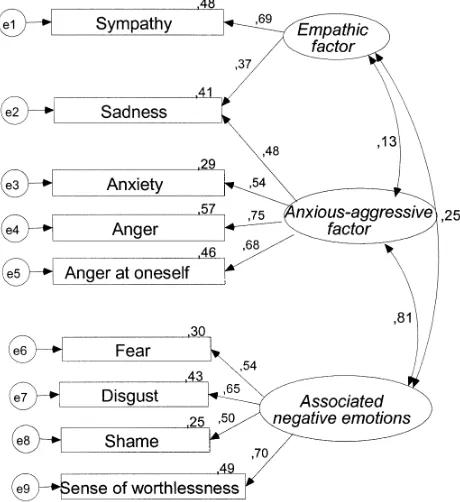
Figure 1 shows the theoretical model (Mt) with the standardized estimates of the factor loadings and the intercorrelations between the factors. The fit indexes are shown in Table 3.
The diagram shows factor loadings that are consistent with the proposed hypothesis. As we can see, the Empathic dimension mainly includes the feeling of sympathy, with the feeling of sadness also being present but with less weight. The Anxious-aggressive dimension mainly includes anxiety, anger and anger at oneself, with sadness also present but again, with less weight. There is a very low covariation between the two dimensions, a finding which is consistent with the theoretical proposals that identify two clearly differentiated and independent
Table 1
Mean, Standard Deviation, Asymmetry, and Kurtosis for each of the Variables
Age Group N M SD Asymmetry Kurtosis
Sympathy 299 4.18 1.89 –.27 –1.03
Sadness 314 4.37 1.83 –.30 –.92
Anxiety 306 4.04 1.88 –.05 –1.14
Anger 304 4.01 1.83 –.03 –1.09
Anger at oneself 329 4.78 1.65 –.45 –.67
Fear 279 2.57 1.90 .96 –.35
Disgust 277 2.40 1.77 1.13 .19
Shame 289 3.12 1.90 .48 –.95
Sense of worthlessness 286 2.88 1.91 .71 –.71
Table 2
Intercorrelations for all the Variables
Sympathy Sadness Anxiety Anger Anger Fear Disgust Shame Sense of at oneself worthlessness
Guilt .167** .338** .345** .312** .405** .119 .200** .145* .304**
Sympathy — .306** .118 .067 .047 .062 .139* .112 .031 Sadness — .218** .349** .371** .340** .349** .295** .404** Anxiety — .412** .387** .381** .257** .186** .321** Anger — .540** .270** .484** .277** .397** Anger at oneself — .232** .247** .258** .395** Fear — .335** .310** .385**
Disgust — .328** .459**
Shame — .331**
Sense of worthlessness —
* p< .05. **p < .01.
factors. As regards the third factor, the Associated negative emotions factor, the coefficients in Figure 1 show that it has good internal consistency, as well as correlations with the other factors in accordance with what had been hypothesized.
As shown in Table 3, the set of fit statistics corresponding to the Mt model is satisfactory and supports the proposed model. Both the GFI and the CFI are satisfactory although moderate. The RMSEA index is within the limits of what can be considered acceptable. The confidence intervals to assess the precision of the RMSEA and ECVI estimates are presented in order to show the stability of these estimates. As we can see, the confidence interval for the RMSEA oscillates between .06 and .10. The highest limit is above what is considered good fit or reasonable errors of approximation, but its range is sufficiently narrow to rely on the precision of that fit index. The interval of the ECVI is also narrow enough to rely on its precision.
In conclusion, we can say that the fit between the theoretical three-factor model and data is moderately good, although it is clear that modifying some parameters of the model would improve that fit considerably. This, in fact, is something we will do at a later stage.
As stated above, the second level of analysis to test the validity of the model is its comparison with other nested models. Table 3 shows the fit indexes of these models. Table 4 shows the test of significance for the differences between models.
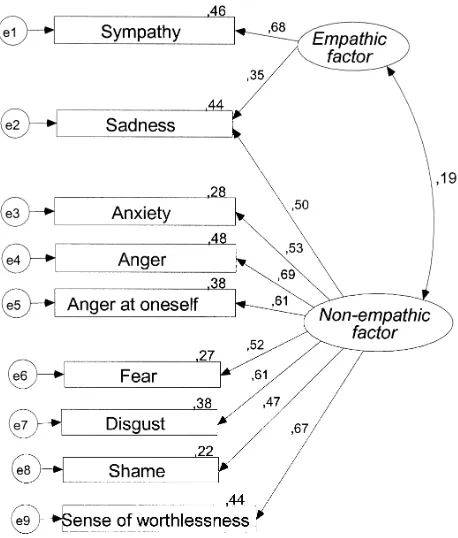
As we can see, the three-factor model or theoretical model (Mt) is clearly superior in its fit than the one-factor and two-factor models. The one-factor model (M1) presents really poor fit indexes: both the absolute index (GFI) and the comparative one (CFI) are below the limits considered acceptable. As regards the two-factor model (M2), the fit indexes are somewhat better but they are also below what is considered acceptable. Figure 2 shows the estimates corresponding to the two-factor model.
This two-factor model is especially interesting because it groups in a single factor two of the factors of the theoretical model, the Anxious-aggressive factor and the
Table 3
Fit Indexes for Nested Models
Model χ2(df) GFI RMSEA (lo-hi) CFI AIC ECVI (lo-hi)
M0 586.4 (36) .558 .238 (.22-.25) .000 604.4 2.24 (1.96-2.54)
M1 103.5 (27) .927 .102 (.08-.12) .861 139.5 .52 (.41-.65)
M2 83.1 (26) .939 .090 (.07-.11) .896 121.1 .45 (.36-.56)
Mt 64.9 (24) .953 .079 (.06-.10) .926 106.9 .40 (.32-.50)
M31 30.9 (21) .976 .042 (.00-.07) .982 78.9 .29 (.26-.36)
M32 118.8 (25) .920 .118 (.10-.14) .830 158.8 .59 (.48-.73)
Note.M0 - Independence model; M1= One-factor model; M2= Two-factor model; Mt= Three-factor model = Theoretical model; M31= Three-factor model-Alternative 1; M32= Three-factor model-Alternative 2; GFI = goodness of fit index; RMSEA = root mean square error of approximation and 90% confidence interval; CFI = comparative fit index; AIC = Akaike’s information index; ECVI = expected cross-validation index and 90% confidence interval.
Table 4
Hierarchical ∆χ2Test between Nested Models
Model ∆χ2 ∆df p
M1-M2 20.4 1 < .01
M2-Mt 18.2 2 < .01
M32-Mt 53.9 1 < .01
Note.M1= One-factor model; M2= Two-factor model; Mt= Three-factor model = Theoretical model; M32= Three-factor
Associated negative emotions factor. As mentioned above, the emotions included in the Associated negative emotions factor can only be considered collateral or not part of the most intrinsic elements of guilt. Nevertheless, from an empirical perspective, they present correlation patterns that could call their merely collateral character into question. Indeed, as shown in Figure 1, the correlation of the Associated negative emotions factor with the Anxious-aggressive factor is .81. We tested a two-factor model with the aim of helping to clarify these empirical correlation patterns and understand what exactly these associated negative emotions represent in relation to the experience of guilt from a conceptual perspective.
The comparison between the two models (Mt - M2) supports the need to distinguish between the Associated negative emotions factor and the Anxious-aggressive factor since the three-factor model is clearly superior to the two-factor model in all fit indexes, as well as in the test of significance of the differences (see Table 4).
Therefore, the results supported the idea that the Associated negative emotions factor is distinguishable from the intrinsic or substantive factors of the subjective experience of guilt and has an adequate level of internal consistency. This factor is closely related to the Anxious-aggressive factor, while only moderately to the Empathic factor. Nevertheless, further analyses are required regarding the internal structure of this factor, since correlations were observed between the errors of some of its emotions and those of the emotions characteristic of the anxious-aggressive dimension of guilt. These inter-correlations reflect the existence of covariation structures that cannot be satisfactorily explained by the three dimensions of the model. They seem to point to a difference in the nature of emotions such as fear and disgust, and shame and sense of worthlessness.
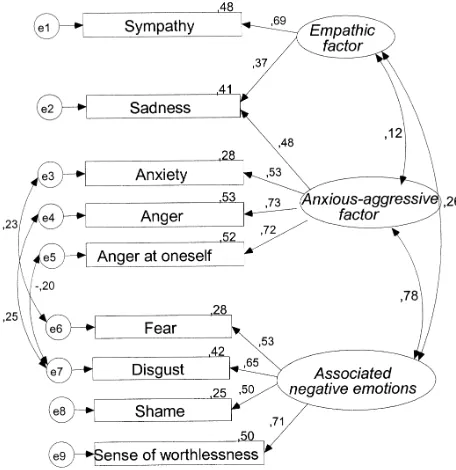
The M31 model explores precisely this possibility by freeing the intercorrelations between the errors of some emotions. Figure 3 shows the estimates obtained. The diagram shows interesting correlations between the emotions of the Anxious-aggressive factor and two of the emotions of the Associated negative emotions factor. The fit indexes corresponding to this model, shown in Table 3, are highly satisfactory but of only relative value, because they have been achieved following empirical post hoccriteria obtained with the same sample. Further research should try to clarify these relations with a wider range of emotions, alternative factorial structures of a hierarchical nature and, especially, different samples.
Nevertheless, from the fit indexes obtained by the M31 model we can indeed draw an important conclusion: the proposed model has a very high fit level in the first two factors, which are precisely those that, from a theoretical viewpoint, were considered intrinsic to or constituent of the subjective experiences of guilt. The source of the distortion of the fit lies in the emotions of the third factor, which we consider related but extrinsic to the subjective experience
of guilt. Therefore, we can conclude that the data clearly support the central corpus of the theory on the subjective experience of guilt.
However, in our strategy of comparing nested models, it seemed necessary to contemplate some other alternative model that altered the configuration of the first two factors. That model was the ‘M32’ model, which affirmed that the feeling of sadness was only an indicator of the Empathic factor. This contradicts one of our main hypotheses, which posed that sadness was an emotion common to the Empathic and Anxious-aggressive dimensions. As can be observed in Table 3, the alteration of this parameter had a strong negative impact on the model’s fit. Table 4 shows that there are significant differences between the fit of the proposed theoretical model and the alternative model (M32). Thus, we can also conclude that sadness is an important element in both the Anxious-aggressive and the Empathic dimensions of the subjective experience of guilt.
Discussion
The theoretical model proposing the existence of two fundamental factors in the subjective experience of guilt, one Empathic and the other Anxious-aggressive, as well as a third factor, the Associated negative emotions factor, was shown to adequately fit the data and to be better than other alternative models.
which contain the common component of sadness. The empathic factor basically consists of the feeling of sympathy, with the feeling of sadness also being present but with less weight. The anxious-aggressive factor mainly includes anxiety, anger and anger at oneself, with sadness also present but again, with less weight. In short, the first factor corresponds to the type of guilt proposed by Hoffman (1982, 1998) and Klein (1973), while the second corresponds quite faithfully to that proposed by Freud (1923/1961, 1930/1961). We can therefore affirm that, at least as regards the Spanish experience of this emotion, both Freud and Hoffman are right. If their theories appear at first to be contradictory, this is because the former focuses his attention on experiences of guilt in which the anxious-aggressive factor is most salient, while Hoffman focuses on those in which the empathic factor predominates.
This conclusion may be useful for clarifying the complex theoretical panorama surrounding the study of guilt, a complexity due, to a large extent, to the different conceptions that exist regarding its emotional nature. As well as this, we should also highlight that, in our study, clear support was found for the presence of a strong aggressive component in the subjective experience of guilt. This aspect, identified very clearly by Freud (1923/1961, 1930/1961), has already been found in a number of previous studies (Baumeister et al., 1995; Bybee & Quiles, 1995; Jones & Kugler, 1993; Jones et al., 1995; Lindsay-Hartz et al., 1995), yet is often overlooked. In conjunction with the results of the aforementioned works, those found in this study suggest that if we really wish to understand experiences of guilt and, in particular, those of a disturbing nature, in all their complexity, then we must pay more attention to the (other and self-oriented) aggressive component that is so often part of them.
As mentioned above, according to our results, a component of sadness is present in both the empathic and anxious-aggressive factors. This result is consistent with the theoretical approaches reviewed in the introduction. Thus, in her analyses regarding depressive guilt, Klein (1973) places special emphasis on the sorrow and depressive feelings that accompany the experience of knowing oneself to be the cause of a beloved object’s suffering. In other words, in addition to empathy, sadness and sorrow are also a part of this type of experience of guilt. The presence of a component of sadness in the more Freudian anxious-aggressive guilt is also hardly surprising. Both Freud and other authors have drawn attention to the relationship between certain anxious types of guilt and depression.
One fundamental theoretical question that remained unanswered when reviewing the diverse conceptions of the emotional quality of the subjective experience of guilt was how two such different subjective emotional experiences such as those postulated by Hoffman (1982, 1998) or Klein (1973) on the one hand, and Freud (1923/1961, 1930/1961) on the other, could both be included under the same emotional term. The fact that sadness is a component (the only one, in fact) common to both types of guilt suggests that this emotional
component may, as far as emotional quality is concerned, serve as a point of union. And indeed, daily experience shows us that most of the guilt experiences (both those of a more empathic nature and those of a more anxious-aggressive nature) include a component of sadness: sadness provoked by one’s own acts, which the individual rejects, and by the sudden awareness that these acts may be atoned for, but never undone. As with sadness, in all experiences of guilt the individual feels that something valued has been lost or spoilt.
Alongside the emotional components mentioned above, the study also analyzed the implication of other components such as fear, disgust, sense of worthlessness and shame in the subjective experience of guilt. These components, as stated in the theoretical review, may be associated with some experiences of guilt, but cannot be considered intrinsic to this emotion. As hypothesized, the intensity of these emotional components in comparison with those of empathy, anxiety, aggressiveness and sadness was notably lower. The results support the hypothesis that these emotions tend to be grouped together under a third factor, which we termed the Associated negative emotions factor because, while being clearly distinguishable from both the empathic and anxious-aggressive factors, it is nevertheless closely linked to the latter. Future studies need to explore the internal structure of this factor in more detail, since correlations were observed between the errors of some of its emotions and those of the emotions characteristic of the anxious-aggressive dimension: positive correlations between fear and anxiety and between disgust and other-oriented aggression, and a negative correlation between disgust and self-oriented aggression. These results seem to point to a difference between the intervention of fear and disgust, on the one hand, and shame and a sense of worthlessness, on the other, in experiences of guilt, since the former correlated with those emotions characteristic of the anxious-aggressive factor, while the latter did not. The clarification of the role of these and other possible negative emotions in the experience of guilt will require additional studies that encompass a wider and more diverse range of emotional terms.
contexts, particularly English-speaking ones, shame occupies a more central place in the factorial structure, forming part, for example, of the anxious-aggressive factor. It would be a good idea not only to replicate this study in another linguistic context –again, English would be especially interesting– to see if the results were any different, but also to replicate it asking participants to refer to their experiences of ‘vergüenza’ or ‘shame’ alongside their experiences of ‘culpa’ or ‘guilt’ (depending on the linguistic context), in order to compare the factorial structures underlying emotional experiences that people label with each of these terms.
This may not only prove a great help in gaining a better understanding of these emotional experiences, it may also contribute to increasing awareness of the (often made) error of making direct generalizations to other cultures regarding their nature and the differences between them, based on studies (no matter how conclusive) of guilt and shame carried out only with English-speaking participants.
In short, this study supports the construct validity of our model of the subjective experience of ‘culpa’, especially regarding the two essential factors, the empathic and the anxious-aggressive factors. Nevertheless, in order to confirm the stability and relevance of the mentioned factors, new studies need to be carried out using different samples, instruments and alternative models. Similarly, cross-cultural studies are also required in order to determine whether or not these factors prove also to be the fundamental dimensions of experiences of guilt and similar emotions in other cultures.
Such studies may be of great help in clarifying the emotional quality of the wide range of emotional experiences grouped under the generic term guilt. This is fundamental to achieving a better understanding of the diverse effects of guilt, their adaptive nature, their implications in the field of pathology and the moral realm, gender differences in this emotion, etc. Many of the apparent contradictions between the conclusions drawn from different studies would disappear if we bore in mind that these studies focus their attention on different kinds of guilt experiences. Thus, authors that base their work on a more empathic view of guilt find that this emotion has highly positive effects of great worth in the interpersonal and moral field, with a clear adaptive value (Hoffman, 1982, 2000; Tangney & Dearing, 2002). However, those who focus their attention on more anxious-aggressive kinds of experience, while accepting that guilt may have positive effects, point out that it also involves a great deal of suffering for the individual, is the underlying cause of many pathologies and can severely interfere with that individual’s relationship with others (Bybee & Quiles, 1998; Freud, 1923/1961, 1930/1961).
It is important to continue the effort to integrate the conclusions drawn by diverse studies in this field, many of which are contradictory only at a first glance. Our identification of two basic dimensions in experiences of ‘culpa’, one anxious-aggressive and the other empathic, aims to contribute to this endeavor.
References
Abe, J. A. (2004). Shame, guilt, and personality judgment. Journal of Research in Personality, 38, 85-104.
American Psychological Association. (1992). Ethical principles of psychologists and code of conduct. American Psychologist, 47, 1597-1611.
Apodaca, P., & Páez, D. (1992). Los modelos estructurales: posibilidad y limitaciones. In D. Páez, J. Valencia, J. F. Morales, B. Sarabia, & N. Ursua (Eds.), Teoría y método en Psicología Social. Barcelona: Anthropos.
Arbuckle, J. L., & Wothke, W. (1999). Amos user’s guide: Version 4.0. Chicago: SPSS.
Barret, K. C. (1998). The origins of guilt in early childhood. In J. Bybee (Ed.), Guilt and children(pp. 75-90). San Diego, CA: Academic Press.
Baumeister, R. F., Reis, H. T., & Delespaul, P. (1995). Subjective and experiential correlates of guilt in daily life. Personality and Social Psychology Bulletin, 21, 1256-1268.
Baumeister, R. F., Stillwell, A. M., & Heatherton, T. F. (1994). Guilt: An interpersonal approach. Psychological Bulletin, 115, 243-267.
Bentler, P. M. (1990). Comparative fit indexes in structural models. Psychological Bulletin, 107, 238-246.
Berndsen, M., van der Pligt, J., Doosje, B., & Manstead, A. S. R. (2004). Guilt and regret: The determining role of interpersonal and intrapersonal harm. Cognition-and-Emotion, 18, 55-70. Buss, A. H. (1980). Self-consciousness and social anxiety.San
Francisco: Freeman.
Buss, A. H. (2001). Psychological dimensions of the self.Thousand Oaks, CA: Sage.
Bybee, J., & Quiles, Z. N. (1998). Guilt and mental health. In J. Bybee (Ed.), Guilt and children(pp. 270-291). San Diego, CA: Academic Press.
Cheung, G. W., & Rensvold, R. B. (2002). Evaluating goodness-of-fit indexes for testing measurement invariance. Structural Equation Modeling, 9, 233-255.
Cliff, N. (1983). Some cautions concerning the application of causal modeling methods. Multivariate Behavioral Research, 18, 115-126.
Cuttance, P., & Ecob, R. (Eds.). (1987). Structural modeling by example: Applications in educational, sociological, and behavioral research.Cambridge, UK: Cambridge University Press. Elosua, P. (2005). Evaluación progresiva de la invarianza factorial
entre las versiones original y adaptada de una escala de autoconcepto. Psicothema, 17, 356-362.
Etxebarria, I. (1994). “Non-rational guilt”: Predictors of its appearance in processes of change in moral values. Journal of Moral Education, 23, 145-164.
Eysenck, H. J. (1977). Crime and personality. New York: Routledge. (Original work published 1964)
Freud, S. (1961). The ego and the id. In J. Strachey (Ed. & Trans.), The standard edition of the complete psychological works of Sigmund Freud(Vol. 19, pp. 3-66). London: Hogarth Press. (Original work published 1923)
Freud, S. (1961). Civilization and its discontents. In J. Strachey (Ed. & Trans.), The standard edition of the complete psychological works of Sigmund Freud(Vol. 21, pp. 57-146). London: Hogarth Press. (Original work published 1930) Frijda, N. H. (1993). The place of appraisal in emotion. In N. H.
Frijda (Ed.), Appraisal and Beyond. The issue of cognitive determinants of emotion(pp. 357-387). Hove, UK: Erlbaum. Fromm, E. (1947). Man for himself. New York: Rinehart and Winston. [Spanish translation: Etica y Psicoanálisis. Madrid: Fondo de Cultura Económica, 1985].
Harder, D. W. (1995). Shame and guilt assessment and relationships of shame and guilt proneness to psychopathology. In J. P. Tangney & K. W. Fischer (Eds.), Self-conscious emotions: The psychology of shame, guilt, embarrassment, and pride(pp. 368-392). New York: Guilford Press.
Hoffman, M. L. (1982). Development of prosocial motivation: Empathy and guilt. In N. Eisenberg-Berg (Ed.), The development of prosocial behavior(pp. 281-313). New York: Academic Press.
Hoffman, M. L. (1994). Discipline and internalization. Developmental Psychology, 30, 26-28.
Hoffman, M. L. (1998). Varieties of empathy-based guilt. In J. Bybee (Ed.), Guilt and children(pp. 91-112). San Diego, CA: Academic Press.
Hoffman, M. L. (2000). Empathy and moral development. Implications for caring and justice. Cambridge, UK: Cambridge University Press.
Hurtado de Mendoza, A. (2007). Hacia una aproximación enciclopédica del concepto de vergüenza y el concepto de shame [Towards an encyclopedic approach to the concepts of vergüenza and shame].Unpublished doctoral dissertation, Universidad Autónoma de Madrid. Madrid, Spain.
Hurtado de Mendoza, A., & Parrott, W. G. (2002, July). Semantics and experiences of shame in Spanish and English. Poster presented at the XII Conference of the International Society for Research on Emotion, Cuenca, Spain.
Jones, W. H., & Kugler, K. (1993). Interpersonal correlates of the Guilt Inventory. Journal of Personality Assessment, 61, 246-258.
Jones, W. H., Kugler, K., & Adams, P. (1995). You always hurt the one you love: Guilt and transgressions against relationship partners. In J. P. Tangney & K. W. Fischer (Eds.), Self-conscious emotions. The psychology of shame, guilt, embarrassment, and pride (pp. 322-339). New York: Guilford Press.
Jöreskog, K. G., & Sörbom, D. (1993). LISREL 8: Structural equation modelling with the SIMPLIS command language. Hillsdale, NJ: Erlbaum.
Klein, M. (1973). On the theory of anxiety and guilt. In J. Riviere (Ed.), Developments in psychoanalysis. London: Hogarth Press. Kochanska, G., Gross, J. N., Lin, M. H., & Nichols, K. E. (2002). Guilt in young children: Development, determinants, and
relations with a broader system of standards. Child Development, 73, 461-482.
Kroon, R. M. (1988). Aanleidingen en structuur van schuldgevoel [Antecedents and structure of the emotion of guilt].Master’s Thesis, Psychology Department, Amsterdam University. No. psy.11.8.88.225.
Lewis, H. B. (1971). Shame and guilt in neurosis. Madison, CT: International Universities Press.
Lewis, M. (2000). Self-conscious emotions: Embarrassment, pride, shame, and guilt. In M. Lewis & J. M. Haviland-Jones (Eds.), Handbook of emotions(pp. 623-636). New York: Guilford Press.
Lindsay-Hartz, J., De Rivera, J., & Mascolo, M. (1995). Differentiating shame and guilt and their effects on motivation. In J. P. Tangney & K. W. Fischer (Eds.), Self-conscious emotions: Shame, guilt, embarrassment, and pride(pp. 274-300). New York: Guilford Press.
Lutwak, N., Panish, J. B., Ferrari, J. R., & Fazzino, B. E. (2001). Shame and guilt and their relationship to positive expectations and anger expressiveness. Adolescence, 36, 641-653. Marsh, H. W., Kit-Tai, H., Balla, J. R., & Grayson, D. (1998). Is
more ever too much?: The number of indicators per factor in confirmatory factor analysis. Multivariate Behavioral Research, 33, 181-220.
Maruyama, G. M. (1998). Basics of structural equation modeling. Thousand Oaks, CA: Sage.
Mosher, D. L. (1965). Interaction of fear and guilt in inhibiting unacceptable behavior. Journal of Consulting Psychology, 29, 161-167.
Mosher, D. L. (1979). The meaning and measurement of guilt. In C. E. Izard (Ed.), Emotions in personality and psychopathology (pp. 105-129). New York: Plenum.
Muthén, B., & Kaplan, D. (1985). A comparison of methodologies for the factor analysis of non-normal likert variables. British Journal of Mathematical and Statistical Psychology, 38, 171-189.
Pascual, A., Etxebarria, I., & Pérez, V. (2007). Culpa y vergüenza: ¿Los límites entre ambas son los mismos en castellano, en inglés y en euskera? Edupsykhé 6, 3-20.
Russell, J. A. (1991). Culture and the categorization of emotion. Psychological Bulletin, 110,426-450.
Russell, J. A., Fernández-Dols, J. M., Manstead, A. S. R., & Wellenkamp, J. C. (Eds.). (1995). Everyday conceptions of emotion: An introduction to the psychology, anthropology and linguistics of emotion. Dordrecht, Holland: Kluwer.
Smith, R. H., Webster, J. M., Parrott, W. G., & Eyre, H. L. (2002). The role of public exposure in moral and nonmoral shame and guilt. Journal of Personality and Social Psychology, 83, 138-159.
Steiger, J. H. (1989). Structural model evaluation and modification: An interval estimation approach. Multivariate Behavioral Research, 25, 173-180.
Tangney, J. P. (1995). Recent advances in the empirical study of shame and guilt. American Behavioral Scientist, 38, 1132-1145.
Tangney, J. P., Burggraf, S. A., & Wagner, P. E. (1995). Shame-proneness, guilt-Shame-proneness, and psychological symptoms. In J. P. Tangney & K. W. Fischer (Eds.), Self-conscious emotions: shame, guilt, embarrassment, and pride(pp. 243-267). New York: Guilford Press.
Tangney, J. P., & Dearing, R. L. (2002). Shame and guilt. New York: Guilford Press.
Tangney, J. P., Marschall, D., Rosenberg, K., Barlow, D. H., & Wagner, P. (1996). Children’s and adult’s autobiographical accounts of shame, guilt, and pride experiences. George Mason University.
Tangney, J. P., Wagner, P. E., Burggraf, S. A., Gramzow, R., & Fletcher, C. (1991, June). Children’s shame-proneness, but not guilt-proneness, is related to emotional and behavioral maladjustment.Poster session presented at the meeting of the American Psychological Society, Washington, DC.
Tangney, J. P., Wagner, P. E., Fletcher, C., & Gramzow, R. (2001). Shamed into anger? The relation of shame and guilt to anger and self-reported aggression. In W. G. Parrot (Ed.), Emotions
in social psychology (pp. 285-294). Philadelphia, PA: Psychology Press.
Thompson, R. A., & Hoffman, M. L. (1980). Empathy and the development of guilt in children. Developmental Psychology, 16, 155-156.
Tracy, J. L., & Robins, R. W. (2004). Putting the self into self-conscious emotions. Psychological Inquiry, 15, 103-125. Watson, D., & Clark, L. A. (1992). Affects separable and inseparable:
On the hierarchical arrangement of the negative affects. Journal of Personality and Social Psychology, 62, 489-505.
Zahn-Waxler, C., & Kochanska, G. (1990). The origins of guilt. In R. A. Thompson (Ed.), Nebraska Symposium on Motivation 1988(pp. 183-258). Lincoln: University of Nebraska Press. Zahn-Waxler, C., & Robinson, J. (1995). Empathy and guilt: Early
origins of feelings of responsibility. In J. P. Tangney & K. W. Fischer (Eds.), Self-conscious emotions: shame, guilt, embarrassment, and pride(pp. 143-173). New York: Guilford Press.