ISSN: 2231-3354 Received on: 06-05-2012 Revised on: 12-05-2012 Accepted on: 17-05-2012
DOI: 10.7324/JAPS.2012.2533
Anuonye J. C.
Food Science and Nutrition Department, Federal University of Technology Minna.
Jigam A. A and Ndaceko G. M
Department of Biochemistry, Federal University of Technology Minna
For Correspondence
Ali A. Jigam. (Assoc. Prof.),
Department of Biochemistry, Federal University of Technology, Minna. P.M.B 65 Minna. Telephone: +2348036136862
Effects of Extrusion-Cooking on the Nutrient and
Anti-Nutrient Composition of Pigeon Pea and Unripe
Plantain Blends
Anuonye J. C., Jigam A. A and Ndaceko G. M
ABSTRACT
The effects of extrusion cooking on the nutrient and anti-nutrient composition of raw and extruded blends of pigeon pea and unripe plantain flours were evaluated. Pigeon pea seeds were cleaned and processed into flour while unripe plantain was peeled, sliced, dried and milled into flour separately and sieved to pass 0.85mm mesh. The moisture content of the flours was determined. Unripe plantain flour was added to pigeon pea flour at 25% levels of substitution. The moisture content of the blends was adjusted to 25% levels. The blends were extruded using a Brabender laboratory single-screw extruder (Duisburg DCE 330 model) at 120rpm and temperature of 1000c. The proximate composition, minerals, amino acid profile and some vitamins of raw and extruded samples were determined. Antinutrients (Phytate, saponnis, oxalate, tannin, trypsin inhibitor, lectin and hydrogen cyanide content) of raw and extruded samples were also estimated. Results of proximate composition, showed a significant (P<0.05) increase in fat content (1.97%) and energy value (1420 kj/100g), while marginal decrease was noticed in protein (22.98%), ash (3.72%) and crude fibre (7.04%). The results of mineral content showed significant (p<0.0.5) increase in the extrudate iron (5.02mg/100g) zinc (4.35mg/100g) calcium (32.35mg/100g) and potassium (333.07mg/100g). Vitamin content was significantly (P<0.05) reduced in the extrudate Vitamin A (4.29mg/100g), Vitamin B1
(4.03mg/100g), Vitamin B2 (0.40mg/100g), and Vitamin C (0.01mg/100g). The amino acid
profile was affected by extrusion process but the essential amino acids in the extrudate met requirements for adults. Blending pigeon pea and unripe plantain flour at 25% of unripe plantain flour substitution resulted in the reduction of anti-nutrients evaluated. Extrusion cooking further considerably lowered these anti-nutrients to safer levels.
Keywords: pea, unripe plantain flour, blending, extrusion-cooking.
INTRODUCTION
It has been reported that in developing countries such as Nigeria protein malnutrition persists as a principal health problem among children below the age of five (UNICEF, 1996). Therefore, the need to find inexpensive sources of protein food of good quality cannot be over emphasized. The protein calorie sources of vegetable origin have been proposed as a solution to this problem (Abioye et al., 2011). Pigeon pea (Cajanus cajan) is a legume which forms important component of the diets in many developing countries (Aron, 2002). Legumes are usually rich in proteins, essential amino acids and minerals, and are used to supplement other foods (Etonihu et al., 2009).
Among the cereal-based diets of Asians, Pigeon pea is consumed in various forms and supplies about 30-49% of the protein needs thereby contributing to a nutritionally balanced human food (Jambunathan and Sigh, 1981).
Plantain (Musa spp) is a popular dietary staple due to its versatility and good nutritional value (Abioye et al., 2011). In Nigeria and many African countries, plantains are used as an inexpensive source of calories (Akubor et al., 2003). The fruit or pulps of unripe or half ripe plantains are roasted on heated charcoal. The resultant product is usually consumed with other delicacies such as roasted plums, avocado, roasted fish, and sometimes with combination of hot stew (Adeniji et al., 2007). It is also consumed mainly as snacks in the form of chips, Dodo Ikire e.t.c (Abioye et al., 2011). Unripe plantain is traditionally processed into flour in Nigeria and in other West and Central African Countries (Ukhum and Ukpebor, 1991). It is however gradually finding applications in weaning food formulation and composite flour preparations (Olaoye et al., 2006).
Blending of pigeon pea and unripe plantain would provide a wide range of high protein, calories, and micronutrients if properly processed. Furthermore, blending of pigeon pea high in protein (mostly essential amino acids) and unripe plant in rich calories and dietary minerals would provide reasonable levels of complementarily. The retention of these essential nutrients would be enhanced through the application of extrusion cooking processes (Iwe, 2003). Extrusion cooking has some unique features compared to other heat process (Filli et al., 2010). Iwe (2003) explained that precooking would be important in developing countries where quick cooking saves scarce fuel and simplifies preparation. Again, a precooked product that requires minimal further cooking before serving is obtained from extrusion cooking. To achieve such aims of precooking targeting enzyme denaturation, antinutrient inhibition, microbial inactivation, general product acceptability e.t.c, extrusion cooking presents the best option (Anuonye et al., 2009). The deleterious effects of anti-nutrients are widely reported. Fava beans (Vicia faba,L.) produces severe haemolytic anemia in G6PD deficiency,hydrocyanic acid common in cassava and Lima beans is a potent inhibitor of the electron transport chain,etc (Osagie,1998). Extrudates are microbiologically safe, can be stored for long periods because of low moisture content (Filli and Nkama, 2007). The objective of this present work was to evaluate the impact of extrusion cooking
on the proximate and anti-nutrient composition of extruded mixtures of pigeon pea and unripe plantain flour.
MATERIALS AND METHODS
Mature pigeon pea seeds were obtained from New Central Market Minna, Niger State, Nigeria. Dried seeds (500g) were sorted, washed, tempered and cracked to dehull the seeds. The dehulled mass was winnowed manually. The resulting grit was ground in a laboratory attrition mill to fine flour and sieved to pass sieve mesh of 0.85mm. Unripe plantain fingers were obtained from Ebo Village in Lapai Local Government Area of Niger State, Nigeria. Twenty fingers of the fruit sample were washed and peeled manually using stainless kitchen knife. The pulps were sliced longitudinally to about 15mm thickness. The slices were steam blanched in NaHS04 for 5minutes to prevent browning. The
slices were sun dried for 3 days at 35-40oc and milled using a laboratory attrition mill to fine flour that passed through a laboratory sieve mesh of 0.85mm. The moisture content of the flour was determined and adjusted to 25% according to methods described by Anuonye et al., (2007). The unripe plantain flour was blended with the pigeon pea flour at 25% levels of substitution. Extrusion cooking was performed in a single screw extruder, (Model Brabender Duisburg DCE-330 Germany) equipped with a variable speed D-C drive unit, and strain guage type torque meter. The extruder was fed manually through a screw operated conical hopper at a constant speed of 80rpm which ensures the flights of the screw fills and avoiding accumulation of the materials in the hopper. The extruder barrel has a 20mm diameter with length to diameter ratio (L.D) of 20:1. The extruder had variable screws and heater with a fixed diameter of 2mm and length. After steady state conditions were attained emerging extrudates were collected and air dried at room temperature. The extrudites were milled into flour using attrition mill to pass screen size of 0.85mm and kept in airtight containers for further analysis
PROXIMATE ANALYSIS
Percent moisture, crude fat, ash, crude fiber and crude protein contents were determined using the methods of Association of Official Analytical Chemists (AOAC, 2006). Amino acid profile was determined as described by Spackman et al., (1958). The carbohydrate was calculated by difference. Gross energy value (KJ/100g DM) was calculated as described by Ekanayake et al., (1990), mineral contents and Vitamin were evaluated in raw and extruded samples according to AOAC (2006). Samples were analyzed in triplicates.
ANALYSIS OF ANTI-NUTRITIONAL FACTORS
STATISTICAL ANALYSIS
Data collected were analysed using Analysis of Variance (ANOVA) with the Statistical Package for Social Sciences (SPSS) for windows version 16. Results were expressed as mean + SEM.
RESULTS AND DISCUSSION
Table:1 presents the proximate composition of both raw samples and the extruded blend. There was no significant (P>0.05) difference in the moisture content of the sample.
Table. 1: Proximate Composition of Raw and extruded blend samples.
Values are means and standard deviations of three determinations.
Values not followed by the same superscript in the same row are significantly different (p<0.05).
The low moisture content will give the product a long shelf life as reported by Aremu et al., (2006). There was a significant (P<0.05) increase in the fat content of the extruded blend. This shows that blending had improved the proximate composition as reported by Anuonye et al., (2009), and Obatolu (2002). The protein content of extrudates decreased but the decrease was not significant (P>0.05). This trend was also observed by Anuonye et al., (2009). This decrease might be due to the gelatinization effect of the extrusion processing (Rampersad et al., 2003). There was no significant (P>0.05) difference in the values of ash, fibre and carbohydrate contents in the extrudates. This might be due to the level of the dilution as reported by Anuonye et al., (2009) in the case of Acha (Digitaria exillis)/Soybean flour blend. Reduction in protein content led to increase in the calorific value. This was expected and was in conformity with reported trends (Anuonye et al., 2009; Iwe et al., 2001). Table 2 shows the result of dietary mineral composition of raw samples and extruded blends. There were significant (P<0.05) differences.
Table. 2: Mineral composition (mg/100g) of raw samples and extruded blend.
Mineral composition Pigeon pea Unripe
plantain
Extruded blend
Fe 4.11 + 0.00b
3.52 + 0.00c
5.02 + 0.00a
Zn 4.32 + 0.00a
2.16 + 0.00b
4.35 + 0.00a
Cu 25.01 + 0.00a
15.25 + 0.00b
25.65 + 0.00a
Mg 135.57 + 0.00a
124.42 + 0.00b
136.57 + 0.00a
Ca 26.11 + 0.00b
33.35 + 0.00a
32.35 + 0.00a
K 117.30 + 0.00b 325.38 + 0.00a 333.07 + 0.00a Na 95.04 + 0.00b 120.83 + 0.00a 98.21 + 0.00b Values are means and standard deviations of three determinations.
Values not followed by the same superscript in the same row are significantly different (p<0.05).
The result of Vitamin content of raw samples and extruded blend is shown in (table 3). Extrusion cooking caused significant (P<0.05) decrease in the Vitamin content of the extrudate.
Table. 3: Vitamin contents (mg/100g) of raw samples and extruded blend.
Vitamin (mg/100g) Pigeon pea Unripe
plantain
Extruded blend
A 11.53 + 0.02 12.55 + 0.00 4.29 + 0.01 B1 15.82 + 0.02 16.45 + 0.00 4.03 + 0.01
B2 0.88 + 0.02 0.43 + 0.00 0.40 + 0.04
C 0.04 + 0.00 0.08 + 0.00 0.01 + 0.00 Values are means and standard deviations of three determinations.
Values not followed by the same superscript in the same row are significantly different (p<0.05).
The extrudates had higher values for mineral composition than individual raw samples which show that fortification had improved the nutritional value of extrudates. This increase has been attributed to screw wear in the extruder (Artz et al., 1992). This trend is in conformity with earlier reports of Harper (1988); Anuonye et al., (2009). The reason may be due to heat sensitivity and oxidation tendency of this class of nutrients. Table 4, shows the result of amino acid composition of raw samples and extruded blends. Extrusion cooking resulted in reduction of most of the amino acids assessed while increment was noticed in glutamic acid in the extrudate.
Table. 4: Amino acid profile of raw Pigeon pea, Unripe plantain and extruded
samples (g/100g).
Amino acid Raw
Pigeon pea Unripe plantain Extrude d blend FAO(g/100 g protein) children Adult
Lysine 7.80 2.31 3.25 5.50 2.40
Histidine 3.67 0.88 1.66 1.40 -
Arginine 5.88 3.00 5.02 - -
Aspartic acid 11.58 1.00 6.02 - -
Threonine 3.12 2.05 2.11 4.00 1.40
Serine 3.59 4.10 2.32 - -
Glutamic acid 9.24 3.08 12.12 - -
Proline 3.18 3.06 1.91 - -
Glycine 3.08 2.08 3.02 - -
Alanine 3.80 0.40 2.82 - -
Cysteine 1.19 3.49 0.66 - -
Valine 5.85 0.39 3.02 5.00 2.00
Methionine 1.19 0.78 0.70 - -
Isolencine 3.47 1.02 2.29 4.00 2.00
Leucine 6.47 2.42 5.11 7.00 2.80
Tyrosine 2.63 6.63 1.77 - -
Phenylalanine 6.15 0.76 5.16 - -
Source: FAO (1970)
Protein denaturation due to heating leading to transamination and deamination reactions and hence reduction in amino acids have been reported by Yaqoub et al., (2008). Comparing the amino acid of the samples with FAO (1970) recommended intake for adults and children, values obtained from the extruded blend meets the essential amino acid requirement of adults while children requirements are also substantially present.
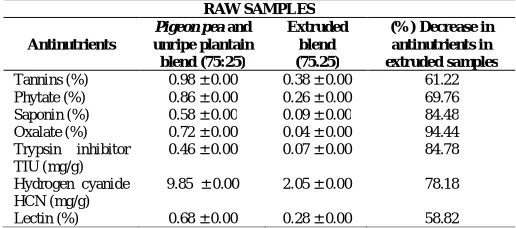
The results of the antinutritional components of raw samples and extruded blend are shown in table 5. Extrusion cooking reduced the phytate level by 68.80% from (0.86% to 0.26%). It would be expected that lowering this compound should enhance the bioavailability of such minerals as zinc and iron in the
Raw Samples
Nutrient Pigeon pea Unripe
plantain
Extruded blend
Moisture Content (%) 8.75 + 0.05b
10.21 + 0.20a
7.99 + 0.02b
Fat Content (%) 1.81 + 0.02a
0.98 + 0.04b
1.97 + 0.03a
Protein (N% x 6.25) 23.78 + 0.04b 6.57 + 0.02c 22.98 + 0.03a Ash Content (%) 3.89 + 0.04b
4.42 + 0.04a
3.72 + 0.02b
Crude fibre (%) 8.45 + 0.03a
3.93 + 0.05c
7.04 + 0.01b
Carbohydrate (by diff) %
53.32 + 0.87b
62.95 + 0.06a
53.78 + 0.04b
Energy value (KJ/100g)
1377.67 + 0.01b
1218.10 + 0.04c
extrudates as phytic acid has been implicated in making these minerals unavailable as reported by Anuonye et al., (2009). The levels of tannin was reduced from 0.98% to 0.38% in extrudates or 61.22%. This showed that extrusion cooking caused significant (P<0.05) decrease in this antinutrient. Tannins form insoluble complexes with proteins thereby decreasing the digestibility of proteins (Uzoechina, 2007). Tannins also decrease palatability, cause damage to intestinal tract, and enhance carcinogenesis (Makkar and Becker, 1996). The saponin content was significantly (P<0.05) reduced from 0.58% in raw sample blends to 0.09% in the extrudate which indicates 84.48% reduction. Saponins increase permeability of small intestinal mucosa cells thereby inhibiting nutrient transport (Jimoh et al., 2011). They however can lower plasma cholesterol concentrations (Oakenfull et al, 1979).
Table. 5: Levels of some Anti-nutrients in raw samples and extruded blend.
RAW SAMPLES
Antinutrients
Pigeon pea and unripe plantain blend (75:25)
Extruded blend (75.25)
(%) Decrease in antinutrients in extruded samples
Tannins (%) 0.98 ± 0.00 0.38 ± 0.00 61.22 Phytate (%) 0.86 ± 0.00 0.26 ± 0.00 69.76 Saponin (%) 0.58 ± 0.00 0.09 ± 0.00 84.48 Oxalate (%) 0.72 ± 0.00 0.04 ± 0.00 94.44 Trypsin inhibitor
TIU (mg/g)
0.46 ± 0.00 0.07 ± 0.00 84.78
Hydrogen cyanide HCN (mg/g)
9.85 ± 0.00 2.05 ± 0.00 78.18
Lectin (%) 0.68 ± 0.00 0.28 ± 0.00 58.82
The extrusion process significantly (P<0.05) reduced oxalate content by 94.44%. Oxalate may be present as oxalic acid or as insoluble calcium oxalate which when present in high concentration in diet may increase the risk of renal calcium absorption (Osagie, 1998).
Trypsin inhibitor was reduced significantly (P<0.05) from 0.46mg/g in the raw sample blends to 0.07mg/g or 84.78% in the extrudates. The thermoliability of Trypsin inhibitor implies that protein digestibility will not be hampered when the product is consumed as reported by Iorgyer et al., (2009). Hydrogen cyanide (HCN) in the raw samples was reduced significantly (P<0.05) from 9.8mg/kg to 2.05mg/kg in the extrudate equivalent to 78.18% reduction. Iorgyer et al., (2009) has reported that hydrogen cyanide is heat labile and volatile which confirms the reduction after subjecting the sample to extrusion process. Consumption of foods containing cyanogens could result in acute or chronic toxicity. The Lectin level was significantly (P<0.05) reduced from 0.68% in the raw samples to 0.28% in the extrudates or 58.82% reduction. It is remarkable that lectins are usually reported as being heat labile, their stability however vary between plant species as reported by Almeida et al., (1991). Lectins are proteins with the unique ability to bind specific sugars or glycol proteins. This results into agglutination (clumping) of red blood cells from various species of animals as reported by Osagie (1998).
CONCLUSION
Extrusion cooking affected the nutrients especially the proximate composition while the amino acid composition in the
extrudate contain amounts that met adult recommended levels. The extrusion process considerably reduced most of the antinutrients evaluated. The extrudate has good potential as a cheap source of ready-to-eat diet rich in nutrient, safe in antinutrients and could be utilized to improve food security against malnutrition.
ACKNOWLEDGEMENT
The research was funded by a grant from the Science and Technical Education Post Basic (STEP-B) Funds of the Federal University of Technology,MINNA NIGERIA to which the authors are grateful.
REFERENCES
Abioye, V.F., Ade-Omowaye, B.I.O., Babarinde, G.O., and Adesigbin, M.K.. Chemical, Physico Chemical and Sensory Properties of Soy Plantain Flour. Afri. J. Food Sci. 2011; 5(4)176-180.
Adeniji, T.A., Sanni, L.O., Barimalaa, L.S., and Hart, A.D. Nutritional and anti-nutritional composition of flour made from plantain and banana hybrid pulp and peel mixture. Nigerian Food J. 2006; 25 (2): 68-76.
Akubor P.I., Adamolekun F.O., Oba C.O., Obari H, Abudu I.O. Chemical composition and functional properties of cowpea and plantain flour blends for cookie production 2003; 58(3):1-9.
Almeida, N.G. Calderon de la barca, A.M and Valencia, M.E. Effects of different heat treatments on anti nutritional activity of Phaseolus
vulgaris (variety Ojo de carba) Lectin. J. Agr. food chem.1991; 39 (9).
1627-1630.
Annonye, J.C., Badifu, G.I.O., C.U., Inyang, M.A., Akpapunam, C.U., Odumudu, V.I., Mbajika. Protein dispersibility index and trypsin inhibitor actiVitaminy of extruded blends of Acha/soybean: A response surface analysis. Am. J. Food Techn 2007; 2(6): 502-511.
Anuonye, J.C., John, O., Evans, E., Shemelohim, A. Nutrient and antinutrient composition of extruded acha/soybean blends. J. Food
Proc. Preserv. 2009.
AOAC. Official Methods of Analysis of the AOAC. 18th Edn., pp. 20-22 Washington D.C 2006.
Aremu, M.O., Olaofe, O., Akintayo, E.T. A comparative study on the chemical and amino acid composition of some Nigerian underutilized legume flours. Pakistan J. Nutr. 2006; (5): 34-38.
Arntified, S.D., Isamond M.A., Muvray,E.D. Fate of antinutritional factors during micellization technique. Food Sci. Techno. J.
1985; 19: 137-147.
Aron, I. Crop Production in Dry Region, Vol. II, pp. 255-257. Leonard Hill, London. 2002
Artz, E.W., Rao, S.K, Robbert, M.S. Lipid oxidation in extruded products as affected by extrusion temperature and selected antioxidants. In: Food Extrusion Science and Technology (L. Kokini, C.HO and M.V. Karver, Eds. 1992. pp. 449-460.
Balagophalan, C.G., Pad Maja, S.K., Nanda, S.N., Moar Thy Cassava in Food, Feed and Industry. CRC Press Inc. Florida, 1988; pp 187-189.
Ekanayake, S., Jansz, E.R., Nair, B.M. Proximate Composition, Mineral and Amino Acid content of mature Canavalia gladiate seeds.
Food Chem. 1999; 66: 115-119.
Etonihu, A.C., Ayodele, J.T., Ibrahim M. Proximate and Amino acid Composition of wheat species of Pigeon pea grown in Kogi State, Nigeria. Nigerian J. Biochem. and Molecular Bio. 2009; 24(2): 32-36.
FAO. Amino acid content of food Rome. FAO Nutritional Studies No 2433; 1970.
Filli, K.B., Nkama, I. Hydration Properties of extruded fura from millet and legumes. British Food J. 2007; 109(1):68-80.
Filli, K.B., Nkama, I., Abubakar, U.M., Jideani, V.A. Influence of extrusion variables on some functional properties of extruded millet soybean for the manufacture of ‘Fura’: A Nigerian Traditional Food. Afr.
Harper, J.M. Effect of extrusion processing on nutrients in: Nutritional Evaluation of Food Processing, 3rd ed. (E. Karmas and R.S. Harris) 1988; pp. 365-360, van Nostrand Reinhold Company, New York, NY.
Ifeoma, I.T., Chukwunonso, E.E., Obinna, M.N. and Bryan, C.N. Effect of traditional processing techniques on the nutritional and phytochemical composition of African bread fruit (Treculia africana) seeds. J. appl. sci. Environ. Management 2010;14(4) 169-173.
Iorgyer, M.I., Adeka, I.A., Ikondo, N.D., Okoh, J.J. The impact of boiling periods on the proximate composition and levels of some anti nutritional factors in Pigeon pea (Cajanus cajan) seeds. J. Agri.,
Nassarawa State University, Keffi 2009; 5(1):92-102.
Iwe, M.O. The Science and Technology of Soyabeans. Chemistry Nutrition Processing and Utilization, 1st Ed., Rojoint Communication Services Ltd., Enugu Nigeria 2003.
Iwe, M.O., Van Zauilichem, D.J., Ngody, P.O., Ariahu, C.C. Residence time distribution in a single screw extruder processing soy-sweet potato mixtures. Lebesm Wiss u Technology 2001; 34: 71-75.
Jambunathan, R., Singh, U. Grain Quality of Pigeon pea. Pulse Production, Constraints and Opportuntities 1981; pp. 389-395. Oxford and IBH Publishing Co. New Delhi.
Jimoh, W.A., Fagbenro, O.A., Adeparusi, E.O. Effects of processing on some mineral, antinutrients and nutritional composition of sesame (Sesamum indicum) seed meals. Electronic Journal of
Environmental, Agricultural and Food Chemistry 2011; 10(1): 1858-1864.
Makkar, H.P.S., Becker, K. Effects of pH, temperature and time on inactivation of tannin and possible implication in detanification studies.
J Agr and Food Chem. 1996; 44: 1291-1295.
Nwosu, J.N. Effect of soaking, blanching and cooking on the anti nutritional properties of Asparagus bean (Vigna sesquipedis) flour.
Nature and Science 2010; 8(8): 163-169.
Oakenfull, D.G., Fenwick, D.E., Hood, R.L., Topping, D.L.,
Illman, R.J. and storer, G.B. Effects of saponnins on bile acids and plasma lipids in the rat. British J. Nutr. 1979; 42: 209-16.
Obatolu, V.A. Nutrient and Sensory Qualities of Extruded Malted or Unmalted Millet/Soybean Mixture. Food Chem. 2002; 76:129-133.
Okpala, L.C., and Okoli, E.C. Nutritional Evaluation of cookies produced from pigeon pea, cocoyam and sorghum flour blends. Afr. J
Biotechnology 2011; 10(3): 433-438.
Olaoye, O.A., Onilade A.A., and Idowu, O.A. Quality Characteristics of bread produced from Composite Flours of Wheat, Plantain and Soybeans. Afr. J. Biotechnology 2006; 5(11): 1102-1106.
Osagie, A.U. Antinutritional factors. Nutrition Quality of Plant Foods. 1998; 221-244.
Rampersad, R., Badrie, N., Commission, G.E. Physico chemical and sensory characteristic of flavoured snacks from extruded cassava/Pigeon pea flour, J. Food Sci. 2003; 68:363-367
Spackman, D.H., Stein, E.H., Moore, S. Automatic recording apparatus for use in chromatography of amino acids. Analytical Chemistry.
1958; 30:1185-1190.
Ukum, M.E., Ukpebor, I.E. Production of Instant Plantain Flour, Sensory Evaluation and Physico Chemical changes during Storage. Food
Chemistry 1991; 42(3): 287-299.
United Nations Children Emergency Fund. Child Nutrition, New York, USA. Published for UNICEF by Oxford Universities Press 1996; pp. 82.
Uzeochina, O.B. Evaluation of the effect of processing techniques on the nutrient and antinutrients contents of Pigeon pea
(Cajanus cajan) Seed flours. J. Food Sci. 2007; 28:76-77.
Yaqoub, A.G., A. Yaqoub, Mohammed A. Mohammad and Asma A.A. Effect of soaking, sprouting and cooking on chemical composition, Bioavailability of minerals, Vitamins and protein Digestibility of Roselle (Hibiscus Sabdariffa L.) Seed. Pakistan J. Nutr.