Copyright © 2012 IJECCE, All right reserved
Data Mining Techniques : An MRDM Approach
Ashok K Panda
Dept. of CSE & IT, MITS Engg. College Rayagada, Odisha, INDIA
Rashmita Panigrahi
Dept. of CSE & IT, MITS Engg. College Rayagada, Odisha, INDIA [email protected]S. N. Dehuri
Dept. of I & Comm Tech,F M University Balesore, Odisha, INDIA
M. R. Patra
Dept. of Comp. Science,Berhampur University Berhampur, Odisha, INDIA
Abstract — Data mining techniques with the existing approaches look for data as patterns in a single data table. In recent years, the most common types of patterns and data mining approaches are extended to the multi-relational data. Multi-Relational Data Mining (MRDM) approaches involve multiple tables (relations) from a relational database. MRDM now encompasses association rule discovery, decision trees and distance-based methods among others. Three popular techniques such as classification, clustering and association rules have been explored in propositional and structured data mining. It then provides an insight into various classification methods including Inductive Logic Programming, Relational database, emerging patterns and associative approaches. MRDM approaches have been successfully applied to a number of problems in a variety of areas especially in the area of bioinformatics. This paper discusses some of the characteristics and comparisons in detail and finally on future directions of some applications of MRDM.
Keywords – Classification, decision tree, inductive logic programmig, multi relational data mining.
I. I
NTRODUCTIONData mining has extracted a great deal of attention in the information industry and in society at large in recent years. Due to wide availability of huge amounts of data, imminent need for tuning such data into useful information and knowledge , data mining can be viewed as a result of natural evolution of information technology. Data mining refers to “extracting” or “mining” knowledge from the large amounts of data. Thus, more appropriately named as knowledge mining from data or as knowledge extraction or data/pattern analysis, or data archaeology/data dredging or as KDD (knowledge discovery from data). Relational databases are the popular format for structured data, and one of the richest sources of knowledge in the world. There are many real world applications of decision making process based on information stored in relational databases. Multi-relational data mining (MRDM) aims to discover knowledge directly from relational data. There have been many approaches for classification, such as neural networks and support vector machines; however, they can only be applied to data in single flat relations. It is counter-productive to convert multi-relational data into single flat table because such conversion may lead to the generation of huge relation and lose essential semantic information. The important MRDM task is Multi-Relational Classification (MRC) which aims to build a classification model that utilizes information in different relations.
A.
MRDM motivation
Most of the data mining algorithms available are based on an attribute- value setting that restricts their use to
datasets consisting of a single table (or relation) allowing the analysis of fairly simple objects. It requires that each object be described by a fixed set of attributes each of which can only have a single (unstructured) value. To represent more complex and structured objects, one has to employ a relational database containing multiple tables describing each object by multiple records containing multiple relations. Specific algorithms are required that cope with the structural information occurring in relational databases. The MRDM framework described in this paper can be used to such algorithms.
B.
MRDM frame work
In our search for patterns in the relational database, we will need to query individuals for certain structural properties. MRDM is the multi-disciplinary field dealing with knowledge discovery from relational databases consisting of multiple tables. Mining data which consists of complex/structured objects also falls within the scope of this field, since the normalized representation of such objects in a relational database requires multiple tables.
Typical data mining approaches look for patterns in a single relation of a database. For many applications, squeezing data from multiple relations into a single table requires much thought & effort and can lead to loss of information. An alternative for these applications is to use multi-relational data mining. This analyzes data from a multi-relation database directly without the need to transfer the data into a single table first. Thus the relations mined, reside in a relational or deductive database with background knowledge which corresponds to views in the database.
Present MRDM approaches consider all of the main data mining tasks, including association analysis, classification, clustering, learning probabilistic models and regression. The pattern languages used by single-table data mining approaches for these data mining tasks have been extended to the multiple-table case. Relational pattern languages now include relational association rules, relational classification rules, relational decision trees, and probabilistic relational models, among others. MRDM algorithms have been developed to mine for patterns expressed in relational pattern languages. MRDM aims at integrating results from existing fields such as inductive logic programming (ILP), KDD, statistics, machine learning and relational databases; producing new techniques for mining multi-relational data and practical applications of such techniques.
Copyright © 2012 IJECCE, All right reserved MRDM methods are based on two alternative
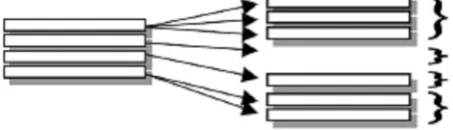
approaches: propositional and structural. The propositional approach requires the transformation of multi-relational data into a propositional (or attribute-value) representation by building features that capture relational properties of data. This kind of transformation, named Propositionalization, decouples feature construction from model construction so that conventional propositional regression methods may be applied to transformed data, and a wider choice of robust and well-known algorithms are allowed. The structural approach takes into account the original data structure, so that the whole hypothesis space is directly explored by the mining method. MRDM algorithms search a large hypothesis space in order to find a suitable model for a given data set. In our MRDM framework we will mainly express such structural characteristics by building on conditions at the low level of relationships between pairs of tables. For example, we will select candidate subgroups of molecules by extracting structural features from the molecule and the atom table and the association between them. We will refer to such incomplete and localized information as local structure. By combining conditions on the local structure (not necessarily involving the target table) we end up with expressions about individuals. Local structure involves data in two tables, but more importantly, the association between them. The association will typically be one-to-many (or many-to-one depending on the order of the two tables). Such a many-to- one-to-many relationship basically defines a grouping on the records in the table on the many side, as demonstrated below:
Fig.1. One–to-many relationships
We can select records in one table on the basis of features of the associated group of records in the other table. This way of extracting information about local structure by means of describing groups of records will be the primary approach to building descriptions of individuals.
There are two important ways of expressing conditions on groups in local structure. Choosing one of these ways has a major impact on the pattern language to be used, and thus on the type of knowledge that can be extracted from the database. Furthermore, this choice determines the applicable algorithms.
These approaches are:
• Conditions on the occurrence within the group of records with a particular characteristic. These so-called existential features typically involve one or more attributes of the records, but can also just refer to the existence of a record, or of records that are again related to records in the other tables through other associations. This approach has been the predominant mode of work in other Structured Data Mining
frameworks, such as Inductive Logic Programming and Graph Mining.
• Conditions on the group of records as a whole. By means of so-called aggregate functions we can describe a group in a variety of ways. For example, groups can be selected on the basis of their size or on the average value within the group of a particular numeric attribute.
• Such conditions are a superset of the existential conditions, as we can include the exists aggregate function. The approach based on aggregate functions has only recently been receiving attention in the field of Structured Data Mining [28, 29, 30, 31, 32, 33, 34].
II. D
ATAM
ININGT
ECHNIQUESData Mining Technique can be broadly divided into two categories: a) Propositional Data Mining and b) Multi Relational Data Mining (MRDM)[4].
A. Propositional Data Mining:
An important formalism in Data Mining is known as Propositional Data Mining. The assumption is that each individual is represented by a fixed set of characteristics, called attributes, as a collection of attribute-value pairs, typically stored as vector of values. Hence the central database of individuals becomes a table: rows (or records) correspond to individuals, and columns as attributes. The algorithms thus employ propositional logic to identify subgroups, hence the name Propositional Data Mining. Classifiers work on a single table (attribute-value learning) with a fixed set of attributes, so their use is restrictive in DM applications with multiple tables.
B. Structured Data mining :
Many databases are simply too complex to analyze with a propositional algorithm without ignoring important information. Rather than working with individuals that can be thought of as vectors of Attribute-value data, one has to deal with structured objects that consist of parts connecting in a variety of ways. Data Mining algorithms will have to consider not only attribute value information concerning parts (which may be absent), but also important information concerning the presence of different types of parts, and how they are connected. This class of techniques that support the analysis of structured objects is Structured Data mining. These are of four categories, as outlined below, which are characterized by the choice of representation of the structured individuals. Although within each category the identification with the chosen representation is often very strong, it makes sense to view them in the broader perspective of Structured Data Mining.
Copyright © 2012 IJECCE, All right reserved text retrieval. With the increasing demand on the analysis
of large amounts of structured data, graph mining has become an active and important theme in data mining. Graph mining is used to mine frequent graph patterns and perform characterization, discrimination, classification etc. Inductive Logic Programming (ILP):[21], [22] The database consists of a collection of facts in first-order logic. Each fact represents a part, and individuals can be reconstructed by piecing together these facts. First-order logic (often Prolog) can be used to select subgroups. [54] Semi-Structured Data Mining :[53] The database consists of XML documents, which describe objects in a mixture of structural and free-text information.
Multi-Relational Data Mining (MRDM):[52]The database consists of a collection of tables (a relational database). Records in each table represent parts, and individuals can be reconstructed by joining over the foreign key relations between the tables.[35][36][37]. Subgroups can be defined by means of SQL or a graphical query language.
III. T
HEM
RDMA
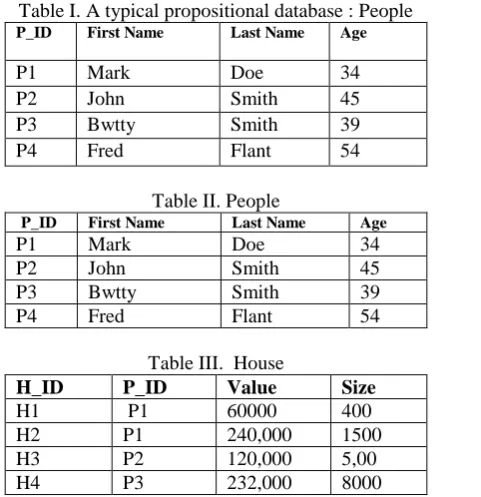
PPROACHMost existing data mining methods are propositional, and hence unfortunately do not work with many current databases, which contain multiple tables, such as those typically required for spatial data. Current databases need to store data that is simply too complex to be expressed as a single type of entity, or could contain relationships between entities. Propositional data mining in these cases is replaced by MRDM [14, 18]. MRDM works with data stored in a multi-relational database that contain |T| types of entities, T={t1, t2, …, t|T|}, as well as the relationships between these entities. In this type of database, all the relationships between the entities are explicitly given and are expressed through the use of Foreign Keys (FK) which refer the Primary Key (PK) of other entity-types. Table-1. illustrates an entity-type in a multi-relational dataset which refers Table 2.
Table I. A typical propositional database : People
P_ID First Name Last Name Age
P1 Mark Doe 34
P2 John Smith 45
P3 Bwtty Smith 39
P4 Fred Flant 54
Table II. People
P_ID First Name Last Name Age
P1 Mark Doe 34
P2 John Smith 45
P3 Bwtty Smith 39
P4 Fred Flant 54
Table III. House
H_ID P_ID Value Size
H1 P1 60000 400
H2 P1 240,000 1500
H3 P2 120,000 5,00
H4 P3 232,000 8000
Table IV. People housed- Universal Relation
First_Name Last_name Age Value Size
Mark Doe 45 60000 4000
Mark Doe 45 240000 1500
John Smith 34 700000 500
Betty Smith 39 232000 8000
Table V. People-house aggregated
In this example, the column ‘P_ID’ ofHouse is acting as the FK column since it refers values from the PK feature of People. It is not trivial to extend techniques that mine propositional data so that they work efficiently and accurately on multi-relational databases [16, 14, 18]. One alternative is to convert the multiple relationships and entity-types to a single relation, the so-called universal relation (Table-4), that represents all of the data in the database. The result of this process can be huge, contain much duplicate information and still loose essential information [18, 19]. For example, if similar entities are grouped, a single entity might end up in multiple groups even though conceptually it is a single entity. Assume two groups are created: G1={H1, H3} and G2={H2, H4}, i.e.: people with a house worth <$200,000 and >$200,000 respectively (groupings shown in Table-4). While this is a valuable grouping, Person P1 would belong to multiple groups since he owns houses of both types. Aggregation would be able to resolve this predicament but if House was to be aggregated (resulting in Table-5) then the fact that ‘John Smith’ owns multiple houses is lost.
Relational databases are the most popular repository for structured data where multiple relations are linked together via entity-relationship links. Relational classification approaches can only be applied to data represented in single,”flat” relational form that expect data in a single table. MRDM methods search for patterns that involve multiple tables (relations) from a relational database where each table is represented as an entity or relationship, described by a set of attributes, converts multiple relational data into a single flat relation using joins and aggregations.
There is a single, yet essential disadvantage to the propositional paradigm: there are fundamental limitations to the expressive power of the propositional framework. Objects in the real world often exhibit some internal structure that is hard to fit in a tabular template. Some typical situations where the representational power of Propositional Data Mining is insufficient as the following: • Real world objects often consist of parts, differing in
size and number from one object to the next. A fixed set of attributes cannot represent this variation in structure.
Copyright © 2012 IJECCE, All right reserved attributes of the individual without introducing some
artificial and harmful ordering.
• Real-world objects can exhibit a recursive structure. The MRDM approaches are a) based on Selection Graph b) based on Tuple ID propagation and c) Based on Multi view Learning.
Selection graph model can use SQL to directly deal with relational tables. Selection graph based MRC from a multi-relational data mining frame, get out of ILP approaches and transform the relationship between the tables into intuitive selection graph and is easy to be represented by SQL that can complete MRC.
Tuple ID propagation model joins relational tables through propagating tuple ID which is to propagate class ID from target table to other tables in relational database. By doing so, the next computing tasks can do with little redundant, and the required space is also small than the physical join. The method do not implement so many physical connections as ILP and so reduce the costs of time and space. [3] In essence, Tuple ID propagation is a method for virtually joining non-target relations with the target one. It is a flexible and efficient method.
The multi-view learning problem with ‘n’views can be seen as ‘n’ inter-dependent relations and are thus applicable to multi-relational learning. The Multi View Classification (MVC) approach employs the multi-view learning framework to operate directly on multi-relational databases with conventional data mining methods. The approach works in five stages such as : 1. Information Propagation Stage, 2. Aggregation Stage, 3.Multiple Views Construction Stage, 4.View Validation Stage, 5. View Combination Stage.
The comparative analysis shows some strong points of Multi View Learning (MVL) compare to other approaches. The first is that the relational database is able to keep its compact representation and normalized structure.
Table VI. Comparative analysis of MRDM approach:
The second is that it uses a framework that is able to directly incorporate any traditional single-table data mining algorithm. The third is that the multi-view learning framework is highly efficient for mining relational databases in term of running time. The algorithm should be scalable in the size of the database tables as well as the number of such tables. It should work directly out of existing databases since it is not feasible (From both time and space perspective) to transform data even in individual tables to different forms of representations. It should be able to work without requiring collation or replication of data from all tables. Since there may be different authorization controls for different database tables, the algorithm should be modular with an ability to execute different parts of the algorithm by different users/stages. The algorithm should effectively leverage the semantic grouping that is implicit in the design of RDBMS. MRDM aims to discover knowledge directly from the relational data through three different task or approaches such as : Multirelational classification
Multirelational clustering
Multirelational frequent pattern mining
Multirelational classification aims to build a classification model that utilizes information in different relation. Classification is a form of data analysis that can be used to extract models describing important data classes or to predict future data trends. Classification predicts categorical (discrete, unordered) labels, whereas prediction models continuous valued functions. The classification across multiple database relations is divided into two steps with the same propositional classification (i).To learn classification model from examples (Learning step or Training Phase) and ii).To classify and test using the model. Based on the methods of knowledge representation, this paper focuses on the relational classification with four main categories such as : i). ILP (Inductive Logic Programming based MRC (LBRC) ii). Relational database based MRC (RBRC), iii).Emerging Patterns based MRC iv).Associative MRC. An extensive survey of literature was made to identify various research issues in this filed. The following sections present different methods and the research directions in each area.
Copyright © 2012 IJECCE, All right reserved methods), and constraint based methods. Some algorithms
may belong to more than one category.
Multirelational frequent pattern mining:
It aims at finding patterns involving interconnected items in different relations such as : Mining Multilevel Association Rules : For many applications, it is difficult to find strong associations among data items at low or primitive levels of abstraction due to the scarcity of data at those levels. Strong associations discovered at high levels of abstraction may represent commonsense knowledge. Moreover, what may represent common sense to one user may seem novel to another. Therefore, data mining systems should provide capabilities for mining association rules at multiple levels of abstraction, with sufficient flexibility for easy traversal among different abstraction spaces. Mining Multi Dimensional Association Rules: Following the terminology used in multidimensional databases, we refer to each distinct predicate in a rule as a dimension.Comparative Study Between MRDM, ILP, GM, SGM comparative study between the different techniques available in SDM approach are as per the Table mentioned below.
Table.VII. Comparative study of different Techniques Name of
concept
MRDM ILP GM SSDM
Attributes Yes Yes No Yes
Numeric value Yes Yes No No
Intentional data Yes Yes No No Graph/tree Graph Graph Graph Tree
Order in structural parts
No No No Yes
Structured terms
Yes Yes No No
Attribute are the field values of any relation (table).For example name field can be the attribute of a student relation from the above table we can know that all the technique support the attribute except the graph mining. Attributes with numeric values are supported by only the MRDM and ILP technique whereas GM and SSDM doesn’t supports directly attribute with the numeric value. Intentional data are supported by both the technique MRDM and ILP, where as MRDM achieves it by means of view definitions and ILP treats it in a natural way. Graphical representation is adopted by the entire structured data mining paradigms(MRDM,ILP,GM) except the SSDM. From the above example we can see that only SSDM can represent the parts in a structural way through tree except other three .for ex-A parent child relationship can be represented by tree properly rather graph.
After studying a lot of papers, related to MRDM and we are concluding that structured terms can be represented through both MRDM and ILP technique. Apart from the representational details we can make differentiate among the SDM approach techniques through the expressive power and the utilization of different language. This can be shown in the following tabular representation.
Table VIII. Comparative study in different languages
From the above diagrammatic representation we can get the result in the favor of MRDM, which means MRDM is the best techniques among all the structured data mining approaches.
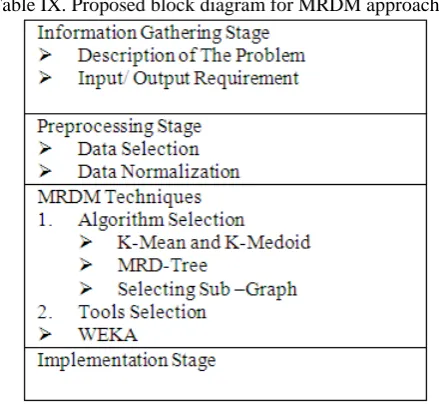
Proposed block diagram of MRDM:
Table IX. Proposed block diagram for MRDM approaches
Proposed method in MRDM:
Whatever the data mining algorithms are available in now a days that are looks for rules in a single table but almost all database are inter-related with each other like primary and foreign key relationship which is so called as multi-relational .During our study of MRDM we feel and proposed that a novel distributed data-mining method to mine important rules in multiple tables (relations).This method has the ability to combine with the genetic algorithm to enhance the mining efficiency. Genetic algorithm is in charge of finding antecedent rules and aggregate of transaction set that produces the corresponding rule from the chief attributes. If the Researcher will use this technique in MRDM then they will get the benefits like:
It can process multi-relational database efficiently.
Rules produced have finer pattern
IV. MRDM A
LGORITHMSCopyright © 2012 IJECCE, All right reserved algorithm. For practical implementation a number of
details need to be dealt with, especially where efficiency and scalability are concerned. This section presents such an implementation. The package boosts a Client/Server architecture with a clear separation between the relatively lightweight search process and the computation-intensive evaluation of candidate patterns in the database. This separation is attractive from an architectural point of view because it allows a variety of RDBMSs to be used, ranging from well-known commercial database systems to Data Mining-optimized query engines such as Monet [15], without having to alter software on the client side. Furthermore, the client and server can be run on separate workstations, each optimized for the specific workload, thus making a first, but essential, step towards scalability.
The separation of search process and evaluation of candidate patterns is achieved through multi-relational data mining primitives. Data mining primitives typically contain sufficient information to determine the evaluation measure value for a range of similar candidate patterns. The mining algorithm never accesses data directly, but through the use of a small set of predefined primitives. The statistical summaries can generally be produced by a single query to the database, for example a single SQL statement. As a result, the RDBMS can optimize the access to the data that is required for evaluating multiple patterns, in one single process. The primitive in question can be expressed in SQL. It basically sums up the available elements and counts the positive and negative examples in which each element occurs.
Multi-Relational Decision Trees Algorithm:
[47]Top-down induction of decision trees is basically a Divide-and-Conquer algorithm. The algorithm starts with a single node at the root of the tree, which represents all individuals. By analyzing all possible refinements of the empty extended selection graph, and examining their quality by applying some interestingness measure, the optimal refinement is determined. This optimal refinement together with its complement is used to create the patterns associated with the left and the right branch, respectively. Based on the stopping criterion, it may turn out that the optimal refinement and its complement do not give cause for further splitting. In this case, a leaf node is introduced instead. Whenever the optimal refinement does provide a good split, a left and right branch are introduced and the procedure is applied to each of these recursively.
BuildTree (tree T, database D, pattern P) R = Optimal Refinement (P, D)
if Stopping Criterion(R) T = leaf(P)
else Pleft = R(P) Pright = Rcompl (P) BuildTree (left, D, Pleft) BuildTree (right, D, Pright) T = node (left, right, R)
The function Optimal Refinement takes the current pattern P and considers every possible generic Positive refinement with respect to the data model of D. For each of these generic refinements a Multi-relational data mining
primitive call is sent to the server that handles the data, and the necessary statistics are retrieved. The statistics describe the support of all possible refinements derived from the current generic refinement. However, these counts also imply the support of the complementary negative refinements. The two sets of counts are used to compute the interestingness measure of choice. This process is repeated for every possible generic positive refinement and the optimal refinement is returned. The function Stopping Criterion determines whether the optimal refinement leads to a good split based on the statistics associated with the optimal refinement and its complement. A range of stopping criteria can be used, depending on the induction paradigm (classification, clustering, regression, etc.), but the actual choice is immaterial to the present discussion.
V. L
ITERATURES
URVEYCopyright © 2012 IJECCE, All right reserved the efficiency of the methods. It is easy to discover a huge
number of patterns in a database where most of these patterns are actually obvious, redundant, and useless or uninteresting to the user. To prevent the user from being overwhelmed by a large number of uninteresting patterns, techniques are needed to identify only the useful/interesting patterns and present them to the user. Neural networks are suitable in data-rich environments and are typically used for extracting embedded knowledge in the form of rules, quantitative evaluation of these rules, clustering, self-organization, classification and regression. They have an advantage, over other types of machine learning algorithms for scaling. Biological Applications of Multi-relational data mining [46] provides one interesting lesson that biological applications such as pharmacophore discovery have provided is how naturally multi-relational data mining address the multiple instances problem. Recently, Perlich and Provest in their paper [42] provide a useful hierarchy of data mining tasks, based on representation, where multiple instances tasks from a class subsumed by multi-relational task. Census Data Mining– An Application: The complexity of multi-relational application mainly depends of the number of links, the number of secondary attributes to be selected, the depth of relation graph, and aggregation operation .Scalability is also the problem, when several tables are very large. Some special predicates are expensive to calculate
VI. F
UTURED
IRECTIONTo get better results, the researcher are encouraged to try the demand forecasting technique i.e Linear regression and non linear regression technique ,support vector machine(SVM) along with the two techniques used in Neural Network i.e. Effective Combination of Neural Network and Data Mining Technology & Effective Combination of Knowledge Processing and Neural Computation. Future work on data streams, i.e. handling evolving relational databases in MRDM Classification could be of immense use. Testing this method’s scalability against very large databases. Also, experimental evaluation on learning tasks with more than two classes may be further investigated. Multiple distinct sources of information can provide improved accuracy and the challenge that biological applications raise for multi-relational data mining systems is ease of use. A biologist can run a decision –tree leaner or a linear regression routine or her data with relatively little training and preprocessing .But running a multi-relational data mining system typically requires a much larger knowledge engineering effort. Hence Research is needed into ways of making multi-relational data mining system easier to use by biologist or other domain expert. Evaluating for a data mining implementation algorithm to be suitable is the need of research following indicators and characteristics existing neural network which has high precision in the quality of modeling. Artificial Neural network can be seen as a black box for users. Other areas to be focused are Development of ontology-guided multi-relational decision tree learning algorithms to generate classifiers at multiple
levels of abstractions, incorporation of sophisticated pruning methods or complexity regularization techniques into MRDTL-2 to minimize over fitting and improve generalization, Developments of variant of MRDTL can learn from heterogeneous ,distributed, autonomous data. Inability to handle missing attribute values in the real-world classification tasks can be topic for further research.
VII. C
ONCLUSIONMulti relational data mining is used to retrieve the data across several tables. This paper provides comparative study on multi-relational data mining approaches in different fields. MRDM uses huge search space of patterns which is greatly reduced, that makes scaling up to large databases .It is important to realize from the descriptions that, the formulation of multi-relational data mining is very general and a special case of data in the form of sequences, trees, and graphs. We have presented a genus of Structured Data Mining paradigms that each approach has the representation of data, and consequently the manipulation and analysis of the database, from a unique tradition. MRDM is an important member of this family of paradigms. .This paper provides an overview of MRDM approaches to the real world applications and so the classification methods across multiple database relations including ILP, Relational database & Decision tree induction that emphasizes to overcome the real world problems. The paper also envisages that, MRDM not only deals with the structured and propositional data mining but also discovered the patterns through ILP systems. Also we present some of the topics for further researches which are discussed in brief as future directions.
R
EFERENCES[1] M. Thangaraj, “A Study on Classification Approaches across MultipleDatabase Relations”, International Journal of Computer Applications (0975–8887) Volume 12–No.12, January 2011. [2] Jing-Feng Guo, “An Efficient Relational Decision Tree
Classification Algorithm”, Third International Conference on Natural Computation ICNC 2007.
[3] Yin, X., Han, J., Yang, J., and Yu, P.S., CrossMine: Efficient Classification across Multiple Database Relations, in Proceedings of the 2004 International conference on Data Engineering (ICDE'04), Boston, MA, 2004.
[4] Hongyan Liu, Xiaoxin Yin, and Jiawei Han, “d” , MRDM-2005, Chicago, 2005 Arno Jan Knobbe, A Ph.D Theis on Multi relational Data Mining SIKS
[5] Arlow, J., Emmerich, W., Quinn, J. Literate Modeling –
Capturing Business Knowledge with the UML, In proceedings of UML ’98, 1998
[6] Blaha, M., Premerlani, W. Object-Oriented Modeling and Design for Database Applications, Prentice Hall, 1998
[7] A. Anthony and M. des Jardins. Open problems in relational data clustering. In Proceedings of ICML Workshop on Open Problems in Statistical Relational Learning, Pittsburgh, PA, 2006.
[8] P. Berkhin. Survey of clustering data mining techniques. Technical report, Accrue Software, San Jose, CA, 2002. [9] PAN Cao, WANG Hong-yuan,,Multi-relational classification on
the basis of the attribute reduction twice, Journal of Communication and Computer, ISSN 1548-7709, USA, Nov. 2009, Volume 6, No.11 (Serial No.60.
Copyright © 2012 IJECCE, All right reserved Inductive Logic Programming, Volume 314 of Lecture Notes in
Artificial Intelligence, Springer Verlag, 1996
[11] Dzeroski, S. 2003. Multi-relational data mining: an introduction, [J]. SIGKDD Explorations, vol. 5(1):1-16.
[12] Dzeroski, S., Lavtac, N. 2001. eds, Relational data mining, Berlin: Springer
[13] Wrobel S, “Inductive Logic Programming for Knowledge Discovery in Databases: Relational Data Mining”, Berlin: Springer, pp.74-101, 2001.
[14] Appice, A.; Ceci, M.; Lanza, A.: “Discovery of spatial association rules in georeferenced census data: a relational mining approach”. In Proceedings of Intelligent Data Analysis (2003)
[15] Apt., K.R., Bol, R.: “Logic Programming and Negation: A Survey”, Journal of Logic Programming, No. 19-20, pp 9-71 (1994)
[16] Dzeroski, S.: “Multi-relational data mining: an introduction”.In SIGKDD Explorations, Volume 5, pp 1–16 (2003)
[17] Dzeroski, S; Lavrac, N.: “Relational Data Mining”. Springer, c2001, ISBN: 3- 54042-289-7
[18] Yin, X.; Han J.; Yang J.; Yu, P.S.: “CrossMine: Efficient Classification Across Multiple Database Relations”. In Proceedings of ICDE (2004)
[19] Yin, X.; Han, J.; Yang, J.: “Efficient Multi-relational
Classification by Tuple ID Propagation”. In the Workshop on Multi-relational Data Mining in with KDD (2003)
[20] T.Washio and H.Motoda ,State of the art of graph–based data mining SIGKDD Explorations ,5:59-68,2003.
[21] N.Lavrac and S.Dzeroski.Inductive Logic Programming Techinques and Applications.Ellis Horwood,1994.
[22] S.Muggleton.Inverse entailment and progol.New Generation computing Special Issue on Inductive Logic Programing ,3:245-286,1995.
[23] Keim, D., Wawryniuk, M.:“Identifying Most Predictive Items”, Workshop on Pattern Representation and Management (2004).
[24] Scheffer, T.:“Finding Association Rules That Trade Support Optimally against Confidence”, Lecture Notes in Computer Science, Volume 2168, pp 424 (2001).
[25] Date, C. An Introduction to Database Systems, Volume I, The Systems Programming Series, Addison-Wesley, 1986. [26] Ullman, I.D. Principles of Databases and Knowledge-Based
Systems, Volume I Computer Science Press, 1988.
[27] Ullman, J., Widom, J., A First Course in Database Systems, Prentice Hall, 2001.
[28] Friedman, N., Getoor, L., Koller, D., Pfeffer, A., Learning Probabilistic Relational Models, In Proceedings of IJCAI‟,1999.
[29] Knobbe A., De Haas,M.,Siebes, A. Propositionalization and Aggregates, In Proceedings of PKDD 2001, LNAI 2168, pp. 277-288, 2001.
[30] Knobbe, A., Siebes, A., Marseille, B. Involving Aggregate Functions in Multi-Relational Search, In Proceedings of PKDD 2002, LNAI 2431, 2002.
[31] Krogel,M.,Wrobel,S.Transformation-Based Learning Using Multirelational Aggregation, In Proceedings of ILP 2001, LNAI 2157, pp. 142-155. 2001.
[32] Krogel, M., Rawles, S., Železný, F., Flach, P., Lavrač, N., Wrobel, S. Comparative Evaluation of Approaches to Propositionalization, In Proceedings of ILP 2003,
[33] Neville, J., Jensen, D., Friedland, L., Hay, M. Learning Relational Probability Trees, In Proceedings of SIGGKDD ‟, 2003.
[34] Perlich, C., Provost, F. Aggregation-Based Feature Invention and Relational Concept Classes, In Proceedings of SIGGKDD ‟, 2003.
[35] A. Clare, H. E. Williams, and N. Lester. Scalable multi-relational association mining. In ICDM, 2004.
[36] L. Dehaspe and L. D. Raedt. Mining association rules in multiple relations. In ILP, 1997.
[37] S. Dzeroski and N. L. editors. Relational Data Mining.Springer, 2001.
[38] 38. Qin Ding,Bhavin Parikh.,A model for Multi-Relational Data Mining on Demand Forecasting.
[39] Y. Bengio, J. M.B uhmann, M. Embrechts, and J. M. Zurada, “Introduction tothe special issue on neural networks for data mining and knowledge discovery,” IEEE Transactions on Neural Networks, vol. 11, pp. 545–549, 2000.
[40] Caragea,D., Silvescu., A., and Honavar, V.(ISDA 2003) Decision tree Induction Distributed, Heterogeneous, Autonomous Data Sources In: Proceedings of the conference on Intelligent Systems Design and Applications .In Press
[41] Caragea, D.,Silvescu.A and Honavar ,V:Invited Chapter. Towards a Theoretical Framework for Analysis and synthesis of Agents that learn from Distributed Dynamic Data Sources Technical Report., Emerging Neural Architectures Based on Neuroscience, Berlin : Springer-Verlag(2001)
[42] Knobbe, J., Blockeel, H., Siebes, A., and Van der Wallen, D.: Multi-relational Data Mining. In: Proceedings of Benelearn (1999)
[43] Hector Ariel Leiva: A multi-relational decision tree learning algorithm. M.S. thesis. Department of Computer Science. Iowa State University (2002).
[44] Jaime Reinoso-Castillo: Ontology-driven information extraction and integration from Heterogeneous Distributed Autonomous Data Sources. M.S. Thesis. Department of Computer Science. Iowa State University (2002).
[45] Zhang, J., and Honavar, V. (2003). Learning Decision Tree Classifiers from Attribute-Value Taxonomies and Partially Specified Data. In: Proceedings of the international Conference on Machine Learning. Washington, DC. In press.
[46] P.Finn,S.Muggleton,D.Page,andA.Srinivasan. Discoveryof pharmacophores using Inductive Logic Programming .Machine Learning ,30:241-270,1998.
[47] Anna Atramentov, Hector Leiva, and Vasant HonavarA Multi-relational Decision Tree Learning Algorithm - Implementation and Experiments
[48] Saurabh Tandel et l,Int.J.Comp.Tech.Appl,Vol 2 (6), 3097-4002 [49] Amaury Habrard, Marc Bernard, and Fran_cois Jacquenet,, c
Springer-Verlag 2003, LNAI 2780
[50] M.-A. Krogel and T. Scheffer. Effectiveness of information extraction, multi-relational and multi-view learning for predicting gene deletion experiments. In BIOKDD, 2003. [51] Mark-A. Krogel, Tobias Scheffer, In Proceedings of the IEEE
International Conference on Data Mining. 2003.
[52] P.Neelamadhab and P.Rasmita, “Data warehousing and OAPL,MRDM technology In the decision support system in the21st century” , VSRD Technical Journal
[53] Wang, K., Liu, H. Discovering structural association of semi structured data, IEEE Trans. Knowledge and Data Engineering (TKDE2000), 12(3):353-371, 2000.
[54] de Raedt, L. (Ed.) Advances in Inductive Logic Programming, IOS Press, 1996.
A
UTHOR’
SP
ROFILEAshok K. Panda
born on 16thJuly 1966 in Gunupur, Odisha, India. He has completed his M.Tech. in Computer Science in 2008, PGDCSA in 1991, HDCSin 2004 & Diploma in Management in 2007 after completion of M.Sc. in 1989 at NIT , Rourkela, India . Now he is pursuing PhD in Computer Science from Berhampur University, India in the field of Web mining applications. His area of research is web mining, data mining, soft computing and related field.
He is now working as Associate Professor in computer Science & Engineering in MITS Engg. College, Odisha, India since 2008. He has published many papers in National, International conferences & journals. He has served in many positions including Principal, HOD & Academic Director during his 20 years in education.
Copyright © 2012 IJECCE, All right reserved
Mrs. Rasmita Panigrahi
is currently working as a lecturer in the department of information and technology, Gandhi Institute of Engineering and Technology .She received her MCA from BPUT, (Biju Patanaik University of Technology) University ,Rourkela 2010 and she has completed M.Tech. (Computer Science) in Berhampur University, Berhampur. Her main research interests are Data warehousing and Mining, Distributed Database System, Designing and Algorithm. and cryptography .She has published three papers in International/National Journals some of the journals are having impact factor and attended the several conferences.
S. N. Dehuri
Dept. of I & Comm Tech, F M University Balesore, Odisha, INDIA
M. R. Patra
Dept. of Comp. Science, Berhampur University Berhampur, Odisha, INDIA