R E S E A R C H A R T I C L E
Open Access
Controller and battery changes due to
technical problems related to the HVAD®
left ventricular assist device - a single
center experience
Emil Najjar
1,2*, Ann Hallberg Kristensen
2, Tonje Thorvaldsen
1,2, Laila Hubbert
2, Peter Svenarud
2,3,
Magnus Dalén
2,3, Agneta Månsson Broberg
1,2and Lars H. Lund
1,2Abstract
Background:The use of left ventricular assist devices (LVADs) has increased in the last decade. Major complications have been well described, but there is no data on device alarms and actual or threatening malfunction which impair quality of life and may impair outcomes. This study describes the technical problems related to the use of the HVAD® left ventricular assist device in a single center.
Methods:We retrospectively reviewed device malfunctions and outcomes in 22 patients with HVAD®left ventricular assist device followed at Karolinska University Hospital between 2011 and 2016. Device malfunction was defined by INTERMACS as a failure of one or more of the components of the LVAD system. The primary outcome was defined as death or hospitalization or unplanned urgent clinic visit due to device alarm of unknown significance or actual or threatening malfunction. Separate secondary outcomes were malfunction resulting in controller exchange and malfunction resulting in battery change. Exploratory outcomes were death, transplantation, or explantation because of recovery.
Results:Median age was 59 years and 19% were women. Over a mean follow-up time of 1.7 years (37 patient-years), the primary outcome occurred 30 times (0.8 events per patient-year; 0 deaths, 2 hospitalizations and 28 un-planned clinic visits). Secondary outcomes were 41 device malfunctions for 14 patients requiring 45 controller exchanges in 12 patients (1.1 events per patient-year) and 128 battery changes in 12 patients (3.5 events per patient-year). Exploratory outcomes were 8 deaths (36.4%), 7 transplantations (31.8%) and 2 explants due to recovery (9.1%).
Conclusion:The use of HVAD® was associated with technical problems requiring frequent un-planned clinic visits and changes of controller and/or batteries. There were no deaths due to device malfunction. Further studies are warranted to evaluate the risk of device malfunction and associated reductions in quality of life and cost.
Keywords:Heart failure, HVAD®, Left ventricular assist device, Alarm, Device malfunction
* Correspondence:[email protected] 1
Department of Medicine, Unit of Cardiology, Karolinska Institutet, Karolinska University Hospital, S3:02, Stockholm 17176, Sweden
2Heart and Vascular Theme, Karolinska University Hospital, Stockholm,
Sweden
Full list of author information is available at the end of the article
Background
Heart failure (HF) is associated with impaired quality of life, poor prognosis and high costs to society [1–3]. Heart transplantation is still the best available treatment for end-stage HF for appropriate patients, but it is restricted by the limited number of donor organs. This organ short-age has led to increased use of left ventricular assist devices (LVADs) during the last decade [4, 5] as bridge to trans-plantation (BTT) [6,7] or destination therapy (DT) [8].
Despite advances in technology, LVADs are still associ-ated with complications such as infection, bleeding, thrombosis and stroke, which have been well described in the literature. Furthermore, device malfunction may be life threatening [9–11]. Therefore, algorithms and alarms designed to detect or avert threatening or actual device malfunction have been developed and are incor-porated into device controller units. The HeartWare® left ventricular assist device (HVAD®; HeartWare®, Inc. Framingham, MA, USA) is a small intrapericardial centrifugal-flow LVAD approved by the United States Food and Drug Administration (FDA) as a bridge to transplantation in 2012 [12]. Anecdotally, we observed frequent device alarms and malfunction in our LVAD clinic. Even though they may not represent or cause serious clinical complications, device alarms and mal-function can be a major nuisance, cause anxiety and re-duce quality of life for patients, and increase the burden and cost for health care providers for device checks and potential related care. These have not previously been pre-viously quantified. We systematically reviewed our experi-ence with HVAD®-related device malfunctions.
Methods
Patients
All patients followed at the Karolinska University Hospital after HVAD® implantation between 2011 and 2016 were reviewed retrospectively. The retrospective review of patient outcomes had ethics approval; individual patient consent was not required or obtained.
Baseline and outcome data were abstracted from the pa-tient medical records. In the clinical setting these papa-tients are seen every 1–2 weeks in an out-patient nurse based LVAD-coordinator clinic which includes documentation of LVAD settings, readouts and alarms. All hospitaliza-tions for patients with an LVAD occur at our hospital. In addition, we had access to all HVAD® log files saved due to technical problems during the study period.
A device malfunction was defined according to INTERMACS as a failure of one or more of the compo-nents of the HeartWare®system [13].
Outcomes
All outcomes were presented in the entire cohort as number of events per patient-year (EPPY). The primary
outcome was defined as death or hospitalization or un-planned urgent (within 12 h of the patient’s call to our center to report a device alarm) clinic visit due to device alarm of unknown significance or actual or threatening malfunction. The total number of controller exchange/ battery change was displayed in a bar chart for each pa-tient. Separate secondary outcomes were malfunction resulting in controller exchange (which temporarily stops the pump and carries risk) and malfunction resulting in battery change. Each controller and battery exchange was recommended by HeartWare®, Inc. support staff. Explora-tory outcomes were death, transplantation, or explantation because of recovery.
Statistical analysis
Statistical analysis was performed using SPSS version 23.0 (SPSS Inc., Chicago, Ill. USA). Baseline continuous variables are expressed as median (interquartile range) and compared by the Mann-Whitney’s test while categori-cal variables are presented as numbers and percentages and compared using Fischer’s exact test.
Results
Twenty two patients with HVAD® were included in the study (The total number of implantations at our center during the study period was 21 and all of them received HVAD® while one patient was operated in India). At time of implantation, median age was 59 (51; 65) years, 19% were women, median body surface area (BSA) was 1.96 (1.76; 2.10) m2, median estimated glomerular filtra-tion rate (eGFR) was 56 (38; 78) mL/min/1.73 m2 and median EF was 20% (15%; 25%). Idiopathic dilated car-diomyopathy was the main underlying cause of HF and accounted for 46% of all causes. The indications for HVAD® were DT (32%), BTT (36%), and bridge to deci-sion (BTD) (32%).
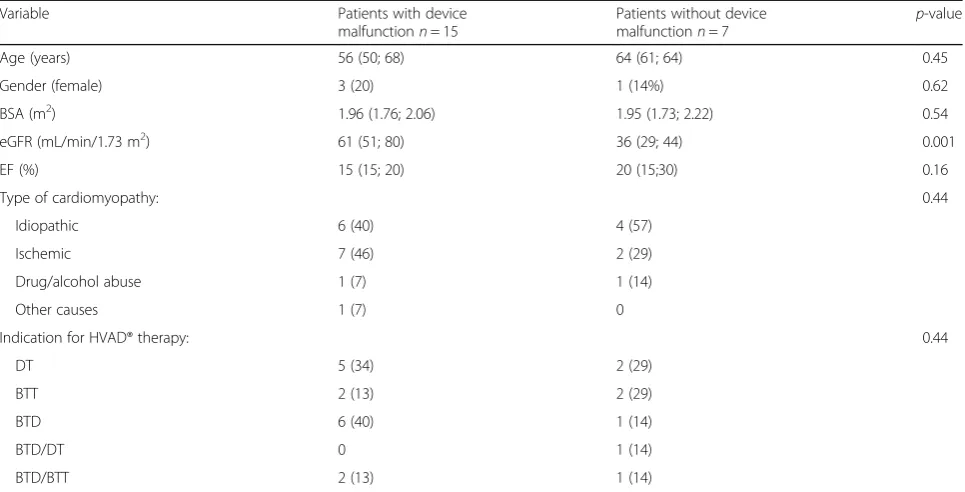
Table1details the baseline characteristics of the study patients at the time of implantation, comparing those who did (n= 15) vs. did not (n= 7) experience any device malfunction during follow-up.
Over a mean follow-up of 1.7 years (Total follow-up time 37 patient- years), the primary outcome occurred 30 times (0.8 times per patient-year; 0 deaths, 2 hospital-izations and 28 un-planned clinic visits). Seven of the 22 patients were transplanted, 2 had the device removed after myocardial recovery, 8 died, while 5 remained on HVAD® support at the end of the study period. Table 2 shows the outcomes in patients with and without device malfunction.
of a multiorgan failure or secondary to stroke. Those 5 pa-tients did not have a device malfunction during the sup-port time.
Few cases of pump thrombosis occurred during the study time and they were all successfully treated medic-ally using thrombolysis. There were no deaths due to pump thrombosis.
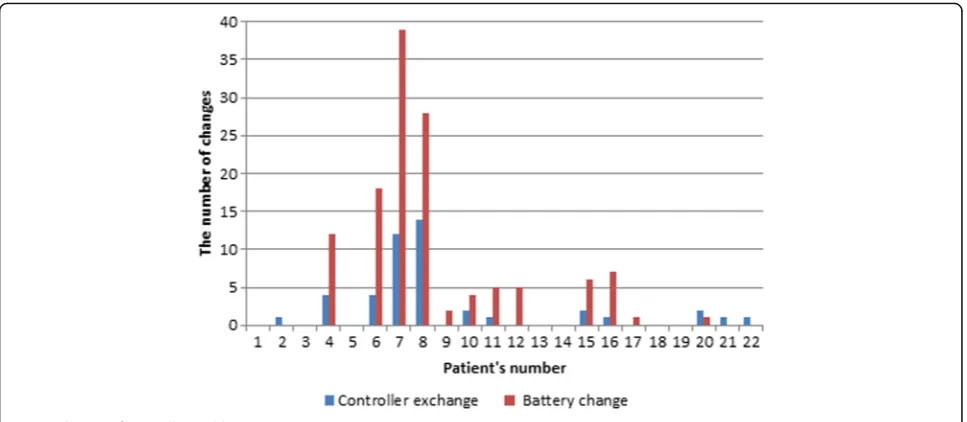
For secondary outcomes, 41 device malfunctions oc-curred (1.1 EPPY) requiring 45 controller exchanges in 12 patients (1.2 EPPY) and 128 battery changes in 12 pa-tients (3.5 EPPY) (Fig. 1). Figure 1 illustrates that 7 pa-tients out of 22 did not have a device malfunction.
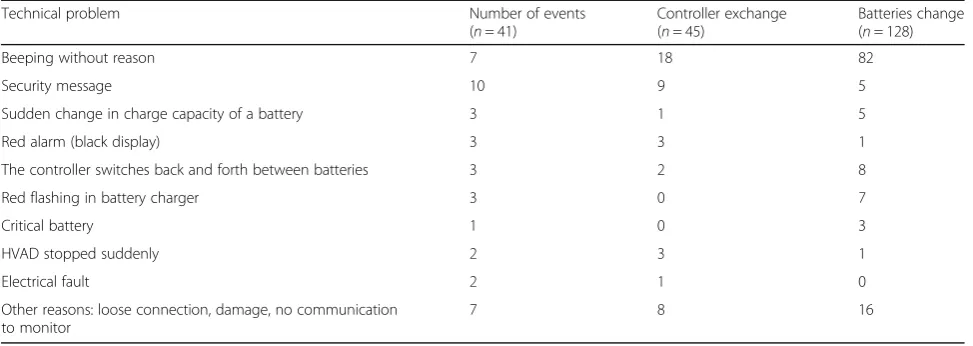
The number of controller and battery changes per year is illustrated in Fig. 2 while the definition of underlying technical problems, their frequency and the performed measures are presented in Table 3. The most common alarms were security messages and beeping without apparent reason, however, the latter required more
repeated controller and/or battery changes than any other alarms. We measured blood pressure (not in all patients) using Doppler when the patients attended to our center because of alarms and there was no associ-ation between blood pressure (as a surrogate measure of after-load) and alarms; i.e. many of those who had the alarms did have a normal blood pressure.
Discussion
To our knowledge, this is the first report to assess spe-cifically HVAD®-related technical problems. The tech-nical problems faced in our center did not lead to death, pump exchange or any serious consequences; however, the exchange of controller exposed the patients to high risks related to controller disconnection and the time needed to reconnect the new controller during which the patients had no pump support. Moreover, the fre-quent alarms impaired quality of life for patients and Table 1Patient characteristics at the time of implantation (n= 22)
Variable Patients with device
malfunctionn= 15
Patients without device
malfunctionn= 7 p
-value
Age (years) 56 (50; 68) 64 (61; 64) 0.45
Gender (female) 3 (20) 1 (14%) 0.62
BSA (m2) 1.96 (1.76; 2.06) 1.95 (1.73; 2.22) 0.54
eGFR (mL/min/1.73 m2) 61 (51; 80) 36 (29; 44) 0.001
EF (%) 15 (15; 20) 20 (15;30) 0.16
Type of cardiomyopathy: 0.44
Idiopathic 6 (40) 4 (57)
Ischemic 7 (46) 2 (29)
Drug/alcohol abuse 1 (7) 1 (14)
Other causes 1 (7) 0
Indication for HVAD® therapy: 0.44
DT 5 (34) 2 (29)
BTT 2 (13) 2 (29)
BTD 6 (40) 1 (14)
BTD/DT 0 1 (14)
BTD/BTT 2 (13) 1 (14)
The baseline characteristics of the study patients at the time of implantation, comparing those who did (n= 15) vs. did not (n= 7) experience any device malfunction during follow-up
Abbreviations: HVAD®HeartWare®left ventricular assost system,BSABody surface area,eGFREstimated glomerular filtration rate using the CKD-EPI (chronic kidney disease epidemiology collaboration),DTDestination therapy,BTT= Bridge to transplantation,BTDBridge to decision,EFEjection fraction
Data are presented as median (interquartile range) or n (%)
Table 2Duration of support and exploratory outcomes in patients with and without device malfunctions
Outcome With device malfunction
(n= 15)
Without device malfunction (n= 7)
Duration of support (Days) overall
Dead 3 (20%) 5 (71%) 96.5 (30.5;472.3)
Remained on device 5 (33.5%) 0 1037 (350.5;1772)
Transplanted 5 (33.5%) 2 (29%) 380 (336;754)
Weaned after recovery 2 (13%) 0 709.5
caused many un-planned visits with increased costs and burden for health care providers.
The current study focuses on minor technical prob-lems which although minor, were considerably greater in incidence than any kind of technical problems or com-plications shown in previous studies. Previous data re-port only major complications, often requiring device replacement, which we had none. The first large HVAD® study, ADVANCE [6], with 140 patients, reported only 26 device malfunctions from 20 patients and 6 of these malfunctions led to a device replacement. The recent ENDURANCE reported 124 events (0.30 EPPY) of device malfunction or failure in 93 patients (31.4% of the study group); however, there were no details about the cause or the type of device malfunction or failure [14]. Additionally, 2 HVAD® studies which included 242 patients reported only 10 cases of manufacturing defect or device exchange
due to other causes without specifying the cause [9, 15]. The post-marketing registry study (ReVOLVE) did not re-port any case of technical problems [12].
Addtionally, a systematic search of PubMed and Web of Science did not reveal any reports similar to ours. How-ever, HeartWare® Inc. recently sent an urgent medical de-vice correction letter to recall HVAD® controllers of some models due to a loose connector that may allow moisture to enter the controller with increased risk of corrosion, electrical issues, reduced speaker volume and connection failures. Another safety alert was sent by HeartWare® Inc. in June 2016 to recall the batteries of HVAD® with specific serial numbers because they may lose power prematurely due to faulty cells [16,17].
The software of all controllers was upgraded at our center in May 2016 but the problems with malfunctions continued. All technical problems were solved according
Fig. 1Change of controller and batteries (amongn= 22 patients)
to the recommendations of the manufacturer by chan-ging the controller or the batteries. Two out of the 4 pa-tients who had the highest percentage of alarms continued to have frequent alarms despite the imple-mented procedures. The first one continued to have alarms until death and the second one until transplant-ation. The other 2 patients experienced fewer alarms after implementing the recommended procedures and software upgrading. The medical staff taking care of our HVAD® patients is experienced with different types of ventricular assist devices and our patients received the required education needed to handle a mechanical pump so the question that remains unanswered is the under-lying cause that can explain these technical problems.
Furthermore, we do not know whether our center is unique regarding this issue or whether the problem is underreported by other hospitals.
Limitations
The study is limited by the small sample size and being a single center study. The findings need confirmation by other studies.
Conclusions
The use of HVAD® in our center was associated with a high rate of technical problems requiring frequent un-planned clinic visits and changes of controller and/or batteries. There were no deaths due to device malfunc-tion. Further studies are warranted to study the risk of device malfunction and associated reductions in quality of life and cost.
Abbreviations
BTD:Bridge to decision; BTT: Bridge to transplantation; DT: Destination therapy; eGFR: Estimated glomerular filtration rate; EPPY: Events per patient-year; FDA: the United States Food and Drug Administration; HF: Heart failure; HVAD®: HeartWare®HeartWare® Left ventricular assist device; LVADs: left ventricular assist devices
Availability of data and materials
The datasets used and/or analysed during the current study are available from the corresponding author on reasonable request.
Authors’contributions
All authors have participated in the work, have reviewed the manuscript and agreed with the content of the article and submission for publication.
Ethics approval and consent to participate
The study complies with the Declaration of Helsinki and was approved by the regional ethical review board (Dnr2016/2576–32). There was no need to have informed consent since the study was a retrospective analysis of available data from patients with LVADs.
Competing interests
LHL: No disclosures directly related to the present work. Unrelated disclosures are: Research grants from Astra Zeneca, Boston Scientific; consulting or speaker’s honoraria from Novartis, Astra Zeneca, Bayer, St Jude, Medtronic, HeartWare, Vifor Pharma.
LH: No disclosures directly related to the present work. Unrelated disclosures are: speaker’s honoraria from MSD and Novartis.
Other authors none.
Publisher’s Note
Springer Nature remains neutral with regard to jurisdictional claims in published maps and institutional affiliations.
Author details
1Department of Medicine, Unit of Cardiology, Karolinska Institutet, Karolinska
University Hospital, S3:02, Stockholm 17176, Sweden.2Heart and Vascular Theme, Karolinska University Hospital, Stockholm, Sweden.3Department of Molecular Medicine and Surgery, Karolinska Institutet, Stockholm, Sweden.
Received: 19 February 2018 Accepted: 1 June 2018
References
1. McMurray JJ, et al. ESC Guidelines for the diagnosis and treatment of acute and chronic heart failure 2012: The Task Force for the Diagnosis and Treatment of Acute and Chronic Heart Failure 2012 of the European Society of Cardiology Developed in collaboration with the Heart Failure Association (HFA) of the ESC. Eur Heart J. 2012;33(14):1787–847.
2. Jencks SF, Williams MV, Coleman EA. Rehospitalizations among patients in the Medicare fee-for-service program. N Engl J Med. 2009;360(14):1418–28. 3. Chen J, et al. National and regional trends in heart failure hospitalization
and mortality rates for Medicare beneficiaries, 1998-2008. JAMA. 2011; 306(15):1669–78.
Table 3Technical problems and the needed measures performed at the same or different occasion
Technical problem Number of events
(n= 41)
Controller exchange (n= 45)
Batteries change (n= 128)
Beeping without reason 7 18 82
Security message 10 9 5
Sudden change in charge capacity of a battery 3 1 5
Red alarm (black display) 3 3 1
The controller switches back and forth between batteries 3 2 8
Red flashing in battery charger 3 0 7
Critical battery 1 0 3
HVAD stopped suddenly 2 3 1
Electrical fault 2 1 0
Other reasons: loose connection, damage, no communication to monitor
4. Kirklin JK, et al. Seventh INTERMACS annual report: 15,000 patients and counting. J Heart Lung Transplant. 2015;34(12):1495–504.
5. Lund LH, Matthews J, Aaronson K. Patient selection for left ventricular assist devices. Eur J Heart Fail. 2010;12(5):434–43.
6. Aaronson KD, et al. Use of an intrapericardial, continuous-flow, centrifugal pump in patients awaiting heart transplantation. Circulation. 2012;125(25): 3191–200.
7. John R, et al. Lessons learned from experience with over 100 consecutive HeartMate II left ventricular assist devices. Ann Thorac Surg. 2011;92(5): 1593–9. discussion 1599–600
8. Slaughter MS, et al. Advanced heart failure treated with continuous-flow left ventricular assist device. N Engl J Med. 2009;361(23):2241–51.
9. Strueber M, et al. Multicenter evaluation of an intrapericardial left ventricular assist system. J Am Coll Cardiol. 2011;57(12):1375–82.
10. Stulak JM, et al. Adverse events in contemporary continuous-flow left ventricular assist devices: a multi-institutional comparison shows significant differences. J Thorac Cardiovasc Surg. 2016;151(1):177–89.
11. Mehra MR, et al. A fully magnetically levitated circulatory pump for advanced heart failure. N Engl J Med. 2017;376(5):440–50. 12. Strueber M, et al. Results of the post-market registry to evaluate the
HeartWare left ventricular assist system (ReVOLVE). J Heart Lung Transplant. 2014;33(5):486–91.
13. Holman WL, et al. INTERMACS: interval analysis of registry data. J Am Coll Surg. 2009;208(5):755–61. discussion 761–2
14. Rogers JG, et al. Intrapericardial left ventricular assist device for advanced heart failure. N Engl J Med. 2017;376(5):451–60.
15. Slaughter MS, et al. HeartWare ventricular assist system for bridge to transplant: combined results of the bridge to transplant and continued access protocol trial. J Heart Lung Transplant. 2013;32(7):675–83. 16. FDA. HeartWare Ventricular Assist Device (HVAD) Pumps by HeartWare Inc.
Class I Recall - Loose Connectors May Prevent Alarm from Sounding. 2016. Available from:https://www.fda.gov/medicaldevices/safety/listofrecalls/ ucm529494.htm.