ISSN: 2306-9007 Hammami & Zghal (2016) 117
I
www.irmbrjournal.com March 2016I
nternationalR
eview ofM
anagement andB
usinessR
esearchVol. 5 Issue.1
R
M
B
R
Study of Factors Affecting the Use of the Internet Technologies
in SME: Case of the Tunisian Manufacturing Sector
ILHEM HAMMAMI
Doctor in marketing at the Faculty of Economics Sciences and Management of Tunis
Email: [email protected]
Tél: +21640522381
MUSTAPHA ZGHAL
Professor at the Faculty of Economics Sciences and Management of Tunis
Email: [email protected]
Abstract
This research emphasizes, in a clearer and more differentiating way, the motives or the incentives of the use of the Internet Technologies (IT) by the managers of SME. It is to this problem of the use of the IT in the companies that this communication contributes, via two studies carried out with the managers of the Tunisians SME situated in the regions of big Tunis and Sahel, a quantitative and qualitative study. The results obtained from a qualitative study show globally that the use of the IT within the SME Tunisian is determined by the entrepreneurial and environmental factors. The obtained results, for the method of the structural equations, validate the proposed model by highlighting the entrepreneurial and environmental factors.
Key Words: SME, Internet Technologies, Entrepreneurial Factors, Environmental Factors.
Introduction
The distribution of the Internet Technologies (IT) within countries can establish an effective lever of the economic and social development. The IT allow to spread knowledge and to increase the macroeconomic performances of nations and the micro-economic performances of companies by the increase of the productivity. The use of the Internet technologies develops in companies to assure more and more numerous tasks such as the communication, the search for information, the marketing of products and services, group work, management of the company, the prospecting, etc. This use depends on a company in another one according to several factors.
The present study aims at presenting the factors which determine the use of the main applications of the Internet (which are according to Monod E., 2003: the Intranet, the Extranet, the e-commerce, monitoring on the Internet and the Web site) in the company. Thus, we go accentuated the factors which act on the behavior of the SME to the use of the Internet applications and which are: the entrepreneurial factors, the factors bound to the environment, the technological factors and the organizational factors.
ISSN: 2306-9007 Hammami & Zghal (2016) 118
I
www.irmbrjournal.com March 2016I
nternationalR
eview ofM
anagement andB
usinessR
esearchVol. 5 Issue.1
R
M
B
R
Literature Review
The use of the Internet applications develops in companies to assure more and more numerous tasks such as the communication, the research for information, the marketing of products and services, the group work, the management of the company, the prospecting, etc. This use depends on a company in another one according to several factors.
The Entrepreneurial Factors
One of the main specificities of the SME is the centralist power of the leader which plays a central role in the company. In SME, almost all the decisions are taken in the presence of the leader and it is the same concerning the adoption of new technologies. For that purpose, Kalika (2006) considers that the decisions taken by the leader are closely linked to the way according to which the administrator is going to administer the IT.
The role of the leader is one of factors of success in a SME of reduced size that in large companies. Furthermore, the leader of the company plays an important role in the creation of the skills necessary for the technological innovation. For that purpose, the use of the IT implies not only the material resources of the SME, but also the development of the knowledge of the users. Thus, a process of learning of these technologies is necessary.
Aldebert B. and Gueguen G. (2009) showed that the small company is often bound to the history, to the experience and to the psychological profile of his manager. It is intended to allow the satisfaction of the objectives of the leader (Saporta, 1997). In the face of the importance of the manager in the strategic decision-making, a question settles on its role in the appropriation and the practices regarding IT of his company.
The leader of SME is considered as the essential factor in the process of introduction of the IT of the company. Certain studies led by researchers such as Raymond and al., (1998); Limayem and Chabdoub, (1999), concentrated on the criteria conditioning choices regarding IT by the leader of SME. So, for Monnoyer-Longé (2002), the leader is envisaged as initiator of a proactive approach during the introduction of the IT in his company.
In the same context, several authors such as Raymond and al, (1998); Limayem and Chabdoub, (1999); Monnoyer, (2002); consider that the ascendancy of the leader noticed at the level of choices IT also appears at the level of the use. Our research thus joins in a shutter sector of researches which highlight the manager in choices regarding IT by allowing a continuation on the use.
According to Uwizeyemungu S. and Raymond L. (2004), the SME will more be inclined to adopt the TI when his leader is characterized by a style of transformational leadership, a perception insists on the positive aspects towards these technologies, of a proactive strategic orientation, of an autocratic decision-making style (centralization), a capacity of innovation and a low aversion at the risk. Furthermore, our review of the literature insists on the importance of the attitude of the leader of the company in choices operated regarding information technologies.
If the influence of the attitude and the profile of the manager on the strategic orientation of the SME and its mode of organization is recognized, this influence will also be applied on the mode of integration and appropriation of the IT, confirm Aldebert B. and Gueguen G. (2009).
ISSN: 2306-9007 Hammami & Zghal (2016) 119
I
www.irmbrjournal.com March 2016I
nternationalR
eview ofM
anagement andB
usinessR
esearchVol. 5 Issue.1
R
M
B
R
researchers consider that of what think the individuals of the use of the IT is affected by their perception of approval or disapproval of the present significant people in their circle of acquaintances (Chang and Cheung, 2001; Venkatesh and Davis, 2000). Furthermore, these researchers stipulate that the affect, the social factors, the facilitative terms and the perception of the short-term effects influence positively the intention to use the internet as far as the individual perceives that he has resources and support sufficient.
Riemenschneider and Mykytyn (2000) consider that the work experience of leader is an inhibitive factor of the use of the IT. Furthermore, Raymond and al. (2005) suggest that the work experience makes sensitive the manager in the importance of the use of the IT as far as this one can favor the management of the information and the uncertainty in the context of international business.
Raymond and St-Pierre (2005) mention that the experience of the leader of the SME influences positively the adoption of a system of technological production "sophisticated". If his characteristics (level of training, experience, age, etc.) are important, his perception in the choices IT of the SME is also determining (Raymond, 2001).
Riemenschneider and Mykytyn (2000) considers that the training of leader is an inhibitive factor of the use of the IT. Furthermore, Raymond and al. (2005), Raymond and St-Pierre (2005) suggest that the educational degree makes sensitive the manager in the importance of the use of the IT as far as this one can favor the management of the information and the uncertainty in the context of international affairs.
Boutary and Monnoyer (2003) identified four types of behavior, concerning the leaders who have an interest for the IT, according to the degree of proactivity of the managers (modest or high) and their attitude towards the technologies (initiator or follower).
Researchers' large number demonstrates that the interest of the leader for the IT affects the practices of the SME and the performance which results from it. In their research on the relation between the interest of the leader to the IT and the performance of the company, Aldebert B. and Gueguen G. (2009) stipulates that this interest limits itself to initiator's role (use of the IT). Indeed, the manager who has an interest for the IT and whom he removes from it of the satisfaction, is going to invest in these technologies and to incite all the employees to use them. Thus, the leader will be envisaged as an initiator of the practices IT (Aldebert B. and Gueguen G., 2009).
Aldebert B. and Gueguen G. (2009) suppose that the more the leaders are interested in ICTs (Information and Communication Technologies), the more the degree of use of various informative tools within their companies is important and more the staff is mobilized as for their use. The interest of the manager will have an effect "initiator" on the used informative tools and a bigger use will pull a better performance. So, the interest of the manager will have a "moderating" effect and he amplifies the use of the informative tools to obtain a better performance. Thus, these authors insist on the presence of a positive relation between the use of the informative tools and the performance of the SME and this relation will be more important if the interest of the leader for ICTs is upper.
St-Pierre J. and al. (2006) consider that the objectives of the leader determine the use of the Internet applications (external communication network) within the SME. They consider that the more the leader is directed to the international, the more he is sensitive to the technologies susceptible to help him to reach his goals of development in costs relatively low.
The Organizational Factors
ISSN: 2306-9007 Hammami & Zghal (2016) 120
I
www.irmbrjournal.com March 2016I
nternationalR
eview ofM
anagement andB
usinessR
esearchVol. 5 Issue.1
R
M
B
R
Uwizeyemungu S. and Raymond L. (2004) stipulate that a SME having very specific processes, structures and flexible processes and which is in a situation of rarity of financial and human resources would be less inclined to use the IT. On the other hand, the SME which has a bigger degree of formalization would more be inclined to use the TI. We can notice while equipment in IT as well as use which is made differ from a company in another one according to numerous criteria such as the size, the business sector, the dispersal, etc.
Concerning the size of the company, certain authors suppose that the more the organization is big, the more she will have more resources to facilitate the initiation, the adoption and the setting-up of the technologies (Grover and Goslar, 1993, quoted in Uwizeyemungu S. and Raymond L.,2004).
The process of adoption of the IT depends on characteristics of the company such as the size, and the biggest companies adopt the IT earlier than the smallest. Another factor, which translates a need for intra or extra-organizational communication, also contributed to accelerate the process of the adoption and the use of the Internet. This factor is the membership of the company in a group (the dispersal). Indeed, near half of the multi-companies sites adopted Internet for more than five years (among which 12,5% for more than 10 years) against only 38% of the mono-companies site which are connected for more than 5 years (among which less than 6% for more than 10 years). Also, 48,1% of companies belonging to a group are connected for more than 5 years (among which 11,7% for more than 10 years), against 39,3% for the companies which do not belong to a group (among which 6,5% for more than 10 years) (Lethiais V. and Smati W., 2008).
The Technological Factors
Cragg and King (1993); Thompson S.H and al. (1998) consider that perceived profits (or the relative advantages) during the use of the Internet applications are a determining factor of the adoption of the IT by SME. It of other term, when the leader does not perceive these profits, this one tends not to use him (Iacovou and al., 1995). As for Harisson and al. (1997), they insist on the subjectivity of the interest of the leader and they consider that the perception seems more important than the rational calculation. Thompson S.H and al. (1998) consider that the compatibility is a determiner of the decision of the use of the Internet technology within the SME.
The Environmental Factors
Uwizeyemungu S. and Raymond L., (2004) consider that the sensibility of the market at the price, the strong growth and the dynamism of the business sector, the opening to the technologies of information of the immediate relational circle of acquaintances of the owner-leader and the existence of narrow logistic links between the SME and his business partners, it is factors which urge the leader to use the IT.
A company will more be incited to use the IT, to strengthen its performances in a competitive environment that in a protected environment. Therefore, the level of competition influences the decisions of the leaders to implement IT. For example, many companies do not practice the e-commerce because their products are not considered adapted to the e-commerce or because the market is considered too narrow. In other cases, "the e-commerce appears as competing with the existing models of companies" OCDE (2003).
The Qualitative Study
Description of the Qualitative Study
ISSN: 2306-9007 Hammami & Zghal (2016) 121
I
www.irmbrjournal.com March 2016I
nternationalR
eview ofM
anagement andB
usinessR
esearchVol. 5 Issue.1
R
M
B
R
Within the framework of our work, the objective of the qualitative exploratory study is to collect the elements which history the use of the Internet applications within the SME. We thus chose within the framework of the qualitative study, to realize semi-directive individual interviews with the leaders of the Tunisians SME, to become attached directly to their speeches to determine the various factors which history the use of the Internet applications within SME.
Materials and Methods
Within the framework of the qualitative study concerning the determination of factors influencing the use of the IT in the company, eight semi-directive conversations of a rough duration of forty five minutes were organized within the company. The size of the sample is based on the principle of the semantic saturation. The qualitative material was afterward recorded and then retranscribes for purposes of analysis. Let us note that the data collection qualitative took a lapse of time of more or less two months between January and February, 2013.
By basing itself on the literature and on the problem of study, a guide of interview (see appendix A) was then developed by respecting required rules (Giannelloni and Vernette, 2001). This one articulates around axes reflecting the problem of the study. Globally, a single main theme was handled which results from the literature and a discussion with the leaders of companies. Furthermore, we resorted to the criterion of semantic saturation which consists, according to Glaser and Strauss (1967), in stopping the conversations from the moment that the meditative information is not new anymore (Mucchielli, 1991). We watched besides to respect the neutrality and the objectivity in the analysis of the speeches of the leaders. The latter made afterward the object of an analysis of thematic contents having been entirely and faithfully retranscribed and registered.
Appendix A: Guide of interview
Theme: the factors of use of the Internet applications in the company
Q1: Can you quote us the reasons which urge you to use the Internet and its applications within your
company?
Questions of relaunching:
Q2: Do you think that entrepreneurial factors can influence your behavior face to face the use of the Internet applications? If yes, quote me these factors.
Q3: Do you think that the environment of the company has an effect on the use of the Internet
applications within your company? If yes, tell me how does it take place?
Q4: Do you think that the manager of the company plays an important role in the strategy of the use
of the Internet applications? If yes, describe us how?
To constitute the sample, we addressed the basis of the lists of the exporting companies established by the Center of Promotion of the Exports (CEPEX). The majority of the sampled companies are considerable average (between 50 and 250 employees) and which belong to the textile, pharmaceutical and plastic industries.
Results of the Qualitative Study
ISSN: 2306-9007 Hammami & Zghal (2016) 122
I
www.irmbrjournal.com March 2016I
nternationalR
eview ofM
anagement andB
usinessR
esearchVol. 5 Issue.1
R
M
B
R
Appendix 2: Some detailed elements of the analysis of thematic contents
Factors Identified unity Examples of expressed
verbatim
Indication of appearance entrepreneurial
factors
- Interest of the
leader to the
Internet applications
«...I carry a big interest for the Internet and its applications...»
8
- Aversion at the risk
« ... I behave in a careful way to the little familiar technologies … »
7
Environnementa l factors
- Intensity of the competition
« … The large number of the existing competitors on the market obliges us to use advanced Internet technologies to avoid the risk of staying outside»
8
- Intensity of the information
« … Our sold products require a lot of information and advertising and this incites us to use Internet technologies to facilitate the sale of our products … »
6
Hypotheses of Search and Abstract Model
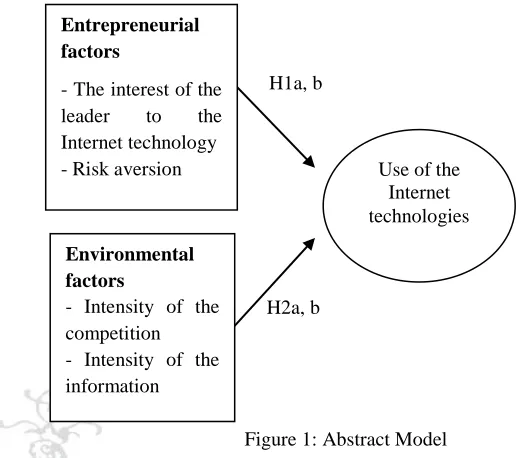
By basing itself on a qualitative study with eight leaders of the Tunisians SME and a review of literature, we can notice that entrepreneurial factors such as the interest of the leader to the Internet technologies (H1a) and his aversion at the risk ( H1b) exercise a significant influence on the use of these technologies within the company.
We thus suppose that the leaders strongly interested in the Internet applications will make their companies aim towards a more important use of these technologies.
H1a: A SME whose leader has a higher interest for Internet applications are experiencing greater use of these technologies.
The second sub-hypothesis (H1b) is formulated in reference to the realized qualitative study and to the conclusions of the works of Thompson S.H Teo and al. (1998).
H1b: A SME whose leader has a risk aversion would have least use the Internet applications.
Factors environmental as the competitive intensity (H2a) and the informative intensity (H2b) exercise a significant effect on the use of the Internet applications within the SME, according to several authors such as Thompson S.H and al., 1998; Uwizeyemungu S. and Raymond L., 2004.
H2a: the more the intensity of the competition in the industry is raised, the more the company knows a more important use of the Internet applications.
H2b: the more the intensity of the information in the industry is raised, the more the company knows a more important use of the Internet applications.
ISSN: 2306-9007 Hammami & Zghal (2016) 123
I
www.irmbrjournal.com March 2016I
nternationalR
eview ofM
anagement andB
usinessR
esearchVol. 5 Issue.1
R
M
B
R
the environment of the company. The figure 1 illustrates all the variables held by this search as well as the links which connect them.
Figure 1: Abstract Model
The relations represented in the model are those that will be tested by the structural equations. Our model will be tested on a representative sample of the Tunisians SME practicing in the industrial sector.
Empirical Study
Methodology
To measure empirically the effect of entrepreneurial and environmental factors on the use of the Internet applications in the company and test the abstract model presented above, we chose the survey by questionnaire as instrument of collection of information. Our empirical approach took place in two stages. At first the choice of the scales of measure to be held, then the realization of the fieldwork.
Constructs are measured by scales stemming from the literature. The used measuring scale is the scale of Lickert in 7 points. For the operationalization of the interest of the leader to the Internet Technologies, the aversion at the risk, the intensity of the competition and the intensity of the information, we retained the scale of Thompson S.H Teo and al. (1998) appendix 3.
Appendix 3: Measurement scales of the variables of the model Measure of
variable
Reference Items
Interest of the leader to the Internet Technologies
Thompson S.H Teo et al. (1998)
1. The leader of the company is interested in the adoption of the Internet.
2. The leader considers that the adoption of the Internet within the company is important.
3. The leader accepts the little familiar technologies. 4. The leader agrees to invest funds in the Internet technologies.
Aversion at the Thompson S.H 1. The company has no tradition to be the first one to try the
H2a, b H1a, b
Use of the Internet technologies Entrepreneurial
factors
- The interest of the
leader to the
Internet technology - Risk aversion
Environmental factors
ISSN: 2306-9007 Hammami & Zghal (2016) 124
I
www.irmbrjournal.com March 2016I
nternationalR
eview ofM
anagement andB
usinessR
esearchVol. 5 Issue.1
R
M
B
R
risk Teo et al. (1998) new technology.
2. The company does not spend in the development of new products with regard to the competitors.
3. The company does not recruit technical staffs 4. The company is not aware by the last technological developments.
5. The leader does not show its assistance for the adoption of the Internet.
6. The leader does not accept the organizational changes. Intensity of the
competition
Thompson S.H Teo et al. (1998)
1. There is a severe competition based on the price. 2. There is a severe competition based on the quality of products and the novelty.
3. There is a high number of competitors in the industry. Intensity of the
information
Thompson S.H Teo et al. (1998)
1. The product in our industry requires a lot of information to sell.
2. The product in our industry is complex to understand or use. 3. The command of products in our industry is a complex process.
4. The product in our industry is characterized by a long life cycle.
The data collection was made by questionnaires with a sample of 206 leaders of the Tunisian manufacturing SME. Two hundred and fifty companies of the sector of manufacturing industries implanted in the region of the Sahel were selected. 206 leaders agreed to answer the questionnaire that is a rate of answer bordering the 81.6%.
Analysis and Results
The test of the quality of scales was made by the Analysis in Principal Component (APC) and by the calculation of the alpha of Cronbach. The factorial analysis "allows to analyze the factorial structure deducted from the review of the literature and to cleanse the scales of measure" (Chaouch N. and Zghal M, 2012).
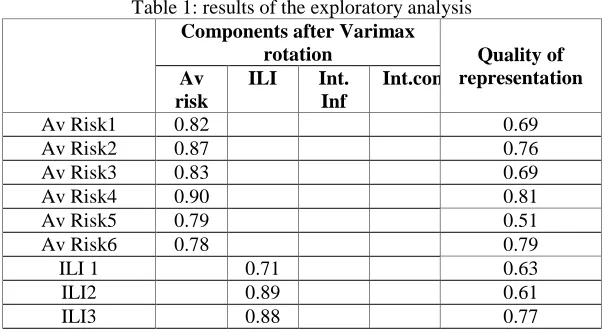
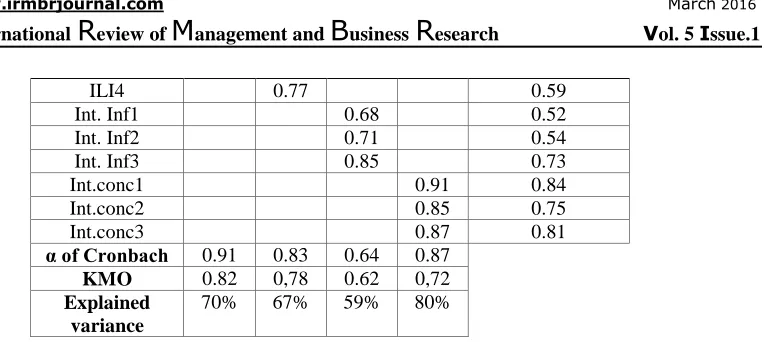
The exploratory analysis of our search allows us to identify the latent variables and to verify the coherence intern of scales. So, the table 2 presents the results relative to the APC and to the analysis of internal reliability of the obtained dimensions.
Table 1: results of the exploratory analysis Components after Varimax
rotation Quality of
representation Av
risk
ILI Int.
Inf
Int.conc
Av Risk1 0.82 0.69
Av Risk2 0.87 0.76
Av Risk3 0.83 0.69
Av Risk4 0.90 0.81
Av Risk5 0.79 0.51
Av Risk6 0.78 0.79
ILI 1 0.71 0.63
ILI2 0.89 0.61
ISSN: 2306-9007 Hammami & Zghal (2016) 125
I
www.irmbrjournal.com March 2016I
nternationalR
eview ofM
anagement andB
usinessR
esearchVol. 5 Issue.1
R
M
B
R
ILI4 0.77 0.59
Int. Inf1 0.68 0.52
Int. Inf2 0.71 0.54
Int. Inf3 0.85 0.73
Int.conc1 0.91 0.84
Int.conc2 0.85 0.75
Int.conc3 0.87 0.81
α of Cronbach 0.91 0.83 0.64 0.87
KMO 0.82 0,78 0.62 0,72
Explained variance
70% 67% 59% 80%
According to the table 1, the quality of representation of items is good. The percentage of the variance restored by the APC for the scales of measures of the variables is globally upper to 60 % so justifying that the data are factorizable and that the result is satisfactory. The matrix of the components after rotation Varimax shows that items group together under unidimensional variables: aversion at the risk, the interest of the leader to the IT, the intensity of the competition and the intensity of the information.
Besides, the indicators of relevance of the APC are satisfactory for the various scales because the Alphas of Cronbach are superior to 0.6. So, we can consider that these results are satisfactory at the exploratory level. The confirmatory analysis allows us to verify the reliability (by the calculation of the Rhô of Jöreskog) and the validity for every obtained dimension. Besides, the procedure of Fornell and Larcker (1981), was followed to calculate the convergent validity. The table 2 presents the results of our analysis.
Table 2: check of the convergent validity
Dimensions Fiability (Rhô of
Jöreskog)
convergent validity
Interest of the leader to the Internet applications 0.88 0.58
Aversion at the risk 0.95 0.67
Intensity of the competition 0.89 0.71
Intensity of the information 0.67 0.46
As shows him the table 2, the values of the coefficient Rhô of Jöreskog is satisfactory because they exceed the minimal threshold recommended of 0.6 (Bagozzi, quoted by Sandvik I.L., Kare Sandvik, 2003). Besides, we notice that the conditions of the convergent validity respected the minimal threshold of 0.5 with the exception of the dimension intensity of the information with a value equal to 0.46. However, this value is considered as satisfactory because it is very close to the minimal threshold admitted in the empirical works.
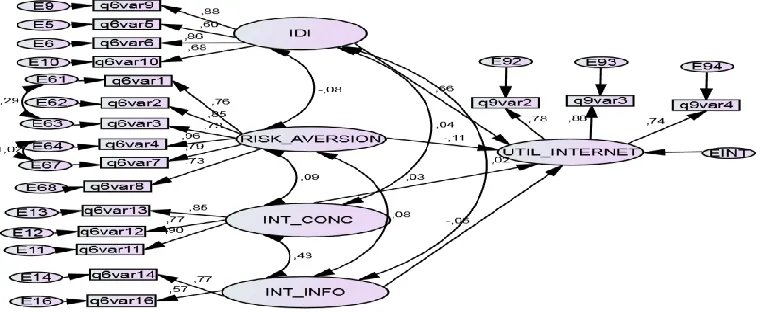
The causal model presented at the level of the appendix 4 we allows to verify the hypotheses of search and informs us about the intensity of the structural links between the use of the Internet applications and its histories.
Table 3: the adjustment of the causal model
Indice
Chi-deux/ddl
GFI AGFI TLI RMSEA NFI CFI
valeur 1.198 0.928 0.900 0.984 0.031 0.930 0.987
ISSN: 2306-9007 Hammami & Zghal (2016) 126
I
www.irmbrjournal.com March 2016I
nternationalR
eview ofM
anagement andB
usinessR
esearchVol. 5 Issue.1
R
M
B
R
Finally, the RMSEA is lower at the threshold of 0.1. So, the table 4 makes the synthesis of the conclusions on the validity of each of the hypotheses of search.
Table 4: Significativity of the causal links and validation of the hypotheses
Hyp Causal link
Estimate Sig validation hyp.
H1a ILI --> Use of the I Internet application
a
0.549 Sig.*
Valid
H1b Av. Risk -->Use of the
Internet applications -0.117 0.077
Valid
H2a Int. conc.-->Use of
the Internet applications 0.034 0.700
Invalid
H2b Int. Info. -->Use of the
Internet applications -0.089 0.581
Invalid
The table 4 shows that the interest of the leader to the Internet applications and his aversion at the risk exercise direct and significant effects at the threshold of 1 % on the use of the Internet applications in the company. These results allow then to confirm the hypotheses H1a and H1b. Consequently, we can conclude that the use of the Internet applications depends simultaneously on these two elements. On the other hand, both rejected structural links concern the relations enter the use of the Internet applications, on one hand, and the competitive intensity and the informative intensity on the other hand. However, the coefficients of regression estimated for these two relations have opposite signs to those initially planned in the hypotheses of search. Consequently, the hypotheses justifying these structural links (H2a and H2b) must be rejected. In other words, it emerges from the collected empirical data, that the environmental factors have effects on the use of the Internet applications inverse to those planned by the dominant theory from which arise our hypotheses of search.
Discussion of the Results and the Conclusion
ISSN: 2306-9007 Hammami & Zghal (2016) 127
I
www.irmbrjournal.com March 2016I
nternationalR
eview ofM
anagement andB
usinessR
esearchVol. 5 Issue.1
R
M
B
R
entrepreneurial factors, the factors bound to the environment, the technological factors and the organizational factors. So, we ruled out a number of these factors. This limitation of the number of factors is a preliminary result of a qualitative search obtained during the exploration of the data and before the test of the hypotheses of search which was realized with eight leaders of the SME Tunisians.
The hypothesis concerning the structural link between the use of the Internet applications and the interest of the leader to these technologies is significant and of sign corresponding to the initial hypothesis. The positive effect of the interest of the leader to these technologies (the Intranet, the Extranet, the business intelligence, the e-commerce and the Web site) on their use within the company is thus validated and the role initiator of the leader is validated by our empirical investigations. This result confirms the works of Julien and Morin (1996), Barney (1996), Beamish and Dhanaraj (2003), Prahalab and Hamel (1990), Laghzaoui (2006), Filion (1991), Allali (2004) and Baile S. and Djambou, R. (2008), and confirms that the degree of use of the Internet applications is positively influenced by the interest of the leader to these technologies. Besides, the sign of the relation of the variable aversion at the risk with the use of the Internet applications is considered negative according to the hypotheses of search. It leads in particular to validate the hypothesis on the link between the use of the Internet applications and the aversion at the risk. This result confirms the works of Uwizeyemungu S. and Raymond L., (2004); Thompson S.H Teo and al. (1998) and confirms that the degree of use of the Internet applications is negatively influenced by the aversion at the risk of the leader.
As for the hypotheses concerning the relations between the environmental factors, such as the intensity of the competition and the intensity of the information, and the use of the Internet applications in the SME are not significant and these results confirm the works of Julien and Morin (1996), Barney (1996), Beamish and Dhanaraj (2003), Prahalab and Hamel (1990), Laghzaoui (2006), Filion (1991), Allali (2004) and Baile S. and Djambou, R. (2008). We were not able to demonstrate that the use of the Internet applications is submitted to the influence of variables bound to the environment of the company. These results seemed to us surprising because the environment is a key factor of the strategic analysis (Ansoff, 1987). Furthermore, these results seem to be contradictory to the literature which indicates that the behavior of the SME is determined by their environment (Gueguen, 2001). These results can be justified by the fragility of the SME in terms of resources what obliges him at first to have a behavior of survival by making best use of its resources without being really conscious of his environment (Aldebert B., 2008). The leader of the SME concentrates above all on the urgency as well as on its closest environment, because at this level he thinks of having the biggest margin of laborer and of having a better control of his actions.
This search admits certainly limits. Indeed, at the theoretical level, other concepts or dimensions, which seem relevant in the explanation of the behavior of the SME in the use of the Internet applications, were not taken into account. In methodological term, the limits of the search concern the made choices or the practical constraints met during the implementation of the tests of the abstract model. It is in particular about two limits. The first limit concerns the diversity of the business sectors of the SME sampled. Indeed, studies carried out on samples of SME which are not homogeneous can hide particular behavior which must be taken into account. Second limited concern the size of the company which was measured with a single variable (number of employees). Furthermore, it is mainly about SME having between approximately 10 and 250 employees. Except these margins stay the big as well as very small companies which are not represented in the sample and on whom the results of the study would not be automatically generalizable.
ISSN: 2306-9007 Hammami & Zghal (2016) 128
I
www.irmbrjournal.com March 2016I
nternationalR
eview ofM
anagement andB
usinessR
esearchVol. 5 Issue.1
R
M
B
R
So, it would also be necessary to study more in depth the possibility of existence of the other organizational factors, entrepreneurial, technological or environmental which can influence the behavior of the company to the use of the Internet applications. It is the sidelining of these other possibilities that engenders the theoretical limits of the search. Thus, these theoretical proposals showed themselves, rather useful but probably insufficient to model the present with a big precision.
Furthermore, it would be necessary to target a sample of SME belonging to a single sector to verify the homogeneity of the results and use thorough analyses of samples stratified to characterize the behavior regarding use of the Internet applications according to the strategic orientations of the directors of industrial companies.
References
Aldebert B. (2008) « Technologie de l’information et de la communication : un outil stratégique pour les petites et moyennes entreprises touristiques ? », Management et Sciences Sociales, vol 5, n°381. Aldebert B. et gueguen G. (2009) « Intérêt du dirigeant de PME touristiques pour les TI : quels effets sur
l’utilisation et la performance ? », 14ème colloque de l’AIM.
Allali, B. (2004) « Quel rôle la vision des dirigeants joue-t-elle dans l’internationalisation de leurs PME ? Etude des cas multiples de PME marocaines et canadiennes du secteur agroalimentaire », 7ème CIFEPME, Montpellier, France.
Ansoff H.I. (1987) «The emerging Paradigm of strategic Behavior », Strategic Management Journal, vol 8, pp.501-515.
Baile s. et djambou R. (2008) « Gouvernance TI et Performance à l’International des PME Gabonaises : Une modèle d’analyse du Succès des TIC basé sur les Ressources », 9ème Congrès CIFEPME, Univ. Catholique de Louvail, 29-31 Octobre 2008.
Barney J.B. (1996) « The Resource-Based Theory of the Firm », Organization Science, Vol.7, N°5, pp. 469-501.
Beamish P. et Dhanaraj C.A. (2003) « Resource-Based Approach to the Study of Export Performance », Journal of Small Business Management, Vol. 29, N°3, pp.242-261.
Chang M. K. et Cheung W. (2001) « Determinants of the intention to use Internet/WWW at work: a confirmatory study », Information & Management, vol. 39, pp.1-14.
Chaouch N. et Zghal M. (2012) « Contrôle formel vs informel : interaction et effet sur la performance de la relation de coopération », Revue Tunisienne du Marketing, vol 2, n°2&3, 2012.
Filion L.J. (1991) « Vision et Relations : Clefs du succès de l’entrepreneur », Montréal, Editions de l’entrepreneur.
Giannelloni J.L. et Vernette E. (2001) « Etudes de marché », Paris, Vuibert.
Gueguen G. (2001) « Environnement et management stratégique des PME : le cas du secteur Internet », thèse de doctorat en science de gestion, Université Montpelier, 587p.
Julien P.A. (1995) « New technologies and technological information in small business », Journal of Business Venturing, vol. 10, pp.459-475.
Julien p.a. et morin M. (1996) « Mondialisation de l’économie et PME québécoises », Presse de l’Université du Québec.
Laghzaoui S. (2006) « L’internationalisation des PME: Pour une relecture en termes de ressources et compétences», 8ème congrès international Francophone en entrepreneuriat et PME, octobre 2006, Haute école de gestion (HEG) Fribourg, Suisse.
Lethiais v. et smati W. (2008) « Appropriation des TIC et performance des entreprises », Môle Armoricain de Recherche sur la Société de l’Information et les usages d’Internet (Marsouin), Enquête 2008. Limayem m. et chabchoub N. (1999) « Les facteurs influençant l’utilisation d’Internet dans les
organisations canadiennes », Systèmes d’Information et Management, vol. 1, n°4.
Monod E. (2003) « Internet et performance de l'entreprise : Etude de l'organisation industrielle de 104 PME en Loire-Atlantique », ANN. Télécommun., vol 58, n° 1-2, 2003.
ISSN: 2306-9007 Hammami & Zghal (2016) 129
I
www.irmbrjournal.com March 2016I
nternationalR
eview ofM
anagement andB
usinessR
esearchVol. 5 Issue.1
R
M
B
R
Ocde (2003) « Les TIC et la croissance économique, Panorama des industries, des entreprises et des pays de l’OCDE », Organisation de Coopération et de développement Economiques, Paris 2003.
Prahalad c. et hamel G. (1990) « The Core Competence of the Corporation», Harvard Business Review, Vol.90, N° 3, pp. 79-91.
Raymond L. (2001) « Determinants of web site implementation in small businesses », Internet Research, vol. 11, n°5.
Raymond L., Bergeron F., Leclerc C. et Gladu M. (1998) «Impact de la congruence des TIC sur la performance des PME : une étude empirique », Actes du 6ème Congrès Européen sur les Systèmes d’Information, Aix en Provence.
Raymond L. et St-pierre J. (2005) « Antecedents and performance outcomes of advanced manufacturing systems sophistication in SMEs », International Journal of Operations & Production Management, vol 25, n°6.
Riemenschneider C.L. et Mykytyn P.P. (2000) « What small business executives have learned about managing information technology », Information and Management, 37, pp.257-269.
St-pierre J., Monnoyer M. C. et Boutary M. (2006) « Le rôle des TIC sur le degré d’exportation des PME: une étude exploratoire », 8ème congrès international Francophone en entrepreneuriat et PME : L’internationalisation des PME et ses conséquences sur les stratégies entrepreneuriales, octobre 2006, Suisse.
Thompson S.H Teo, Margaret T. et Wong K.B (1998) « A contingency model of Internet adoption in Singapore », International Journal of Electronic Commerce, vol 2, n°2, pp. 95-118.
Uwizeyemungu S. et Raymond L. (2004) « Profil d'adoption des systèmes de gestion intégrés dans les PME manufacturières », 7ème Congrès International Francophone en Entrepreneuriat et PME (CIFEPME), 27, 28 et 29 Octobre 2004, Montpellier.