T. A. Khan and J. V. Khan (2018) / Diversity of Genus Plagiochasma in Satpuda Range of Khandesh Region, Maharashtra 50
International Journal of Current Research in
Biosciences and Plant Biology
Volume 5 ●Number 11 (November-2018)● ISSN: 2349-8080 (Online)
Journal homepage: www.ijcrbp.com
Original Research Article doi: https://doi.org/10.20546/ijcrbp.2018.511.005
Diversity of Genus
Plagiochasma
in Satpuda Range of
Khandesh Region, Maharashtra, India
Tanveer A. Khan
1* and Javed V. Khan
21Department of Botany, H. J. Thim College of Arts and Science, Mehrun, Jalgaon-425 001,
Maharashtra, India
2Department of Biotechnology, PGCSTR, Jalgaon-425 001, Maharashtra, India
*Corresponding author.
A r t i c l e I n f o A B S T R A C T
Date of Acceptance:
24 October 2018
Date of Publication:
06 November 2018
Satpuda range of Khandesh region is an-ignored geographical area by Indian bryologist. Hence, very little information is available regarding bryoflora of this range. In this study attempt was made to find out the status of genus Plagiochasma in this
region. Out of 35 species of Plagiochasma only 8 are validly reported from the Indian
subcontinent. In present study three species of Plagiochasma viz., Plagiochasma rupestre
Forst, Plagiochasma pterospermum Mass, Plagiochasma appendiculatum Lehm. & Lindenb.
have been reported for the first time from Satpuda range of Khandesh region of Maharashtra. The morphotaxonomical details along with their distribution in India
have been given in present paper.
K e y w o r d s
Bryoflora
Khandesh region
Plagiochasma
Satpuda range
Introduction
Khandesh region consists of three districts Jalgaon, Dhule and Nandurbar. Khandesh lies at the Northwestern corner of the Deccan plateau, in the valley of the Tapti river, and is bounded in the north by the Satpuda ranges, in the east by the Berar (Vidarbha) region, in the south by the hills of Ajanta, belonging to the Marathwada region of Maharashtra, and in the west by the Northern most ranges of the Western Ghats, and beyond
T. A. Khan and J. V. Khan (2018) / Diversity of Genus Plagiochasma in Satpuda Range of Khandesh Region, Maharashtra 51
an upland basin of the most northerly section of the Deccan table land. Along the whole northern frontier, the district is bounded by the Satpuda ranges, a mountainous tract from 48.27-64.36 km wide.
Khandesh region though botanically rich in biodiversity have not been explored extensively except a few sporadic reports on floristic of Yadav et al. (2003), Kshirsagar and Patil (2008) and Patil (2003). During bryoflora explorations of Khandesh region of Maharashtra state, 03 interesting specimens belonging to Plagiochasma
were collected from wet hill slope and margins of water courses. Close examination with the help of literature and specimens reveal that they were not recorded earlier from Khandesh region. All of them have been identified as Plagiochasma
rupestre Forst, Plagiochasma pterospermum
Mass, Plagiochasma appendiculatum Lehm. & Lindenb., which proved to be first report for Satpuda range of Khandesh region of Maharashtra. Identification of all these taxa is confirmed by Bryology Unit (Department of Botany, University of Lucknow), who confirmed the identity of the species.
Materials and methods
Satpuda ranges, which is one of the major hotspot of plants in Khandesh region. While working on a floristic study of Khandesh region of Maharashtra State, frequent collection tours in every season was undertaken to collect plants. The outcome of the collection tour was the 03 new taxa of bryophytes that are Plagiochasma rupestre Forst.,
Plagiochasma pterospermum Mass., Plagiochasma
appendiculatum Lehm. & Lindenb.
All taxa have been identified with the help of available literature. The voucher specimens are deposited at the Department of Botany, H.J. Thim College of Arts and Science Mehrun Jalgaon, Maharashtra. The Plagiochasma species have been described with their Latin names, followed by author’s citations. Detailed descriptions of the taxa are given.
Results and discussion
While exploring the study area 3 species of
Plagiochasma have been collected from satpuda
range of Khandesh region detailed descriptions are given below:
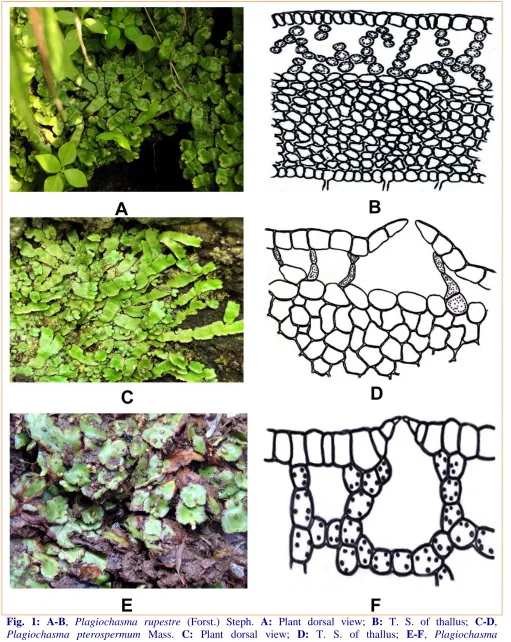
Plagiochasma rupestre(Forst.) Steph. Plagiochasma
subgen. Micropylum Bischl., Rev. Bryol. Lichenol. 43: 63-109 (1977); Plagiochasma. (Micropylum)
rupestre (Forst.) Steph., Spec. Hep. 1:80 (1899);
Alam et al., Indian J. Forestry 32(4): 624 (2009);
Aytonia rupestris Forst. Char. Gen. Pl: 148 (1776);
Plagiochasma nepalense (Lehm. et Bisch.) Steph.,
Spec. Hep. 1: 81 (1898); Plagiochasma simlense
Kash. (P. simlensis) J. Bombay. Nat. Hist. Soc. 25: 279 (1917). Fig. 1 (A-B).
Thallus dark green 10-12 × 4-5 mm, simple, with apical innovations, edges purple, more or less broad, entire or slightly crenulate. Midrib distinct with closely arranged pores, pores simple, minute, not raised over the surface, about 14 -20 µm in diameter with a concentric ring of 6 cells. Ventral scales purple-red, appendages broadly triangular 1-2.6 × 1-1.3 mm, covering the entire ventral surface, narrowly arranged in 2 rows, one on each side of the midrib, with an elongated appendage, 3 - 6 × 0.08 - 0.1 mm. Air chambers compact not very distinct, thallus differentiated into assimilatory and storage zone, cells of assimilatory zone thin walled parcnchymatous containing chloroplast. Storage zone cells thin walled and compactly arranged.
T. A. Khan and J. V. Khan (2018) / Diversity of Genus Plagiochasma in Satpuda Range of Khandesh Region, Maharashtra 52
Fig. 1: A-B, Plagiochasma rupestre (Forst.) Steph. A: Plant dorsal view; B: T. S. of thallus; C-D,
T. A. Khan and J. V. Khan (2018) / Diversity of Genus Plagiochasma in Satpuda Range of Khandesh Region, Maharashtra 53
Distribution: Occasional. In Satpuda ranges. On gravelly, rocky substrate or on rocks along hill slopes.
GPS reading: N 21˚20'46.30" E 75˚19'28.59" (Elevation 332.6m)
Specimens examined: Jalgaon Dist., Devjiri, TAK
19. Nandurbar Dist., Amlibarighat TAK31; Molgi,
TAK 47.
Plagiochasma pterospermum Mass., Mem. Acad.
Agrie Verona 73: 46 (1897); Alam et al., Indian J. Forestry 32(4): 631 (2009); Plagiochasma
articulatum Kashyap, New Phytol. 13: 320 (1914).
Fig. 1 (C-D).
Thallus dark green, 8-32 × 5-10 mm, edges purple, extremely undulate, apex notched. Midrib distinct. Dorsal surface of thallus with distantly arranged pores, pore about 28.2 - 30.6 µm in diameter, slightly raised, with 3-4 concentric rings of cells, inner most ring made up of 8 cells each. Ventral scales purple, closely arranged, sometimes imbricate, in two rows, one on each side of midrib, with 1 to 5 cells wide 1-3 linear appendages (1.5-2.0 × 0.5-0.9 mm). Assimilatory zone having air chambers in 5-6 rows at midrib and 2 rows at margins without assimilatory filaments. Storage zone confined to the midrib region.
Monoicous. Male receptacles sessile, horse shoe-shaped, dorsal, present near the apex of thallus lobe, with small papillae over the disc. Female receptacle dorsal on thallus, shortly stalked, surrounded by large number of linear receptacular scales; receptacular scales 2.5-5.5 × 1-1.5 mm, 3-5 cells in width at base. Stalk without rhizoidal furrow. Disc of female receptacle 3-4 lobed, sporophyte horizontally placed. Capsule wall single layered, cells 15-38 × 15-22 µm with trigones. Spores tetrahedral, 70-87 × 80-90 µm, distal face with irregularly distributed lamellae. Proximal face with distinct triradiate mark and lesser number of lamellae. Spore surface yellowish brown in colour giving an appearance of wing at the periphery. Elaters 140-280 × 9-18 µm, branched, bi - tri spirate, brownish in colour.
Distribution: Rare. In wet patches, besides water streams, along hill slopes.
GPS reading: N 21˚22'37.25" E 75˚45'24.97"
(Elevation 753.6m)
Specimens examined: Jalgaon Dist., Langdha Aamba, TAK 63. Nandurbar Dist., Toranmal, TAK
79; Kalapani, TAK 92.
Plagiochasma appendiculatum Lehm. & Lindenb.
in Lehmann, Novarum et minus cognitarum stirpium pugillus quartus: 14 (1832); Gottsche et al.: 517 (1844-1847); Steph.: 782 (1898); Kashyap: 318 (1914); Perold in Bothalia 25, 1: 13-29 (1995). Fig. 1 (E-F).
T. A. Khan and J. V. Khan (2018) / Diversity of Genus Plagiochasma in Satpuda Range of Khandesh Region, Maharashtra 54
not thickened. Assimilation tissue 350-450 µm thick, air chambers vacant, in many layers, upper ones ±20 µm wide, lower down wider, ± 60 µm wide, cells in bounding walls 35-48 × 20-35 µm. with a brown oil body. 20-30 µm wide: storage tissue occupying ventral 1/2 of thickness of thallus, cells angular, up to 40 µm wide; rhizoids also smooth. 12-25 µm wide. Scales red. Appendages typically decolorate, arranged in 2 forwardly directed ventral rows, one on either side of midrib, asymmetric, obtusely triangular with flatly arched base, progressively tapering above, deeply constricted and folded where joined with large, orbicular appendage, the latter up to 700 µm long, 500 µm across widest part in middle. 310-365 µm wide at base, at margin 1 rows of small rectangular cells 10-16 × 7-12 µm. alternating with slightly larger cells, in the centre of appendage toward base, cells large, rectangular. ± 75 × 37 µm enclosed by numerous rows of irregularly shaped cells; body of scale up to 1200 µm long. 11µm across base, cells rectangular. ± 60 × 20 µm. 5 or 7 smaller, scattered ones with remains of oil bodies. ± 26 × 20 µm: at margins cells small, ± 24 × 12 µm. walls thin, curved, irregularly with long, projecting papillae.
Monoicous, however male and female receptacles frequently on separate plants. Androecia in sessile cushions, oval, horseshoe or heart-shaped. 1.4-2.6 × 2.0 mm. on leading branch medianly. near apex, proximally partially enclosed by narrow curved groove in thallus. Base encircled by blunt, hyaline or partly purple paleae. 540-570 × 120-170 µm. cells rectangular. ± 56 × 20 µm. toward apex smaller, quadrate. ± 23 × 24 µm. near to base margins with some projecting papillae. 24 × 12 µm. Archegoniophores single or several in acropetal sequence medianly along main branch, firstly surrounded by arching hyaline paleae. ± 800 × 100 µm, lower cells typically rectangular. 35-48 × 20 µm, toward peak smaller. ± 18 × 14 µm and at margin 14 × 23 µm, missing papillae. Carpocephala 2 × 2 mm when 4 lobes present, elevated on stalk, 1.2-2 mm long, ± 70 µm in diameter, in transverse section 1 or 2 rows of cortical cells, 16-26 × 16-28 µm, medullary cells angular, up to 36um wide,
thin-walled. Spores 70-80 µm diameter, triangular-globular, polar, pale brown, translucent, wing ± 8 µm wide, margin undulate, minutely crenulate.
GPS reading: N 21o 40' 26.09'' E 74o1' 29.68'' (Elevation 726.7m)
Distribution: Occasional. In Satpuda ranges grow on moist hill slopes.
Specimens examined: Jalgaon Dist., Jamnya, TAK
107. Nandurbar Dist., Dab, TAK 121; Dadgaon,
TAK 147.
All pertinent literature were gone through, notably Perold (1995), Alam and Srivastava (2009) and consulted with Dr. Afroz Alam, Department of Bioscience and Biotechnology, Banasthali University Rajasthan. In Khandesh region only floristic surveys other than bryoflora have been done so far by Yadav et al. (2003), Patil (2003), Kshirsagar and Patil (2008), Khan and Chaudhari (2014), and Khan et al. (2015). There is no literature available regarding bryoflora of Satpuda range in the Khandesh region of Maharashtra. It was found that, these species were not reported in any of the Khandesh region. These species are new record for the Satpuda range of Khandesh region of Maharashtra State. The specimens are deposited in the herbarium of Department of Botany, H.J. Thim College of Arts and Science Mehrun Jalgaon. On close examination of specimens and detailed scrutiny of literature published till today on these taxa, it can be claimed that these are new records for Satpuda range of Khandesh region of Maharashtra.
Conclusion
Plagiochasma rupestre Forst, Plagiochasma
pterospermum Mass, Plagiochasma appendiculatum
T. A. Khan and J. V. Khan (2018) / Diversity of Genus Plagiochasma in Satpuda Range of Khandesh Region, Maharashtra 55
Conflict of interest statement
Authors declare that they have no conflict of interest.
Acknowledgement
The authors wish to express their gratitude to Dr. Afroz Alam, Department of Bioscience, Banasthali University, Rajasthan, who confirmed the identity of the species and also providing the literature. Thanks are also due to the Principal, H. J. Thim College, Jalgaon, for providing laboratory and library facilities.
References
Alam, A., Srivastava, S. C., 2009. Current status of genus Plagiochasma in Nilgiri and Palni Hills with semi details of spores. Indian J. For. 32(4), 623-634.
Khan, T. A., Chaudhari, G. S., 2014. New records of Cyperaceae for Khandesh region of Maharashtra, India. Plant Archiv. 14(1), 235-240.
Khan, T. A., Desai, V. V., Gawande, N. R., 2015. Four new flowering plant records from Satpuda range of Jalgaon District, (MS) India. Biosci. Discov. 6(1), 45-48.
Kshirsagar, S. R., Patil, D. A., 2008. Flora of Jalgaon District, Maharashtra. Bishen Singh Mahendra Pal Singh, Dehradun. pp.41-376. Patil, D. A., 2003. Flora of Dhule and Nadurbar
District (Maharashtra). Bishan Singh Mahendra Pal Singh Deharadun, 53-649.
Perold, S. M., 1995. Studies in the Marchantiales (Hepaticae) from southern Africa. 8. The genus
Plagiochasma (Aytoniaceae: Aytonioideae) and
six local taxa. Bothalia. 25(1), 13-29.
Yadav, S.S., Patil, V. S., Mathew, V., 2003. Seven new flowering plant records from Khandesh Satpuda, Maharashtra State. Plant Archiv. 3(1), 129-131.
How to cite this article:
Khan, T. A., Khan, J. V., 2018. Diversity of genus Plagiochasma in Satpuda range of Khandesh Region, Maharashtra, India. Int. J. Curr. Res. Biosci. Plant Biol. 5(11), 50-55.