Reyhan Akat (Correspondence)
[email protected]
0 312 410 1420This article is published under the terms of the Creative Commons Attribution License 4.0 Author(s) retain the copyright of this article. Publication rights with Alkhaer Publications. Published at: http://www.ijsciences.com/pub/issue/2017-08/
DOI: 10.18483/ijSci.1407; Online ISSN: 2305-3925; Print ISSN: 2410-4477
shown an attitude. Stirling believed and strived to build a humanistic architecture, using mainly the elements and references that the people would understand and accept. When we look at the whole of architectural life, we can say that Stirling is not worried about creating a strong theory, and that he has transferred the orientations of world architecture to architecture practice with great intuition and courage.
Keyword: James Stirling, James Stirling's architectural works, architectural works, Postmodernism, Brutalism
1 - INTRODUCTION
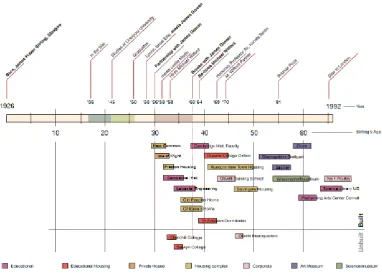
Stirling, born in 1926 Glaskow, began to live here a year later with his family migrating to Livarpool. His full name is James Fraser Stirling. Between 1943 and 1945, he studied architecture at the Livarpol School of Art, joined the war between 1943-1945, and attended the Post-war Livarpool University Faculty of Architecture. Stirling, determined by the color schemes of his father, who was a naval engineer of architecture, is a very modest, faraway architect. Being able to stand out from a nice colleague and propose new solutions and to keep it in a unique personality line has made James Stirling a well-known, well-watched architect of the world. It has been awarded the Pritzker Prize, which is regarded as the Nobel of architecture in the age that can be considered young for an architect (Figure 1) [Jacobus, 1975; Jencks, 1987; Jenks, 1989; Köksal, 1992; Şahinler, 1989; Tanyeli, 1992; Tümertekin, 1992].
He was one of the most recognized and respected architects in the world who died in 1992, and at the same time one of the most misunderstood and misinterpreted architects, even by his fans. He was particularly uncomfortable when he tried to categorize and classify the works of critics and tried to link his work to Post Modernism. Thirty years from Brutalism to neo-Constructivism and during the tragic demise, the architectural mosque has seen major shifts towards some sort of historicity, which has now lost its popularity [Borden, D., Elzanowski, J., Lawrenz, C., Miller, D., Smith, A. and Taylor, J., 2010].
James Stirling, one of the most influential architects of the postwar era, used an eclectic quotation style to promote the clogged International Style and to create a revived Modernism in architecture. Their designs were mostly built in traditional styles that were widespread in the region or with local materials. Stirling's work was consistently cheerful and ironic; This was an accomplishment that was achieved by deliberately blurring Modernist and Classical elements. Particularly interested in the issue of the humanitarianization of the Modernist environment, Stirling made freehand drawings from historical examples to develop his own variable language. The sensitivity to the tradition and the cultural depth it possesses has attracted the attention of leading architectural critics and theorists.
If there is one message that James Stirling has left us, it is not too much trapped between the principles of any architectural style. An architecture can easily flow from one style to another. All the architectural buildings have those unexpected details, those half-mids references.
We are witnessing the first time that the famous British architect, who emphasized his career with a postmodernist understanding of his own, and announced his voice for the first time in Brütalist camp. Stirling's brutalist products also have a different character. We can call it a refined, refined Brutalism with old [Özer, 1993].
http://www.ijSciences.com Volume 6 – August 2017 (08)
149
increasingly interested in the structure systems in Cape Canaveral in America [Kortan, 1996].
Influenced by the later designs of Le Corbusier and the theories of the Smithsons, Stirling and Gowan produced several influential buildings which started a trend toward brick and exposed concrete. Stirling's early designs, especially for Cambridge and Oxford, often emphasized concept over aesthetic and utilitarian needs. His later works appeared more formal due to their influence from Post-Modern classicism. Criticized for his ability to continually alter his fundamental architectural principles, Stirling uses an experimental design approach that shows little commitment to one particular style (http://www.greatbuildings.com/architects/James_Stir ling.html), [Dennis, 1991].
Aldo Rossi explored the underlying patterns of urban formation, which he saw as the only true source for
architecture; Relate architecture to tradition, though not directly referenced. Freedom to refer to the origins of James Stirling's monumental sense of emotion [Melvin, 2009].
Leicester University Engineering Building (1959-1963), University of Cambridge History Faculty (1964-1967), Olivetti Building (1969-1972), etc. Stirling was in a position opposite to the 'box' architecture, which was found in original, single-time mania- tist behaviors loaded with personal expression in his works. It is seen in a different line from the 70's: neo-classicism effect. From now on, he was interested in Soane, Gandy, Goodridge, and Von Klenze and Schinkel from German neo-classical English architects, using an eclectic, historical background in his work. Stirling believed and made an effort to build a humanistic architecture, using mainly the elements and references that the people would understand and accept [Kortan, 1996].
Figure 1. Stirling timeline (http://www.except.nl/overig/yale/sem3/Stirling_paper.pdf9)
2. MATERIALS AND METHODS
2.1 Field of work
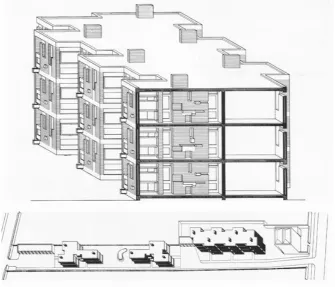
From the works of James Striling; (Leicester, 1959-1963), Faculty of History (Cambridge, 1964-1967), Mass Housing (Runcorn, 1967-1976), Olivetti Building (Haslemere, 1969-1958), Ham Common settlement (London, 1955-1958) 1972), Neue Staatsgalerie (Stutgart 1977-1984), Science Center
(Berlin 1979-1987), Sackler Museum (Cambridge 1979-1984), Clore Gallery (London 1980-1986), Performing Arts Center (Cornell University, İthaca, 1983-1988) was taken as a study area.
From the works of James Striling;
http://www.ijSciences.com Volume 6 – August 2017 (08)
150
2.2.Methods
In this study, James Stirling, one of the foremost architects in the 20th century architecture sector, and his works were studied and examined based on the literature review.
Selection of samples; a detailed data collection work based on a review of various journals, books, city yearbooks, theses, etc.
The determination of the properties of the samples was carried out in two stages.
A form which is used to record the photos, slides, surveys of the buildings and the information collected,
Includes a literature review of the information.
http://www.ijSciences.com Volume 6 – August 2017 (08)
151
Figure 3. perspective https://sancheztaffurarquitecto.wordpress.com/2013/02/05/documentos-aprendiendo- de-stirling-1926-1992-leccion-sobre-dibujos-de-arquitectura-1951-82-v-sanchez-taffur/
3.2 Leicester University Engineering Building (Leicester, 1959-1963)
The modernist box, which incorporates everything, exhibits an attitude of preferring to break for the sake of a team of pieces. As a result, a large building has become a collection of smaller buildings, each of which has its own specific function.
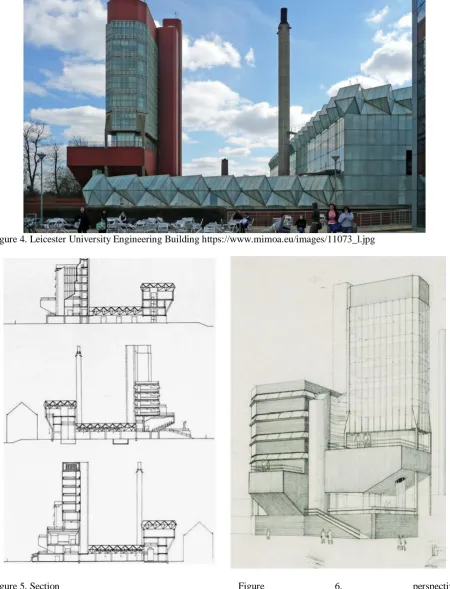
The Leicester University Engineering Building, which combines the red bricks and tile gardens of the last days of Stirling and Gowan's partnerships to divide, refers to the ventilation pipes of steam boats, industrial cama, double-burned bricks and other unrecognized industrial features of the structure. The work distracts the seriousness of extreme architectural stiffness and opposes the meaning of modernism [Borden, D., Elzanowski, J., Lawrenz, C., Miller, D., Smith, A. Ve Taylor, J., 2010].
One of the most successful practitioners of the brutalist movement, the British architect Leicester University, in the Engineering Complex, it is seen that the concepts of brutalist flow are processed with a great aesthetic understanding. Constructive elements are specified by their own qualities and various volumes can be read and recognized one by one by proclaiming their freedom in a way that they can understand the characters thoroughly [Özer, 1993], (Figure 4,5,6)
http://www.ijSciences.com Volume 6 – August 2017 (08)
152
Figure 4. Leicester University Engineering Building https://www.mimoa.eu/images/11073_l.jpg
Figure 5. Section Figure 6. perspective https://www.tumblr.com/tagged/james-stirling
http://www.ijSciences.com Volume 6 – August 2017 (08)
153
3.3 The Faculty of History (Cambridge, 1964-1967)
There is a brutalism effect on the structure. Material and construction are clearly visible. Deaf parts are made of brick, the other parts are made of glass surfaces covered with steel structure. The gallery corridors on every floor are facing the library, and the top of the library is completely transparent.
It was necessary to provide multi-directional approaches in the History Faculty. To allow for different cross-campus circulation routes four entrances have been provided, two of which are at ground level. At the front of the building there is also an approach by ramp to the staff entrance. The accommodation includes a reading room for 300
readers (12,600 square feet of shelving) which accounts for approximately half the floor area; the other accommodation is staff, seminar and common rooms
(http://www.greatbuildings.com/buildings/History_Fa culty_Library.html). (James Stirling, Michael Wilford and Associates, James Stirling, Michael Wilford, and Associates: Buildings and Projects, 1975-1992,. Thames & Hudson, 1994, p97.).
Inside the two right-angled wings is the sloping glass roof of the reading room. This widespread use of glass surfaces and inclined planes has been an influential factor in the architecture of the last decade (Figure 7,8,9,10,11) [Stierlin, 1977].
Figure 7. The Faculty of History https://c1.staticflickr.com/9/8476/8106748826_bf87e3112d_b.jpg
Figure 8. section http://www.flickriver.com/photos/iqbalaalam/tags/jamesstirling/ Figure 9 perspective https://s-media-cache-
http://www.ijSciences.com Volume 6 – August 2017 (08)
154
Figure 10, 11. Plan drawing http://www.greatbuildings.com/buildings/History_Faculty_Library.html
3.4 Runcorn new town housing (Runcorn, 1967-1976)
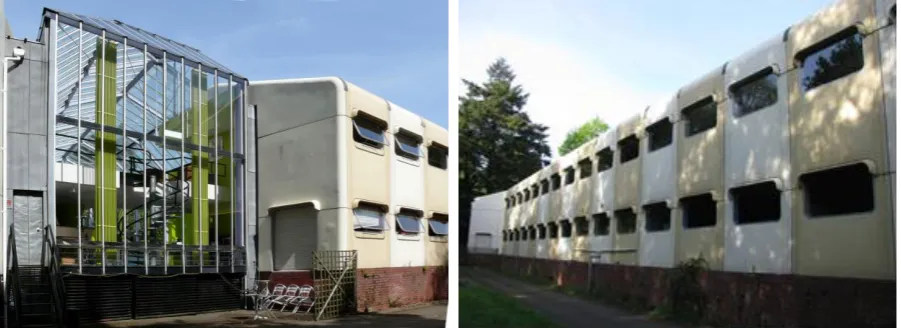
The Runcor district is on a central road between Lverpoolla and Manchester. The government's goal is to make up for the lack of housing in the city. It is connected to the shopping and entertainment center in the center by bridges. There is a bar, laundry, sales units. The purpose of this construction is mass production. It is observed that the seating areas are opened to the garden or balconies. The bedrooms have round windows (Figure 12,13,14).
Its proportions, its sequence of squares and its abstracted-colonnade main facades were based on the Georgian precedents of the cities of Bath and Edinburgh. It offered a high-density, low-rise (five-storey) solution to the national housing problem at a time when Victorian ‘slums’ in nearby Liverpool were being demolished in swathes, and when many
public housing authorities were still moving their tenants into new tower blocks which were themselves to prove troublesome. The first phases of Southgate combined in-situ and precast concrete construction with the colourful grp (glass-reinforced plastic) panels beloved of the nascent high-tech tendency in British architecture. Stirling used such plastic panels elsewhere, for instance on his Olivetti UK training centre. The final phase abandoned concrete entirely in favour of grp-clad timber frame. Southgate was, then, a project on the cusp of different approaches – stylistically anticipating the postmodernism of the Italian school while incorporating high-tech elements, and constructionally combining heavyweight and lightweight techniques. Stirling project: interesting, monumental even, but lacking a sense of greatness
(http://hughpearman.com/the-naked-and-the- demolished-the-scandalous-tale-of-james-stirlings-lost-utopia/).
http://www.ijSciences.com Volume 6 – August 2017 (08)
155
Figure 13. perspective http://hughpearman.com/the-naked-and-the-demolished-the-scandalous-tale-of- james-stirlings-lost-utopia/
Figure 14. perspective
http://www.architectmagazine.com/design/urbanism-planning/what-went-wrong-at-runcorn_o
3.5 Olivetti Building (Haslemer, 1969-1972)
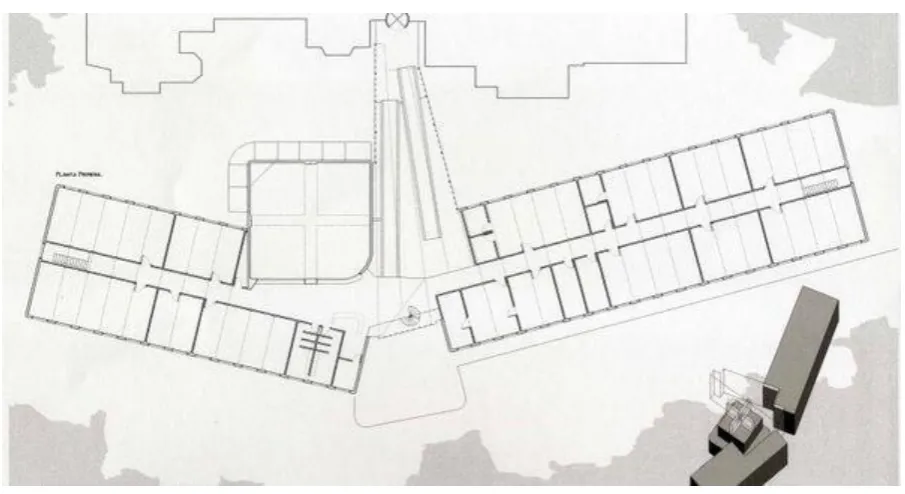
The brutalism effect is observed in this building using ready-made elements. Cape Caneveral, who sits in the interior design in 1965, says that he is influenced by the space base and the famous James Bont film "you only live twice." He was influenced by the top, shaped the circulation volumes and the control center, and the main auditorium affected by the film. Despite the scientific connotations, this language did not abandon the Platoist mass expression in Olivetti. Symmetry is proof of two rectangles. Allows post-modern line approach, the third stage (Figure 15,16,17,18,19 ) [Köksal, 1992; Şahinler, 1989; Tanyeli, 1992; Tümertekin, 1992].
To convert a 42-acre estate to a training center, the Olivetti corporation renovated a turn of the century ‘Tudorbethan’ manor house to a residence for students and added a teaching wing. Two wings of classrooms, one for technicians and one for salesmen, follow the ground contours at the edge of the woods to facilitate planned extension and preserve adjacent trees. The siting splays the wings at slightly less than thirty degrees to each other. A ‘glazed link’ from the house extends between and joins the wings. To one side of the hall at the confluence of the wings and link is a ‘multi-space’—an ‘all-purpose-everything auditorium
(http://www.greatbuildings.com/buildings/Olivetti_Tr aining_School.html) [Stirling J, Wilford, M. 1994].
Figure 15. Olivetti Building https://www.flickr.com/photos/iqbalaalam/5942421130
http://www.ijSciences.com Volume 6 – August 2017 (08)
156
Figure 17. perspective https://s-media-cache-
ak0.pinimg.com/originals/b2/5f/03/b25f03eb6dd4aa0fd44d7c729c1a94ae.jpg
Figure 18. perspective
https://i.pinimg.com/736x/88/d0/6c/88d06c7585a4c3d2096e1c7097bd4d7f.jpg https://s-media-cache-
ak0.pinimg.com/originals/b2/5f/03/b25f03eb6dd4aa0fd44d7c729c1a94ae.jpg
Figure 19. Plan Drawing https://s-media-cache-
ak0.pinimg.com/600x315/f5/ff/05/f5ff050c2b6bc25be72cd233cde6b13e.jpg
3.6 Neue Staatsgalerie (Stutgart, 1977-1984)
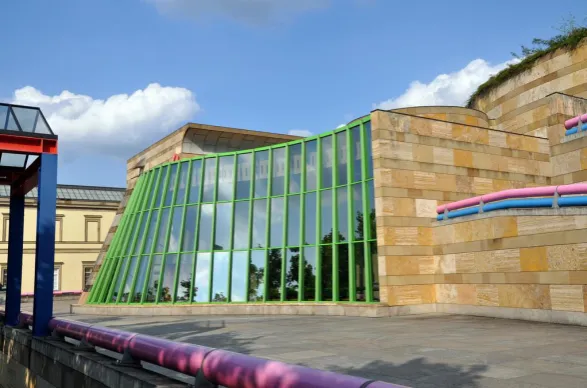
The mysterious image of Stirling is most clearly seen in his masterpiece, Staatsgalerie in Stuttgart, Germany. The building takes you through a simple circulation plan, where you will experience a series of public plazas, each with a distinct character. The project responds to the formal typologies and planning mass of the region without being buried in them. The mischievous character is not in the form of plan itself, but at entry points, bars, elevators etc. Shows.
In order to achieve a dynamic impact, he has boldly removed the ceiling of the building. The inside of the building is covered with warm colored marble walls and the floor is covered with green rubber [Borden, D., Elzanowski, J., Lawrenz, C., Miller, D., Smith, A. Ve Taylor, J., 2010].
http://www.ijSciences.com Volume 6 – August 2017 (08)
157
colored tapes are quoted from the Siena cathedral, from the arrangement of the exhibition spaces in the rotunda Schinkel museum in the middle, by the glass surface elevated by the High Tech architecture, and by the selected colors, from the pop culture. Interesting is the open pedestrian road, which runs through the middle rotundo and forms a ramp that connects the lower section with the upper section [Gieselmann, 1996].
The pieces of the building, which are the essential elements of the building, express their own freeforms and exhibit diversity and heterogeneity in the composition, consisting of several different forms: entrance hall, exhibition hall, rotunda, conference hall, articulated in a building to freely express their personalities. Baroque behaviors such as wavy walls, ramps used since ancient Egypt, circle forms of the Renaissance, transparent curtain walls of metal and glass, as well as the expression of stone, which is an archaic material, bring dynamism, vitality and tension to the mass. All of this combined with the use of cold
and warm colors together and balanced, the unit comes out an interesting and unique product [Kortan, 1996].
The Stuttgart state gallery is one of the foremost examples of postmodernism with its use of pluralistic language spanning historicism and its relation to the urban environment. The project consists of the main mass, which is located between the two different high speed traffic roads of the city and which has the complex shaped and circular plan of the stomach which is required to be connected to the existing museum and which houses the museum places where the plaza is placed and the terraces on different levels. The building is kept open to the pedestrian traffic continuously by means of a short-cut goat connected to the road connecting the terraces starting from the upper road and lining the ceiling of the circular planned square and forming the lower boundaries of the complex (Figure 20,21,22) [Köksal, 1992; Şahinler, 1989; Tanyeli, 1992; Tümertekin, 1992].
Figure 20. Neue Staatsgalerie http://www.architravel.com/architravel_wp/wp- content/uploads/2015/10/Neue-Staatsgalerie_1.jpg
Figure 21,22. First Floor and Ground Floor, Plan of the Neue Staatsgalerie https://image.slidesharecdn.com/modernismpostmodernisminarchitectre-
http://www.ijSciences.com Volume 6 – August 2017 (08)
158
units where conference rooms, administrative units, secretarial and group work can be carried out, is gathered in independent buildings according to the chapter headings and all these structures are placed
building was completed after four years of construction [https://www.wzb.eu/en/about-the-wzb/wzb-architecture].
Figure 23. Science Centre http://www.cca.qc.ca/img-
collection/q4T8BUTXt6QVrCNGupWgPrcPaBw=/1400x1043/413604.jpg
http://www.ijSciences.com Volume 6 – August 2017 (08)
159
3.8 The Sackler Museum (Cambridge, 1979-1984)
The entrance gate on a flat surface is highlighted with a number of motifs. With stone columns, wall-mounted half columns, it reminds us of past periods (Figure 25,26,27).
The circulation flow in the Sackler is interrupted by a series of contra axes and stop movements as you move from the entry hall and up the stair to the top-floor galleries. The in-between transitional elements normally found in Baroque ensembles, such as vestibules and ante-rooms, are here excluded, making for an abrupt juxtaposition of basic elements. The staircase is therefore more a picturesque and less a sequential element in the spatial whole. Visitors moving through the Sackler will experience a succession of minor shocks or jolts. Firstly, they have to go down instead of up to enter the building. Then, entering through the glass lobby between the
columns, the cross axis of the entrance hall immediately creates a stop movement: across the hall the staircase reverts to the axis on which they entered and, when the gallery at the top is reached its axis is again at right angles and so on. In a short staccato walk the reorientation of stop/go axis changes is a substitute for the transitional vestibules in a Baroque sequence. There will be the traffic of students en route to classrooms and the flow of the public visiting the galleries; it could be quite active, a sort of mini-bazaar. the Sackler does have rooms, but not always with an axial relationship to each other; some have two openings per wall, so you may experience some ambiguity as to the type of room you are. The final gallery with the big window is parallel to the first gallery but the in-between spaces may seem somewhat like a maze [https://www.architectural- review.com/rethink/1986-july-sackler-sequence-an-interview-with-james-stirling/8612456.article].
Figure 25. The Sackler Museum
https://upload.wikimedia.org/wikipedia/commons/9/9b/Sackler_Museum%2C_Harvard_University.jpg
Figure 26. perspective https://s-media-cache-
http://www.ijSciences.com Volume 6 – August 2017 (08)
160
Figure 28. Clore Gallery https://s-media-cache-
ak0.pinimg.com/originals/cd/b2/d6/cdb2d620e50a57a2e79eb8dcc2eac758.jpg
3.10 Performing Arts Center (Cornell University, Ithaca, 1983-1988)
It is a post modern structure. In the entrance there is a combination of triangular pedestal, stone pavement
and modern material. A columned entrance is visible round windows of the Roman period. Extremely eclectic (Figure 29,30).
Figure 29. Performing Arts Center
http://www.ijSciences.com Volume 6 – August 2017 (08)
161
Figure 30. Performing Arts Center https://tr.pinterest.com/source/architectural-review.com/
4. DISCUSSION AND CONCLUSION
The architectural works of James Stirling, one of the foremost architects of the 20th century, aimed to be an example of new designs with architectural insights.
The works of Jamers Stirling (Ham Common settlement, Leicester University Engineering Building, The Faculty of History, Runcorn new town housing, Olivetti Building, Neue Staatsgalerie, Berlin
social science center, The Sackler Museum, Clore Gallery, Performing Arts Center) that have been studied are discussed and explained based on the literature.
We can say that Stirling, a humanist, reformist, and social Utopian attitude, has transferred the orientations of the world architecture to a practice of architecture with great intuition and courage, before he is concerned about creating a strong theory.
Tablo 1. Examined the works of James Stirling table
JAMES STIRLING –WORKS
http://www.ijSciences.com Volume 6 – August 2017 (08)
162
The Faculty of History (Cambridge, 1964-1967)(3) Runcorn new town housing (Runcorn, 1967-1976) (4)
Olivetti Building (Haslemer, 1969-1972)(5) Olivetti Building (Haslemer, 1969-1972)(6)
Neue Staatsgalerie (Stutgart, 1977-1984) (7) Berlin social science center (Berlin, 1979-1987) (8)
http://www.ijSciences.com Volume 6 – August 2017 (08)
163
Performing Arts Center (Cornell University, Ithaca, 1983-1988) (11)
Performing Arts Center (Cornell University, Ithaca, 1983-1988) (12)
5. REFERENCES
1. Architectural Movements I, 1st Edition, Yem yayın, 1996
2. Collective, Architecture, NTV publications, 2012
3. Sharp, D. The Illustrated Encyclopedia of Architects and
Architecture. New York, Quatro Publishing, 1991. 4. Köksal, A., "Century Architecture lost a Master", Decoration,
1992 issue: 9.
5. Kortan, E., On the Recent Developments in Architecture,
Constructed Choices9 Architectural currents II, ed., July, Istanbul, 1996.
6. Melvin, J., Understanding the Architecture of the IMS, 2nd
Edition, ed., 2009.
7. Jacobus; J. James Stirling, Oxford University press, nex
York, 1975.
8. Jencks, C., Post Modernizsm, Academy Editions, London,
1987.
9. Jenks, C., "Interview with James Stirling", Decoration, 1989, issue: September.
10. Lawrence, J.; Miller, C., Smith, D., A., and Taylor, J.,
Application Books Architecture, NTV Publications, 2nd Edition 2010, Istanbul.
11. Gieselmann, R. Searching for Style in Architecture,
Constructed Choices, 1996.
12. Stierlin, H., Encyclopedia of World Architecture, Evergreen,
Spain, 1977.
13. Şahinler, F., "Stirling from Istanbul", Dekorason, 1989, issue: September.
14. Tanyeli, U., "Life of Stirling's Pikaresk", Decoration, 1992. 15. Tümertekin, H., "Only Building Designed", Decoration,
1992, issue 9.
Table photo references
1- http://www.themodernhouse.com/wp-content/uploads/tmh/25437/hist20140811_DSC_1404_WEB. jpg 2- https://c1.staticflickr.com/4/3407/3530555142_ffd91a5069_b .jpg 3- https://c1.staticflickr.com/5/4080/4934612209_2cb3b44670_ b.jpg 4- https://c2.staticflickr.com/6/5291/5472284838_39aaee426c_b .jpg 5- https://library.ndsu.edu/repository/bitstream/handle/10365/19 343/ALA05036.jpg?sequence=1 6- https://s-media-cache-ak0.pinimg.com/736x/8d/dc/fd/8ddcfddcc9141d931b4ef73c9 48274ee--james-stirling-training-school.jpg 7- https://herrmanns.files.wordpress.com/2014/02/neue_staatsga lerie_fassade.jpg 8- http://www.cca.qc.ca/img-collection/iHZ9mUiH6pLC3mkC49e1bdRJGCw=/1400x104 9/413603.jpg 9- http://static.panoramio.com/photos/large/46059527.jpg 10- https://s-media-cache-ak0.pinimg.com/736x/7c/0a/4b/7c0a4b28f90eed7839e65341 56622e1d--james-stirling-tate-britain.jpg 11- https://s-media-cache-ak0.pinimg.com/736x/47/b6/32/47b6320008638f297f8e654a 70d88d60--james-stirling-art-centers.jpg 12- https://s-media-cache-ak0.pinimg.com/736x/dd/49/42/dd49427430c2df0990ba6996 495e2787--james-stirling-performing-arts.jpg Figure references
1. Figure 1 - Stirling timeline
(http://www.except.nl/overig/yale/sem3/Stirling_paper.pdf9)
2. Figure 2. Ham Common settlement
http://www.themodernhouse.com/wp-content/uploads/tmh/700/history-2.jpg
3. Figure 3
https://sancheztaffurarquitecto.wordpress.com/2013/02/05/do cumentos-aprendiendo-de-stirling-1926-1992-leccion-sobre-dibujos-de-arquitectura-1951-82-v-sanchez-taffur/
4. Figure 4. Leicester University Engineering Building
https://www.mimoa.eu/images/11073_l.jpg
5. Figure 5. Section
https://arquigraph.tumblr.com/post/131544208146/james-stirling-leicester-laboratory-building
6. Figure 6. perspective
https://www.tumblr.com/tagged/james-stirling
7. Figure 7. The Faculty of History
https://c1.staticflickr.com/9/8476/8106748826_bf87e3112d_ b.jpg
8. Figure 8.
http://www.flickriver.com/photos/iqbalaalam/tags/jamesstirli ng/
9. Figure 9
https://s-media-cache-ak0.pinimg.com/originals/79/e6/26/79e626d5d105e9e876acd c47ae0205d1.jpg
10. Figure 10, 11. Plan drawing
http://www.greatbuildings.com/buildings/History_Faculty_Li brary.html
11. Figure 12. Runcorn new town housing
http://cdnassets.hw.net/eb/0d/0bebe5db4c608930023df468e1 95/1976-20c-20riba9949-hero-tcm20-658840.jpg
12. Figure 13. perspective
http://hughpearman.com/the-naked- and-the-demolished-the-scandalous-tale-of-james-stirlings-lost-utopia/
13. Figure 14.
http://www.ijSciences.com Volume 6 – August 2017 (08)
164
19. Figure 20.
http://www.architravel.com/architravel_wp/wp-content/uploads/2015/10/Neue-Staatsgalerie_1.jpg
20. Figure 21,22. First Floor and Ground Floor, Plan of the Neue
Staatsgalerie
https://image.slidesharecdn.com/modernismpostmodernismin architectre-141126203204-conversion-gate01/95/modernism-postmodernism-in-architecture-27-638.jpg?cb=1471331033
8dcc2eac758.jpg
27. Figure 29.
http://www.bestvalueschools.com/wp- content/uploads/2014/05/17-SCHWARTZ-CENTER-FOR-THE-PERFORMING-ARTS.jpg
28. Figure 30.