Practical Approaches to Principal Component Analysis in the
Presence of Missing Values
Alexander Ilin [email protected]
Tapani Raiko [email protected]
Adaptive Informatics Research Center
Aalto University School of Science and Technology P.O. Box 15400, FI-00076 Aalto, Finland
Editor: Tommi Jaakkola
Abstract
Principal component analysis (PCA) is a classical data analysis technique that finds linear transfor-mations of data that retain the maximal amount of variance. We study a case where some of the data values are missing, and show that this problem has many features which are usually associated with nonlinear models, such as overfitting and bad locally optimal solutions. A probabilistic formulation of PCA provides a good foundation for handling missing values, and we provide formulas for doing that. In case of high dimensional and very sparse data, overfitting becomes a severe problem and traditional algorithms for PCA are very slow. We introduce a novel fast algorithm and extend it to variational Bayesian learning. Different versions of PCA are compared in artificial experiments, demonstrating the effects of regularization and modeling of posterior variance. The scalability of the proposed algorithm is demonstrated by applying it to the Netflix problem.
Keywords: principal component analysis, missing values, overfitting, regularization, variational Bayes
1. Introduction
Principal component analysis (PCA) is a data analysis technique that can be traced back to Pearson (1901). It can be used to compress data sets of high dimensional vectors into lower dimensional ones. This is useful, for instance, in visualization and feature extraction. PCA has been exten-sively covered in the literature (e.g., Jolliffe, 2002; Bishop, 2006; Diamantaras and Kung, 1996; Haykin, 1989; Cichocki and Amari, 2002). PCA can be derived from a number of starting points and optimization criteria. The most important of these are minimization of the mean-square error in data compression, finding mutually orthogonal directions in the data having maximal variances, and decorrelation of the data using orthogonal transformations.
In the data compression formulation, PCA finds a smaller-dimensional linear representation of data vectors such that the original data could be reconstructed from the compressed representation with the minimum square error. Assume that we have n d×1 data vectors y1,y2, . . . ,yn that are modeled as
yj≈Wxj+m, (1)
Diamantaras and Kung, 1996) find W, xj and m such that the reconstruction error
C=
n
∑
j=1
kyj−Wxj−mk2 (2)
is minimized. In matrix notation, the data vectors and principal components can be compiled into
d×n and c×n matrices Y= [y1 y2 . . . yn]and X= [x1 x2 . . . xn], and yi j, wik and xk j denote the elements of the matrices Y, W and X, respectively. The bias matrix M contains n copies of the bias vector m as its columns. Principal subspace methods find W and X such that Y≈WX+M and the minimized cost function is the sum of the squared elements (or Frobenius norm) of matrix Y−WX−M:
C=kY−WX−Mk2F. (3)
Without any further constraints, there exist infinitely many ways to perform a decomposition that minimizes (2) or equivalently (3). This can be seen by noting that any rotation or scaling of W can be compensated by rotating or scaling X accordingly, leaving the product WX the same. However, the subspace spanned by the column vectors of the matrix W, called the principal subspace, is unique.
PCA finds a specific representation of the principal subspace. It is traditionally defined using the requirement that the column vectors of W are mutually orthogonal, have unit length and, fur-thermore, for each k=1, . . . ,c, the first k vectors form the k-dimensional principal subspace. This
makes the solution practically unique (except for changing the sign, and in the special case of having equal eigenvalues, e.g., Diamantaras and Kung, 1996; Jolliffe, 2002; Haykin, 1989). In this article, we use the term PCA for methods which seek representations (1) by minimizing the error (2). Thus we assume that once the principal subspace is found, it can be transformed into the PCA solution. This is indeed true for the case of fully observed vectors yjbut can be more difficult in the case with missing values, as we discuss in Section 4.
Let us now consider the same problem when the data matrix Y has missing entries. In this paper, we make the typical assumption that values are missing at random (MAR) (Little and Rubin, 1987), that is, given the observed data, the missingness does not depend on the unobserved data or latent variables. An example where the assumption does not hold is when out-of-scale measurements are marked missing. In the following example, the data matrix contains N=9 observed values and 6 missing values (marked with a sign×):
Y=
y11 y12 y13 y14 ×
y21 y22 × × y25
× × y33 y34 ×
.
A natural extension of PCA for the case with missing values would be to find a representation such that Y≈WX+M for the observed values. The rest of the matrix WX+M can be taken as the reconstruction of missing values.
−2 0 2 4 −3
−2 −1 0 1 2 3 4 5
missing observed
−2 0 2 4
−3 −2 −1 0 1 2 3 4 5
missing observed
y2 y2
y1 y1
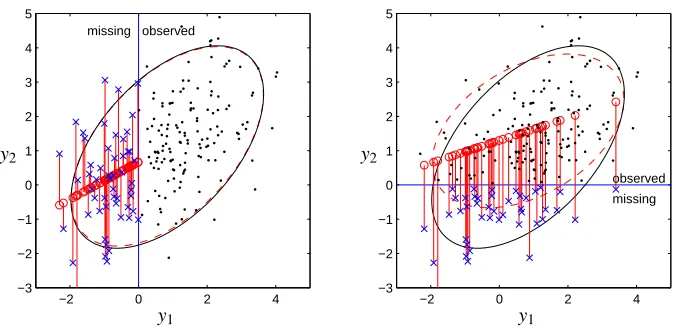
Figure 1: Two examples of PCA with missing values. In the left, the missing value mechanism is
missing at random (MAR), while on the right, it is missing not at random (MNAR). The
black dots represent fully observed samples, while the blue crosses represent observations where only the horizontal value has been observed. The red circles represent the recon-structions of the missing values produced by VBPCA. The dashed red ellipses represent the estimated data covariance. On the left, the estimated covariance is quite close to the data covariance (black ellipse).
term m in (1), which is not generally equal to the row-wise mean of the data matrix, as in clas-sical PCA. 4) Standard PCA approaches can easily lead to overfitting, thus regularization is often required. 5) The algorithms may require heavy computations, especially for large-scale problems. 6) The concept of the PCA basis in the principal subspace is not easily generalized in the pres-ence of missing values. 7) The choice of the dimensionality of the principal subspace is generally more difficult than in classical PCA. Thus, the PCA problem has many features which are usually associated with nonlinear models. This paper discusses some of these important issues providing illustrative examples and presenting ways to overcome possible difficulties.
All the methods studied in this work assume MAR, so they cannot be expected to work in the
missing not at random (MNAR) case. Fig. 1 gives a first example of PCA with missing values. The
data contain 200 samples generated from a Gaussian distribution represented by the black ellipse. In the first case (left subfigure), the vertical value is missing when the horizontal value is negative. This setting is MAR since the missingness depends only on the observed data. In the second case (right subfigure), the vertical value is missing when the vertical value itself is negative. Now the missingness depends on the missing data, and the missing value mechanism is thus MNAR. As expected, the variational Bayesian PCA (VBPCA, see Section 3.3) works well in the MAR case and gives reasonable reconstructions for the missing values. Also, the vertical part of the bias term m is estimated to be 1.13 which is much closer to the true value 1.10 than the row-wise mean 1.50 of the observed values in the data.
problem is to adjust standard PCA algorithms to handle partially observed instances. The choice of the algorithm is not very crucial in such a simple case, as most of the approaches would provide similar solutions. However, in other applications, the available observations can be very sparse and the modeling task is often to reconstruct the missing part from the observed data only. Examples include collaborative filtering problems which is the task of predicting preferences by using other people’s preferences (e.g., Hofmann, 2004), and historical data reconstruction in climatic records (e.g., Kaplan et al., 1997).
Historically, the missing value problem in PCA was first studied by Dear (1959) who used only one component and just one imputation iteration (see below). It was based on the minimum mean-square error formulation of PCA introduced by Young (1941). Christoffersson (1970) also used a one-component model for reconstructing missing values. Wiberg (1976) first suggested to directly minimize the mean-square error of the observed part of the data. An algorithm by de Ligny et al. (1981) already worked with up to half of the values missing. The missing values problem using a multivariate normal distribution has been studied even earlier than using PCA, for instance, by Anderson (1957). More historical references can be found in the book by Jolliffe (2002).
More recently, PCA with missing values was studied by Grung and Manne (1998). They pro-posed using either the imputation or the faster alternating W–X algorithm (see below). They dis-cussed the overfitting problem and suggested to delete troublesome rows or columns from data. Tipping and Bishop (1999) introduced the probabilistic formulation of PCA (PPCA). Although they mentioned shortly missing data, they did not provide the formulas to be used for incomplete data. Bishop (1999) introduced variational Bayesian PCA (VBPCA) for choosing the number of components in PCA. Raiko and Valpola (2001) reconstructed missing values with VBPCA to com-pare some nonlinear models to it. Oba et al. (2003) applied VBPCA for missing value estimation in gene expression profile data, and mentioned that it performs much better than the existing methods for missing value estimation.
The present article reviews possible approaches to the problem with the emphasis on probabilis-tic models and Bayesian methods. The rest of the arprobabilis-ticle is organized as follows. In Section 2, we present classical algorithms for PCA based on minimizing the reconstruction error similar to (2) and the method based on estimation of the covariance matrix (imputation algorithm). We review how the algorithms are normally used for fully observed data and explain how they can be adapted to the case with missing values. We explain possible difficulties of the standard methods including bad lo-cally optimal solutions, numerical problems and overfitting. Simple examples are given to illustrate these problems. In the same section, we discuss the properties of the imputation algorithm, such as implicit remedies against overfitting and overlearning and its expectation-maximization (EM) interpretation.
Section 3 presents probabilistic models for PCA which provide a good foundation for handling missing values. First, we introduce formulas for the probabilistic PCA model in the case with missing values. Then, we describe Bayesian regularization for handling problems that arise when data are sparse. We provide formulas for performing maximum a posteriori estimation and for variational Bayesian inference.
Section 6 discusses large-scale problems and computational complexity. In case of high dimen-sional and very sparse data, overfitting becomes a severe problem and traditional algorithms for PCA are very slow. We introduce a novel fast optimization algorithm and show how to use it in Bayesian models.
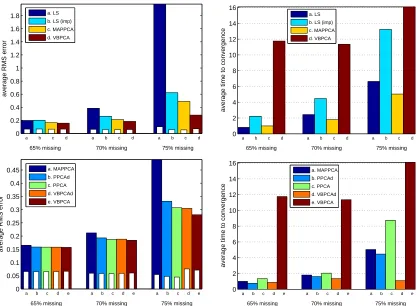
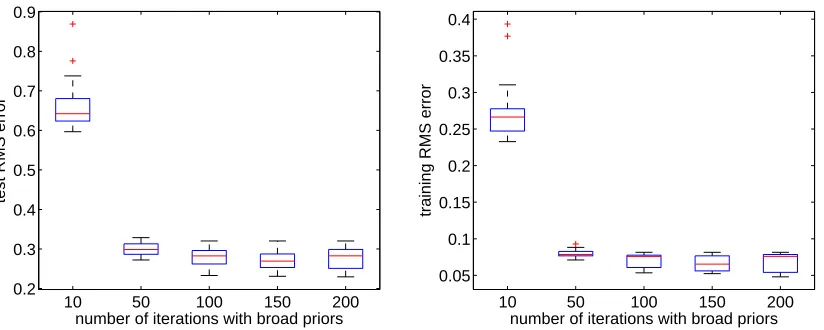
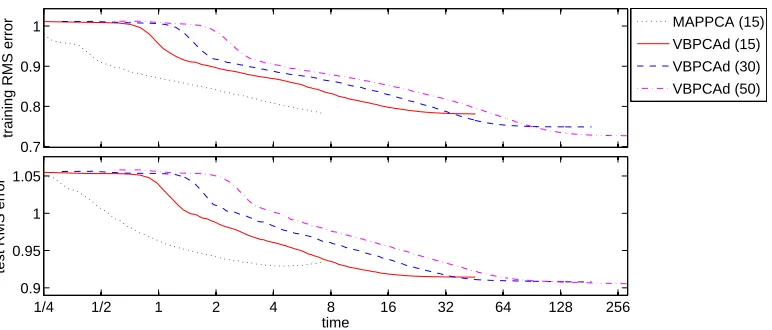
In Section 7, different versions of PCA are compared in artificial experiments, demonstrating the effects of regularization and modeling of posterior variance. We demonstrate the importance of tricks such as fixing hyperparameters for the early learning in variational Bayesian methods. The scalability of the proposed algorithm is demonstrated by applying it to the Netflix problem. Finally, we conclude in Section 8.
1.1 Notation
The following notation is used throughout the article. Bold capital letters denote matrices, bold lower-case letters denote vectors, and normal lower-case letters denote scalars. The basic model equation is yj≈Wxj+m, where column vectors yj are the data cases, W is the matrix that maps the principal components xjto the data, and m is the bias vector. Indices i=1, . . . ,d and j=1, . . . ,n go over the rows and columns of Y, respectively. The index of a principal component is denoted by
k=1, . . . ,c. Notation i j is used for the index of yi j, the i j-th element of matrix Y. O is the set of indices i j corresponding to observed values yi j, Oiis the set of indices j (similarly Oj is the set of indices i) for which yi j is observed.|Oi|is the number of elements in Oiand N=|O|is the number of observed data elements. Notation Ai:and A: j is used for the i-th row and j-th column of a matrix A, respectively. Both Ai:and A: j are column vectors. The i-th row of W is denoted by wi=Wi:, and the j-th column of X is xj=X: j. Table 1 lists the symbols used in the paper.
2. Least Squares Techniques
In this section, we present classical algorithms for PCA based on minimizing the reconstruction error similar to (2) and the method based on estimation of the covariance matrix.
2.1 The Cost Function
The minimum mean-square error compression of data is the formulation for PCA (Young, 1941) that can be generalized to the case with missing values in a very straightforward manner. The cost function (2) is adapted such that the sum is taken over only those indices i and j for which the data entry yi j is observed (Wiberg, 1976):
C=
∑
i j∈O
(yi j−yˆi j)2, (4)
ˆ
yi j =wTixj+mi= c
∑
k=1
wikxk j+mi. (5)
In this section, we consider algorithms optimizing cost function (4), which we call the least squares (LS) approach to PCA of incomplete data.
d dimensionality of the data vectors (indexed by i)
n number of data vectors (indexed by j)
c number of principal components (indexed by k)
Y={yi j} d×n data matrix
yj d-dimensional data vector ( j-th column of Y)
ˆ
yi j reconstruction of the data element yi j
m={mi} d-dimensional bias vector
M = [m m . . . m], d×n bias matrix mi posterior mean of mi (scalar)
e
mi posterior variance of mi(scalar)
W={wik} d×c matrix for the mapping from principal components to the data
W:k k-th column of matrix W (d-dimensional vector)
wi i-th row of W (c-dimensional vector)
wi posterior mean of wi (c-dimensional vector)
W = [w1w2 . . . wd]T, d×c matrix of posterior means of wi Σwi posterior covariance of wi(c×c matrix)
e
wik posterior variance of wik(scalar)
X={xk j} c×n matrix of principal components
xj c-dimensional principal component vector ( j-th column of X)
xj posterior mean of xj(c-dimensional vector)
X = [x1x2 . . . xn], c×n matrix of posterior means of xj Σx posterior covariance of xj (same c×c matrix for each j) Σxj posterior covariance of xj (separate c×c matrix for each j)
e
xk j posterior variance of xk j(scalar)
C cost function to be minimized
O set of indices i,j for which yi j is observed
Oi set of indices j for which yi jis observed
Oj set of indices i for which yi jis observed γ learning rate (positive scalar)
εj d-dimensional noise vector ( j-th out of n vectors)
vy noise variance (scalar)
N
(x; µ,Σ) Gaussian pdf over variable x with mean µ and covarianceΣvm prior variance for the elements of m (scalar)
vw,k prior variance for the elements of W:k(scalar for each k) ξ = (vy,vw,k,vm)hyperparameters
θ parameters, typicallyθ= (W,X,m)
an extension to the weighted case, where each observation has a weight varying from 0 to 1, is a dif-ficult non-convex problem where the cost function can have multiple local minima. We demonstrate this phenomenon for a simple data set with missing values, that is with weights either 0 (missing value) or 1 (observed value). In our example, model (1) with one principal component and fixed m=0 is fitted to the data
Y=
0.8 0.8
1 ×
× 1
≈
w1
w2
w3
x1 x2
.
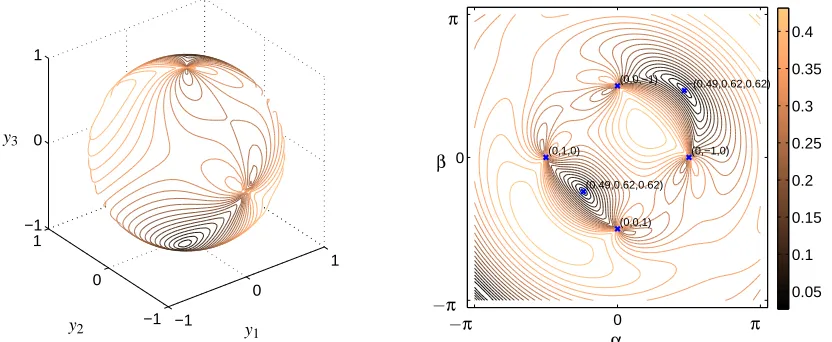
To discard the scaling ambiguity of the PCA solution, the column vector W can be restricted to have unit length. Thus, the minimized error can be represented as a function of two parameters which define a unit length vector in the three-dimensional space. The cost function in this simple example has three local minima, as shown in Fig. 2: The global minimum W=±[0.49 0.62 0.62]T corresponds to zero cost while the other two minima (close to±[0 1 0]Tand±[0 0 1]T) provide a non-zero error. Each of the two sub-optimal solutions reconstructs perfectly only three out of four observed values in Y.
−1
0
1
−1 0 1 −1 0 1
y1
y2
y3
(0,1,0) (0,−1,0)
(0,0,1) (0,0,−1)
(0.49,0.62,0.62)
−(0.49,0.62,0.62)
0 0
0.05 0.1 0.15 0.2 0.25 0.3 0.35 0.4
α β
π
π
−π −π
Figure 2: Example of local minima for the cost function (4). Data are three-dimensional (d=3), the model has one principal component (c=1) and therefore the PCA solution can be defined by a unit length vector W. Left: The cost function plotted on a surface of unit length vectors. Right: The same plot using the Euler vector representation: The matrix W is constructed fromαandβas W=eA[1 0 0]T with A a 3×3 matrix with four nonzero elements a12=−a21=α and a13=−a31=β. Coordinates in brackets correspond to coordinates in Euclidian space in the left hand side plot.
The cost function (4) can be minimized using any optimization procedure. Two possible ap-proaches are presented in the following.
2.2 Alternating W–X Algorithm
Complete data. It is possible to optimize the cost function (3), and therefore to find the principal
can be obtained from an ordinary least squares problem. We will further refer to this approach as the alternating algorithm.
The algorithm alternates between the updates
X= (WTW)−1WTY, (6)
W=YXT(XXT)−1. (7)
This iteration can be efficient when only a few principal components are needed, that is c≪d
(Roweis, 1998). The bias vector m is the row-wise mean of the data and the above equations assume that it has been subtracted from the data as a preprocessing step.
Incomplete data. Grung and Manne (1998) studied the alternating algorithm in the case of
missing values. In order to get the accurate least squares solution, we include the bias term into the estimation procedure, yielding the update rules
xj=
∑
i∈Oj wiwTi
−1
∑
i∈Oj
wi(yi j−mi), j=1, . . . ,n, (8)
mi=
1
|Oi|j
∑
∈Oi
yi j−wTixj
, (9)
wi=
∑
j∈Oi xjxTj
−1
∑
j∈Oi
xj(yi j−mi), i=1, . . . ,d, (10)
where miis the i-th element of m.
2.3 Gradient Descent Algorithm
Complete data. The basis of neural network implementation of PCA learning rules is a gradient
descent optimization procedure. Such algorithms work online, processing only one input vector yj at once. The learning rules implement stochastic gradient descent and the algorithms will eventually converge to a basis in the principal subspace. Each data vector may have to be processed several times for convergence. The same can also be implemented in a batch procedure.
Using gradient descent for minimization of (4) w.r.t. W yields the update rule
W←W+γ(Y−WX)XT, (11)
whereγ>0 is called the learning rate. Minimization w.r.t. matrix X can be performed using the least squares solution in (6). Some neural algorithms use learning rules which either explicitly or-thogonalize W or which yield an orthogonal W at the convergence. Then the update of X can be simplified to X=WTY, which together with (11) is the batch version of the Oja learning algo-rithm (Oja, 1983; Diamantaras and Kung, 1996). The bias m is again removed from the data as a preprocessing step.
Incomplete data. In the presence of missing values, the gradient descent update rule for W is
W←W−γ∂C
∂W, with
∂C
∂wik
=−2
∑
j∈Oi
where ˆyi j is given in (5). Matrix X could be updated using (8) but a gradient-based update can also be used:
X←X−γ∂C
∂X, with
∂C
∂xk j
=−2
∑
i∈Oj
(yi j−yˆi j)wik.
The bias term m can be updated using (9). As we discuss in Section 6.1, gradient-based learning can be computationally more efficient than the alternating algorithm because there is no need to
compute matrices
∑i∈Ojwiw T i
−1 and
∑j∈Oixjx T
j
−1
in (8) and (10).
2.4 Numerical Problems and Overfitting
Least squares PCA methods can work well for data sets with few missing values but they may not be applicable to sparse data sets because of severe problems with overfitting. Suppose that for some
j the number|Oj|of observed measurements yi jis smaller than the number of principal components
c. Then, the corresponding least square problem is ill posed: the matrix∑i∈OjwiwTi is rank deficient and Equation (8) cannot be used. Moreover, even if|Oj|is greater than c, matrix∑i∈Ojwiw
T
i may
be badly conditioned and the corresponding xj can become infinitely large. This means that the parameters would be overfitted to explain well a few observed values but the generalization ability of the model would be poor (e.g., reconstruction of missing data would be very inaccurate). This is exactly what happens in the vicinity of the two local minima in the example in Fig. 2.
The same problem can happen when the rows of W are estimated using, for example, (10): matrix∑j∈Oixjx
T
j can be rank deficient or badly conditioned. This is more probable when some rows of Y contain very few measurements. However, these problems can generally appear for any data set and for any algorithm optimizing the cost function (4).
Overfitting problems can be avoided by using proper regularization. A common way to prevent unbounded growth of model parameters is to add terms which penalize large parameter values into the cost function. The amount of regularization can be determined, for instance, by cross-validation. Another possibility is to use probabilistic methods (see Section 3) in which the extra penalty terms come naturally from a probabilistic model.
2.5 Method Using Singular Value Decomposition
Complete data. Perhaps the most popular approach to PCA is based on singular value decomposition
(SVD) of the data matrix or (equivalently) eigen-decomposition of the sample covariance matrix. SVD of the data matrix is given by:
Y=UΣVT,
where U is a d×d orthogonal matrix, V is an n×n orthogonal matrix andΣis a d×n
pseudo-diagonal matrix (pseudo-diagonal if d=n) with the singular values on the main diagonal (e.g., Haykin,
1989). The PCA solution is obtained by selecting the c largest singular values fromΣ, by forming W from the corresponding c columns of U, and X from the corresponding c rows ofΣVT (Jolliffe, 2002). The bias m is again removed from the data as a preprocessing step.
PCA can equivalently be defined using the eigen-decomposition of the d×d covariance matrix
C of the column vectors of the data matrix Y: C=1
nYY
The diagonal matrix D contains the eigenvalues of C, and the columns of the matrix U contain the unit-length eigenvectors of C in the same order (Cichocki and Amari, 2002; Diamantaras and Kung, 1996; Jolliffe, 2002; Haykin, 1989). Again, the columns of U corresponding to the largest eigenvalues are taken as W, and X is computed as WTY. This approach can be more efficient for cases where d≪n, since it avoids the computation of the n×n matrix V.
Incomplete data. The same approach cannot be directly used in the presence of missing values.
Estimating the covariance matrix C becomes difficult. Let us consider a simple (but incorrect) estimate where we just leave out terms with missing values from the average for each element of C. For the data matrix below, we get
Y=
−
1 +1 0 0 ×
−1 +1 × × 0
× × −1 +1 ×
, C= 1
nYY
T=
0.5 1 0 1 0.667 ×
0 × 1
.
There are at least two problems. First, the estimated covariance 1 between the first and second components is larger than their estimated variances 0.5 and 0.667. This clearly leads to the sit-uation where the covariance matrix is not positive (semi)definite and some of its eigenvalues are negative. Secondly, the covariance between the second and the third component could not be esti-mated at all. For these reasons, this is a viable option only if the number of missing values is not significant. There are many algorithms for finding a proper estimate of the covariance matrix (e.g., Ghahramani and Jordan, 1994; Boscardin and Zhang, 2004) but they are computationally intensive iterative algorithms.
A simple alternative is an iterative procedure which performs PCA more directly. It alternates between imputing the missing values in Y and applying standard PCA to the infilled (complete) data matrix Yc (e.g., Jolliffe, 2002). Initially, the missing values can be replaced, for example, by the row-wise means of Y. The covariance matrix of the complete data Yccan be estimated without the problems mentioned above, and W can be computed using its eigen-decomposition. The bias term m can be updated as the row-wise mean of Yc. Next, the principal components X are calculated:
X=WT(Yc−M),
the reconstructions can be used as a better estimate for the missing values:
Yc=
Y for observed values WX+M for missing values
and PCA can be applied again to the updated data matrix Yc. This process can be iterated until convergence. We will further refer to this approach as the imputation algorithm. In Appendix A, we show that the imputation algorithm also minimizes the cost function (4) and that it implements the EM steps for a simple probabilistic model. This approach requires the use of the complete data matrix, and therefore it is computationally very expensive for large-scale problems.
with the row-wise means of the data matrix introduces a bias in favor of the most “conservative” solutions. In practice, there can be infinitely many solutions that provide the same reconstruction error for the observed part but that have different reconstructions for the missing part. In such cases, the effect of the initialization can last even if the algorithm is iterated indefinitely.
Our experiments show that the imputation algorithm also has resistance against overlearning. By overlearning we mean situations when the training error decreases but the generalization ability of the model gets worse. Badly overfitted solutions correspond to regions in the parameter space where a small decrease of the training error can cause a large increase of the test error. However, the penalty term (which keeps the reconstructions of missing data close to the infilled values) makes the steps shorter and learning can practically stop once the algorithm enters regions where the training error changes very little. Thus, this regularization effect is due to early stopping.
3. Probabilistic Models for PCA
In this section, we presents probabilistic models for PCA which provide a good foundation for handling missing values.
3.1 Probabilistic PCA
The probabilistic formulation of PCA offers a number of benefits, including well-founded regular-ization, model comparison, interpretation of results, and extendability. Probabilistic PCA (Tipping and Bishop, 1999) explicitly includes the noise term in a generative model
yj=Wxj+m+εj. (12)
Both the principal components xj and the noiseεj are assumed normally distributed:
p(xj) =
N
(xj; 0,I), (13)p(εj) =
N
(εj; 0,vyI), (14)where
N
(x; µ,Σ)denotes the normal probability density function (pdf) over variable x with mean µ and covarianceΣ. The parameters of the model include W, m and vy. The model can be identified by finding the maximum likelihood (ML) estimate for the model parameters using the EM algorithm (Dempster et al., 1977).Complete data. The E-step estimates the conditional distribution of the hidden variables X
given the data and the current values of the model parameters:
p(X|Y,W,vy) = n
∏
j=1
N
xj; xj,Σxj
,
where the covariance matrixΣxj is same for all xj:
Σxj =Σx=vy
vyI+WTW
−1
, j=1, . . .n,
and the means xjcan be summarized in the columns of matrix
X= 1 vy
The M-step re-estimates the model parameters as
W=YXT(XXT+nΣx)−1, (16)
vy= 1
nd
d
∑
i=1 n
∑
j=1
yi j−wTi xj
2
+1
dtr(WΣxW
T).
Note that vy is updated as the mean-square error plus the extra term which accounts for the uncer-tainty in X.
Tipping and Bishop (1999) showed that W converges to the principal subspace. In the zero-noise limit, that is for vy →0, the iterations (15)–(16) reduce to the least squares projections in (6)–(7) (Roweis, 1998). Note also that the ML estimator for m is given by the row-wise mean of the data (Tipping and Bishop, 1999). Therefore, it can be computed once and removed from the data in the preprocessing step.
Incomplete data. The generalization to the case with missing values happens as follows. First
we write an element-wise version of the probabilistic model in (12)–(14):
yi j=wTixj+mi+εi j, ∀i j∈O,
p(xj) =
N
(xj; 0,I),p(εi j) =
N
(εi j; 0,vy).We treat wi, mi, and vy as model parameters and xj as latent variables and apply the standard EM algorithm to arrive at the following update rules:
Σxj =vy
vyI+
∑
i∈Oj wiwTi
−1
, (17)
xj= 1
vy Σxj
∑
i∈Oj
wi(yi j−mi), j=1, . . . ,n,
mi=
1
|Oi|j
∑
∈Oi
yi j−wTi xj
,
wi=
∑
j∈Oi
xjxTj+Σxj
−1
∑
j∈Oi
xj(yi j−mi), i=1, . . . ,d, (18)
vy= 1
Ni j
∑
∈Oyi j−wTi xj−mi
2
+wTiΣxjwi
.
There are several distinctions compared to the fully observed data: 1) The optimal m depends on other parameters and therefore it has to be updated in the iterative procedure. 2) The covariance Σxj is different for each xj. 3) Each row of W is recomputed based only on those columns of X which contribute to the reconstruction of the observed values in the corresponding row of the data matrix. The same applies to the computation of the columns of X. Thus, the computations required for incomplete data are generally heavier.
3.2 Examples of Overfitting with Probabilistic PCA
PPCA provides some remedy against overfitting, in contrast to the least squares approach. First, a nonzero noise level vy regularizes badly conditioned matrices∑i∈Ojwiw
T
if the noise level is small, badly conditioned matrices∑i∈Ojwiw T
i result in large values both in the means xj and in the covariance matricesΣxj. This diminishes the effect of large values in xj when W is re-estimated using (18).
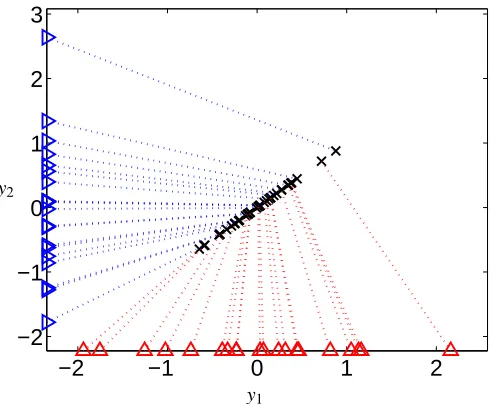
However, PPCA can overfit, for example, if the estimated number of principal components is unreasonably large. In the example in Fig. 3, PPCA with one (c=1) principal component is applied to two-dimensional (d =2) data and each data vector is only partly observed (i.e., either y1 j or
y2 j is known for all js). The observations are represented by triangles placed on the two axes in Fig. 3. The data points reconstructed with a trained PPCA model lie on a line, thus the model invents correlations that are not observed in the data. In fact, there are infinitely many PPCA models which are equally good and the final solution (and hence the reconstructions) depends on initialization. The situation would not change significantly if there were a few fully observed data vectors. Then, the trained model would be defined by those few samples and it would not generalize well for new data.
A similar overfitting example is presented in Fig. 4. There, three-dimensional data are described well by a model with c=1 principal component. The first two rows of Y are fully observed while there are only two measurements in the third row (Fig. 4a). The reconstructions of the third row of Y are very inaccurate because the model relies only on the two available observations.
3.3 Variational Bayesian PCA (VBPCA)
A common way to cope with the overfitting problem is to penalize parameter values which cor-respond to more complex explanations of the data. A natural regularization in PCA is using pe-nalization of large values in matrices W and X. In the Bayesian formulation, this is equivalent to introducing a prior over the model parameters. For example, the PPCA model in (12)–(14) can be complemented with Gaussian priors over the elements of vector m and matrix W:
p(m) =
N
(m; 0,vmI), (19)p(W) =
c
∏
k=1
N
(W:k; 0,vw,kI). (20)Here, we use a zero mean prior for m for the sake of simplicity. Including a mean hyperparameter
µ, that is p(m) =∏i
N
(mi; µ,vm), can be useful in practice.The model (20) uses a shared prior for all elements in the same column of W, parameterized with vw,k. This is done to allow automatic selection of the right number of components needed for PCA. The hyperparameters vm, vw,k can also be updated during learning (e.g., using the evidence framework or variational approximations). If the evidence of the relevance of the k-th principal com-ponent for reliable data modeling is weak, the corresponding vw,kshould tend to zero. This is called
automatic relevance determination (e.g., Bishop, 2006). The prior in (19)–(20) also introduces a
bias towards the PCA basis within the principal subspace (Luttinen and Ilin, 2010).
Let us assume that we perform ML estimation of the hyperparameters ξ= (vy,vw,k,vm)in the probabilistic model defined in (12)–(14) and (19)–(20). This can be done using the EM-algorithm if one treats the model parametersθ= (W,X,m)as hidden random variables. Implementation of the EM algorithm would require the computation of the posterior of the hidden variables p(θ|Y,ξ)
−2 −1 0 1 2 −2
−1 0 1 2 3
y2
y1
Figure 3: A simple example of overfitting with PPCA: data are two-dimensional and each sample contains only one observed value. The measurements are marked with blue and red trian-gles at the two axes. The reconstructions provided by a trained PPCA model are shown with crosses.
−2 0 2
−2 0 2
0 20 40 60 80 100
−4 −2 0 2 y1
y2
y3
samples
−2 −1 0 1 2
−4 −3 −2 −1 0 1 2
x1
y3
Using the variational approach (Wallace, 1990; Hinton and van Camp, 1993), the E-step is modified to update the approximation q(θ)so as to minimize the cost function
C(q(θ),ξ) = Z
q(θ)log q(θ)
p(Y,θ|ξ)dθ= Z
q(θ)log q(θ)
p(θ|Y,ξ)dθ−log p(Y|ξ). (21)
On the M-step, the approximation q(θ)is used as it was the actual posterior p(θ|Y,ξ)in order to increase likelihood p(Y|ξ). This can be seen as minimization of (21) w.r.t.ξ (Neal and Hinton, 1999).
The first term in (21) is the Kullback-Leibler divergence between the true posterior and its approximation. Since it is always non-negative, the cost function provides a lower bound of the log-likelihood:
log p(Y|ξ)≥ −C(q(θ),ξ). (22) This property can be used to compare solutions corresponding to different local minima of (21). More details on variational methods can be found, for example, in the book by Bishop (2006).
The variational Bayesian (VB) approach to PCA can be implemented by minimization of (21) w.r.t. the approximating pdf q(θ)andξ.1 The complexity of the cost function (21) depends on the form of the approximating pdf q(θ). A computationally convenient form for the PCA model is
q(θ) =
d
∏
i=1
q(mi) d
∏
i=1
q(wi)
n
∏
j=1
q(xj). (23)
Then, the cost function can be minimized alternately w.r.t. one factor q(θi)in (23) while keeping the other ones fixed. Because we use conjugate priors in (19)–(20), it is possible to find optimal pdfs
q(θi)on each step: The optimal q(mi), q(wi)and q(xj)are Gaussian and their update boils down to re-estimation of the corresponding means and covariance matrices.
In Appendix C, we present the update rules for the resulting algorithm, which we call VBPCA. There, we assume incomplete data sets, the update rules for the fully observed data can be found in the paper by Bishop (1999). Note the resemblance of the learning rules to the EM algorithm applied to PPCA. The mean parameters W, X, m of the approximating pdfs can be used as estimates of the corresponding model parameters. The covariance matricesΣwi,Σxj and variancesmei reflect the uncertainty about the corresponding quantities.
The advantages of the VB approach can be summarized in the following.
• VB learning is sensitive to posterior probability mass rather than posterior probability density, which makes it more resistant against overfitting compared to point estimation (e.g., PPCA or MAPPCA presented in Section 6.4). Typically, overfitted solutions correspond to high peaks in the posterior density while robust solutions contain much of the posterior probability mass in their neighborhood.
• The method provides information about uncertainty for the unknown quantities (in the esti-mated posterior covariance matrices). This can be useful to detect unreliable results similar to the one presented in Fig. 4. For example, the uncertainty of the reconstructions of missing values can be estimated as we show in Section 5.
• The VB cost function can be used for comparison between different solutions based on (22): A smaller cost yields a greater lower bound of the solution evidence. This is a useful feature for PCA of incomplete data as, in this problem, even simpler models can provide cost func-tions with multiple local minima. A greater lower bound does not guarantee a better solution, but still it seems to be a reliable measure in practice, see Figure 11 for an example.
4. Rotation in the Principal Subspace to the PCA Basis
A useful property of classical PCA is that the principal components are ordered by the amount of data variance they explain, which allows an intuitive interpretation of the results. Such a represen-tation is quite trivial for complete data sets but the extensions to the case of incomplete data is not straightforward. In this section, we show how to find such a basis in the principal subspace esti-mated by different algorithms for incomplete data. We refer to this basis as the PCA basis in the principal subspace.
One can define the PCA basis for complete data as the solution which minimizes (2) and which satisfies the following conditions: 1) the principal components (in the rows of X) are zero mean, mutually uncorrelated and scaled to unit variance:
1
n
n
∑
j=1
xj =0, (24)
1
n
n
∑
j=1 xjxTj =
1
nXX
T=I (25)
and 2) matrix W has mutually orthogonal columns which are ordered according to their norms:
WTW=diag(s), (26)
sk≥sl, k<l, (27)
where diag(s) denotes a diagonal matrix with diagonal elements sk =kW:kk2. Note that the nor-malized columns of W and their squared norms sk are the eigenvectors and eigenvalues of the data covariance matrix.
We propose to use the same conditions (24)–(27) to define the PCA basis in the principal sub-space estimated for incomplete data. Note the important difference to the complete data case: The PCA basis for complete data is unique (assuming distinct eigenvalues of the data covariance matrix) and it does not depend on the dimensionality for the assumed principal subspace. This cannot be guaranteed for incomplete data case: The principal subspace estimated with the same algorithm us-ing fewer components may differ from the leadus-ing directions of the PCA basis found in the subspace with more components.
4.1 Least Squares Approaches
The first step to transform a solution{W,m,X}found by a least squares algorithm (as presented in Sections 2.2-2.3) is to center the rows in X to zero mean:
xj←xj−µ, (28)
mpca=m+Wµ, (29)
with µ=1n∑nj=1xj. This ensures (24). The next step is to transform linearly W and X:
Wpca=WUD1x/2V, (30)
Xpca=VTD−x1/2UTX, (31) where matrices U, Dx are computed by eigen-decomposition
1
nXX
T=UDxUT (32)
and V is calculated by eigen-decomposition
D1x/2UTWTWUD1x/2=VDwVT. (33) It is easy to show that the transformed solution satisfies (25)–(26):
1
nXpcaX
T pca=
1
nV
TD−1/2
x UTXXTUD−x1/2V
=VTD−x1/2UTUDxUTUD−x1/2V=VTD−x1/2DxDx−1/2V=VTV=I,
WTpcaWpca=VTD1x/2UTWTWUD1x/2V=VTVDwVTV=Dw. 4.2 Probabilistic PCA
We show in Appendix B that the following conditions hold at the convergence of PPCA:
1
n
n
∑
j=1
xj =0, (34)
Σ∗=1 n
n
∑
j=1
xjxTj+Σxj
=I, (35)
which can be seen as the analogue of (24)–(25). Note thatΣ∗becomes the sample covariance matrix of the principal components in the noiseless limit, when vy→0. The extra requirements (26)–(27) can be used to define the (practically) unique PCA basis for a PPCA solution. They resolve the rotational ambiguity caused by the fact that any orthogonal transformation of the principal subspace does not changeΣ∗in (35).
1
nXXTis replaced withΣ∗. Finally, one can rotate the posterior covariance matrices of the estimated principal components:
Σxj,pca=V TD−1/2
x UTΣxjUD −1/2
x V, (36)
which follows from (31).
Although the optimal PPCA solution satisfy at least conditions (34)–(35), convergence of the learning algorithm to the optimal solution can be very slow. Therefore, performing the described transformations during learning can speed up learning. In the experiments, we use the transforma-tions after each iteration.
4.3 VBPCA
It can be shown (Luttinen and Ilin, 2010) that VBPCA described in Section 3.3 converges to the solution which satisfies (34)–(35) and the condition analogous to (26):
d
∑
i=1
wiwiT+Σwi
=diag(s), (37)
where wi,Σwi are the posterior means and covariance matrices for the rows of matrix W (see Ap-pendix C for notation details). Thus, one can simply use the ordering requirement (27) to define a meaningful basis for a VBPCA solution. Performing a transformation that ensures (34)–(35) and (37) during learning can speed up convergence (Luttinen and Ilin, 2010). The transformation can be performed similarly to (30)–(33) with the exception that XXTis replaced with∑nj=1xjxTj+Σxj
in (32) and WTW is replaced with∑di=1wiwiT+Σwi
in (33). Finally, one can rotate the posterior covariance matrices using (36) and
Σwi,pca=VTDx1/2UTΣwiUD 1/2
x V.
In the experiments, we use the transformations after each iteration.
5. Reconstruction of Missing Values and Selection of Model Rank
PCA is a popular approach to the problem of missing value reconstruction. The estimated principal components capture the correlations between different variables, which allows for reconstruction of missing values from the observed ones. The models discussed in this article compute reconstruc-tions using (5), in which wi, mi, xjare replaced with the respective posterior means wi, mi, xj when applicable. Additionally, one can estimate the uncertainty of the predictions for PPCA and VBPCA by computing its variance
e
yi j=mei+wTiΣxjwi+x T
jΣwixj+tr(ΣxjΣwi),
where mei, Σxj, Σwi represent the posterior uncertainties of the respective parameters and Σwi is zero for PPCA. This is a useful feature of the probabilistic methods compared to the least-squares approach.
The most straightforward way to define the rank of the model is to use cross-validation. The data set is divided into training and validation parts, models with different ranks are fitted to the training set and the the rank is selected based on the performance on the held-out validation set.
Another way is to use probabilistic methods for model selection. For example, Minka (2001) developed a means to detect the dimensionality of the principal subspace for complete data using Laplace’s method and Bayesian information criterion (BIC) applied to the PPCA model. He also discussed other alternatives but his approach showed the best performance. However, the extension of Laplace’s method to the case of incomplete data is not straightforward. An additional difficulty is the possibility that the posterior distribution over the model parameters has multiple modes cor-responding to different principal subspaces. VBPCA can select the optimal number of components automatically by setting some columns of W to zero. However, the VB cost function may have many local minima which correspond to different model ranks and exploring different local solu-tions can be a tedious procedure. Hoff (2008) estimated the dimensionality of the principal subspace in the complete data using a sampling procedure.
6. Speeding Up Learning For Sparse High-Dimensional Data Sets
Obtaining a reasonably good solution in appropriate time is a very important issue for high-dimensional problems in which learning may take several days, as in the example consid-ered in Section 7.4. The algorithms presented in the previous sections scale differently to problems with large dimensions and large degree of sparsity of observed values.
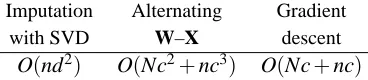
The computational complexities of different algorithms are summarized in Tables 2 and 3. For example, the alternating optimization algorithm for PPCA requires computation and inversion of matrices∑j∈OixjxTj+Σxj
and
vyI+∑i∈OjwiwTi
, which are generally unique for each row of W
and each column of X, respectively. The corresponding computational complexity is O(Nc2+nc3)
per iteration,2 which is quite a bit heavier than O(ndc) per iteration (Roweis, 1998) required for complete data.
The computational complexity O(Nc+nc)of the gradient method is small compared to previ-ously reported results. For instance, Srebro and Jaakkola (2003) reported the complexity O(ndc2)
for a more general model which was a huge improvement over the complexity O(n3c3) of the al-gorithms proposed even earlier. Using the numbers from the Netflix problem considered in Sec-tion 7.4 (N≈108, n≈480189, d=17770, c=30), we get rough estimates of the differences in practice: Imputation algorithm nd2≈1014, (Srebro and Jaakkola, 2003) ndc2≈1012, alternating W–X Nc2+nc3≈1011, and gradient Nc+nc≈109.5.
Once the model has been learned and fixed, doing inference on a new sample is fast. Using the alternating algorithm, it requires only one E-step with O(N0c2+c3), where N0≤d is the number of observed values in the new sample, while imputation and gradient algorithms require a number of iterations with O(dc)and O(N0c)each.
Efficient memory usage is an important issue for sparse data sets. It is preferable that the amount of used memory scales linearly with the number of observed values regardless of the data matrix dimensionalities. In Table 2, we provide the number of parameters estimated by different models, which gives the lower bound for the amount of the required memory. Only the imputation algorithm
Number of Imputation Alternating Gradient
Section parameters with SVD W–X descent
LS 2 (d+n)c X X X
MAPPCA 6.4 (d+n)c X X
PPCA 3.1 (d+n)c+nc2 X
VBPCA 3.3 (d+n)(c+c2) X
PPCAd 6.3 (d+2n)c X
VBPCAd 6.3 (2d+2n)c X
Table 2: Memory requirements and applicability of optimization methods to different models. We mark only the optimization schemes which can easily be implemented using the formulas provided in this paper. Some of the methods mentioned here will be presented in the upcoming sections.
Imputation Alternating Gradient
with SVD W–X descent
O(nd2) O(Nc2+nc3) O(Nc+nc)
Table 3: Summary of computational complexities (per iteration) of different optimization methods, assuming na¨ıve computation of products and inverses of matrices and ignoring the com-putation of SVD in the imcom-putation algorithm.
requires memory for the complete data matrix, and even that requirement can be diminished at a cost of greater time complexity.
6.1 Gradient-Based Learning
The gradient-based optimization scheme, extending the Oja learning algorithm to regularized PCA models, can be very efficient for large-scale problems and sparse data sets. The computational complexity of one iteration scales very well with dimensionalities, which can lead to faster learning in practice. The gradient-based approach can also be advantageous compared to the alternating optimization scheme as the latter discards the joint effect of parameters W and X on the changes in the cost function. This results in slow convergence without proper speed-up procedures (e.g., Honkela et al., 2003).
We also propose to use a speed-up to the gradient descent algorithm. In Newton’s method for optimization, the gradient is multiplied by the inverse of the Hessian matrix. Newton’s method is known to be fast-converging, but using the full Hessian is computationally costly in high-dimensional problems (d≫1). We propose a simplified approach which uses only the diago-nal part of the Hessian matrix and includes a control parameterαthat allows the learning algorithm to vary from the standard gradient descent (α=0) to the diagonal Newton’s method (α=1). The final learning rules then take the form
θi←θi−γ
∂2C
∂θ2 i
−α∂C
For example, the cost function (4) has the second-order derivatives
∂2C
∂w2ik =j
∑
∈Oix2 k j,
∂2C
∂x2k j =i∈
∑
Ojw2 ik,
which can be computed efficiently for sparse data. We showed the efficiency of the proposed op-timization scheme in the application to large-scale PCA problems in our conference papers (Raiko et al., 2008, 2007a).
6.2 Online Learning
In cases where the number of data samples is very large, n≫d, it is wasteful to go through the
whole data set before updating W (and m). Using online learning (Oja, 1983), one sample j is processed at a time as follows: The principal components xjare inferred using (8) (or the E-step in general), and W is updated using the gradient approach. When sweeping through the data, updates concerning the latter samples benefit from using the W that has already been updated using the earlier ones. This reduces the required number of iterations. Downsides of this approach include that determining the step size, or using speed-ups such as the one in Section 6.1 or the conjugate gradient, becomes difficult. Also, for enabling parallel implementation, one should process at least a small batch of samples at a time before updating W (e.g., Salakhutdinov et al., 2007). Online learning was not considered in this paper.
6.3 Factorial Variational Approximations
The overfitting problem can be more severe for high-dimensional sparse data sets. The situations discussed in Sections 2.4 and 3.2 are more probable when data points are sparsely distributed in high dimensions. Thus, methods penalizing large values of model parameters and taking into account their posterior uncertainty are especially relevant here.
The PPCA and VBPCA approaches, which take into account the posterior uncertainty at least in X, are hardly applicable to large-scale problems. First, the computational burden of one iteration of the alternating W–X scheme is very large (see Table 3) and application of the gradient-based optimization is cumbersome because of the need to compute c×c covariance matrices. Second, the
required memory is at least nc2elements for storing posterior correlations only in X. This becomes infeasible for many large-scale problems even for a decent number of principal components.
A possible solution is to take into account only some posterior correlations and to use variational techniques for learning. For example, the posterior approximation q(θ) in VBPCA can be made fully factorial leading to
q(θ) =
d
∏
i=1
q(mi) d
∏
i=1 c
∏
k=1
q(wik) k
∏
c=1 n
∏
j=1
q(xk j). (38)
instead of (23). Such posterior approximation was used, for example, by Raiko et al. (2007b) for PCA in the presence of missing values. The implementation proposed there was based on the imputation algorithm and thus not easily scalable to high-dimensional sparse problems.
The fully factorial approximation (38) reduces significantly the number of variational parame-ters. They now include the mean parameters mi, wikand xk j and the variance parametersmei,weik,
e
cost function is given in Appendix D. It can be minimized in different ways, for example, by using the gradient-based optimization scheme explained in Section 6.1. The complete algorithm works by alternating four update steps: {weik,∀i,k},{exk j,∀k,j},{wik,xk j,∀i,k,j}, and{vy,vw,k,vm,∀k}. The required derivatives are reported in Appendix D. We will further refer to this algorithm as VBPCAd. The idea of fully factorial approximation can also be used for reducing the complexity of PPCA. The posterior of the hidden states p(X|Y,W,m,vy) can be approximated to be fully factorial on the E-step. The approximating pdf (38) can be fitted to the true posterior by minimizing the cost function
CPPCA=
Z
q(X)log q(X)
p(Y,X|W,m,vy)
dX,
which is motivated by the variational view of the EM algorithm. The resulting update rules resemble the ones of VBPCAd with the exceptions outlined in Fig. 5. We refer to this approach as PPCAd.
Note that the approximation used in PPCAd does not restrict the generality of the PPCA model when it is applied to complete data. The variational approximation introduces a bias in favor of so-lutions for which the form of the posterior approximation agrees with the form of the true posterior (e.g., Ilin and Valpola, 2005). The posterior covariance matrixΣxj, which is the same for each j in the fully observed case, is diagonal if and only if the columns of W are mutually orthogonal. There-fore, restricting the posterior covariance to be diagonal guarantees that (26) holds at convergence. Requirements (24)–(25) are fulfilled because of the assumed prior model for X. Thus, PPCAd for complete data should converge to the PCA basis. PPCAd applied to incomplete data is biased in favor of solutions in which the true posterior covariance matrices are closer to being diagonal. Note also that the idea of speeding up learning by using transformations as described in Section 4.3 for VBPCA, cannot be used for VBPCAd, because the transformations would break up the diagonality of the posterior covariance matrices.
There is an interesting connection between the speed-up proposed in Section 6.1 and the fully diagonal posterior approximation. The second order derivatives needed for the speed-up coincide with the inverse of the posterior variance of each parameter, and thus their computation is practically free.
6.4 Ignoring Posterior Uncertainty (MAPPCA)
A further simplification is to use maximum a posteriori (MAP) estimation for the model parameters. The minimized cost function is then minus log-posterior of the parameters. Assuming uniform prior for hyperparameters vy, vw,k, vm, it is proportional to
CMAP=
1
vyi j
∑
∈O(yi j−wTixj−mi)2+N log 2πvy+ 1
vm d
∑
i=1
m2i +d log 2πvm
+
c
∑
k=1
"
1
vw,k d
∑
i=1
w2ik+d log 2πvw,k+ n
∑
j=1
x2k j+n log 2π #
. (39)
and it should be minimized w.r.t. the unknown quantities W, X, vy, vw,k, vm. We refer to this approach as MAPPCA.
avoided. First, using an improper prior for hyperparameters leads to a situation where the posterior pdf is infinitely large when vw,k→0,∑di=1w2ik→0. This can be overcome by penalizing too small values of the variance hyperparameters. For example, a hyperparameter vz, which is a variance parameter of the prior for a set of zero-mean variables{zi,i=1, . . . ,M}, can be updated as vz=
2β+∑M i=1hz2ii
2α+M , where
z2
i
denotes the expectation of z2
i over the posterior, and α and β are some small values (we used α=10−3 and β=10−3). This update rule corresponds to broad priors restricting vz to be positive and it guarantees that vz ≥ α+Mβ/2. The maximum likelihood (ML) estimate vz=M1 ∑Mi=1
z2iis achieved whenα→0,β→0.3
Another issue is the non-identifiability of scaling between W and X. A practical way to avoid this problem is to fix the scale by normalizing the rows of X to zero mean and unit variance (after each update) and compensating by scaling the columns of W accordingly. This guarantees the fulfilment of (24)–(25), which are the conditions justified by the prior model.
6.5 Summary of the PCA Variants
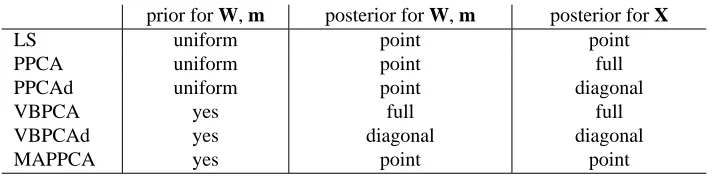
The differences between the six described variants of the PCA models are summarized in Table 4 and Fig. 5. The approaches differ on the posterior models and on the use of prior for W and m. All the variants can be derived as special cases of VBPCA by making simplifying assumptions, which is shown in Fig. 5.
7. Experiments
We study the properties of the discussed algorithms first using artificial data and then presenting a case study using the Netflix competition data (Netflix, 2007). In the experiments with artificial data, we generated data matrices Y according to model (12)–(14) with fixed dimensionalities d, c and n. The mixing matrix W was generated by taking a random orthogonal matrix and scaling its columns by 1,2, . . . ,c. The bias term m was selected randomly from a Gaussian distribution with
variance 10. For one of the data sets (10-5-mlp), we nonlinearly transformed the resulting data. The observed values were selected randomly in Y and the rest of the data matrix was used to compute the test reconstruction error.
We used four types of data sets in the experiments:
• Data Set 10-5-g: The data set is for the case where d≪n and Gaussian components. We
generated n=1000 samples from a 10-dimensional Gaussian distribution with c=5 principal directions. The standard deviation of the noise in (14) was√vy=0.5.
• Data Set 10-5-mlp: The data lie within a nonlinear manifold and d≪n. The data were
generated by a random nonlinear transformation of five-dimensional Gaussian data to the 10-dimensional space and adding relatively small Gaussian noise. The transformation was performed by randomly initialized multi-layer perceptron networks. The number of samples was n=1000.
• Data Set 10-4-mog: The data set is a linear combination (12) of non-Gaussian xjand d≪n.
We used c=4 independently distributed non-Gaussian components (elements of xj). The
prior for W, m posterior for W, m posterior for X
LS uniform point point
PPCA uniform point full
PPCAd uniform point diagonal
VBPCA yes full full
VBPCAd yes diagonal diagonal
MAPPCA yes point point
Table 4: Variants of probabilistic approaches to PCA.
VBPCA
? diagonal posterior
Σxj=diag(exk j)
VBPCAd
?
uniform prior vw,k,vm→∞
point posterior
Σwi,mei→0
PPCA
? diagonal posterior
Σxj=diag(xek j)
PPCAd ?
uniform prior vw,k,vm→∞
point posterior e
wik,mei→0
?
point posterior
Σxj→0
LS
point posterior e
xk j→0
MAPPCA
-uniform prior
vw,k,vm→∞ ?
point posterior
Σwi,mei,Σxj→0
Figure 5: Relationships between the PCA variants are easily described by deriving each of them as a special case of VBPCA. The corresponding update rules can also be derived from the VBPCA update rules using the given restrictions.
−5 0 5
0 0.2 0.4
−5 0 5
0 0.2 0.4
−50 0 5
0.2 0.4
−50 0 5
0.2 0.4
p(x)
x1 x2 x3 x4
Figure 6: The distributions of the four components used to generate the 10-4-mog data set.
Data Set d n c Gaussianity Square root of variances 10-5-g 10 1000 5 yes [5 4 3 2 1 0.5...0.5]
10-5-mlp 10 1000 5 no varying by nonlinear transformation 10-4-mog 10 1000 4 no [4 3 2 1 0.5...0.5]
100-10-g 100 100 10 yes [10 9 ... 1 0.1 ... 0.1 ]