INTRODUCTION
In recent years the total reaction cross-section of heavy ions has become the focus of extensive theoretical1-4 and experimental5 attention. The reaction cross-section also finds applications in diverse research areas such as radiobiology and space science6,7. Moreover the total reaction cross-section, σR, is one of the mostimportant physical quantities describing the properties of nuclear reaction. The reaction cross-section is used to calculate the nuclear root mean square radius (rms) which is necessary to understand the nucleus-nucleus reactions and scattering mechanisms¹. In Ref. [6], the effective rms radii of nucleon distribution of B, Be and He isotopes had been deduced by comparing the experimental data for the reaction cross-section by theoretical calculations based on Glauber theory. The optical limit to Glauber theory is usually used with appreciable success to describe the reaction cross section between complex nuclei2,3,8. The inputs to these calculations are the nucleon- nucleon (NN) reaction cross-section, σNN, and the density distribution of the interacting nuclei. Recently, this method has been used to determine the rms radii of the interacting nuclei and to study halo nuclei3,6,8,9. The value of σR for a pair of
The behavior of reaction cross-section at low and
intermediate energies by considering in-medium
effects in
σσσσσ
NNfor light and heavy target nuclei
H. EL-GEBALY
Department of Physics, Faculty of Science, Cairo University, Giza (Egypt). (Received: May 04, 2010; Accepted: June 26, 2010)
ABSTRACT
The in-medium effects in nucleon-nucleon cross-section were treated using different approaches. We study the variation of σR with different values of rms. Also we study the variation of σR with different values of incident energy per projectile nucleon for light interacting pair 12C-12C and heavy target nucleus
pair12C-208Pb.The coulombs repulsion was taken into consideration by assuming a simple model. We
found that the in-medium effects on σR are small when the target nucleus becomes heavy.
Key words: Nucleon-nucleon cross-section, light & heavy target nuclei.
interacting nuclei calculated in the frame work of the optical limit of Glauber theory is affected by different factors. One of these factors is the method of treating in-medium effects. Also, it is sensitive to the range of the NN force and the values of rms radii of the nuclei considered. σR is usually calculated by assuming the zero-rang force [3] of the interacting nucleons and the NN reaction cross-section is considered through different approaches [ 1,5,9]. First, σNN is taken directly as free NN cross-section, f
NN
σ [8], without density dependence or evaluated at constant density usually assumed to be equal to saturation nuclear matter density ( ρ=0.17 fm-3 )[1,9].This approach in treating in-medium effects permits extracting σNN out of integrations since, in this case, it has constant value. Moreover for constant value of σNN and assuming Gaussian shapes for the density distribution, most of the integrals in calculating σR can be performed analytically which means that the evaluation of σR is numerically very simple.
The accurate treatment of in-medium effects is the geometric approach of Pauli blocking which needs numerical calculations of five fold integral to get σNN. Due to this complexity, many authors simplified this effect by assuming different approximations10-13. Recent expression for σNN was derived in Ref’s [1,9] which takes in-medium effects through density and energy dependence in σNN. When σNN (ρ) is determined from local matter density in each volume element of the nuclear overlap region, the value of σR is reduced by few percent compared with that obtained using free NN cross section
σ
NNf [10,14]. This is because the constant effective global density ρ in σNN which produces the same value of óR as the more complicated correct treatment of density dependence is too small compared to the saturation nuclear matter density ρ = 0.17 fm-3 [9]. Since the calculated value of σR is affected by several factors like the method of treating in-medium effects, rms radii of nuclei and range of NN force, it is needed to study the variation of σR with these factors.The aim of the present work is to study the variation of the reaction cross-section at low and intermediate energies with different approaches of considering in-medium effects of σR .In this study we assume spherical shapes for both target and projectile nuclei and we consider different values of rms radius of the interacting nuclei. We use the recent density and energy dependent σNN derived in Ref.[9]. In the present study we first take σNN to be the free NN cross-section then we evaluate it at constant density value ρ =0.175 fm-3. We compare the values of σR calculated by these two methods with the results obtained assuming local density variation in each volume element through the integration process.
The next section briefly describes the method of calculating σR using the optical limit of Glauber theory. The results and discussion are given in section -3.
Formulation
In the optical limit of Glauber theory, calculations of σR need a knowledge of the nuclear transparency T(b). This quantity is the probability that a projectile with impact parameter b will be transmitted through the target. Assuming purely absorptive and zero range approximation of the
interacting nucleons, T(b) is given by
...(1) where Rv is the separation vector joining the centers of mass of the interacting nuclei and
/
Lab p
E A
is the incident energy per projectile nucleon in the laboratory system.
NN σ
is the in-medium nucleon-nucleon cross-section
( , / ) NN EL Ap σ ρ
at the given incident energy.
The iso-spin averaged NN cross section is evaluated at density value ρ ρ= p( )r +ρT(Rv v+r) and averaged over the reaction cross sections of neutron,, proton-proton and neutron-proton , as
...(2)
where AP(T),ZP(T) and NP(T) are the projectile (target) mass, charge, and neutron numbers, respectively.
The reaction cross-section is obtained after integration of the nucleus-nucleus over all impact parameters as,
...(3)
We assume that the density of the heavy spherical nuclei is given by the Fermi shape
...(4)
For light nucleus, we take the density parameters from Ref.[15]. The root mean square radius of the nucleus
2 1/ 2
r
〈 〉
is defined by
A correct parameterization of the cross-section between two free nucleons is given by Charagi and Gupta [1]. It depends on the incident nucleon energy in laboratory system as
...(6)
where
In-medium effects modify the free space cross-section in the following way,
for two similar nucleons,
for two different nucleons ...(7)
The multiplicative factors which take medium effects into consideration are given by [9],
...(8)
In using the last equations, the correct treatment of ρ–dependence is to take the density ρ as the sum of the projectile and target densities in each volume element
drv
. This corresponds to the local density at each point along the trajectory. Another approach to consider approximate medium effects is to evaluate
( , ) n n p χ
at constant global density which is usually equal to the value of saturated nuclear matter density. In case of neglecting in-medium effects in calculating σR we use equations (6) for σNN instead of equations (7,8). In the present work the reaction cross-section is calculated for the light and heavy target pairs 12C-12C and 12C-208Pb at different values of incident energy per projectile nucleon in the range (10-1000 MeV/nucleon).
RESULTS AND DISCUSSIONS
The aim of the present paper is to show the dependence of the reaction cross-section for
light and heavy target nuclei on the method of treating in-medium effects in . For this purpose we calculate the reaction cross-section for the two pairs 12C-12C and 12C-208Pb. Fermi shape matter density distribution is assumed for the heavy target nucleus 208Pb. The calculations are done at different values of the incident energy per projectile nucleon, ELab/ Ap, and different values of rms radius of 12C-nucleus had been taken from 2.32 fm [16] to 2.5 fm [5]. In the present work the values of energy considered, start from 10 MeV/ nucleon up to 1000 MeV/ nucleon. In-medium effects are included in σNN, by considering local-variation of density in each volume element during the integration process,
exact NN
σ
, then
NN
σ is calculated at global constant value of density. Also we calculated σR variation with energy using which corresponds to density value =0.0 fm-3.
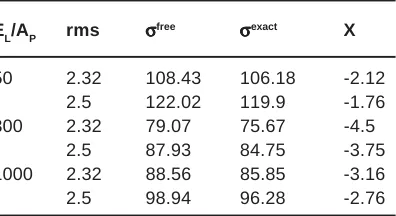
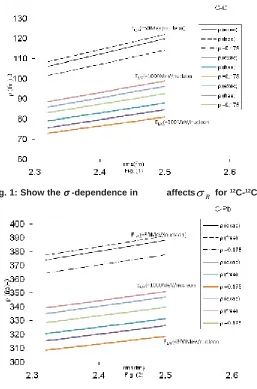
Fig’s (1) , (2) and tables (1) , (2) shows how the method used to treat ñ -dependence in affects, we present in tables (1) and (2) the values of for 12C and 208Pb target nuclei calculated by different methods and at different energy values. Each table contains the calculations of for two values of rms radius of 12C-nucleus. For light target nucleus, table (2a) shows that the percentage difference between σexct and is about 4.49 % and 3.75%, for r ms values = 2.32 fm & 2.5 fm respectively at ELab/Ap =300 MeV/ nucleon. But for the heavy target nucleus the above differences are 1.66% and 1.53% for the same energies as shown in table (2b). In case of coulomb modification, for light target nucleus, table (2c) shows that the percentage difference between σexct and is about 4.11 % and 3.58%, for rms values = 2.32 fm & 2.5 fm respectively at ELab/Ap =300 MeV/ nucleon. But for the heavy target nucleus the above differences are 1.67% and 1.55% for the same energies as shown in table (2d).
Table 2(b): The same as table (1a) but for 12C-208Pb For C-Pb ….without c. modification EL/AP rms σσσσσfree σσσσσexact X
50 2.32 377.55 374.1 -0.92
2.5 391.4 388.24 -0.81
300 2.32 320.65 315.41 -1.66
2.5 331.4 326.4 -1.53
1000 2.32 339.25 335.1 -1.24
2.5 351.05 347.1 -1.14
Table 1(a): The same as table (1a) but for 12C-208Pb
C-C E=50 E=300 E=1000
m b m b m b
ρ free 75.428 -66.57 49.2 -35.07 57.65 -45.2
ρ exact 76.14 -70.5 49.44 -39.04 57.85 -48.39
ρ 0.175 69.28 -59.08 43.8 -28.81 52.81 -39.21
Table 1(b): show the ηηηηη -dependence in
NN σ
affects
σ
R for 12C-12CC-Pb E=50 E=300 E=1000
m b m b m b
ρ free 76.71 199.54 59.59 182.35 65.37 187.56
ρ exact 78.41 192.15 60.91 174.08 66.55 180.69
ρ0.175 73 195.23 55.8 179.17 62.07 184.55
Table 2(a): Shows the values of 12C-12C cross-sections for different values of (σσσσσ and rms )
without coulomb modification For C-C ….without c. modification EL/AP rms σσσσσfree σσσσσexact X
50 2.32 108.43 106.18 -2.12
2.5 122.02 119.9 -1.76
300 2.32 79.07 75.67 -4.5
2.5 87.93 84.75 -3.75
1000 2.32 88.56 85.85 -3.16
2.5 98.94 96.28 -2.76
Table 2(c): The same as table (2a) but for with coulomb modification For C-C ….without c. modification EL/AP rms σσσσσfree σσσσσexact X
50 2.32 105.26 103.05 -2.14
2.5 118.67 116.57 -1.8
300 2.32 82.66 79.39 -4.11
2.5 92.2 89.01 -3.58
1000 2.32 88.41 85.7 -3.16
2.5 98.79 96.13 -2.76
Table 2(d): The same as table (2c) but for 12C-208Pb For C-Pb ….without c. modification EL/AP rms σσσσσfree σσσσσexact X
50 2.32 334.64 331.4 -0.97
2.5 347.72 344.74 -0.86 300 2.32 314.06 308.89 -1.67 2.5 324.71 319.76 -1.55 1000 2.32 337.21 333.07 -1.24 2.5 348.98 345.04 -1.14
Table 3(b): The same as table (3a) but for 12C-208Pb
EL/AP σσσσσexact (rms=2.32) σσσσσfree (rms=2.32) σσσσσexact (rms=2.5) σσσσσfree (rms=2.5)
Without With without with without with without with
C.mod. C.mod. C.mod. C.mod. C.mod. C.mod. C.mod. C.mod.
10 453.47 218.2 455.71 219.86 471 231.51 473 232.89
50 374.1 331.4 377.55 334.64 388.24 344.74 391.4 347.72
80 350.6 324.77 354.7 328.7 363.51 337.21 367.33 340.89
100 340.2 319.85 344.62 324.13 352.55 331.84 356.72 335.87
150 324.56 311.31 329.54 316.18 336.4 322.59 340.8 327.21
300 315.41 308.89 320.65 314.06 326.4 319.76 331.4 324.71
500 321.97 318.02 326.82 322.82 333.3 329.27 337.92 333.86
800 331.07 328.56 335.43 332.9 342.86 340.3 347..02 344.44
1000 335.1 333.07 339.25 337.21 347.1 345.04 351.05 348.98
Table 3(a): Comparison between σσσσσexact and σσσσσfree at minimum rms and maximum rms with and without coulomb modification for the pair 12C-12C EL/AP σσσσσexact (rms=2.32) σσσσσfree (rms=2.32) σσσσσexact (rms=2.5) σσσσσfree (rms=2.5)
Without With without with without with without with
C.mod. C.mod. C.mod. C.mod. C.mod. C.mod. C.mod. C.mod.
10 148.32 129.75 149.43 130.79 168.6 148.83 169.6 149.79
50 106.18 103.05 108.43 105.26 119.9 116.57 122.02 118.67
80 93.8 91.96 96.52 94.66 105.6 103.64 108.2 106.23
100 88.37 86.94 91.32 89.87 99.3 97.8 102.15 100.62
150 80.3 79.39 83.59 82.66 89.97 89.01 93.17 92.2
300 75.67 75.23 79.07 78.62 84.58 84.12 87.93 87.46
500 79.06 78.78 82.2 81.92 88.47 88.18 91.56 91.27
800 83.75 83.58 86.6 86.42 93.87 93.69 96.67 96.48
1000 85.85 85.7 88.56 88.41 96.28 96.13 98.94 98.79
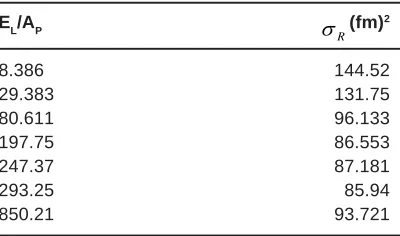
Table 4: Experimental data for C-C EL/AP
R
σ
(fm)28.386 144.52
29.383 131.75
80.611 96.133
197.75 86.553
247.37 87.181
293.25 85.94
850.21 93.721
The coulomb interaction can affect the reaction cross-section especially at small energies. It deflects the projectiles away from the reaction
region. It can be taken into consideration by modifying the trajectories using the equation
Fig. 1: Show the σσσσσ -dependence in
NN
σ
affects
σ
R for 12C-12CFig. 2: Show the σσσσσ -dependence in affects for 12C-12C
1. S.K.charagi and S. K.Gupta, Phys, Rev. C 41: 1610 (1990).
2. R.J.Glauber Lectures in Theoretical Physics, edited by W.E.Britten et.al, (interscience, New York 1959)Vol. I, 315, W.Czyz and L. C. Mamximom, Ann Phys. (N. Y.) 52: 059 (1959). 3. J.A.Christley, and J.A.Tostevin, Phys. Rev.
C59: 2309 (1999).
4. S.John,L.W.Townsend,J.W.Wilson and R.K.Tripathi, Phys.Rev. C48: 766 (1993). 5. S.Kox et al., Phys.Rev. C35, 1678 (1987),
M.Buenerd et al., Nucl.Phys.A424, 313 (1984),and C.Perrin et al.,Phys.Rev.Lett.49, 1905 (1982).
6. I.Tanihata et al., Phys. Lett. B. 206: 592 (1988), I.Tanihata et al., Phys. Lett. B. 160: 380 (1985), I.Tanihata et al., Phys. Rev. Lett. 55: 2676 (1985), I.Tanihata et al., Phys. Lett. B. 286: 261 (1992).
7. J.W.Wilson et al., “Transport methods and interaction for space radiations” NASA
REFERENCES
Publications 1257 (1991).
8. M.Ismail, Aly Ellithi, H.Abu-Shady, Phys. Rev. C71: 027601 (2005)
9. Cai Xiangzhou, Feng Jun, Shen Wenqing, Ma Yugang, Wang Jiansong and Ye Wei Phys. Rev. C58: 572 (1998).
10. R.E.Warner, I.J.Thompson, and J.A.Tostevin
Phys. Rev. C65: 044617 (2002).
11. N.J.DI Giacomo, J.C.Peng, and R.M.Devries,
Phys.Lett. 101B: 383 (1981).
12. M.S.Hussien, R.A.Rego and C.A.Bertulaini,
Phys. Rep. 201: 279 (1991).
13. C.A. Bertulani, Phys. G. Nucl. Phys. 27: L67 (2001).
14. M.Ismail, M.M.Osman, H.El-Gebaly, F. Salah and W. M. Seif, Phys. Rew. C 69: 014606 (2004).
15. G.F.Ber tsch,B.A.Brown and H.Sagawa,
Phys.Rev. C39: 1154 (1989).