THE PERCEPTIONS OF MALAYSIAN
CONSUMERS TOWARDS THE USAGE AND THE
FUTURE OF EBOOKS
Poh Swee Hiang
Abstract
T
he sales of eBooks in developing countries are not encouraging. This studyattempts to find out the existing perceptions of Malaysian consumers towards the usage and the future of eBooks. A semi-structured interview was carried out. Nine participants, each with five to ten years of eBook experience, were selected.
Three of them are eBook consumers and the others are eBook industrialists. The
findings show that eBooks are easy to use, subject to Internet connectivity, successful downloading, and device suitability. EBooks face the challenge against digital texts that do not conform to the conventional format of a book and the need to enhance their features with audio, visual, or interactive elements. The future of eBooks lies with the generation of digital natives who grow up handling screens of electronic devices effectively. They may even transform eBooks with artificial technology into a product that serves their natural, exploratory, and interactive learning styles.
Keywords: eBook, ease of use, digital natives, artificial intelligence
Introduction
The commonly used term for electronic books in the publishing world is ‘eBook’ (Maddox, 2009). EBooks make up 21% of all book sales in the USA and 17% in the UK (Wischenbart, 2015, 2016). Even in Europe as a whole, eBook sale is currently around 5% (New European Media, 2016). In Malaysia, sales of eBooks represent less than one percent of the total sales of published books, (Itar, 2015, 16 December). This study attempts to find out the existing perceptions of Malaysian consumers towards eBooks starting with the aspect of usage. Other aspects to be studied include: type of devices used, preferences towards eBooks compared with other media, how
to popularise eBooks through effective marketing, and the future of eBooks.
Wischenbart (2018) concluded that the hybridisation and simultaneous combination of old and new practices have emerged in the publishing industry. Contents are now created across different formats and media, by professionals versus amateurs, and by publishing companies versus self-published individuals. Smartphones have become the preferred device for accessing contents, so much so that “mobile is eating the world” (Evans, 2013). As a result, digitalisation brings reading, movies, games, and
social interactions seamlessly and coequally to the attention of consumers.
With the above development as the background, this study was carried with the objective of projecting the probable future of eBooks based on the existing experience and opinions of the eBook consumers. The result of this study would be useful as a reference for the eBook industry to strategise on how to transform it into a vigorous and profitable business.
Methology
This is a qualitative study using interview as the main method, supplemented by data obtained from a video recording of a panel discussion and personal communications with four principals who are related to the eBook industry.
Interviews
A semi-structured interview method was used to obtain participants’ views and opinions, which could reveal and explain the existing eBook phenomenon in Malaysia based on their prior experiences and preconceived notions. Questions were also asked to generate projections on the future of eBooks.
The interviews were carried out using a mobile social-media communications application (app) called WhatsApp. Participants were asked one question after another in an open-ended manner so that clarifications to the previously answered questions could be pursued. Although questions were open-ended, the basic set of questions asked was limited to 18. As some questions were only relevant to the eBook consumers, while others were relevant to eBook industrialists, not every participant was asked the entire list of questions. The interviews were carried out between 11th and 27th of June, 2018.
The responses were sent from a smartphone to a computer and saved in plain text format and subsequently converted into Word format. A qualitative data analysis was done based on these eBook related themes: usage, devices, eBook preference, marketing, and the future. An interesting topic, artificial intelligence, cropped up as this research was carried out.
Thailand, and Malaysia towards book publishing in their respective countries and Taiwan were widely discussed and compared.
Subjects
Nine participants were interviewed. The participants were selected based on the knowledge that they have been involved in the field of eBooks for at least five years so that in-depth views and opinions can be obtained to reveal and explain the existing phenomenon as well as to generate possible scenarios on the future of eBooks. The selection of participants is not to be regarded as representative of all
eBook consumers or industrialists.
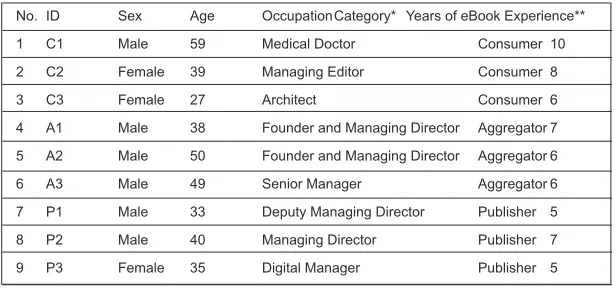
They each had between five to ten years of eBook experience. Three of them are eBook consumers while the remaining six are eBook industrialists (Table 1). The three consumers have been active eBook consumers since they started using eBooks between six to ten years ago. The other six subjects are involved in the eBook industry as aggregators or publishers. Of the three eBooks aggregators, two are founders and entrepreneurs of two active Malaysian eBookstores while the third person works for a government-linked corporation that helps to develop and promote the Malaysian book industry internationally. The remaining three participants work for two different publishers that are active in both print and eBook domains.
Table 1: Subjects of Interview (n = 9)
No. ID Sex Age Occupation Category* Years of eBook Experience** 1 C1 Male 59 Medical Doctor Consumer 10 2 C2 Female 39 Managing Editor Consumer 8 3 C3 Female 27 Architect Consumer 6 4 A1 Male 38 Founder and Managing Director Aggregator 7 5 A2 Male 50 Founder and Managing Director Aggregator 6 6 A3 Male 49 Senior Manager Aggregator 6 7 P1 Male 33 Deputy Managing Director Publisher 5 8 P2 Male 40 Managing Director Publisher 7 9 P3 Female 35 Digital Manager Publisher 5
Notes: * Category of involvement with eBooks: eBooks consumer, eBook aggregator, Publisher ** Years of using or working on eBooks
Of the eBook consumers, C1 has read 50 eBooks over ten years, C3 has read 20 trade eBooks over the past six years although she has been reading more
eBooks, inclusive of academic titles, on laptops since her college days eight years
Results and Discussions
The results of this study are discussed under six different themes as below.
Usage
The three regular eBooks consumers are certain that eBooks are useful but not easy to use. C1 finds it easy to carry scores of books at any one time. He uses a Kindle, an e-reader produced by Amazon, to read novels with stories unfolding in sequence. The only disadvantage is that eBooks cannot be flipped as in print books, and hence cannot be used as reference books. C2 concurs that this is quite troublesome sometimes when she needs to go back to previous pages. With a hard copy, she can easily knows roughly where to look back. Although eBooks come with a search function, she does not use it as she does not even think of keywords when browsing back. C3 is satisfied with using portable eBooks for casual reading. However if it involves marking up and doing notes, then they might not be as intuitive as physical books. She sums up her opinion simply as “I guess we’re not used to it”.
Only one eBook producer, A2, agrees that eBooks are not easy to use, particularly for working adults, because most working adults access eBooks via their smartphones, which can strain their eyes.
On the contrary, all the other five eBooks producers agreed that eBooks are easy to use. To A1, one of the valued propositions of eBooks is that they are practical. They can be accessed at anytime and can be read with graphics that suit the users. To him, the perception that eBooks are difficult to use usually comes from print book readers who are trying to justify their unwillingness to migrate. P1 asserts that the functionalities of eBook platforms and existing eBook formats have improved over recent years. EBooks today can be accessed and read easily on user friendly platforms. Hence he thinks that eBooks are both useful and easy to use today. P2 contends that eBooks are easy to use and so much better for travelling due to size and weight considerations. P3 concurs that eBooks are easy to use. Problems in utilising eBooks are more related to Internet connectivity
rather than inherent eBook features.
A3 postulates that the comment of the uneasiness of using eBooks may come from some digital immigrants (DI). Digital immigrants have been adapting all
their lives and accessing reading materials via print-on-paper. Therefore they may
find it troublesome to read eBooks. To him, portability and user experience (UX) make it easier to read eBooks with the advanced technology of current reading apps. A gadget such as a mobile phone can carry up to 200 eBooks in ePub format, making eBooks far easier to access than print books. Furthermore, users can adjust the size of the text according to their preference and the screen size of their device, making their reading experience easier and more comfortable.
like driving a car with a manual gearbox. Once used to it, however, one will find driving to be fun and rejoicing. He also points out that using eBooks requires certain conditions: Internet access, a device, etcetera. The most common complaint received from eBooks customers is “cannot download”, which can indicate several things: no Internet access, poor connectivity, server failure, or even lack of knowledge about how to perform a download. According to e-Sentral.com, an eBook platform, 6% of eBooks consumers have complaints. Of these complaints, 40% are download-related issues.
The above results show that eBooks are generally useful, but its ease of use is subject to the availability of Internet connectivity and the ability of the consumers to download eBooks.
Devices
Two eBook users, C1 and C3, use Kindles. C1 used to have a Xiaomi Pad tablet device, but did not really know how to use it properly. He finds the glare of a computer screen objectionable when reading eBooks. C3 uses a laptop when reading eBooks for assignments, utilising Adobe software for making notes. She does not use an iPad to read eBooks as she thought that she would be distracted by other applications and end up not reading. C2 uses a smartphone to read eBooks. She finds it convenient to read eBooks in ePub version with reflowable text as she mostly reads Chinese language eBooks. Though she owns an iPad, she finds it inconvenient, heavy and troublesome to lug around. A2 opines that mobile devices are great for reading shorter articles or news. College and secondary school students prefer to read academic eBooks using their personal computers, which have larger screens and larger storage capacities for downloading books.
P1 emphasises the suitability of e-reading devices. EBook-reading on digital devices are not comfortable for users over a long period of time. Although an eInk device, which displays a paper-like screen, is a good alternative, it requires a device separate from our normal mobile phone or tablet. It is thus troublesome to add an additional eInk device to a multi-purpose device that shows colourful
graphics and plays video contents.
thought that she was playing with the smartphone when she was actually reading
eBooks frequently.
As eBooks can be read in multiple platforms using multiple devices, there is
no single preferred device at the moment.
EBook Preferences
Although free or pirated eBooks are available, all the three eBook consumers pay for their eBooks. C1 points out that he pays when he needs an eBook, knows the author personally, or feels the need to help a cause. C3 pays if there is a good bargain. Some
eBooks are cheaper than their print version, sometimes priced perceptively cheap at
around one pound (GBP). The eBooks she has bought are novels, which will only be read once, classical philosophy texts, and publications that she does not feel the need to keep physical copies of. C2 reads mostly overseas publications. She pays in order to support and encourage the authors to continue to write more stories. Furthermore, purchasing hard copies can be very expensive, as postage normally amounts to about half of the price of a book. The above three eBooks consumers have grown to embrace the digital payment culture, as opposed to an issue pointed out by P2 that many consumers still expect everything on Internet to be free.
Many novel publishers in Indonesia are still worried that their eBooks are pirated and sold on the Internet for a fraction of their normal price. Although eBooks can be protected by using Digital Rights Management (DRM) from being downloaded and copied, some young technopreneurs, either being ignorant or defiant of copyright laws, have screenshot eBook page by page and sold them that way. The Publishers Association of Indonesia, IKAPI, is intensifying its
copyright education programme to young consumers particularly and the general
public generally concerning the importance of copyright protection (personal communication, Lia Andriana, 2018, July 5; Taipei Rights, 2018, July 4).
C1 would still purchase print books if there is a bargain for physical copies, or a possibility to reuse or revisit the books later on. C2 will buy hard copies when she wants to keep the physical copy of a book. Although reading eBooks has become a habit for the three eBooks consumers, they still prefer print books when there is a desire to keep a physical copy to be read multiple times.
The challenge with text-only eBooks is that they are typically available also in alternate media such as print books. A2 sees a way to attract more eBook consumers by having more interactive contents which are not available in
non-digital media.
free reading and writing platform, Wattpad (wattpad.com), which is doing well in Malaysia as it incorporates social networking. Lia Andriana, Founder of the publisher Penerbit Haru of Indonesia, relates that many of the successful authors of stories on Wattpad end up publishing their work as bestselling novels (personal communication, Lia Andriana, 2018, July 5).
P2 highlights the importance of user experience (UX), as reading using a device may not be a natural way to attain the pleasure of reading. At home and in office, he prefers print editions for a better reading experience. In a car while driving, he prefers an audio book to catch up with reading the kinds of books that do not require photographs, charts, or images. P2’s preference for audio books reflects the work of SH Tan, the General Manager of a Singapore company that specialises in audiobooks for schools. SH Tan recounts that text-based eBooks sell much better with additional effects, even if the stories are just read out loud (personal communication, Tan Seng Heng, 2018, June 5). G Tan, the founder of The Grayhawk Agency in Taiwan, shares his happiness in catching up with reading by listening to eBooks while he walks to his office as well as working out in the gymnasium (personal communication, Gray Tan, 2018, July 5). A2 indicates that his interactive eBooks for the young adults, rare eBooks, and eBooks which are difficult to obtain in print format are categories that
are popular on his eBook platform.
There is a challenge of eBooks against digital texts that do not conform to the conventional format of a book in the digital environment today. For text-only eBooks, a further challenge would be the need to enhance their features with audio,
visual, or interactive elements.
Marketing
A1 thinks that there is no clear solution as perhaps some print book users are not meant to migrate. Marketing should be focusing on those who are willing to migrate and the digital native generation who are more comfortable with operating devices and who will not have much to compare to vis-a-vis print book reading. He foresees two possible alternatives related to eBook usage in Malaysian education. First, eBooks are to be used in the schools enforceable by a government policy. This new generation will naturally use eBooks because they are used to them since their school days. The other way is if there is a powerhouse with enough money to advertise and promote eBooks to become trendy. Indeed, C1 has proposed to advertise eBooks on the Facebook, which e-Sentral has been doing. The feedback, according to A1, is that the response has not been encouraging, as the interests of Facebook users are too broad. It is thus difficult to carry out customer segmentation analysis in order to target eBooks towards the potential customers accurately and profitably. In fact, e-Sentral has spent more than 2.4 million Ringgit (MYR) in advertising and promotion over the last five years, and the response has been lukewarm though there
G Tan reported that there was an eBook sales spike in Taiwan over the 2017/2018 fiscal year in his briefing on the Taiwanese book market and books from Taiwan during the Taipei Rights Workshop 2018, Summer Edition. He attributed this encouraging phenomenon, which he termed as the eBook Finally Happening, to three factors. First, the eBook market was stimulated by the arrival of the new and heavily discounted e-reader Kobo. Although the local eBook business already had a five year history, Kobo’s arrival was a mild tsunami. Secondly, a local company, Readmoo, released an e-reader called mooInk. MooInk is an eInk device that makes reading on the screen comfortable. It can also convert the horizontal flow of Chinese characters vertically, as there is still a substantial bisection of Chinese readers who prefer reading traditional Chinese texts vertically. Finally, the most popular e-commerce platform selling physically books in Taiwan, books. com, began to sell eBooks. This business undertaking by a trusted brand boosted the confidence of the reading community to accept eBooks as an alternative to print. On average, an eBook is priced at 70-75% of the price of a physical book, and there are additional discounts from most eBooksellers. It is estimated that eBook sales has amounted to 5% of the book sales for selected bestsellers (Tan, 2018, July 3).
Nunchanock Kamchitanon, an editor from Matichon Publishing Group in Thailand, is banking on promoting reading as part of the lifestyle of the Generation Y who are active on social networking. By making known that one is reading a certain book with the uploading of a book cover or talking about it will uplift one’s status, though one may not have read the book at all (Taipei Rights, 2018, July 4). Thus an eBook can be part of a package in the promotion of a certain title or character that is popular and trendy. In Indonesia, some Wattpad novels are made into movies. The creative authors are using social media to create their fan-based communities with movie trailers, sound tracks, and chats between characters (Taipei Rights, 2018, July 4).
As a millennial online consumer, C3 proposes fierce promotions be carried out as is done by the clothing industry. Amazon has been good in doing this for the book industry, by having one pound (GBP) or 99 cent promotions at a single time with different titles. She also proposes a business model based on subscription or membership, just like the music app, Spotify. Readers pay monthly fee instead of paying for each book. She agrees with A1 that efforts are needed to approach and
persuade the government and other institutions to incorporate eBooks into their education policies.
The Future
Both P2 and A3 point out that reading culture is the main issue in popularising eBooks because people are reading less nowadays. A2 concurs and sees the need
to cultivate and develop a generation of eBook lovers though they read all kinds of digital media on their screens.
Comparing eBooks to print books in the future, C1 believes that some consumers will always prefer to hold paper-based books while reading. He believes it may take another ten to fifteen years for eBooks to be more popular than print books.
A3, P1, and P3 also think that eBooks may be more popular in five to ten years’ time, as more and more digital natives access content via eBooks and the advancements in device technology will make reading eBooks much easier. The next generation of digital natives will be more comfortable with digital device usage. They would, presumably, be more used to reading books on digital devices, as
compared to the current generation. The trend of the tech-savvy younger generation
reading more digital content instead of printed newspapers will be replicated for
eBooks.
C3, who reads twice as many eBooks as print books, would prefer to purchase eBooks from sources or platforms offering eBooks with affordable prices and up-to-date titles of a variety of genres. However, as an architect, she needs access to visual information such as construction drawings, blue-prints, and 3D graphical representations. So, she does not think that she would give up on print. She foresees the growth of eBooks as the digitisation of books is being carried out by many influential organisations and institutions. On whether eBook reading will overtake print books reading, she has this to say:
I think the changes happen over generations. Usability, I believe, is subject to personal background and familiarity. When the new generation grows up surrounded by screens, be it tablets or handphones, their acceptance of eBooks inevitably will be higher compared to our generation. Especially if the schools promote the use of eBooks. If the government incorporates the use of eBooks, the publishing, design, education, and other related industries will also push for the proliferation of eBooks.
Artificial Intelligence
into the eBook system to make it an effective and efficient ubiquitous learning machine (personal communication, Ian Denison, 2018, May 31).
A1 thinks that artificial intelligence (AI) will make eBooks more interesting but he is not sure whether it can benefit all readers. P1 has high hope that digital natives themselves will create another level of better eBooks as technology is getting better and better over time. A2 further points out that AI will assist eBook publishers and
eBooksellers to understand user preference and recommend appropriate eBooks for
the users. In addition, AI can also be applied during the eBook production phase by
speeding up the editing process and optimising layout techniques and artistic inputs.
Conclusion
This study shows that digital immigrants are used to reading print books, which they utilise to compare with their user experience (UX) of using eBooks. Perhaps their dissatisfaction may not be applicable to digital natives. Although the eBook industrialists have all the reasons to stand firm with their contention that eBooks are useful and easy to use, eBook consumers point out that eBooks are more suitable for casual reading without in-text cross-referencing. To attract more digital immigrants to use eBooks, the UX of using eBooks has to exceed that of using print books.
There are still issues of the connectivity and device suitability that need to be addressed. EBook consumers expect seamless integration of content, device, and technology once they want to read. Internet availability for realtime streaming to read online or downloading to make a copy available for anytime and offline reading have to be assured to avoid frustration. These are simple issues which, however, are
real distractions.
There are high hopes that eBooks will attract the current generation of digital natives, as they have grown up handling screens effectively. Perhaps, when schools use eBooks as textbooks, students will read eBooks naturally and in preference to print books. The efforts of the Malaysian Ministry of Education to embark on the development and introduction of interactive digital textbooks starting with Primary Year 1 and Secondary Form 1 in 2019 may pave the way for eBook popularity with the new generation.
Perhaps, it is not excessive to infer that the use of eBooks is more a case of social determinism than technological determinism. The main reason could be that the print books have been in existence for centuries, whereas the use of an electronic device to read a book does not add more value to the content or knowledge one can
get from reading. To popularise eBooks, the format of an eBook has to make the
consumer feel it as convenient as using a print book, if not even more so. It is also clear that social and economic factors would be driving this technological change,
instead of the reverse.
process, and think about the information they receive (Prensky, 2001). Additionally, the development of future eBooks has to suit the habits and skills of digital natives in interacting with and responding to their digital devices. Perhaps, when the time comes, they themselves will be able to transform eBooks into a product that serve their own tastes and inclinations, and they will then prefer eBooks to print. They
may hold on to reading eBooks in their media-rich learning environments, instead of lending their attention to videos, e-games, social media, and other trivial sites on
the Internet. Hence, eBooks may evolve into a product which includes these features to serve the natural, exploratory, and interactive learning styles of the generations
to come.
References
Evans, B. (2016, December 9). Mobile is eating the world [Blog post]. Retrieved from https://www.ben-evans. com/benedictevans/2016/12/8/mobile-is-eating-the-world
Abd. Aziz Itar. (2015, December 16). Industri percetakan buku diramal pupus [Book printing industry is predicted to be extinct]. Utusan Online. Retrieved from http://www.utusan.com.my/berita/nasional/ industri-percetakan-buku-diramal-pupus-1.169407
Maddox, M. (2009). Ebook, eBook, ebook or e-book?. Retrieved from http://www.dailywritingtips.com New European Media. (2016). Vision & SRIA 2016. Retrieved from https://nem-initiative.org/wp-content/
uploads/2016/12/nemvisionsria-2016.pdf
Prensky, M. (2001). Digital natives, digital immigrants. On the Horizon, 9(5), 1-6.
Taipei Rights. (2018, July 4). Panel discussion [Video file]. Retrieved from https://www.facebook.com/taipei. rights/videos/965771380270558/
Tan, G. (2018, July 3). The only way is up: The Taiwan book market [PowerPoint slides]. Re-trieved from https://www.dropbox.com/s/78raw1gdqr0rnkt/180703%20%E4%B8%AD%E6%96%87%E6%9B%B8 %E5%B8%82%E7%B0%A1%E4%BB%8B.pptx?dl=
Wischenbart, R. (2015). The business of books 2015. Retrieved from http://www.book-fair.com/pdf/ buchmesse/wp_the_business_of_books_2015.pdf
Wischenbart, R. (2016). The business of books 2016. Retrieved from http://www.buchmesse.de/pdf/white_ paper_business_of_books_june_2016.pdf
Wischenbart, R. (2018). The business of books 2018. Retrieved from http://www.buchmesse.de/pdf/white_ paper_business_of_books_june_2016.pdf