Sarita Shankar Pol
et al
, International Journal of Computer Science and Mobile Applications,
Vol.3 Issue. 5, May- 2015, pg. 15-20
ISSN: 2321-8363
Private Cloud: By Means of Different
Open Source Softwares
Sarita Shankar Pol
#1, Prof. Shyamrao V Gumaste
*2#Computer Engineering-SPPU, Pune, Computer Engineering-SPPU, Pune 1 [email protected]
Abstract
—
Cloud Computing technique allows us to access cloud services dynamically over
internet when data is needed. Cloud is majorly divided into two types, private cloud and public
cloud, hybrid cloud. This paper discusses about implementing a private cloud using open source
softwares like eucalyptus, Maas/juju. This private cloud is capable of providing facilities to to the
particular institute for private use for infrastructure(IaaS) and platform as a
service(PaaS).Infrastructure includes memory storage, servers, virtualization, compute and
network services and platform as a service(PaaS) includes operating system, middle-ware and
runtime environment. The private cloud implementation is done using OpenStack, Eucalyptus,
MaaS/Juju which are freely available to use for the creation of private cloud.
Keywords
— Internet, private cloud, eucalyptus, open nebula, open stack
I. INTRODUCTION
Cloud Computing is a technology for storage that uses internet and central remote servers to maintain personal or professional data and applications. Cloud computing allows consumers to use applications without installation as well as access to their personal files at any computer with internet access. This computing technology allows for much more efficient computing by centralizing data storage, processing and bandwidth. In the simplest terms, cloud computing means storing and accessing data and programs over the Internet instead of your computer's hard drive. The cloud is just a metaphor for the Internet . It goes back to the days of flowcharts and presentations that would represent the gigantic server-farm infrastructure of the Internet as nothing but a puffy, white cumulonimbus cloud, accepting connections and doling out information as it floats.
A simple example of cloud computing is Ymail, Gmail, or Hotmail etc. All you need is just an internet connection and you can start sending emails by virtual environment. The server and email management software is all on the cloud ( internet) and is totally managed by the cloud service provider Yahoo , Google etc.
Sarita Shankar Pol
et al
, International Journal of Computer Science and Mobile Applications,
Vol.3 Issue. 5, May- 2015, pg. 15-20
ISSN: 2321-8363
such as Eucalyptus, OpenStack and Maas and Juju. A comparative study is made about these three open source software’s based on their architectures and setup. Cloud implementation, programming language, database compatibility, OS compatibility of these software’s are
Girish L S[1] propose a process framework for supporting of the cloud computing and it is proposed that PaaS clouds would have long term commitments because of unavailability of alternative solutions. To meet the quality of private cloud for college setup for virtual lab effectively as well as efficiently.
III.PROPOSED SYSTEM ARCHITECTURE
Public Cloud
A public cloud is established where several organizations have similar requirements and seek to share infrastructure and data so as to appliance. In addition, it can be economically attractive as the resources utilized and shared in the community are already exploited. This is the cloud computing model where service providers make their computing resources available online for the public[5]. It allows the users to access various important resources on cloud, such as:Software, Applications or Stored data. On of the prime benefits of using public cloud is that the users are emancipated from performing certain important tasks on their computing machines that they cannot get away with otherwise, these include:Installation of resources, their configuration; and Storage.
Advantages of using Public Cloud
For obvious reasons, public cloud is bound to offer a multitude of benefits for its users, which can be sensed by its ubiquitous demand. Some of the most important ones are mentioned here:
1. Efficient storage and computing services
2. Inexpensive, since all the virtual resources whether application, hardware or data are covered by the the service provider.
3. Allow for easy connectivity to servers and information sharing.
4. Assures appropriate use of resources as the users are required to pay only for the services they require. 5. Highly reliable and redundant.
6. Widespread availability irrespective of geographical precincts.
7. Sets the business people free from the hassles of buying, managing and maintaining all the virtual resources at their own end, the cloud server does it all.
8. Public cloud, in today's advanced workplace, empowers employees and enable them to become productive even when outside the office. The SaaS model ensures that corporations save on IT expenditures while delivering the flexibility of productivity software on the cloud.
Private cloud
Sarita Shankar Pol
et al
, International Journal of Computer Science and Mobile Applications,
Vol.3 Issue. 5, May- 2015, pg. 15-20
ISSN: 2321-8363
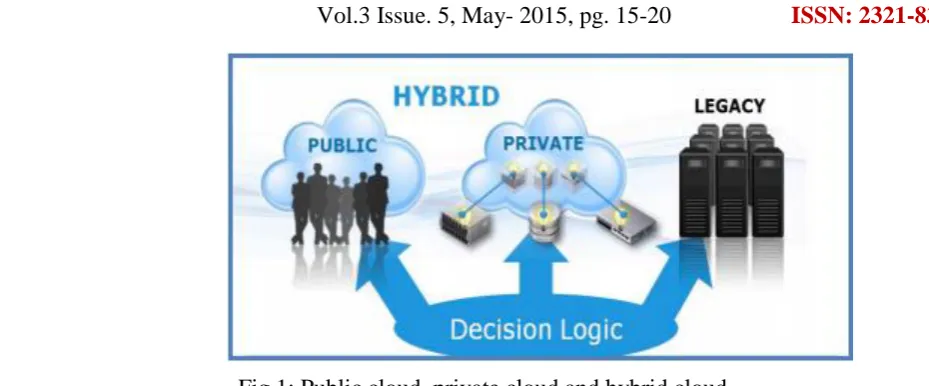
Fig 1: Public cloud, private cloud and hybrid cloud
Hybrid cloud
A hybrid cloud is a combination of a private cloud and public cloud services where one or several services exist between the environments. The goal is to combine services from both the clouds and data from a variety of cloud models to computing environment. Combining public services for clouds which are available with private clouds and data center as a hybrid. Not all companies which are taking advantage of hybrid cloud that use some public and some private cloud services have a hybrid cloud. Rather, a hybrid cloud is basically an environment where the private cloud and public services are used together to create a new balanced idea of both the cloud providers. A cloud is hybrid if :
If company uses public platform that sends data to a private cloud .
When company has number of softwares, SaaS(Software as a Service) applications and moves data between private.
IV.IMPLEMENTATION
Making a private cloud:
A. Eucalyptus
-EUCALYPTUS (Elastic Utility Computing Architecture for Linking Your Program To Useful System., is an open Source software, was developed by University of California for the Cloud Computing to implement Infrastructure as a Service(IaaS).It is the first open source software which is compatible with Amazon Web Service(AWS). Amazon Web Service (AWS) is major players for providing Infrastructure As A Service(IaaS)[2].
Cloud Controller (CLC) - Is the entry point into private cloud for end user, project managers developers and administrator. It also help in manage to controller virtualized resources.
Cluster Controller (CC):Executes on a machine that has network connectivity to virtual machines that are running on Node Controller and Cloud Controller.
Storage Controller (SC): provides block-level side network storage for the support for Amazon [3].
Sarita Shankar Pol
et al
, International Journal of Computer Science and Mobile Applications,
Vol.3 Issue. 5, May- 2015, pg. 15-20
ISSN: 2321-8363
B. OpenStack
-OpenStack was actually announced for the open stack softwares for making the private cloud. It is the fastest growing free open source software. Rackspace contributed their "Cloud Files" platform to power Object Storage part of the OpenStack, to power the Compute part. OpenStack[4] is collection of open source software project that develops and cloud computing technologist can use to setup and run their cloud compute and storage infrastructure. OpenStack Object Storage Infrastructure also as called Swift and OpenStack Image Service Infrastructure also called Glance. Nova is the main part of Infrastructure as a service and it also is the Fabric controller for the OpenStack cloud.
C. MaaS/Juju -
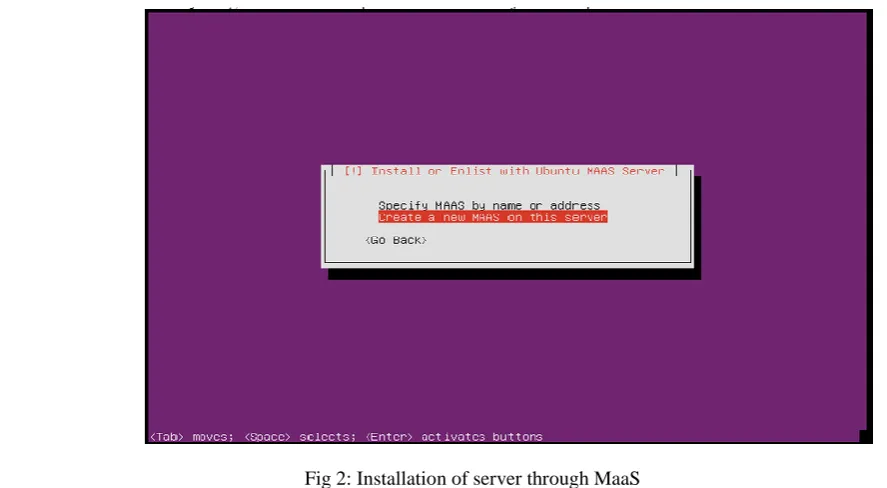
Canonical’s MAAS brings the dynamism of cloud computing to the world of physical provisioning and Ubuntu. Connect, commission and deploy physical servers in record time, re-allocate nodes between services dynamically, and keep them up to date [5]
Fig 2: Installation of server through MaaS
Sarita Shankar Pol
et al
, International Journal of Computer Science and Mobile Applications,
Vol.3 Issue. 5, May- 2015, pg. 15-20
ISSN: 2321-8363
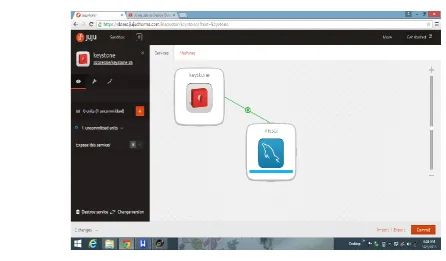
Fig 3: Adding applications to juju
In this way private cloud can be created through the maas and juju charms. Such free softwares are easily available to create the virtual environment through the cloud
V. CONCLUSIONS
In this way we have seen the methods for the private cloud for setting up the cloud with the help of the open source softwares like the eucalyptus, open stack, Maas/Juju, which softwares freely available for the private cloud. The private clouds like the virtual labs is totally dependent on the private network.
ACKNOWLEDGEMENT
It gives me great pleasure in expressing thanks and gratitude to my guide Prof. Shyamrao V. Gumaste, Head of the Computer Engineering Department, for his valuable guidance and encouragement throughout the Project work. I am heartily thankful for his time to time suggestion and the clarity of the concepts of the topic that helped me a lot during this work. Throughout the work there was great help and support given by my husband Prof. Sachin S Nehe, HOD, Mechanical Dept, SRCOE. Also I am giving gratitude to my all colleagues of Computer Department for their help and guidance. I am very much grateful to all.
REFERENCES
[1] ‖Building Private Cloud using OpenStack‖, Girish L S, Dr. H S Guruprasad., IJETTCS, Volume 3, Issue 3, May – June 2014
[2] SonaliYadav, ―Comparative Study on Open Source Software for Cloud Computing Platform: Eucalyptus, Openstack and Opennebula‖, International Journal Of Engineering And Science, Vol.3, Issue 10 (October 2013), pp 51-54, ISSN (e): 2278-4721, ISSN (p):2319-6483.
Sarita Shankar Pol
et al
, International Journal of Computer Science and Mobile Applications,
Vol.3 Issue. 5, May- 2015, pg. 15-20
ISSN: 2321-8363
[4] Wei Hao, I-Ling Yen, BhavaniThuraisingham, ―Dynamic Service and Data Migration in the Clouds‖, 33rd Annual IEEE InternationalComputer Software and Applications Conference, Seattle, WA,20-24 July 2009, pp 134-139,Print ISBN: 978-0- 7695-3726-9, DOI: 10.1109/COMPSAC.2009.127.
[5] Scott Tilley,TauhidaParveen, ―Migrating Software Testing to the Cloud‖, IEEE International Conference on Software Maintenance (ICSM), Timisoara, 12-18 Sept. 2010, pp 1,Print ISBN: 978-1-4244-8630-4, DOI:10.1109/ICSM.2010.5610422.