Retrospective Evaluation ofa
Collaborative LearningScience Module:
The’ Users Perspective
Dorothy DeWitt [1], SaedahSiraj [2], Norlidah Alias[3], Hai Leng, Chin[4]
[1] Faculty of Education University of Malaya, Kuala Lumpur
[2] Faculty of Education University of Malaya, Kuala Lumpur
[3] Faculty of Education University of Malaya, Kuala Lumpur
[4] Faculty of Education University of Malaya, Kuala Lumpur
ABSTRACT
This study focuses on the retrospective evaluation of collaborative mLearning (CmL) Science module for teaching secondary school science which was designed based on social constructivist learning theories and Merrill’s First Principle of Instruction. This study is part of a developmental research in which computer-mediated communication (CMC) tools such asdiscussion forums, collaborative work spaces (wiki), and text messaging was employed. The user evaluation focuses on the retrospective evaluation of sixteen (16) Form 2 students as users on completion of the module. Data collection was from a surveys and interviews. However, to ensure reliability, the results were triangulated with the users’online communications on the forums, wikis, and text messages. The findings showedthat the CmLmodule has several strengths and weaknesses. However, the CmL module could be used for learning as it provided an opportunity for scientific inquiry in the search for information and through both online and face-to-face discussions while solving problems. In addition, the findings show that the CmLmodule could be used to encourage scientific inquiry for encouraging the nature of science.
Keywords: Collaborative communication tools, Mobile learning, Informal learning, learning, Computer-mediated Evaluation.
INTRODUCTION
The nature of science is the characteristic of scientific knowledge of the natural world which is derived through scientific inquiry (Lederman, 2012). Scientific inquiry through scientific processes is done in collaboration with other scientists (Abruscato, 2000; Hogan &Fisherkeller, 2005). Hence, science is a culture where the scientists are the practitioners of the culture, using the language of the culture to collaborate in scientific inquiry (Lederman, 2012).
A similar discovery approach of scientific inquiry focusing on the nature of science, and not the content or scientific knowledge,should be used when teaching science. In order to do this, science learners need to be able to interact socially: to communicate and debate issues regarding science and society, as well as use science for their personal needs in life. Through their discussions and social interactions, the learners attempt to link the newly acquired knowledge with their existing knowledge, to interpret nature following certain rules and standards (DeWitt &Siraj, 2008; Galili, 2012).
The language of science,scientific verbal knowledge, is important for building science concepts. The culture and social activity in scienceare important for all learners to build their knowledge and promote critical thinking (Galili, 2012; Hoyle & Stone, 2000). While scientific terms can be defined formally, the language structures and the interpretation of the culture of rules in science are acquired informally (Galili, 2012). Social interactions in the culture of science enable the patterning and modeling of the language of science (Galili, 2012; Karpov& Haywood, 1998).
In the Malaysian scenario, there is little time for social interaction in the science classroom. Teachers perceive that there is insufficient time to complete the science syllabus. The emphasis in most schools is on passing the standardized examinations. This has lead teachers to emphasize on the memorization of facts, rather than on the scientific processes (Chong, 2005).
www.mojet.net
Computer-mediated communication (CMC) tools can facilitate the communication and extend it outside the classroom (Anastopolou,Sharples, Ainsworth, Crook, O’Malley, & Wright, 2011; Arrigo, Gentile, Taibi, Chiappone, &Tegolo, 2004; Capuano, Gaeta, Miranda, &Pappacena, 2004; Guzdial& Turns, 2000; Chang, 2010; Jeng, Wu, Huang, Tan, & Yang, 2010; Slotta& Linn, 2000; Saeed, Yang, &Sinnappan, 2009). CMC tools such as wikis, forums and text messaging enable informal discussions in science outside the formal classroom, and can be monitored by a facilitator or tutor. Research has shown that formal classroom learning can be supplemented with informal learning through technology use (Anastopolou et al., 2011).
Collaborative learning occurs as the acquisition of knowledge, skills and attitude as a result of interactions in a group (Johnson & Johnson, 2004). When CMC tools are used, collaborative mlearning, which occurs as a result of interactions in a group, can happen at anytime and anywhere, even outside the formal classroom environment (Siraj& Alias, 2005; Siraj, 2005). Learning in this way can provide the social interaction for developing the culture of science (Galili, 2012; Karpov& Haywood, 1998).
Although studies on the use of CMC tools for collaborative mlearninghave been conducted, most of the studies have focused on one or at most two CMC tools (Arrigo et al., 2004; Capuano et al., 2004; Guzdial& Turns, 2000; Saeed, Yang, &Sinnappan, 2009; Slotta& Linn, 2000). This study seeks to investigate the effectiveness of a combination of three CMC tools on learning with the collaborative mlearning (CmL) Science module. In this study, the three CMC tools of the wiki, discussion forum and text messaging would be combined to develop the CmL Science module.
PURPOSE OF THE STUDY
The purpose of this research is to evaluate theCmL Science module developed based on Merrill’s principles of instruction for learning. This study seeks to answer the following research questions:
1. What are the strengths and weakness of the CmL Science module?
2. How do learners learn with the CmLScience module?.
THE LANGUAGE OF SCIENCE
Language enables the culture and thinking processes for the construction of knowledge (Galili, 2012; Hoyle & Stone, 2000). Scientific verbal knowledge, or the knowledge for communicating in the science vocabulary, is required for understanding and communicating in science so that dialogues to build the culture of science can occur (Hoyle & Stone, 2000; Karpov& Haywood, 1998). Learners can then construct meaningful phrases using scientific terms to communicate their thoughts and develop science concepts through inquiry (Hoyle & Stone, 2000; Karpov& Haywood, 1998). Student-centered discussion develops critical thinking skills, as arguments are resolved to reach a mutual understanding (Hoyle & Stone, 2000; Karpov& Haywood, 1998).
Scientific knowledge is a culture, and cultural content knowledge which refers to the nature of science needs to be taught through discourse (Galili, 2012). The vocabulary and structures of the language of science is a cultural aspect acquired through discourse during social interactions. Vygotsky’s view is that scientific knowledge and procedures should not be taught directly but should be constructed by learners during discussions to buildunderstanding of science concepts (Karpov& Haywood, 1998).
Social interactions and dialogue internalizes learning as learning is situated (Chang, 2010; Jeng, Wu, Huang, Tan, & Yang 2010). Computers and mobile phones are the cultural tools in the external environment whilethe language, the environment, and the CMC tools are the abstract social tools which assist in developing. The cultural and social tools encourage the process of cognitive change in the learner (Gredler, 1997).
In the CmL module, knowledge creation is affordedthrough scientific inquiry and arguments to generate new ideas (Laru, Jarvela, &Clariana, 2012; Rogers, Connelly, Hazlewood, & Tedesco 2010; So, Tan, &Tay 2012). At the same time, learners are scaffold by their instructor and peers (Boticki, Looi, & Wong, 2011; Timmis, 2012). Hence, learners’social interaction in the culture of science promote inquiry through peer collaborationto develop their understandings (Vygotsky, 1981).
www.mojet.net
DESIGN OF INSTRUCTION FOR LEARNING SCIENCE
The CmLScience module designed for teaching science is based on Vygotsky’s social constructivist learning theories.Hence, activities for learners to build their personal understanding through discussions, opportunities for patterning and modeling with individualized support,as well as scaffolding to address the difficulties learners experience in trying to comprehend the language of science are provided. Social interactions are encouraged to provide opportunities to link the science knowledge withlearners’ prior experience in a culture of building meaningful science knowledge (Brown, 2006).
The use of CMC tools, such as wikis and discussion forums, for teaching science is not new. The Knowledge Integration Environment (KIE), a platform for storage of web resources and scaffolding through tips and guidance for the activities, employed anonline asynchronous discussion forum for collaborative mLearning in science (Slotta& Linn, 2000). Another platform for collaborative mLearning, CaMILE, has discussion forums and encourages communication and collaboration on science projects (Guzdial& Turns, 2000). Both these platforms wereeffective in learning science.
Textual learning objects have been pushed to learners through short messaging system (SMS) for language instruction (Capuano et al., 2004). Text messages have been used combined with a wiki (Arrigo et al., 2004) and with discussion forums (Rau, Gao, & Wu, 2008). A combination of CMC tools for learning science improved examination performance and motivated learners can be used(Rau, Gao, & Wu, 2008).
In the Malaysian context, there is a lack of research in the use of a combination of CMC tools on a CmL platform for teaching science. Hence, it is believed that the CmL Science module in this study, which will employ three CMC tools,will have similar results to other studies. The CmL module can provide experiences for building scientific knowledge and concepts to encourage the scientific inquiry process. Further, it is hoped that this study will provide insights in the use of a CmL environment for science instruction.
FIRST PRINCIPLES OF INSTRUCTION
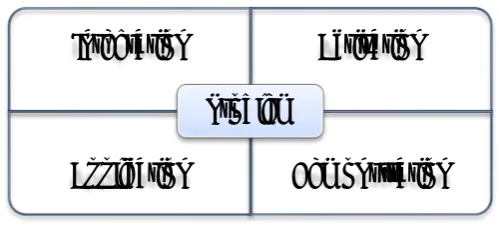
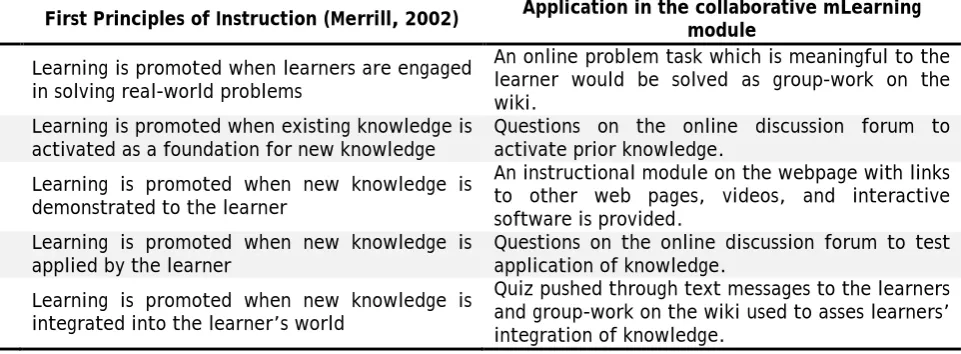
The design of this module was based on the First Principles of Instruction (Merrill, 2002).These design-orientated principles could be used to solve real-world problems for learning environments in any delivery system (Figure 1). Instruction should then take into account the four phases of learning: (a) activation of prior experience; (b) demonstration of skills; (c) application of skills; and (d) integration of these skills into real world activities. Application of the First Principles of Instruction in the CmL module is summarized in Table 1.
Figure 1: First Principles of Instruction
Integration
Activation
Application
Demonstration
Problem
www.mojet.net
Table 1: Application of First Principles of Instruction
First Principles of Instruction (Merrill, 2002) Application in the collaborative mLearning module
Learning is promoted when learners are engaged in solving real-world problems
An online problem task which is meaningful to the learner would be solved as group-work on the wiki.
Learning is promoted when existing knowledge is
activated as a foundation for new knowledge Questions on the online discussion forum to activate prior knowledge. Learning is promoted when new knowledge is
demonstrated to the learner
An instructional module on the webpage with links to other web pages, videos, and interactive software is provided.
Learning is promoted when new knowledge is
applied by the learner Questions on the online discussion forum to test application of knowledge. Learning is promoted when new knowledge is
integrated into the learner’s world
Quiz pushed through text messages to the learners and group-work on the wiki used to asses learners’ integration of knowledge.
METHODOLOGY
DESIGN OF THE STUDY
The study is part of a developmental research which focuses on the final user-evaluation of theCmL module (MuhamadSabri, Nor Aziah, Zawawi&Nurulhuda 2012; Richey 1997;Wang &Hanafin 2005). The evaluation is based on the usability evaluation method framework where retrospective evaluation was employed. (Chai & Chen, 2004;Norlidah Alias, SaedahSiraj&VanithaThanabalan, 2011). Retrospective evaluation focuses the users’ reactions on completion of the module (Gertler,Martinez,Premand, Rawlings&Vermeersch, 2011).
An urban secondary school in the state of Selangor, which had an enrolment comprising of the multi-racial communities of Malaysia, was selected. The CmL Science module was implemented withsixteen Form 2 students. On completion of the tasks in the module, the users’ reaction towards the usability of the module for learningwas determined. A survey of the usability of the module, and an interview was conducted. The responses in the retrospective evaluation were triangulated with data from online communications in the module for reliability.
DEVELOPMENT OF THECMLSCIENCE MODULE
The CmLScience module on the topic of Nutrition was designed based on social constructivist learning theoriesand the First Principles of Instruction (Merrill, 2002).Learnershad many misconceptions in the topic of Nutrition. Secondary school children were confused about the concept of food: water and vitamins are not food but were considered as food (Lee &Diong, 1999). In addition, students rated Nutrition as the most difficult topic with a lot of factual knowledge in science (DeWitt &Siraj, 2007).
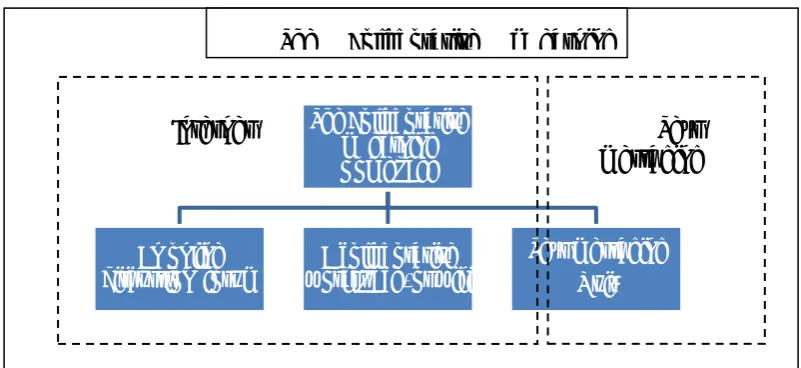
The CmLmodule was hosted on a website, with links to content, videos, animations, and CMC tools.The activities were designed to incorporate a main problem task which had to be solved collaboratively on a wiki. In addition, other smaller problem tasks to activate, demonstrate, apply and integrate knowledge were discussedon a forum, while individualized quiz were pushed through text messaging.
The web page and its links to content and interactive tools provided the demonstration of knowledge while application was through the questions on the discussion forum. For integration of knowledge, learners had the opportunity to reflect and use the knowledge learnt through questions on the discussion forum and SMS Quiz.
www.mojet.net
Figure 2: Tools in the collaborative mLearning module
Module Implementation
The CmLScience module was implemented with a group of sixteenForm 2students from the selected school. The participants were from a pool of volunteers and equal numbers of high, medium and low-achievers in science were selected.Most of the students in the selected school (81.6%) owned a mobile phone, and had access to computers (63.9%). However, laptops with a mobile broadband modem for internet access,and mobile phones for text messaging after school hours in school were provided to enable students who required access.
Data Collection and Analysis
The CmL module was implemented with the group of students. In retrospective evaluation, data collection is done after the completion of the module. The data collected from the survey of the usability of the CmL module was analysed using descriptive statistics. The participants were interviewed on the usability of the CmL module. The transcript of the interview was coded and analysed for the emergent themes.
The data was analyzed to find the strengths and weaknesses of the CmL module and how the students in the context of the study were learningin the CmL environment. Triangulation of data was done through the analysis of the online communications in the module for reliability.
RESULTS AND DISCUSSION
The research questions on the strengths and weakness of the CmL module and how learners learn with the CmL Science module is discussed below.The findings of this study may provide insights into the effects of CmL and whether it could be used for teaching science.
STRENGTHS AND WEAKNESS OF THE MODULE
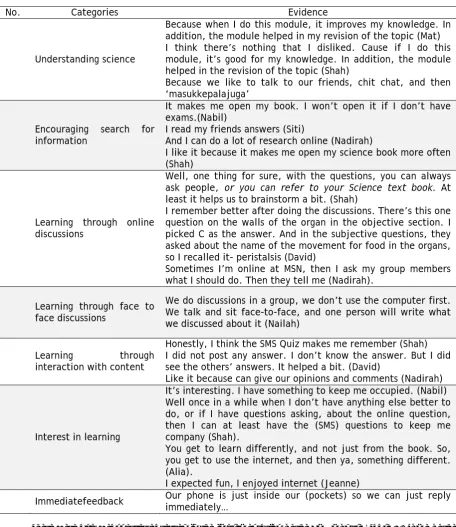
The qualitative analysis of the data showed that the CmLmodule had several strengths as it improved understanding, encouraged the search for information, and learning through online and face-to-face discussions, as well as interaction with content with immediate feedback (Table 2). In addition, the users were motivated and interested in learning.
The Collaborative
mLearning
Homepage
An online
discussion forum
workspace, or wiki
A collaborative
Text messaging
Quiz
The Collaborative mLearning
Text
messaging
Internet
www.mojet.net
Table 2: The strengths of learning withthe CmLScience Module
No. Categories Evidence
Understanding science
Because when I do this module, it improves my knowledge. In addition, the module helped in my revision of the topic (Mat) I think there’s nothing that I disliked. Cause if I do this module, it’s good for my knowledge. In addition, the module helped in the revision of the topic (Shah)
Because we like to talk to our friends, chit chat, and then ‘masukkepalajuga’
Encouraging search for information
It makes me open my book. I won’t open it if I don’t have exams.(Nabil)
I read my friends answers (Siti)
And I can do a lot of research online (Nadirah)
I like it because it makes me open my science book more often (Shah)
Learning through online discussions
Well, one thing for sure, with the questions, you can always ask people, or you can refer to your Science text book. At least it helps us to brainstorm a bit. (Shah)
I remember better after doing the discussions. There’s this one question on the walls of the organ in the objective section. I picked C as the answer. And in the subjective questions, they asked about the name of the movement for food in the organs, so I recalled it- peristalsis (David)
Sometimes I’m online at MSN, then I ask my group members what I should do. Then they tell me (Nadirah).
Learning through face to face discussions
We do discussions in a group, we don’t use the computer first. We talk and sit face-to-face, and one person will write what we discussed about it (Nailah)
Learning through interaction with content
Honestly, I think the SMS Quiz makes me remember (Shah) I did not post any answer. I don’t know the answer. But I did see the others’ answers. It helped a bit. (David)
Like it because can give our opinions and comments (Nadirah)
Interest in learning
It’s interesting. I have something to keep me occupied. (Nabil) Well once in a while when I don’t have anything else better to do, or if I have questions asking, about the online question, then I can at least have the (SMS) questions to keep me company (Shah).
You get to learn differently, and not just from the book. So, you get to use the internet, and then ya, something different. (Alia).
I expected fun, I enjoyed internet (Jeanne)
Immediatefeedback Our phone is just inside our (pockets) so we can just reply immediately…
There were also weaknesses observed in the implementation of the CmL module (Table 3). Some of the users’ faced technical difficulties and were not too sure on the implementation. In addition, the use of English as the medium of instruction was raised. The users’ perception of knowledge, and other external factors such as school work and parental restrictions on the use of internet interfered with the learning and the process of scientific inquiry.
www.mojet.net
Table 3: The weakness of learning withthe CmL Science Module
No. Categories Evidence
Technical difficulties
I don’t know how to use. (Alvin)
I dislike doing it because I don’t have a Yahoo account (Chan) I am a little confused with Yahoo Tech groups.(Nadirah)
(Freewebs- Participation in this forum was easier and can post discussions)
The online stuff kinda hard as I can only access the internet sometimes. Depends on the connection. (Nabil)
Language - English Yes, some language problems. Grammar - I don’t understand (David)
Perception of learning I don’t read others’ answers. Because if I read their answers, maybe they’ll think I’m copying them (Nadirah). I don’t think if I see the others answers I will learn (David)
Other Priorities I was preoccupied with homework (Ann) Because sometimes I’m not in the mood to (Gwen) Parental control My mother don’t let me use so much internet (Shahirah) Group work Dislike it because I need group members (Shah)
LEARNING SCIENCE
From the survey, most of the users (84.3%) believed their understanding in science improved after completing the module, while the rest were undecided (17.7%). The use of the CmL moduleencourages learning as it improves understanding (Table 2). While searching for informationin either online or print materials, demonstration of knowledge was exhibited and this provided experiences for modeling science inquiry.Learners had the opportunity to observe and pattern the scientific verbal and cultural content knowledge in the nature of science (Galili, 2012) through the problem-solving task.
In addition, the social interactions through discussions, both online and face-to-face, using the language of science contributed to the culture of scientific inquiry in learning. During the discussions, patterns of language use and processes of inquiry are formed while learners collaborate on their tasks, while quietly observing the discussions among their peers. Learning was a social activity where elements in the environment, including answers of the participants could be artifacts to “mediate” learning within the culture of scientific knowledge building.
Lack of participation could be due to technical difficulties in using the discussion forum, and difficulty with the medium of instruction: English.However, it was verified that learnerswho did not participate did read their peers’ postings. Learners perceived that reading others’ postingswas considered copying. Their beliefwas that learning was individualized and a not process to be shared with others.
In general, the CmL module motivated the learners as they were interested to use it. Learning takes place formally and informally when the social interactions through other learners’ answers and mediated learning.
IMPLICATIONS AND CONCLUSIONS
The findings of this study indicate that the CmLScience module enables learning science through the process of scientific inquiry(Lederman, 2012). Learners participated in the collaborative discussions in science using CMC tools, indicating that CMC tools can be used to support a scientific learning culture (Anastopolou et al., 2011; Arrigo et al., 2004; Guzdial& Turns, 2000). The communications which were part of the process of achieving a shared goal in the task (Johnson & Johnson, 2004) enabled the thinking processes is actually beneficial for learning for constructing science knowledge (Hoyle & Stone, 2000). Communication and learning can be conducted virtually outside the science classroom.
The use of a combination of CMC tools have been shown to be effective for learning (Arrigo et al., 2004; Rau et al., 2008). In the CmL module, a combination of three CMC tools was used for teaching science. Providing a combination of tools allowed learners to respond and use the tool most convenient or most preferred for learning. The learners’ preference for different tools might be related to different learning styles of the learner and could be a possible area for further research.In addition, only sixteen users participated in this study. The findings of the study
www.mojet.net
are still relevant as the participants were selected from different science abilities. However, future studies could be done to determine the effectiveness of the CmL module with a larger sample.
When CMC tools are used, collaborative mlearning is encouraged (Guzdial& Turns, 2000; Slotta& Linn, 2000) as learners to work in groups to solve tasks. The findings of this study reinforce the fact that collaborating in scienceas acultural and social activity is important for learners to develop their understandings and promote critical thinking through the language of science (Galili, 2012; Hoyle & Stone, 2000). The patterns and modeling of the language of science used during the discussions could be developed(Galili, 2012; Karpov& Haywood, 1998).
The ‘silent observers’ lurking in the background did not seem to participate, observeing the social interactions, were also involved in the informal learning process when they viewed others’ answers. Their observations would contribute to the patterns of science culture for modeling (Karpov& Haywood, 98). Further investigation could be done to determine if the lack of participation was because of the inaccurate perception of the nature of science whereby the learners expected only one correct answer. These learners have to be given scaffolding and encouragement to participate in the interactions for developing the culture of scientific inquiry in the nature of science(Galili, 2012; Lederman, 2012). Considerations may have to be made for the social and cultural tools to include more exemplars and guidance for discussion questions (Gredler, 1997).
A discovery approach in teaching science which emphasizes the nature of science and scientific inquiry should allow social interactions. In this study, the social interactions and collaboration, both formally and informally, have contributed to building scientific verbal knowledge (Abruscato, 2000; Hogan &Fishkeller, 2005). Learning occurred during the process of communication and scientific inquiry was encouraged through the problem- solving tasks. However, thedevelopment of the true nature of science in which knowledge is subjective requires a more rigorous design.
The findings are important as in the transformation of the education system there is a need to design effective methods of building knowledge in science. In the CmLmodule a discovery approach to allow the processes of learning science through communication and discussion is encouraged. Social interaction in which the learner debates issues and integrates with their existing knowledge is useful in building meaningful knowledge. The use of suitable instructional design principles, which allow for problem-solvingin learning can be employed(Merrill, 2002).
In summary, the CmLScience module is can be used forlearning science to address the learning needs in science. In addition, learning through social interaction may be extended to the teaching of other subjects as well.
ACKNOWLEDGEMENT
The authors wish to thank the Faculty of Education, University of Malaya, and the Ministry of Education Malaysia. This work was supported in part by a grant from the Postgraduate Research Fund, University of Malaya, Kuala Lumpur.
REFERENCES
Abruscato, J. (2000). Teaching Children Science: A Discovery Approach, 5th ed., NeedhamHeights, MA: Allyn& Bacon.
Anastopolou, S., Sharples, M., Ainsworth, S., Crook, C., O’Malley, C., & Wright, M. (2011). Creating personal meaning through technology-supported science inquiry learning across formal and informal settings. International Journal of Science Education, 34 (2),251-273.
Arrigo, M., Gentile, M., Taibi, D., Chiappone, G., &Tegolo, D. (2004). mCLT: Anapplication for collaborative learning on a mobile telephone. Mobile learning anytimeeverywhere: A book of papers from MLEARN 2004 [Electronic version], Attewell, J.,&Savill-Smith, C. eds., London, UK: Learning and Skills Development Agency, pp.11-15,2004.
Brown, B. A. (2006). Its Isn’t No Slang That Can Be Said About This Stuff: LanguageIdentity And Appropriating Science Discourse.Journal of Research in Science Teaching,43(1), 96– 126.
www.mojet.net
Boticki, I., Looi, C. K, & Wong, L. H. (2011). Supporting mobile collaborative activitiesthrough scaffolded flexible grouping. Educational Technology and Society. 14 (3), 190-202.
Capuano, N., Gaeta, M., Miranda, S., &Pappacena, L. (2004). A system for adaptiveplatform-independent mobile learning. Mobile learning anytime everywhere: A book ofpapers from MLEARN 2004 [Electronic version], Attewell, J., &Savill-Smith, C. eds.,London, UK: Learning and Skills Development Agency, 15-19.
Chai, C.S. & Chen, D. (2004). A review on usability evaluation methods for instructional Journal of Multimedia.Vol 31(3), 2004, pg231.
Chang, W. L. (2010). An agent-based system for collaborative informal learning in apervasive environment. International Journal of Mobile Communications, 8 (2). 187-209.
Chong, B. P. (2005). Understanding Of The Nature Of Science And Its Relationship WithAcademic Achievement And Gender Among Form 6 Students. M.Ed. Project paper, Dept.Maths and Science Education, University of Malaya, Kuala Lumpur, Malaysia.
DeWitt, D., &SaedahSiraj. (2007). A Need For Collaborative Mobile Learning In Form 2 Science. Proc. 1st International Malaysian Educational Technology Convention 2007: Smart Teaching and Learning:
Reengineering ID. Utilization and Innovation of Technology, 936 942.
DeWitt, D., &SaedahSiraj. (2008). Designing A Collaborative mLearning Environment For Form 2 Science. Proc. International Conference on Educational Innovation.
Galili, I. (2012). Cultural Content Knowledge – the framework of contribution of history and philosophy of science to science education. Proceedings of The First International History, Philosophy and Science Teaching Asian Regional Conference 2012: Exploring science: Contributions from history, philosophy and education of science. Seoul National University, Seoul, Korea.18 – 20th October, 121-125.
Gertler, P. J.; Martinez, S., Premand, P., Rawlings, L. B., Vermeersch, C M. J. (2011). ImpactEvaluation in Practice [Electronic version].Washington, D. C.:The International Bank for Reconstruction and Development / The World Bank . Accessed 23 October 2012 from http://www.worldbank.org/pdt. 2011
Gredler, E. G. (1997). Learning and instruction: Theory into practice, 3rd ed., Upper Saddle River, NJ: Merrill Prentice Hall.
Guzdial, M., & Turns, J. (2000). Computer-supported collaborative learning in Engineering: The challenge of scaling-up assessment,”Innovations in science and mathematics education: Advance design for technologies of learning. M.J. Jacobson, M. J. & R.B. Kozma, R. B. eds., Mawah, NJ: Lawrence Erlbaum Associates Inc., 227-257.
Hogan, K., &Fisherkeller, J. (2005). Dialogue as Data: Assessing Students’ Scientific Reasoning With Interactive Protocols. Assessing Science Understanding: A Human Constructivist View,Mintzes, J., Wandersee, J. H., & Novak, J. D., eds., London: Elsevier Inc., 95-127.
Hoyle, P., & Stone, C. (2000). Developing the Literate Scientist.Issues in Science Teaching. Sears, J., & Sorensen, P. eds., London: RoutledgeFalmer, 89-99.
Jeng, Y. L., Wu, T. T., Huang, Y. M., Tan, Q, & Yang, S. J. H. (2010). The Add-on impact of mobile applications in learning strategies: a review study. Educational Technology and Society. 13(3), 3-11.
www.mojet.net
Johnson, D. W., & Johnson, R. T. Cooperation and the use of technology. Handbook of Research on Educational Communications and Technology, 2nd ed., Jonassen, D. H. ed., Mawah, NJ: Lawrence Erlbaum Associates Publishers, 785-812.
Karpov, Y. V., & Haywood, H. C. (1998). Two ways to elaborate Vygotsky’s concept of mediation: Implications for instruction. American Psychologist, 53 (1), 27-36.
Laru, J., Jarvela, S., &Clariana, R. B. (2012). Supposting collaborative inquiry during a biology field trip with mobile peer-to-peer tools for learning: a case study with K-12 learners. Interactive Learning Environments. 20 (2), 103-117.
Lederman, N. (2012). Nature of science and scientific inquiry: The potential contribution of history and philosophy of science to students’ scientific literacy. Proceedings of The First International History, Philosophy and Science Teaching Asian Regional Conference 2012: Exploring science: Contributions from history, philosophy and education of science. Seoul National University, Seoul, Korea.18 – 20th October, 69-74.
Lee, Y. J., &Diong, C. H. (1999). Misconceptions On The Biological Concept Of Food: Results Of A Survey Of High School Students. ED 438 176, Eric database, available at http://www.eric.ed.gov/ERICWebPortal/
Merrill, M. D. (2002). First principles of instruction. Educational Technology Research and Development,50 (3) 43 - 60.
MuhamadSabriSahrir, Nor Aziah Alias, Zawawi Ismail, &Nurulhuda Osman, (2012). Employing design and development research (DDR) approaches in the design and development of online Arabic vocabulary learning games prototype. The Turkish Online Journal of Educational Technology, 11 (2), 108-119.
Norlidah Alias, SaedahSiraj,& T. VanithaThanabalan (2011). An Evaluation on the Usability of Physics Module: Teachers’ Retrospective. JurnalPendidikan (EdisiKhas).Universiti Malaya. 167-181
Rau, P-L.P., Gao, Q., & Wu, L. M. (2008). Using mobile communication technology in high school education: Motivation, pressure and learning performance. Computers and Education,50 (1), 1-22. (Science Direct database).
Ritchey, R. C. (1997). Research on instructional development. Educational Technology Research and Development, 45(3), 91-100.
Rogers, Y., Connelly, K., Hazlewood, W., & Tedesco, L. (2010). Enhancing learning: a study of how mobile devices can facilitate sensemaking. Personal Ubiquitious Computing. 14, 111-124
Saeed, N., Yang, Y., &Sinnappan, S. (2009). Emerging Web Technologies in Higher Education: A Case of Incorporating Blogs, Podcasts and Social Bookmarks in a Web Programming Course based on Students' Learning Styles and Technology Preferences. Educational Technology & Society, 12(4), 98–109.
SaedahSiraj&NorlidahAlias (2005). An Evaluation of Mlearning. The International Journal of Learning, 12. http://www.Learning-Journal.com
SaedahSiraj. (2005). mLearningdalampembangunansekolahberteknologi di Malaysia: Prospekpelaksanaan, (“mLearning in the development for schools with technology in Malaysia: Implementation prospects”), Paper presented at National Seminar on ICT in Education 2005, TanjungMalim, Malaysia, 17-19th November.
www.mojet.net
Slotta, J. D., & Linn, M. C. (2000). The Knowledge Integration Environment: Helping students use the internet effectively.Innovations in science and mathematics education: Advance design for technologies of learning, Jacobson, M. J., &Kozma, R.B. eds.,Mawah, NJ: Lawrence Erlbaum Associates Inc., 193-226.
So, H. J., Tan, E., &Tay, J. (2012). Collaborative mobile learning in situ from knowledge building perspectives. Asia Pacific Educational Research, 21 (1), 51-62.
Timmis, S. (2012). Constant companions: instant messaging conversations as sustainable supportive study structures amongst undergraduate peers. Computers and Education. 59 (1). 3-18.
Vygotsky, L. (1981). The genesis of higher mental functions. The concept of activity in Soviet psychology, J.V. Wertsch, ed., New York: Sharpe.
Yang, F.-Y., & Tsai, C.-C. (2008). Investigating university student preferences and beliefs about learning in the Web-based context. Computers and Education, 50(4), 1284-1303.
Wang, F., &Hanafin, M. J., (2005). Design-based research and technology enhanced learning environments. Educational Technology Research and Development,53(4), 5-23.
www.mojet.net