ISSN: 2306-9007 Yi & Anh (2016) 594
I
www.irmbrjournal.com June 2016I
nternationalR
eview ofM
anagement andB
usinessR
esearchVol. 5 Issue.2
R
M
B
R
The Handmade Effect: What is Special about Buying
Handmade?
YI HSU
Associate Professor, Department of Business and Administration, National Formosa University, Huwei, Yunlin, Taiwan
Email: [email protected]
Tel: +886 958872228
ANH NGUYEN NGOC
Graduate Student, Department of Business and Administration, National Formosa University, Huwei, Yunlin, Taiwan
Email: [email protected]
Tel: +886 978739486
Abstract
This research aims to examine the “handmade effect” - if, how and why customers choose handmade over machine-made and products not mentioning production mode. By interviewing and distributing three questionnaire surveys to 531 well-selected respondents, the research has been the first series of tests succeeded to prove the handmade effect as well as explain and compare which attributes determine customer’s purchasing intention between high and low involvement handmade products; and contribute to stimulate the development and preservation of traditional handicraft. ANOVA, MANOVA and Polynomial regression are performed and suggest that despite the rapid development of automatically machine, products promoted as handmade are still in consumers’ favor thanks to their outstanding features. Based on these initial statistic evidences handmade producers and marketers could focus to highlight products differentiations, hence promote more efficiently. The findings also enable governments and other related stakeholders to preserve and promote traditional handicraft products into contemporary markets by forming more effective marketing approaches.
Key Words: Handmade, High-Involvement, Low-Involvement, Customer Purchasing Intention, Traditional Handicraft.
Introduction
ISSN: 2306-9007 Yi & Anh (2016) 595
I
www.irmbrjournal.com June 2016I
nternationalR
eview ofM
anagement andB
usinessR
esearchVol. 5 Issue.2
R
M
B
R
Accessories (Hermes), Guitar (Candelas) to daily-used such as Bread and sandwiches (Pret A manger, Udi’s), Cosmetics and soaps (LUSH, Ajali), Household furniture (Etsy) were promoted as handmade. Better yet, such brands have been always expanding healthily in the recent unhealthy economy. Etsy a peer-to-peer e-commerce website focused on handmade items experiences the sales volume increased more than six times within four years 2010 to 2014 from US 314 million dollars US 1932 million dollars which remarkably 71 times higher since it was founded in 2005 (figures combined from Statistica.com). Similarly, the high fashion handmade brand Hermes International Group as per its annual financial reports 2005-2014, grew up steady while maintaining cut-throat price with revenue increasing 288 percent from US 1553 million to US 4483 million dollars. There would be interesting reasons to explain why handmade products, both high-involvement and low-involvement are never forgotten, yet still plays a crucial part in modern marketplace. As such, there is a need for examining this hypothesis - whether promoting as handmade increase customer purchasing intention, and which particular features of these products make them attractive. Out of our surprise, there is no such study about this topic; our study is the pioneer to examine and compare the attributes lead to customers’ purchasing intention of high/low involvement handmade products. We also research on the third group - traditional handicraft to contribute in preserving local culture and artistic values.
There are several benefits of studying that. Firstly, the results enable marketers to position right products’ features to communicate with customers. Secondly, from the perspective of preserving culture, government bodies and other stakeholders would practice effective promoting activities to retain the historical artistic values and bring them closer to daily life. As such, artisan and local community would be also beneficial thanks to higher income and blooming tourism.
This research includes three studies, the first one examined the so-called handmade effect: whether products made by hand in general are more attractive to customers comparing to machine-made and no mode of production mentioning. The second succeeded to answer what factors making handmade products perceived more customers’ purchasing intention, comparing between low and high-involvement products. The third investigated which attributes making traditional handicraft attractive to give suggestions for different stakeholders.
Literature Review
Handmade versus Machine-made in Customer Purchasing Intention
Customer purchasing intention is defined as the probability of intention to purchase, or willingness to
obtain a good or service in the future (Whitlark and Michael, 1993).There are different ideas about whether
product being promoted as handmade would affect positively on customer purchasing intention. According to Thomas (2015), the raise of machine-made rugs already replaced the traditional Indian handmade rugs since customers’ priority is quality, not the method of producing. Whereas, Christoph, Martin & Stijn, (2015) supported the future of handmade products providing evidence that handmade has positive effect on consumers’ perceived product attractiveness and buyers are even willing to pay higher price for handmade. To make this matter clear we attempt to testify the possibility that mode of production (including machine-made, handmade or no mode of production quoted) affect customers’ purchasing intention which could be hypothesized as:
H1: Products promoted as handmade positively affect customer purchasing intention.
ISSN: 2306-9007 Yi & Anh (2016) 596
I
www.irmbrjournal.com June 2016I
nternationalR
eview ofM
anagement andB
usinessR
esearchVol. 5 Issue.2
R
M
B
R
The research also studies on another category of handmade - traditional handicraft. According to UNESCO (1997) traditional handicraft is handmade with distinctive features such as being produced by generations of skillful workers in a forming craft villages or areas; using raw materials from sustainable resources and containing artistic/ creative/ culturally attached/ religious/ socially symbolic value. Traditional craft might fall into high-involvement like San Yi wood carving village or low-involvement like the neighbor village – Yuan Li grass weaving in Taiwan. In spite of beautiful artistic and social value, traditional handicraft is unlikely to catch up with modern society due to rapid development of machine in mass production and impracticality. This unhappy fact discourages craftsmen and the young generation to follow the traditional route, or worse still would lead to the extinction of these beautiful cultures. Ms. Gou Xiu Zhou – the owner of a traditional Taiwanese oil paper umbrella shop disappointedly told us in spite of the high traffic, customers no longer bought the traditional handicraft products, and her shop’s revenue now came from other machine-made souvenirs. As such how to increase sales to support craftsman and preserve the art should be given more care by government and authorities.
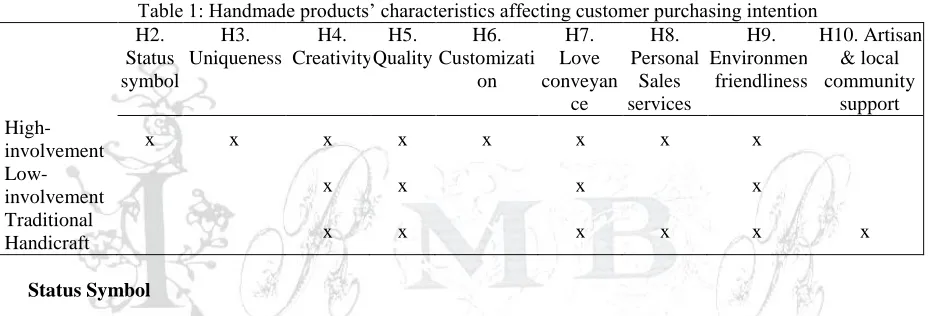
Nine relevant characteristics of handmade products are taken into account to explain customer purchasing intention towards handmade as Table 1
Table 1: Handmade products’ characteristics affecting customer purchasing intention H2.
Status symbol
H3. Uniqueness
H4. Creativity
H5. Quality
H6. Customizati
on
H7. Love conveyan
ce
H8. Personal
Sales services
H9. Environment
friendliness
H10. Artisan & local community
support
High-involvement x x x x x x x x
Low-involvement x x x x
Traditional
Handicraft x x x x x x
Status Symbol
For centuries, human beings have striven not only for material benefits but also invisible values including status symbol. Status is the position or rank in a society or within a group that others award to an individual (Goffman 1959). Since people are desire to achieve high status, they are always looking for its symbols. The symbols are varied among different countries and religions at different time period. In ancient time, status symbols could be the belongings (like jade and jewelry in Asia) or color of clothes (yellow exclusively represents royal in Chinese emperors; whereas in Rome, the king’s color is purple). In modern society, status symbols could be simply as any consumption of expensive items comparing to the average in the product category with the intent of display wealth in public – ranging from driving a posh car to using a crocodile handmade bag. High involvement handmade products could be listed as one component of luxury expensive goods which work effectively to display social label to highlight the owners’ willingness to pay premium prices with functionally equivalent good (Batra et al., 2000). As such, status symbol is taken as one of the possible attributes affects the purchase of high-involvement handmade products which could be hypothesized as,
H2: Status symbol positively influenced on customers’ purchasing intention of high-involvement handmade product
Uniqueness
ISSN: 2306-9007 Yi & Anh (2016) 597
I
www.irmbrjournal.com June 2016I
nternationalR
eview ofM
anagement andB
usinessR
esearchVol. 5 Issue.2
R
M
B
R
and enhance personal and social identity (Tian, Bearden & Hunter, 2001). Which else could work better than high-involvement handmade – one unique piece being created by hands and reflecting individual value? This need for uniqueness can have a significant effect on a high-involvement handmade consumer’s purchase decisions like to adopt new products or brands more quickly (Amaldoss and Jain, 2005; Zimmer, Little and Griffiths, 1999) or be willing to pay price differentials for products which reflect such differentials(Amaldoss and Jain, 2005). For that reason, hypothesis 3 is formed as,
H3: Uniqueness positively influenced on customers’ purchasing intention of high involvement handmade product
Creativity
Creativity can be defined as the ability to generate valuable ideas (Boden 2004). Valuable, here, have many meanings: interesting, useful, beautiful, simple, richly complex, and so on. Ideas also covers a wide range of meanings not only concepts, stories, interpretations but also graphic images, sculptures, house, etc. As a result, products embedding creativity offers exceptional value to consumers leading to more willingness to purchase (Robertson & Gatignon, 1986; Kleinschmidt & Cooper, 1991; Andrews & Smith, 1996). Handmade in general have been identified as one of creative industries together with architecture, film and video, interactive leisure software, music, the performing arts, etc. (Julie, 2009) that makes creativity is one of important factors to consider for consumers in the buying process. We have hypothesis 4 as,
H4: Creativity positively influenced on customers’ purchasing intention of high-involvement handmade, low-involvement handmade and traditional handicraft product
Quality
Speaking of customers’ purchasing intention, quality is the most effective paths to differentiation and competitive advantage to ensure customers’ satisfaction (Buzzell & Gale, 1987). For a large number of people, handmade also equals to well-made and previous researchers have confirmed the outstanding quality of handmade products impacts on customer’s intention. From daily-use low involvement product as food, when being handmade and produced according to a natural mode of production often on the farm itself has a positive impact on consumers’ appreciation of the quality of a given foodstuff (Calatrava and Sayadi, 2008). With high-involvement category, Vadakepat and Khateeb, 2012 also found that despite poor promotion, distribution and customer service house made cottage industry in Kerala could still compete with the machine made competitors thanks to good quality. For those reasons, it is a big mistake not taking quality of handmade as one of the attributions to customers’ purchasing intention. We hypothesize as,
H5: Quality positively influenced on customers’ purchasing intention of high-involvement handmade, low-involvement handmade and traditional handicraft product
Customization
ISSN: 2306-9007 Yi & Anh (2016) 598
I
www.irmbrjournal.com June 2016I
nternationalR
eview ofM
anagement andB
usinessR
esearchVol. 5 Issue.2
R
M
B
R
requirements and expectations are remarkably different is a big challenge for mass customization manufacturer. As such, customization is still considered a big advantage for high-involvement handmade product and will be taken into consideration to explain purchasing decision as hypothesis 6.
H6: Customization positively influenced on high-involvement handmade product
Love Conveyance
Love is broadly understood as a passionate affection and a feeling of warm personal attachment in this research love was defined in a more specific way as the producer’s love for his or her work making handmade products as a symbol sense. With well-practiced skills and throughout materials knowledge the handmade makers bring a uniquely in-depth knowledge of materials, material qualities (Pye, 1968) and materials’ responsiveness to process (McCullough, 1996). Their work was described by Christoph, Martin & Stijn (2015) as intimate connection between maker and user; the love being imbued is also able to transfer to the one receiving handmade products as gifts. They also proved when handmade bought as a present the givers possess strong preferences for handmade and willing to pay more than 17% comparing to machine made products with equivalent function. For those reasons, hypothesis 7 about love imbued in handmade is formed as,
H7: Love conveyance positively influenced on customers’ purchasing intention of high-involvement handmade, low-involvement handmade and traditional handicraft product
Personal Level Sales Service
Sales service has been widely used to describe services that are provided to the customer during and after products have been sold to ensure trouble-free over products’ life cycle, in which providing personal level is one of the strategies to meet customers’ expectation. High-involvement handmade brands have always been known for their well-executed sales and after care services in individual to protect trademark and maintain customer’s commitment (Kapferer & Bastien, 2009). Also, with traditional handicraft –unique products created by makers’ heart, it is possible to imagine they would definitely sold in a warm and cozy conversation with detailed explanation to customers. For those reasons, high-involvement and traditional handicraft perceived customers favor thanks to personal service. Previous scholars including Keaveney (1995) and Russo & Cardinali (2012) argued that well-handed service increase perceptions of customer satisfaction and build brand differentiation which critically affects customers’ purchasing intention. We have hypothesis 8 as
H8: Personal level customer service positively influenced on customers’ purchasing intention of high-involvement handmade and traditional handicraft product
In modern society, people are increasingly aware of the impact of their consumption choices on the society which brought the new term as ethical consumption meaning consumers’ adoption of consumption behaviors to support socially responsible (e.g., buying fair trade, sweatshop-free, organic, or local products; supporting cause marketing campaigns; boycott of products perceived to be unethical) (Papaoikonomou, Valverde and Ryan, 2012). In this research, we consider two aspects of ethical consumption for handmade products which are environment friendliness and artisan & local community support.
Environment Friendliness
ISSN: 2306-9007 Yi & Anh (2016) 599
I
www.irmbrjournal.com June 2016I
nternationalR
eview ofM
anagement andB
usinessR
esearchVol. 5 Issue.2
R
M
B
R
a much smaller scale than machine-made. These environment friendly products have been researched from numerous perspectives including eco-conscious product purchasing (Schlegelmilch, Bohlen & Diamantopoulos, 1996), and willingness to pay higher price (Laroche, Bergeron & Barbaro, 2001).
H9: Environment friendliness positively influenced on customers’ purchasing intention of high-involvement handmade, low-high-involvement handmade and traditional handicraft product
Artisan & Local Community Support
Another aspect of ethical consumption affect customer’s purchasing process is the artisan/craft person support. Unfortunately, Ellis (2014) debated that due to falling demand in digital age, some traditional craft are now at the risk of disappearing resulting more difficulties for craft makers. However, millions of artisans and crafts makers who possess outstanding skills and knowledge are still passionate to conserve the tradition. This craftsmanship plays important roles to deliver more valuable, unique, and aesthetically pleasing experience to customer (Lin & Pei, 2015). As such, buying handmade to a large number of people is supporting craftsmen’s dream in maintaining their business and talented. Moreover, the value of traditional craft not only limits at financial aspects it also encourages a more social equality among disadvantaged groups. It is not difficult to find non-profit organizations and social enterprises selling variety of traditional handicraft made by the disables the minorities and the senior in attempt of helping them to feel normal to reach out with the society. Also, regarding gender equity, craft production has significant meaning by increasing sense of dignity and well-being among rural women and redefining their roles as active members of society (Stephen, 1991; Janis, 2011). From the theoretical background, we hypothesize as follows
H10: Artisan & local community support positively influenced on customers’ purchasing intention of traditional handicraft
Study 1: The Handmade effect
Method – Study 1
In order to testify hypothesis 1 - existence of the so called handmade effect whether customers tend to purchase products being promoted as handmade, we conducted two questionnaires for low-involvement and high-involvement group. For the first group, customers only saw the soap package not the products itself and were asked to rank from 1 to 5 (strongly disagree to strongly agree) whether they would i-be
more appealed to, ii-take more care and iii-be willing to buy soaps advertised as handmade, machine made
or not mentioning mode of production. The same method was conducted for high-involvement group supposing they are looking for luxury accessories & clothes from high-end brand like Gucci, Hermes, and Louis Vuiton. There is a total of 465 people joining our research in which low-involvement includes 117 respondents answering via email survey (average income of USD 434 per month, average age of 26 and 49% female; 64% Vietnamese, 20% Taiwanese and 16% other nationalities including Indonesian, Mongolian, Thailand, American, El Salvador, South African); the other group receives 248 respondents through surveying and interviewing (average income of USD1566 per month; average age of 34.9 and majority is Female accounted for 79%; 69% Vietnamese, 16% Taiwanese and 15% other nationalities including American, Korean, Indian, England, Japanese, Scotland, Australian) who are parents of international schools’ students in Vietnam and luxury products’ customers in Taiwanese department stores.
Analysis – Study 1
ISSN: 2306-9007 Yi & Anh (2016) 600
I
www.irmbrjournal.com June 2016I
nternationalR
eview ofM
anagement andB
usinessR
esearchVol. 5 Issue.2
R
M
B
R
Table 2: Univariate Result for each Dependent variable – effect of mode of production on purchase intention
High - involvement Low - involvement
df F-value p-value df F-value p-value
Intercept 1 21064.53 0.000* 1 9212.611 0.000*
Mode of production 2 79.91 0.000* 2 41.212 0.000*
(Note *: p <0.05)
Table 2 demonstrates the univariate results from ANOVA one way test. It is easy to observe the significance of this test since at the alpha = 0.05, P-value < 0.05; F-value > F critical (F critical of both groups = 2.99) for both high and low-involvement products. From these statistical evidences it could be implied that there is a significant difference between products being promoted as handmade and machine made and no production cue which supporting hypothesis 1.
After that, by performing Scheffé test, production-mode means are compared to giving evidence of statistics significance like Table 3.
Table 3: Scheffé test – relation between every two modes of production
High-involvement Low-involvement
Machine-made 3.405
Handmade 3.937
No production
cue 3.212
Machine-made 3.359
Handmade 3.934
No production
cue 3.157
Machine-made 0.000* 0.005499 0.000* 0.076555
Handmade 0.000* 0.000* 0.000* 0.000*
No production cue 0.005499 0.000* 0.076555 0.000*
(Note *: p <0.05)
The interrelation between handmade - machine-made and handmade – no production cue provides initial evidence that product promoted in handmade definitely stand out among all. There is no significant difference between machine-made and no production cue.
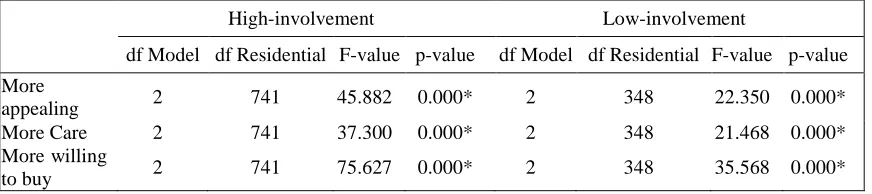
However, to testify whether good or bad the difference handmade perceives we group three judging categories in our survey: i-more appealing, ii-more care and iii-more willing to buy to perform multivariate MANOVA comparing multivariate sample means then select whole model sample square versus residual sample square and Hotelling test to examine significance as per Table 4 and Table 5 respectively..
Table 4: Whole model sample square versus Residual sample square: Impact tendency on purchase intention
High-involvement Low-involvement
df Model df Residential F-value p-value df Model df Residential F-value p-value
More
appealing 2 741 45.882 0.000* 2 348 22.350 0.000*
More Care 2 741 37.300 0.000* 2 348 21.468 0.000*
More willing
to buy 2 741 75.627 0.000* 2 348 35.568 0.000*
ISSN: 2306-9007 Yi & Anh (2016) 601
I
www.irmbrjournal.com June 2016I
nternationalR
eview ofM
anagement andB
usinessR
esearchVol. 5 Issue.2
R
M
B
R
F-value > F critical (F critical of both groups = 2.99), p-value < 0.05 at the significant level alpha = 0.05 for both high and low-involvement in Table 4 proving the significance for this study.
Table 5: Hotelling test - Effect of impact tendency on purchase intention
Value F-value Effect df Error df p-value
High-involvement 28.541 7030.519 3 739 0.000*
Low - involvement 26.516 3058.17 3 346 0.000*
(Note *: p <0.05)
Results of Hotelling test on Table 5 also shows the same trend with F-value > F critical, p-value < 0.05. MANOVA test revealed that there is strong evidence proving products being advertised as handmade would be more appealing, receive more care and perceive higher purchasing intention form customers. In the next study, we discover the reasons why handmade perceived more customer preferences than the other two groups.
Study 2: Which Particular Factors Make Handmade Products influence Customers’ Purchasing intention?
Method – Study 2
To answer the question in study 2, we predicted possible features of handmade products in order to design two applicable questionnaires for groups of high and low-involvement. For high-involvement handmade products, we examine 8 characteristics including: status symbol, uniqueness, customization, quality, creativity, environment friendliness, personal-level sales service and love conveyance. For low-involvement group 4 characteristics are taken into account including quality, creativity, environment friendliness and love conveyance. The questions are incorporated with survey in study 1 requiring respondents based on their own experience/opinion to rank on a 5-point scale (from 1- strongly disagree to 5 - strongly agree). For that reason, the samples for both groups remain similar as study 1.
Initially, we run factor analysis to get factor scores for supported characteristics of high and low-involvement handmade products. The results support all predicted features which enables the study to examine further the 8 features of high-involvement and 4 of low-involvement products. In the next step, Polynomial regression analysis was performed. Polynomial regression designs contain main effects and higher-order effects for the continuous predictor variables that are widely recognized to prove the
relationship between independent variables xi (i=0, 1, 2…k) and the dependent variable Y with parameters
βi are regression coefficients.
The equation of polynomial regression of high-involvement products could be written as formula 1
Y1 = β10 + β11x11 + β12 x12 +…+β18 x18 + β111 x112 + β122 x122 + …+ β188 x182 (Formula 1)
In which
Y1: customer purchasing intention for high-involvement handmade products
x11: Status symbol factor; x12: Uniqueness; x13: Creativity; x14: Quality; x15: Customization; x16: Love
conveyance; x17: Personal level sales service; x18: Environment friendliness.
β1i (i=0, 1, 2,..8 and i=11, 22,..., 88): respective regression coefficients of high-involvement factors
ISSN: 2306-9007 Yi & Anh (2016) 602
I
www.irmbrjournal.com June 2016I
nternationalR
eview ofM
anagement andB
usinessR
esearchVol. 5 Issue.2
R
M
B
R
Y2 = β20 + β21x21 + β22 x22 +β23 x23 + β24 x24+ β211 x212 + β222 x222 + β233 x232 + β244 x242 (Formula 2)
In which
Y2: customer purchasing intention for low-involvement handmade products
x21: Creativity; x22: Quality; x23: Love conveyance; x24: Environment friendliness.
Β2i (i=0, 1, 2, 3, 4 and i=11, 22, 33, 44): respective regression coefficients of low-involvement factors
In study 2, polynomial regression test provides evidence on sum of squares of whole model and residual and parameter estimates of sigma restricted parameterization for coefficients, from that the relationship between each independent variable and dependent variable was proven in high and low-involvement products. The difference could also be indicated by comparing the results of the two groups.
Analysis – Study 2
Table 6 demonstrates the results of effects from high and low-involvement handmade on purchasing intention of customers with three statistic evidences: R-square, F-value and p-value.
Table 6: Effects from different features of high and low-involvement handmade product on customer purchasing intention
Multiple
R R2
Adjusted R2
df Model
df
Residential F-value p-value
High-involvement 0.729 0.531 0.499 16 232 16.428 0.000*
Low - involvement 0.477 0.228 0.171 8 108 3.982 0.000*
(Note *: p <0.05)
R-square and adjusted R-square are the measurement for reduction in variability of purchase intention, the values are close to 1 and significant for high-involvement group. Besides, F critical of high-involvement is 1.7 lower than the F observed for high-involvement at 16.428 and in low-involvement group F observed at 3.982 also smaller than F critical at 2.086. Finally, p-value in both case are close to 0. In short, this provides initial evidences for significant effects of different features of high and low-involvement groups on the intention to purchase handmade products.
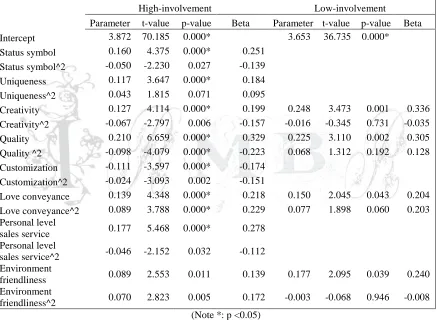
The relationship between independent variable - each feature of handmade and dependent variable – customer purchasing intention are shown in Table 7 with parameter estimates of sigma restricted parameterization for coefficients.
Firstly, the effect of status symbol on customer purchasing intention in high-involvement handmade products is significant. Status symbol figures with β=0.251 > 0, p < 0.05 indicates a positive relationship between status symbol and purchase intention, in other words, there is statistic evidence proving that consumer buy handmade to gain status symbol. As such, hypothesis 2 is supported with high-involvement group. However, due to status symbol square β= -0.139 < 0, p < 0.05 there is a negative significant relation meaning in the event of buying in large quality status symbol is not one of the factors attract customers of high involvement products.
Uniqueness also plays significant roles for customers to buy high-involvement handmade products since uniqueness factor showing β=0.184 > 0, p < 0.05, hypothesis 3 is supported with high-involvement. When buying in large quality, nonetheless uniqueness square p> 0.05 is not considered attractive feature for customer to buy handmade.
ISSN: 2306-9007 Yi & Anh (2016) 603
I
www.irmbrjournal.com June 2016I
nternationalR
eview ofM
anagement andB
usinessR
esearchVol. 5 Issue.2
R
M
B
R
is a positive relation between creativity of handmade with customer buying intention. Hypothesis 4 is supported for both high and low involvement. Meanwhile, in case of purchasing in large quantity, the relationship is negative with high-involvement products β= -0.156 < 0, p < 0.05 but an insignificant with low-involvement p> 0.05 which indicate that creativity is not taken into account as attractive features for handmade being bought in bulk.
Similarly, quality figures in both high and low groups are significant and suggests positive relation with customer purchasing intention. Quality for high-involvement β=0.329 > 0, p < 0.05; for low-involvement β=0.304 > 0, p < 0.05. Hypothesis 5 is supported with both groups. Under the condition of buying in large quantity, the relationship of high-involvement handmade quality and purchase intention is negative β=-0.223 > 0, p < 0.05 but insignificant with the other group.
Table 7: Polynomial regression of effects from handmade products’ features on customer purchasing intention
High-involvement Low-involvement
Parameter t-value p-value Beta Parameter t-value p-value Beta
Intercept 3.872 70.185 0.000* 3.653 36.735 0.000*
Status symbol 0.160 4.375 0.000* 0.251
Status symbol^2 -0.050 -2.230 0.027 -0.139
Uniqueness 0.117 3.647 0.000* 0.184
Uniqueness^2 0.043 1.815 0.071 0.095
Creativity 0.127 4.114 0.000* 0.199 0.248 3.473 0.001 0.336
Creativity^2 -0.067 -2.797 0.006 -0.157 -0.016 -0.345 0.731 -0.035
Quality 0.210 6.659 0.000* 0.329 0.225 3.110 0.002 0.305
Quality ^2 -0.098 -4.079 0.000* -0.223 0.068 1.312 0.192 0.128
Customization -0.111 -3.597 0.000* -0.174
Customization^2 -0.024 -3.093 0.002 -0.151
Love conveyance 0.139 4.348 0.000* 0.218 0.150 2.045 0.043 0.204
Love conveyance^2 0.089 3.788 0.000* 0.229 0.077 1.898 0.060 0.203
Personal level
sales service 0.177 5.468 0.000* 0.278
Personal level
sales service^2 -0.046 -2.152 0.032 -0.112
Environment
friendliness 0.089 2.553 0.011 0.139 0.177 2.095 0.039 0.240
Environment
friendliness^2 0.070 2.823 0.005 0.172 -0.003 -0.068 0.946 -0.008
(Note *: p <0.05)
Customization is considered in high-involvement group showing significant but negative effect to customer purchasing intention with negative Beta and p-value lower than 0.05. For that reason, customization is not one factor that customers consider when buying high-involvement handmade. Hypothesis 6 is not supported with high-involvement.
ISSN: 2306-9007 Yi & Anh (2016) 604
I
www.irmbrjournal.com June 2016I
nternationalR
eview ofM
anagement andB
usinessR
esearchVol. 5 Issue.2
R
M
B
R
customer with love conveyance square β=0.229 > 0, p < 0.05 while low-involvement handmade shows insignificant relation (p > 0.05). Hypothesis 7 is supported with both groups.
Personal level sales service indicating positive effect on customer with β=0.278 > 0, p < 0.05 but ineffective for large quantity since personal level sales service square β< 0. Hypothesis 8 is also supported with high-involvement products.
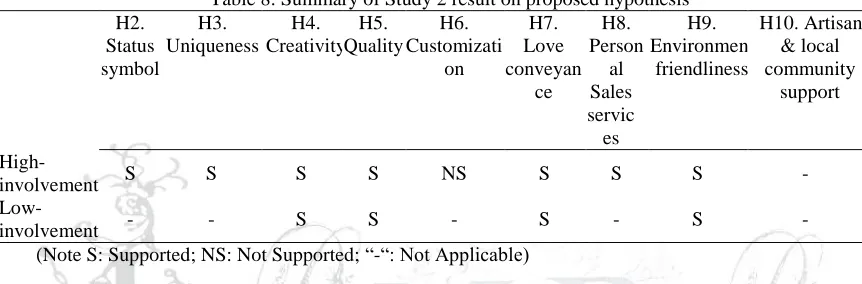
Environment friendliness like love conveyance proving positive effect in both purchasing small and large quantity of high-involvement handmade. (β=0.139 and β=0.172 respectively, p < 0.05). With low-involvement product there is also a positive effect only when selling handmade in small quantity with β=0.240 > 0 and p < 0.05. Hypothesis 9 is supported for both groups. The result for study 2 is demonstrated as table 8.
Table 8: Summary of Study 2 result on proposed hypothesis H2.
Status symbol
H3. Uniqueness
H4. Creativity
H5. Quality
H6. Customizati
on
H7. Love conveyan
ce
H8. Person
al Sales servic es
H9. Environment
friendliness
H10. Artisan & local community
support
High-involvement S S S S NS S S S -
Low-involvement - - S S - S - S -
(Note S: Supported; NS: Not Supported; “-“: Not Applicable)
In summary, for high-involvement group all hypothesizes except for customization are supported which make status symbol, uniqueness, creativity, quality, love conveyance, personal sales service and environment friendliness have positive influence on customer purchasing intention of luxury products. Whereas, all four hypothesizes of low-involvement are supported, meaning creativity, quality, love conveyance and environment friendliness positively affect customers when purchasing low-involvement handmade.
Study 3: Traditional handicraft
Method - Study 3
Study 3 is concerned about a special component of handmade products – traditional handicraft, which attributes make traditional craft attractive to consumer. We conduct the third survey asking 27 customers who are interviewed at a Meinong traditional oil-paper umbrella village in Taiwan and another 139 Vietnamese online respondents mostly are selected from handmade, Do it yourself - DIY community. These 166 people (average income of USD 460; average age of 24.3; 52% female) are asked to rank in 5-point scale (strongly agree – 5 to strongly disagree – 1) giving their opinions when buying traditional handicraft. There are 6 features of handicraft are taken into consideration including creativity, love conveyance, personal sales service, quality, environment friendly and artisan & local community support.
ISSN: 2306-9007 Yi & Anh (2016) 605
I
www.irmbrjournal.com June 2016I
nternationalR
eview ofM
anagement andB
usinessR
esearchVol. 5 Issue.2
R
M
B
R
The equation of polynomial regression of traditional handicraft could be written as formula 3
Y3 = β30 + β31x31 + β32 x32 +…+ β35 x35+ β311 x31 2 + β
322 x32
2 + … + β 355 x35
2
(Formula 3)
In which
Y3: customer purchasing intention for traditional handicraft
X31: Creativity; x32: Love conveyance; x33: Personal sales service; x34: Environment friendliness; x35:
Artisan & local community support
Β3i (i=0, 1, 2,3,4,5 and i=11, 22, 33, 44, 55): respective regression coefficients of low-involvement factors
After that, the two tests on sum of squares of whole model and residual and parameter estimates of sigma restricted parameterization for coefficients are conducted.
Analysis - Study 3
The result for sum of squares of whole model and residual are shown in Table 9 bellow.
Table 9: Traditional handicraft’s effect on customer purchasing intention Multiple
R R2
Adjusted R2
df Model
df
Residential F-value p-value
Traditional Handicraft 0.823 0.677 0.656 10 155 32.429 0.000*
(Note *: p <0.05)
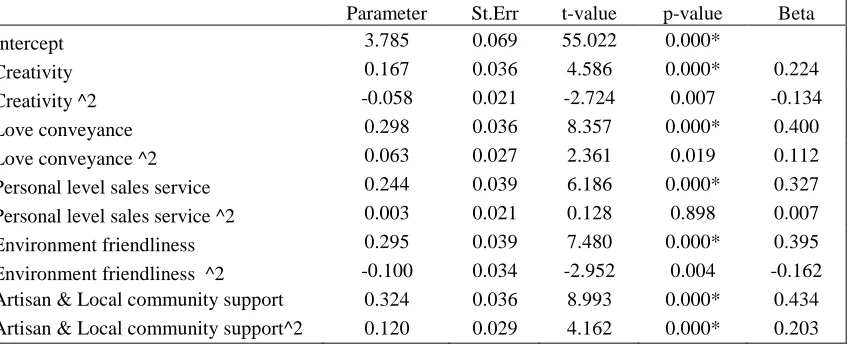
With R-square and adjusted R close to 1, F-value > F critical (F critical = 1.67) and p-value showing significant statistics for effect of traditional handicraft on customer purchasing intention. In order to observe effect of each attribute of traditional handicraft on customers, we have Table 10 of parameter estimates of sigma restricted parameterization for coefficients as follows.
Table 10: Polynomial regression of effects from traditional handicraft’s on purchasing intention
Parameter St.Err t-value p-value Beta
Intercept 3.785 0.069 55.022 0.000*
Creativity 0.167 0.036 4.586 0.000* 0.224
Creativity ^2 -0.058 0.021 -2.724 0.007 -0.134
Love conveyance 0.298 0.036 8.357 0.000* 0.400
Love conveyance ^2 0.063 0.027 2.361 0.019 0.112
Personal level sales service 0.244 0.039 6.186 0.000* 0.327
Personal level sales service ^2 0.003 0.021 0.128 0.898 0.007
Environment friendliness 0.295 0.039 7.480 0.000* 0.395
Environment friendliness ^2 -0.100 0.034 -2.952 0.004 -0.162
Artisan & Local community support 0.324 0.036 8.993 0.000* 0.434
Artisan & Local community support^2 0.120 0.029 4.162 0.000* 0.203
(Note *: p <0.05)
ISSN: 2306-9007 Yi & Anh (2016) 606
I
www.irmbrjournal.com June 2016I
nternationalR
eview ofM
anagement andB
usinessR
esearchVol. 5 Issue.2
R
M
B
R
friendliness (β environment friendliness = 0.395 > 0; β environment friendliness^2 =-0.162 < 0) implies that in case of selling handmade for individual, there is positive effects on customer purchasing intention. Hypothesis 4 and 9 are supported with traditional handicraft. However, in case of wholesale, the influence of creativity and environment friendliness are ambiguous. For the other four independent variables, both Beta value are observed positive, in other words these factors (love conveyance, personal sales service and artisan & local community support) are proven to affect customer purchasing intention in case of buying small and large quantity. Hypothesis 7, 8 and 10 are supported for traditional handicraft. Result is summarized as Table 11.
Table 11: Summary of Study 3 result on proposed hypothesis H2.
Status symbol
H3. Uniqueness
H4. Creativity
H5. Quality
H6. Customizati
on
H7. Love conveyan
ce
H8. Persona
l Sales servic es
H9. Environment
friendliness
H10. Artisan & local community
support
Traditional
Handicraft - - S NS - S S S S
(Note S: Supported; NS: Not Supported; “-“: Not Applicable)
Discussion
In study 1, hypothesis 1 - Products promoted as Handmade positively affect customer purchasing intention was supported, that strongly proved the existence of the handmade effect. Products marketed as machine-made and not mentioning mode of production show no difference in Hotelling test and fairly similar means implying equal interest from customers.
In study 2, we have successfully discovered attributes positively affect customers purchasing intention of handmade products better yet we could diagnose the differences between high-involvement and low-involvement. Consumers rely on quality, creativity, imbued love and environment friendliness when purchasing handmade both luxury and daily-used. Moreover, in the event of buying luxury handmade, customers also consider their status symbol and uniqueness as important factors to show their differences among the others and achieve higher status. There are two features of high-involvement stands out by demonstrating positive effect on purchase intention when purchasing both small and large quantities which are the love imbued inside the handmade and environment friendliness. The hypothesis about customization is rejected could be explained that under the requirement in our survey, customers are asked to give their opinions when purchasing clothes and accessories from luxury brands (like Hermes, Gucci, Louis Vuiton) which are not easily being customized based on buyer’s orders which support Jie et al. (2015) that consumers of high-involvement possess a strong tendency to choose products that look familiar to other consumers to be easily recognized by others. As such, customization is not judged as one of the important factor when buying high-involvement handmade. From the findings for high and low involvement products, marketers and producers now have initial evidence to focus the right features to make handmade more attractive and irresistible to their buyers.
ISSN: 2306-9007 Yi & Anh (2016) 607
I
www.irmbrjournal.com June 2016I
nternationalR
eview ofM
anagement andB
usinessR
esearchVol. 5 Issue.2
R
M
B
R
giving modern society more opportunity to appreciate local products and support the craftsmen & local community.
Conclusion
Across three studies, we observe a special appreciation of customer to human factor in production process and confirm the important role and potential of handmade in contemporary society. Such positive handmade effects on customer purchasing intention could be explained by influences of different features of handmade products. Study 1 provides evidence that products being handmade marketed do have positive effects on purchase intention. Study 2 takes another step to answer why consumer buy handmade, also gives a reliable base to compare two groups of high-involvement and low-involvement. It is note-worthy for marketer that four factors: love conveyance, creativity, quality and environment friendly make both high and low-involvement handmade attractive. They are status symbol, uniqueness and personal level sales service that keep high-involvement’s attractiveness different from low-involvement. In the event of selling handmade in large quantity, love conveyance of low-involvement; as well as love conveyance and environment friendliness of high-involvement should be highlighted to engage customers. Study 3 taps into traditional handicraft - a unique component of handmade giving evidence that love conveyance, creativity, environment friendliness, personal level sales service and artisan & local community support are attributes attract buyers. In order to gain broader efficiency for both wholesale and retail customers, craftsmen and government should focus to differentiate their products as transferable love symbol from the makers to users and gift receivers, and customer would enjoy a personal level sales service when buying handicraft; also the purchase is meaningful to support artisan & local community.
Recommendation
To our best knowledge this research is the first series of experiment on possible driven creating handmade effects there are definitely some limitations to consider for further research. Firstly, in reality there is a blur line between machine made and no production quoted. Study 1 suggests fairly similar results between machine-made and no production cue possibly if it is not handmade producers rarely quote and consumers often pay very little care to mode of producing. Secondly, our respondents were limited in imagining buying soap as low-involvement products and luxury accessories & clothes as high-involvement products. Further study could research on a different set of boarder objects to get more completed results. Thirdly, combining with Christoph, Martin & Stijn’s research (2015) which succeeded to prove customers interest in handmade in Austria, the Netherlands and the United States, handmade effect is strongly believe to be universal. However, for study 2 and 3 our samples were located mainly in Vietnam and Taiwan. It is suggested for further research to study on these matters in other regions/countries.
References
Amaldoss, W. and Jain, S. (2005). “Pricing of conspicuous goods: a competitive analysis of social effects”.
Journal of Marketing, Vol.42, 30-42.
Andrews, J., & Smith, D. C. (1996). In search of the marketing imagination: Factors affecting the creativity
of marketing programs for mature products. Journal of Marketing Research, Vol. 33, 174–187.
Batra R, Ramaswamy V, Alden D, Steenkamp JB & Ramachander S. (2000). Effects of brand local and
nonlocal origin on consumer attitudes in developing countries. Journal of Consumer Psychology,
Vol.9(2), 83–95.
Boden, M.A. (2010) Computer Models of Creativity, 23-34. AI Magazines. Hong Kong, China: Conference
on Intelligent User Interfaces
Buzzell, R.D., & B.T. Cale (1988) The Profit impact of market strategy principles. New York: The Free Press.
ISSN: 2306-9007 Yi & Anh (2016) 608
I
www.irmbrjournal.com June 2016I
nternationalR
eview ofM
anagement andB
usinessR
esearchVol. 5 Issue.2
R
M
B
R
(ed.), Boutonnet J.P. (ed.), Bernués A. (ed.). Mediterranean livestock production: uncertainties and opportunities. 197-203, Zaragoza, Spain: Seminar of the Scientific-Professional Network on Mediterranean Livestock Farming.
Christoph F., Martin S. & Stijn M.J.V.O, (2015). The handmade effect: What’s Love got to do with it?
Journal of Marketing, Vol.79, 98-110
Ellis-Petersen, H. (2014). Traditional skills at risk of dying out, says craft group. Retrieved April 19, 2016, from http://www.theguardian.com/culture/2014/dec/30/traditional-skills-endangered-heritage-craft
Goffman E. (1951). Symbols of Class Status. The British Journal of Sociology, Vol.2(4), 294-304
Etsy: Total annual merchandise sales volume 2015, Statistic. (n.d.). Retrieved April 05, 2016, from http://www.statista.com/statistics/219412/etsys-total-merchandise-sales-per-year/
Grohmann, B. & Bodur, H. (2014). Brand Social Responsibility: Conceptualization, Measurement, and
Outcomes. Journal of Business Ethics, Vol.131(2), 375-399
Janis J (2011). The tourism-development nexus in Namibia – a study on national tourism policy and local
tourism enterprises’ policy knowledge. Working paper. Helsinki, Finland: University of Helsinki, Department of Economic and Political Studies.
Jie Chen, Lefa Teng, Shixiong Liuc & Huihuang Zhud, (2015) Anticipating regret and consumers'
preferences for counterfeit luxury products. Journal of Business Research, Vol. 68, 507–515.
Julie Carr (2009). Creative industries, creative workers and the creative economy: a review of selected recent literature. Scottish Government Social Research, 3-5.
Kapferer, J.N.& Bastien, V. (2009): The Luxury Strategy. Break the Rules of Marketing to Build Luxury Brands. London: Kogan.
Kapferer.J. & Laurent.G (1985). Consumers' Involvement Profile: New Empirical Results, in. Elizabeth C.H (ed) and Moris B. H. (ed). Association for Consumer Research, Vol. 12, 290-295. Provo,Utah, America
Keaveney, S. M. (1995). Customer switching behavior in service industries: An exploratory study. Journal
of marketing, Vol.59(2).
Kleinschmidt, E. J., & Cooper, R. G. (1991). The impact of product innovativeness on performance.
Journal of Product Innovation Management, Vol.8, 240–251.
Landes, David S. (1969). The Unbound Prometheus: Technological Change and Industrial Development in
Western Europe from 1750 to the Present. Cambridge, New York: Press Syndicate of the University of
Cambridge.
Laroche, M., Bergeron, B., & Barbaro, G. (2001). Targeting consumers who are willing to pay more for
environmentally friendly products. Journal of Consumer Marketing, Vol.18, 503–520.
Lin, L., & Pei, M. (2015). Food for memories and culture – A content analysis study of food specialties and
souvenirs. Journal of Hospitality and Tourism Management, Vol. 22, 19-29.
McCullough. M., (1996). Abstracting craft: the practiced digital hand. MIT Press, Cambridge, Mass.
Mendelson and Parlaturk, (2008). Competitive customization. Manufacturing & Service operations
management, Vol.10 (3), 377-390.
Papaoikonomou, E., Valverde, M., & Ryan, G. (2012). Articulating the meanings of collective experiences
of ethical consumption. Journal of Business Research, Vol.110(1), 15–32.
Pye, D., (1968). The Nature and Art of Workmanship. A&C Black, London.
Risdiyono & Pisut Koomsap (2011). Design by customer: Concept and applications. Journal of Intelligent
Manufacture, Vol 24(2), 295-311.
Robertson, T. S., & Gatignon, H. (1986). Competitive effects on technology diffusion. Journal of Marketing, Vol.50, 1–12.
Russo, I., and Cardinali, S. (2012). Product returns and customer value: a footware industry case. In
Physica-Verlag HD (ed) Modelling Value. 79-97.
Schlegelmilch, B.B., Bohlen, G.M., & Diamantopoulos, A. (1996). The link between green purchasing
decisions and measures of environmental consciousness. European Journal of Marketing, Vol.30, 35–
55.
Snyder, C.R. and Fromkin, H.L., (1980). Uniqueness: The human pursuit of difference. New York: Plenum
ISSN: 2306-9007 Yi & Anh (2016) 609
I
www.irmbrjournal.com June 2016I
nternationalR
eview ofM
anagement andB
usinessR
esearchVol. 5 Issue.2
R
M
B
R
Snyder, C.R., (1992). Product scarcity by need for uniqueness interaction: A consumer catch-22 carousel?
Basic and Applied Social Psychology, Vol.13(1), 9-24
Stephen L., (1991). Culture as a resource: four cases of self-managed indigenous craft production in Latin
America. Economic Development and Cultural Change, Vol.40, 101-130.
Sunita P. G., Shiware T.A. (2013). Trends of Indian handicraft export since 2001. Sona Global
Management Review, Vol.7(2), 38-45
Thomas & Paolo, (2013). Customers’ online shopping preferences in mass customization. Journal of Direct, Data and Digital Marketing Practice, Vol.15(1), 20–35.
Thomas Leslee, (2015). Rise of the machine made are rugs. Furniture Today, 14-16.
Tian, K.T., Bearden, W. O., & Hunter, G. L. (2001). Consumers’ need for uniqueness: scale development
and validation. Journal of Consumer Research, Vol.28, 50-66
UNESCO/ITC Final report (1997). Crafts and the international market: Trade & customs codification - Manila, CLT/CONF/604/7
Vadakepat,V. & Khateeb, F. A., (2012) Globalizing rural markets: evidence from handmade traditional
product markets. Global Journal of business research, Vol.6(4), 35.
Whitlark, David B. Geurts, Michael D. & Swenson, Michael J., (1993). New Product Forecasting with a
Purchase Intention Survey. Journal of Interactive Marketing, Vol.25, 270.