P. Ponmalar
et al
, International Journal of Computer Science and Mobile Applications,
Vol.2 Issue. 5, May- 2014, pg. 14-19
ISSN: 2321-8363
©2014, IJCSMA All Rights Reserved, www.ijcsma.com 14
A SELF-SYSTEMATIZE DEPENDENCE
SCULPT FOR DECENTRALIZED SYSTEMS
P. Ponmalar, K. Rajasundari, M.E.,
II M.E CSE, Asst. Professor,
Francis Xavier Engg. College, Francis Xavier Engg. College,
Tirunelveli Tirunelveli
Abstract
—Open nature of peer-to-peer systems exposes them to malicious activity. Building trust relationship among the peers can mitigate attacks of malicious peers. This paper proposed the distributed algorithms that enable a peer to reason about trustworthiness of other peers based on past interactions and recommendations. Peers create their own trust network in their proximity by using local information available and do not try to learn global trust information. Two contexts of trust, service, and recommendation contexts are defined to measure trustworthiness in providing services and giving recommendations. Interactions and recommendations are evaluated based on relevant, recentness, and peer satisfaction parameters. Additionally, recommender’s trustworthiness and confidence about a recommendation are considered while evaluating recommendations. Simulation experiments on a file sharing application show that the proposed model can mitigate attacks on different malicious behavior models. In these experiments, good peers were able to form trust relationships in their proximity and isolate malicious peers.Keywords:
Distributed algorithm, Auto update mechanism, Trust relationship for Peers systemsI.
INTRODUCTION
P. Ponmalar
et al
, International Journal of Computer Science and Mobile Applications,
Vol.2 Issue. 5, May- 2014, pg. 14-19
ISSN: 2321-8363
©2014, IJCSMA All Rights Reserved, www.ijcsma.com 15
II. SYSTEM ANALYSISA. PROBLEM DEFINITION
To identify the malicious peer in P2P system and to create the trust relationship and to create the trust relationship among the peer. To provide two contexts of trust services and giving recommendations to measure the trustworthiness. It represents distributed algorithms to ensure trustworthiness in peer based on past interactions and recommendations.
B. EXISTING SYSTEM
Most previous works on trust management in peer-to-peer systems have focused on the Reliability. A peer that issues a query for the trust ratings of another peer should be able to compute the true trust value despite the presence of malicious peers. In these systems, a peer is assigned a trust value or reputation based on a trust metric. Although various systems differ in how this metric is defined, in general, the trust value associated with a peer is calculated based on the feedback provided by other peers. Peers rate the performance or behavior of another peer based on their previous interactions.
C. PROPOSED SYSTEM
To introduce the term witness anonymity to refer to this combination of seemingly conflicting requirements, i.e., identity anonymity for honest peers and accountability for misbehaving peers. The major goal of the work is to show how peer-to-peer trust management systems can be extended to provide witness anonymity. Another important motivation for witness anonymity is simply to preserve the privacy of peers participating in the peer-to-peer trust management system. A protocol called the Secure Deep Throat (SDT) for providing witness anonymity in peer-to-peer systems. To the best of the knowledge, SDT is the first protocol that can support both aspects of witness anonymity.
III. SYSTEM ARCHITECTURE
Peer Login
Network
Source Peer
Send message to destination
Receiver peer send the ack to
Database
Find Path
Verify Sign
Send the malicious peer
S E R V E R
Server will verify once again sign
Find the malicious peer
Providing accountability in
P. Ponmalar
et al
, International Journal of Computer Science and Mobile Applications,
Vol.2 Issue. 5, May- 2014, pg. 14-19
ISSN: 2321-8363
©2014, IJCSMA All Rights Reserved, www.ijcsma.com 16
IV. SYSTEM MODULES
A.
Peer Registration
To add any number of Peers dynamically and construct the connections dynamically. Construct the dynamic network topology. Peer can easily leave from the network. Distributed hash Table (DHT) maintains the peer details and also it
updates the status of each peer in network.
B. ERT Construction
In this module, Elastic Routing Table in each node is constructed. It contains the in link and out link details of each node.
In degree and out degree calculated for each node depends upon the connections details.
C. In degree Construction
The degree of each node is updated based on the degree value. The load status of each peer in the network is measured
here. Capacity value also calculated by using available degree value divide by total degree value. Capacity value maintain
in the elastic routing table.
D. Best Peer Selection
Best peer selected based on high degree value and capacity value. That means high capacity value peer has less amount of
load in the network. So high capacity value peer is selected. So allocated work completed in very less time period. Network
also avoids the unwanted load problem in process time. Peer join and reliving suffer degree value of each peer.
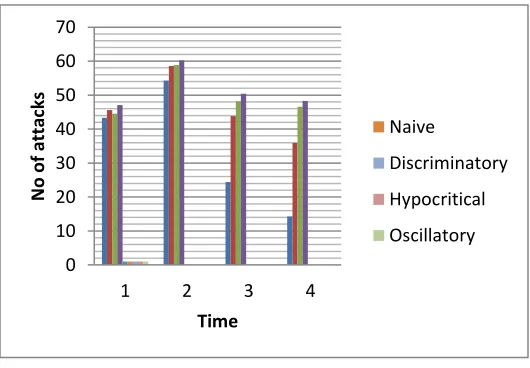
Fig. Individual Attacker ( 10% malicious)
010 20 30 40 50 60 70
1 2 3 4
N
o
o
f att
ac
ks
Time
Naive
Discriminatory
Hypocritical
P. Ponmalar
et al
, International Journal of Computer Science and Mobile Applications,
Vol.2 Issue. 5, May- 2014, pg. 14-19
ISSN: 2321-8363
©2014, IJCSMA All Rights Reserved, www.ijcsma.com 17
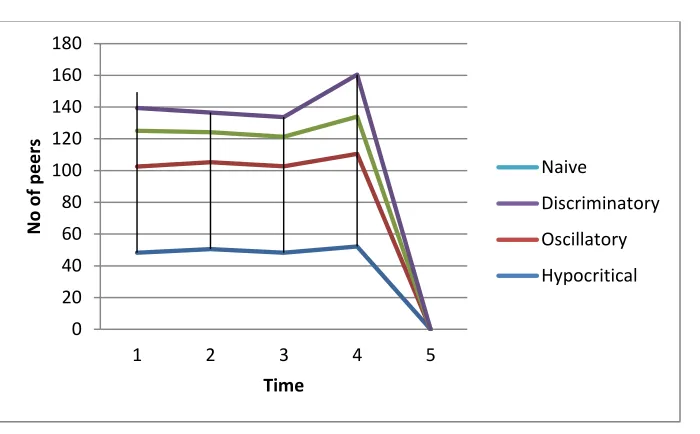
Fig. Individual Pseudospoofers( 10% malicious)
V. CONCLUSION
A trust model for P2P networks is presented, in which a peer can develop a trust network in its proximity. A peer
can isolate malicious peers around itself as it develops trust relationships with good peers. Two context of trust, service and
recommendation contexts are defined to measure capabilities of peers in providing services and giving recommendations.
Interactions and recommendations are considered with satisfaction, weight and fading effect parameters. A recommendation
contains the recommenender’s own experience, information from its acquaintances, and level of confidence in the
recommendation. These parameters provided as a better assessment of trustworthiness. My future work will enhance the
security of P2P system and recommendation-based attacks in most experiments. If a peer changes its point of attachment to the
network, it might lose a part of its trust network. These issues might be studied as a future work to extend the trust model.
REFERENCES
1.
Aberer.A, A.Datta, and M.Hauswirth(2005),‘P-Grid:Dynamics of Self-Ststems and Applications’,Vol. 3845, No. 3, pp. 31-382. Boyd.S, Ghosh.A, Prabhakar.B, and Shah.D(2006),‘Randomized Gossip Algorithms’,Vol. 52,No. 6, pp. 2508-2530.
3. Friedman.E.J and Resnick.P(2001),‘The Social Cost of Cheap Pseudonyms’, J.Economics and Management
Strategy,Vol. 10,No. 2, pp. 173-199. 0
20 40 60 80 100 120 140 160 180
1 2 3 4 5
N
o
o
f p
e
e
rs
Time
Naive
Discriminatory
Oscillatory
P. Ponmalar
et al
, International Journal of Computer Science and Mobile Applications,
Vol.2 Issue. 5, May- 2014, pg. 14-19
ISSN: 2321-8363
©2014, IJCSMA All Rights Reserved, www.ijcsma.com 18
4. Hoffman.K, Zage.D, and Nita-Rotaru.C(2009),‘A Survey of Attack and Defence Techniques for Reputation
Systems’,ACM Computing Surveys,Vol. 42, No.1, pp. 21-31.
5. Ratnasamy.S, Francis.P ,Handley.M, Karp.R, and Shenker.S(2001),‘A Scalable Content-Addressable Network’,ACM
SIGCOMM Computer Comm.Rev, Vol. 31, No. 4, pp. 161-172.
6. Resnick.P, Kuwabara.K, Zeckhauser.R, and E.Friedman(2000),‘Reputation Systems’ Comm.ACM,Vol. 43,No. 12, pp.
45-51
.
7.
Ripeanu.M,Foster.and Iamnitchi.A(2002),‘Mapping the GnutellaNetwork Properties of Large-
Scale Peer-to-Peer Systems and Implications for System Design’,Vol. 6, No. 1, pp. 50-57.8. Sherwood.R, Lee.S, and Bhattacharjee.B(2006),‘Cooperative Peer Groups in Nice’,Computer Networks, Vol. 50,No.
4, pp. 523-544.
9. Song.S, Hwang.K, Zhou.R, and Kwok.Y.K(2005),‘Trusted P2P Transactions with Fuzzy Reputation
Aggregation’IEEE Internet Computing’,Vol. 9, No. 6, pp. 24-34
10. Staab.S, Bhargava.B, Lilien.L, Rosenthal.A, Winslett.M, Sloman.M, Dillon.T, Chang.E, Hussan.F.K, Nejdl.W,
Olmedilla.D, and Kashyap.V(2004), ‘The Pudding of Trust’,IEEE Intelligent Systems,Vol. 19, No. 5, pp. 74-88.
11. Stoica.I, Morris.R, Karger.D, Kaashoek.M.F, and Balakrishnan.H (2001),‘Chord:A Scalable Peer-to-Peer Lookup
Service for Internet Applications’ ,ACM SIGCOMM Computer Comm.Rev, Vol. 31, No. 4, pp. 149-160.
12. Tran.N, Min.B, Li.J and Subramanian.L(2009), ‘Sybil-Resilient Online Content Voting’ Proc. Sixth USENIX Symp.
Networked Systems and Implementation (NSDI),Vol. 12,No. 3,pp. 45-53.
13. Victor.P, Cornelis.C,De Cock.M ,and Pinheiro da Silva.P(2009),‘Gradual Trust and Distrust in Recommender
Systems’,Fuzzy Sets Systems’,Vol. 160, No. 10, pp. 1367-1382.
14. Yu.H, Kaminsky.M, Gibbons.P.B, and Flaxman.A(2006),‘Sybilguard:Defending against Sybil Attacks via Social
Networks’,ACM SIGCOMM Computer Comm.Rev,Vol. 36,No. 4, pp. 267-278.
15. Zhou.R and Hwang.K(2007), ‘Powertrust:A Robust and Scalable Reputation System for Trusted Peer-to-Peer
P. Ponmalar
et al
, International Journal of Computer Science and Mobile Applications,
Vol.2 Issue. 5, May- 2014, pg. 14-19
ISSN: 2321-8363
©2014, IJCSMA All Rights Reserved, www.ijcsma.com 19
Authors Bibliography