Synthesis with Variation of Some Basic Properties of
Si-Al-O-N- Based Ceramic Materials
TANMOy DAS
1*and GOuTAM HAzrA
21Dept. of Chemistry, The University of Burdwan, Burdwan-713 104,West Bengal India. 2Dept. of Chemistry, Kalna College, Kalna, Burdwan-713409, West Bengal, India.
*Corresponding author E-mail : [email protected] http://dx.doi.org/10.13005/msri/140110 (Received: June 20, 2017; Accepted: June 21, 2017)
ABSTrACT
Sialon is an excellent material belonging to the oxynitride ceramics. It has high strength, wear resistance, and other mechanical and chemical properties. b–sialon has the general formula of Si
6-ZAlZOZN8-z,where z=0 to 2.1. In the present work in total nine different Sialon samples with different
compositions were sintered at 7 different temperatures viz., 1575 to 1840oC. Green density, fired
density, % linear shrinkage at different temperatures and compositions were reported. Theoretical density of 3.2 gm/cc. was almost reached. The properties were compared and various parameters were corroborated In terms of at % N.
Keywords: Sintering, linear shrinkage, b-SiAlON, cold isostatic pressing, attrition milling, refractories, fabrication, oxynitride, sieving, mesh, green density, fired density, linear shrinkage.
INTrODuCTION
Silicon nitride and oxynitride ceramics have attracted interest for high-temperature engineering and are termed as engineering ceramics .Its application is based on their properties such as:(1) high strength; (2) wear resistance; (3) high decomposition temperature; (4) oxidation resistance; (5) thermal shock resistance; (6) low coefficient of friction; (7) resistance to corrosive environments1,2.
Al3+ can enter the silicon nitride crystal without
changing the structure by replacing Si4+,if at the
same time N3+ is replaced by O2,, similar to the
compound N2O3,as well . Such a solution was named
“SiAlON”. SiAlON -ceramics are a specialised class of high temperature refractory materials, with high strength (including at high temperature), good thermal shock resistance by molten non-ferrous metals, compared to other refractory materials such as alumina. A typical use is with handling of molten
aluminium. They also are exceptionally corrosion resistant, low thermal expansion and oxidation resistance up to above 1000oC3.Sialons are ceramic
alloys based on the element silicon (Si), aluminium (Al), oxygen (O) andnitrogen (N). Sialons exits in three basic forms .Each form is iso-structural with one of the two common forms of Si3N4, b and a
and with sillicon oxynitride. SiAlON is based upon the atomic arrangement existing in b-Si3N4. In this
material, Si is substituted by Al with corresponding replacement of N by O. The second form of Si3N4
with which sialon is iso-structural is b-Si3N4. The
stacking structure in b-Si3N4 is different from b-Si3N4
in that the long ‘channels’ which run through the a
structure are blocked at intervals. This gives rise to a series of interstitial holes. In each Si12N16 unit
cell there are two interstitial holes4. In b-sialons, Si
interstitial holes. In this way cations of yttrium (Y), calcium (Ca), lithium (Li) and neodymium (Nd) for example can be incorporated into the structure .The final form of sialon, O-sialon, is iso-structural with silicon oxynitride (Si2N2O). The structure of Si2N2O consists of layers of Si3N4 rings joined by Si-O-Si bonds. In O-sialon, Al and O are replaced by some Si and N atoms.
In liquid phase sintering of Sialon some metal oxides like Y2O3 or MgO is added to promote
their sintering which ultimately go to the grain-boundary of such ceramics. This is called the oxynitride glass4,6.The drawback is that during
working condition of these ceramic materials, different foreign elements depending on the substrate make a way through the grain-boundary phase and lead to the their deterioration5.
Sialon has the applications in engineering ceramics viz., cutting tool, bearing balls, bearing casing, turbine materials etc 2.
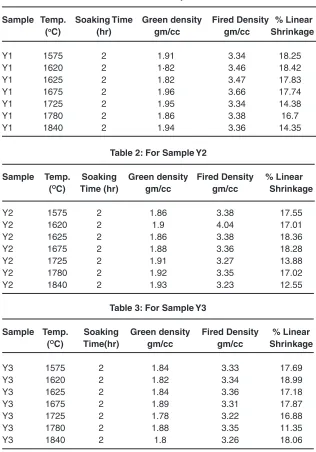
Table 1: for sample y1
Sample Temp. Soaking Time Green density Fired Density % Linear
(oC) (hr) gm/cc gm/cc Shrinkage
Y1 1575 2 1.91 3.34 18.25
Y1 1620 2 1·82 3.46 18.42
Y1 1625 2 1.82 3.47 17.83
Y1 1675 2 1.96 3.66 17.74
Y1 1725 2 1.95 3.34 14.38
Y1 1780 2 1.86 3.38 16.7
Y1 1840 2 1.94 3.36 14.35
Table 2: For Sample y2
Sample Temp. Soaking Green density Fired Density % Linear
(OC) Time (hr) gm/cc gm/cc Shrinkage
Y2 1575 2 1.86 3.38 17.55
Y2 1620 2 1.9 4.04 17.01
Y2 1625 2 1.86 3.38 18.36
Y2 1675 2 1.88 3.36 18.28
Y2 1725 2 1.91 3.27 13.88
Y2 1780 2 1.92 3.35 17.02
Y2 1840 2 1.93 3.23 12.55
Table 3: For Sample y3
Sample Temp. Soaking Green density Fired Density % Linear
(OC) Time(hr) gm/cc gm/cc Shrinkage
Y3 1575 2 1.84 3.33 17.69
Y3 1620 2 1.82 3.34 18.99
Y3 1625 2 1.84 3.36 17.18
Y3 1675 2 1.89 3.31 17.87
Y3 1725 2 1.78 3.22 16.88
Y3 1780 2 1.88 3.35 11.35
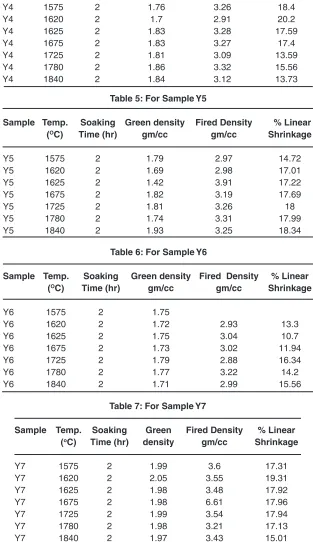
Table 4: For Sample y4
Sample Temp. Soaking Green density Fired Density % Linear
(OC) Time (hr) gm/cc gm/cc Shrinkage
Y4 1575 2 1.76 3.26 18.4
Y4 1620 2 1.7 2.91 20.2
Y4 1625 2 1.83 3.28 17.59
Y4 1675 2 1.83 3.27 17.4
Y4 1725 2 1.81 3.09 13.59
Y4 1780 2 1.86 3.32 15.56
Y4 1840 2 1.84 3.12 13.73
Table 5: For Sample y5
Sample Temp. Soaking Green density Fired Density % Linear
(OC) Time (hr) gm/cc gm/cc Shrinkage
Y5 1575 2 1.79 2.97 14.72
Y5 1620 2 1.69 2.98 17.01
Y5 1625 2 1.42 3.91 17.22
Y5 1675 2 1.82 3.19 17.69
Y5 1725 2 1.81 3.26 18
Y5 1780 2 1.74 3.31 17.99
Y5 1840 2 1.93 3.25 18.34
Table 6: For Sample y6
Sample Temp. Soaking Green density Fired Density % Linear
(OC) Time (hr) gm/cc gm/cc Shrinkage
Y6 1575 2 1.75
Y6 1620 2 1.72 2.93 13.3
Y6 1625 2 1.75 3.04 10.7
Y6 1675 2 1.73 3.02 11.94
Y6 1725 2 1.79 2.88 16.34
Y6 1780 2 1.77 3.22 14.2
Y6 1840 2 1.71 2.99 15.56
Table 7: For Sample y7
Sample Temp. Soaking Green Fired Density % Linear (oC) Time (hr) density gm/cc Shrinkage
Y7 1575 2 1.99 3.6 17.31
Y7 1620 2 2.05 3.55 19.31
Y7 1625 2 1.98 3.48 17.92
Y7 1675 2 1.98 6.61 17.96
Y7 1725 2 1.99 3.54 17.94
Y7 1780 2 1.98 3.21 17.13
Table 8: For Sample y8
Sample Temp. Soaking Green density Fired Density % Linear
(oC) Time (hr) gm/cc gm/cc Shrinkage
Y8 1575 2 2.11 3.42 11.35
Y8 1620 2 2.11 3.6 19.6
Y8 1625 2 2.12 3.67 11.22
Y8 1675 2 2.07 3.76 18.27
Y8 1725 2 2.07 3.75 18.44
Y8 1780 2 2.06 3.28 19.28
Y8 1840 2 2.07 3.74 17.85
Table 9: For Sample y9
Sample Temp. Soaking Green density Fired Density % Linear
(oC) Time (hr) gm/cc gm/cc Shrinkage
Y9 1575 2 2.47 3.19 8.91
Y9 1620 2 2.21 3.91 18.39
Y9 1625 2 2.32 3.29 10.32
Y9 1675 2 2.39 3.54 12.27
Y9 1725 2 2.37 4.09 16.54
Y9 1780 2 2.43 3.26 16.79
Y9 1840 2 2.35 4.23 17.33
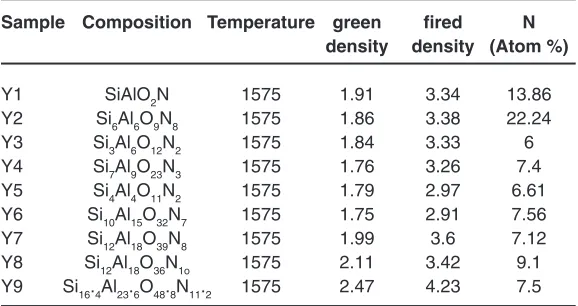
Table 10: Sample No. With varying N (Atom%) concentration
Sample Composition Temperature green fired N
density density (Atom %)
Y1 SiAlO2N 1575 1.91 3.34 13.86
Y2 Si6Al6O9N8 1575 1.86 3.38 22.24 Y3 Si3Al6O12N2 1575 1.84 3.33 6 Y4 Si7Al9O23N3 1575 1.76 3.26 7.4 Y5 Si4Al4O11N2 1575 1.79 2.97 6.61 Y6 Si10Al15O32N7 1575 1.75 2.91 7.56 Y7 Si12Al18O39N8 1575 1.99 3.6 7.12 Y8 Si12Al18O36N1o 1575 2.11 3.42 9.1 Y9 Si16.4Al23.6O48.8N11.2 1575 2.47 4.23 7.5 Composition wise these b-Sialons can be
considered as a solid solution between Si3N4 and Al3O3N7. Self propagating high temperature synthesis
(SHS) of Sialon is another beautiful method involving high temperature processing8.
In another work a unique method was developed9 in the pressureless densification of a
ceramic with composition in the Sialon region.
In a separate approach sialon was synthesised under a low n-pressure by gel mixture8.
Effect of alumino silicate son the pressure less densification of a ceramic with composition in the Sialon region was studied7. Self-propagating high
temperature synthesis (SHS) was adopted and outstanding characterisation was achieved8.
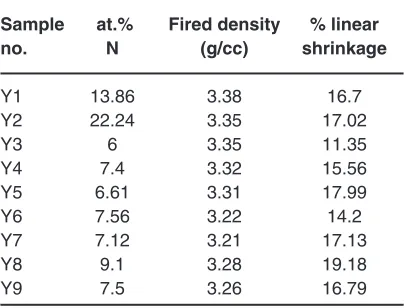
(3.51 g/cc). Various methods have been discussed in the synthesis of b-Sialon based ceramic materials and on their net shape consolidation into radome Table 11: Variation of parameters with N
content (Atom %) at different Temp.
Variation of parameters with N content (Atom%) at Firing Temperature 15750C
Sample at.% N Fired density % linear
no. (g/cc) shrinkage
Y1 13.86 3.34 18.42
Y2 22.24 3.45 17.01
Y3 6 3.4 17.18
Y4 7.4 3.26 20.2
Y5 6.61 2.97 17.01
Y6 7.56 2.91 10.7
Y7 7.12 3.42 19.31
Y8 9.1 3.6 19.6
Y9 7.5 3.19 18.39
Variation of parameters with N content (Atom %) at Firing Temperature 16200C
Sample at.% Fired density % linear
no. N (g/cc) shrinkage
Y1 13.86 3.34 19.25
Y2 22.24 3.45 17.55
Y3 6 3.4 17.69
Y4 7.4 3.26 18.4
Y5 6.61 2.97 14.72
Y6 7.56 2.91 10.7
Y7 7.12 3.42 17.31
Y8 9.1 3.6 19.6
Y9 7.5 3.19 8.91
Variation of parameters with N content (Atom%) at Firing Temperature 16750C
Sample at.% Fired density % linear
no. N (g/cc) shrinkage
Y1 13.86 3.34 14.38
Y2 22.24 3.27 13.88
Y3 6 3.22 16.88
Y4 7.4 3.09 13.59
Y5 6.61 3.26 18
Y6 7.56 2.88 16.34
Y7 7.12 3.54 17.94
Y8 9.1 3.75 18.44
Y9 7.5 4.09 16.54
Variation of parameters with N content (Atom%) at Firing Temperature 17250C
Sample at.% Fired density % linear
no. N (g/cc) shrinkage
Y1 13.86 3.34 19.25
Y2 22.24 3.45 17.55
Y3 6 3.4 17.69
Y4 7.4 3.26 18.4
Y5 6.61 2.97 14.72
Y6 7.56 2.91 10.7
Y7 7.12 3.42 17.31
Y8 9.1 3.6 19.6
Y9 7.5 3.19 8.91
Variation of parameters with N content (Atom %) at Firing Temperature 17800C
Sample at.% Fired density % linear
no. N (g/cc) shrinkage
Y1 13.86 3.38 16.7
Y2 22.24 3.35 17.02
Y3 6 3.35 11.35
Y4 7.4 3.32 15.56
Y5 6.61 3.31 17.99
Y6 7.56 3.22 14.2
Y7 7.12 3.21 17.13
Y8 9.1 3.28 19.18
Y9 7.5 3.26 16.79
Variation of parameters with N content (Atom%) at Firing Temperature 18400C
Sample at.% Fired density % linear
no. N (g/cc) shrinkage
Y1 13.86 3.36 14.35
Y2 22.24 3.23 12.55
Y3 6.0 3.26 18.06
Y4 7.4 3.12 13.73
Y5 6.61 3.25 18.34
Y6 7.56 2.99 15.56
Y7 7.12 3.43 15.01
Y8 9.1 3.74 17.85
structure was done11. Reaction sintering of Sialon
from Si3N4,AlN and Al2O3without externally added sintering aids was done by several workers12-15. Out
of different methods in our case we had adopted the high temperature sintering procedure.
MATerIALS AND MeTHODS
Reaction sintering of SiAlON from the system Si3N4-AIN-Al2O3 (Sarabhai M. Chemicals, India), SiO2 (Quartz, Optical Grade) without externally adding aids were done. From the batch materials for e.g., Si3N4, AIN, Al2O3 of specific particle size, the powder with some pre-determined composition was chosen (Table 10). These were mixed and fired at high temperature for a period of time and under nitrogen atmosphere. The batches of 100g of materials were attrition milled with 700g of Al2O3 ball of size of about 2mm for 3-4 hour in pure acetone. The milled powder was then air –dried and sintered through a 150 mesh sieve. Cold pressed pellets of cylindrical were prepared by uniaxial pressing followed by isostatic pressing at around 300 MPa pressure .Green density of the samples were measured from their dimension .The pressed pellets were taken in BN-coated graphite crucible and were sintered in a controlled atmosphere furnace. The firing temperature was varied in the range 1575 to 1840 oC for a time period of 2h. Linear
shrinkage, weight loss and green and fired density were measured using conventional methods. Phase identification was done by XRD analyses using CuKa
radiation (Philips PW 1730). % linear shrinkage was measure from dimension of the final product. All the firings here were done in a Hot Press, Vacuum Industries Inc, U.S.A., under nitrogen atmosphere.
reSuLT AND DISCuSSION
Composition wise these b-Sialon can be considered as a solid solution between Si3N4 and Al3O3N7. Out of different methods, in our case
we had adopted the high temperature sintering procedure2,3.
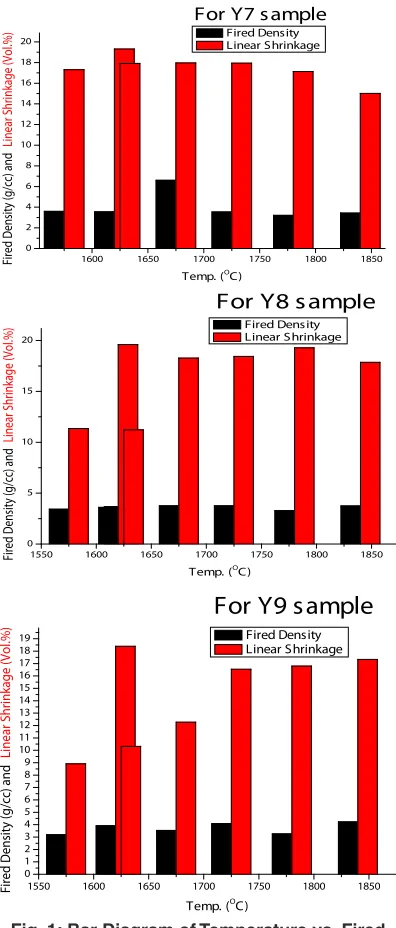
The followings are the tables (Table 1) through (Table 9) of sample no., temperature, time etc. vs. time and density values. The changes in properties follow regular pattern in some sense with variation in temperature of firing and at % N in the concentration. Sialon materials which can be considered as a solid solution based on the Si3N4structure. Based on a composition and viewpoint these materials can be regarded as solid solution between Si3N4 and Al3O3N7.] Self Fig. 1: Bar Diagram of Temperature vs. Fired
Density (g/cc in all cases) and % Linear Shrinkage for different samples
1600 1650 1700 1750 1800 1850 0 2 4 6 8 10 12 14 16 18 20
For Y7 sample
Fired Density (g/cc) and
Linear Shrinkage (Vol.%)
Temp. (OC)
Fired Density Linear Shrinkage
1550 1600 1650 1700 1750 1800 1850 0
5 10 15 20
For Y8 sample
Fired Density (g/cc) and
Linear Shrinkage (Vol.%)
Temp. (OC)
Fired Density Linear Shrinkage
1550 1600 1650 1700 1750 1800 1850
0 1 2 3 4 5 6 7 8 9 10 11 12 13 14 15 16 17 18 19
For Y9 sample
Fired Density (g/cc) and
Linear Shrinkage (Vol.%)
Temp. (OC)
propagating high temperature synthesis of Sialon is another beautiful method involving high temperature processing11. Sintering Parameters of different
samples
In the following tables Table1 through Table 9,Sample Temperature, Time, Green density (gm/cc) , Fired Density (gm/cc) and % Linear Shrinkage of different samples are tabulated the present work:
The density of such hard materials with high fired density is compared to that of diamond8. Here
only temperature 15750 C was taken since it is the
lowest temp. of study as in the present work . As is evidenced from Table 10, for the samples Y1 and Y2 show a lowering of % Linear shrinkage. The table also shows no regular pattern with change of N (at %). On the contrary for samples
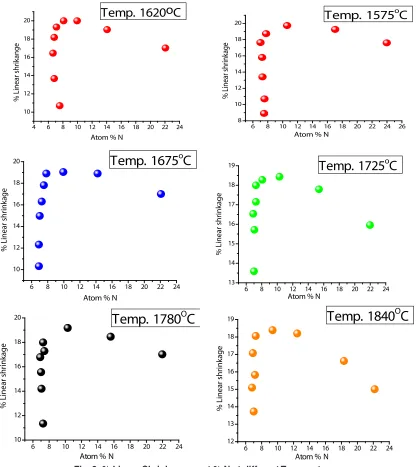
Fig. 2: % Linear Shrinkage vs. at % N at different Temperatures 4 6 8 10 12 14 16 18 20 22 24
10 12 14 16 18 20
%
Linear shrikange
Atom % N
Temp. 1620oC
6 8 10 12 14 16 18 20 22 24 26 8
10 12 14 16 18 20
% Linear shrinkage
Atom % N
Temp. 1575
oC
6 8 10 12 14 16 18 20 22 24
10 12 14 16 18 20
% Linear shrinkage
Atom % N
Temp. 1675
oC
6 8 10 12 14 16 18 20 22 24
13 14 15 16 17 18 19
% Linear shrinkage
Atom % N
Temp. 1725
oC
6 8 10 12 14 16 18 20 22 24
10 12 14 16 18 20
% Linear shrinkage
Atom % N
Temp. 1780
OC
6 8 10 12 14 16 18 20 22 24
12 13 14 15 16 17 18 19
% Linear shrinkage
Atom % N
Y1,Y2 show as lowering of %Linear shrinkage with temperature while the other show reverse.
In a unique method Sialon was synthesised under a low N-pressure by gel mixture8. These
materials can be regarded as solid solution between Si3N4 and Al3O3N7.
In case of Y9 with higher N (atom %) of 7.5 the fired density is the highest of 4.23. Interestingly the linear shrinkage value is lower here compared to others. For Y2 with highest at% N 22.24% fired density is the highest at 15750C among all other
samples. Thus increase in N at% is not the only criterion in the study.
The fired density observed by other authors15 is also in the range that of ours around 3.0
gm/cc.
As shown in the plots [Figs 1 and 2] both the fired density and the % linear shrinkage show some pattern when plotted against at % N. This is a regular feature in all the plots. The plots initially show a steep rise and then get levelled off or decrease to a little extent. In all cases it is obvious that the fired density was twice than the green one as observed. [Table 1 through Table 9].
Variation in % linear shrinkage values
The % linear shrinkage vs atom % N is synnonimous to tightening and compactness. As found in the Fig.2at low at% N shrinkage is low so also at high at % N while intermediate at the intermediate concentration of N. A good shrinkage implies a better binding.
This might be explained in the light of as we are going from oxide system to oxynitride system the O is slowly being replaced by N, Now O is dibridhing (-O-) while N is tribridging (〉N-) leading to higher compactness in the structure of Sialon. Now ultimately it may so happen that when O concentration leads to a limiting low lowering of the % linear shrinkage at high N value or remains almost the same due to saturation N uptake capacity. Structural aspects of Sialon have been well discussed7.
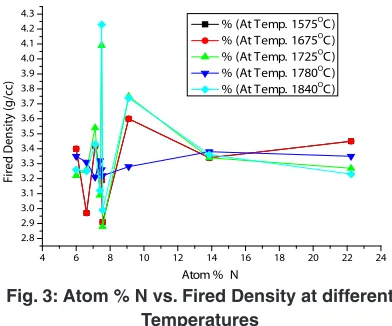
This reflects that with increased tribridging N (in place of dibridging O, in the structure) the fired density gets up a steep rise. After reaching a maximum value it gets saturation and sometimes a lowering in value though it cannot be explained [Figs 1 and 2].
The % linear shrinkage also follows a steep rise with increase in N and becomes levels off at the end a slow decrease. Thus the enhanced amount of N does not play any role in altering the effect. The theoretical density of sialon being 3.2 g/cc, the remaining of the highest value for any sample is significant.
Variation of % linear shrinkage was at per with some earlier workers15, that is, in between 16-19
% and that of ours.
With temperature, however, there is shown no regular trend with change in at% N. On the other hand some irregular phenomenon is shown.
Asis evidenced from Fig1 that the Fired Density remaining the same with some exception. But % linear shrinkage shows some variation for different samples as the temperature is varied.
Among all samples the fired density is found to be highest for Y9 at 18400C,ie. 4.23 g/cc
with an at. % N of 9.1.(Table 11) From the figure 3 it is evident that with increasing at % N initially fired density show a steep rise and then levels off after a sharp fall.
Fig. 3: Atom % N vs. Fired Density at different Temperatures
4 6 8 10 12 14 16 18 20 22 24
2.8 2.9 3.0 3.1 3.2 3.3 3.4 3.5 3.6 3.7 3.8 3.9 4.0 4.1 4.2 4.3
Fired Density (g/cc)
Atom % N
% (At Temp. 1575OC)
% (At Temp. 1675OC)
% (At Temp. 1725OC)
% (At Temp. 1780OC)
In case of Y7 with higher N (at. % of 7.12) the fired density is the highest of 3.6. Actually it is Y3 with 6 at.% N which has the highest fired density of 3.4 with a firing temperature of 1575 0C.Interestingly
the linear shrinkage value is lower here compared to others. For Y2 with highest at.% N (22.24) fired density is highest at 1575 0C among all other
samples.
The % linear shrinkage is on the other hand is with a highest value for Y8 i.e., 19.28 and then value remains at the top at 18 for any of the sample, Overall at soaking temp. of 1575oC the value of fired
density reaches a maximum of 4.23 though it does not contain the the highest nitrogen content. It is again due to the fact that as the O is replaced by N a saturation is reached even after that N is increased in some cases it shows a decreasing value. The peculiarity here is that % linear shrinkage viz., 19.25, is also having the highest value for sample Y1. In case of Y1 the % linear shrinkage is found to be highest (18.20 %) at the lowest temp of study while the lowest value is observed (14.35%)atthe highest temperature of 18400C studied so far. A saturation
value is observed in both cases of fired density and % linear shrinkage with atom % N value. Change of fired density and % linear shrinkage both observed to depend upon the sintering temperature and at % N.
CONCLuSION
Synthesis of Sialon of various compositions with the help of excess silica with nitrogen rich liquid shows expected property dependence. On the average for all sintered samples the theoretical density was almost reached . The properties like fired density and their variation with N-content and % linear shrinkage are well in accordance which has been properly explained. Change of fired density and % linear shrinkage both depend on the sintering temperature and at % N which is the essence of this study. Thus it can be considered as the simultaneous effect of soaking temperature and presence of nitrogen which are responsible for their variation in our studied properties.
ACKNOWLeDGeMeNTS
The authors wish to acknowledge the intellectual support rendered by Dr S. Bandopadhya, Scientist, Central Glass & Ceramic Research Institute, Kolkata. We also wish to give thanks Sj. Tanmoy Pandit and Sj. Sujit Kr. Pal, for other types of support. The monetory grant in the form of a Research Associateship (CSIR) is also gratefully acknowledged.
reFereNCeS
1. Jack,K .H.,J. Mat. Sc. 11:, 1135-1138(1976) 2. Mukerji, J., Greil, P., Petzow, G.: Sc. of
Sintering, 15: 43-53(1983)
3. Bandopadhya,S., and J.Mukerji, Key E n g i n e e r i n g M a t e r i a l s, 29 -3 1 :1 2 1 -134,(1989)
4. Arias, A., J.Mat. Sc., 16:787-799 (1981) 5. Das, T. , Bull. of Materials Science, 23:
499-507(2000)
6. Mukerji J. and P.K.Das, Indian J. Technol, 24: 209-214(1986)
7. Cozzan Clayton, Griffith Kent J., Geneva Laurita, Hu, Jerry G., Grey, Clare P.andSeshadri, Ram, Inorganic Chemistry,56:2153-2158(2017) 8. Kheirandish, A.R., Nekouee, Kh.A.,
Khosroshahi, Ehsani, N., Int. Journal of
Refractory Metals and Hard Materials, 55: 68-79,2016
9. Hussain, Azhar, PaveseMatteo, Settineri Luca, Fino, P,Biamino, S.Badini, International Conference on Chemical, Agriculture and Medical Science(CAMS-2013) Dec. 29-30(2013), Kualalampur (Malaysia)
10. Bisht, Atul, Chockalingam, Sreekumar, Tripathi,R.K., Dwivedi, Neeraj,Dayal, Sourabh, Kumar ,Sushil,Panwar O.S., Chand, Jagdish, Singh, Sandeep , Kesarwani, Ajay, Diamond & Related Materials, 36:44-50(2013) 11. Ganesh Ibram , Processing and Application
of Ceramics, 5:113-138(2011)
13. Briggs, J., Mater. Res. Bull,12: 1047-55(1977)
14. Mintono, M., Kuramoto, N. and Inomata, Y.,
J.Mater. Sci., 14:2309-16(1979)