World Maritime University
The Maritime Commons: Digital Repository of the World
Maritime University
World Maritime University Dissertations
Dissertations
2001
Moving to zero : the potential for improving
environmental protection under the discharge
regime of Annex I of MARPOL 73/78
Md. Shafiqul Islam
World Maritime UniversityFollow this and additional works at:
http://commons.wmu.se/all_dissertations
Part of the
Environmental Studies Commons
This Dissertation is brought to you courtesy of Maritime Commons. Open Access items may be downloaded for non-commercial, fair use academic purposes. No items may be hosted on another server or web site without express written permission from the World Maritime University. For more
Recommended Citation
Islam, Md. Shafiqul, "Moving to zero : the potential for improving environmental protection under the discharge regime of Annex I of MARPOL 73/78" (2001).World Maritime University Dissertations. 399.
W
W
O
O
R
R
L
L
D
D
M
M
A
A
R
R
I
I
T
T
I
I
M
M
E
E
U
U
N
N
I
I
V
V
E
E
R
R
S
S
I
I
T
T
Y
Y
Malmö, Sweden
MOVING TO ZERO: THE POTENTIAL
FOR IMPROVING ENVIRONMENTAL
PROTECTION UNDER THE DISCHARGE
REGIME OF ANNEX I OF
MARPOL 73/78
By
M
M
D
D
.
.
S
S
H
H
A
A
F
F
I
I
Q
Q
U
U
L
L
I
I
S
S
L
L
A
A
M
M
B
Baannggllaaddeesshh
A dissertation submitted to the World Maritime University in partial fulfillment of the requirements for the award of the degree of
M
M
A
A
S
S
T
T
E
E
R
R
O
O
F
F
S
S
C
C
I
I
E
E
N
N
C
C
E
E
in
M
MAARRIITTIIMMEEAAFFFFAAIIRRSS
(
(
M
M
a
a
r
r
i
i
t
t
i
i
m
m
e
e
S
S
a
a
f
f
e
e
t
t
y
y
a
a
n
n
d
d
E
E
n
n
v
v
i
i
r
r
o
o
n
n
m
m
e
e
n
n
t
t
a
a
l
l
P
P
r
r
o
o
t
t
e
e
c
c
t
t
i
i
o
o
n
n
)
)
2
2000011
DECLARATION
I certify that all the material in this dissertation that is not my own work has been
identified, and no material is included for which a degree has previously been
conferred on me.
The content of this dissertation reflect my own personal views, and are not
necessarily endorsed by the University.
Signature:……….
Date:………..
Supervised by:
Professor Dr. Moira McConnell
World Maritime University
Assessed by:
Professor Dr. P. K. Mukherjee
World Maritime University
Co-assessed by:
Mr. Kjell Grahn, Visiting Professor,
ACKNOWLEDGEMENT
I am deeply indebted to my Course Professor, Dr. Proshanto Kumar Mukherjee, for
his encouragement and belief in my ability to carry out this research work and
suggest something that would be beneficial for the world.
I express my profound gratitude to my supervisor, Professor Dr. Moira McConnell,
for her untiring effort to keep me focused on the topic of discussion and an overall
careful supervision of my work. I am also indebted to Associate Professor Jan-Åke
Jönsson for his advice and careful supervision of my technical commentary.
I am also grateful to all the faculty Professors, Lecturers, Research Assistants and
Staff of World Maritime University, for their endless support and encouragement to
make this dissertation a good piece of work. Especially, to former Associate
Professor Fernando Pardo, who supplied me with the METNET project materials, to
Associate Professor Robert McFarland and Mr. Jens-Uwe Schröder, Coordinator of
the METNET project, for sharing their views, to Lecturer Mr. Jan Horck and Mr.
John Liljedahl for their kind initiative to contact and collect materials from the
manufacturers, to Lecturer Mr. Clive Cole for his linguistic correction of my
dissertation, to the assistant librarian Ms. Susan Wangeci-Eklow for her quick review
of the reference list and comments on structure, to Ms. Deborah Sam, who actually
taught me the writing process and helped me in improving my ability to express
myself in the English language, to Ms. Cecilia Denne for her ever eager attitude to
help me with the library research.
I extend thanks to my fellow colleagues, who were a source of inspiration to me.
Many of them are great friends and excellent peers.
I would like to extend my special thanks to Dr. Cato Ten Haller-Tjabbes of the
Netherlands Institute for Sea Research, who kindly sent me the scientific report and
I wish to acknowledge my thanks to Mr. Pekka Korhonen and Ms. Anu Keltaniemi
of the Finnish Maritime Administration, Mr. Arne Ulstrup and Mr. Finn Otto Hansen
of the Danish Maritime Administration, and Mr. Peter Lundahl Rasmussen of
BIMCO, for their kind support and suggestions in relevant matters.
I would also like to thank Mr. Jason A. Caplan of EnSolve Biosystem Inc., Mr. Satya
Ganti of Sarva Bio Remed, LLC., Mr. Ole Thomasen of Martex International a/s, and
Mr. Benny Karlsson of Marinfloc AB, for supplying me with the necessary
information about their products.
My deep appreciation and thanks to the trustees of the IMO – Norway technical
co-operation fund, without whose sponsorship, I could not have accomplished this
research work at this University.
Lastly, I am thankful to my wife and two children for their unending love and
DEDICATION
Dedicated to my father,
who passed away during my research work for this dissertation.
ABSTRACT
Title of Dissertation: Moving to zero: The potential for improving
environmental protection under the discharge
regime of Annex I of MARPOL 73/78
Degree: MSc
Scientific research reveals that a 15-ppm regulatory limit of oil discharge from
shipboard operations has a long-term harmful effect on the marine environment, its
biodiversity and eco-system. Statistics on marine pollution shows a substantial
reduction in operational discharge of oil from tanker operations, whereas a negligible
change has been observed in operational discharges from machinery spaces. As a
result, operational discharges from machinery spaces remain the largest oil polluting
source of the oceans from shipping activities.
Discharges from machinery spaces also have a problem of complying with the
regulatory limit of 15-ppm due to the presence of detergents and emulsion causing
substances in the bilge water and oil. However, technological developments in oily
water separators and other oil filtering techniques, in some parts of the world, show a
remarkable improvement in the maintenance of the regulatory limit. Use of these
technologies can reduce the oil content of the operational discharges from machinery
spaces much below the regulatory limit and even almost to zero-ppm, and hence
eliminate the harmful effects of operational discharges into the marine environment.
This study provides the possibility to reduce the present regulatory limit of 15-ppm
to zero ppm in the near future through a thorough discussion of the development of
the legal, technical and enforcement regimes under MARPOL 73/78.
Key words: Oil pollution, Marine environment, Engine room discharges, Discharge
TABLE OF CONTENTS
Declaration ii
Acknowledgement iii
Dedication v
Abstract vi
Table of Contents vii
List of Tables xi
List of Figures xii
List of Abbreviations xiii
Introduction 1
1 Sources of marine pollution by oil and their impact 3
on ocean ecology
1.1 Sources of oil in the oceans 4
1.2 Oil from shipping activities 8
1.2.1 Operational discharges from the engine room 10
1.2.2 Regulatory control of tank discharge vs. engine 11
room discharge
1.3 Biological impact of oil on the oceans 12
1.3.2 Invertebrates 15
1.4 Discussion 16
2 Development of the International legal regime 17
on marine pollution
2.1 Development prior to 1954 18
2.1.1 National legislations 18
The U.K. 18
The U.S.A. 19
2.1.2 International Regulatory activities 20
2.1.2.1 The 1926 draft Convention on oil Pollution 20
2.1.2.2 The 1935 draft Convention on oil Pollution 21
2.2 The 1954 Oil Pollution Conference and Convention 22
2.2.1 OILPOL 1954 22
2.2.2 OILPOL 1954 amendments 23
2.3 The 1973 Conference on marine pollution 26
2.3.1 MARPOL 73 26
2.4 The 1978 MARPOL Protocol 29
2.4.1 MARPOL 73/78 amendments 33
2.5 Discussion 33
3 Development of the Technical regime 36
3.1 Oily Water Separators currently in use 37 3.1.1 The 100-ppm gravity separator 38
3.1.2 The 15-ppm separator 39
3.2 Problems with separators 40
3.3 New or Emerging Technologies and Techniques 41
3.3.1 Membrane Technology 42
3.3.1.1 Ultra filtration membrane technology 42
3.3.1.2 Ceramic micro filtration membrane 44 technology
3.3.2 Flocking or Chemical dosing Technology 47
3.3.2.1 Marinfloc bilge water cleaning system 47
3.3.2.2 Operating Procedure 48
3.3.3 Bacteria Technology 50
3.3.3.1 Bioremediation 50
3.3.3.2 Biodispersion 53
3.4 Discussion 54
4 The enforcement regime under MARPOL 73/78 and 56
non-compliance culture
4.1 Survey/Inspections and certification 57
4.1.1 Initial survey 57
4.1.2 Mandatory annual survey 58
4.1.3 Intermediate survey 58
4.1.4 Renewal survey 58
4.1.5 Additional survey 58
4.1.6 Port State Control Inspection 58
4.2 Surveillance/Monitoring 59
4.2.1 Visual observation 59
4.2.2 Remote sensing 60
4.4 Reasons for non-compliance 62
4.4.1 Inability to enforce MAROL Convention 62
4.4.2 Misinterpretation of MARPOL regulations 63
4.4.3 Crew incompetence 64
4.4.4 Equipment failure or incapability 65
4.4.5 Lack of Reception facilities and Commercial gain 65
4.4.6 Difficulty in detection of violation and evidentiary 67 proof in court
4.5 Discussion 68
5 Conclusion 70
LIST OF TABLES
Table 1 Estimated oil input in the sea, 1998 6
Table 2 Comparison of oil discharge into the sea from 9
marine transport activities in different decades
Table 3 Operational discharge standards for oil: 31
1954 to 1983
Table 3a Operational discharge standards for oil: 32
1983 through to the present
LIST OF FIGURES
Figure 1 Percentage of different oil input sources, 1998 7
Figure 2 Comparative graph of oil inputs into the sea from 10
maritime transport activities in different decades
Figure 3 Oily water separator 38
Figure 4 Oil content monitoring unit 40
Figure 5 Martex ultra filtration membrane separator 43
Figure 6 Ceramic filtration system 45
Figure 7 Principle of cross filtration 45
Figure 8 Marinfloc separator with chemical dosing system 48
Figure 8(a) Marinfloc separator with chemical dosing system 49
Figure 9 Biomechanical oily water separator 50
Figure 9(a) Biomechanical oily water separator, stage 1 51
Figure 9(b) Biomechanical oily water separator, stage 2 51
LIST OF ABBREVIATION
BIMCO The Baltic and International Maritime Council
BLG Sub-committee on Bulk, Liquids and Gasses
CBT Clean Ballast Tank
COW Crude Oil Washing
DE Sub-committee on Ship Design and Equipment
DNA Deoxyribo Nucleic Acid
DWT Deadweight tons
GRT Gross Registered Tonnage
HSSC Harmonized System of Survey and Certification
ICONS International Commission on Shipping
IMCO Intergovernmental Maritime Consultative Organization
IMO International Maritime Organization
IOPP International Oil Pollution Prevention
ISM International Safety Management
LOT Load On Top
MARPOL The International Convention on the Prevention of Pollution from Ships
MEPC Marine Environment Protection Committee
MER Marine Engineers Review
OILPOL The International Convention for the Prevention of Pollution of the Sea by Oil
ORB Oil Record Book
PSCO Port State Control Officer
SBT Segregated Ballast Tank
SOLAS The International Convention for the Safety of Life at Sea
STCW The International Convention on Standards of
Training, Certification and Watchkeeping for Seafarers
UNCLOS The United Nations Convention on the Law of the Sea
INTRODUCTION
A bird, oil soaked and dead, or a beach, soiled with black oil; are the first few images
that cross our minds whenever we think about ships and pollution. Besides accidental
spills from ships, which are occasional, but dramatic and sensational, there is another
kind of oil pollution carried out everyday, called operational discharge. Statistics on
marine pollution reveals that the operational discharge from ships is the largest
source of ship source oil pollution of seas.
Operational discharge is carried out due to ballasting and tank washing of the cargo
tanks of a tanker, known as discharge due to tanker operations, and pumping out of
oily bilge water from machinery spaces of all ships. Due to the development of
technology and application of stricter rules concerning tanker discharge, pollution
from tankers has been reduced substantially. The discharge from machinery space,
however, remains the largest source of marine pollution at present.
The International Convention for the Prevention of Pollution from Ships, (MARPOL
73/78), in particular Annex I of this Convention, deals with oil pollution from ships.
Although, current scientific evidence suggests that even a small amount of oil can be
harmful to the marine environment, the MARPOL 73/78 Regulations 9, 10, and 16 of
Annex I allow a 15-ppm (parts per million) oil discharge from the machinery spaces
of ships. However, this regulatory limit of 15-ppm discharge is often exceeded for
various reasons, hence causing more pollution and more harm to the marine
environment, its biodiversity and eco-system.
Considering the fact that the technology to reach a close to zero-ppm discharge is
available now, the intention of this paper is to explore the possibilities of improving
the regulatory standard by reducing the present discharge limit of engine room
discharge from 15-ppm to zero-ppm within coastal areas, since most marine
eco-system and its biodiversity. Moreover, this will help to preserve our supply of the
food chain. Another intention is to increase the reader’s general understanding about
oil pollution and oil pollution prevention regimes related to marine transportation,
thus creating a greater awareness among them and through them to those who can
bring about changes to improve the present standard of engine room operational
discharge to zero-ppm.
The scope of discussion, however, will be limited to the development of the legal
regime, development of the technical regime and enforcement regime under
MARPOL 73/78. The methodology that has been adopted to write this dissertation is
mainly research of reference materials, books, journals, periodicals available at the
World Maritime University library and study materials from Professors and visiting
lecturers. Also, interaction with many surveyors and maritime officials during field
studies in the Scandinavian countries and in the U.K. In addition, intensive
correspondence with many scholars and scholarly persons and different
manufacturers of oily water separators and their responses have made it possible to
complete this dissertation.
This dissertation consists of five chapters. Chapter 1 will provide a general view of
oil pollution, its sources and in particular the operational discharges from shipping
sources. The effect of oil on the marine environment and why we need to improve
the regulatory limit is also described in this Chapter. In Chapter 2, a historical
development of operational oil discharge control is discussed to find out if there is
any provision or scope left for the improvement of the present regulatory limit.
In Chapter 3, technical developments in respect of pollution prevention equipment
are discussed to see if the equipment is available to comply with the proposed
regulatory limit of zero-ppm discharge. In Chapter 4, the enforcement regime under
MARPOL 73/78 is discussed to see whether the proposed change in the regulatory
limit will have any implications on the present enforcement regime and if any, how
to overcome them. In Chapter 5, a conclusion is drawn on the basis of the overall
CHAPTER 1
SOURCES OF MARINE POLLUTION BY OIL AND THEIR
IMPACT ON OCEAN ECOLOGY
Oceans, which cover 71% of the earth’s surface and contain 97% of the world’s
water, constitute the marine environment (Goosens, 1999). Oceans and seas are the
center of the earth’s ecology and they sustain a great diversity of life on this planet.
They also affect climate by interacting with the atmosphere. Moreover, as a primary
source of living and nonliving natural resources, oceans meet much of the human
needs and provide protein, energy, and means of transportation, employment, and
recreation. They also support many other economic, social and cultural activities
(Asaduzzaman, 1998).
However, many human activities on land, in the oceans and in the air cause damage
to the marine environment, its biodiversity and eco-system. Pollutants are many and
they cause various degrees of harm to the marine environment. The 1982 United
Nations Convention on the Law of the Sea (UNCLOS) defines pollution of the
marine environment in Article 1(4) as follows:
The introduction by man, directly or indirectly, of substances or energy into the marine environment including estuaries, which results or is likely to result in such deleterious effects as harm to living resources and marine life, hazards to human health, hindrance to marine activities, including fishing and other legitimate uses of the sea, the impairment of quality for use of seawater and reduction of amenities.
Oil is the most significant pollutant of the sea in terms of frequency and quantity
carried across the oceans by ships as well as the fact that ship’s operations are also a
source of oil pollution (IMO, 1998; Asaduzzaman 1998; Sasamura,1990). It refers to
a wide range of material including petroleum (crude oil), bunker fuel, petrol and
smothers organisms (Gold, 1998). After weathering, it forms floating tar balls and
when washed up on the coast reduces the quality of beach amenities. Petroleum
products such as petrol are particularly toxic but also extremely volatile and hence
evaporate quickly from the sea’s surface (Donaldson, 1994). The polluting oil,
however, does not come from ships only, it has many other sources. In this chapter
these sources will be identified and ship source oil pollution will be discussed in
detail, particularly operational discharges from ships. Thereafter, the biological
impact of such discharges will be highlighted with the need to improve the present
regulatory limit by reducing the discharge standard to zero ppm.
1.1 Sources of oil in the oceans
The sources of oil in the sea can be categorized into natural sources, offshore oil
production, marine transportation, coastal, municipal, and industrial waste and
runoffs and ocean dumping.
1.1.1 Natural Sources
There are two ways for oil to enter the sea from natural sources. One is natural
seepage, which occurs due to the escaping of oil from fractured rock strata (Cowell,
1976). The other is erosional input, which assumes a portion of organic carbon
transported by all rivers into the sea is petroleum.
1.1.2 Offshore Oil Production
Operational discharge and accidents are two main causes of oil pollution input from
offshore oil production. Operational discharge, often termed as produced water
meaning oil when extracted from an oil reservoir, extracts a certain amount of water
with it. This water is processed to reduce the oil content in it and then discharged into
the sea. Oil pollution input from accidents involves minor spills caused by leaking,
seeping and oozing, as well as severe accidents, e.g. blowouts.
1.1.3 Marine Transportation
Operational discharges from ships and spills from accidents are also causes of oil
etc. due to bad navigation or steering failure; fire due to bad housekeeping and
structural failure such as the ‘Erika’ incident due to poor maintenance, are all reasons
for oil spills at sea. Operational discharge, on the other hand, is the intentional
discharge of oil or oil-water mixtures from ships resulting from their operation, and
in particular concerns the discharge from engine rooms or machinery spaces. This
latter aspect is the focus of this dissertation.
1.1.4 The Atmosphere
Unburnt fuel oil carried by exhaust gasses from different engines and boilers and
refined oil exposed to the open air are the reasons for oil input from the atmosphere.
When fuel oil is not burnt properly due to various faults of the engine, the exhaust
gasses carry a part of this unburnt oil into the atmosphere. Similarly, a highly refined
petroleum product, when exposed to the air, easily volatilizes and enters into the
surrounding atmosphere. After a certain time these oil droplets, mixed with rain or
snow, will come back to the earth and find their way into the sea.
1.1.5 Municipal Waste
Municipal waste is mainly the drainage from households and similar places in the
municipal area. Oil in various forms is used everyday for heating, cooking, body
massaging, health care, beauty care etc. All these oils, after use, are washed down the
drain into the drainage system.
1.1.6 Industrial Waste
Industrial waste that carries oil can be divided into non-refinery and refinery
industrial wastewater. Some non-refinery industrial wastewater is discharged into
municipal drainage systems. However, a large part of it is discharged directly
through coastal effluents. This fraction is sizable and cannot be neglected. Refinery
industrial wastewater, on the other hand, is discharged either after treatment into
estuaries or without treatment into municipal drainage systems. Both systems cause
1.1.7 Urban and Rural Run-off
These constitute the treated and untreated wastewater that has been discharged into
the interior rivers and carried into the sea.
1.1.8 Ocean Dumping
Ocean dumping is another source of oil pollution, which is related to the sludge and
underflows of municipal wastewater treatment plants. The sludge is usually carried
into barges and dumped into the sea or discharged through pipelines. Dumping of
this kind also brings large amounts of oil into the sea every year. However, dumping
by barges falls under the source of maritime transportation and is dealt with in the
London Dumping Convention, 1972.
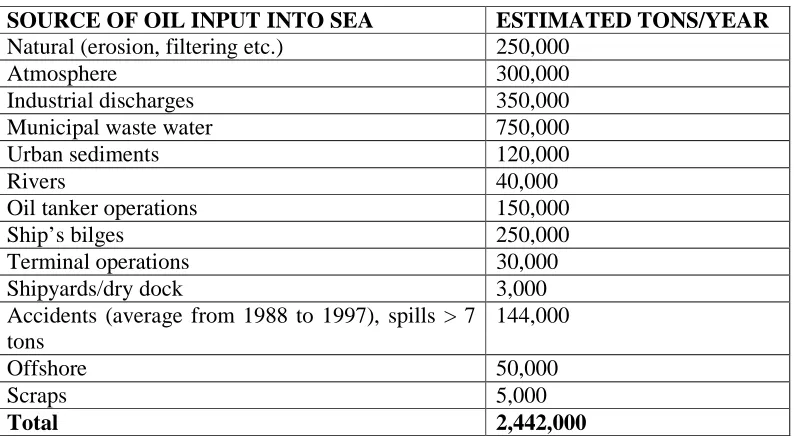
A 1998 estimate of the different sources of oil in the oceans is presented in Table 1
and their relative percentage is shown in Figure 1 below. Table 1 shows the total oil
input from land-based sources, namely, industrial, municipal wastewater, urban
sediments and rivers to be 1,260,000 tons in 1998, whereas, that from ship
TABLE 1: Estimated oil input into the sea, 1998
SOURCE OF OIL INPUT INTO SEA ESTIMATED TONS/YEAR
Natural (erosion, filtering etc.) 250,000
Atmosphere 300,000
Industrial discharges 350,000
Municipal waste water 750,000
Urban sediments 120,000
Rivers 40,000
Oil tanker operations 150,000
Ship’s bilges 250,000
Terminal operations 30,000
Shipyards/dry dock 3,000
Accidents (average from 1988 to 1997), spills > 7 tons
144,000
Offshore 50,000
Scraps 5,000
Total 2,442,000
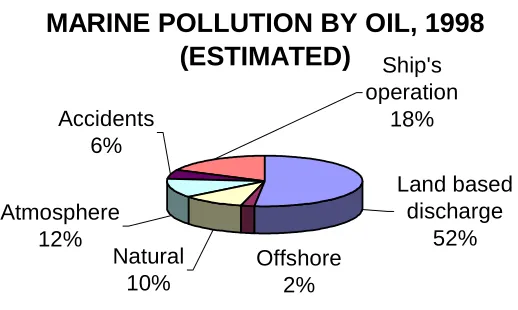
FIGURE 1: Percentage of different oil input sources
MARINE POLLUTION BY OIL, 1998
(ESTIMATED)
Atmosphere 12%
Offshore 2%
Ship's operation
18%
Natural 10% Accidents
6%
Land based discharge
52%
Source: Compiled from Table 1
sources amounted only to 582,000 tons. This amount of discharge from ship source is
less than 50% of the land-based discharge. Figure 1 gives a clear picture of this fact,
showing land-based discharge to be 52% and ship’s operational and accidental
discharges to be 18% and 6% respectively.
The reason for such reduced oil input from ship sources compared to land-based
sources can be attributed to the existence of the International Convention for the
Prevention of Pollution from Ships, MARPOL 73/78. Shipping is an international
trade and as such requires unified and harmonized regulations to deter pollution.
MARPOL 73/78 was the answer to such requirements. Presently, as of July 31, 2001,
there are 116 countries that have ratified and/or acceded the Convention and are
bound by its provisions in respect of prevention and control of pollution from
shipping activities. Prevention of pollution from land-based sources, however,
remains under the domain of national legislation of individual countries but these
legislations are not fully effective to control such pollution. Article 207 of the
UNCLOS 82, requires States to adopt laws and regulations to prevent, reduce and
control such pollution from land-based sources. The same Article also obliges
governments to harmonize their policies at the regional level and to endeavor to
Figure 1 demonstrate, relatively little progress has been made to prevent, reduce and
control pollution from land-based sources compared to marine transport pollution
sources.
1.2 Oil from shipping activities
The first documented shipment of petroleum took place in 1539, when a Spanish ship
the ‘Santa Cruz’, transported petroleum from Venezuela to alleviate the gout of
Emperor Charles I (Cowell, 1976). Much later in 1859, when oil was discovered in
the United States of America (USA) (Royal Dutch, 1983; Ratcliffe, 1985),the new
era of civilization had begun. To meet the demand of industrialization the first cargo
of oil was transported from the USA to Great Britain in barrels in the holds of the
224-ton brig ‘Elizabeth Watts’ (Mards, 1982; Marton, 1984).
In those early days, oil production was relatively small, hence, the amount
transported was limited and the pollution caused by such small vessels was
negligible. However, at the end of the First World War, oil gained in demand as a
source of energy as well as a source for production of certain chemical products and
synthetic materials (Young, 1973). After the Second World War, with the increased
development of the world economy, the demand for oil increased sharply.
With the development of the world’s economy and the increased demand for oil, the
oil industry also developed very quickly. A faster and cheaper way to get to the
destination became the sole motto of transportation. Shipping, as the cheapest mode
of international bulk transport became the central carrier for the oil industry.
However, oil spilled, due to accidents or discharged due to tank washing and
deballasting operations during transportation and causing pollution to the sea, raised
concern in many ports and terminals around the world. This concern heightened with
the increase in the size of the tanker due to economies of scale and profit
maximization (Ma, 2000). The first tanker of 100,000 deadweight tons (dwt) was
delivered in 1959 and an order for a 200,000 dwt was placed in the mid 1960s (IMO,
modern world, the frequency of carriage and carrying capacity of ships also
increased greatly. This in turn increased the threat of polluting the marine
environment from operational discharges even further.
As mentioned in the introduction, this dissertation examines operational discharges
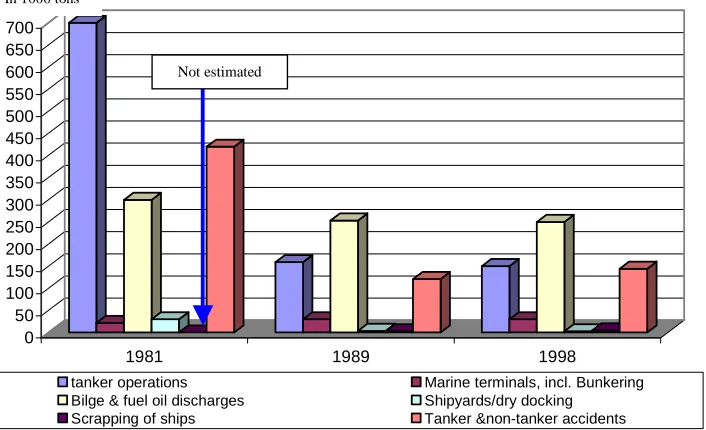
from ships. Table 2 and Figure 2 below shows there are a number of sources of
operational discharges largely related to the process of ship ballasting and tank
washing of tankers as well as the discharge resulting from machinery spaces or
engine rooms of all kind of ships.
TABLE 2: Comparison of oil discharges into the sea from maritime transport
activities in different decades
SOURCE OF POLLUTION 1981 1989 1998
Tanker operations 700,000 159,000 150,000 Marine terminals, including
bunkering
22,000 30,000 30,000
Bilge and fuel oil discharges 300,000 253,000 250,000 Shipyards/dry docking 30,000 4,000 3,000 Scrapping of ships Not estimated 3,000 5,000 Tanker accidents 400,000 114,000
Non-tanker accidents 20,000 7,000
144,000
TOTAL 1,472,000 570,000 582,000
Sources: Adapted from National Academy of Science and National Research
Council, 1985, MEPC 30/INF.13 (19 September 1990) and Pardo, 2001.
It will be seen in Chapter 2 that international regulations were initially aimed at
restricting and eliminating operational discharges due to ballasting and tank washing
operations of cargo tanks from tanker ships. However, this source is not yet fully
eliminated (see Table 2 and Figure 2). Nevertheless, MARPOL73/78 regulations
Figure 2: Comparative graph of oil inputs into the sea from maritime transport
activities in different decades
0 50 100 150 200 250 300 350 400 450 500 550 600 650 700
1981 1989 1998
tanker operations Marine terminals, incl. Bunkering Bilge & fuel oil discharges Shipyards/dry docking
Scrapping of ships Tanker &non-tanker accidents
Source: Compiled from Table 2
correct operational procedures, have substantially reduced the amount of operational
discharges from tanker operations, and also, almost eliminated it as a source of
pollution. The operational pollution resulting from engine room discharges of all
kinds of ships including tankers, however, remains a major source of marine
pollution at present. This dissertation primarily focuses on the latter source, i.e., oil
and oil-water mixture intentionally discharged from machinery spaces.
1.2.1 Operational discharges from the engine room
These discharges take place due to the pumping out of engine room bilges from all
engine-driven or mechanized vessels plying the seas. During engine operations,
different types of oil, along with water, leak from pumps, engines, tanks etc., and
accumulate at the bottom of the engine room, an area called the bilge. This
accumulated oily-water mixture from bilges needs to be pumped out from time to
time to prevent flooding and to eliminate the risk of fire hazards (M’Gonigle and In 1000 tons
Zacher, 1979, p. 22). In addition, heavy oils used as bunker fuel for the engine, are
purified on board ship prior to use. This purification of oil generates some sludge,
which also requires pumping out. Furthermore, some ships, such as container vessels
and fishing vessels, carry ballast water in their fuel oil tanks (although an IMO
resolution suggests not to) to maintain stability (Sasamura, 1990). This oily water is
also pumped out in the course of time.
1.2.2 Regulatory control of tank discharge vs. engine room discharge
In the early days, the operational discharges from cargo tanks of a tanker and from
the engine room of all ships were considered routine operations and hence carried out
without any obligations. However, introduction of pollution prevention conventions
such as OILPOL, 1954 initially and later on MARPOL 73/78, which came into force
in 1983, reduced and controlled such pollution incidents. The comparison table 2 for
oil input into the sea from maritime activities in different decades, and its graphical
representation in figure 2 shows a remarkable reduction in oil input from tanker
operations. Tanker operational discharge decreased dramatically from 700,000 tons
in 1981 to 159,000 tons in 1989 and thereafter to 150,000 tons in 1998. The reason
for such a remarkable reduction can be attributed to a variety of technological
advances in tanker operations influenced by the MARPOL 73/78 Convention.
Technological innovation such as the Load-on-Top (LOT) system, followed by
Crude Oil Washing (COW) and Segregated Ballast Tanks (SBT), along with overall
tighter regulations internationally, have probably reduced oil discharge into the sea
from ballasting and tank cleaning operations to the lowest-ever minimum. However,
the remaining 150,000 tons of oil coming from tanker operations is assumed to be the
contribution from old tankers that are still operating at sea under a ‘grandfather
clause’ of MARPOL 73/78.
The recent decision of the early phasing out of these older tankers by IMO (IMO,
2000, p 22; MEPC 46/23, 2001) will further improve the situation. The whole tanker
segregated ballast tanks to carry enough water to provide stability and
maneuverability under normal weather conditions. Only during bad weather, or in
unavoidable circumstances would ballasting of cargo tanks be a necessity, hence
chances of pollution occurring would be minimal. The author firmly believes that
after the phasing out of older tankers the world’s oceans will be much safer and
cleaner.
However, the same Table 2 and Figure 2 reveal that the largest single source of oil
entering the sea through shipping activities in the years of 1989 and 1998 is bilge and
fuel oil discharges from the machinery spaces of all ships. The reason for such a
large amount of discharge could be that the old ships are still fitted with 100-ppm
oily water separators rather than 15-ppm oil filtering equipment. A regulation to
equip all vessels with a 15-ppm oily water separator and oil filtering equipment
became mandatory from 1998 through an amendment to MARPOL 73/78 in 1992
(see chapter 2). In this regard one can be optimistic that statistics after 1998 would
show a dramatic reduction.
However, with the 15-ppm regulatory limit of oil discharge, there is apprehension
that the total discharge of bilge oil will remain a substantial amount (National
Research Council, 1985; El-Maghrabi, 1988). Moreover, many scientists believe that
the presence of even minute oil particles in the sea has adverse effects on the marine
eco-system and its biodiversity. This dissertation considers the view that even the
legally allowed level of oil discharge can have a severe impact on the oceans. The
biological effects of oil on fish and other living organisms at sea are described below.
1.3 Biological impact of oil on the oceans
The biological effects of discharged oil from ships depend on many factors
including: the type of oil discharged, the quantity of oil, season, the hydrographic
situation (saline content, temperature, wave turbulence, currents, winds, oxygen
conditions) and the construction of the ecosystem affected (Lidgren & Norby, 1980,
Lidgren & Norby (1980) also state that a discharge of crude oil or some oil products
from a ship may cause:
• the elimination of sensitive species
• non-lethal effects – for example behavioral disturbances, malformations
• the absorption of oil components into the tissues • changes in the physical or chemical environment • fouling of beaches (p. 32).
The extent and permanency of this influence varies greatly. On beaches exposed to
powerful waves, for example, the oil can vanish within a year in a natural manner.
However, in calm creeks, wetlands and bays it can remain unchanged for many
years.
The environmental effects of oil may be characterized according to their permanency
as short-term and long-term effects. The dramatic short-term effects are easy to
observe but it is difficult to evaluate the long-term effects, as they are not
immediately evident. For this reason it is also difficult to quantify the production loss
or the loss of functional importance due to oil pollution.
In the short-term, birds are mostly affected by oil discharge. Only a small oil spot of
2x3 cm2 on the breast of a wild duck can cause its death due to loss of heat in a cold
sea (Lidgren, & Norby, 1980, p. 33). The oil destroys the water-repellant qualities of
the plumage. The birds also injure themselves by swallowing the oil while cleaning
their plumage. They can develop pneumonia, hemorrhage from the lungs or the
intestinal tissues, degeneration of the liver, and kidney damage.
It is observed that adult fish being able to swim quickly leave the polluted area as
soon as they can. Thus, the risk of fish dying exists mainly in enclosed waters or
when there are very large discharges. It is also observed that the light oil, being more
toxic, causes more death of fish than crude oil (Lidgren, & Norby, 1980; Gin & et al,
The non-lethal effects of discharged oil on fish are more serious in the long-term
than the direct deaths caused. Oil pollution in non-lethal concentrations may produce
behavioral disturbances in fish, e.g., changes in the digestion of food, reproductional
disturbances, disturbances in the migratory pattern, genetic disturbances, an
increased sensitivity to disease, etc. In addition to this, the fish may acquire an oily
taste or smell, making them unpalatable for human consumption (Gold, 1998).
Many fish are pelagic during their development stages and the eggs, larvae, or spawn
float in the water layer near the surface. Due to their limited ability to swim in these
stages they are more subject to oil pollution than adult fish. The oil also has a
negative impact on the hatching of fish eggs (Lidgren, & Norby,1980; Gin & et al,
2001).
Research has also shown that hydrocarbons have a greater influence on the function
of sense organs and so can influence the behavior of fish and invertebrates by
reducing or changing sensory information reaching their brain (Blaxter &
Hallers-Tjabbes, 1992). An experiment showed that the sub-lethal effects take place at a
much lower concentration than the lethal effects and yet the sub lethal effects may
become lethal in the long run. The fact is that the crude oil contains toluene, benzene
and phenol and when discharged into the sea each of these ingredients affects the
marine organisms, e.g., fish and invertebrates in various concentrations.
1.3.1 Fish
Blaxter & Hallers-Tjabbes (1992) reviewed such sub-lethal effects of the ingredients
of oil on fish at various concentrations and noted that;
Using more complex mixture Webber et al. (1981) found that migrating adult Pacific salmon avoided mixtures of aromatic hydrocarbons at 3.2 ppm or higher while Boehle (1986) found that cod avoided water containing more than 0.1 ppm of petroleum hydrocarbon. Oil is known to damage the olfactory epothelium in salmon (Babcock, 1985). Hellsrtrom & Doving (1983, quoted by Boehle) claimed, using electro physiological techniques, that cod can detect petroleum hydrocarbons at 0.0001 ppm. Pearson et al. (1983) found that sediment polluted with oil at an initial concentration of 3.5 ppm was unattractive to burrowing sand lance (p 51).
1.3.2 Invertebrates
It has been also observed that sediment polluted with oil, especially the water soluble
fraction (wsf), has an impact on the sensory perception and behavior of invertebrates.
Blaxter & Hallers-Tjabbes (1992) also reviewed such impacts on the invertebrates
and noted;
An initial concentration of 3.5 ppm oil in the surface layer proved to be unattractive for burrowing little neck clam Protothaca staminea; this resulted in an increased rate predation by the Dungeness crab, Cancer magister (Pearson et al., 1981)
Low concentrations of crude oil or its derivatives were found to affect food recognition in gastropods and in several crustaceans. The snail Nassarius obsoletus was no longer attracted to oyster extract in water containing 0.01 ppm of the water-soluble fraction (wsf) of kerosene (Jacobson & Boylan, 1973). 0.025 ppm of the wsf of Prudhoe Bay Crude Oil reduced the food search behavior in the shrimp Pandalus americanus (Malins et al., 1982). Different phases of the food search behavior of Homarus americanus were suppressed at 0.08 – 0.15 ppm of the wsf of No 2 Fuel Oil (Atema et al., 1979; Atema et al., 1981). … The feeding signal to Gammarus olivii was completely suppressed at 1 ppm oil and partly suppressed at 0.1 ppm oil in G. olivii and also in Idotheca baltica (Milovidova, 1974). The number of Cancer magister individuals responding to food was reduced at 0.27 ppm wsf of Prudhoe Bay crude oil (Pearson et al.,1981b).
The above evidence of scientific research clearly shows that the regulatory limit of
15-ppm oil discharge is neither safe for the marine environment nor beneficial for
human beings, as it affects the food chain.
1.4 Discussion
Marine pollution as a whole has been discussed in this Chapter including various
sources of oil input into the sea. However, the focus has been on marine
transportation with an emphasis on operational discharge, especially discharge from
machinery spaces. The present statistics have revealed that the discharge of bilge oil
from machinery spaces is the largest source of oil pollution from shipping activities
(see Table 2/Figure 2) and requires stricter regulations to be controlled (Wells,
2001).
There is a growing apprehension however, that even with a 15-ppm discharge limit
(effective from 1998 for existing and new ships), the aggregated amount of bilge oil
discharged from ships all over the world could be substantial. Moreover, scientific
evidence shows that the present regulatory limit of 15-ppm oil discharge is not safe
for marine organisms and may destroy the food chain in the long run. These
situations call for an improvement in standards, especially when the technology is
available to do so, by reducing the regulatory limit of discharge to zero-ppm or close
to it.
It is understood that sufficient improvement has been made in the cargo operation of
tankers such as the inclusion of LOT, SBT and COW systems to eliminate pollution
from ballasting and tank washing. A discharge from SBT is a discharge of clean
ballast and hence does not pollute the environment. However, discharge from
machinery spaces needs to be addressed. To address the problem of reducing the
regulatory discharge limit to zero-ppm, it is necessary to understand the international
law-making process concerning the marine environment. The next Chapter will deal
CHAPTER 2
DEVELOPMENT OF THE INTERNATIONAL LEGAL REGIME
ON MARINE POLLUTION
The previous Chapter examined the impact of oil on the ocean and the causes of
ships’ operational discharges, particularly discharges from engine room. This
Chapter will examine the international legal response to this problem.
One of the roles of law is to prevent someone from doing something that is or that
might be injurious, harmful, and hazardous to others and to the society in general.
Laws are formulated to protect society by preventing, restricting or eliminating such
injurious or harmful activities. For example, the discharge of tank washings from
cargo tanks was found to be harmful in the early days of the 20th century because
they were a fire hazard to ports and raised health risks in coastal resorts. The
fishermen and the owners of the beach resorts, whose living was jeopardized by such
activities, organized protests and pressurized governments to take action against such
harmful activities (Pritchard, 1987). Indeed, a signed petition of 18,000 residents of
the Isle of Wight was presented to the British Prime Minister in 1925.
That was the beginning of the formulation of laws against marine pollution. This
Chapter will discuss the development of laws addressing intentional ship source oil
pollution of the oceans, from its initial stage in the early 20th century to the
regulatory limit of oil discharge of 15-ppm existing at present. The discussion will
outline the development of the international regulations, OILPOL 1954 Convention,
MARPOL 1973 Convention and its protocol in 1978 and its amendment that
produced the current regulatory limit of 15-ppm discharge from the engine room.
Thereafter, the possibilities to improve the discharge standard by reducing the
2.1 Development prior to 1954
During and immediately after the First World War, there was a dramatic increase in
the demand for oil. This was partly due to the replacement of coal by oil as a source
of power. This also correspondingly increased the tanker movements at sea, which in
turn, increased operational discharges from tankers in the form of ballasting,
deballasting and tank washings as discussed in Chapter 1. This resulted in an oil
layer containing highly flammable substances such as naptha, benzene and gasoline
(Terrel, 1987) in the major oil loading and discharging ports or terminals. Thus,
many ports and oil terminals had fires and a lot of properties were damaged and lives
were lost (Pritchard, 1987; Yi, 1988). Moreover, the fishermen and the resort owners
were experiencing damage to fisheries and amenities. As a result, some industrialized
countries formulated national rules to restrict such oil discharges from ships.
2.1.1 National Legislation
U.K. and U.S.A. were among the earliest countries to develop domestic regulations
against oil pollution that influenced the international legal regime.
2.1.1.1 The U.K.
The United Kingdom was one of the earliest countries that made rules to control oil
discharges from ships. In 1918, the British Admiralty and Ministry of Shipping
issued wartime regulations to the masters of ships (Pritchard, 1987). These
regulations instructed the shipmasters to discharge oily ballast and cleaning water
from their ships outside the three-mile territorial water limit. They also suggested
taking proper precautions against leakages of oil when loading, unloading or
re-fueling in ports (Pritchard, 1987, p 1).
The British Government subsequently set up its first national law against oil
pollution, the so-called Oil in Navigable Waters Act of 1922, which entered into
force on 1st January 1923 and became the first national law against pollution. In this
Act, the three-mile discharge zone entered into the statutes. It also included a
maximum fine of £100 for a ship or land installation causing oil or oily wastes to
separate oil from an oil-water mixture and the provision of reception facilities to
receive waste oil from ships, were suggested but not made part of the new Act
(Pritchard, 1987). However, for commercial reasons shipmasters preferred the zone
system. Moreover, effective oily water separators were not technically and
commercially available at that time (Pritchard, 1987).
2.1.1.2 The U.S.A.
The United States of America, the principal center of the oil trade during 1920s, had
also suffered from harbor fires. It was believed that a flare or an electric wire
accidentally dropped into the river, could destroy the entire New York harbor. This
would be over $11.5 billion in annual trade at stake. Fire underwriters and New York
harbor officials in 1921 secured the designation of a 25-mile zone within which it
was prohibited to discharge oily wastes from ships (Pritchard, 1987, p 2).
The United States of America, issued its first national law against oil pollution, the
Oil Pollution Act of 1924, on 7 June 1924 (Pritchard, 1987). This Act proved to be
more stringent and effective than the British Act. It empowered enforcement by the
U.S. Coast Guard as well as by port officials. It also defined oil in a broader
perspective and imposed higher sanctions of $ 2000 for an offence (Pritchard, 1987,
p 7). In addition, oil pollution was described as a penal offence in the Act. The Act
also adopted a zonal system to drive away oil pollution to outside territorial waters.
These U.K. & U.S.A. regulations, although only at a national level, initiated the
zonal system of controlling oil pollution. However, these Acts in reality diverted oil
pollution away from ports but onto the coastal areas in the vicinity of the ports. The
oil so discharged beyond the three-mile territorial water drifted to coastal areas
where even no port existed. Thus the Acts, instead of reducing or controlling
pollution, simply transferred the pollution from one area to another. For this reason,
the UK and the USA did not consider the situation of oil pollution control as being
satisfactory. As the biggest oil supplying country at that time, the USA urgently felt
2.1.2 International Regulatory activities
Initiatives were taken to reduce or eliminate marine pollution through an
international agreement in 1926 and 1935 but failed to achieve any fruitful result.
2.1.2.1 The 1926 Draft Convention on Oil Pollution
A Conference was called in Washington, D.C to discuss the adoption of effective
measures against oil pollution of the sea (Pritchard, 1987). Twenty seven delegates
representing thirteen major maritime nations attended the conference from 8 to 16
June, 1926. The participating countries were Belgium, Britain, Canada, Denmark,
France, Germany, Italy, Japan, the Netherlands, Norway, Spain, Sweden, and the
United States (Pritchard, 1987, p 16). This was the first ever, international
conference on oil pollution control at sea.
At this Conference, the discharge standard of 500 parts per million (ppm) was
considered negligible. However, a condition was attached to the definition of
negligible pollution, to the effect that oily discharges which left a trail in the ship’s
wake sufficient to form a film on the surface of the sea, visible to the naked eye in
daylight and in clear weather would be prohibited. Usually, the ‘visible sheen’ of oil
in the ship’s wake, came from the discharge of oily water at the last stage of its
pumping, when the oil and water interface was reached. The oil content in this
mixture was believed to be as high as 10,000-ppm (Pritchard, 1987, p 19).
The Conference also agreed to establish the pollution control zone within which
persistent oils or oily mixtures may not be discharged. The width of the zone was to
be decided by the coastal States, but the zone could not exceed 50 nautical miles
from the nearest coastline and 150 miles in exceptional circumstances (Pritchard,
1987). This was an innovative step given that the limits of the territorial sea were still
undetermined and contested.
These standards and the zone system were the first to set up the international limits
on ships intending to discharge their oily wastes or ballast water into the waters, then
the zone system to control oil pollution internationally, however, was not entirely
satisfactory. Nevertheless, it did produce some positive results. On the request of the
British government, the ship owners of seven major maritime countries voluntarily
accepted the fifty-mile discharge prohibition zone (M’Gonigle and Zacher, 1979, p
83). Therefore, it can be said that the 1926 draft Convention had taken the first step
of combating oil pollution at sea internationally, although, it had the unfortunate fate
of never entering into force.
Following the 1926 conference, many maritime nations made their own standards for
the control of oil pollution in their own pollution zones. Some of these standards
were stricter than those set up by the 1926 draft Convention. For example, Spain in
1925, and Portugal in 1927, issued circulars prohibiting the discharge of oil by ships
within six miles of their coast. The British Government had lodged a protest against
the Spanish circular since it exceeded the normal territorial water limit of three
nautical miles (Pritchard, 1987). The dispute regarding the limits of the territorial sea
was the major setback of this Convention and hence it failed to enter into force.
2.1.2.2 The 1935 Draft Convention on Oil Pollution
In 1935, at the initiative of the British government, the League of Nations passed a
resolution for the preparation of a draft convention and an international conference
on oil pollution (Pritchard, 1987). The draft league Convention, stylistically and
legally superior to that of the 1926 draft Convention, was prepared and circulated to
governments on November 27, 1935. Despite favorable replies to an oil pollution
agreement, the draft Convention was never signed and the proposed diplomatic
conference never summoned.
Both the 1926 and 1935 Conventions, in spite of their failure to enter into force,
focused on some of the relevant issues such as the enforceability of zonal
arrangements, monitoring and verification of compliance with the discharge
provisions, the magnitude of penalties, reception facility requirements, and the
distribution of enforcement jurisdiction between flag and coastal states (Mitchell,
2.2 The 1954 Oil Pollution Conference and Convention
Although the UK and USA initiatives prior to the Second World War failed in
controlling oil pollution by ships internationally, the draft agreements had facilitated
negotiations that arose after World War II. A dramatic increase in crude oil demand
also increased the discharge of persistent crude oil after tank-cleaning and ballast
operations (Kirby, 1968). The number of complaints of spoiled beach resorts and the
large number of dead seabirds grew rapidly in the United Kingdom and elsewhere in
Europe. The British Government took the initiative again to call for the international
control of oil pollution by ships.
2.2.1 The International Convention for the Prevention of Pollution of the Sea by Oil, 1954 (OILPOL)
From 26 April to 12 May 1954, an international Conference on pollution of the sea
sponsored by the British Government, was held in London. The delegates from
thirty-two countries representing 95% of world shipping, participated in the
conference. After much discussion, the conference drafted a convention, which
became the first internationally agreed treaty on the control of oil pollution at sea,
called the International Convention for the Prevention of Pollution of the Sea by Oil,
1954 (OILPOL). This Convention accepted a fifty-mile zone for control of discharge
levels both from the engine room and cargo area of ships, and that the discharge of
oily mixture within this zone containing more than 100 parts per million (100-ppm)
of the oil in the mixture would be an administrative offence. However, it failed to
impose any restrictions on discharges made outside the zones or on total discharges,
thus relying on the redistribution of discharges outside the zones to mitigate the
environmental damage (Mitchell, 1994). The parties to the Convention were required
to ensure the provision of reception facilities for non-tanker ships but not for tankers.
The master of the ship needed to record all ballasting, cleaning, and discharge
operations in a newly developed oil record book. Port states could inspect these
books but were not allowed to delay the ship. Moreover, inspections were limited in
that their objective was to provide evidence to flag states for the prosecution of
should be the same as within the territorial waters. Furthermore, all parties to the
Convention were required to report to the Secretariat regarding the installation of
reception facilities and application of the treaty as well as actions taken on violation
referred to them for prosecution.
The Convention entered into force on 26 July 1958. Despite its drawbacks, Sasamura
(1990), a Japanese expert on marine pollution and a former official of International
Maritime Organization (IMO), described the 1954 Convention as a significant
achievement for the maritime community. Through this Convention, the marine
community first tackled the problem of pollution and took controlling measures at
the international level at a time when the world community in general was not
particularly conscious of the need for environmental protection.
2.2.2 OILPOL 1954 amendments
OILPOL 1954 was amended twice in 1962 and 1969, and the amendments entered
into force in 1967 and 1978 respectively. At the conference in 1962, a number of
amendments to the 1954 Convention were passed, including an extension of the
zones subject to prohibition. The whole of the Baltic and the North Sea were made
prohibited zones. As a first step towards a total prohibition of oil discharges, all new
tankers over 20,000 gross tonnages were banned from discharging operational
discharges in excess of 100 ppm, thus requiring the installation of equipment to
ensure compliance. It was further decided that the member states should take suitable
measures to encourage the setting up of shore reception facilities at loading ports for
oily residues from ships.
On 21 October 1969, the Intergovernmental Maritime Consultative Organization
(IMCO), which is now called the International Maritime Organization (IMO), passed
further amendments to the Convention at its 6th Assembly. The Assembly, being
under pressure from the oil companies and the major maritime nations, accepted the
Load On Top (LOT) method for tank cleaning and withdrew the prohibited zones
of a tanker. However, the regulatory limit for engine room discharge remained the
same at 100-ppm. The 1969 amendments brought in restrictions on operational
discharge in the following ways:
For oil tankers
Operational discharges of oil due to ballasting and tank washing of cargo tanks from
tankers were allowed only when all the following conditions were met:
1. the total quantity of oil which a tanker may discharge in any ballast voyage whilst under way must not exceed 1/15,000 of the total cargo carrying capacity of the vessel;
2. the rate at which oil may be discharged must not exceed 60 liters per nautical mile traveled by the ship; and
3. no discharge of any oil whatsoever must be made from the cargo spaces of a tanker within 50 miles of the nearest land.
A new form of oil record book was appended to the 1969 amendments to reflect the
approved practice of LOT.
For machinery spaces of all ships
The discharge from machinery space bilges was allowed only when all of the
following conditions were met:
1. the rate at which oil may be discharged whilst the ship is underway must not exceed 60 liters per nautical mile being traveled by the ship;
2. the oil content of any bilge water discharged must be below 100 parts per million; and
3. discharge must be made as far as practicable from land.
It was assumed that the establishment of the instantaneous rate of discharge of 60
liters per nautical mile would produce a sheen on the water, which would break up
and disperse in a period of two to three hours. With the acceptance of the 1969
amendments, the oil companies were able to eliminate the equipment-dependent
standard of the 1962 requirement for the operational discharge from new tankers.
However, in exchange they had to accept a standard for ballast discharge, based on a
standard of no “visible trace” within the zones. This was a significant achievement
because any sighting of discharge from a tanker could be considered as a violation
underlying principle of pollution regulation. The 1926, 1935, 1954, and 1962 rules
had all permitted discharges except in prohibited zones (Mitchell, 1994). However,
the new rules in 1969 prohibited discharges in all oceans except under certain
conditions. It was also a requirement for the first time in the international rules, to
reduce the amount of oil entering the oceans from shipping activities rather than
aiming to redistribute them.
In 1971, OILPOL, 1954 was further amended to incorporate the cargo tank size in
the Convention to limit the hypothetical oil outflow in the case of collision or
grounding. Tanks were to be arranged so that oil spills would not exceed 30.000
cubic meters. The size of the center tanks and side tanks could not exceed 50,000
cubic meters and 22,500 cubic meters respectively. These regulations were
applicable only to new ships.
In comparison with the 1926 Convention, the 1954 Convention was the first to
receive international validity; as the 1926 Convention had never been ratified by
interested states. The standards for discharging oily water or tank washings were
stricter than those of 1926. Moreover, the 1954 Convention endorsed LOT, while the
1926 Convention had not taken any effective measures to handle the oil residues left
in tanks, meaning that the zone system could not be observed easily. Furthermore,
the 1954 Convention made the 50 nautical mile zone compulsory for discharge from
the cargo space of a tanker, and recommended engine room discharge to be made as
far from land as practicable, while the 1926 Convention stipulated the zone system as
being at the discretion of the port State. This meant the near coastal areas, as
discussed earlier, would suffer pollution again, because the discharged oil would be
driven back onto the coasts.
Nevertheless, after nearly 20 years of operation, OILPOL 1954 was found to have
some inherent shortcomings. It could not meet the demands of continuous changes
that had been taking place in the shipping industry, especially in the pollution
controlling aspect at sea. Thus it was necessary to develop a new convention to
2.3 The 1973 Conference on Marine Pollution
To replace the OILPOL 1954 Convention, IMO convened an international
conference at its head office in London from 8 October to 2 November 1973. The
conference was attended by over 600 delegates from 71 countries with a heightened
concern over oil pollution, as the sea borne oil trade increased from 158 million tons
in 1954 to 1366 million tons in 1973 (Mitchell, 1994). The objectives of the
conference were:
1) To draft a comprehensive convention that would completely eliminate the willful and intentional discharges of oil and noxious or hazardous substances other than oil into the seas by ships and other marine crafts and minimization of accidental spills by all kind of ships at sea.
2) To achieve by the end of the decade, complete elimination of pollution by normal operations of ships, and,
3) To expand the scope of the Intervention Convention to cover substances other than oil causing pollution at sea (Pritchard, 1987).
2.3.1 The International Convention for the Prevention of Pollution from Ships (MARPOL 73)
The 1973 conference produced a new convention called the International Convention
for the Prevention of Pollution from Ships (MARPOL), which had a broader scope
than any other previous agreements. The Convention applied to oil platforms as well
as ships and included refined as well as crude oil. It dealt not only with oil, but other
forms of marine pollution except the disposal of land-generated waste into the sea by
dumping (which was covered by London Dumping Convention, 1972). Most of the
technical measures were included in five annexes to the Convention which dealt
respectively with the following:
Annex I Oil
Annex II Noxious liquid substances carried in bulk (e.g. chemicals) Annex III Harmful substances carried in packages (e.g. tanks and
containers) Annex IV Sewage Annex V Garbage
In the 1973 Conference, discharge regulations for the operational discharge of oil
were discussed. The United States proposed stricter regulations, such as the
extension of tanker zones from 50 miles to 100 miles, reduction in the rate of
discharge from 60 to 30 liters per mile, and clean ballast to be defined as containing
less than 10-ppm oil instead of 15-ppm (M’Gonigle and Zacher, 1979, p 113).
Unfortunately, the United States received very little support for these proposals.
As a result, the character of discharge regulations accepted in this Conference
remained the same as in the 1969 amendments. However, the maximum discharge
for new tankers was reduced from 1/15,000 to 1/30,000 of their cargo carrying
capacity and for non-tankers a prohibition on all discharges in a twelve (12) mile
zone was made instead of the vague statement stipulated in 1969 amendment to the
OILPOL 1954 Convention, that they discharge “as far from land as practicable”.
Another important addition to the discharge regulation was a provision allowing for
the creation of “special areas”, where the scientific evidence suggests that the threat
to the marine environment is great. No discharge would be allowed in this area
except for “clean ballast” that is, no “visible trace” as under 1969 amendments or
less than 15-ppm oil content. A number of such areas were agreed on for the
enclosed seas surrounding Europe and the Middle East – the Mediterranean, Baltic,
Black, and Red Seas and Persian (Arabian) Gulf, but not the North Sea (Mitchell,
1994, p 95; M’Gonigle and Zacher, 1979, p 113). However, outside the tanker zone
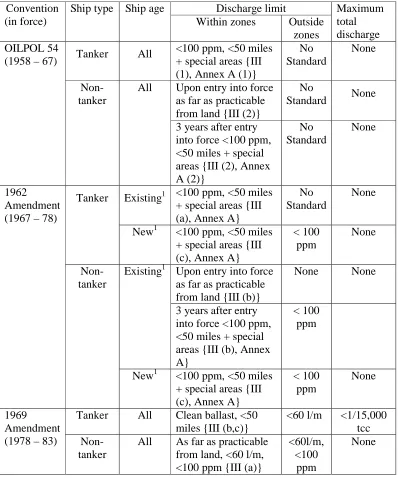
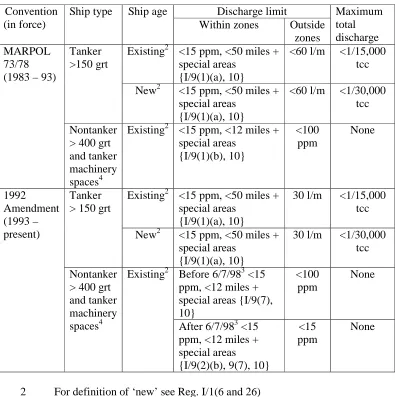
and special areas, discharges below 60 liters per mile remained legal (see Table 3a).
This Conference also adopted equipment standards to comply with the performance
standard of discharge regulations. Regulations 14 through 18 include requirements
for slop tanks, oil monitoring systems, oily water separators, filtering systems,
oil/water interface detectors, special piping arrangements and storage tanks. The
most important technical innovation at this Conference was the inclusion of
regulation 13 requiring segregated ballast tanks for all tankers over 70,000 dwt. With