Towards Shibboleth-based Security in the
e-Infrastructure for Social Sciences
Wei Jie, Michael Daw, Rob Procter, Alex Voss
National Centre for e-Social Science, University of Manchester, UK [email protected]
Abstract. The e-Infrastructure for e-Social Sciences project leverages Grid computing technology to provide an integrated platform which enables social science researchers to securely access a variety of e-Science resources. Security underpins the e-Infrastructure and a security framework with authentication and authorization functionality is a core component of the e-Infrastructure for social sciences. To build the security framework, we adopt Shibboleth as the basic authentication and authorization infrastructure and further combine PERMIS advanced authorization technology. As a result, this security framework integrates the advantages of both Shibboleth cross-domain identity federation and PERMIS policy driven role based authorization control, thus presenting a promising security model for secure access to the e-Infrastructure for the social sciences.
Introduction
The UK Economic and Social Research Council (ESRC) has funded a three year project to create an e-Infrastructure for the e-Social Sciences (E-Infrastructure, 2007). This project leverages Grid technology (Foster, 1999) to build an e-Infrastructure on the UK National Grid Service (NGS) and provide integrated access to a variety of resources for social science research, including datasets, tools, services and easy-to-use user environments.
Security underpins the e-Infrastructure for the social sciences as it is one of the foundations of any working Grid infrastructure (e.g., Foster, 1998). Without robust, reliable and simple Grid security infrastructure combined with commonly accepted security practices, large portions of the research community and wider industry will not engage. As an important activity of the e-Infrastructure for Social Sciences project, we will build a security framework enabling secure access to the e-social science resources.
The e-Infrastructure allows resources to be shared between members of virtual organizations (VOs). However, if an organization is to allow its resources to be shared amongst its VO members, it needs to be able to determine who is authorized to access these resources in which ways, and who is not. Access control rests on the two related concepts of authentication (establishing the identity of a person) and authorization (regulating what an identified person is allowed to do, cf. Broadfoot, 2003), which are two fundamental but critical issues in constructing the security framework for the e-Infrastructure.
wish to keep their own authentication systems, so the security framework of the e-Infrastructure needs to reconcile with existing authentication systems and seamlessly make them interoperable.
Authorization requires the e-Infrastructure security framework to implement access control mechanisms which reflect resource owners’ privileges, and protect resources by only allowing authorized accesses. Besides, the security infrastructure should provide resource owners flexibility to define their access control policy (be it coarse-grain or fine grain), as well as modify or extend their current policy with ease.
Our security framework leverages the widely accepted Shibboleth (Shibboleth, 2007) technology for the authentication infrastructure and combines this with PERMIS (PrivilEge and Role Management Infrastructure Standard) (Chadwick, 2003) as authorization technology. In this way, it offers scalable and flexible Grid VO-wide authentication as well as policy-driven, rolbased, multi-grained authorization for access to and usage of the e-Infrastructure. In this paper, we focus on the philosophy and principles for constructing the security framework. Firstly, we introduce the background of Shibboleth and PERMIS as well as the motivations for adopting them as the authentication and authorization infrastructure. Then we discuss the issues and challenges of using Shibboleth and PERMIS in the security framework. We conclude the paper with an outline of the direction for future work.
Adopting Shibboleth and PERMIS as the authentication
and authorization infrastructure
The UK academic community is currently in the process of strategically deploying Shibboleth technologies as the next generation authentication and authorization infrastructure for accessing web-based resources. Shibboleth is an authentication and authorization architecture (Scavo, 2005) to support inter-institutional sharing of resources (or services) that are subject to access control.
Shibboleth does not carry out authentication itself. Instead, it implements a set of SAML protocols (Saml, 2007) for the secure passing of identity information between institutions and resource providers. It relies on the institution to establish identity (i.e., authentication), and on the resource provider to control access rights (i.e., authorization). In other words, Shibboleth separates the user authentication that is performed by users’ respective home institution, and the authorization that is performed by the resource providers to be accessed based on users’ attributes that have been passed to it.
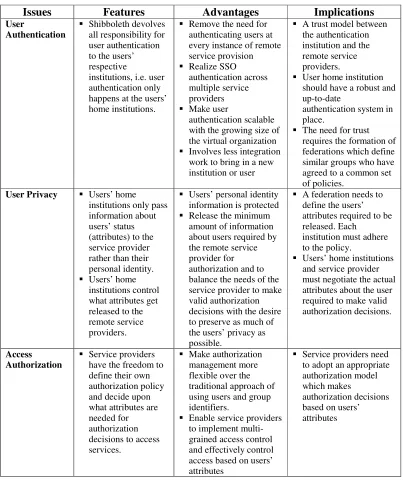
Issues Features Advantages Implications User
Authentication
Shibboleth devolves
all responsibility for user authentication to the users’ respective
institutions, i.e. user authentication only happens at the users’ home institutions.
Remove the need for
authenticating users at every instance of remote service provision Realize SSO authentication across multiple service providers Make user authentication scalable with the growing size of the virtual organization Involves less integration
work to bring in a new institution or user
A trust model between
the authentication institution and the remote service providers.
User home institution should have a robust and up-to-date
authentication system in place.
The need for trust requires the formation of federations which define similar groups who have agreed to a common set of policies.
User Privacy Users’ home institutions only pass information about users’ status (attributes) to the service provider rather than their personal identity.
Users’ home
institutions control what attributes get released to the remote service providers.
Users’ personal identity information is protected
Release the minimum
amount of information about users required by the remote service provider for authorization and to balance the needs of the service provider to make valid authorization decisions with the desire to preserve as much of the users’ privacy as possible.
A federation needs to define the users’ attributes required to be released. Each
institution must adhere to the policy.
Users’ home institutions and service provider must negotiate the actual attributes about the user required to make valid authorization decisions.
Access Authorization
Service providers have the freedom to define their own authorization policy and decide upon what attributes are needed for authorization decisions to access services.
Make authorization
management more flexible over the traditional approach of using users and group identifiers.
Enable service providers to implement multi-grained access control and effectively control access based on users’ attributes
Service providers need
to adopt an appropriate authorization model which makes
authorization decisions based on users’ attributes
Table I. Shibboleth Technology Features, Advantages and Implications
requested. This de-couples the user’s privileges from their local identity and allows a more dynamic and flexible approach to access control.
Issues and challenges of Shibboleth in e-Infrastructure
for social sciences
Our security framework for social science e-Infrastructure will leverage Shibboleth as the authentication infrastructure and combines it with PERMIS authorization technology to provide scalable and flexible Grid authentication as well as policy-driven, role-based, multi-grained authorization for access to and usage of the resources in the e-Infrastructure. However, the uptake and adoption of Shibboleth and PERMIS within the e-Infrastructure is not without potential concerns. In particular, three critical issues need to be addressed:
• Integration of Shibboleth with other authentication systems Currently, many tools and most publicly-curated datasets of social science interest rely on the Athens access management system (Athens, 2007) and community investments in Athens-based security control needs to be preserved. At the same time, the e-Infrastructure will utilize the NGS which relies on the PKI-based Grid Security Infrastructure (Gsi, 2007) built in the Globus Toolkit (Globus, 2007). All these demand a pragmatic strategy for integration with the Shibboleth-based security framework in order to both preserve investment and adapt to the emerging environment.
As such, we need to build gateways between Shibboleth infrastructure and other authentication systems including the above-mentioned Athens and PKI-based Grid Security Infrastructure of the Globus Toolkit. Therefore a Shibboleth-based authentication model needs to be established to interoperate users’ identity in different security domains.
We will follow developments in the Eduserv’s Shibboleth-Athens gateway (Shibathens, 2007) as well as projects on Shibboleth-enabled NGS including the ShibGrid project (Shibgrid, 2007) and the SHEBANGS project (Shebangs, 2007), with a view to their adoption for the security framework in the e-Infrastructure project. We will also examine related projects such as the GridShib project (Gridshib, 2007) and the ESP-Grid project (Espgrid, 2007) which investigates how Shibboleth offers solutions to the issues of Grid authentication, authorization and security.
• Using PERMIS for authorization management When used in conjunction with Shibboleth, PERMIS extends the authorization system used in Shibboleth by introducing hierarchies of roles and conditional decision making. In PERMIS, each site administrator throughout a VO can act as an attribute authority and assign attributes to his/her site members. Thus the allocation of entitlements (or ACs) is distributed throughout the entire VO, and the burden of VO administrators is relieved.
PERMIS-based authorization engine should be designed to make access control decisions, and manage user attributes and authorization policies. We will explore the Open PERMIS project (Openpermis, 2007) and utilize its open source package as a foundation in the design and implementation of our authorization engine.
• Integration of Shibboleth with PERMIS The goal of the Shibboleth and PERMIS integration is to coordinate the identity federation and attribute assignment function of Shibboleth with the policy-based enforcement function offered by the PERMIS access control infrastructure in order to provide policy-driven attribute-based access control decision making based on user attributes.
There is some existing work addressing the integration of Shibboleth and PERMIS. We will leverage the outcome of certain projects such as the GridShib and GridShibPERMIS (Gridshibpermis, 2007) projects which aim to integrate the combined Globus Toolkit and Shibboleth infrastructure with the PERMIS authorization infrastructure. We will also investigate the BRIDGES (Biomedical Research Informatics Delivered by Grid Enabled Services) project (Bridges, 2007) which leverages Shibboleth as the authentication infrastructure and subsequently uses PERMIS to determine authorization decisions based on user attributes retrieved from Shibboleth.
Conclusions and future work
Security is a fundamental requirement in the e-Infrastructure for the social sciences project. The emergence of Shibboleth and advanced authorization technologies like PERMIS provides a promising solution for the security infrastructure. In future work, we will investigate typical use cases in the social sciences, and design and implement a demonstrator security framework based on the principles discussed in this paper. The security framework is expected to be capable of granting users secure, anywhere, anytime access to a variety of resources in order to facilitate their social science research. As a consequence, Shibboleth would be adopted as an integral component in the strategic approach of the future development of the next generation secure e-Infrastructure for social science education and research.
References
Athens. (n.d.): Athens for Education, retrieved on May 2007, from http://www.athens.ac.uk/.
Bridges. (n.d.): BRIDGES project, retrieved on May 2007, from http://www.brc.dcs.gla.ac.uk/projects/bridges/
Broadfoot, P. J. and Martin, A. P. (2003). A Critical Survey of Grid Security Requirements and Technologies, Oxford University Computing Laboratory Technical Report, PRG-RR-03-15.
Chadwick, D.W. and Otenko, A. (2003). The PERMIS X.509 Role Based Privilege Management Infrastructure, Future Generation Computer Systems, vol. 19, no. 2, 2003, pp. 277-289.
Espgrid. (n.d.). ESP-Grid project, retrieved on May 2007, from http://labserv.nesc.gla.ac.uk/projects/esp-grid/index.html.
Farrell, S. and Housley, R. (2002). An Internet Attribute Certificate Profile for Authorization, Internet-draft 2002.
Foster, I., Kesselman, C., Tsudik, G. and Tuecke, S. (1998). A Security Architecture for Computational Grids, the ACM Conference on Computers and Security, 1998.
Foster, I. and Kesselman, C. (1999). The Grid: Blueprint for a New Computing Infrastructure, Morgan Kaufmann, San Mateo, USA.
Globus (n.d.). Globus Toolkit, retrieved on May 2007, from http://www.globus.org.
Gridshib.(n.d.). GridShib project, retrieved on May 2007, from http://gridshib.globus.org.
Gridshibpermis (n.d.). GridShibPERMIS project, retrieved on May 2007, from http://www.jisc.ac.uk/uploaded_documents/GRIDShibPermis.pdf
Gsi (n.d.). Grid Security Infrastructure, retrieved on May 2007, from http://www.globus.org/toolkit/docs/4.0/security/key-index.html.
Openpermis (n.d.). Open PERMIS project, retrieved on May 2007, from http://www.openpermis.org/.
Saml (n.d.). Security Assertion Markup Language (SAML) v1.1. OASIS Standard 200308. OASIS Security Services Technical Committee, retrieved on May 2007, from http://www.oasisopen.org/specs/index.php#samlv1.1, 2003.
Scavo, T. and Cantor, S. (2005). Shibboleth Architecture Technical Overview, Internet 2 document: draft-maceshibboleth-tech-overview-02, available at http://shibboleth.internet2.edu/docs/draft-mace-shibbolethtec h-overview-latest.pdf.
Shebangs (n.d.). Shibboleth Enabled Bridge to Access the National Grid Service
(SHEBANGS), retrieved on May 2007, from
http://www.sve.man.ac.uk/Research/AtoZ/SHEBANGS.
Shibathens (n.d.). Shibboleth-Athens gateway, retrieved on May 2007, from http://www.athensams.net/news/shibgatewaylaunch.html.
Shibboleth (n.d.). Shibboleth project, retrieved on May 2007, from http://shibboleth.internet2.edu.
Shigrid (n.d.). ShiGrid project, retrieved on May 2007, from http://www.nesc.ac.uk/esi/events/622.