13 -15 March,, 2002 DRTC, Bangalore
Paper: CD
Content Development: Where Do We Go
Wrong?
Madhuchanda Bhattacharyya
Central Computer Centre
Indian Statistical Institute
Bangalore 560 059
email: [email protected]
Abstract
The middle to the late 90s saw a rise in the power of the
Internet. The beginning of this century has witnessed a sudden
downfall in its potency as a commercial force. The problem lies
not only in business and financing models but also website
content. The time has come for some introspection on our Web
world — primarily websites and try to analyze the reasons for
the changed situation — figure out where we went wrong and
what is perhaps needed to be set right. This paper focuses on
Web content development, with inclination to commercially
driven websites and explains its importance to the Internet
There is no dearth of documents and information resources to choose from when we seek
from the Internet. Search engines have improved, subject gateways have developed with
some satisfaction and with the knowledge of the right tools, we find the Web more amenable
to our search needs than it was, say, four or five years ago.
Does this herald the beginning of the flawless era of digital documentation? Can we say that
our information needs are always met perfectly by what the present Web has to offer? Are we
in a position to announce our complete dependence on the Internet for our information
requirements?
The answer is not simple. These questions raise more doubts. Why is it that so many
businesses done through websites have failed? Why do we find several websites that had
demonstrated a reputation in the beginning have now ceased updating their information and
stopped several services? Why has the website industry had such a great descent?
While our dependence on the Web has increased in all aspects of life, there are still several
impediments to our complete faith in Internet resources. And we find that this distrust has a
lot to do with the 'free' attribute of the Internet.
Distrusting the 'free' medium
The term 'free' when applied to the Internet has different connotations.
§ Almost all the content is there for all to access freely
§ Practically anyone is free to publish on the Web
§ Publishing on the Web is practically free of costs
While there are a lot of advantages of all this 'freedom', there is one big loser - the quality of
content. And there are several issues because of which the content on the Internet suffers:
1. There are practically no standards, norms or even traditions to guide publishing on the
Web as there are in print publishing.
2. The content provider does not have to go through publishers, editors, etc. and in the
3. The universal permissiveness of Web publishing also means that banning, or
prohibiting is next to impossible and while this is good for freedom of expression, an
abundance of objectionable material becomes easily available.
4. The relative anonymity of the ‘publisher’ make s the user feel like he’s floundering in
the dark, especially when it comes to financial transactions.
Hence, it is not surprising when we find that generally people do not want to completely rely
on Internet content. People are especially wary of using the Internet in matters where there
are financial implications.
Even in the cases where people do trust and do dealings on a website, it is generally when the
website is attached to an organization or entity with already established market and business
credentials.
Tracing Web content development
The history of Web content development is not ancient — it has taken place over the past 6-7
years. Despite all the multimedia excess, elaborate pictures, downloaded music, and stock
reports, the mainstay of most Web pages is the written word.
John Hewitt [1] has identified definite stages or waves in the development of Web content.
The early need for Web content resulted in an inundation of poorly written and badly planned
sites. All businesses, from huge commercial empires to minor-league enterprises hurried to
make a presence on the Web. In order to do this, they often depended on programmers — any
employee or vendor who knew HTML to set up their site. Usually, this was achieved either
by simply copying and pasting their existing advertising and marketing materials, or
attempting to create something totally new and often useless. This First Wave has subsided to
some extent.
The Second Wave heralded the assertion of the idea of the Internet as a medium of its own.
Leading this wave has been the idea of the portal. A portal is a spot that features extensive,
reports, horoscopes, stock tickers, and have begun to produce content of their own. The
concept of Web content has moved from being a mere appendage to a primary consideration
in commercial value and resulted in the movement from dry one-dimensional information
content to value-added content. We now appear to be at the crest of the Second Wave.
Nowadays, some magazines do more than simply reprint their magazine on the Web — they
add web-only content. Freed from the limitations of the printing process, they can now add
articles almost instantaneously, and they can feature articles that are either too long or too
specialized for a massive print run. Moreover, they can add more features and information to
articles that also appear in the print versions of their publications, from specialized links to
added graphics and online polls. Push/pull technology has delivered specific information to
the user — what information professionals refer to as SDI service.
Writers were among the first to get involved in the Internet and the World Wide Web. With
newsgroups, they began exchanging information and research. Realizing that the power of
publishing was now cheap and accessible, they began to create their own e-zines (web-only
or web-accessible magazines) the attraction of which is that one copy can reach multiple
readers, thereby opening many smaller markets for writers.
The third wave
The Third Wave of Internet content appears to be the best opportunity for writers and
information professionals. This will be a wave in which Web sites begin to provide content as
a means to profit. Sites such as Ask.com, Learn2.com, About.com, and Suite101.com are
beginning to prove that content-based sites can be commercially viable. These aren’t
magazines, or e-zines, but a new species of publication altogether. Sites like Ask.com and
Learn2.com are generating advertising revenues by providing information. Ask.com works as
a supercharged search service, one that tries to give you the answer to any question you ask.
What separates Ask.com from search engines such as Lycos and AltaVista, is that Ask.com
doesn’t limit itself to searching the web. Ask.com has created internal content that it looks for
first, and then it uses all of the other search engines on the Web to try to provide answers it
doesn’t have. Learn2.com provides a similar service, but without the search engine basis and
About.com and Suite101.com are taking a different approach, but are still concentrating on
answering questions. These sites work by creating online communities. They attempt to have
an internal Web resource, with articles and links and advertisements, to cover thousands of
topics. They provide the general format, but they rely on a writer/webmaster to maintain the
content of each page. That person, who has expertise on the topic, writes and solicits articles
and maintains fresh links to outside sites. The idea of these sites is to create more specialized
portals. The business concept is rather simple but powerful — while each of these sites may
not generate sufficient business to generate a great deal of revenue on their own, when
banded together under one central roof, they make for a effective coalition.
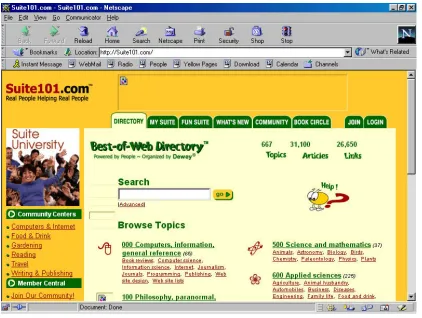
Fig 1: The Suite101.com home page
It is interesting to note that Suite101.com (Fig 1) uses the Dewey Decimal Classification
Scheme to classify its subject interests, even calling itself the Best-of-Web Directory™ with
Web content: what makes business sense?
From evaluating certain websites and their commercial viability, there are certain features
that make business sense:
1 ‘PORTALIZING’
It has been found that a conglomeration of resources makes a better business model on
the Web. There are so many specialized services that one can provide, but information
about them is best available at one hub. It uses the concept of ‘library browsing’ on the
shelves — where one can chance upon a related requirement while looking for a
particular one.
2 VALUE ADDED SERVICES
Apart from serving as a PR device and advertising its products and services, a Website
needs to attract an audience. The site needs to have content that motivates people to visit
repeatedly. This is achieved only adding value-added content. This could be updated and
useful information or ideas, a brain teaser, a contest, etc. This needs enormous
imagination and creativity and the HTML/XML expert does not necessarily provide this.
The need for such a person resulted in the rise of the Web Writer/Editor.
Content: creating a resource
When content is created, in effect the author/publisher is primarily creating an information
resource. This information could lead to fulfilling needs for research, education, business,
charity, or any conceivable activity. It can advertise a product, create and sell a service, or
simply make one's life much easier.
In short, content is what makes or breaks a website. What do we refer to as content? In the
context of the Internet, we have to take into considerati on many attributes of what we see on
AUTHORSHIP
The author is the primary provider of the information on a website. Such a person has to not
only excel in writing skills, but also have higher-end skills such as manual HTML and XML
coding, knowledge of JavaScript, Java, VBscript, Perl/CGI, and Dynamic HTML. A
sufficient comfort level of being able to use a web-page development package such as
Microsoft FrontPage, Adobe PageMill, or HomeSite is necessary. Besides this, some
companies may desire knowledge of Robohelp HTML if their content is more technically
oriented.
AUTHENTICITY AND REPUTATION
A business site especially suffers when its credentials are not established. People are
extremely wary of doing business and financial transactions on the Net because of the
possibility of fraud. The ‘credit card fraud’ is a real fear of the Internet surfing public. An
interesting development can be noted in e-commerce nowadays through a TV advertisement
for bazee.com where a lady is seen espousing the use of the Internet-based purchase and sale
service while emphasizing that payments can be made in cash. This is a classic example of a
website content and service addressing an apprehension of the general public. The content of
a website can influence the level of success of operations, which in turn breeds reputation.
ACTUAL COMPOSITION
This is what most people actually refer to as content, although the other attributes are part of
the content. The composition refers to the text, images, logos, multimedia and interactive
features, design and style, language, and consistency of format of the website.
Conclusion: what can we do right?
The paper has been discussing the various aspects of content development — on whatever
has been done so far and what we can look forward to in the future. In the process, the
development of websites themselves has been traced, substantiating that content itself forms
It is difficult to actually list out what inspires good content and a commendable website since
there are so many types, purposes and objectives of websites. However, whatever be the type
of website, the following points may always be considered:
§ The most important is to focus on the objective of the Internet resource — the
intended purpose of the website.
§ Updating the content and information as and when required, so that people always
come back for more.
§ To establish the website’s credentials, by always providing unambiguous content and
honest follow -up service.
§ To adapt the content to changing times and be creative and accommodating enough to
give what the users require and want.
Keeping these issues in mind while developing content may lead to the resurgence of
confidence in the Dotcom ventures.
References
1. Hewitt (John). Web Content Development: The New Writing Career.
http://www.poewar.com/articles/web_content_development.htm
2. Solomon (Susan). A Progressive Approach to Content Development. 2002.