KIRKPATRICK’S LEVEL 3 AND LEVEL 4 EVALUATIONS
by
Perri Estes Kennedy
A thesis
submitted in partial fulfillment of the requirements for the degree of
Master of Science in Instructional & Performance Technology Boise State University
DEFENSE COMMITTEE AND FINAL READING APPROVALS
of the thesis submitted by
Perri Estes Kennedy
Thesis Title: Training Professionals’ Usage and Understanding of Kirkpatrick’s Level 3 and Level 4 Evaluations
Date of Final Oral Examination: 18 April 2012
iv
ACKNOWLEDGEMENTS
For their assistance in the completion of this thesis, I am in debt to many people. Dr. Yonnie Chyung has been my endlessly patient advisor and sounding board throughout the entire process. She has always had a sensible solution to each of my new-researcher qualms and I could not have completed this project without her experience and wisdom to help me. From Dr. Don Winiecki, I learned how to channel my natural
cynicism into intellectual inquiry and to never mistake assertions for truth. Dr. Robert Brinkerhoff’s methodology guided me through this research and I am grateful for his encouraging words.
Thank you to the LinkedIn group managers who allowed me to solicit their members for this research. I would particularly like to thank Wendy Kirkpatrick (Kirkpatrick Evaluation), Christopher Pappas (Instructional Design and E-Learning Professionals Group), and Jenny Thompson (eLearning Guild) for their assistance.
I have learned a tremendous amount from my peers in the IPT program and continue to learn from them beyond the classroom. My special thanks go to Chester Stevenson and Shannon Rist with whom I’d worked from the first group project to the culminating activities. We’ve spent a lot of late nights talking about things like
v
vi ABSTRACT
Behavior-based (Level 3) and results-based (Level 4) evaluations of training interventions can provide organizations with substantive proof of the value of those interventions. Training professionals have long acknowledged the necessity of
conducting such evaluations, yet Level 3 evaluations are conducted for only about half of all training interventions and Level 4 for about one-third. This research examined the frequency with which training professionals currently conduct Level 3 and Level 4 evaluations, their perceptions on the utility of Level 3 and Level 4 evaluations, and the factors that facilitate or obstruct their attempts to perform such evaluations.
The research was conducted using Brinkerhoff's Success Case Method as its framework. Sixty-eight training professionals completed an online survey to assess their usage and understanding of Level 3 and Level 4 evaluations, indicate their success or non-success to conduct these evaluations, and rate the factors which may have
vii
than 60% of their training interventions. The three key factors identified by survey respondents as impacting their ability to conduct Level 3 and Level 4 evaluations were the availability of resources such as time and personnel, managerial support, and expertise in evaluative methodology. The interview data supported the survey findings but also showed that expertise also extended to an understanding of what a results-based evaluation can measure and how it is relevant to an organization; if the training
professional cannot clarify the relevance of evaluating training interventions in terms of organizational goals, the organization may not see the value in expending the resources needed to conduct evaluations.
viii
TABLE OF CONTENTS
ACKNOWLEDGEMENTS ... iv
ABSTRACT ... vi
LIST OF TABLES ... xii
LIST OF FIGURES ... xiv
CHAPTER ONE: INTRODUCTION ... 1
Introduction ... 1
Significance of the Problem ... 7
Research Questions ... 8
Definition of Terms... 10
CHAPTER TWO: LITERATURE REVIEW ... 13
Part 1: Human Performance Technology ... 13
Human Performance Technology and the Role of Evaluation ... 13
Kirkpatrick’s Four Levels of Training Evaluation... 13
Part 2: Evaluation of Training Programs ... 17
The Importance of Instructional Evaluation ... 17
Gauging the Effectiveness of Training ... 18
Making the Business Case for Training ... 19
Frequency of the Levels ... 20
ix
Part 3: The Importance of Evaluation to Human Performance Technology ... 26
CHAPTER THREE: METHODOLOGY ... 28
Population and Sampling ... 29
Instruments ... 30
Overall Methodology Framework... 32
Implementing the Success Case Method ... 34
CHAPTER FOUR: DATA ANALYSIS AND FINDINGS ... 42
Part 1: Survey Data ... 42
Demographics ... 42
Frequency of Evaluations ... 44
Perceptions About Evaluation... 46
Level 3 Stakeholders ... 49
Level 3 Reasons for Evaluation ... 50
Level 3 Factors Potentially Impacting Evaluation ... 51
Level 4 Stakeholders ... 52
Level 4 Reasons for Evaluation ... 53
Level 4 Factors Potentially Impacting Evaluation ... 54
Level 3 and Level 4 Facilitating Factors... 55
Part 2: Interview Data ... 57
Facilitating Factors for Level 3 and Level 4 Evaluations ... 59
Obstructing Factors for Level 3 and Level 4 Evaluations ... 64
The Organizational Factor ... 67
x
Discussion ... 71
Frequency of Level 3 and Level 4 Evaluations ... 71
Stakeholders ... 72
Reasons for Evaluation ... 72
Barriers and Facilitators ... 73
Conclusions ... 76
Limitations of the Study... 77
Recommendations for Future Studies ... 78
REFERENCES ... 80
APPENDIX A ... 83
Gilbert’s Behavior Engineering Model ... 83
APPENDIX B ... 86
Boise State University Institutional Review Board Notification of Approval ... 86
APPENDIX C ... 89
Solicitation for Survey Participants ... 89
APPENDIX D ... 91
Survey Cover Letter ... 91
APPENDIX E ... 94
Full Survey ... 94
APPENDIX F... 116
Written Informed Consent Letter and Verbal Informed Consent Script... 116
APPENDIX G ... 121
xi
xii
LIST OF TABLES
Table 1. Gilbert's Behavior Engineering Model (BEM). ... 3
Table 2. Kirkpatrick's Four Levels of Evaluation. ... 4
Table 3. Pulichino’s Survey Results on Frequency of Organizational Kirkpatrick Usage, Listed by Percentage. ... 5
Table 4. Pulichino 2006 Survey Results on Usage of Kirkpatrick Levels... 21
Table 5. ASTD 2009 Survey Results on Usage of Kirkpatrick Levels. ... 21
Table 6. Pulichino 2007 Survey Results on Value of Evaluation Data. ... 22
Table 7. ASTD 2009 Survey Results of Value of Evaluation Data. ... 22
Table 8. Pulichino 2007 Survey Results on Perceived Barriers to Level 3 Evaluation. ... 24
Table 9. Pulichino 2007 Survey Results on Perceived Barriers to Level 4 Evaluation. ... 24
Table 10. ASTD 2009 Survey Results on Perceived Barriers to Level 3 and Level 4 Evaluations. ... 25
Table 11. Structure for Impact Model Based on Gilbert’s BEM Components. ... 35
Table 12. Demographic Data for Survey Respondents. ... 42
Table 13. Estimates of % of Training Evaluated, By Level. ... 45
Table 14. Perceived Sufficiency of Evaluation Results for Judging Training Effectiveness. ... 46
Table 15. Perceived Importance of Conducting Each Level of Evaluation. ... 47
Table 16. Comparison of Perceived Sufficiency and Importance of Level, n=59. ... 48
Table 17. Perception of Positive Correlation Between Kirkpatrick Levels, n=68. ... 48
xiii
Table 19. Stakeholders for Level 3 Evaluations. ... 49
Table 20. Reasons for Evaluation at Level 3. ... 50
Table 21. Reasons for Non-Evaluation of Level 3. ... 51
Table 22. Availability of Level 3 Evaluation Factors, By Respondent Category. ... 51
Table 23. Stakeholders for Level 4 Evaluations. ... 52
Table 24. Reasons for Evaluation at Level 4. ... 53
Table 25. Reasons for Non-Evaluation at Level 4. ... 54
Table 26. Availability of Level 4 Evaluation Factors, By Respondent Category. ... 55
Table 27. Facilitating and Obstructing Factors For Both Levels. ... 56
Table 28. Interviewees by Success Categories. ... 58
xiv
LIST OF FIGURES
CHAPTER ONE: INTRODUCTION
Introduction
The International Society for Performance Improvement (ISPI) (2012) explains Human Performance Technology (HPT) as a systematic approach to improving
productivity and performance in the workplace through influencing human behaviors and accomplishments. The HPT approach examines the current and desired levels of
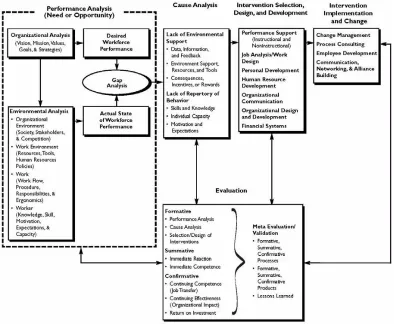
Figure 1. Human Performance Technology (HPT) Model. Note. Reprinted with permission. Copyright 2004. The International Society for
Performance Improvement. HPT model is from page 3 of Fundamentals of Performance Technology, Second Edition by D.M. Van Tiem, J.L. Moseley, and J.C. Dessinger. All rights reserved.
Tying the HPT process together is the concept of evaluation, which Scriven (1991) describes as the systematic determination of the intrinsic merit or extrinsic worth of something. Performance analysis and cause analysis are formative evaluations
designed to give feedback for performance improvement and to guide decision-making when weighing intervention alternatives. After implementation, performance
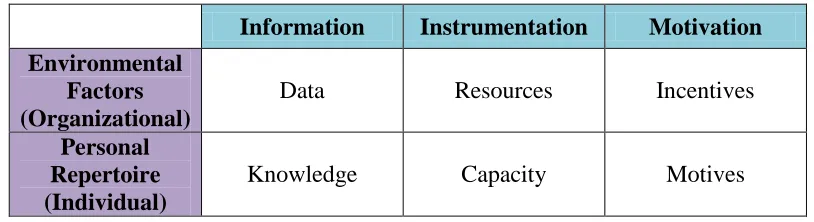
One tool commonly used for cause analysis is Thomas Gilbert’s (2007) Behavior Engineering Model (BEM), shown in Table 1 (for more information about the BEM, see Appendix A). The BEM identifies information, instrumentation, and motivation as the three types of workplace behavior, with each existing at both the organizational and individual levels.
Table 1. Gilbert's Behavior Engineering Model (BEM).
Information Instrumentation Motivation Environmental
Factors (Organizational)
Data Resources Incentives
Personal Repertoire (Individual)
Knowledge Capacity Motives
According to Gilbert (2007), workplace performance can be improved through using the BEM to take a systematic look at what he determined to be the six possible causes of performance deficiencies and then directly or indirectly changing the specific behaviors identified as those that prevent optimal performance.
U.S. organizations spent over $78 billion on internal training programs in 2007 (American Society for Training & Development, 2010); thus, it would seem prudent that organizations attempt to determine, through valuations of on-the-job relevancy and performance results, if this was money well spent.
One means for doing this is the Kirkpatrick scale. Kirkpatrick (2010), in his doctoral dissertation research, proposed what later came to be known as his Four Levels for evaluation of training programs. The four levels are described in Table 2.
Table 2. Kirkpatrick's Four Levels of Evaluation. Level Focus of Evaluation
1: Reaction How favorably the learners react to the instruction
2: Learning How well the learners learn the knowledge or skills imparted during the instruction
3: Behavior To what level the learners apply the new knowledge or skills in their on-the-job behaviors
4: Results To what level the instruction achieves the intended impact on workplace outcomes
Kirkpatrick’s Four Levels are broadly accepted as the standard model in use by the field, and training professionals frequently use Kirkpatrick’s terminology when referring to evaluations of training interventions (Holton III, 1996).
Harless (1976) defined “true” training evaluation as that which examined on-the-job relevancy of the instructional content and the results produced by the training; this correlates to evaluations at Level 3 and Level 4 in Kirkpatrick’s terminology.
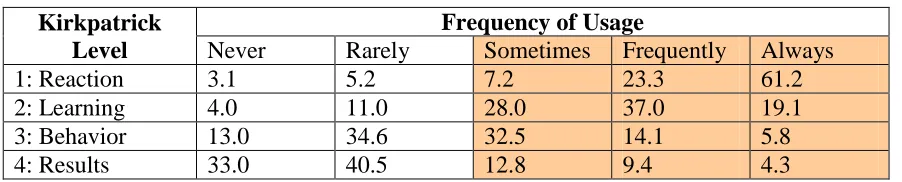
What happens in actual practice? Pulichino (2007) surveyed over 400 training professionals in 2006 and discovered that although a large percentage of them conducted Level 1 (reaction) and Level 2 (learning) assessments, far fewer conducted evaluations at Level 3 (behavior) and Level 4 (results). Table 3 represents his findings.
Table 3. Pulichino’s Survey Results on Frequency of Organizational Kirkpatrick Usage, Listed by Percentage.
Kirkpatrick Level
Frequency of Usage
Never Rarely Sometimes Frequently Always
1: Reaction 3.1 5.2 7.2 23.3 61.2
2: Learning 4.0 11.0 28.0 37.0 19.1
3: Behavior 13.0 34.6 32.5 14.1 5.8
4: Results 33.0 40.5 12.8 9.4 4.3
Despite the training field acknowledging the value of assessing training
interventions at all levels as demonstration of their organizational impact (Rummler & Brache, 1995, p. 198), only 19.9% of the surveyed professionals reported that their organizations always or frequently assessed post-training behaviors (Level 3) and 13.7% always or frequently assessed post-training business outcomes (Level 4) (p. 81).
One factor that Pulichino did not explore was the respondents’ interpretation of the Kirkpatrick levels. Did they believe that Kirkpatrick’s Four Levels was a model describing a progression of linked evaluations? Critics of Kirkpatrick’s work point to this variable interpretation as a liability, as the concept of “levels” implies a series of linked evaluations that build upon prior results. Alliger and Janak (1989) discussed the common assumptions of causality, correlation of results, and relative value and concluded that there was insufficient evidence to validate any such relationships between the levels. Holton (1996) characterized Kirkpatrick’s Four Levels as taxonomy rather than as a functional model. So how do training professionals in the field see the levels? If they believe the common assumptions, does this impact how, or if, they conduct evaluations of behavior or results? If they believe in the causality between levels, would they assume that positive results automatically follow positive behavior?
Another question of interpretation is how “results” are defined by training professionals. If there is no universally accepted definition of what a Level 4 evaluation examines, does that affect the likelihood that Level 4 evaluations are conducted in different organizations? In its survey on evaluation, the American Society for Training and Development (ASTD) (2009b) found that organizations that reported conducting Level 4 evaluations most often measured post-training customer satisfaction (39%) and employee satisfaction (37%) levels, followed by measurements of post-training
skills? Is it designed to improve customer satisfaction survey results, or to improve customer retention? Of the eight potential measurements listed on ASTD’s survey, the one least often selected as one performed by organizations as part of a Level 4 evaluation was business outcomes.
Significance of the Problem
U.S. organizations spend billions of dollars each year on training interventions in an effort to improve the performance of their employees and in turn improve the business outcomes of the organization (ASTD, 2010). However, an ASTD survey in 2009 revealed that 54.5% of training professionals reported that recent economic conditions have
required at least a moderate adjustment to their departments’ operations, and that 34.7% reported that their yearly training budget had been reduced (ASTD, 2009a). If a training department hopes to retain its budget and establish its importance to the organization, it needs a way to substantiate its real worth to the organization (McLinden, 1995; Rummler & Brache, 1995).
Stufflebeam and Shinkfield (2007) define the evaluation process as a way to show the reliability, effectiveness, and efficiency of a given program. Evaluation of training interventions is a concrete way a training department can measure its results and thus show both its value to the organization and its commitment to producing a positive return on the organization’s investment in training.
department intending to prove its business value should evaluate how the intervention actually changed those behaviors (Kirkpatrick Level 3) and impacted business outcomes (Kirkpatrick Level 4).
There appears to be scant published research on the extent to which training professionals evaluate their product at the behavior and outcome levels and the factors that prevent or promote such evaluations. This thesis project was proposed as a way to add to that research, in an attempt to better understand when and how training
professionals conduct behavior-based and results-based evaluations in their
organizations. If training professionals can recognize the potential barriers to evaluation within themselves and their organizations, they can create strategies to reduce or remove such barriers. Conversely, if they can identify the factors that facilitate evaluation, they may be more willing or able to make use of these factors.
Research Questions
This research was conducted to understand training professionals’ conduct of behavior-based (Kirkpatrick Level 3) and results-based (Kirkpatrick Level 4) evaluations of training interventions and to examine factors that influence their conduct of such evaluations. This study was focused on individuals whose primary job duties include internal training functions for the organizations with which they are employed.
Non-Success Cases: These training professionals have attempted to conduct Level 3 or Level 4 evaluations of at least one training program in their organizations but were prevented by one or more factors from obtaining results that could be submitted to the stakeholders.
Non-Evaluators: These training professionals have not attempted to conduct Level 3 or Level 4 evaluations in their organizations. The purpose of this research was to answer two research questions:
Research Question 1: With what frequency do training professionals conduct Level 3 and/or Level 4 evaluations for their organizations?
Sub-question 1a: Who are the stakeholders for these evaluations? Sub-question 1b: For what reasons do training professionals conduct or attempt to conduct the evaluations?
Research Question 2: What factors act as facilitators or barriers to conducting Level 3 and Level 4 training evaluations?
Sub-question 2a: For Success Cases, what are the facilitating factors and the barriers, and how did they impact the performance of evaluations? Sub-question 2b: For Non-Success Cases, what are the facilitating factors and the barriers, and how did they impact the attempts to perform
evaluations?
Prior research studies had identified factors that enhance or restrict the ability of training professionals to conduct behavior-based and results-based training evaluations. The promoting factors tended to be environmental in nature, driven by the needs and requirements of the organization. When Moller and Mallin (1996) surveyed training professionals, they found that evaluation duties were included in the official job description of 60% of respondents, and 77% of the organizations with formal training programs require the conducting of evaluations. Pulichino (2007) found that
organizations that based their training expenditures on the need to combat competitive pressure and to maintain a knowledgeable workforce were the most likely to conduct Level 3 and Level 4 training evaluations. Barriers to conducting training evaluations could be environmental, such as a culture resistant to sharing confidential data, or individual, such as a lack of expertise in evaluation methods. The data collection
instruments for this research were designed to look at both environmental and individual factors.
Definition of Terms
Training professionals are individuals whose primary job functions involve the improvement of the workplace-related knowledge and skills of an organization's
employees through educational methods. The training professional may be involved with assessing knowledge and skill deficiencies, designing and developing educational
programs, delivering educational programs to employees, and evaluating the
A training intervention or training program is an educational program developed by training professionals in order to resolve a knowledge or skills deficiency. Training programs may vary in duration and complexity depending on an organization’s needs.
A training evaluation is the systematic analysis of a training program to determine whether it has achieved the goals established for the program. To develop an evaluation process, the training professional must determine whether the purpose of the evaluation is to determine a program’s quality (merit) or value to the organization (worth), to look for aspects of the program that need improvement, or both (Davidson, 2005).
Behavior-based evaluation is a systematic analysis of a training program to determine whether it has changed actual on-the-job behaviors of the employees who completed the program. In other words, a behavior-based evaluation examines what was learned and how much of it was put to use by the employees. If the intended behavior resulting from a training program is a more consistent use of Customer Relationship Management (CRM) software for a sales team, the behavior-based evaluation might examine the extent to which the sales employees apply the knowledge learned to use the software and for what purposes. Level 3 of Kirkpatrick’s (1996) Four Levels of
evaluation is a behavior-based evaluation.
Results-based evaluation is a systematic analysis of a training program to
CHAPTER TWO: LITERATURE REVIEW
Part 1: Human Performance Technology
Human Performance Technology and the Role of Evaluation
Pershing (2006) defined Human Performance Technology (HPT) as the design and development of results-oriented systemic interventions meant to improve
organizational productivity. The International Society for Performance Improvement (ISPI), a professional organization that promotes the use of HPT, presents it as a systematic process that starts with performance analysis, continues with cause analysis, intervention selection and implementation, and ends with evaluation, all phases of which are also interconnected.
The HPT model developed by Van Tiem, Moseley, and Dessinger (2004), seen in Figure 1 (p. 13), includes formative evaluation as an essential conclusion to each phase that validates the findings of that phase and guides the organization in its approach to the next phase. The model suggests summative evaluations to gauge immediate reactions to interventions and a confirmative (outcome) evaluation to examine how the interventions impacted job performance and met organizational goals.
Kirkpatrick’s Four Levels of Training Evaluation
written by Donald Kirkpatrick, now an emeritus professor of Management at the University of Wisconsin (Kirkpatrick, 1996). Each of the articles, based on his doctoral dissertation about evaluating training for supervisors, focused on one “step” of
evaluation.
The steps were widely adopted within the training community (Newstrom, 1978),
as they formed a simple yet flexible way of identifying different criteria for evaluation.
Although Kirkpatrick originally referred to the criteria as steps, at some point the
community re-labeled them as levels (Kirkpatrick, 1996).
Level 1 is Reaction, defined by Kirkpatrick (1996) as how well trainees like a
particular training program. Level 1 measures the learners’ immediate response to the
training and may encompass anything from how relevant the course content was to their
job duties to how comfortable were the classroom chairs. Kirkpatrick recommended that
Level 1 evaluations be performed through written, anonymous comment sheets designed
to collect quantifiable data relevant to the learners’ satisfaction with the training program.
It is easy for training professionals to conduct Level 1 evaluations, as they have access to
the learners at the time of training and have control over the collection of Level 1 data.
Level 2 is Learning, which tests the knowledge or skills acquired during the
training session. Kirkpatrick and L’Allier (2004) noted that Level 2 evaluations may
require a pre-assessment test as well as a post-training test in order to accurately measure
how much knowledge the learners have gained through the training session. Like Level 1,
Level 2 data collection can be controlled by the training professionals.
Level 3 is Behavior, which measures the transfer of training, or how effectively
concepts learned during training immediately after the session ends, but as Tyler (1942)
emphasized, learning is intended to change behaviors. If the workers do not use their
newly-acquired knowledge on the job, the training has a poor return on the resources
invested because it has not accomplished its primary purpose. Evaluating worker
behaviors is considerably more complex than gathering reactions and assessing
immediate learning. Training professionals seeking to conduct such evaluations must
collect data from multiple sources to generate a thorough view of the post-training
behaviors. Some data may be quantitative and objective, like production numbers pre-
and post-training. Other data, like performance reviews from supervisors, are subjective
in nature; Kirkpatrick and L’Allier (2004) recommended that training professionals
develop a methodology for observing and quantifying the behavior in order to make it
measureable and subject to analysis in consistent and efficient ways.
Level 4 is Results, which is a measure of to what extent the training program
contributed to meeting the organization’s objectives for the program. A simple goal that
is not greatly affected by external variables can be evaluated on its results with relative
ease; Kirkpatrick (1996) mentioned a typing class as such an example, wherein results
would be measured by comparing current typing speed and accuracy to the speed and
accuracy measured prior to the class. For more complex training content and more
complex organizational goals, Level 4 evaluation methods should be developed along
with the training program to ensure that the training has a clear set of measurable
objectives.
One drawback to the reliance on Kirkpatrick’s Four Levels as a guide to training
Kirkpatrick did not create or recommend a specific methodology for conducting
evaluations for any of the four criteria, and stated that his Four Levels are best regarded
as a categorization scheme (Kirkpatrick & L’Allier, 2004).
Part 2: Evaluation of Training Programs
The Importance of Instructional Evaluation
When Tyler (1949) defined his views on curriculum and instruction in American schools, he identified four key questions that were essential when developing any instructional plan:
1. What educational purposes should the school seek to attain?
2. What educational experiences can be provided that are likely to attain these purposes?
3. How can these educational experiences be effectively organized? 4. How can we determine whether these purposes are being attained?
The fourth question focused on educational evaluation. Tyler’s (1942) concept of
effective learning was a process that achieved not merely the delivery of information, but a permanent change in the learner’s behavior patterns. Simple knowledge tests were inadequate as evaluation as they could not demonstrate that the instruction actually affected learner behaviors and thus could not demonstrate the actual effectiveness of the instruction in achieving its goals:
Since the program seeks to bring about certain changes in the behavior of students, and since these are the fundamental educational objectives, then it follows that an evaluation of the educational program is a process for finding out to what degree these changes in the students are actually taking place. (p. 496)
order to achieve a business outcome, the purpose of a training evaluation should be to examine if workers are using the new behaviors on the job and if by doing so they are achieving the desired business outcome.
Gauging the Effectiveness of Training
The primary purpose of a training evaluation is, quite logically, to evaluate the training program. Scriven (1991) defined evaluation as “the process of determining the merit, worth, or value of something” (p. 139). Stufflebeam and Shinkfield (2007) explained that evaluations confirm worth, value, opportunities for improvement, accreditation, accountability, and ultimately whether a program should be kept or discontinued.
It would seem logical that an organization that takes the time to evaluate its training programs would try to determine if the workers actually learned and used the desired knowledge, and then use this information to make any necessary improvements or other changes to the training program. When ASTD (2009b) surveyed its membership on their use of training evaluations, 87.7% of the respondents believed their organizations should use evaluation results to determine if the workers learned what they were
supposed to, and 91.3% believed that their organizations should use evaluation results to improve training programs. However, when asked what their organizations actually did, only 39.1% of the organizations examined what workers learned, and only 52.9% of the organizations used the results to improve their training programs.
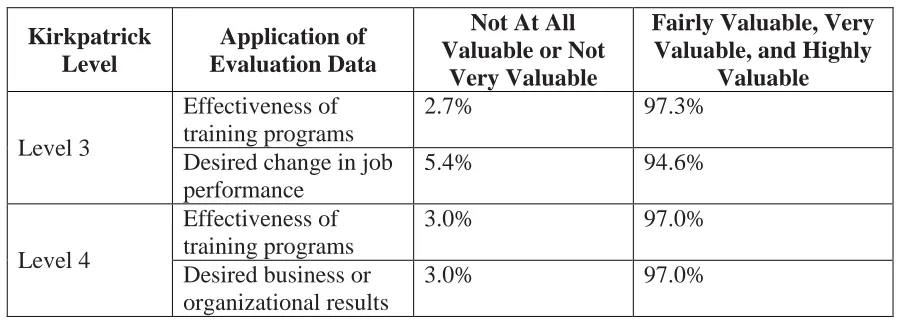
their “evaluations” no more than quick learner surveys on how enjoyable the class was? If the latter is true, the organizations would lack any useful data which would help them determine the merit, worth, or value of the training programs in relation to the objectives of the training. ASTD (2009b) found that 75.0% of its survey respondents believed that behavior-based training evaluations had a high or very high value to their organizations, yet only 52.5% reported that their organizations actually conducted any behavior-based training evaluations. Pulichino’s (2007) survey of training professionals produced an almost identical result, finding that 52.4% of respondents’ organizations had conducted any behavior-based training evaluations; in terms of the value of such evaluations, his respondents reported that 97.3% of their organizations valued behavior-based training evaluations as a way to measure training effectiveness and 94.6% as a way to measure a change in job performance.
Making the Business Case for Training
Why should an organization spend money on training its workers? ASTD’s 2010 State of the Industry Report stated that U.S organizations spent nearly $126 billion on workforce training in 2009, with over $78 billion spent on internal training. They estimated that an average of 62.5% of those internal training expenditures went for training personnel, administration, and development costs. ASTD noted that
from upper management to cut training costs, and 60% reported that they were expected to expand training programs without any additional department funding.
Vance (2011) advised that a training department should function like a business unit within the organization, with a clear mission, a compelling business plan, and a strategy for measuring accomplishments. By doing so, the training department would both be perceived as a strategic business partner and maximize the return on learning investment. Berk (2005) suggested that training leaders focus on collecting data that
would show the tangible business impact of training, including measurements of
improvements and analysis of the actual effect of training on outcomes. While such
metrics would promote the importance of the training department to the organization’s
leaders, the Expertus Inc. and Training Industry Inc. (2008) survey found that only 20% of the surveyed training managers conducted evaluations of training which reflected its impact on productivity, expenditures, and other aspects of importance to upper
management.
Kirkpatrick and L’Allier (2004) summed up the value of demonstrating the alignment between training results and business needs as follows:
The creation of well-constructed evaluations can be useful in generating support for budget expenditures, continuing and modifying existing programs, and measuring the impact specific training programs have on the organization’s business goals. (p. 30)
Frequency of the Levels
Two recent studies surveyed training professionals to determine how often they
their organizations valued the evaluation data, and what their reasons were for conducting
such evaluations.
In 2006, Pulichino (2007) surveyed 446 members of the eLearning Guild, an
organization of training professionals focused on the development and implementation of
the electronic delivery of instruction. He asked about their organizations’ usage of
training evaluation types as defined by Kirkpatrick’s levels. See Table 4 for his findings.
Table 4. Pulichino 2007 Survey Results on Usage of Kirkpatrick Levels. Kirkpatrick
Level
Frequency of Usage
Never Rarely Sometimes Frequently Always
1: Reaction 3.1 5.2 7.2 23.3 61.2
2: Learning 4.0 11.0 28.0 37.0 19.1
3: Behavior 13.0 34.6 32.5 14.1 5.8
4: Results 33.0 40.5 12.8 9.4 4.3
If the data for “Sometimes,” “Frequently,” and “Always” are combined to
represent an acceptable degree of evaluation usage, then 91.7% of the respondents’
organizations conducted Level 1 evaluations, and 84.1% conducted Level 2 evaluations.
This figure drops to 52.4% for Level 3 evaluations and 26.5% for Level 4 evaluations.
Three years later, ASTD (2009b) surveyed 704 of its members, all professionals
in training and related fields. Respondents were asked which of the Kirkpatrick Levels of
evaluation were used in their organization to any extent; the findings are in Table 5.
Table 5. ASTD 2009 Survey Results on Usage of Kirkpatrick Levels. Kirkpatrick Level Frequency of Usage
Pulichino (2007) asked respondents how much value their organizations
perceived they received from Level 3 and Level 4 evaluations. Their responses are in
Table 6.
Table 6. Pulichino 2007 Survey Results on Value of Evaluation Data. Kirkpatrick
Level
Application of Evaluation Data
Not At All Valuable or Not
Very Valuable
Fairly Valuable, Very Valuable, and Highly
Valuable
Level 3
Effectiveness of training programs
2.7% 97.3%
Desired change in job performance
5.4% 94.6%
Level 4
Effectiveness of training programs
3.0% 97.0%
Desired business or organizational results
3.0% 97.0%
ASTD’s (2009b) survey asked respondents how much they thought their organizations valued the results of training evaluations. Their responses are in Table 7. Table 7. ASTD 2009 Survey Results of Value of Evaluation Data.
Kirkpatrick Level No Value A Little Value Some Value High Value Very High Value Reactions of participants
(Level 1)
1.2% 14.2% 48.6% 22.8% 13.1%
Evaluation of learning (Level 2)
0.5% 4.2% 40.4% 38.1% 16.8%
Evaluation of behavior (Level 3)
1.3% 2.8% 21.0% 46.4% 28.6%
Evaluation of results (Level 4)
8.6% 6.0% 25.9% 26.7% 32.7%
valued the results of Level 3 evaluations, and 59.4% strongly valued the results of Level 4 evaluations.
In any event, all of these studies demonstrated a large gap between the level of value placed on Level 3 and Level 4 training evaluations by organizations and the actual performance of these evaluations.
Barriers to Evaluation at Level 3 and Level 4
If the results of Level 3 and Level 4 evaluations are so highly valued by organizations, why are these evaluations conducted so infrequently?
Moller and Mallin (1996) gathered qualitative data from their survey of
instructional designers, asking them to discuss the presence of organizational barriers that hindered their efforts to conduct evaluations at any level. 88% of the respondents stated that such barriers existed in their organizations, with the dominant barrier being related to a lack of time and other resources to conduct evaluations. Moller and Mallin (1996) also documented responses related to organizational cultures resistant to evaluation, lack of access to the data required to conduct evaluations. They reported that only a small number of respondents identified a lack of ability or methodology as a barrier. However, their survey included questions about the methodology in use to conduct evaluations at each level, and they found that respondents frequently identified methods which were inadequate or inappropriate for the evaluation level. For example, post-training
Pulichino (2007) asked survey respondents to rate the importance of possible reasons why their organizations do not conduct Level 3 and level 4 training evaluations. Table 8 represents the choices presented to the survey respondents as barriers to Level 3 evaluations and the percentage who rated each choice as fairly important, very important, or highly important. Table 9 represents the same information for Level 4 evaluations. Table 8. Pulichino 2007 Survey Results on Perceived Barriers to Level 3 Evaluation.
Reason Rated as
important Difficulty accessing the data required for Level 3 evaluations 86.2
No management support for Level 3 evaluations 85.1
Level 3 evaluations too time-consuming 83.3
Level 3 evaluations not considered an important priority for the training department
69.6
Level 3 evaluations too costly 67.2
We do not have the required expertise for Level 3 evaluations 52.2 Level 1 and/or Level 2 evaluations are sufficient for determining the
effectiveness of training programs
32.7
Table 9. Pulichino 2007 Survey Results on Perceived Barriers to Level 4 Evaluation.
Reason Rated as
important Difficulty accessing the data required for Level 4 evaluations 90.5
Level 4 evaluations too time-consuming 85.1
No management support for Level 4 evaluations 79.5
Level 4 evaluations too costly 75.6
Level 4 evaluations not considered an important priority for the training department
75.4 We do not have the required expertise for Level 4 evaluations 64.7 Level 1 and/or Level 2 evaluations are sufficient for determining the effectiveness of training programs
41.5
felt they lacked the necessary expertise to evaluate behavior, and nearly two-thirds lacked the expertise to evaluate results.
Pulichino (2007) made particular note of the respondents’ answers about the priority placed on training evaluations by their training departments:
Although not one of the most important reasons cited by participants, the fact that Level 3 and 4 evaluations are not considered important or urgent by training professionals suggests that a "priority divide" may exist between the training department and the business units they serve. Perhaps too many training
professionals are satisfied with measuring only what they can directly control, that is, student reaction and learning, and are content to leave the measurement of behavior and results to some other group in the organization. (p. 120-121)
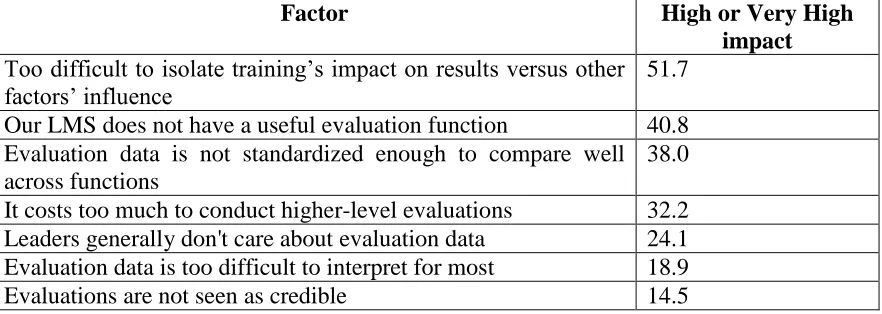
ASTD (2009b) asked its survey respondents to what extent various factors negatively impacted their organizations’ ability to conduct Level 3 and Level 4 evaluations. The factors and the percentage of respondents who rated the impact of each as high or very high are represented in Table 10.
Table 10. ASTD 2009 Survey Results on Perceived Barriers to Level 3 and Level 4 Evaluations.
Factor High or Very High
impact Too difficult to isolate training’s impact on results versus other
factors’ influence
51.7 Our LMS does not have a useful evaluation function 40.8 Evaluation data is not standardized enough to compare well across functions
38.0 It costs too much to conduct higher-level evaluations 32.2 Leaders generally don't care about evaluation data 24.1 Evaluation data is too difficult to interpret for most 18.9
Evaluations are not seen as credible 14.5
results, may be a self-fulfilling prophecy. ASTD’s analysis showed a negative correlation between the perception that proving the impact of training is too difficult to accomplish and the overall effectiveness of an organization’s evaluation efforts, and concluded that organizations that avoid evaluation due to perceived difficulty may be sabotaging their training efforts through inaction.
Part 3: The Importance of Evaluation to Human Performance Technology ISPI (2012) developed the Ten Standards of Performance Technology as a
guideline for the systematic practice of HPT. Those seeking the professional credential of Certified Performance Technologist (CPT) are required to document how they have demonstrated each of the ten standards in their practice.
The behavior-based or results-based evaluation of a training-based intervention, when completed and presented to the stakeholders, would fulfill five of the ten ISPI standards as follows:
Focus on results: A behavior-based or results-based training evaluation should be
designed to demonstrate to what degree the training intervention achieved the goals for which it was designed.
Systemic approach: A behavior-based or results-based evaluation will use
Add value to your work: By conducting behavior-based or results-based training
evaluations, the HPT practitioner helps an organization to determine if it is using its resources effectively when developing and implementing training interventions.
Collaborating with clients: The HPT practitioner cannot conduct behavior-based
or results-based evaluations in isolation from the client. He or she must earn support from the client organization for the evaluation process by educating it on the value of
evaluation towards achieving business goals and then work in partnership with the organization at all levels during the evaluation process.
Systematic evaluation: The HPT practitioner must approach the evaluation
process with a clear system that includes the design, development, and implementation of an effective evaluation method, followed by communication of the results to the
organization.
CHAPTER THREE: METHODOLOGY
The purpose of this research was to examine how often training professionals evaluate the success of their training programs in producing the on-the-job behaviors and business outcomes that the programs were intended to create. The research also looked at the individual and organizational factors that affected the ability of training professionals to conduct such evaluations and how those factors helped or limited the successful performance of the evaluations. This research was approved by Boise State University’s Institutional Review Board (see Appendix B).
This research was designed to answer two primary questions and associated sub-questions:
Research Question 1: With what frequency do training professionals conduct Level 3 and/or Level 4 evaluations for their organizations?
Sub-question 1a: Who are the stakeholders for these evaluations? Sub-question 1b: For what reasons do training professionals conduct or attempt to conduct the evaluations?
Research Question 2: What factors act as facilitators or barriers to conducting Level 3 and Level 4 training evaluations?
Sub-question 2b: For Non-Success Cases, what are the facilitating factors and the barriers, and how did they impact the attempts to perform evaluations?
Sub-question 2c: For Non-Evaluators, what are the facilitating factors and the barriers, and why were evaluations not attempted?
Population and Sampling
This study was focused on individuals whose primary job duties include internal training functions for the organizations with which they are employed. Additional
qualitative data was collected from individuals who are involved in training functions but not as a primary job duty or not for internal clients.
The U.S. Department of Labor’s Bureau of Labor Statistics (2012) estimated that in 2011, almost 233,000 individuals worked as training and development managers and specialists in the United States. For the purposes of this study, the population was initially limited to those training professionals who are members of online professional forums on LinkedIn.com. With the permission of forum leaders, an invitation to participate in the research project (included in Appendix C) was posted to each of the following LinkedIn groups:
ASTD National (approximately 45,000 members) Kirkpatrick Partners (approximately 2,900 members)
Instructional Design & E-Learning Professionals' Group (approximately 22,000 members)
E-Learning Guild (approximately 23,000 members)
Four study participants contacted the researcher directly to ask permission to re-post the study solicitation message to their own professional online networks; this
permission was granted. The survey instrument did not track respondents by source, so it is unknown which outlets were the most successful for soliciting participants.
Instruments
Questions for the survey instrument were based primarily on the factors identified by Pulichino (2007) and ASTD (2009b) in their research on training evaluation usage and barriers. The questions were refined through consultation with the members of the thesis committee, who contributed their experience in research and the HPT field to increase the relevancy and clarity of the questions and available answers.
An examination of prior research on the frequency of training evaluations and the factors that impact evaluations indicated some consistency in the factors considered as important. Some of the common factors were environmental, in that they were the result of organizational structure, culture, and actions. Other common factors were individual and were the result of knowledge, experience, and perception.
The first page of the survey was a Survey Cover Letter (Appendix D) which served as an informed consent form, as required by Boise State University’s Institutional Review Board (IRB) to protect human research subjects. Respondents who declined to continue with the survey exited before providing any data.
individuals whose primary duties involved internal training and development functions. The eliminated respondents were invited to answer two free response questions; this qualitative data was included in the final analysis.
After a set of questions about frequency of evaluations and perceptions of their importance, the survey respondents answered a single question about the completion of Level 3 evaluations, which identified them as Success Cases (those who completed at least one Level 3 evaluation and delivered the results to a stakeholder), Non-Success Cases (those who attempted at least one Level 3 evaluation but were unable to complete it), and Non-Evaluators (those who did not attempt any Level 3 evaluations). The Success Cases and Non-Success Cases received similar sets of questions about the factors that affected their evaluations; the only difference was the phrasing of the question to reflect attempts versus completions. The Non-Evaluators received a different set of questions to explore the reasons why no Level 3 evaluations were attempted.
After the questions about Level 3 evaluations, the respondents were asked the same questions about their completions, attempts, or non-attempts of Level 4 evaluations.
At the end of the survey, respondents were invited to volunteer for post-survey interviews. These respondents were categorized according to their success at each
and Level 4. Different scripts were created for Success Case, Non-Success Case, and Non-Evaluator informants. All of the interview scripts are included in Appendix G.
Overall Methodology Framework
Brinkerhoff (2003) developed the Success Case Method (SCM) as a way to analyze the effectiveness of a program, using both quantitative and qualitative data, by looking for successful elements and determining what conditions led to that success. The ASTD (2009b) study on training evaluation singled out the SCM as an evaluation
methodology popular with organizations; 47.7% of respondents reported that their organizations conducted interviews with successful learners as a way to evaluate training results.
This research project was structured around Brinkerhoff’s (2003) SCM for evaluation. According to Brinkerhoff, the SCM can be used to answer any or all of the following four questions about a given program:
What is really happening?
What results, if any, is the program helping to produce? What is the value of the results?
How could the initiative be improved? (pp. 6-13)
The SCM consists of five steps: 1. Focus and plan the SCM evaluation 2. Create an impact model
3. Survey all program recipients to identify success and non-success cases 4. Interview success and nonsuccess cases and document their stories 5. Communicate findings, conclusions, and recommendations
Steps 3 and 4 allow for the collection of both quantitative data from the survey and qualitative data from the interviews. Previous research studies on the topic of
evaluation usage by training professionals had collected only quantitative survey data on the frequency of training evaluations and the factors that affected the evaluations; by following the SCM structure, this study allowed for qualitative data that looked at the stories behind the numbers of those who were successful at conducting evaluations and those who were not.
A unique aspect of the SCM is its use of a survey instrument to identify extreme cases with whom to conduct those narrative interviews. Extreme case selection focuses on the individuals who are farthest from the mean of the sample distribution and thus represent the most unusual cases. In an SCM, the extreme cases represent the most successful and least successful program recipients and are not meant to be representative of the "typical" program recipient. Seawright and Gerring (2008) note that this method of selection is only appropriate in an exploratory study involving open-ended questioning, before a specific hypothesis has been formed.
questions developed for an SCM evaluation allow for semi-structured, open-ended questioning so the program recipients are free to relate their experiences about specific aspects of the program. A similar narrative-based exploration of human performance is Flanagan’s (1954) Critical Incident Technique, which asks informants to identify and discuss extreme behaviors that they have witnessed in a specified context.
Implementing the Success Case Method Step 1: Focus and plan the SCM evaluation
The first step of a SCM evaluation includes defining the purpose of the study, why and to whom it is important, and the overall strategy for collecting the necessary data.
The purpose of this study, as defined by its primary research questions, was to examine the frequency with which training professionals conduct Level 3 and Level 4 evaluations, and to examine the factors that impact this frequency.
As this study does not look at a planned program or a specific organization, there is no formal stakeholder who requested the evaluation or would directly benefit from receiving the results. In this case, the field of workforce training and development was identified as the stakeholder, as the study results were meant to contribute to the base of knowledge about the field.
The study population was not centralized in location or organization, and the timeframe of the study itself was limited by the academic schedule, so the overall
and non-success cases based on the analysis of survey responses. Interviews were done by telephone or Voice Over Internet Protocol (VOIP).
Step 2: Create an impact model
Brinkerhoff (2003) defined an impact model as “a carefully articulated and
concise forecast of what the most successful performance might be expected to look like” (p. 76). This research study defined a successful performer as a training professional who successfully conducted training evaluations that measured the impact of the instruction on individual employee behaviors and/or achievement of organizational goals and then communicated the evaluation results to the organization for its benefit.
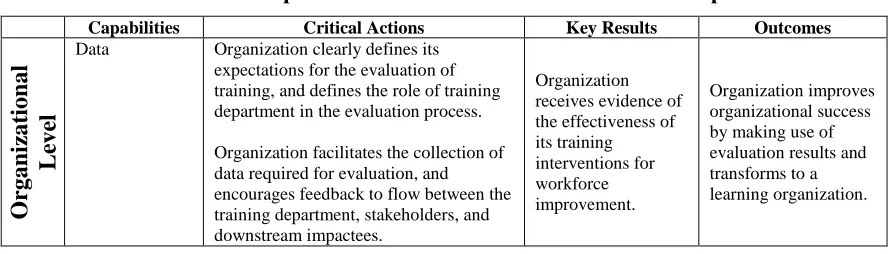
Specific capabilities needed for the successful completion of training evaluations had not been identified prior to the study, so potential capabilities of the population were structured around the components of Gilbert’s (2007) Behavior Engineering Model (BEM), with successful performance defined as the completion of behavior- and results-based evaluations of training interventions (For more information about Gilbert’s BEM, see Appendix A). This study’s impact model is shown in Table 11.
Table 11. Structure for Impact Model Based on Gilbert’s BEM Components. Capabilities Critical Actions Key Results Outcomes
Organi zat ion al L eve l
Data Organization clearly defines its expectations for the evaluation of training, and defines the role of training department in the evaluation process.
Organization facilitates the collection of data required for evaluation, and encourages feedback to flow between the training department, stakeholders, and downstream impactees.
Instruments Organization allocates sufficient personnel to the training department to allow adequate time for the evaluation process without negatively impacting other departmental priorities.
Organization acquires or develops tools for collection and analysis of evaluation data.
Incentives Organization makes visible how it values evaluation as an important component of workforce improvement. In d ivi d u al L eve l
Knowledge Training professional uses the terminology, concepts, and models applicable to training evaluation.
Training professional communicates effectively with organization at all levels.
Training professional successfully conducts evaluation of training, generates evidence of contribution towards organizational goals involving workforce improvement, and then communicates results to the appropriate groups.
Training professional or training department functions as a strategic business partner and is actively involved in improving
organizational success. Capacity Training professional possess the
cognitive capability to make data-based evaluative judgments.
Motives Training professional wants to perform the required jobs and has motives aligned with the work and work environment.
Step 3: Survey all program recipients to identify success and non-success cases
Potential survey participants were solicited online; see Population and Sampling Plan for details. The solicitation message included a link to an online survey hosted by Qualtrics.
Survey respondents were screened for eligibility at the start of the survey. Only those who self-identified as individuals whose primary job function was related to training and development for internal organizational clients were allowed to take the full survey. Those who worked primarily with external clients, or whose primary job
The full survey instrument created for this research was divided into three parts (see Appendix E). The first part of the survey instrument collected demographic information and asked questions related to respondents’ perceptions of training evaluation at Level 3 and Level 4 and the frequency with which their organizations conducted training evaluations at all four levels.
At the end of the first part of the survey, respondents answered a single question about their success in completing of Level 3 evaluations; their responses to this question identified them as Level 3 Success Cases (those who completed at least one Level 3 evaluation and delivered the results to a stakeholder), Level 3 Non-Success Cases (those who attempted at least one Level 3 evaluation but was unable to complete it), and Level 3 Non-Evaluators (those who did not attempt any Level 3 evaluations). For the second part of the survey, each of these groups answered a different set of questions regarding the factors that impacted their ability to conduct Level 3 evaluations.
After the questions about Level 3 evaluations, the respondents were asked a single question about the completion of Level 4 evaluations to identify them as Level 4 Success Cases, Level 4 Non-Success Cases, and Level 4 Non-Evaluators. For the third part of the survey, each of these groups answered a different set of questions regarding the factors that impacted their ability to conduct Level 4 evaluations.
At the end of the survey, respondents were invited to volunteer for post-survey interviews. Only those who volunteered were considered when selecting Success Cases, Non-Success Cases, or Non-Evaluators to be interviewed.
full survey but answered the two free-response questions. Sixty-four respondents completed the second part of the survey about success with Level 3. Sixty-one respondents completed the third part of the survey about their success with Level 4.
In this step, the methodology used for this study diverged from the SCM. Brinkerhoff (2003) stated that interviewees should be selected based on the degree of self-reported success as determined by survey responses. However, the survey instrument for this study did not attempt to measure the degree of success. With no definite common factor among respondents except professional field, it would have been very difficult to establish a rating system that would be universal to such a variety of backgrounds, job functions, and organizational structures; what one respondent considered a completed and successful evaluation might be regarded by another respondent as incomplete and
unsuccessful.
A decision was made to maximize the amount of qualitative interview data available, and thus all survey respondents who volunteered for interviews were contacted with requests for interviews.
Step 4: Interview success and nonsuccess cases and document their stories
Thirty-two survey respondents volunteered to be contacted for interviews. The prospective interviewees were contacted by e-mail to schedule a telephone or Voice Over Internet Protocol (VOIP) interview; 22 individuals actually participated in the interview step of this project.
a Verbal Informed Consent script at the beginning of the interview; all interviewees gave their verbal consent and were interviewed. Informants were notified in the Written Informed Consent and Verbal Informed Consent that the interview would be digitally audio recorded unless they denied permission; all interviewees allowed audio recording for the full interviews.
Brinkerhoff (2003) recommended that SCM interviews be 30 to 45 minutes long. However, the interviewees for this study had received no direct benefit from participation in a program or initiative, nor did they have professional or personal obligations to
participate. To increase the likelihood of cooperation, potential informants were told that interviews would last only 15 to 30 minutes and would be scheduled and conducted to avoid inconveniencing participants more than necessary. Informants who were willing to talk for a longer period of time were encouraged to do so; actual interview times ranged from 12 to 40 minutes, with the majority lasting 20-25 minutes.
The interviews were designed as semi-structured, which allowed for open-ended responses to scripted and follow-up questions. Separate interview scripts were written for Success Cases, Non-Success Cases, and Non-Evaluators; scripts were chosen for each subject based on his or her self-categorization questions from the survey. In each script, the questions asked the informants to describe the factors that contributed to the
completion, non-completion, or non-attempt to conduct evaluations of training at both Level 3 and Level 4.
Step 5: Communicate findings, conclusions, and recommendations
The qualitative data for this research was collected through two methods. The online survey included two free-response questions:
1. What do you think is the most critical facilitating factor that organizations should maintain in order to successfully conduct Level 3 and Level 4 evaluations, and why do you think so?
2. What do you think is the most obstructing barrier that organizations should reduce or remove in order to successfully conduct Level 3 and Level 4 evaluations, and why do you think so?
All survey respondents, including those ineligible to take the full survey, were given the opportunity to answer these questions.
The rest of the qualitative data was collected through interviews conducted over the telephone or via a VOIP (Skype) connection.
Responses from the survey and interviews were first sorted using Brinkerhoff’s (2003) “bucket” concept, using the following broad domains:
Barriers to evaluation
Facilitating factors for evaluation
The contents of each “bucket” were analyzed using deductive coding, which LeCompte and Schensul (1999) referred to as “analysis from the top down.” The coding categories followed Gilbert’s (2007) Behavior Engineering Model, with each response assigned to one of the six categories below:
Organizational Data
Organizational Incentives Individual Knowledge Individual Capacity Individual Motives
After the responses had been coded into these categories, the analysis focused on the three categories to which almost all responses from both “buckets” had been
CHAPTER FOUR: DATA ANALYSIS AND FINDINGS
The findings for this research are divided into two parts:
Part 1: Quantitative and qualitative data collected through the online survey
Part 2: Qualitative data collected through post-survey interviews with survey participants
Part 1: Survey Data
The survey instrument used in this research project served two purposes. One was to collect quantitative data on the frequency with which training evaluations were
performed and the factors that impacted that frequency. The second was to categorize respondents by their success, non-success, or non-attempt to conduct training evaluations at Level 3 and Level 4.
Demographics
Sixty-eight individuals completed the first part of the survey instrument, which collected demographic information and questioned the respondents on their usage and perceptions of Level 3 and Level 4 evaluations. The demographic information is shown in Table 12.
Table 12. Demographic Data for Survey Respondents. Gender
Male 33.82%
Age Range
18 - 29 4.41%
30 - 39 25.00%
40 - 49 32.35%
50 -59 30.88%
60 or older 7.35%
Job Function
Instructional Designer 25.00%
Trainer 19.12%
Human resources professional in training & development 7.35%
Human resources professional (other) 1.47%
Organizational development specialist 1.47%
Manager in training & development, organizational development, or human resources
36.76%
Manager (other) 0.00%
Other 8.82%
Years of Experience
Less than 2 years 5.88%
2 to 5 years 8.82%
6 to 15 years 50.00%
More than 16 years 35.29%
Number of Employees in Organization
Fewer than 100 2.94%
100 - 500 27.94%
501 - 1500 20.59%
More than 1500 44.12%
Not sure 4.41%
Highest Degree Earned
High school diploma 2.94%
Associate's degree 2.94%
Bachelor's degree 35.29%
Master's degree 48.53%
Doctorate 10.29%
Highest Instructional Design Degree Earned
Bachelor's degree 8.82%
Master's degree 39.71%
Doctorate 8.82%
Certificate 19.12%
none 23.53%
Evaluation-specific Course Completed
Non-credit seminar or workshop 19.12%
Both credit and non-credit courses 33.82%
No evaluation-specific course completed 19.12%
Respondents were also asked the type of organization for which they worked; the largest concentration was in the health care industry, which employed 13.24% of the respondents.
The remaining questions in the first part of the survey explored the Research Questions and associated sub-questions for this thesis research:
Research Question 1: With what frequency do training professionals conduct Level 3 and/or Level 4 evaluations for their organizations?
Sub-question 1a: Who are the stakeholders for training evaluations? Sub-question 1b: For what reasons do training professionals conduct or attempt to conduct training evaluations?
Research Question 2: What factors act as facilitators or barriers to conducting Level 3 and Level 4 training evaluations?
Sub-question 2a: For Success Cases, what are the facilitating factors and the barriers, and how did they impact the performance of evaluations? Sub-question 2b: For Non-Success Cases, what are the facilitating factors and the barriers, and how did they impact the attempts to perform
evaluations?
Sub-question 2c: For Non-Evaluators, what are the facilitating factors and the barriers, and why were evaluations not attempted?
Frequency of Evaluations
entered their estimates using a slider to indicate approximate percentages. The
respondents’ estimates were grouped into categories as Rarely (0% to 20% of training evaluated), Infrequently (21% to 40% of training evaluated), Sometimes (41% to 60%), Often (61% to 80%), and Almost Always (81% to 100%). The results are shown in Table 13.
Table 13. Estimates of % of Training Evaluated, By Level.
Rarely Infrequently Sometimes Often Almost
Always n
Level 1 0.00% 11.86% 8.47% 8.47% 71.19% 59
Level 2 3.64% 21.82% 20.00% 25.45% 29.09% 55 Level 3 28.26% 28.26% 17.39% 13.04% 13.04% 46
Level 4 55.26% 26.32% 5.26% 5.26% 7.89% 38
If the responses for “Sometimes,” “Often,” and “Almost Always” are grouped together as an indication of how respondents’ organizations are evaluating on a somewhat regular basis, it appears that Level 1 evaluations are conducted 88.13% of the time, Level 2 evaluations 74.54% of the time, Level 3 evaluations 43.47% of the time, and Level 4 evaluations 18.41% of the time.
Perceptions About Evaluation
Alliger and Janak (1989) identified three assumptions about the Kirkpatrick levels that they believed were common among researchers and practitioners in the training field. The first assumption was that the levels were presented in ascending order of importance, in that results from Level 1 evaluations are not as valuable as those from Level 2, and Level 2 results are not as valuable as Level 3 ones. The second and third assumptions are closely related and assume a causal link existing between the levels and a positive
correlation between the results at each level. The survey asked respondents their opinions on the importance and usefulness of evaluations at each level and if they believed in a positive correlation between results at the different levels.
To discover how respondents viewed the value of the different levels of evaluation, they were asked to rate how sufficient each level was for judging the effectiveness of training programs. The results are shown in Table 14.
Table 14. Perceived Sufficiency of Evaluation Results for Judging Training Effectiveness.
Very insufficient
Somewhat insufficient
Neither sufficient
nor insufficient
Somewhat sufficient
Very
sufficient n Level 1 16.18% 16.18% 14.71% 42.65% 10.29% 68 Level 2 10.29% 22.06% 7.35% 47.06% 13.24% 68 Level 3 14.29% 15.87% 7.94% 36.51% 25.40% 63 Level 4 31.67% 16.67% 8.33% 16.67% 26.67% 60