[ Team LiB ]
• Table of Contents
Introduction to Parallel Computing, Second Edition
By Ananth Grama, Anshul Gupta, George Karypis, Vipin Kumar
Publisher: Addison Wesley
Pub Date: January 16, 2003
ISBN: 0-201-64865-2
Pages: 856
Increasingly, parallel processing is being seen as the only cost-effective method for the fast solution of computationally large and data-intensive problems. The emergence of inexpensive parallel computers such as commodity desktop multiprocessors and clusters of workstations or PCs has made such parallel methods generally applicable, as have software standards for portable parallel programming. This sets the stage for substantial growth in parallel software.
Data-intensive applications such as transaction processing and information retrieval, data mining and analysis and multimedia services have provided a new challenge for the modern generation of parallel platforms. Emerging areas such as computational biology and
nanotechnology have implications for algorithms and systems development, while changes in architectures, programming models and applications have implications for how parallel platforms are made available to users in the form of grid-based services.
This book takes into account these new developments as well as covering the more traditional problems addressed by parallel computers.Where possible it employs an
architecture-independent view of the underlying platforms and designs algorithms for an abstract model. Message Passing Interface (MPI), POSIX threads and OpenMP have been selected as
programming models and the evolving application mix of parallel computing is reflected in various examples throughout the book.
[ Team LiB ] [ Team LiB ]
• Table of Contents
Introduction to Parallel Computing, Second Edition
By Ananth Grama, Anshul Gupta, George Karypis, Vipin Kumar
Publisher: Addison Wesley
Pub Date: January 16, 2003
ISBN: 0-201-64865-2
Pages: 856
Increasingly, parallel processing is being seen as the only cost-effective method for the fast solution of computationally large and data-intensive problems. The emergence of inexpensive parallel computers such as commodity desktop multiprocessors and clusters of workstations or PCs has made such parallel methods generally applicable, as have software standards for portable parallel programming. This sets the stage for substantial growth in parallel software.
Data-intensive applications such as transaction processing and information retrieval, data mining and analysis and multimedia services have provided a new challenge for the modern generation of parallel platforms. Emerging areas such as computational biology and
nanotechnology have implications for algorithms and systems development, while changes in architectures, programming models and applications have implications for how parallel platforms are made available to users in the form of grid-based services.
This book takes into account these new developments as well as covering the more traditional problems addressed by parallel computers.Where possible it employs an
architecture-independent view of the underlying platforms and designs algorithms for an abstract model. Message Passing Interface (MPI), POSIX threads and OpenMP have been selected as
programming models and the evolving application mix of parallel computing is reflected in various examples throughout the book.
[ Team LiB ]
• Table of Contents
Introduction to Parallel Computing, Second Edition
By Ananth Grama, Anshul Gupta, George Karypis, Vipin Kumar
Publisher: Addison Wesley
Pub Date: January 16, 2003
ISBN: 0-201-64865-2
Pages: 856
Copyright
Pearson Education
Preface
Acknowledgments
Chapter 1. Introduction to Parallel Computing
Section 1.1. Motivating Parallelism
Section 1.2. Scope of Parallel Computing
Section 1.3. Organization and Contents of the Text
Section 1.4. Bibliographic Remarks
Problems
Chapter 2. Parallel Programming Platforms
Section 2.1. Implicit Parallelism: Trends in Microprocessor Architectures*
Section 2.2. Limitations of Memory System Performance*
Section 2.3. Dichotomy of Parallel Computing Platforms
Section 2.4. Physical Organization of Parallel Platforms
Section 2.5. Communication Costs in Parallel Machines
Section 2.6. Routing Mechanisms for Interconnection Networks
Section 2.7. Impact of Process-Processor Mapping and Mapping Techniques
Section 2.8. Bibliographic Remarks
Problems
Chapter 3. Principles of Parallel Algorithm Design
Section 3.1. Preliminaries
Section 3.2. Decomposition Techniques
Section 3.4. Mapping Techniques for Load Balancing
Section 3.5. Methods for Containing Interaction Overheads
Section 3.6. Parallel Algorithm Models
Section 3.7. Bibliographic Remarks
Problems
Chapter 4. Basic Communication Operations
Section 4.1. One-to-All Broadcast and All-to-One Reduction
Section 4.2. All-to-All Broadcast and Reduction
Section 4.3. All-Reduce and Prefix-Sum Operations
Section 4.4. Scatter and Gather
Section 4.5. All-to-All Personalized Communication
Section 4.6. Circular Shift
Section 4.7. Improving the Speed of Some Communication Operations
Section 4.8. Summary
Section 4.9. Bibliographic Remarks
Problems
Chapter 5. Analytical Modeling of Parallel Programs
Section 5.1. Sources of Overhead in Parallel Programs
Section 5.2. Performance Metrics for Parallel Systems
Section 5.3. The Effect of Granularity on Performance
Section 5.4. Scalability of Parallel Systems
Section 5.5. Minimum Execution Time and Minimum Cost-Optimal Execution Time
Section 5.6. Asymptotic Analysis of Parallel Programs
Section 5.7. Other Scalability Metrics
Section 5.8. Bibliographic Remarks
Problems
Chapter 6. Programming Using the Message-Passing Paradigm
Section 6.1. Principles of Message-Passing Programming
Section 6.2. The Building Blocks: Send and Receive Operations
Section 6.3. MPI: the Message Passing Interface
Section 6.4. Topologies and Embedding
Section 6.5. Overlapping Communication with Computation
Section 6.6. Collective Communication and Computation Operations
Section 6.7. Groups and Communicators
Section 6.8. Bibliographic Remarks
Problems
Chapter 7. Programming Shared Address Space Platforms
Section 7.1. Thread Basics
Section 7.2. Why Threads?
Section 7.3. The POSIX Thread API
Section 7.4. Thread Basics: Creation and Termination
Section 7.5. Synchronization Primitives in Pthreads
Section 7.6. Controlling Thread and Synchronization Attributes
Section 7.7. Thread Cancellation
Section 7.8. Composite Synchronization Constructs
Section 7.10. OpenMP: a Standard for Directive Based Parallel Programming
Section 7.11. Bibliographic Remarks
Problems
Chapter 8. Dense Matrix Algorithms
Section 8.1. Matrix-Vector Multiplication
Section 8.2. Matrix-Matrix Multiplication
Section 8.3. Solving a System of Linear Equations
Section 8.4. Bibliographic Remarks
Problems
Chapter 9. Sorting
Section 9.1. Issues in Sorting on Parallel Computers
Section 9.2. Sorting Networks
Section 9.3. Bubble Sort and its Variants
Section 9.4. Quicksort
Section 9.5. Bucket and Sample Sort
Section 9.6. Other Sorting Algorithms
Section 9.7. Bibliographic Remarks
Problems
Chapter 10. Graph Algorithms
Section 10.1. Definitions and Representation
Section 10.2. Minimum Spanning Tree: Prim's Algorithm
Section 10.3. Single-Source Shortest Paths: Dijkstra's Algorithm
Section 10.4. All-Pairs Shortest Paths
Section 10.5. Transitive Closure
Section 10.6. Connected Components
Section 10.7. Algorithms for Sparse Graphs
Section 10.8. Bibliographic Remarks
Problems
Chapter 11. Search Algorithms for Discrete Optimization Problems
Section 11.1. Definitions and Examples
Section 11.2. Sequential Search Algorithms
Section 11.3. Search Overhead Factor
Section 11.4. Parallel Depth-First Search
Section 11.5. Parallel Best-First Search
Section 11.6. Speedup Anomalies in Parallel Search Algorithms
Section 11.7. Bibliographic Remarks
Problems
Chapter 12. Dynamic Programming
Section 12.1. Overview of Dynamic Programming
Section 12.2. Serial Monadic DP Formulations
Section 12.3. Nonserial Monadic DP Formulations
Section 12.4. Serial Polyadic DP Formulations
Section 12.5. Nonserial Polyadic DP Formulations
Section 12.6. Summary and Discussion
Problems
Chapter 13. Fast Fourier Transform
Section 13.1. The Serial Algorithm
Section 13.2. The Binary-Exchange Algorithm
Section 13.3. The Transpose Algorithm
Section 13.4. Bibliographic Remarks
Problems
Appendix A. Complexity of Functions and Order Analysis
Section A.1. Complexity of Functions
Section A.2. Order Analysis of Functions
Bibliography
[ Team LiB ]
Copyright
Pearson Education Limited
Edinburgh Gate
Harlow
Essex CM20 2JE
England
and Associated Companies throughout the world
Visit us on the World Wide Web at: www.pearsoneduc.com
First published by The Benjamin/Cummings Publishing Company, Inc. 1994
Second edition published 2003
© The Benjamin/Cummings Publishing Company, Inc. 1994
© Pearson Education Limited 2003
The rights of Ananth Grama, Anshul Gupta, George Karypis and Vipin Kumar to be identified as authors of this work have been asserted by them in accordance with the Copyright, Designs and Patents Act 1988.
All rights reserved. No part of this publication may be reproduced, stored in a retrieval system, or transmitted in any form or by any means, electronic, mechanical, photocopying, recording or otherwise, without either the prior written permission of the publisher or a licence permitting restricted copying in the United Kingdom issued by the Copyright Licensing Agency Ltd, 90 Tottenham Court Road, London W1T 4LP.
The programs in this book have been included for their instructional value. They have been tested with care but are not guaranteed for any particular purpose. The publisher does not offer any warranties or representations nor does it accept any liabilities with respect to the programs.
All trademarks used herein are the property of their respective owners. The use of any
trademark in this text does not vest in the author or publisher any trademark ownership rights in such trademarks, nor does the use of such trademarks imply any affiliation with or
endorsement of this book by such owners.
British Library Cataloguing-in-Publication Data
A catalogue record for this book is available from the British Library
Library of Congress Cataloging-in-Publication Data
A catalog record for this book is available from the Library of Congress
07 06 05 04 03
Printed and bound in the United States of America
Dedication
To Joanna, Rinku, Krista, and Renu
[ Team LiB ]
Pearson Education
We work with leading authors to develop the strongest educational materials in computing, bringing cutting-edge thinking and best learning practice to a global market.
Under a range of well-known imprints, including Addison-Wesley, we craft high-quality print and electronic publications which help readers to understand and apply their content, whether studying or at work.
To find out more about the complete range of our publishing, please visit us on the World Wide Web at: www.pearsoneduc.com
[ Team LiB ]
Preface
Since the 1994 release of the text "Introduction to Parallel Computing: Design and Analysis of Algorithms" by the same authors, the field of parallel computing has undergone significant changes. Whereas tightly coupled scalable message-passing platforms were the norm a decade ago, a significant portion of the current generation of platforms consists of inexpensive clusters of workstations, and multiprocessor workstations and servers. Programming models for these platforms have also evolved over this time. Whereas most machines a decade back relied on custom APIs for messaging and loop-based parallelism, current models standardize these APIs across platforms. Message passing libraries such as PVM and MPI, thread libraries such as POSIX threads, and directive based models such as OpenMP are widely accepted as standards, and have been ported to a variety of platforms.
With respect to applications, fluid dynamics, structural mechanics, and signal processing formed dominant applications a decade back. These applications continue to challenge the current generation of parallel platforms. However, a variety of new applications have also become important. These include data-intensive applications such as transaction processing and information retrieval, data mining and analysis, and multimedia services. Applications in emerging areas of computational biology and nanotechnology pose tremendous challenges for algorithms and systems development. Changes in architectures, programming models, and applications are also being accompanied by changes in how parallel platforms are made available to the users in the form of grid-based services.
This evolution has a profound impact on the process of design, analysis, and implementation of parallel algorithms. Whereas the emphasis of parallel algorithm design a decade back was on precise mapping of tasks to specific topologies such as meshes and hypercubes, current emphasis is on programmability and portability, both from points of view of algorithm design and implementation. To this effect, where possible, this book employs an architecture
independent view of the underlying platforms and designs algorithms for an abstract model. With respect to programming models, Message Passing Interface (MPI), POSIX threads, and OpenMP have been selected. The evolving application mix for parallel computing is also reflected in various examples in the book.
This book forms the basis for a single concentrated course on parallel computing or a two-part sequence. Some suggestions for such a two-part sequence are:
Introduction to Parallel Computing: Chapters 1–6. This course would provide the basics of algorithm design and parallel programming.
1.
Design and Analysis of Parallel Algorithms: Chapters 2 and 3 followed by Chapters 8–12. This course would provide an in-depth coverage of design and analysis of various parallel algorithms.
2.
Most chapters of the book include (i) examples and illustrations; (ii) problems that supplement the text and test students' understanding of the material; and (iii) bibliographic remarks to aid researchers and students interested in learning more about related and advanced topics. The comprehensive subject index helps the reader locate terms they might be interested in. The page number on which a term is defined is highlighted in boldface in the index. Furthermore, the term itself appears in bold italics where it is defined. The sections that deal with relatively complex material are preceded by a '*'. An instructors' manual containing slides of the figures and solutions to selected problems is also available from the publisher
(http://www.booksites.net/kumar).
As with our previous book, we view this book as a continually evolving resource. We thank all the readers who have kindly shared critiques, opinions, problems, code, and other information relating to our first book. It is our sincere hope that we can continue this interaction centered around this new book. We encourage readers to address communication relating to this book to [email protected]. All relevant reader input will be added to the information archived at the site http://www.cs.umn.edu/~parbook with due credit to (and permission of) the sender(s). An on-line errata of the book will also be maintained at the site. We believe that in a highly
dynamic field such as ours, a lot is to be gained from a healthy exchange of ideas and material in this manner.
[ Team LiB ]
Acknowledgments
We would like to begin by acknowledging our spouses, Joanna, Rinku, Krista, and Renu to whom this book is dedicated. Without their sacrifices this project would not have been seen completion. We also thank our parents, and family members, Akash, Avi, Chethan, Eleni, Larry, Mary-Jo, Naina, Petros, Samir, Subhasish, Varun, Vibhav, and Vipasha for their affectionate support and encouragement throughout this project.
Our respective institutions, Computer Sciences and Computing Research Institute (CRI) at Purdue University, Department of Computer Science & Engineering, the Army High Performance Computing Research Center (AHPCRC), and the Digital Technology Center (DTC) at the
University of Minnesota, and the IBM T. J. Watson Research Center at Yorktown Heights,
provided computing resources and active and nurturing environments for the completion of this project.
This project evolved from our first book. We would therefore like to acknowledge all of the people who helped us with both editions. Many people contributed to this project in different ways. We would like to thank Ahmed Sameh for his constant encouragement and support, and Dan Challou, Michael Heath, Dinesh Mehta, Tom Nurkkala, Paul Saylor, and Shang-Hua Teng for the valuable input they provided to the various versions of the book. We thank the students of the introduction to parallel computing classes at the University of Minnesota and Purdue university for identifying and working through the errors in the early drafts of the book. In particular, we acknowledge the patience and help of Jim Diehl and Rasit Eskicioglu, who worked through several early drafts of the manuscript to identify numerous errors. Ramesh Agarwal, David Bailey, Rupak Biswas, Jim Bottum, Thomas Downar, Rudolf Eigenmann, Sonia Fahmy, Greg Frederickson, John Gunnels, Fred Gustavson, Susanne Hambrusch, Bruce Hendrickson, Christoph Hoffmann, Kai Hwang, Ioannis Ioannidis, Chandrika Kamath, David Keyes, Mehmet Koyuturk, Piyush Mehrotra, Zhiyuan Li, Jens Palsberg, Voicu Popescu, Alex Pothen, Viktor Prasanna, Sanjay Ranka, Naren Ramakrishnan, Elisha Sacks, Vineet Singh, Sartaj Sahni, Vivek Sarin, Wojciech Szpankowski, Srikanth Thirumalai, Jan Vitek, and David Yau have been great technical resources. It was a pleasure working with the cooperative and helpful staff at Pearson Education. In particular, we would like to thank Keith Mansfield and Mary Lince for their
professional handling of the project.
The Army Research Laboratory, ARO, DOE, NASA, and NSF provided parallel computing research support for Ananth Grama, George Karypis, and Vipin Kumar. In particular, Kamal Abdali, Michael Coyle, Jagdish Chandra, Frederica Darema, Stephen Davis, Wm Randolph Franklin, Richard Hirsch, Charles Koelbel, Raju Namburu, N. Radhakrishnan, John Van
Rosendale, Subhash Saini, and Xiaodong Zhang have been supportive of our research programs in the area of parallel computing. Andrew Conn, Brenda Dietrich, John Forrest, David Jensen, and Bill Pulleyblank at IBM supported the work of Anshul Gupta over the years.
[ Team LiB ]
Chapter 1. Introduction to Parallel
Computing
The past decade has seen tremendous advances in microprocessor technology. Clock rates of processors have increased from about 40 MHz (e.g., a MIPS R3000, circa 1988) to over 2.0 GHz (e.g., a Pentium 4, circa 2002). At the same time, processors are now capable of executing multiple instructions in the same cycle. The average number of cycles per instruction (CPI) of high end processors has improved by roughly an order of magnitude over the past 10 years. All this translates to an increase in the peak floating point operation execution rate (floating point operations per second, or FLOPS) of several orders of magnitude. A variety of other issues have also become important over the same period. Perhaps the most prominent of these is the ability (or lack thereof) of the memory system to feed data to the processor at the required rate. Significant innovations in architecture and software have addressed the alleviation of bottlenecks posed by the datapath and the memory.
The role of concurrency in accelerating computing elements has been recognized for several decades. However, their role in providing multiplicity of datapaths, increased access to storage elements (both memory and disk), scalable performance, and lower costs is reflected in the wide variety of applications of parallel computing. Desktop machines, engineering workstations, and compute servers with two, four, or even eight processors connected together are becoming common platforms for design applications. Large scale applications in science and engineering rely on larger configurations of parallel computers, often comprising hundreds of processors. Data intensive platforms such as database or web servers and applications such as transaction processing and data mining often use clusters of workstations that provide high aggregate disk bandwidth. Applications in graphics and visualization use multiple rendering pipes and
processing elements to compute and render realistic environments with millions of polygons in real time. Applications requiring high availability rely on parallel and distributed platforms for redundancy. It is therefore extremely important, from the point of view of cost, performance, and application requirements, to understand the principles, tools, and techniques for
programming the wide variety of parallel platforms currently available.
[ Team LiB ]
1.1 Motivating Parallelism
Development of parallel software has traditionally been thought of as time and effort intensive. This can be largely attributed to the inherent complexity of specifying and coordinating
concurrent tasks, a lack of portable algorithms, standardized environments, and software development toolkits. When viewed in the context of the brisk rate of development of
microprocessors, one is tempted to question the need for devoting significant effort towards exploiting parallelism as a means of accelerating applications. After all, if it takes two years to develop a parallel application, during which time the underlying hardware and/or software platform has become obsolete, the development effort is clearly wasted. However, there are some unmistakable trends in hardware design, which indicate that uniprocessor (or implicitly parallel) architectures may not be able to sustain the rate of realizable performance increments in the future. This is a result of lack of implicit parallelism as well as other bottlenecks such as the datapath and the memory. At the same time, standardized hardware interfaces have reduced the turnaround time from the development of a microprocessor to a parallel machine based on the microprocessor. Furthermore, considerable progress has been made in
standardization of programming environments to ensure a longer life-cycle for parallel
applications. All of these present compelling arguments in favor of parallel computing platforms.
1.1.1 The Computational Power Argument – from Transistors to FLOPS
In 1965, Gordon Moore made the following simple observation:
"The complexity for minimum component costs has increased at a rate of roughly a factor of two per year. Certainly over the short term this rate can be expected to continue, if not to increase. Over the longer term, the rate of increase is a bit more uncertain, although there is no reason to believe it will not remain nearly constant for at least 10 years. That means by 1975, the number of components per integrated circuit for minimum cost will be 65,000."
His reasoning was based on an empirical log-linear relationship between device complexity and time, observed over three data points. He used this to justify that by 1975, devices with as many as 65,000 components would become feasible on a single silicon chip occupying an area of only about one-fourth of a square inch. This projection turned out to be accurate with the fabrication of a 16K CCD memory with about 65,000 components in 1975. In a subsequent paper in 1975, Moore attributed the log-linear relationship to exponential behavior of die sizes, finer minimum dimensions, and "circuit and device cleverness". He went on to state that:
"There is no room left to squeeze anything out by being clever. Going forward from here we have to depend on the two size factors - bigger dies and finer dimensions."
He revised his rate of circuit complexity doubling to 18 months and projected from 1975
onwards at this reduced rate. This curve came to be known as "Moore's Law". Formally, Moore's Law states that circuit complexity doubles every eighteen months. This empirical relationship has been amazingly resilient over the years both for microprocessors as well as for DRAMs. By relating component density and increases in die-size to the computing power of a device, Moore's law has been extrapolated to state that the amount of computing power available at a given cost doubles approximately every 18 months.
Staying clear of this debate, the issue of translating transistors into useful OPS (operations per second) is the critical one. It is possible to fabricate devices with very large transistor counts. How we use these transistors to achieve increasing rates of computation is the key architectural challenge. A logical recourse to this is to rely on parallelism – both implicit and explicit. We will briefly discuss implicit parallelism in Section 2.1 and devote the rest of this book to exploiting explicit parallelism.
1.1.2 The Memory/Disk Speed Argument
The overall speed of computation is determined not just by the speed of the processor, but also by the ability of the memory system to feed data to it. While clock rates of high-end processors have increased at roughly 40% per year over the past decade, DRAM access times have only improved at the rate of roughly 10% per year over this interval. Coupled with increases in instructions executed per clock cycle, this gap between processor speed and memory presents a tremendous performance bottleneck. This growing mismatch between processor speed and DRAM latency is typically bridged by a hierarchy of successively faster memory devices called caches that rely on locality of data reference to deliver higher memory system performance. In addition to the latency, the net effective bandwidth between DRAM and the processor poses other problems for sustained computation rates.
The overall performance of the memory system is determined by the fraction of the total memory requests that can be satisfied from the cache. Memory system performance is addressed in greater detail in Section 2.2. Parallel platforms typically yield better memory system performance because they provide (i) larger aggregate caches, and (ii) higher
aggregate bandwidth to the memory system (both typically linear in the number of processors). Furthermore, the principles that are at the heart of parallel algorithms, namely locality of data reference, also lend themselves to cache-friendly serial algorithms. This argument can be extended to disks where parallel platforms can be used to achieve high aggregate bandwidth to secondary storage. Here, parallel algorithms yield insights into the development of out-of-core computations. Indeed, some of the fastest growing application areas of parallel computing in data servers (database servers, web servers) rely not so much on their high aggregate computation rates but rather on the ability to pump data out at a faster rate.
1.1.3 The Data Communication Argument
As the networking infrastructure evolves, the vision of using the Internet as one large heterogeneous parallel/distributed computing environment has begun to take shape. Many applications lend themselves naturally to such computing paradigms. Some of the most impressive applications of massively parallel computing have been in the context of wide-area distributed platforms. The SETI (Search for Extra Terrestrial Intelligence) project utilizes the power of a large number of home computers to analyze electromagnetic signals from outer space. Other such efforts have attempted to factor extremely large integers and to solve large discrete optimization problems.
In many applications there are constraints on the location of data and/or resources across the Internet. An example of such an application is mining of large commercial datasets distributed over a relatively low bandwidth network. In such applications, even if the computing power is available to accomplish the required task without resorting to parallel computing, it is infeasible to collect the data at a central location. In these cases, the motivation for parallelism comes not just from the need for computing resources but also from the infeasibility or undesirability of alternate (centralized) approaches.
[ Team LiB ]
1.2 Scope of Parallel Computing
Parallel computing has made a tremendous impact on a variety of areas ranging from
computational simulations for scientific and engineering applications to commercial applications in data mining and transaction processing. The cost benefits of parallelism coupled with the performance requirements of applications present compelling arguments in favor of parallel computing. We present a small sample of the diverse applications of parallel computing.
1.2.1 Applications in Engineering and Design
Parallel computing has traditionally been employed with great success in the design of airfoils (optimizing lift, drag, stability), internal combustion engines (optimizing charge distribution, burn), high-speed circuits (layouts for delays and capacitive and inductive effects), and
structures (optimizing structural integrity, design parameters, cost, etc.), among others. More recently, design of microelectromechanical and nanoelectromechanical systems (MEMS and NEMS) has attracted significant attention. While most applications in engineering and design pose problems of multiple spatial and temporal scales and coupled physical phenomena, in the case of MEMS/NEMS design these problems are particularly acute. Here, we often deal with a mix of quantum phenomena, molecular dynamics, and stochastic and continuum models with physical processes such as conduction, convection, radiation, and structural mechanics, all in a single system. This presents formidable challenges for geometric modeling, mathematical modeling, and algorithm development, all in the context of parallel computers.
Other applications in engineering and design focus on optimization of a variety of processes. Parallel computers have been used to solve a variety of discrete and continuous optimization problems. Algorithms such as Simplex, Interior Point Method for linear optimization and Branch-and-bound, and Genetic programming for discrete optimization have been efficiently parallelized and are frequently used.
1.2.2 Scientific Applications
The past few years have seen a revolution in high performance scientific computing applications. The sequencing of the human genome by the International Human Genome Sequencing Consortium and Celera, Inc. has opened exciting new frontiers in bioinformatics. Functional and structural characterization of genes and proteins hold the promise of
understanding and fundamentally influencing biological processes. Analyzing biological
sequences with a view to developing new drugs and cures for diseases and medical conditions requires innovative algorithms as well as large-scale computational power. Indeed, some of the newest parallel computing technologies are targeted specifically towards applications in
bioinformatics.
Bioinformatics and astrophysics also present some of the most challenging problems with respect to analyzing extremely large datasets. Protein and gene databases (such as PDB, SwissProt, and ENTREZ and NDB) along with Sky Survey datasets (such as the Sloan Digital Sky Surveys) represent some of the largest scientific datasets. Effectively analyzing these datasets requires tremendous computational power and holds the key to significant scientific discoveries.
1.2.3 Commercial Applications
With the widespread use of the web and associated static and dynamic content, there is increasing emphasis on cost-effective servers capable of providing scalable performance.
Parallel platforms ranging from multiprocessors to linux clusters are frequently used as web and database servers. For instance, on heavy volume days, large brokerage houses on Wall Street handle hundreds of thousands of simultaneous user sessions and millions of orders. Platforms such as IBMs SP supercomputers and Sun Ultra HPC servers power these business-critical sites. While not highly visible, some of the largest supercomputing networks are housed on Wall Street.
The availability of large-scale transaction data has also sparked considerable interest in data mining and analysis for optimizing business and marketing decisions. The sheer volume and geographically distributed nature of this data require the use of effective parallel algorithms for such problems as association rule mining, clustering, classification, and time-series analysis.
1.2.4 Applications in Computer Systems
As computer systems become more pervasive and computation spreads over the network, parallel processing issues become engrained into a variety of applications. In computer security, intrusion detection is an outstanding challenge. In the case of network intrusion detection, data is collected at distributed sites and must be analyzed rapidly for signaling intrusion. The
infeasibility of collecting this data at a central location for analysis requires effective parallel and distributed algorithms. In the area of cryptography, some of the most spectacular applications of Internet-based parallel computing have focused on factoring extremely large integers.
Embedded systems increasingly rely on distributed control algorithms for accomplishing a variety of tasks. A modern automobile consists of tens of processors communicating to perform complex tasks for optimizing handling and performance. In such systems, traditional parallel and distributed algorithms for leader selection, maximal independent set, etc., are frequently used.
While parallel computing has traditionally confined itself to platforms with well behaved compute and network elements in which faults and errors do not play a significant role, there are valuable lessons that extend to computations on ad-hoc, mobile, or faulty environments.
[ Team LiB ]
1.3 Organization and Contents of the Text
This book provides a comprehensive and self-contained exposition of problem solving using parallel computers. Algorithms and metrics focus on practical and portable models of parallel machines. Principles of algorithm design focus on desirable attributes of parallel algorithms and techniques for achieving these in the contest of a large class of applications and architectures. Programming techniques cover standard paradigms such as MPI and POSIX threads that are available across a range of parallel platforms.
Chapters in this book can be grouped into four main parts as illustrated in Figure 1.1. These parts are as follows:
Fundamentals This section spans Chapters 2 through 4 of the book. Chapter 2, Parallel
Programming Platforms, discusses the physical organization of parallel platforms. It establishes cost metrics that can be used for algorithm design. The objective of this chapter is not to
provide an exhaustive treatment of parallel architectures; rather, it aims to provide sufficient detail required to use these machines efficiently. Chapter 3, Principles of Parallel Algorithm Design, addresses key factors that contribute to efficient parallel algorithms and presents a suite of techniques that can be applied across a wide range of applications. Chapter 4, Basic Communication Operations, presents a core set of operations that are used throughout the book for facilitating efficient data transfer in parallel algorithms. Finally, Chapter 5, Analytical
algorithm.
Parallel Programming This section includes Chapters 6 and 7 of the book. Chapter 6,
Programming Using the Message-Passing Paradigm, focuses on the Message Passing Interface (MPI) for programming message passing platforms, including clusters. Chapter 7, Programming Shared Address Space Platforms, deals with programming paradigms such as threads and directive based approaches. Using paradigms such as POSIX threads and OpenMP, it describes various features necessary for programming shared-address-space parallel machines. Both of these chapters illustrate various programming concepts using a variety of examples of parallel programs.
Non-numerical Algorithms Chapters 9–12 present parallel non-numerical algorithms. Chapter 9 addresses sorting algorithms such as bitonic sort, bubble sort and its variants, quicksort, sample sort, and shellsort. Chapter 10 describes algorithms for various graph theory problems such as minimum spanning tree, shortest paths, and connected components. Algorithms for sparse graphs are also discussed. Chapter 11 addresses search-based methods such as branch-and-bound and heuristic search for combinatorial problems. Chapter 12 classifies and presents parallel formulations for a variety of dynamic programming algorithms.
Numerical Algorithms Chapters 8 and 13 present parallel numerical algorithms. Chapter 8 covers basic operations on dense matrices such as matrix multiplication, matrix-vector multiplication, and Gaussian elimination. This chapter is included before non-numerical
algorithms, as the techniques for partitioning and assigning matrices to processors are common to many non-numerical algorithms. Furthermore, matrix-vector and matrix-matrix
multiplication algorithms form the kernels of many graph algorithms. Chapter 13 describes algorithms for computing Fast Fourier Transforms.
[ Team LiB ]
1.4 Bibliographic Remarks
Many books discuss aspects of parallel processing at varying levels of detail. Hardware aspects of parallel computers have been discussed extensively in several textbooks and monographs [CSG98, LW95, HX98, AG94, Fly95, AG94, Sto93, DeC89, HB84, RF89, Sie85, Tab90, Tab91, WF84, Woo86]. A number of texts discuss paradigms and languages for programming parallel computers [LB98, Pac98, GLS99, GSNL98, CDK+00, WA98, And91, BA82, Bab88, Ble90, Con89,
CT92, Les93, Per87, Wal91]. Akl [Akl97], Cole [Col89], Gibbons and Rytter [GR90], Foster [Fos95], Leighton [Lei92], Miller and Stout [MS96], and Quinn [Qui94] discuss various aspects of parallel algorithm design and analysis. Buyya (Editor) [Buy99] and Pfister [Pfi98] discuss various aspects of parallel computing using clusters. Jaja [Jaj92] covers parallel algorithms for the PRAM model of computation. Hillis [Hil85, HS86] and Hatcher and Quinn [HQ91] discuss data-parallel programming. Agha [Agh86] discusses a model of concurrent computation based on actors. Sharp [Sha85] addresses data-flow computing. Some books provide a general overview of topics in parallel computing [CL93, Fou94, Zom96, JGD87, LER92, Mol93, Qui94]. Many books address parallel processing applications in numerical analysis and scientific computing [DDSV99, FJDS96, GO93, Car89]. Fox et al. [FJL+88] and Angus et al. [AFKW90]
provide an application-oriented view of algorithm design for problems in scientific computing. Bertsekas and Tsitsiklis [BT97] discuss parallel algorithms, with emphasis on numerical applications.
Akl and Lyons [AL93] discuss parallel algorithms in computational geometry. Ranka and Sahni [RS90b] and Dew, Earnshaw, and Heywood [DEH89] address parallel algorithms for use in computer vision. Green [Gre91] covers parallel algorithms for graphics applications. Many books address the use of parallel processing in artificial intelligence applications [Gup87, HD89b, KGK90, KKKS94, Kow88, RZ89].
A useful collection of reviews, bibliographies and indexes has been put together by the
Association for Computing Machinery [ACM91]. Messina and Murli [MM91] present a collection of papers on various aspects of the application and potential of parallel computing. The scope of parallel processing and various aspects of US government support have also been discussed in National Science Foundation reports [NSF91, GOV99].
A number of conferences address various aspects of parallel computing. A few important ones are the Supercomputing Conference, ACM Symposium on Parallel Algorithms and Architectures, the International Conference on Parallel Processing, the International Parallel and Distributed Processing Symposium, Parallel Computing, and the SIAM Conference on Parallel Processing. Important journals in parallel processing include IEEE Transactions on Parallel and Distributed Systems, International Journal of Parallel Programming, Journal of Parallel and Distributed Computing, Parallel Computing, IEEE Concurrency, and Parallel Processing Letters. These proceedings and journals provide a rich source of information on the state of the art in parallel processing.
[ Team LiB ]
Problems
1.1 Go to the Top 500 Supercomputers site (http://www.top500.org/) and list the five most powerful supercomputers along with their FLOPS rating.
1.2 List three major problems requiring the use of supercomputing in the following domains:
Structural Mechanics. 1.
Computational Biology. 2.
Commercial Applications. 3.
1.3 Collect statistics on the number of components in state of the art integrated circuits over the years. Plot the number of components as a function of time and compare the growth rate to that dictated by Moore's law.
1.4 Repeat the above experiment for the peak FLOPS rate of processors and compare the speed to that inferred from Moore's law.
[ Team LiB ]
Chapter 2. Parallel Programming
Platforms
The traditional logical view of a sequential computer consists of a memory connected to a processor via a datapath. All three components – processor, memory, and datapath – present bottlenecks to the overall processing rate of a computer system. A number of architectural innovations over the years have addressed these bottlenecks. One of the most important innovations is multiplicity – in processing units, datapaths, and memory units. This multiplicity is either entirely hidden from the programmer, as in the case of implicit parallelism, or exposed to the programmer in different forms. In this chapter, we present an overview of important architectural concepts as they relate to parallel processing. The objective is to provide sufficient detail for programmers to be able to write efficient code on a variety of platforms. We develop cost models and abstractions for quantifying the performance of various parallel algorithms, and identify bottlenecks resulting from various programming constructs.
We start our discussion of parallel platforms with an overview of serial and implicitly parallel architectures. This is necessitated by the fact that it is often possible to re-engineer codes to achieve significant speedups (2 x to 5 x unoptimized speed) using simple program
transformations. Parallelizing sub-optimal serial codes often has undesirable effects of unreliable speedups and misleading runtimes. For this reason, we advocate optimizing serial performance of codes before attempting parallelization. As we shall demonstrate through this chapter, the tasks of serial and parallel optimization often have very similar characteristics. After discussing serial and implicitly parallel architectures, we devote the rest of this chapter to organization of parallel platforms, underlying cost models for algorithms, and platform
abstractions for portable algorithm design. Readers wishing to delve directly into parallel architectures may choose to skip Sections 2.1 and 2.2.
[ Team LiB ]
2.1 Implicit Parallelism: Trends in Microprocessor
Architectures*
While microprocessor technology has delivered significant improvements in clock speeds over the past decade, it has also exposed a variety of other performance bottlenecks. To alleviate these bottlenecks, microprocessor designers have explored alternate routes to cost-effective performance gains. In this section, we will outline some of these trends with a view to understanding their limitations and how they impact algorithm and code development. The objective here is not to provide a comprehensive description of processor architectures. There are several excellent texts referenced in the bibliography that address this topic.
Clock speeds of microprocessors have posted impressive gains - two to three orders of magnitude over the past 20 years. However, these increments in clock speed are severely diluted by the limitations of memory technology. At the same time, higher levels of device integration have also resulted in a very large transistor count, raising the obvious issue of how best to utilize them. Consequently, techniques that enable execution of multiple instructions in a single clock cycle have become popular. Indeed, this trend is evident in the current generation of microprocessors such as the Itanium, Sparc Ultra, MIPS, and Power4. In this section, we briefly explore mechanisms used by various processors for supporting multiple instruction execution.
2.1.1 Pipelining and Superscalar Execution
Processors have long relied on pipelines for improving execution rates. By overlapping various stages in instruction execution (fetch, schedule, decode, operand fetch, execute, store, among others), pipelining enables faster execution. The assembly-line analogy works well for
understanding pipelines. If the assembly of a car, taking 100 time units, can be broken into 10 pipelined stages of 10 units each, a single assembly line can produce a car every 10 time units! This represents a 10-fold speedup over producing cars entirely serially, one after the other. It is also evident from this example that to increase the speed of a single pipeline, one would break down the tasks into smaller and smaller units, thus lengthening the pipeline and increasing overlap in execution. In the context of processors, this enables faster clock rates since the tasks are now smaller. For example, the Pentium 4, which operates at 2.0 GHz, has a 20 stage
pipeline. Note that the speed of a single pipeline is ultimately limited by the largest atomic task in the pipeline. Furthermore, in typical instruction traces, every fifth to sixth instruction is a branch instruction. Long instruction pipelines therefore need effective techniques for predicting branch destinations so that pipelines can be speculatively filled. The penalty of a misprediction increases as the pipelines become deeper since a larger number of instructions need to be flushed. These factors place limitations on the depth of a processor pipeline and the resulting performance gains.
Example 2.1 Superscalar execution
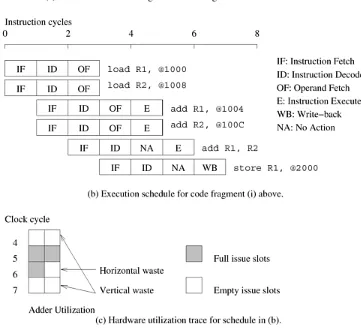
Consider a processor with two pipelines and the ability to simultaneously issue two instructions. These processors are sometimes also referred to as super-pipelined processors. The ability of a processor to issue multiple instructions in the same cycle is referred to as superscalar execution. Since the architecture illustrated in Figure 2.1 allows two issues per clock cycle, it is also referred to as two-way superscalar or dual issue execution.
Figure 2.1. Example of a two-way superscalar execution of
instructions.
Consider the execution of the first code fragment in Figure 2.1 for adding four numbers. The first and second instructions are independent and therefore can be issued concurrently. This is illustrated in the simultaneous issue of the instructions
@100C are also mutually independent, although they must be executed after the first two instructions. Consequently, they can be issued concurrently at t = 1 since the processors are pipelined. These instructions terminate at t = 5. The next two instructions, add R1, R2 and store R1, @2000 cannot be executed concurrently since the result of the former (contents of register R1) is used by the latter. Therefore, only the add instruction is issued at t = 2 and the store instruction at t = 3. Note that the instruction add R1, R2 can be executed only after the previous two instructions have been executed. The instruction schedule is illustrated in Figure 2.1(b). The schedule assumes that each memory access takes a single cycle. In reality, this may not be the case. The implications of this assumption are discussed in Section 2.2 on memory system performance.
In principle, superscalar execution seems natural, even simple. However, a number of issues need to be resolved. First, as illustrated in Example 2.1, instructions in a program may be related to each other. The results of an instruction may be required for subsequent instructions. This is referred to as true data dependency. For instance, consider the second code fragment in Figure 2.1 for adding four numbers. There is a true data dependency between load R1, @1000 and add R1, @1004, and similarly between subsequent instructions. Dependencies of this type must be resolved before simultaneous issue of instructions. This has two implications. First, since the resolution is done at runtime, it must be supported in hardware. The complexity of this hardware can be high. Second, the amount of instruction level parallelism in a program is often limited and is a function of coding technique. In the second code fragment, there can be no simultaneous issue, leading to poor resource utilization. The three code fragments in Figure 2.1(a) also illustrate that in many cases it is possible to extract more parallelism by reordering the instructions and by altering the code. Notice that in this example the code reorganization corresponds to exposing parallelism in a form that can be used by the instruction issue mechanism.
Another source of dependency between instructions results from the finite resources shared by various pipelines. As an example, consider the co-scheduling of two floating point operations on a dual issue machine with a single floating point unit. Although there might be no data
dependencies between the instructions, they cannot be scheduled together since both need the floating point unit. This form of dependency in which two instructions compete for a single processor resource is referred to as resource dependency.
The flow of control through a program enforces a third form of dependency between instructions. Consider the execution of a conditional branch instruction. Since the branch destination is known only at the point of execution, scheduling instructions a priori across branches may lead to errors. These dependencies are referred to as branch dependencies or
procedural dependencies and are typically handled by speculatively scheduling across branches and rolling back in case of errors. Studies of typical traces have shown that on average, a branch instruction is encountered between every five to six instructions. Therefore, just as in populating instruction pipelines, accurate branch prediction is critical for efficient superscalar execution.
fragments. However, the processor needs the ability to issue instructions out-of-order to accomplish desired reordering. The parallelism available in in-order issue of instructions can be highly limited as illustrated by this example. Most current microprocessors are capable of out-of-order issue and completion. This model, also referred to as dynamic instruction issue, exploits maximum instruction level parallelism. The processor uses a window of instructions from which it selects instructions for simultaneous issue. This window corresponds to the look-ahead of the scheduler.
The performance of superscalar architectures is limited by the available instruction level parallelism. Consider the example in Figure 2.1. For simplicity of discussion, let us ignore the pipelining aspects of the example and focus on the execution aspects of the program. Assuming two execution units (multiply-add units), the figure illustrates that there are several zero-issue cycles (cycles in which the floating point unit is idle). These are essentially wasted cycles from the point of view of the execution unit. If, during a particular cycle, no instructions are issued on the execution units, it is referred to as vertical waste; if only part of the execution units are used during a cycle, it is termed horizontal waste. In the example, we have two cycles of vertical waste and one cycle with horizontal waste. In all, only three of the eight available cycles are used for computation. This implies that the code fragment will yield no more than three-eighths of the peak rated FLOP count of the processor. Often, due to limited parallelism, resource dependencies, or the inability of a processor to extract parallelism, the resources of superscalar processors are heavily under-utilized. Current microprocessors typically support up to four-issue superscalar execution.
2.1.2 Very Long Instruction Word Processors
The parallelism extracted by superscalar processors is often limited by the instruction look-ahead. The hardware logic for dynamic dependency analysis is typically in the range of 5-10% of the total logic on conventional microprocessors (about 5% on the four-way superscalar Sun UltraSPARC). This complexity grows roughly quadratically with the number of issues and can become a bottleneck. An alternate concept for exploiting instruction-level parallelism used in very long instruction word (VLIW) processors relies on the compiler to resolve dependencies and resource availability at compile time. Instructions that can be executed concurrently are packed into groups and parceled off to the processor as a single long instruction word (thus the name) to be executed on multiple functional units at the same time.
The VLIW concept, first used in Multiflow Trace (circa 1984) and subsequently as a variant in the Intel IA64 architecture, has both advantages and disadvantages compared to superscalar processors. Since scheduling is done in software, the decoding and instruction issue
mechanisms are simpler in VLIW processors. The compiler has a larger context from which to select instructions and can use a variety of transformations to optimize parallelism when compared to a hardware issue unit. Additional parallel instructions are typically made available to the compiler to control parallel execution. However, compilers do not have the dynamic program state (e.g., the branch history buffer) available to make scheduling decisions. This reduces the accuracy of branch and memory prediction, but allows the use of more
sophisticated static prediction schemes. Other runtime situations such as stalls on data fetch because of cache misses are extremely difficult to predict accurately. This limits the scope and performance of static compiler-based scheduling.
[ Team LiB ]
2.2 Limitations of Memory System Performance*
The effective performance of a program on a computer relies not just on the speed of the processor but also on the ability of the memory system to feed data to the processor. At the logical level, a memory system, possibly consisting of multiple levels of caches, takes in a request for a memory word and returns a block of data of size b containing the requested word after l nanoseconds. Here, l is referred to as the latency of the memory. The rate at which data can be pumped from the memory to the processor determines the bandwidth of the memory system.
It is very important to understand the difference between latency and bandwidth since different, often competing, techniques are required for addressing these. As an analogy, if water comes out of the end of a fire hose 2 seconds after a hydrant is turned on, then the latency of the system is 2 seconds. Once the flow starts, if the hose pumps water at 1 gallon/second then the 'bandwidth' of the hose is 1 gallon/second. If we need to put out a fire immediately, we might desire a lower latency. This would typically require higher water pressure from the hydrant. On the other hand, if we wish to fight bigger fires, we might desire a higher flow rate, necessitating a wider hose and hydrant. As we shall see here, this analogy works well for memory systems as well. Latency and bandwidth both play critical roles in determining memory system
performance. We examine these separately in greater detail using a few examples.
To study the effect of memory system latency, we assume in the following examples that a memory block consists of one word. We later relax this assumption while examining the role of memory bandwidth. Since we are primarily interested in maximum achievable performance, we also assume the best case cache-replacement policy. We refer the reader to the bibliography for a detailed discussion of memory system design.
Example 2.2 Effect of memory latency on performance
Consider a processor operating at 1 GHz (1 ns clock) connected to a DRAM with a latency of 100 ns (no caches). Assume that the processor has two multiply-add units and is capable of executing four instructions in each cycle of 1 ns. The peak processor rating is therefore 4 GFLOPS. Since the memory latency is equal to 100 cycles and block size is one word, every time a memory request is made, the processor must wait 100 cycles before it can process the data. Consider the problem of computing the dot-product of two vectors on such a platform. A dot-dot-product computation performs one multiply-add on a single pair of vector elements, i.e., each floating point operation requires one data fetch. It is easy to see that the peak speed of this computation is limited to one floating point operation every 100 ns, or a speed of 10 MFLOPS, a very small fraction of the peak processor rating. This example highlights the need for effective memory system performance in achieving high computation rates.
2.2.1 Improving Effective Memory Latency Using Caches
innovations in memory system design. One such innovation addresses the speed mismatch by placing a smaller and faster memory between the processor and the DRAM. This memory, referred to as the cache, acts as a low-latency high-bandwidth storage. The data needed by the processor is first fetched into the cache. All subsequent accesses to data items residing in the cache are serviced by the cache. Thus, in principle, if a piece of data is repeatedly used, the effective latency of this memory system can be reduced by the cache. The fraction of data references satisfied by the cache is called the cache hit ratio of the computation on the system. The effective computation rate of many applications is bounded not by the processing rate of the CPU, but by the rate at which data can be pumped into the CPU. Such computations are referred to as being memory bound. The performance of memory bound programs is critically impacted by the cache hit ratio.
Example 2.3 Impact of caches on memory system performance
As in the previous example, consider a 1 GHz processor with a 100 ns latency DRAM. In this case, we introduce a cache of size 32 KB with a latency of 1 ns or one cycle (typically on the processor itself). We use this setup to multiply two matrices A and B
of dimensions 32 x 32. We have carefully chosen these numbers so that the cache is large enough to store matrices A and B, as well as the result matrix C. Once again, we assume an ideal cache placement strategy in which none of the data items are
overwritten by others. Fetching the two matrices into the cache corresponds to fetching 2K words, which takes approximately 200 µs. We know from elementary algorithmics that multiplying two n x n matrices takes 2n3 operations. For our
problem, this corresponds to 64K operations, which can be performed in 16K cycles (or 16 µs) at four instructions per cycle. The total time for the computation is
therefore approximately the sum of time for load/store operations and the time for the computation itself, i.e., 200+16 µs. This corresponds to a peak computation rate of 64K/216 or 303 MFLOPS. Note that this is a thirty-fold improvement over the previous example, although it is still less than 10% of the peak processor performance. We see in this example that by placing a small cache memory, we are able to improve
processor utilization considerably.
The improvement in performance resulting from the presence of the cache is based on the assumption that there is repeated reference to the same data item. This notion of repeated reference to a data item in a small time window is called temporal locality of reference. In our example, we had O(n2) data accesses and O(n3) computation. (See the Appendix for an
explanation of the O notation.) Data reuse is critical for cache performance because if each data item is used only once, it would still have to be fetched once per use from the DRAM, and therefore the DRAM latency would be paid for each operation.
2.2.2 Impact of Memory Bandwidth
Memory bandwidth refers to the rate at which data can be moved between the processor and memory. It is determined by the bandwidth of the memory bus as well as the memory units. One commonly used technique to improve memory bandwidth is to increase the size of the memory blocks. For an illustration, let us relax our simplifying restriction on the size of the memory block and assume that a single memory request returns a contiguous block of four words. The single unit of four words in this case is also referred to as a cache line.
how this helps the performance of applications for which data reuse is limited.
Example 2.4 Effect of block size: dot-product of two vectors
Consider again a memory system with a single cycle cache and 100 cycle latency DRAM with the processor operating at 1 GHz. If the block size is one word, the
processor takes 100 cycles to fetch each word. For each pair of words, the dot-product performs one multiply-add, i.e., two FLOPs. Therefore, the algorithm performs one FLOP every 100 cycles for a peak speed of 10 MFLOPS as illustrated in Example 2.2.
Now let us consider what happens if the block size is increased to four words, i.e., the processor can fetch a four-word cache line every 100 cycles. Assuming that the
vectors are laid out linearly in memory, eight FLOPs (four multiply-adds) can be performed in 200 cycles. This is because a single memory access fetches four consecutive words in the vector. Therefore, two accesses can fetch four elements of each of the vectors. This corresponds to a FLOP every 25 ns, for a peak speed of 40 MFLOPS. Note that increasing the block size from one to four words did not change the latency of the memory system. However, it increased the bandwidth four-fold. In this case, the increased bandwidth of the memory system enabled us to accelerate the dot-product algorithm which has no data reuse at all.
Another way of quickly estimating performance bounds is to estimate the cache hit ratio, using it to compute mean access time per word, and relating this to the FLOP rate via the underlying algorithm. For example, in this example, there are two DRAM accesses (cache misses) for every eight data accesses required by the algorithm. This corresponds to a cache hit ratio of 75%. Assuming that the dominant overhead is posed by the cache misses, the average memory access time contributed by the misses is 25% at 100 ns (or 25 ns/word). Since the dot-product has one
operation/word, this corresponds to a computation rate of 40 MFLOPS as before. A more accurate estimate of this rate would compute the average memory access time as 0.75 x 1 + 0.25 x 100 or 25.75 ns/word. The corresponding computation rate is 38.8 MFLOPS.
Physically, the scenario illustrated in Example 2.4 corresponds to a wide data bus (4 words or 128 bits) connected to multiple memory banks. In practice, such wide buses are expensive to construct. In a more practical system, consecutive words are sent on the memory bus on subsequent bus cycles after the first word is retrieved. For example, with a 32 bit data bus, the first word is put on the bus after 100 ns (the associated latency) and one word is put on each subsequent bus cycle. This changes our calculations above slightly since the entire cache line becomes available only after 100 + 3 x (memory bus cycle) ns. Assuming a data bus operating at 200 MHz, this adds 15 ns to the cache line access time. This does not change our bound on the execution rate significantly.
The above examples clearly illustrate how increased bandwidth results in higher peak computation rates. They also make certain assumptions that have significance for the programmer. The data layouts were assumed to be such that consecutive data words in
An example of such an access pattern is in reading a dense matrix column-wise when the matrix has been stored in a row-major fashion in memory. Compilers can often be relied on to do a good job of restructuring computation to take advantage of spatial locality.
Example 2.5 Impact of strided access
Consider the following code fragment:
1 for (i = 0; i < 1000; i++) 2 column_sum[i] = 0.0;
3 for (j = 0; j < 1000; j++)
4 column_sum[i] += b[j][i];
The code fragment sums columns of the matrix b into a vector column_sum. There are two observations that can be made: (i) the vector column_sum is small and easily fits into the cache; and (ii) the matrix b is accessed in a column order as illustrated in Figure 2.2(a). For a matrix of size 1000 x 1000, stored in a row-major order, this corresponds to accessing every 1000th entry. Therefore, it is likely that only one word in each cache line fetched from memory will be used. Consequently, the code
fragment as written above is likely to yield poor performance.
Figure 2.2. Multiplying a matrix with a vector: (a) multiplying
column-by-column, keeping a running sum; (b) computing each
element of the result as a dot product of a row of the matrix
with the vector.
The above example illustrates problems with strided access (with strides greater than one). The lack of spatial locality in computation causes poor memory system performance. Often it is possible to restructure the computation to remove strided access. In the case of our example, a simple rewrite of the loops is possible as follows:
Consider the following restructuring of the column-sum fragment:
1 for (i = 0; i < 1000; i++) 2 column_sum[i] = 0.0; 3 for (j = 0; j < 1000; j++)
4 for (i = 0; i < 1000; i++)
5 column_sum[i] += b[j][i];
In this case, the matrix is traversed in a row-order as illustrated in Figure 2.2(b). However, the reader will note that this code fragment relies on the fact that the vector
column_sum can be retained in the cache through the loops. Indeed, for this particular example, our assumption is reasonable. If the vector is larger, we would have to break the iteration space into blocks and compute the product one block at a time. This concept is also called tiling an iteration space. The improved performance of this loop is left as an exercise for the reader.
So the next question is whether we have effectively solved the problems posed by memory latency and bandwidth. While peak processor rates have grown significantly over the past decades, memory latency and bandwidth have not kept pace with this increase. Consequently, for typical computers, the ratio of peak FLOPS rate to peak memory bandwidth is anywhere between 1 MFLOPS/MBs (the ratio signifies FLOPS per megabyte/second of bandwidth) to 100 MFLOPS/MBs. The lower figure typically corresponds to large scale vector supercomputers and the higher figure to fast microprocessor based computers. This figure is very revealing in that it tells us that on average, a word must be reused 100 times after being fetched into the full bandwidth storage (typically L1 cache) to be able to achieve full processor utilization. Here, we define full-bandwidth as the rate of data transfer required by a computation to make it
processor bound.
The series of examples presented in this section illustrate the following concepts:
Exploiting spatial and temporal locality in applications is critical for amortizing memory latency and increasing effective memory bandwidth.
Certain applications have inherently greater temporal locality than others, and thus have greater tolerance to low memory bandwidth. The ratio of the number of operations to number of memory accesses is a good indicator of anticipated tolerance to memory bandwidth.
Memory layouts and organizing computation appropriately can make a significant impact on the spatial and temporal locality.
2.2.3 Alternate Approaches for Hiding Memory Latency
Imagine sitting at your computer browsing the web during peak network traffic hours. The lack of response from your browser can be alleviated using one of three simple approaches:
spatial locality in accessing memory words. Of these three approaches, spatial locality of memory accesses has been discussed before. We focus on prefetching and multithreading as techniques for latency hiding in this section.
Multithreading for Latency Hiding
A thread is a single stream of control in the flow of a program. We illustrate threads with a simple example:
Example 2.7 Threaded execution of matrix multiplication
Consider the following code segment for multiplying an n x n matrix a by a vector b to get vector c.
1 for(i=0;i<n;i++)
2 c[i] = dot_product(get_row(a, i), b);
This code computes each element of c as the dot product of the corresponding row of
a with the vector b. Notice that each dot-product is independent of the other, and therefore represents a concurrent unit of execution. We can safely rewrite the above code segment as:
1 for(i=0;i<n;i++)
2 c[i] = create_thread(dot_product, get_row(a, i), b);
The only difference between the two code segments is that we have explicitly specified each instance of the dot-product computation as being a thread. (As we shall learn in Chapter 7, there are a number of APIs for specifying threads. We have simply chosen an intuitive name for a function to create threads.) Now, consider the execution of each instance of the function dot_product. The first instance of this function accesses a pair of vector elements and waits for them. In the meantime, the second instance of this function can access two other vector elements in the next cycle, and so on. After l
units of time, where l is the latency of the memory system, the first function instance gets the requested data from memory and can perform the required computation. In the next cycle, the data items for the next function instance arrive, and so on. In this way, in every clock cycle, we can perform a computation.
Prefetching for Latency Hiding
In a typical program, a data item is loaded and used by a processor in a small time window. If the load results in a cache miss, then the use stalls. A simple solution to this problem is to advance the load operation so that even if there is a cache miss, the data is likely to have arrived by the time it is used. However, if the data item has been overwritten between load and use, a fresh load is issued. Note that this is no worse than the situation in which the load had not been advanced. A careful examination of this technique reveals that prefetching works for much the same reason as multithreading. In advancing the loads, we are trying to identify independent threads of execution that have no resource dependency (i.e., use the same registers) with respect to other threads. Many compilers aggressively try to advance loads to mask memory system latency.
Example 2.8 Hiding latency by prefetching
Consider the problem of adding two vectors a and b using a single for loop. In the first iteration of the loop, the processor requests a[0] and b[0]. Since these are not in the cache, the processor must pay the memory latency. While these requests are being serviced, the processor also requests a[1] and b[1]. Assuming that each request is generated in one cycle (1 ns) and memory requests are satisfied in 100 ns, after 100 such requests the first set of data items is returned by the memory system. Subsequently, one pair of vector components will be returned every cycle. In this way, in each subsequent cycle, one addition can be performed and processor cycles are not wasted.
2.2