F LU I D S
Outline
Fluid
Density
Pressure
Fluid at Rest
Pascal’s law
Buoyant Forces and Archimedes’s
Principle
14-1 fluids, density and pressure
Fluids
o A fluid, is a substance that can flow , like water or
air, and conform to a container.
o The term fluid refers to gases and liquids. Gases
and liquids both have atoms/molecules that are free to move around.
Density
Is a mass per unit volume. ρ = m/V
SI units: kg/m3
14-1 fluids, density and pressure
Pressure
The pressure, force acting on an area, is defined as:
We could take the limit of this for infinitesimal area, but if the force
is uniform over a flat area A we write
Eq. (14-3)
14-1 fluids, density and pressure
Pressure is a Scalar quantity, but the Force is a
Vector quantity.
The atmosphere is the average pressure of the
atmosphere at the see level.
Units: the pascal (1 Pa = 1 N/m2)
the atmosphere (atm)
the torr (1 torr = 1 mm Hg)
A living room has floor dimensions of 3.5 m and 4.2 m and a height of 2.4 m.
Where air =1.21 kg/m3 , P=1.01×10⁵ N/m2
Example
14.01
Example
14.01
SolutionSolution
(a) What does the air in the room weigh when the air pressure is 1.0 atm?
(b) What is the magnitude of the atmosphere's force on the floor of the room?
W =mg= Vg= 1.21 kg/m3 × (3.5m× 4.2m × 2.4m) ×
9.8m/s2
=418N
F=PA F=P(LW) =1.01×105 × (3.5 m×
4.2m) = 1.5×10
6 N (a)
14-2 Fluids at Rest
Hydrostatic
pressures are those caused by fluids at
14-2 Fluids at Rest
Write the balance of forces:
Rewrite: forces with pressures, mass with density
For a depth h below the surface in a liquid this becomes:
Eq. (14-5)
Eq. (14-7)
14-2 Fluids at Rest
The pressure P in equation 14-8 is the absolute pressure
The pressure p
0, the pressure due to the
atmosphere, and the additional pressure from the fluid
The difference between absolute pressure and
atmospheric pressure is called the gauge
Problem 21 , page 51
What gauge pressure must a machine
produce in order to suck mud of density 1800
kg/m
3up a tube by a height of 2.0 m?
Solution:
ρ = 1800 kg/m3
h = 2.0 m
14-2 Fluids at Rest
Answer: All the pressures will be the same. All that matters is the distance h, from the surface to the location of interest, and h is the same in all cases.
Pressure Depends on Depth, not Shape
Example
Example
14.03
14.03
SolutionSolution
The U-tube in Figure contains two liquids in static equilibrium: Water of density (w = 998 kg/m3) is in the right arm and oil of unknown density x is in the left. Measurement gives l = 135 mm
and d = 12.3 mm. What is the density of the oil?
Pint = p0 + ρwgl (right arm)
Pint = p0 + ρxg(l+d) (left arm)
Equating these two expression:
x = w l
l +d
mm mm mm m kg x 3 . 12 135 135 / 998 3 + =
915
kg
/
m
3x
=
14-3 Measuring Pressure
Mercury barometers
Use to measure atmosphere pressure.
The height difference between the air-mercury interface and
the mercury level is h:
Height of mercury column is numerically
equal to torr pressure only if:
o Barometer is at a place where
g has its standard value
o Temperature of mercury is 0°C
Eq. (14-9)
14-3 Measuring Pressure
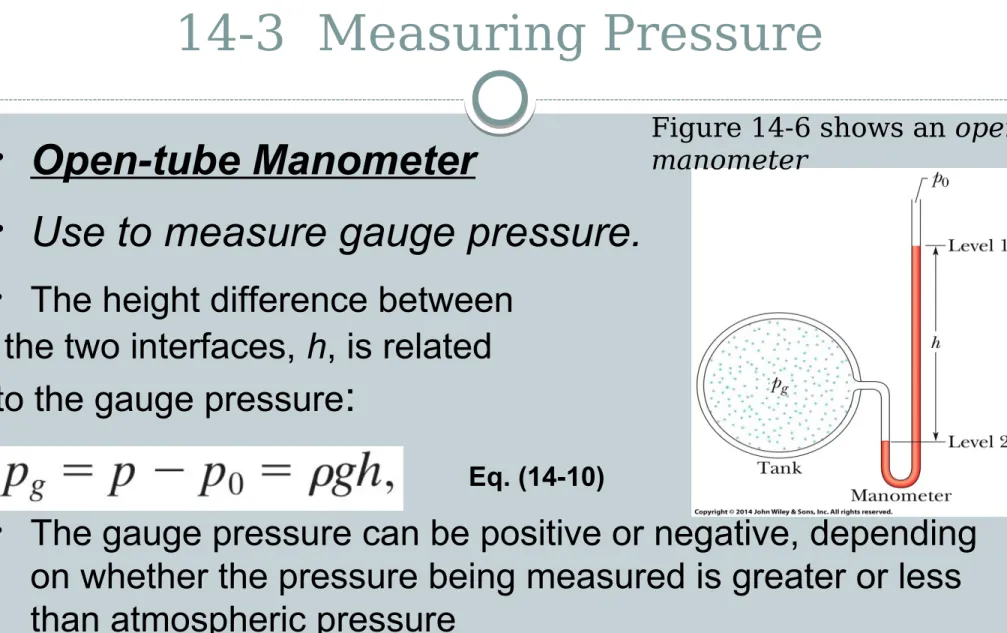
Open-tube Manometer
Use to measure gauge pressure.
The height difference between
the two interfaces, h, is related to the gauge pressure
:
The gauge pressure can be positive or negative, depending
on whether the pressure being measured is greater or less than atmospheric pressure
Figure 14-6 shows an open-tube manometer
14-4 Pascal's Principle
Pascal's principle governs the transmission of pressure through
an incompressible fluid
:
Consider a cylinder of fluid (Figure 14-7)
The atmosphere, container, and shots exert
pressure pext, on the piston and thus on the liquid. the p at any point in the liquid:
p = pext + ρgh
increasing p
ext by adding more shots will increase p at any
14-4 Pascal's Principle
Describes the basis for a hydraulic lever
Input and output forces related by:
The distances of movement are related by:
Eq. (14-13)
Eq. (14-14)
14-4 Pascal's Principle
So the work done on the input piston equals the work
output
The advantage of the hydraulic lever is that:
Problem 24, page 51
(a) According to Pascal’s principle,
F/A = f/a F = (A/a)f.
(b) We obtain
Solution:
F = A
a f =
p(30)2
14-5 Archimedes’ Principle
The buoyant force is the net upward force on a
submerged object by the fluid in which it is submerged
This force opposes the weight of the object , It comes from
the increase in pressure with depth
Figure 14-10
14-5 Archimedes’ Principle
• Archimedes' Principle states that:
The buoyant force has magnitude
Where m
f is the mass of displaced fluid
• Then, we can write Archimedes’ principle as:
Eq. (14-16)
s' Principle
A block of wood in static equilibrium is floating:
This is expressed:
Because of Eq. 14-16 we know:
Which means:
Eq. (14-18) Eq. (14-17)
A block of density ρ= 800 kg/m3 floats face down
in a fluid of density ρf= 1200 kg/m3 . The block
has height H=6.0 cm.
(a) by what depth h is the block submerged? Solution:
Fb= mf g = ρf Vf g = ρf L W h g Fg= m g = ρ V g = ρ L W H g
from floating equation: Fb = Fg
ρf L W h g = ρ L W H g ρf h = ρ H
h = ρ H / ρf h = (800) (6.0) / (1200) = 4 cm
• We discuss motion of an ideal fluid
1. Steady flow: the velocity of the moving fluid at any fixed point does not change with time
2. Incompressible flow: The ideal fluid density has a constant, uniform value.
3. Nonviscous flow: Viscosity is, roughly, resistance to flow, fluid analog of friction. No resistive force here.
4. Irrotational flow: May flow in a circle, but a dust grain suspended in the fluid will not rotate about com
14-6
The Equation of Continuity
The flow speed (v) increases when we decrease the
cross-sectional area (A) through which the fluid flows.
We write the equation of continuity:
A v = constant
The bigger the area, the slower the fluid speed.
Figure 14-15
Eq. (14-23)
14-7 Bernoulli’s Equation
Applying the conservation of energy to the
equal volumes of input and output fluid:
The ½ρv2 term is called the fluid's kinetic
energy density
• Equivalent to Eq. 14-28, we can write:
• Applying this for flow through a horizontal
pipe
Eq. (14-28)
Figure 14-19
Eq. (14-29)