SBI-3U
Independent Study Unit (Digestion)
The digestion unit will be taught as a student-directed independent unit. Each student will be responsible for his/her progress and completion of all components. The teacher is available for questions. All material covered will be expected to be understood and will be fair test/exam questions.
The digestive organ system will be examined at the following levels 1) Molecular level of organization
2) Organ level of organization 3) Physical and Chemical Processes
There will also be a research component to this unit and 2 labs.
Time Budget
COMPONENT
Formal Evaluation
EstimatedTime
Actual Time
Completed
Molecular Level of Organization
Questions One page
summary
No YES
Organ Level of Organization
Group diagram Diagram (colouring) Questions Summary No No No YES
Physical & Chemical Processes
Questions
Diagram Summary
No YES Diet Project(Research) YES
Digestion Self Quiz No
Lab-Effect of Amylase on Starch
Hand in Questions, Data Table and Conclusion only
YES
Lab-Investigating the action of a digestive Enzyme
FULL LAB REPORT
Molecular Level of Organization
Macronutrients
1) What are the macronutrients the body requires?
2) Explain which has more energy lipids or carbohydrates?
3) What does it mean if a protein is denatured and how would it affect its’ functioning
4) What happens when there is an amino acid deficiency?
Micronutrients
5) Explain what a micronutrient is and provide an example. 6) What are vitamins and explain their role(s) in the body?
7) Explain the difference between fat- soluble and water-soluble vitamins? 8) a)A person is taking large doses of vitamins in the belief it will keep them
healthy. Explain what would happen to the water soluble vitamins and fat souble vitamins they take in.
b) Furthermore explain if this could have any negative effects on their health
9) What are minerals and what is their role in the body?
Enzymes
10) Explain what an enzyme is and their function in your own words. Provide an example with your answer
11) a)What are two factors that affect enzyme function?
b) What temperature would you expect enzymes to be most efficient in humans? Why?
c) Use a sketch graph to show what happens to enzyme efficiency outside of its optimal conditions
12) Show how water is used by hydrolytic enzymes to break the bond of one
of the following
a) Carbohydrate b) Protein c) Fat
YOU ARE REQUIRED TO PRODUCE A ONE PAGE SUMMARY FOR THIS SECTION TO BE HANDED IN FOR EVALUATION.
It may be a concept map, table, brief point form notes or a combination. It must show the main ideas
Organ Level of Organization
Take a piece of large paper and have the smallest person in your group lie on it on the floor. Trace the outline of their head, torso and to just below the groin with a pencil. When completed have the person move off the paper . Go over the pencil lines in wide black marker.
Use your textbook and other resources to draw and label the following on your diagram. 1. Digestive Organs and structures
2. Function of each organ/structure
3. Include enlargements of particular sections if they seem necessary All the information should be clear and neatly written.
The following questions are to help guide you
Questions
1. What are the 4 components of digestion and what happens in each component? 2. What happens to food in the mouth?
3. What is the other of tube that runs parallel to the esophagus?
4. How do we prevent food from entering this tube and how does the esophagus operate?
5. What is the form of the food when it reaches the stomach? 6. Describe what the stomach looks like?
7. What controls movement of food into and out of the stomach and how does it do this?
8. How is gastric juice flow initiated?
9. After how long and in what form does the food leave the stomach? 10. Describe the small intestine and its purpose.
11. How does peristalsis and digestive juice function in the small intestine?
12. Explain what villi and microvilli are and why they are vital to the absorption of food.
13. What are the functions of the large intestine?
14. Where does our waste get stored and where is it excreted?
15. The liver, gallbladder and pancreas are often referred to as accessory organs in the digestive system. Explain what this means and what their functions are?
YOU ARE REQUIRED TO PRODUCE A ONE PAGE SUMMARY FOR THIS SECTION TO BE HANDED IN FOR EVALUATION.
It may be a table, or graphic organizer, such as, a flow chart, schematic diagram etc. Needs to include:
all important organs/structures and functions, 4 stages of digestion
PHYSICAL AND CHEMICAL PROCESSES
Questions
1. In your own words define physical digestion and state where it takes place.
2. In your own words define chemical digestion and state where it takes place.
3. Peristalsis is a key physical process what is it, why is it important and where does it occur?
4. Where do you find pancreatic juice, how is it stimulated and what does it do?
5. What is bile's main purpose and where is it stored?
Diagram
Draw your own diagram, as much to scale as possible, of the entire tube-like digestive tract of humans. Be sure to include all organs and glands responsible for all functions of digestion. Your diagrams must also include clear labels and the following key must be attached and be associated with your diagram.
A, A - two places where amylase is made B, B - two places where amylase works
C - where maltase, lactase and sucrase work D1 - where bile is made
D2 - where bile is stored
D3 - where bile works
E1 - indicate where gastrin is released
E2 - indicate 3 substances released in the stomach due to gastrin
F1 - where secretin is produced
F2 - where secretin acts, what it does and why it is necessary
G1 - where trypsin and chymotrypsin originate
G2 - where trypsin and chymotrypsin work
H,H,H,H- four places where peristalsis occurs I - where chyme is formed
J - where villi are located in greatest numbers K - where most water is reabsorbed from chyme L - controls passage of fecal material
M - where vitamins B and K are made
On your diagrams, use arrows to indicate the direction of flow of food and digestive juices, use a different colour pencil crayon for each one.
DIET PROJECT
Research a current diet or trend for weight loss.
Evaluate this diet using the Canada Food Guide (http://hc-sc.gc.ca/fn-an/food-guide-aliment/order-commander/index-eng.php#1)
This should be no more than one page and include the following
Name of diet
Overall philosophy of the diet
Promises of the diet
Scientific background of diet working
Does this diet allow you to meet the requirements of the Canada Food Guide
Yes if so detail on how
No, details on what is lacking
Potential problems of the diet
Scientific criticisms of diet
Your overall opinion of the diet and it’s effectiveness
Annotated BibliographyCriteria for evaluation- see Rubric for Research Projects
Digestion Knowledge Self Quiz /24
1. Enzyme found in saliva
2. Organic molecules needed in trace amounts for normal growth and metabolic processes. 3. Enzymes are which type of macromolecule.
4. Chewing, swallowing and dissolving are all types of ______ digestion 5. Involuntary, rhythmic wavelike contractions of smooth muscle. 6. Mineral needed for the production of hemoglobin which carries O2
7. One of the 2 vitamins synthesized in the large intestine.
8. An enzyme that breaks down carbohydrates in the small intestine 9. A protein enzyme found in the stomach.
10. Stomach hormone that triggers HCl and mucus production 11. Storage location of bile
12. Small fingerlike projections that extend into the small intestine. 13. Hormone sent to the pancreas to trigger HCO3- ions and enzymes.
14. The name of the middle part of the small intestine 15. The tube that runs parallel to the esophagus 16. Polysaccharide that cows can digest that we can’t. 17. The approximate pH of the stomach.
18. Name for semi-digested soupy liquid food as it leaves the stomach 19. Temperature and pH that amylase works best at.
20. Biological catalyst
The Effect of Amylase on Starch
Purpose: To determine the effect of the salivary enzyme, amylase on starch molecules. Procedure:
1.) Label four test tubes 1a, 2a, 3a, 4a. 2.) Add 10.0 mL of water to test tube # 1a.
3.) Add 10.0 mL of starch solution to test tubes # 2a, 3a and 4a. 4.) Add 2-3 drops of hydrocholoric acid to test tube # 4a. 5.) Add 2.0 mL of saliva solution to test tubes # 1a, 3a, and 4a. 6.) Place all the test tubes into a 37oC water bath for ten minutes.
7.) After the ten minute incubation period, pour half the contents of the 'a' tubes into a second set of tube called 1b, 2b, 3b and 4b.
8.) Test the 'a' tubes for the presence of starch using iodine solution (2-3 drops). (The color blue-black indicates the presence of starch.)
9) Test all the 'b' tubes for the presence of sugar using the Benedict's reagent test (Add 4-5 drops). Heat in a boiling bath for 3-5 minutes. (An orange color indicates the presence of sugars.) Record the results in the table below. Observations:
Test Tube Contents Iodine Test Benedict's Test
Discussion:
1.) Is there any starch or sugar in saliva? How do you know?
2.) Is there any sugar in the starch solution? How do you know?
3.) Is there any sugar in the # 3 mixture? Is there any starch in this mixture?
4.) Did the amylase catalysed reaction occur in mixture # 4? Explain fully.
5.) Write the word equation for the reaction involved in this experiment
INVESTIGATING THE ACTION OF A
DIGESTIVE ENZYME
INTRODUCTION:
When organisms take food into their bodies, it must be broken down into smaller molecules before it can be used to meet the energy and growth needs of the organisms. The breakdown process is called digestion. There are a number of enzymes in living things whose purpose is to break down food molecules. They are manufactured in such places as the salivary glands, stomach, pancreas, and intestine. In this investigation, you will study pepsin, an enzyme manufactured in the stomach lining and responsible for protein breakdown (digestion) in the stomach.
The protein you will use is cooked egg white. Egg white is made up almost entirely of the protein albumin. When cooked, it is a soft white material that can easily be cut into pieces. When mixed with pepsin, the results of the protein's digestion can be easily observed in a test tube.
You are going to investigate the effects of temperature and pH on the action of pepsin. You will test the enzyme's action at three temperatures and at three pH levels. Before starting the experiment, you should develop a hypothesis. Your hypothesis should be a statement in which you predict (based on prior experience and evidence) the conditions for the optimum (best and most efficient) action of pepsin.
First, let us consider temperature. You will test the effectiveness of the enzyme at three temperatures - 4oC (refrigerator temperature), 21oC (room temperature), and 37oC (human
body temperature). Based on what you already know about the place where the enzyme is produced and used, what temperature do you predict will b e the optimum temperature for the action of pepsin?
You will also test the effectiveness of the enzyme at three pH levels - acidic, basic, and neutral. You will not be adjusting your solutions to exact pH levels, but will use acidic (Hydrochloric Acid) and basic (Sodium Bicarbonate) solutions already prepared for you. Based on what you already know about the place where the enzyme is produced and used, what pH level do you predict will be the optimum pH level for the action of pepsin? Now that you have made the two predictions, state your hypothesis.
PROCEDURE:
1. Bring a cooked egg from home (one per group).
2. Cut the egg white into cubes approximately 5 mm on a side. You will need 36 cubes. The exact size is not critical but the sharpness of the edges is important. 3. Obtain 12 test tubes and, with the wax pencil, number them 1 to 12. Also put
your group letter on EACH test tube.
4. Place 3 cubes of egg white into each of the 12 test tubes.
Table 1: Amounts of reagents to be added to test tubes
TUBE NUMBER
DISTILLED
WATER PEPSIN
HYDROCHLORIC ACID
SODIUM BICARBONATE
1 yyyyy 3 ml 3ml Yyyyy
2 3 ml 3 ml Yyyyyy Yyyyy
3 yyyyyy 3 mL Yyyyyy 3 mL
4 6 mL yyyyyy Yyyyy Yyyyyy
5 yyyyy 3 mL 3 mL Yyyyyy
6 3 mL 3 mL Yyyyy Yyyyyy
7 yyyyyy 3 mL Yyyyyy 3 mL
8 6 mL yyyyyyy Yyyyyy Yyyyy
9 yyyyyyyy 3 mL 3 mL Yyyyyy
10 3 mL 3 mL Yyyy Yyyyyy
11 yyyyyy 3 mL Yyyyyy 3 mL
12 6 mL yyyyyyyy Yyyyyy Yyyyyy
6. Put test tubes 1 - 4 into the test tube rack labeled 4oC. These will be placed in
the refrigerator.
7. Put test tubes 5 - 8 into the test tube rack labeled 21oC. These will be left at
room temperature.
8. Put test tubes 9 - 12 into the test tube rack labeled 37oC. These will be placed
in the incubator.
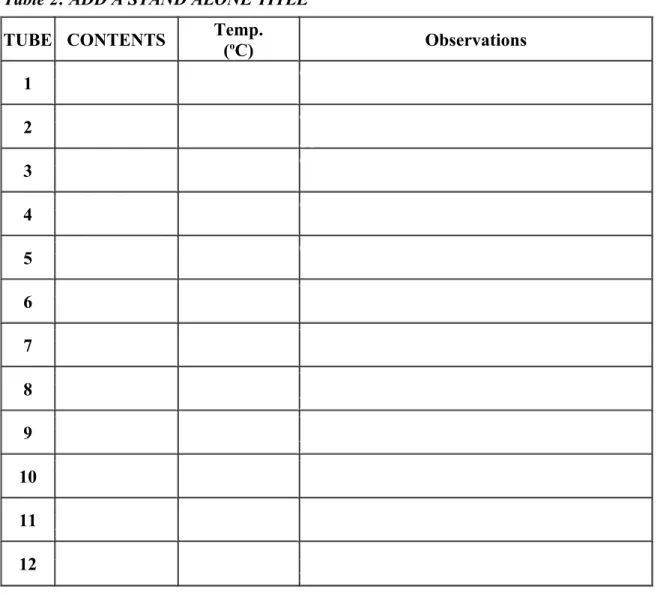
Table 2: ADD A STAND ALONE TITLE
TUBE CONTENTS Temp.
(oC) Observations
1 Rr Gggg
2 Rrr Gggggg
3 Rrrr Ggggg
4 Rrrr Gggg
5 Rrrr Ggggg
6 Rrrr Yyyy
7 Rrrr Yyyy
8 Rrrrr Yyyyy
9 Rrrr Yyyyy
10 Rrrr Yyyy
11 Rrrrrrr Rrrr
12 Rrrrr Rrrrr
Submit a formal lab report>
Questions
1.In which tube(s) was the most protein digested? How do you know? 2.In which tube(s) was the least protein digested? How do you know? 3. Was your hypothesis supported by the experimental data? Explain.
4. From this experiment, what general statement can you make regarding the effect of temperature and pH on the action of pepsin on egg white protein? 5. From this experiment, what general statement can you make regarding the