CSEC Mathematics
Section 8 – Geometry and Trigonometry
Geometry is a branch of Mathematics that
deals with points, lines, surfaces and solids. It examines their properties, measurement and mutual relations in space.
Basic Geometric Concepts
Exercise
Use each of the following word/phrase only once to write on the line provided to make the statement true.
1. A ________ is a location in space or on a surface that occupies no space. A point is so tiny that it is said to have position but no magnitude. Points are often described by their co-ordinates as in Graphical work.
2. A _______ extends indefinitely, it has a thickness of zero, and a volume of zero.
3. A ____________ is a portion of a line between two given points, it has a thickness of zero and a volume of zero. A line segment has finite length e.g. AB.
Straight line Curved line
4. A _________ is a straight line extending indefinitely in one direction from a fixed point called the origin. It has a thickness of zero, and a volume of zero.
6. __________ are lines that meet (or cross, or intersect) at right angles (i.e. 900).
7. A ________ is a closed plane figure
bounded by three or more sides. Each side is a line segment.
8. A geometric ________ can be defined as the part of space bounded by sides. It is a three-dimensional figure. It occupies some volume in it. Thus, it has a length, width and a height.
Angles
When two straight lines meet at a point they form an angle. The point where the two lines (or sides or arms) meet is called a
vertex. An angle is a measure of the space
or ‘opening’ between the two straight lines (or sides or arms) that extend from the common point (or vertex). A protractor is used to measure the size of an angle.
An angle ‘A’ can be represented by the symbol  or ÐA where the symbols ˆ and Ð
both mean ‘angle’.
The magnitude of an angle is not proportional to the lengths of the sides or arms forming the angle. That is, the greater the magnitude of the angle does not does not mean the longer the lengths of the sides or arms forming the angle. And vice versa.
Types of Angles
An acute angle has a measure between 00
A right angle has a measure of 90˚.
An obtuse angle measures between 90˚ and
180˚.
A straight angle measures 1800.
A reflex angle measures between 180˚ and
Complementary angles are two angles that have a sum of 90˚. Each angle is said to be the complement of the other. For example, 500 and 400; 270 and 630.
Supplementary angles are two angles that
have a sum of 180˚. Each angle is said to be the supplement of the other. For example, 100˚ and 80˚; 75˚ and 105˚.
Vertically opposite angles are equal. In the
diagram below angle e = angle m and
= .
500
400 27
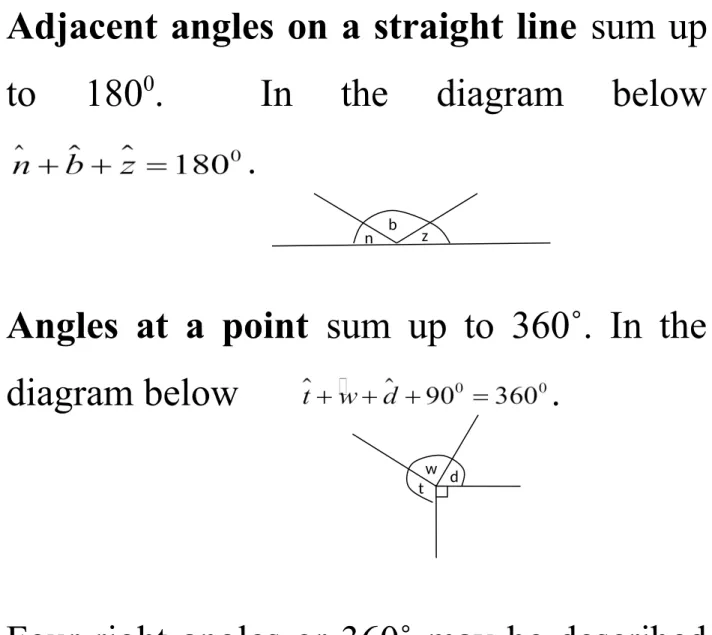
Adjacent angles on a straight line sum up to 1800. In the diagram below
.
Angles at a point sum up to 360˚. In the
diagram below .
Four right angles or 360˚ may be described as a complete revolution or a complete
turn.
Three o’clock (3 o’clock) can be associated with one right angle (90˚), which would be a quarter of a revolution.
n b z
Parallel Lines and Transversal
Corresponding Angles
When a transversal cuts two parallel lines then the corresponding angles formed are equal. Corresponding angles are angles that are in corresponding positions.
Corresponding angles are also referred to as F angles. Thus, the corresponding angles are: a and e – bottom left positions, b and f – top left positions, c and g – top right positions, d and h – bottom right
positions.
Transversal a
Hence, a = e, b = f, c = g and d = h.
Alternate Angles
Alternate angles formed are always equal. These angles are a pair of angles enclosed by a Z shape. Thus, a = g and d = f.
Co-interior Angles
The interior angles formed on the same side of the transversal are supplementary angles. They sum up to 1800. Co-interior angles are
referred to as C angles. Thus, a + f = 1800
The Triangle
A triangle is a three sided plane shape (or figure) bounded by three straight lines. Two triangles are said to be congruent if they are the same. That is, they have all
corresponding sides equal in length and the corresponding angles are all equal in size. An isosceles triangle has two sides equal in length and two angles equal in size.
An equilateral triangle is a triangle with all sides equal in length and all interior angles equal in size.
b b
m
If any side of a triangle is produced, (i.e. extended) then the exterior angle formed is equal to the sum of the two interior opposite angles.
Exterior Angle = The sum of the two
Interior Opposite Angles. That is, c = a + b
The sum of the interior angles of any triangle is 1800. In the diagram above
a + b + e = 1800. Exercise
Answer the following.
Interior Opposite Angles
Int. Adj. Angle
Ext. Angle
a b
2. JANUARY 2012 – QUESTION 5a
3. Find the size of the angle marked by a letter. Give reason for your answer.
i. ii.
1150
1350
b a
c b
a 450
iii. iv.
Construction
An angle, line or polygon (triangle or
quadrilateral) is constructed by using a ruler, pencil and a compass only.
An angle is drawn using a protractor.
Exercise
1. Use your protractor to draw the following angles.
a. 350 b. 1270 c. 2480
d. 3000
m 1150
f
r p
Bisecting a Line Segment
A line segment is bisected by constructing its perpendicular bisector. The perpendicular bisector of a line segment intersect it at right angles and divides the line segment into two halves.
Exercise
1. Bisect the following line segments.
a. PQ = 8 cm b. JT = 7 cm c. LM = 5.6 cm d. FG = 6.4 cm
Note: Constructing the perpendicular bisector is one way of constructing a 900
Constructing An Angle of 600
Draw a line segment AB. Place the metal point of the compass at the point for A or B. Draw an arc through the line AB to intersect at the point X. Place the metal point of the compass at X without changing the distance between the pencil point and the compass. Draw a second arc to intersect the first arc at C.
Draw a straight line from the point A passing through the point C.
A X B
C
Note: To construct an angle of 1200, we
construct an angle of 600. Adjacent angles
on a straight line add up to 1800. Hence,
1800 – 600 = 1200.
Constructing An Angle of 300
Using C and X as centres, bisect angle BAC = 600.
Place the metal point at C then X and draw two arcs to intersect each other at D.
Then BAD = 300.
A
D
X B
C
Constructing An Angle of 900
Draw a line segment PQ. Open your compass to a suitable separation.
Use P as centre, draw an arc to intersect PQ at X and Y.
Open the compass to more than half the distance of XY. Use X and Y as centres,
draw two arcs to intersect above the line PQ at C.
Draw a straight line passing through the points P and C.
X P Q
C
Note: To construct 450, we bisect angle
CPY
Exercise
1. JANUARY 2016 – QUESTION 3b
2. MAY 2015 – QUESTION 3b
4. JANUARY 2014 – QUESTION 5a
5. MAY 2012 – QUESTION 5a
7. MAY 2011 – QUESTION 3b
Exercise
Use each of the following word/phrase only once to write on the line provided to make the statement true.
segment, radius, chord, tangent, arc, sector, centre, circle, diameter,
circumference, base
1. The _________ is a plane curve having its points equidistant from a fixed point within or outside of the circle. It is plane figure bounded by a single curved line.
3. The _________ of a circle is a straight line segment with one end point at the centre of the circle and the other end point on the circumference of the circle. All radii of the same circle are equal.
4. The __________of a circle is any straight line segment that passes through the centre of the circle and joins two points on the circumference. The diameter of the circle is twice the radius of the same circle.
5. A __________ of a circle is a straight line segment joining any two points on the circumference. The diameter is a chord.
7. A _________ of a circle is a plane figure bounded by a chord and an arc. If a chord forms a diameter, then the circle is divided into two equal segments and each is called a semi-circle.
8. A _________ of a circle is a plane figure bounded by two radii and an arc.
9. The ________ of the a circle is the point at the middle of the circle.
10. The ________ is a line that touches a point on the circumference of the circle.
parts of a circle things you should learn about circle theore ms theorem 1: angle at
the centre theore m 2: angle in a semi-circle theore m 3: angles in the same segme nt theorem 4: cyclic quadrilater al theore m 5: tangent theore m 6: alternat e segmen t theore m theore m 7: two
tangen
TX2 = AB . BX
T X
TX is the tangent AX is the secant
Exercise
1. JANUARY 2016 – QUESTION 10b
2y 2y
An angle formed at the centre of a circle is twice the angle formed at the
Answers: i. 900
ii. COD = 1800 – 720 = 1080 ; ACD
= (1800 – 1080) ÷2= 360.
Or OAD = (1800 – 720) ÷ 2 =
540 and ACD = 900 – 540 = 360
iv. OEA = 180
2. JANUARY 2015 – QUESTION 10b
Answers: i. OJH = 900
ii. JOG = 3600 – (900 + 900 + 480) =
1320
iv. JLG = 1800 – 660 = 1140 (opposite
angles in a cyclic quadrilateral, KJLG sum up to
1800).
3. MAY 2014 – QUESTION 10a
Answer: i. BOE = 1800 – (200 + 200) =
1400 (isosceles triangle)
ii. OED = 420 – 200 = 220. Alternate
iii. Opposite angles in a cyclic
quadrilateral sum up to 1800. BFE = 1800
– 700 = 1100.
4. JANUARY 2014 – QUESTION 10a
ii. SKF = 1800 – 540 = 1260 (Opposite
angles in a cyclic quadrilateral sum up to
1800.
iii. ASW = 1800 – (540 + 620) = 640.
Cointerior angles sum up to 1800, ASK +
SAF = 1800
5. MAY 2013 – QUESTION 10a
6. JANUARY 2013 QUESTION 10a
Trigonometry
Trigonometry is a branch of Mathematics concerned with the measurement of
triangle, to calculate unknown angles or lengths.
The acronym for the trigonometric ratios is: SOH CAH TOA.
Sine Cosine Tangent
Sin θ = cos (900 – θ) for θ 900.
Tan θ =
B
A C
c b
a Hypotenuse (hyp) BC is the opposite (opp) side to angle A
BC is the adjacent (adj) side to angle B
Exercise
1. Use your calculator to find (make sure your calculator is in degrees):
a. i) sin 00 ii) sin 300 iii) sin 450 iv)
sin 600 v) sin 900 vi) sin 1800 vi) sin
3000 B A C c b
a Hypotenuse (hyp)
Sin = = and = Sin – 1
Cos = = and = Cos – 1
Tan = = and = Tan – 1
Sin = = and = Sin – 1
Cos = = and = Cos – 1
Tan = = and = Tan – 1 B
A C
c b
b. i) cos 900 ii) sin 600 iii) cos 450 iv)
sin 300 v) cos 00 vi) cos 2700 vi) cos
3600
c. i) tan 00 ii) tan 300 iii) tan 450
iv) tan 600 v) tan 900 vi) tan 1800
vi) tan 3000
2. Use your calculator to find (make sure your calculator is in degrees):
a. i) sin – 1 0 ii) sin – 1 0.5 iii) sin – 1
0.7071 iv) sin – 1 0.8660 v) sin – 1 1
b. i) cos – 1 0 ii) cos – 1 0.5 iii) cos – 1
0.7071 iv) cos – 1 0.8660 v) cos – 1 1
c. i) tan – 1 0 ii) tan – 1 0.5 iii) tan – 1
3. Given the sides of a right angled triangle are PQ = 4, QR = 3 and = 900 find:
a. sin P b. cos P c. tan P d. sin R e. cos R f. tan R
g. h.
4. Find the length of the side marked by a letter, giving your answer to one decimal place.
a. b. c.
Ans: y = 20.0 m Ans: w = 23.7 cm Ans: p = 12.4 cm
d. e.
Ans: h = 11.5 cm Ans: k = 89.1 cm
P R Q 25 cm 370 y B A C 16 cm 560 w L N M 20 cm
600
h
X
Z Y 12 cm
5. Find the size of the angle marked θ (theta – a Greek letter):
a. b. c.
Ans: 48.60 Ans: 56.30 Ans: 60.40
d. e.
Ans: 27.80 Ans: 61.50
Sine Rule (Page 950, Vol. 2 – R. Toolsie)
The sine rule can be used to find unknown sides or angles in a triangle which does not have a right-angle.
B A
C
20 cm 15 cm
θ R S
T
18 10
θ D E
F 37 21 θ D E F
7 m 15 m
θ D E
F 35
The sine rule can be applied where we are given:
1. Two angles and the length of one side of a triangle
2. The lengths of two sides of a triangle and an angle not formed by the two sides.
The sine rule states that the ratio of the
length of a side of a triangle to the sine of its opposite angle is a constant. Thus, ,
and , where D is the
diameter of the circumscribing circle of the triangle. diameter A C B B
The sine rule is .
Note: In any triangle which is not a right
angle triangle, the largest side is opposite the largest angle of the triangle. The smallest side of the triangle is opposite the smallest angle of the triangle.
Exercise
1. In the triangle PQR, = 25.70, =
93.50 and q = 12.3 cm. Find:
a. side p Ans: p = 5.34 cm
b. the diameter of the circumscribing circle of the triangle. Ans: D = 12.3 cm
2. In the triangle ABC, sin A = 0.3, sin B = 0.7 and b = 20 cm. Find a.
A
B C
b c
Ans: a = 8.57 cm
3. Given the triangle XYZ, x = 18 cm, sin X = 0.6 and y = 8 cm. Find sin Y.
Ans: sin Y = 0.27
4. Given the triangle LMN, , and l = 11.5 cm. Find m.
Ans: m = 6.8 cm
5. In the triangle RST, r = 9 m, t = 12 m and . Find:
a. Ans: 9.340
b. the diameter of the circumscribing circle of the triangle.
6. Find the length of AC in the diagram below.
7. Find the size of .
B C
A 515 m
600 380
Cosine Rule
The cosine rule can be used to find unknown sides or angles in a triangle which does not have a right angle.
The cosine rule can be applied when we are given:
1. Two sides and the angle between the two sides of the triangle.
2. The length of three sides of a triangle.
The cosine rule is as follows:
a2 = b2 + c2 – 2bc Cos A or
b2 = a2 + c2 – 2ac Cos B or
c2 = a2 + b2 – 2ab Cos C Exercise
1. In a triangle ABC, a = 12.8 cm, c = 15.3 cm and = 39.50. Find the length of side
b.
Ans: b = 9.78 cm
2. Given the triangle PQR, where p = 5.4 m, q = 9.7 m and r = 12.5 m, find angle Q.
Ans: angle Q = 47.40
3. In a triangle RST, r = 8 cm, s = 12 cm and = 300. Find the length of side t.
Ans: t = 6.46 cm
4. If d = 3 mm, e = 4 mm and f = 5 mm in triangle DEF, determine the magnitude of angle E. Ans: angle E = 53.130
5. Calculate the length of PR correct to two decimal places, in the diagram below.
R
Ans: PR = 26.14 cm
6.
7.
Angles of Elevation and Depression (Page 592, Vol. 1 – R. Toolsie)
B A C 35.1 cm 19.4 cm 25.8 cm
Determine the magnitude of angle BAC correct to one decimal place.
a. Calculate the length of PR
b. Determine the magnitude of angle PRQ correct to one decimal place.
Q P R 15.2 cm 9.7 cm 300
Horizontal line of sight Angle of elevation Inclined line of sight
elevation
Horizontal line of sight Angle of depression
Note: The angle of elevation ( ) = The angle of depression ( ). This is so, since both angles are alternate angles which are equal.
Exercise
1. The angle of elevation of the top of a vertical tree from a man standing on a level ground 25 m away from the base of the tree is 38.50. Calculate the height of the tree
correct to the nearest metre. Ans: h = 20 m
2. A girl 1 m tall stands on top of a vertical building 45 m high, sees a car on the ground at an angle of depression of 550. What is the
distance of the car from the base of the building? Ans: d = 32.2 m
cliff is 90 m above sea level. Calculate his distance from the base of the cliff to one decimal place. Ans: d = 423.4 m
4. A man is standing on top of a cliff 90 m high, sees a building at an angle of
depression of 350. How far is the building
from the base of the cliff? Ans: d = 128.53 m
6. MAY 2014 – Question 5b
7. MAY 2013 – Question 10b
8. A vertical tower BC is situated on a level ground AC. Given that AB = 15 m and the angle of elevation is BAC = 440, calculate,
Ans: BC = 10.42m
b. distance of A from the base of the tower, AC. Ans: AC = 10.79 m
9. A man 1.5 m in height stands on top of a vertical building 42 m high, sees a truck
some distance away, at an angle of
depression of 53.50. What is the distance of
the truck from the base of the building.
10. A sailor 100 m above see level at a coastal lookout point, sights a boat at an angle of depression of 270. Calculate the
horizontal distance of the boat from the sailor.
cliff is 90 m above sea level. Calculate his distance from the base of the cliff to one decimal place.
12. A man is standing on top of a cliff 90 m high, sees a building at an angle of
depression of 350. How far is the building
from the base of the cliff?
8. A vertical tower BC is situated on a level ground AC. Given that AB = 15 m and the angle of elevation is BAC = 440, calculate,
correct to one decimal place, the: a. height of the tower BC;
9. A man 1.5 m in height stands on top of a vertical building 42 m high, sees a truck
some distance away, at an angle of
depression of 53.50. What is the distance of
the truck from the base of the building.
10. A sailor 100 m above see level at a coastal lookout point, sights a boat at an angle of depression of 270. Calculate the
horizontal distance of the boat from the sailor.
Bearings (Page 596, Vol. 1 – R. Toolsie)
The four cardinal directions are north, south, east and west. The position of an object
relative to another object is called its bearing. The bearing of an object is the angle measured in a clockwise direction
3600
North 0000
0900 East
West 2700
0450
from north to the object. Bearings are always written using three digits. Thus,
North is 0000, East is 0900, South is 1800 and
West is 2700.
Exercise
1. Draw a diagram to represent each of the following.
a. The bearing of B from a point A is 0650.
b. The bearing of P from a point Q is 1500.
d. The bearing of R from a point S is 3200.
2.a) The bearing of a point A from a point B is 0750. State the bearing of B from A. Give
reason(s) for your answer.
b) The bearing of a point Q from a point P is 3250. What is the bearing of P from Q.
Give reason(s) for your answer.
3. Find the distance travelled north and the distance travelled east by a plane flying on a bearing of 0480 for 80 km.
8. Calculate the distance travelled south and the distance travelled east by a ship sailing on a bearing of 1500 for 90 km.
9. Determine the distance travelled north and the distance travelled west by a boat on a bearing of 3100 for 75 km.
10. The diagram below not drawn to scale, shows a triangle ABC which represents the cross section of a roof. BD is the
perpendicular to ADC. Calculate the:
150
12.6 cm 8.4 cm A
D C
B a. length of BD
b. measure of angle CBD
c. area of triangle ABC
11. A ship leaves port A and travels on a bearing of 090° for 110 km to port B. The ship then changed course and traveled to port C on a bearing of 180° for 95 km. a. Make a sketch of the path of the ship, showing:
i. The points A, B and C
ii. The distances 110 km and 95 km. Any north lines and right angles
b. Determine:
i. The distance of port A to port C ii. The bearing of port C from port A
Transformation
Properties of Rotation
1. The size and shape of the object is unchanged.
2. The order of the points in a shape is unchanged.
A translation is a movement of a point, line or shape along a straight line. Any
translation can be on a Cartesian plane can be written as a column vector , where x represents a movement parallel to the x-axis and y represents a movement parallel to the y-axis. Movements to the right and upwards are positive. Movements to the left and
downwards are negative. For example, the translation vector means a movement of 3 units to the right followed by a movement of 5 units downward.
The sum of the object point and the
1. The size of the object, the shape of the object and the orientation of the object remains unchanged.
2. Each point moves through the same distance in the same direction.
Consider the diagram graph below:
Triangle A1B1C1 is a translation of triangle
ABC by the vector .
A reflection is a way of transforming a point, line or shape just as a plane mirror does at home. The result of reflecting an object in a mirror line or an axis of
reflection is called its mirror image.
Properties of reflection
2. The size and shape of the object is unchanged.
3. The orientation of the object changes, that is, the image is inverted.
Consider the diagram below.
Triangle U1B1G1 is the image of triangle
UBG, following a reflection of triangle UBG in the y-axis.
Triangle U11B11G11 is the image of triangle
Exercise
A rotation is a movement about a fixed point through an angle in a clockwise or
anti-clockwise direction. The fixed point is called the centre of rotation. Every point turns through the same angle about the same centre in the same direction.
Properties of Rotation
1. The size and shape of the object is unchanged.
2. The order of the points in a shape is unchanged.
Triangle A1B1C1 is the image of triangle
ABC, following a clockwise rotation of 900
about the centre of rotation (2, 0).
Exercise
1.
Enlargement or Reduction
An enlargement is a geometrical
transformation of the plane in which shapes are mapped onto similar shapes using a
centre of enlargement.
distances between the centre and the image to corresponding distances between the
centre and the object.
Thus, the scale factor, k = = = or the scale factor, k = = = .
The scale factor is positive if the image is on the same side of the centre of enlargement and the image has the same orientation as the object. A A1 B C B1 C1 Image Object O
The scale factor is negative if the image is on the other side of the centre of
enlargement and the image is inverted
(upside down) in comparison to the object.