Distributed Data,
Replication and
NoSQL
Administrivia
• Final Exam
– Monday, May 11, 11:30-2:30 – RSF Fieldhouse
– Cumulative, stress end-of-semester – 3 cribsheets
• Review Sessions
– At usual classtime, will be webcasted
– TAs and Prof H holding OH and sections next week
• TA Hours on Piazza
Outline
• Basics
– Traditional DB replication – Replica consistency – Where do updates happen? • Considerations from Massive Scale
– Performance requirements – NoSQL & Eventual Consistency • Programming with Inconsistent data
– Approaches – Expected costs – CALM • NoSQL today
Why Replicate Data?
•
Increase availability
–
Survive catastrophic failures
• Avoid correlation: different rack, different datacenter
–
Bypass transient failures
•
Reduce latency
–
Choose a “nearby” server
• Particularly for geo-distributed DBs–
Ask many servers and take the 1
stresponse
•
Load balancing
•
Other reasons
–
facilitate sharing, security, autonomy, system
management, etc.
A Definition: Replica Consistency
•
Replica Consistency
–
Typically linearizability of single writes
–
Illusion: all copies of data item X updated
atomically
–
Really: readers see values of X that they might
see in a single-node setting
•
Not to be confused with the C in ACID!
–
This has caused endless headaches
•
Not to be confused with serializablity
–
Actions only; not transactions. Single-object writes
–
You can layer serializability on top of linearizable
stores
Traditional DB Replication
Mechanisms
• Small number of big databases (say one per continent) – Replicated for failure recovery, mostly
• Data-shipping
– Interruptive at both ends
– Difficult to get transactional guarantees
• Even single-site transactions would require 2PC!
– Relatively easy interoperability across different systems • Log-shipping
– Cheap/free at the source node – Modest bandwidth: diffs
– Single-node transactional replication comes built-in
• in a snapshot sense at least
– Tricky to do across different systems
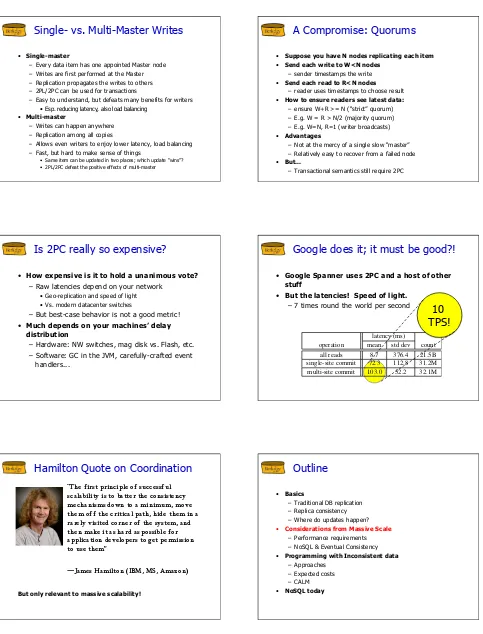
Single- vs. Multi-Master Writes
• Single-master
– Every data item has one appointed Master node – Writes are first performed at the Master – Replication propagates the writes to others – 2PL/2PC can be used for transactions
– Easy to understand, but defeats many benefits for writers
• Esp. reducing latency, also load balancing
• Multi-master
– Writes can happen anywhere – Replication among all copies
– Allows even writers to enjoy lower latency, load balancing – Fast, but hard to make sense of things
• Same item can be updated in two places; which update “wins”?
• 2PL/2PC defeat the positive effects of multi-master
A Compromise: Quorums
• Suppose you have N nodes replicating each item • Send each write to W<N nodes
– sender timestamps the write • Send each read to R<N nodes
– reader uses timestamps to choose result • How to ensure readers see latest data:
– ensure W+R >= N (“strict” quorum) – E.g. W = R > N/2 (majority quorum) – E.g. W=N, R=1 (writer broadcasts) • Advantages
– Not at the mercy of a single slow “master” – Relatively easy to recover from a failed node • But...
– Transactional semantics still require 2PC
Is 2PC really so expensive?
•
How expensive is it to hold a unanimous vote?
–
Raw latencies depend on your network
• Geo-replication and speed of light • Vs. modern datacenter switches–
But best-case behavior is not a good metric!
•
Much depends on your machines’ delay
distribution
–
Hardware: NW switches, mag disk vs. Flash, etc.
–
Software: GC in the JVM, carefully-crafted event
handlers...
Google does it; it must be good?!
•
Google Spanner uses 2PC and a host of other
stuff
•
But the latencies! Speed of light.
–
7 times round the world per second
latency (ms)
operation mean std dev count
all reads 8.7 376.4 21.5B
single-site commit 72.3 112.8 31.2M
[image:2.612.67.550.78.712.2]multi-site commit 103.0 52.2 32.1M
Table 6:
F1-perceived operation latencies measured over the course of 24 hours. [image:2.612.322.548.90.258.2]of such tables are extremely uncommon. The F1 team
has only seen such behavior when they do untuned bulk
data loads as transactions.
Table 6 presents Spanner operation latencies as
mea-sured from F1 servers. Replicas in the east-coast data
centers are given higher priority in choosing Paxos
lead-ers. The data in the table is measured from F1 servers
in those data centers. The large standard deviation in
write latencies is caused by a pretty fat tail due to lock
conflicts. The even larger standard deviation in read
la-tencies is partially due to the fact that Paxos leaders are
spread across two data centers, only one of which has
machines with SSDs. In addition, the measurement
in-cludes every read in the system from two datacenters:
the mean and standard deviation of the bytes read were
roughly 1.6KB and 119KB, respectively.
6 Related Work
Consistent replication across datacenters as a storage
service has been provided by Megastore [5] and
Dy-namoDB [3]. DyDy-namoDB presents a key-value interface,
and only replicates within a region. Spanner follows
Megastore in providing a semi-relational data model,
and even a similar schema language. Megastore does
not achieve high performance. It is layered on top of
Bigtable, which imposes high communication costs. It
also does not support long-lived leaders: multiple
cas may initiate writes. All writes from different
repli-cas necessarily conflict in the Paxos protocol, even if
they do not logically conflict: throughput collapses on
a Paxos group at several writes per second. Spanner
pro-vides higher performance, general-purpose transactions,
and external consistency.
Pavlo et al. [31] have compared the performance of
databases and MapReduce [12]. They point to several
other efforts that have been made to explore database
functionality layered on distributed key-value stores [1,
4, 7, 41] as evidence that the two worlds are converging.
We agree with the conclusion, but demonstrate that
in-tegrating multiple layers has its advantages: inin-tegrating
concurrency control with replication reduces the cost of
commit wait in Spanner, for example.
The notion of layering transactions on top of a
repli-cated store dates at least as far back as Gifford’s
disser-tation [16]. Scatter [17] is a recent DHT-based key-value
store that layers transactions on top of consistent
repli-cation. Spanner focuses on providing a higher-level
in-terface than Scatter does. Gray and Lamport [18]
de-scribe a non-blocking commit protocol based on Paxos.
Their protocol incurs more messaging costs than
two-phase commit, which would aggravate the cost of
com-mit over widely distributed groups. Walter [36] provides
a variant of snapshot isolation that works within, but not
across datacenters. In contrast, our read-only
transac-tions provide a more natural semantics, because we
sup-port external consistency over all operations.
There has been a spate of recent work on reducing
or eliminating locking overheads. Calvin [40]
elimi-nates concurrency control: it pre-assigns timestamps and
then executes the transactions in timestamp order.
H-Store [39] and Granola [11] each supported their own
classification of transaction types, some of which could
avoid locking. None of these systems provides external
consistency. Spanner addresses the contention issue by
providing support for snapshot isolation.
VoltDB [42] is a sharded in-memory database that
supports master-slave replication over the wide area for
disaster recovery, but not more general replication
con-figurations. It is an example of what has been called
NewSQL, which is a marketplace push to support
scal-able SQL [38]. A number of commercial databases
im-plement reads in the past, such as MarkLogic [26] and
Oracle’s Total Recall [30]. Lomet and Li [24] describe an
implementation strategy for such a temporal database.
Farsite derived bounds on clock uncertainty (much
looser than TrueTime’s) relative to a trusted clock
refer-ence [13]: server leases in Farsite were maintained in the
same way that Spanner maintains Paxos leases. Loosely
synchronized clocks have been used for
concurrency-control purposes in prior work [2, 23]. We have shown
that TrueTime lets one reason about global time across
sets of Paxos state machines.
7 Future Work
We have spent most of the last year working with the
F1 team to transition Google’s advertising backend from
MySQL to Spanner. We are actively improving its
mon-itoring and support tools, as well as tuning its
perfor-mance. In addition, we have been working on improving
the functionality and performance of our backup/restore
system. We are currently implementing the Spanner
schema language, automatic maintenance of secondary
indices, and automatic load-based resharding. Longer
term, there are a couple of features that we plan to
in-Published in the Proceedings of OSDI 2012
12
10
TPS!
Hamilton Quote on Coordination
“
The first principle of successful
scalability is to batter the consistency
mechanisms down to a minimum, move
them off the critical path, hide them in a
rarely visited corner of the system, and
then make it as hard as possible for
application developers to get permission
to use them”
—James Hamilton (IBM, MS, Amazon)
But only relevant to massive scalability!
Outline
• Basics
– Traditional DB replication – Replica consistency – Where do updates happen?
• Considerations from Massive Scale – Performance requirements – NoSQL & Eventual Consistency • Programming with Inconsistent data
Update-heavy Global-Scale Services
•
E.g. Amazon, Facebook, LinkedIn, Twitter
–
Shopping, Posting and Connecting
•
Latency and Availability both paramount
–
Favors multi-master solutions, or loose quora
–
Replica consistency becomes frustrating
• See Hamilton
•
Becomes quite natural to ditch Consistency!
–
The rise of NoSQL
NoSQL
• Born in Amazon Dynamo • Typical NoSQL approach
– Simple key/value data model. • put(key, val). get(key, val) – Replicated data (think 3+ replicas) – Multi-master: write anywhere, with timestamp – Update is acked by a single node
• No 2PC!
– Update “gossiped” lazily among the replicas in background
• A.k.a “anti-entropy”, “hinted handoff” and other fancy names
– Reads can consult 1 or more replicas
• Quorums can be used to achieve linearizability
NoSQL ambiguities
•
Atypical to bother with linearizability
•
Per-object ambiguities
–
You may not read the latest version
–
Writers can conflict
• Write the same key in different places • ‘Conflict Resolution’ or ‘Merge’ rules apply:
– E.g. Last/First writer wins • But what clock do you use? – E.g. Semantic merge (e.g. Increment)
•
Across objects
–
Typically no guarantees
–
No notion of “trans”-actional semantics
“Eventual Consistency”
“if no new updates are made to the object, eventually all
accesses will return the last updated value”
-- Werner Vogels, “Eventually Consistent”, CACM 2009
•
Which in practice means...??
Problems with E.C.
•
Two kinds of properties people discuss in
distributed systems:
1.
Safety: nothing bad ever happens
–
False! At any given time, the state of the DB may
be “bad”
2.
Liveness: a good thing eventually happens
–
Sort of! Only in a “quiescent” eventuality.
Outline
• Basics
– Traditional DB replication – Replica consistency – Where do updates happen? • Considerations from Massive Scale
– Performance requirements – NoSQL & Eventual Consistency
• Programming with Inconsistent data – Approaches
How do programmers deal with EC?
1.
What, me worry?
2.
Application-level coordination
3.
Provably consistent code: monotonicity
Case Study: The Shopping Cart
•
Based on Amazon Dynamo
•
With the global 2PC commit order “clock”
Key Value Key Value Key Value Key Value
-1
-1
Key Value Key Value
1
1
1
1
Key Value Key Value
1
1
Key Value
1
1
Key Value
1
1
1
1
Key Value Key Value
1
1
1
1
Key Value Key Value
2
2
✔
1
1
Eventually Consistent Version
•
What could go wrong?
Item Count
1
1
2
Item Count
1
1
-1
-1
1
1
0
What, me worry?
•
How often does inconsistency occur?
–
E.g. What are the odds of a “stale read”?
–
P.B.S. Study at Berkeley (pbs.cs.berkeley.edu)
• Based on LinkedIn and Yammer traces • Stale reads are pretty rare
– Esp in a single datacenter, using flash disks • But they happen!
•
How bad are the effects of inconsistency?
–
In terms of application semantics
–
In terms of exception detection/handling
Application-level Reasoning
•
The most interesting part of the Dynamo paper
is its application-level smarts!
•
Basic idea:
–
Don’t mutate values in a key-value store
–
Accumulate logs at each node!
• Union up a set of items • Union is commutative/associative!
–
Only coordinate for checkout
Monotonic Code
•
Merge things “upward”
–
sets grow bigger (merge: Union)
–
counters go up (merge: MAX)
–
booleans go from false to true (merge: OR)
Intuition from the Integers
VON
NEUMANN
int ctr;
operator:= (x) {
// assign
ctr = x;
}
MONOTONIC
int ctr;
operator<= (x) {
// merge
ctr = MAX(ctr, x);
}
DISORDERLY INPUT STREAMS:
2, 5, 6, 7, 11, 22, 44, 91
5, 7, 2, 11, 44, 6, 22, 91, 5
VON
NEUMANN
MONOTONIC
DISORDERLY INPUT STREAMS:
2, 5, 6, 7, 11, 22, 44, 91
5, 7, 2, 11, 44, 6, 22, 91, 5
0 10 20 30 40 50 60 70 80 90 100
1 2 3 4 5 6 7 8 9 0
10 20 30 40 50 60 70 80 90 100
1 2 3 4 5 6 7 8 9
Intuition from the Integers
VON
NEUMANN
MONOTONIC
DISORDERLY INPUT STREAMS:
2, 5, 6, 7, 11, 22, 44, 91
5, 7, 2, 11, 44, 6, 22, 91, 5
0 10 20 30 40 50 60 70 80 90 100
1 2 3 4 5 6 7 8 9 0
10 20 30 40 50 60 70 80 90 100
1 2 3 4 5 6 7 8 9
General Monotonicity
•
Merge things “upward”
–
sets grow bigger (merge: Union)
–
counters go up (merge: MAX)
–
booleans go from false to true (merge: OR)
•
Can be partially ordered
–
E.g. sets growing
•
Note why this works!
–
Associative, Commutative, Idempotent
•
Core mathematical objects
–
Lattices & Monotonic logic
• E.g. Select/project/join/union. But not set-difference, negation
CALM Theorem
• When can you have consistency without coordination? – Really.
– I mean really. Like “complexity theory” really.
– I.e. given application X, is there any way to code it up to run correctly without coordination?
• CALM: Consistency As Logical Monotonicity
– Programs are eventually consistent (without coordination) iff they are monotonic.
• Monotonicity => coordination can be avoided (somehow)
• Non-monotonicity => coordination required
Hellerstein: The Declarative Imperative, 2010
Example
•
The fully monotone shopping cart
A “seal” or “manifest”
✔
✔
The Burden on App Developers
• Given the tools you have – Java/Eclipse, C++/gdb, etc. • Convince yourself your app is correct
– No race conditions? Fault tolerant?
• Convince yourself your app will remain correct – Even after you are replaced
• Convince yourself the app plays well with others – Does your eventual consistency taint somebody else’s
serializable data?
• Wow. OK. Do you miss transactions yet? – Amazon reportedly replaced Dynamo – Transactions could be practical in a datacenter
• MS Azure makes use of this
– But what about global, high-performance systems?
Shameless plug: BOOM
• Really good programmers avoid coordination – Maybe
• Everyone else needs a better programming model – One that encourages monotonicity, and analyzes for it. – E.g. Bloom (http://bloom-lang.net)
• + Confluence analysis (Blazes)
• + Fault Tolerance analysis (Molly) • Etc.
Outline
• Basics
– Traditional DB replication – Replica consistency – Where do updates happen? • Considerations from Massive Scale
– Performance requirements – CAP, NoSQL, Eventual Consistency • Programming with Inconsistent data
– Approaches – Expected costs – CALM
• NoSQL today
Data Models
•
Key/Value Stores
–
Opaque values
•
“Document” Stores
–
Transparent values: JSON or XML
–
Amenable to indexing by tags
–
Query support still usually pretty simple
•
Think about these in terms of schema design
(e.g. ER diagrams)!
Popular NoSQL Systems
• Hbase, Cassandra, Voldemort, Riak, Couchbase, CouchDB, MongoDB, etc. etc.
• Why so many? – Not all that hard to build
– Lack of standards, design alternatives • Interesting to compare to Hadoop
– Why no NoSQL core? Cause or effect?
Should you be using NoSQL?
• Data model and query support
– Do you want/need the power of something like SQL?
• And are your queries canned, or ad-hoc?
– Do you want/need fixed or flexible schemas
• Note that you can put flexible data into a SQL database – See for example PostgreSQL’s JSON support
• Scale
– Do you want/need massive scalability and high availability?
• What’s your data volume? Update/query workload?
• Will you need geo-replication
– Are you willing to sacrifice replica consistency? • Agility and growth
– Are you building a service that could grow exponentially? – Optimizing for quick, simple coding?
• Or maintainability?
Data & Lessons to Live By
Topics
•
Everything in the slides
except:
–
FDs: What does 3NF achieve, Minimal Covers,
Decomp into 3NF
• But you are responsible for the definition of 3NF
–
Text Search: Crawlers
–
Data Vis: Vega
–
Guest Lectures
• Big Data • Data Science
Topics, cont.
•
In the Advanced Concurrency Control Lecture
:
–
You are not responsible for:
• Index concurrency (B-link trees, phantoms) • Distributed concurrency (2PC)
• Weak Isolation
–
You are responsible for:
• Multigranularity locking • MVCC
As you study…
•
"Reading maketh a full man; conference a ready
man; and writing an exact man."
-Francis Bacon
•
"If you want truly to understand something, try to
change it."
-Kurt Lewin
•
"I hear and I forget. I see and I remember. I do and
I understand."
-Chinese Proverb.
•
"Knowledge is a process of piling up facts; wisdom
lies in their simplification."
-Martin H. Fischer
Data Systems are More Similar than
Different
•
Relational DBs
•
Big Data Analytics
•
NoSQL Key-Value Stores
•
Search engines
•
File Systems
•
Don’t learn a system — learn the principles!
– examine how tricks vary across these use cases – draw connections
– Innovate!
Things are Changing
• Cloud-scale • Multicore • Flash
• Memory-resident databases • Opportunity to revisit, refactor
– Not just the monolithic relational DBMS – Maybe disk seek is free
– Maybe on-chip cache locality is important
– Maybe there’s lots of room for multiple versions of data – Etc. Etc.
• You’ve been trained to roll with—and drive—the change! – Well-grounded and open-minded.
Note: All of CS Moves This Way
•
Data grows exponentially.
•
The number of cores grows exponentially.
•
Programming
is
(parallel) data management.
•
Data-centric methods unlock parallelism.
–
declarative, disorderly
Note: All of human endeavour too
•
Data-centric, measurement-driven thinking
across society
–
Government, policy
–
Economics
–
Medicine
–
Science
–
Business
–
Etc.
You Have Enormous Value
•
Job market
–
McKinsey Big Data Report, 2011:
• “The US alone faces a shortage of 140,000 to 190,000 people with deep analytical skills as well as 1.5 million managers and analysts to analyze big data and make decisions based on their findings.”
–
Choose your own adventure!
• engineering, sales, marketing, R&D, mgmt, etc • systems, applications, data science, … • big SW firms, web services, startups, application
domains… it’s all Data!
You Have Enormous Potential
• Graduate school
– DBs & Data Science now at many top PhD programs – Exciting crossover to other areas
• Save the world! – DataKind.org – CodeForAmerica.org – Data in the First Mile
• http://db.cs.berkeley.edu/papers/cidr11-firstmile.pdf
“More, more I’m still not satisfied”
•
Grad classes @ Berkeley
–
CS262A: grad level intro to DBMS and OS
–
CS286A: grad DB class (not offered next yr?)
–
DB, SysML, AMPLab seminars
•
Watch for 194’s and MOOCs
–
Data Science
–
Programming the Cloud
Parting Thoughts
• Education is the ability to listen to almost anything without losing your temper or your self-confidence.
-Robert Frost
• It is a miracle that curiosity survives formal education.
-Albert Einstein
• Humility...yet pride and scorn; Instinct and study; love and hate; Audacity...reverence. These must mate
-Herman Melville, Art
• The only thing one can do with good advice is to pass it on. It is never of any use to oneself.
-Oscar Wilde
Bye!
Brewer’s CAP Theorem
1.
(replica) Consistency
2.
Availability
3.
(tolerance of network) Partitions
•
Basic formulation
–
A system can only provide 2 of {C, A, P}
•
More practical formulation
–
Partition ~= high latency (the CAL theorem?)
–
If you want High Availability and Low Latency:
• Give up on Consistency.
–
If you want Consistency:
• Give up on High Availability and Low Latency
Additional concern: finding replicas
• Centralized directory
– A single node that maps keys to machines • Hierarchical directory
– Namespace is partitioned and sub-partitioned – Ask “up the tree”
– DNS works this way • Hashing
– Static, well-known hash function is not very flexible.
• More adaptive schemes based on “consistent hashing”
– Truly distributed hashing: e.g. Chord
• All of these should be performant and fault-tolerant too! – Caching of locations is important throughout
– Variety of trickiness here
Fault Tolerance and Load Balancing
• Nodes may fail
– Can be recovered from replicas
– In the interim, the replica nodes may be overloaded
• Interesting questions on how to get graceful degradation
– Some process needs to oversee this
• Various solutions here, both centralized and distributed
• Load balancing
– Even without failures, keys may have skewed access – Consistent hashing helps adapt placement while still