Copyright © 2016 (Aram Sinnreich, [email protected]; Lonny J Avi Brooks, [email protected]). Licensed under the Creative Commons Attribution Non-commercial No Derivatives (by-nc-nd). Available at http://ijoc.org.
Imagining Futuretypes: A Seat at the Nerd Table
Introduction
ARAM SINNREICH
1American University, USA
LONNY J AVI BROOKS
California State University, East Bay, USA
We are explorers Centuries are continents Deeper with each breath
—Author unknown
“I am large,” Walt Whitman wrote. “I contain multitudes” (Whitman, 2001, p. 53). Yet the simplicity of this claim belies the astonishing complexity of the human condition in our hypermediated age. How can we integrate past, present, and future, individual and social, public and private into a cohesive sense of self? And how is this process complicated and negotiated through our increasingly nuanced and pervasive relationship with narratives and the communication networks that carry and shape them? Lisa Nakamura (2013) coined the term cybertype “to describe the distinctive ways that the Internet propagates, disseminates, and commodifies images of race and racism” (p. 3). We and our colleagues have adopted the term futuretype, extending her work to encompass a broader range of issues of difference, and new political actors and subjects, with a focus on the ways in which ideological expectations, assumptions, and biases are encoded into the stories we tell ourselves and one another about the future of our species and life in the universe.
Lisa Nakamura and Peter Chow-White’s edited book Race After the Internet (2013) and Starship Century, an edited anthology by James and Gregory Benford (2013), serve as recent springboards for projecting ourselves into visions of new worlds. Based on these and similar texts, we analyze how scientific discoveries and science fiction tropes act as forecasting signals in shaping our subjectivity, by reflecting our pasts and projecting what’s to come. For a moment, let us visualize the deep past to make sense of how futuretypes may alter the present based on narratives of an imagined future.
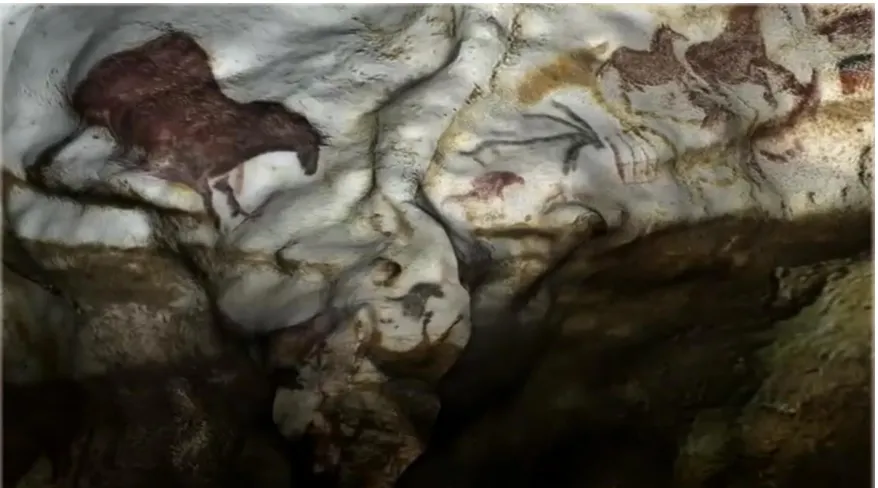
We are in a cave, 30,000 years ago, in a region now called Lascaux, France (Figure 1). At this moment, the cave is a central hub of ritual activity, continually adorned with images of animals, some
with human heads and torsos (similar in some respects to the aesthetic and practice of today’s hipster tattoos). The wide entrance hall to the cave allows for many people to gather and assemble.
[image:2.612.90.529.260.504.2]As one moves through it, the cave reveals itself as a series of tunnels, continually narrowing until only one person can fit into its final crevice. The images along the cave walls resemble hallucinatory dream sequences, marking the real and the subterranean worlds, serving as membranes between upper and lower realms. The cave is a spiritual and embodied journey, the equivalent of a virtual reality experience. Periodically, a leader or tribal elite may emerge from the small inner crevices upon awakening from a dream, to convey a new social order, promising division and exclusivity or perhaps inclusive abundance (Lewis-Williams & Clottes, 1998).
Figure 1. Virtual tour of Lascaux cave paintings.
[Ctrl+Click title to view video clip.]
The New Oxford American Dictionary defines prototype as “a first, typical or preliminary model of something, especially a machine, from which other forms are developed or copied.” Thus, prototypes carry a symbolic element beyond their material and technical affordances. They embody a vision of how an invention fits into an imagined future, and within an idealized set of social relationships. These visions can be self-fulfilling; marketing and public relations professionals, for instance, make pitches for a new technology, which are then integrated into news stories and speculative fiction, and, based on the social traction of these narratives, engineering firms may choose to apportion resources and adjust agendas, delivering on the indirect promise of their own hype, filtered through the media feedback loop. Yet prototypes are not unique to technological inventions and the companies that create them; they may also encompass new forms of community, new civic institutions, and new approaches to organizational communication. President Obama’s 2008 political campaign, for example, became noteworthy in its ability to tap into and consolidate small donations and galvanize its political base, serving as a prototype for widespread, productive civic engagement in the network era.
Ultimately, these visions of the future, embodied in the prototypes of new technologies and new relational configurations, circulate throughout cultural channels as a coin of social capital and a catalyst for collective enterprise. The same is true of the stories we tell about them. By using the term futuretypes, we aim to highlight the aspirational dimension of prototypes, and to identify the stakeholders bidding on conflicting and intersecting visions of a future society. Futuretypes can be understood as the cultural coefficient of prototypes, as rhetorical claims for the legitimacy and desirability of specific assemblages of sociotechnical blueprints. As Frans Berkhout (2006) explains, “expectations are intrinsic to all social action, so that visions of the future are both ubiquitous and context-specific” (p. 299). People or agents act based on their private visions of the future “that are complexly related” to, and deployed in conjunction with, shared and/or collective visions. Berkhout perceives these “visions” as “‘bids’ that are deployed by actors in processes of coalition formation and coordination.” The concept of futuretypes emplaces this process of bidding within the cultural practice of storytelling, itself an instrument and artifact of deeply embedded historical trajectories that suture yesterday’s vision of the future to today’s understanding of the past, while continually modifying and adapting futuretypes to evolving social and scientific realities and imaginaries.
In practice, both the selection and the representation of futuretypes by storytellers may carry ideological capacities, and as scholars we can find meaning in each. A storyteller like Arthur C. Clarke might select the alien encounters futuretype because he believes it serves as a perfect platform to discuss the flaws and idiosyncrasies of our species, and to describe his ambitions for us collectively. A storyteller like Gene Roddenberry might choose to employ the futuretype of material abundance (in the form of replicators), not because he thinks they’re important independently, but because they might be a condition for his vision of a planet living in harmony. A storyteller like Chris Nolan might choose several futuretypes (dream navigation, interstellar travel, etc.), but each in the service of exploring a single theme—family relationships and their tensions with social obligations—essentially the same moral terrain explored some 2,500 years ago in the Bhagavad Gita.
ones. For storytellers, they are convenient starting points for imaginative play, much as blues or rhythm changes might serve an improvisatory musician. For readers, they provide a scaffolding for our own hopes and fears, allowing us to encompass the ever-accelerating rate of social and technological change within a meaningful and contiguous narrative of our individual and collective roles in the chaotic flow of human events. For inventors and innovators, they provide both cautionary and aspirational benchmarks toward which to design and engineer, at times explicitly, as in the case of the Qualcomm Tricorder XPRIZE, which challenges inventors to create a functional version of a machine first imagined on Star Trek. And for societies at large, they allow us collectively to express and explore our deepest fears and fondest desires, safely insulated from abject self-revelation and toxic social politics via the magic rhetorical fig leaf of futurism.
In this issue, we explore a specific set of futuretypes that emerged organically from conversations held at the National Communication Association conferences in 2013 and 2014, featuring many of the contributors to this issue. Although there are scores of widely employed tropes from which we could have chosen, we selected this group of nine for heterogeneity, polysemy, frequency of employment in speculative fiction, thematic resonance with specific contributors, and general potential for fun and illuminating discussion. In no particular order, they are as follows:
Space Colonization & Exploration Alien Encounters
Networked Consciousness Black Holes & Wormholes
Transcending & Extending Mortality End of Material Scarcity
Racial Identity in the Future
Transcendence of Gender & Sexuality Interstellar Media Systems
In our initial conversations, we appreciated the group discussion format as an optimal method for exploring the nested layers-within-layers of signification and power coiled inside of each futuretype; no matter how well versed each discussant was, and how well trodden the narrative soil, each participant would invariably add a new perspective, and a new set of problems and questions, to each subject we raised. When we hit upon the idea of capturing this geekish lightning in a bottle, by creating a special section of an academic journal dedicated to futuretypes, we chose to invent a format of academic discourse that, if not radically new, is certainly foreign to us.
cross-pollination as possible. All writing and editing was undertaken via Google Drive, a “cloud”-based platform (there’s a futuretype we didn’t include!) that enables collaboration on a broad scale. Although many of us find the premise of Romantic authorship a quaint or laughable relic of a bygone cultural era, our institutional affiliations are not quite so progressive, so for the purposes of citation and curricula vitae, we consider a provocateur to be “first author” and respondents to be “coauthors.”
Now that the pieces are written and we are in the midst of editing and compiling them, we have our first opportunity to look through the bottle at the lightning we captured. While it could never match the freewheeling, semiarticulate, collectively improvisatory mayhem of our conversations at NCA, we believe the result as published is an acceptable approximation, giving readers a chance to sit vicariously at the nerd table and listen in on our exuberant geekery. To return to musical metaphor, this is a “live studio album,” a midpoint between the polished, staid publications that normally fill academic journals and the wild-eyed gibberish that reverberates in certain bars at certain hours of certain weeks in proximity to conference hotels the world over.
The contributors to this volume are a diverse bunch, representing several ages, races, genders, sexual identities, regions, education levels, career descriptions, and institutional affiliations, and our discursive language reflects that. At times, we are probably speaking across each other rather than directly at one another. Transitions may seem abrupt, and crucial observations may be left unexamined, while seemingly arcane minutiae may be picked over like a turkey carcass. But that’s the way it is at the nerd table: The thing that binds us together isn’t a shared history, a shared identity, or a shared language, but rather a shared passion for exploring visions of the future, inhabiting alien identities and conversing in imaginary languages. The past eludes us and the present divides us, but, for now at least, the future may just bring us together.
Come, have a seat, join us . . .
References
Benford, J., & Benford, G. (2013). Starship century: Toward the grandest horizon. Charleston, SC: Microwave Sciences/Lucky Bat.
Berkhout, F. (2006). Normative expectations in systems innovation. Technology Analysis & Strategic Management, 18(3/4), 299–311.
Lewis-Williams, D. J., & Clottes, J. (1998). The mind in the cave—The cave in the mind: Altered consciousness in the upper Paleolithic. Anthropology of Consciousness, 9(1), 13–21.
Nakamura, L. (2013). Cybertypes: Race, ethnicity, and identity on the Internet. New York, NY: Routledge.
Nakamura, L., & Chow-White, P. (Eds.). (2013). Race after the Internet. New York, NY: Routledge.