IODINE CLOCK REACTION
59
Purpose:
The rate law for the reaction of an “iodine clock” reaction is to be established.It involves the determination of the order of reaction with respect to each of two reactants, as well as the determination of the rate constant for a particular temperature.
Introduction
: The reaction used in this experiment is a classic example of a chemical clock. The term, chemical clock, refers to a reaction where the concentration of one of the chemical components undergoes an abrupt change in concentration after a time period and leads to a sudden change in color. The reaction in this experiment is termed an iodine clock reaction, because it is the molecular iodine (I2) that undergoes the sudden concentration change. When the iodine concentration increases, it reacts with the starch in the solution to form a complex, turning it a deep blue-black color. This reaction is shown in Equation 1.I2(aq) + starch (aq) I2 starch complex (aq) Equation 1 deep blue-black
There are several variations of iodine clock reactions. This experiment will focus on the reaction of iodate ion (IO3 with an acidified solution of sodium bisulfite (NaHSO3) containing the starch indicator. The reaction occurs in two steps. The first step generates iodide ion (I in Equation 2, which occurs slowly and is the rate determining step. A rate determining reaction is the slowest step in a reaction mechanism and is assumed to be equal to the overall reaction rate because the reaction cannot go faster than the slowest step.
IO3 (aq) + 3 HSO3 (aq) I (aq) + 3 HSO4 (aq) Equation 2 IO3 (aq) + 5 I (aq) + 6 H+(aq) 3 I2(aq) + 3 H2O (l) Equation 3 I2(aq) + HSO3 (aq) + H2O (l) 2I (aq) + HSO4 (aq) + 2H+(aq) Equation 4
As the iodide ion is produced, it is quickly oxidized to iodine (I2) by the iodate ion (Equation 3). However, the iodine is reduced immediately back to iodide by bisulfite (HSO3 ) as seen in Equation 4. Since this step occurs extremely fast, the molecular iodine does not exist long enough to react with the starch and no color change is observed until all of the bisulfite has reacted. At that point, the iodine in Equation 4 is no longer being converted to iodide and the blue-black iodine-starch complex appears. This means that the appearance of the blue-black color is a signal that all of the bisulfite ions have reacted. If we measure the time it takes for the blue-black color to appear, it would give us the rate of the reaction based on the change in concentration of HSO3 , which can be expressed as follows:
Rate = 3
-Δ[HSO ]
Δt where [HSO3 ] = change in concentration of HSO3
and t = time period for the change in concentration of
HSO
3Since t is the time it takes for the blue-black color to appear and that corresponds to the time when all of the bisulfite has reacted, [HSO3 ] must equal to the initial concentration of the bisulfite. The rate is therefore the initial concentration of HSO3 divided by time, t.
A rate law expresses the reaction rate as a function of the concentration of each reactant. The rate at any instant is proportional to the product of the molar concentrations of the reactants, each concentration raised to some exponent that has to be determined experimentally. These exponents do not necessarily correspond to the coefficients of the overall equation because many reactions have reaction mechanisms that occur in multiple steps. The rate determining step that determines the rate law is only one step of a series of steps, not necessarily represented by the overall equation.
The exponents are determined by holding the concentration of all but one reactant constant (so that the concentration of only one reactant is changed). In this way, any change in the rate will be a direct result of a change in a single reactant. Since it is necessary to determine the rate order of each reactant, several sets of data must be collected, one set for each reactant.
The rate law for this reaction will be in the form: Rate = k [IO3 ]
x
[HSO3 ]
y
Equation 5 where k is the rate constant for this reaction at a particular temperature, and x and y are the reaction orders for the iodate and bisulfite ions respectively. The x- and y-values are what you will be determining in this experiment.
Once the data has been collected there are two ways to determine the rate order, x and y. Both methods will be utilized in this experiment to expose you to how they work. The first is mathematically. To do this, you use data from two different trials (with Rate 1 and Rate 2) performed at the same temperature and the concentration of one reactant is kept constant: Rate 1 = k1[IO3 ]1
x
[HSO3 ]1 y
and Rate 2 = k2[IO3 ]2 x
[HSO3 ]2 y
where [IO3 ]1 and [IO3 ]2 are the molar concentrations of iodate in Trials 1 and 2 respectively, and [HSO3 ]1 and [HSO3 ]2 are the molar concentrations of bisulfite in Trials 1 and 2 respectively.
Dividing Rate 1 by Rate 2 gives us Equation 6.
- x - y
k [IO ] [HSO ]
Rate 1 1 3 1 3 1
=
- x - y
Rate 2 k [IO ] [HSO ]
2 3 2 3 2
Equation 6
Note that the rate constants k1 and k2 are the same if we perform the experiments at the same temperature (room temperature). Equation 6 becomes much simpler by canceling k1 and k2. In addition when one reactant concentration is held constant it cancels out as well, thus allowing us to solve for one of the exponents (either x or y).
For example, if [IO3 ] is kept constant, Equation 6 simplifies to Equation 7:
y
- x - y
-k [IO ] [HSO ] [HSO ]
Rate 1 1 3 1 3 1 3 1
= =
- x - y
-Rate 2 k [IO2 3 2] [HSO3 2] [HSO3 2] y
-[HSO ]
Rate 1 3 1
=
-Rate 2 [HSO3 2]
where y is the only unknown in the equation. Solve for y by finding the antilog of both sides of the equation.
A similar operation can be done by keeping the bisulfite concentration constant in order to solve for x.
The second way to determine the rate order is graphically, by using the integrated rate laws. The integrated rate law can be rearranged to place the rate data into a linear equation. Each rate order law has a different linear equation. If [A] is the concentration of reactant A at a given point in time, k is the rate constant, and [A]0 is the initial concentration, we have the following equations:
Zero order: [A] = kt + [A]0 Equation 8
First order: ln [A] = kt+ ln [A]0 Equation 9
Second order: 1/[A] = kt + 1/[A]0 Equation 10
If you prepare the three graphs; [A] vs. time, ln [A] vs. time, and 1/[A] vs. time, only one should produce a straight line. The graph that is linear tells you the order of reaction of that reactant. For example, if the “[A] vs. time” graph is linear, then the reaction is zero order with respect to reactant A. The slope equals to k and the y-intercept equals [A]0.
Safety Precautions:
Wear goggles at all times. Potassium iodate and sodium bisulfite may be harmful if swallowed, may cause irritation to skin, eyes and respiratory tract, may affect blood, kidneys, central nervous system, toxic effects may be delayed. In addition, the bisulfate solution contains sulfuric acid, which is also caustic.
Procedure
:Work with one partner.1. Obtain approximately 60 mL each of 0.020 M potassium iodate solution and 0.010 M starch-sodium bisulfite in clean dry beakers. Fill a 50.0 mL buret with deionized water (remember to first rinse the buret twice with 10 mL of deionized water). Since rates are temperature dependent, it is important that all reagents used are at room temperature.
2. Record the room temperature before you begin the trials and record the room temperature again after you finish all the trials.
3. There are seven trials that are to be set up, and each reaction will be done in duplicate. Trials 1 through 4: bisulfite concentration is constant
iodate concentration is varied Trials 1, 5 through 7: iodate concentration is constant
bisulfite concentration is varied
The success of this experiment depends greatly on how accurately you measure out volumes. Water is dispensed by a buret. It is assumed that you have mastered the technique of dispensing accurately with a buret. Ask your instructor if you are not sure.
4. Examine the 10-mL syringes carefully to determine how this can be done accurately and precisely. The key is to keep your eye on Part A of the plunger in your measurements:
To accurately dispense 2.00 mL of a reagent:
a) First push the plunger all the way in (Part A would line up with Position Zero). b) Immerse the tip of the syringe in the reagent and pump it a few times to get rid of
any air bubbles in the tip.
c) Pull the plunger back until Part A is PRECISELY at 2.00 mL-mark. (During this process, keep the tip below the surface of the reagent so that no air gets back into the plunger.)
d) To deliver this volume, push the plunger all the way in (again Part A would line up with Position Zero). There will be a small amount of liquid remaining at the tip, but that is SUPPOSED TO REMAIN IN THE TIP. DO NOT PUMP THE PLUNGER as you would be delivering more than you are supposed to.
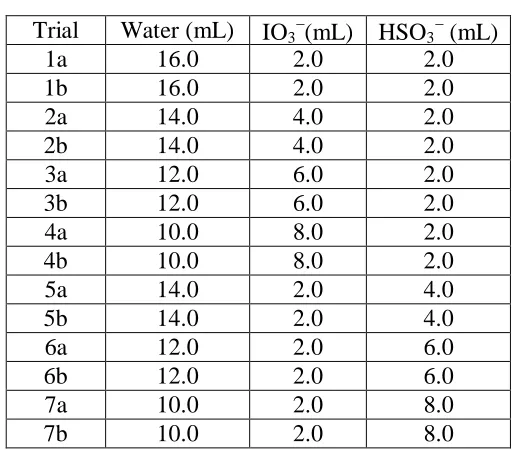
The seven trials are to be set up as indicated in Table 6.1. For each trial, you will first mix the water and bisulfite solutions in a clean 50 mL Erlenmeyer flask and then swirl to mix. Set the flask on a sheet of white paper (so that it is easier to see the color change). One partner will operate a stopwatch, while the other partner adds the iodate solution. It is important that the stopwatch is started exactly at the time the iodate is added because some of the reactions will occur in as quickly as 20 seconds.
When adding the iodate, it is important to add it as quickly as possible but without splashing the sides of the container as this may cause incomplete mixing. Swirl several times to mix. It is not necessary to swirl continuously during the trial. Stop the stopwatch at the first sign of a permanent color change, and record the time to the nearest second.
For the duplicate trials, the times should agree to within ± 5 seconds. If they do not agree, additional trials must be run until you obtain two trials that are within 5 seconds. Between trials, the 50-mL Erlenmeyer needs to be thoroughly rinsed with deionized water and excess water needs to be shaken out.
Table 6.1
Trial Water (mL) IO3 (mL) HSO3 (mL)
1a 16.0 2.0 2.0
1b 16.0 2.0 2.0
2a 14.0 4.0 2.0
2b 14.0 4.0 2.0
3a 12.0 6.0 2.0
3b 12.0 6.0 2.0
4a 10.0 8.0 2.0
4b 10.0 8.0 2.0
5a 14.0 2.0 4.0
5b 14.0 2.0 4.0
6a 12.0 2.0 6.0
6b 12.0 2.0 6.0
7a 10.0 2.0 8.0
7b 10.0 2.0 8.0
DATA ANALYSIS: Steps 1 & 2 of the calculations to be completed in class. Steps 3 – 5 can be completed at home if you run out of time.
1. The rate of each reaction is ∆[HSO3 ]/∆t. Remember that the experimental design is set up so that the bisulfite is always completely used up, therefore you can divide the initial concentration of bisulfite by the time to get the reaction rate. Calculate the average rate for the duplicate trials by using the average time.
2. Use the results from trials 1, 5, 6, and 7 to graphically determine the reaction order with respect to the bisulfite as explained in the introduction. Since there are four sets of data, each of the three graphs that you prepare will have 4 data points. You will prepare these graphs using Excel. Each graph should also include a linear trendline with the linear equation and R2 value displayed. The graph with R2 closest to the value one tells you the order of reaction with respect to the bisulfite ion.
3. Use the average rates from trials 1-4 to mathematically determine the reaction order with respect to the iodate.
4. Combine the results from your mathematical and graphical analyses and give the rate law. In other words, give Equation 5, substituting in place of x and y with the values you have determined in this experiment (rounded to the closest integer).
5. Next, for each of the seven trials, calculate the rate constant (k) based on the rate law you have just stated, and then find the average rate constant. Be sure to include the units for your rate constant.
Pre-Lab Assignment
:
(As usual, do this in your lab notebook.)1. You will be doing two trials for each set of concentrations. What is the criterion to decide whether you need to do more than two trials? Ans. in a full sentence.
3. How many significant figures are in 0.020 M? Keep this in mind as you answer # 6 & 7.
4. You are using 0.020 M KIO3. What is the molarity of IO3 ?
5. How do you solve for y in Equation 7? Use the following data and solve for y.
y
-[HSO ]
Rate 1 3 1
=
-Rate 2 [HSO ]
3 2
First calculate y to the correct sig. fig. before rounding it to the closest integer. Show your work.
6. For the reaction 4 A + 3 B 2 C the following data were obtained at 35.0 C temperature. Use this data to determine the rate law for the reaction and to calculate, k, the rate constant include units for the rate constant. Show your work.
Trial Initial [A]
(mol/L)
Initial [B] (mol/L)
Initial Rate of Formation of C
(mol/L . min)
1 0.100 0.100 5.00
2 0.300 0.100 45.0
3 0.100 0.200 10.0
4 0.300 0.200 90.0
7. Calculate the molar concentration of each reactant for each trial based on the information given in Table 6.1. Prepare a table similar to the one shown below on a new page in your lab notebook and fill in the molar concentrations of [IO3 ] and [HSO3 ]. You will use this table during the experiment.
Example of calculations: Original concentration of IO3 is 0.020 M. In Trial 1a, 2.0 mL
of the solution was diluted to a total volume of 20.0 mL (2.0 mL of IO3 + 2.0 mL HSO3
+ 16.0 mL H2O). This is a dilution problem. Refer to Experiment 3 where you had
solved several dilution problems (Equation 5).
3 3 3
2.0 mL
[IO ] in Trial 1a and 1b 0.020 M IO = 0.0020 M IO 20.0 mL
Trial [IO3 ] [HSO3 ] Time (s)
Average Time (s) 1a 0.0020 M
1b 0.0020 M 2a
2b etc.
Complete the table all the way down to Trial 7b for the molar concentrations (columns 2 and 3). You will not have time to do these calculations in the lab and therefore you must come prepared. You will fill in the Time, and Average Time during the
experiment. (Pre-lab continues on next page)
8. (Answer this on the same page as your answers to #1 through 5.) If it should take 25 seconds for the blue-black color to appear for Trial 2a, what is the rate for Trial 2a? Show your setup and include units.
You will be handing in the carbon copies at the beginning of pre-lab for the answers to questions #1−5 & 7. The carbon copy of the page containing the table to Question #6 is to remain in your lab notebook until the end of the lab period.
Post-Lab Questions:
Please type on a separate sheet of paper.1. Suppose the rate law for a particular reaction between nitrogen dioxide and chlorine is Rate = k [NO2]2[Cl2]. How would each of the following affect the rate of the reaction? a) If the concentration of NO2 is tripled, then the reaction rate would
(increase/decrease?)________________________ by a factor of ____________.
b. If the concentration of NO2 and Cl2 are both doubled, then the reaction rate would (increase/decrease?)_______________________ by a factor of ____________.
c. If the concentration of Cl2 is halved, then the reaction rate would
(increase/decrease?)_______________________ by a factor of ____________.
a.
2. Use the rate law to explain quantitatively how increasing the iodate ion concentration affects the rate of the iodine clock reaction? (State whether it doubles or triples, etc.)
3. Use the rate law to explain quantitatively how decreasing the bisulfite ion concentration affects the rate of the iodine clock reaction? (Again, state whether it doubles or triples, etc.)
4. How would doubling the total volume of the solution by doubling the volume of water, iodate and bisulfite solutions affect the rate of the iodine clock reaction? Explain in full sentences.
5. Why is it important to record the temperature when you did not have to use it in any of your calculations? Explain in full sentences.
Calculations & Results:
Name: _________________________ CHEM 124 Sec: _____ Lab Partner’s Name: ________________________What is the average room temperature? _______
1. Show calculation setup for Trial 1 to show how the initial molarities and average rate are calculated and then fill in the rest of the table.
Setup:
Trial Initial
[IO3 ]
Initial [HSO3]
Average
Time Average rate
1
2
3
4
5
6
7
2. Graphically determine the order with respect to the bisulfite ion using Trials 1 and 5-7. You will turn in all three graphs that you prepare to do this (remember that this is an individual assignment and that your graph should be unique). You should add a
trendline to each graph and display the equation and the R2 value. The R2 value is to be used to help you determine the order of reaction.
Order Integrated Rate Law Trendline R2
Zero [A] = kt + [A]0
1st ln [A] = kt+ ln [A]0
Name: ________________________________ 3. Use Trials 1-4 to mathematically calculate the order with respect to the iodate ion. Use
multiple sets of data (at least three sets) and then calculate the average. Be wise in choosing which trials to use. If the time or rate of one particular trial seems out of place, do not use it. Specify which combinations of trials you are using for this calculation and show your work on a separate sheet of paper.
Combination of Trials
e.g. Trial 1 + Trial 2
Order of Reaction with Respect to IO3–
(to correct sig. fig.)
Order of Reaction with Respect to IO3– (rounded to closest integer)
Average Order of Reaction (rounded to the closest integer) =
4. Use the orders you have determined in Steps 2 & 3 above to write the rate law.
5. Use the rate law you derived on the previous page to calculate the rate constant. Fill in the table below, and show at least one sample set of calculations in the space below. Include units at all times.
rate constant
k1
k2
k3
k4
k5
k6
k7