54 Trans. Phenom. Nano Micro Scales, 4(2): 54-58, Winter and Spring 2016 7508/tpnms.2016.02.007
The effect of small scale on the vibrational response of nano-column based on
differential quadrature method
A. Pourasghar1,*, A. Ghorbanpour Arani2,3, S. Kamarian4
1Young Researchers and Elite club, Islamic Azad University, Central Tehran Branch, Tehran, I. R.Iran
2Faculty of Mechanical Engineering, University of Kashan, Kashan, I. R. Iran
3Institute of Nanoscience & Nanotechnology, University of Kashan, Kashan, I. R.Iran
4Young Researchers and Elite Club, Kermanshah Branch, Islamic Azad University, Kermanshah, I. R.Iran
Received 12 February 2015; revised 1 January 2016; accepted 21 January 2016; available online 28 June 2016
ABSTRACT: The present paper deals with the dynamic behavior of nano-column subjected to follower force using the nonlocal
elasticity theory. The nonlocal elasticity theory is used to analyze the mechanical behavior of nanoscale materials. The used method of solution is the Differential Quadrature Method (DQM). It is shown that the nonlocal effect plays an important role in the vibrational behavior of nano-columns. The results can provide useful guidance for the study and design of the next generation of nanodevices and could be useful in biomedical and bioengineering applications as well as in other fields related with the nanotechnology.
KEYWORDS: differential quadrature method (DQM); nano-column; nonlocal elasticity; Vibration
INTRODUCTION
Nanostructures are of great interest not only for their basic scientific richness, but also because they have the potential to revolutionize critical technologies. From the discovery of fullerenes and Carbon Nanotubes (CNTs) (Eringen., 1972; Iijima., 1991), these applications have experienced an exponential growth, mainly in micro- or nano-electromechanical systems (MEMS or NEMS) devices incorporate structural elements such as beams and plates in micro- (or nano-) length scale and nanomachines (Martin., 1996; Drexler.,1992; Han et al., 1997; Fennimore et al., 2003; Bourlon et al; 2004), as well as in biotechnology and biomedical fields (Saji et al., 2010). Since the atomic and molecular models require a great computational effort, simplified models are useful for
analyzing the mechanical behavior of such devices.Among
the size-dependent continuum theories, the theory of nonlocal continuum mechanics initiated by Eringen and coworkers (Eringen 1972b and 1983) has been widely used to analyze many problems, such as wave propagation, dislocation, and crack singularities and, from the pioneer work of Peddieson et al. (2003), for problems involving nanostructures.
Thus, in recent decades, many researchers have used the nonlocal elasticity theory to analyze the mechanical behaviors of nanostructures such as beams (Reddy., 2007; Loya et al., 2009), rods (Kiani., 2010; Murmu and Adhikari.
*Corresponding Author Email: [email protected]
Tel.: +989372293245; Note. This manuscript was submitted on February 12, 2015; approved on January 1, 2016; published online June 28, 2016.
, 2010), plates (Ke et al., 2008; Murmu and Pradhan., 2009), as well as carbon CNTS (Ansari et al., 2013). Size effects are significant in the mechanical behavior of these structures in which dimensions are small and comparable to molecular distances.
Based on the nonlocal constitutive relation of Eringen, a number of papers have been published attempting to develop nonlocal beam models and apply them to analyze the vibration. Thai (2012) applied the analytical solution to the equations of motion and deflection, buckling and natural frequency of an Euler–Bernoulli beam using the nonlocal elasticity. Reddy and Pang (2008) reformulated the Euler–Bernoulli and Timoshenko beam theories using the nonlocal differential constitutive relations of Eringen. Numerical results were presented to bring out the effect of nonlocal behaviors on deflections, buckling loads and natural frequencies of CNTs.
De Rosa et al. (2008) discussed that the DQM could be employed as an accurate method for practical beam applications. The DQM was applied to a non-uniform beam subjected to a sub-tangential follower force at the free end. The frequency-axial load relationship for a beam with a variable circular cross-section was obtained. Mahmoud et al. (2011) investigated on free vibration analysis of non-uniform column resting on elastic foundation and subjected to follower force. They showed that the first frequency increases with increasing elastic foundation while it decreases with increasing follower load.
In this work, a nonlocal beam model is developed and
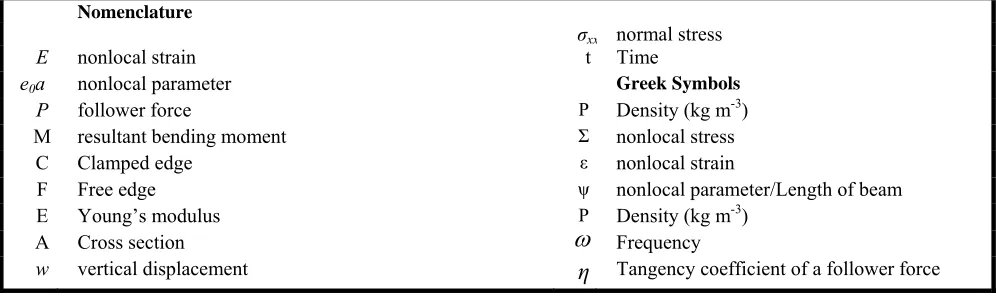
55 Nomenclature
σxx normal stress
Ε nonlocal strain t Time
e0a nonlocal parameter Greek Symbols
P follower force Ρ Density (kg m-3)
M resultant bending moment Σ nonlocal stress
C Clamped edge ε nonlocal strain
F Free edge ψ nonlocal parameter/Length of beam
E Young’s modulus Ρ Density (kg m-3)
A Cross section
Frequencyw vertical displacement
η
Tangency coefficient of a follower forceemployed to study the vibrational characteristics of a nano-column employing Eringen’s nonlocal elasticity theory. Differential quadrature method (DQM) is being utilized and numerical solutions of nondimensional frequencies are obtained.
It is believed that new results are presented for dynamics analysis of nano-columns which are of interest to the scientific and engineering community in the next generation of nanodevices.
Nonlocal elastic model
Unlike the constitutive equation in classical elasticity,
Eringen’s nonlocal elasticity theory (Eringen., 1983) states that the stress field at a reference point x in an elastic continuum depends not only on strain at that point but also on strains at all other points in the domain. According to the nonlocal elasticity theory, this fact was attributed to the atomic theory of lattice dynamics and experimental measurements of phonon dispersion. The scale effects are accounted in this theory by considering internal size as a material parameter. The most general form of the constitutive relation in the nonlocal elasticity type representation involves an integral over the entire region of interest.
The integral contains a nonlocal kernel function, which describes the relative influences of the strains at various locations on the stress at a given location. The one-dimensional nonlocal constitutive relation for a general beam considering Euler–Bernoulli hypothesis can be written as:
2 2
0 2
( )
( ) (
x
e a
)
x
E x
( )
x
(1)Where E is the Young’s modulus of the material, σ and ε
are the nonlocal stress and strain, respectively. The term
(e0a) is the nonlocal parameter or the scale-coefficient that
represents the ratio between a characteristic internal length,
a (such as the lattice spacing), e0, dependent on each
material.
The basic formulations
Consider a cantilevered column subjected to a follower
force p as shown in Figure 1.
Fig. 1. Configuration of nano-Column subjected to follower force
The governing partial differential equation of column resting on an elastic foundation subjected to a follower force is given by the following equation of motion:
2 2
2 ( ) 2 0 0
w w
M p A x L
x x x t
(2)
M being, the resultant bending moment, given by
xx A
M
z dA, where σxx is the normal stress in the xdirection. It is possible to integrate the one-dimensional
nonlocal constitutive equation, equation 1, multipliedby z,
along the cross-section of the beam.
Thus, the following differential relation between the
bending moment, M, and the vertical displacement, w, is
found:
2 2
2
0 2 2
(
)
M
w
M
e a
EI
x
x
(3)It should be noted that when the nonlocal parameter (e0a)
Trans. Phenom. Nano Micro Scales, 4(2) 54-58, Winter and Spring 2016
56
From equations 2 and 3, the nonlocal expression of both bending moment and axial force can be determined as a
function of the displacement w:
2 2
2
0 2 2
( ) ( w) w w
M e a p A EI
x x
t x
(4)
2 2 2 2
2 0
2 x 2 2 (( ) 2 )
w w
EI e a A
x x x
t 2 2 2 2
w
w
p
A
x
t
0
x L
(5)
Where E is the modulus of elasticity, p is the follower
force, w is the lateral displacement of column, ρ is the mass
density per unit length of the column and A is the cross section of the column.
For analysis of the natural frequency, the above equation is formulated as an eigenvalue problem by assuming the following periodic function:
( , )
( )
i tw x t
W x e
(6)Where W(x) is the mode shape of the transverse motion of the beam, therefore:
4 2 2
2 2 2
0
4 2
(
)
2d W
d W
d W
EI
p
A W
e a
A
dx
dx
dx
(7)Quantities have been implemented in equation 5 by changing variables in the following form:
4 4 2
2 0
, e a, ,
x L L A
X P p
L L EI EI
(8)
By substituting this non dimensional parameters into the equation 8, we have:
4 2 2
2 2 2
4 2 2
d W P d W W d W
dX dX dX (9)
Implementation of boundary conditions
Equation 9 is a fourth-order ordinary differential equation.
Thus, it requires four boundary conditions. The boundary conditions are as follows:
For clamped–free supports (C-F) with a follower force P
0 W W x
At x=0 (10a)
2 3
2 3
(1
)
0
W
W
W
P
x
x
x
At x=L (10b)Where η is the tangency coefficient of a follower force P.
GDQ solution of governing equations
In this stage, the GDQ approach is used to solve the governing equations of columns. GDQ approach was developed by Shu and co-researchers (1992 and 2000)
based on the (DQ) technique (Bellman et al., 1972; Bert
and Malik., 1996). In GDQ method the nth. Order partial
derivative of a continuous function f(x,z) with respect to x
at a given point xi can be approximated as a linear
summation of weighted function values at all of the discrete points in the domain of x, i.e.
( , )
1
( , )
i
n x z N n ik ik n
k
f
c f x z
x
,(i=1,2,...N, n=1,2,...N -1)
(11)
Where N is the number of sampling points and is the
xi dependent weight coefficients.
According to the GDQ method, the governing equation 9 should be re-written in discretized form. Therefore equation 9 at a sample grid point (xi) can be written as:
(4) (2) 2
, ,
1 1
2 2 (2) , 1
N N
i j j i j j i
j j
N
i j j
j
c W
P
c W
W
c W
1, 2,...,
i
N
(12)
In the above equation ( ) and ( ) are the weighting
coefficients of the forth and second order derivatives. where
Wii=1, 2,. . ., N, is the functional value at the grid point Xi . The boundary conditions equation 10 should also be re-written in discretized form. So we get,
For clamped–free supports (C-F) with a follower force P
(1)
1 1
1
(2) (3) (1)
1 1 1
0
(1 ) 0
N j j j
N N N
Nj j Nj j Nj j
j j j
W c W and
c W c W P c W
(13)Applying the GDQ procedure, the whole system of differential equations has been discretized and the global assembling leads to the linear algebraic equations where the natural frequencies for FGM beam are obtained:
57
NUMERICAL AND RESULTS
For numerical computation, sampling points with the following coordinates are used (Shu and Richards., 1992)
N i
n i
xi 1,2,...,
1 1 cos 1 2
1
(15)First of all, convergence and validation study of the normalized natural frequency is considered for an isotropic column without elastic foundation in Table 1.
Table 1
Convergence behavior and accuracy of the first two normalized frequencies of non-uniform column with P=0, K=0, α=0.
Natural
frequency N=7 N=10 N=13 N=15 [22]
Ω1 3.4863 3.5160 3.5160 3.5160 3.516
Ω2 21.4246 22.0983 22.0346 22.0345 22.034
As it is noticed, fast rate of convergence of the method is evident for different boundary conditions and it is found that only 15 DQ grid in the thickness direction can yield accurate results. Also, the comparison shows that the present results agree very well with similar ones obtained
by Mahmoud et al. (2011). According to the present model,
the effect of nonlocal parameter on the frequency parameter and critical load of nanobeams are studied in details. At the nanoscale, the nonlocal effects often become more prominent. It can be concluded that nonlocal elasticity and the tangency coefficient play an important role for analyzing dynamic response of rotating nanobeams. In the following, the effects of these parameters are considered. Figure 2 shows the first non- dimensional frequency of nano-column varying with follower load (P). For local
model, the nonlocal parameter, (eoa/L) is assumed to be
zero. While for nonlocal model the nonlocal parameters ѱ
are assumed to be 0.1, 0.2, 0.3, and 0.4. It can be seen that the nano-column with local model has lowest normalized natural frequency. Also, it can be seen that effect of nonlocal parameter is prominent for high value of follower load.
(a) (b) Fig. 2. Non-dimensional frequency parameter of C-F nano-column with
various P (a: η= 1, b: η= 1.5)
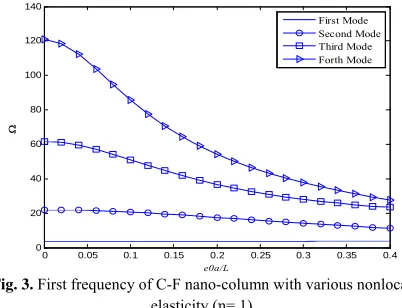
To show the effect of higher modes on the vibration of nanoscale column, the first four frequencies versus the
nondimensional nonlocal parameter for P=0 and η=1 are
plotted in Figure 3. It is observed from Figure 3 that, as the values of nonlocal parameter increase, the values of frequencies become smaller. It is clearly observed that at higher modes the nonlocal effects on the frequency are more. Thus, the nonlocal effects for the vibration of nano-column are more noticeable in higher modes.
Fig. 3. First frequency of C-F nano-column with various nonlocal elasticity (η= 1)
Figure 4 shows the effect of nonlocal elasticity on the first and second non-dimensional frequency. As observed, the critical load (P) of the nano-column decreases with increasing the value of nonlocal elasticity. It means the nonlocal cantilever nano-column shows stiffening effects due to the small scale effects and tends to become stiffer compared to local one.
Fig. 4. First and second frequency of C-F nano-column with various P (η=1)
CONCLUSIONS
In this research work, The governing partial differential equation for a nano-column is derived incorporating the nonlocal scale effects and generalized differential quadrature method is employed in analyzing the vibration characteristics of the nano-column. According to the
0 0.05 0.1 0.15 0.2 0.25 0.3 0.35 0.4 0
20 40 60 80 100 120 140
e0a/L
First Mode Second Mode Third Mode Forth Mode
0 5 10 15 20
2 4 6 8 10 12 14 16 18 20 22
Pcr 1
and
2
Local Model
e0a/L=0.1
e0a/L=0.4
Trans. Phenom. Nano Micro Scales, 4(2) 54-58, Winter and Spring 2016
58
present model, the effect of nonlocal parameter on the frequency parameter and critical load of nano-column are studied in details. At the nanoscale, the nonlocal effects often become more prominent. It can be concluded that nonlocal elasticity and the tangency coefficient play an important role for analyzing dynamic response of
nano-columns. Frequency parameter decreases by increasing the
nonlocal parameter value. The nonlocal cantilever nano-column shows stiffening effects due to the small scale effect and tends to become stiffer compared to local one. It is believed that new results are presented for dynamics analysis of nano-columns which are of interest to the scientific and engineering community in the next generation of nanodevices.
REFERENCES
[1] AC . Eringen: Linear theory of nonlocal elasticity
and dispersion of plane-waves, International Journal of Engineering Science 10 (1972) 233–48.
[2] S. Iijima: Helical microtubules of graphitic carbon, Nature 354 (1991) 56–8.
[3] CR. Martin: Membrane-based synthesis of nanomaterials, Chemical Mater 8 (1996) 1739–46.
[4] KE. Drexler: Nanosystems: molecular machinery,
manufacturing and computation, New York: Wiley (1992).
[5] J. Han, A. Globus, R. Jaffe , G. Deardorff : Molecular dynamics simulation of carbon nanotubebased gear, Nanotechnology 8 (1997) 95– 102.
[6] A. Fennimore , TD. Yuzvinsky, WQ. Han, MS. Fuhrer, J. Cumings, A. Zettl: Rotational actuators based on carbon nanotubes, Nature (2003) 408–24. [7] B. Bourlon, DC. Glattli, C. Miko, L. Forro, A.
Bachtold: Carbon nanotube based bearing for rotational motions, Nano Letter 4 (2004) 709–12.
[8] V. Saji, H. Choe, K. Young: Nanotechnology in
biomedical applications-a review, International Journal of Nano Biomater 3 (2010) 119–39.
[9] AC. Eringen: On differential-equations of nonlocal
elasticity and solutions of screw dislocation and surface-waves, Journal of Apply Physics 54 (1983) 4703–10.
[10] AC. Eringen: Nonlocal polar elastic continua, International Journal of Engineering Science 10 (1972) 1–16.
[11] J. Peddieson, GR. Buchanan , RP. McNitt: Application of nonlocal continuum models to nanotechnology, International Journal of Engineering Science 41 (2003) 305–12.
[12] JN. Reddy: Nonlocal theories for bending, buckling
and vibration of beams, International Journal of Engineering Science 45 (2007) 288–307.
[13] J. Loya, J. Lopez-Puente, R. Zaera, J.
Fernandez-Saez: Free transverse vibrations of cracked nanobeams using a nonlocal elasticity model, Journal of Apply Physics 105 (2009) 044309.
[14] K. Kiani: Free longitudinal vibration of tapered
nanowires in the context of nonlocal continuum theory via a perturbation technique, Physica E 43 (2010) 387–97.
[15] T. Murmu, S. Adhikari: Non local effects in the
longitudinal vibration of doublenanorod systems, Physica E 43 (2010) 415–22.
[16] L.L. Ke, Y.S. Wang, Z.D. Wang: Non-local elastic
plate theories, Proceedings of the Royal Society of London A 463 (2008) 3225–40.
[17] T. Murmu, SC. Pradhan: Small-scale effect on the
free in-plane vibration of nanoplates by nonlocal continuum model, Physica E 41 (2009) 1628–33.
[18] R. Ansari, A. Shahabodini, H. Rouhi: A
thickness-independent nonlocal shell model for describing the stability behavior of carbon nanotubes under compression, Composite Structures 100 (2013) 323– 31.
[19] HT. Thai: A nonlocal beam theory for bending,
buckling, and vibration of nanobeams, International Journal of Engineering Science 52 (2012) 56–64
[20] JN. Reddy, SD. Pang: Nonlocal continuum theories
of beams for the analysis of carbon nanotubes, J Appl Phys 103 (2008) 1–16.
[21] M.A. De Rosa, N.M. Auciello, M. Lippiello: Dynamic stability analysis and DQM for beams with variable cross-section, Mechanics Research Communications 35 (2008) 187–192.
[22] A.A. Mahmoud, A. Ramadan, M.M. Nassar: Free
vibration of non-uniform column using DQM, Mechanics Research Communications 38 (2011) 443–448
[23] C. Shu: Differential quadrature and its application in
engineering, Springer, Berlin, (2000).
[24] C. Shu, BE. Richards: Application of generalized
differential quadrature to solve two-dimensional incompressible Navier Stockes equations, International Journal for Numerical Methods in Fluids 15 ( 1992) 791-798.
[25] R. Bellman, BG. Kashef, J. Casti: Differential
quadrature: a technique for the rapid solution of nonlinear partial differential equations, Journal of Computation Physics 10 (1972) 4&52.