Vol.4, Issue 2, June 2014
Vol.4, Issue 2, June 2014
Modern Journal of Language Teaching Methods (MJLTM)
ISSN: 2251 - 6204
www.mjltm.com
Editor – in – Chief
Hamed Ghaemi, Islamic Azad University, Iran
Editorial Board
Abednia Arman
, PhD in TEFL, Allameh Tabataba’i University, Tehran, Iran
Azizi Masoud
, PhD in Applied Linguisitcs, University of Tehran, Iran
Basiroo Reza
, PhD in TEFL, University of Tehran, International Campus,
Iran
Elahi Shirvan Majid
, PhD in TEFL, Ferdowsi University of Mashhad, Iran
Fernández Miguel
, PhD, Chicago State University, USA
Ghaemi Hamide
, PhD in Speech and Language Pathology, Mashhad
University of Medical Sciences, Iran
Grim Frédérique
M. A., Associate Professor of French, Colorado State
University, USA
Izadi Dariush,
PhD candidate in Applied Linguistics, Macquarie University,
Sydney, Australia
Kargozari Hamid Reza
, PhD Candidate in TEFL, Payame Noor University
of Tehran, Iran
Kaviani Amir
, Assistant Professor at Zayed University, UAE
Kirkpatrick Robert
, Assistant Professor of Applied Linguistics, Shinawatra
International University, Thailand
Morady Moghaddam Mostafa,
PhD Candidate in TEFL, University of
Tabriz, Iran
Ndhlovu Finex,
PhD, Linguistics Programme, University of New England,
Australia
Vol.4, Issue 2, June 2014
Raddaoui
Ali Hechemi,
PhD, Associate Professor of Applied Linguistics,
University of Wyoming in Laramie, USA
Rezaei Saeed
, PhD in TEFL, Sharif University of Technology, Tehran, Iran
Rolstad Kellie,
PhD, Associate Professor of Education, University of
Maryland, USA
Shahbazirad Mohammad
, PhD in English language and Literature, Yerevan
State University, Armenia
Weir George R. S.,
PhD in Philosophy of Psychology, University of
Strathclyde, Glasgow, UK
Zegarac Vladimir
, PhD, University of Bedfordshire, UK
Vol.4, Issue 2, June 2014
Abstracting/Indexing
Index
Copernicus 2011
Linguistics Abstract
EBSCO Publication
Vol.4, Issue 2, June 2014
Lulu Publication
Directory of Open Access Journals
ProQuest
Modern Language Association
Vol.4, Issue 2, June 2014
Cabell's Directories
COPE
Directory of Research Journal Indexing (DRJI)
Vol.4, Issue 2, June 2014
Indian Citation Index
International Society of Universal Research in Sciences
J-Gate
Vol.4, Issue 2, June 2014
Ulrich's
Vol.4, Issue 2, June 2014
TABLE OF CONTENTS
ON EVIDENCE TO PROVE ECONOMY AND SIMPLICITY IN MINIMALIST PROGRAM………....11
Firooz Sadighi Zahra Asvad
AN EXPLORATION ON IRANIAN EFL LEARNERS’ LEARNING STYLE PREFERENCES...17
Giti Mousapour Negari Ezzat Barghi
THE EFFECTS OF TASK COMPLEXITY ON THE COMPLEXITY AND ACCURACY OF FOREIGN LANGUAGE LEARNERS’ ESSAYS……….…25
Sara Ghanbarzadeh Javad Gholami
EMP STUDENTS’ USE OF READING STRATEGIES AND THE IMPACT OF STRATEGY INSTRUCTION ON MEDICAL TEXT COMPREHENSION…………..39
Maryam Khoshbouie
Seyed Jamal Abdorrahimzadeh Mohammad Amin Sorahi
THE IMPACT OF TEACHERS’ REFLECTIVE JOURNAL WRITING ON THEIR SELF-EFFICACY……….………..65
Hasti Rahgozaran Hamid Gholami
IS THERE ANY RELATIONSHIP BETWEEN IRANIAN EFL LEARNERS' PERSONALITY TYPE AND THEIR PRONUNCIATION?...75
Elham Kalani Tehrani Fereidoon Vahdany Masoomeh Arjmandi
EXAMINING IRANIAN LEARNERS’ PRODUCTIVE KNOWLEDGE OF ENGLISH DERIVATIVES……….……96
Maryam Sharif Firooz Sadighi
THE EFFECTS OF COGNITIVE AND META-COGNITIVE STRATEGIES TRAINING ON ENHANCING VOCABULARY STORAGE OF IRANIAN STUDENTS………..….117
Mehran Rahimipour
MOBILE DICTIONARIES VERSUS PRINTED DICTIONARIES: A
COMPARATIVE STUDY IN TRANSLATION ABILITY………...116
Mohammad Reza Khodashenas Zahra Khosrofar
Elaheh Amouzegar
TOWARDS AN INTERACTIVE EFL CLASS: USING ACTIVE LEARNING
STRATEGIES……….124
Valeh Gholami
Mostafa Morady Moghaddam Atena Attaran
Vol.4, Issue 2, June 2014
A QUANTITATIVE STUDY ON THE RELATIONSHIP BETWEEN EFL
UNIVERSITY STUDENT’S EMOTIONAL INTELLIGENCE AND
MOTIVATION………...………137
Seyyedeh Mitra Niroomand Fatemeh Behjat
Mohammad Rostampour
THE DEVELOPMENT OF THE RECEPTIVE AND PRODUCTIVE KNOWLEDGE OF COLLOCATIONS THROUGH INCIDENTAL LEARNING VS. INTENTIONAL LEARNING……….………146
Sadegh Noori Hamid Gholami Seifodin Rajabi
THE EFFECT OF ALTERNATIVE -TEACHING MODEL ON EFL LEARNERS' GRAMMAR ACHIEVEMENT………..………..154
Sholeh Kolahi Leila Safari
THE EFFECT OF WATCHING MOVIES WITH AND WITHOUT SUBTITLES ON IRANIAN EFL LEARNERS’ LISTENING COMPREHENSION………..………168
Mohammad Reza Shamsaddini Batoul Ghanbari
Safieh Nematizadeh
THE RELATIONSHIP BETWEEN GENDER AND LEARNING STRATEGIES….178
Sahereh Akbar Fereidoon Vahdany Masoomeh Arjmandi
THE EFFECT OF MULTIPLICITY IN PRACTICAL-TRANSLATION COURSES ON IRANINA EFL LEARNERS’ WRITTEN TRANSLATION ABILITY………….….…200
Samira Abbasi Ramin Rahimy Masoomeh Arjmandi
THE EFFECT OF USING READING ALOUD ON IMPROVING IRANIAN EFL LEARNERS’ PRONUNCIATION OF WORD STRESS……….209
Sedigheh Shalchian Fereidoon Vahdany Masoomeh Arjmandi
THE STUDY OF DIFFERENT LANGUAGE VIEWS PREVALENT IN TEACHING A SECOND LANGUAGE: EVIDENCE FROM IRANIAN EFL LEARNERS………….227
Zahra Sherafat Fereidoon Vahdany Masoomeh Arjmandi
THE RELATIONSHIP BETWEEN THE LOCATION OF THE TOPIC SENTENCE AND THE COMPREHENSION OF A PASSAGE BY IRANIAN ADVANCED EFL LEARNERS………..237
Rozi Souzanzan Mostafa Zamaniyan
Vol.4, Issue 2, June 2014
THE STUDY OF THE AGE DIFFERENCES REGARDING THE TYPE AND THE AMOUNT OF DISCIPLINE PROBLEMS IN IRANIAN EFL CLASSES………247
Tahere Hasani Poorfallah Fereidoon Vahdany Masoomeh Arjmandi
THE IMPACT OF PUSHED OUTPUT ON ORAL PROFICIENCY OF IRANIAN EFL LEARNERS……….…….259
Aram Reza Sadeghi Beniss Vahid Edalati Bazzaz
THE IMPACT OF READING STRATEGIS’ INSTRUCTION ON IRANIAN
INTERMEDIATE EFL LEARNERS’ READING COMPREHENSION
PERFORMANCE………..…..275
Saide Yousefian Masoud Khalili Sabet
ON THE RELATIONSHIP BETWEENEFL TEACHERS’CRITICAL THINKING AND SELF-EFFICACY………..286
Mitra Zangenehvandi Majid Farahian Hamid Gholami
EXPLORING IRANIAN EFL LEARNERS’ READING COMPREHENSION TEST PERFORMANCE: THE ROLE OF KNOWLEDGE OF READING STRATEGIES AS AN EXTERNAL FACTOR………294
Seyede Zahra Hashemi Mohammad Sadegh Bagheri
BILINGUAL EDUCATION; FROM THEORY TO PRACTICE………....310
Fatemeh Tabari Firooz Sadighi
THE RELATIONSHIP BETWEEN LEARNER'S NEED AND RETENTION OF WORDS IN ESP CONTEXTS………..323
Ali Panah Dehghani Mustafa Zamanian
Vol.4, Issue 2, June 2014
ON EVIDENCE TO PROVE ECONOMY AND
SIMPLICITY IN MINIMALIST PROGRAM
Firooz Sadighi
Department of Foreign Languages, Shiraz Branch, Islamic Azad University, Shiraz, Iran
Zahra Asvad PhD student in TEFL,
Department of Foreign Languages, Shiraz Branch, Islamic Azad University, Shiraz, Iran
Abstract
The most radical reformulation of transformational generative grammar since its inception has been the Minimalist Program (Chomsky, 1995), in which all but the most essential syntactic principles are discarded. Recent research has investigated the complexities evident in earlier models and attempted to eliminate them, or to show how they are only apparent, following from deeper but simpler properties. Examples of this include the reduction of the number of linguistic levels of representation in the model, and the deduction of constraint on syntactic derivation from general considerations of economy and computational simplicity.
Key words: The minimalist program, computational system, economy.
1. Introduction
Transformational generative grammar has evolved through several stages from its foundational principles more than half a century ago (Chomsky, 1957; 1965). This evolution has been marked by the exposition of ever more general principles of syntactic combination and syntax-semantics interfacing, with the fundamental goal of elucidating the computational system within the mind/brain of the language user (I -language) as opposed to the rules of specific natural languages (the E-language approach). The phrase-structure rules of the syntactic component were generalized in X-bar theory (Chomsky, 1972; 1975) and phonological form (PF) and logical form (LF) and their roles as interfaces with other cognitive systems were introduced in Government and Binding theory (Chomsky, 1981). The Principles and Parameters (P&P) approach was a key development toward showing how natural language variation could be traced to a more fundamental linguistic capacity via the setting of parameters (Chomsky & Lasnik, 1993). Differences between languages at S-Structure are reduced to requirements at the PF-interface. Certain features that are visible but not interpretable at PF must be eliminated by the feature checking operation (a function of movement) Chomsky, 1995. Research in the principles-and-parameters framework has come to focus on conditions of `minimality', leading to a notion of
Vol.4, Issue 2, June 2014
`shortest move' that is not defined in terms of government but in terms of more general conditions of economy (Chomsky1995(90).
This little exercise goes to show that already before the minimalist program was announced, `government' had lost much of its significance in generative grammar. More generally, the minimalist program seeks to bring out and eradicate weaknesses in the theory.
The goal of uncovering the most general, and indeed the only indispensable aspects of phrase-structure rules is manifested in Chomsky’s Minimalist Program. According to this approach, syntactic structure is built from the bottom up via a single operation, Merge. At the most fundamental level of syntactic processing, lexical items are combined recursively by this operator to generate new lexical items. These new lexical items can then be merged with other lexical items to generate yet another lexical item, and so forth during the build-up of the complete syntactic structure. Chomsky1995."! The approach leads to a unification of insertion (merge) and movement, which differs from merge only in that the element to be merged is contained in the target of
merger" (figure. 1).
.
(Fig. 1)
As Chomsky (2002, p. 134) notes, for example, “the whole notion of complement and specifier disappears except as a terminological convenience; you have the things that you merge first, the things that you merge second, and so on.”
The best illustration of the bluntest move of minimalist program is the concept of economy.
2. Economy
As a minimalist principle, Chomsky (1993) assumes that the interface representations should be pure and simple, stripped of all features that are not relevant to the cognitive systems they provide input for. This he calls economy of representation, summarized in (1):1
2.1 Economy of representation: Use as few symbols as possible in the output of a derivation. Economy of representation ultimately reduces to the principle of Full Interpretation, In an interface representation, do not use useless symbols.
Vol.4, Issue 2, June 2014
2.2 Economy of derivation: In much recent work in generative grammar, derivations are considered to be subject to principles of economy. In Chomsky (1993), economy of derivation is (implemented in at least two ways: derivations should involve the shortest possible movements and the fewest possible steps.
It can be said that economy of derivation consists in the single requirement that the number of movement steps should be as small as possible .Use as few steps as possible in deriving an output representation(2.2) is a standard feature of the minimalist program of Chomsky (1993). Chomsky argues that derivations are governed by principles summarized here under the label inertness:
2.3 Procrastinate: Move as late as possible.
2.4 Greed: Move “only if movement contributes to licensing of ". (2.3) and (2.4) can be grouped together as following,
2.5 Inertness: Move as little as possible.
The formulation of economy of derivation in (2.2) is more interesting for what it leaves out than for what it contains. In particular, (2.2) makes no reference to the length of the steps involved in a derivation. According to conventional wisdom, short steps are more economical than long steps. Thus, it has been proposed that economy of derivation contains (2.6) in addition to (2.2):
2.6 Economy of derivation part 2:
In deriving a representation, make the shortest possible movements
(2.6) underlies the concept of minimality (Chomsky 1986b, Rizzi 1990), paraphrased in (2.7):
2.7 Minimality: Don’t move " across a place where " could have landed (2.6) also plays a major part in Chomsky (1993).
3. Phases
Chomsky claims that syntactic operations involve a relation between a probe P and a local goal G which is sufficiently 'close’ to the probe (or, in the case of multiple agreements, a relation between a probe and more than one local goal). However, an important question to ask is why probe–goal relations must be local. In this connection, Chomsky (2001, p. 13) states that ‘the P, G relation must be local’ in order ‘to minimize search’ (i.e. in order to ensure that a minimal amount of searching will enable a probe to find an appropriate goal). The implication shed light to the fact that the Language Faculty can only process limited amounts of structure at one time, and can only hold a limited amount of structure in its ‘active memory’ (Chomsky 1999, p. 9). In order to ensure a ‘reduction of computational burden’(1999, p. 9) Chomsky proposes that ‘the derivation of EXP[ressions] proceeds by phase’ (ibid.), so that syntactic structures are built up one phase at a time. He maintains (2001, p. 14) that ‘phases should be as small as possible, to minimise memory’.
One of the principal empirical arguments for phases is based on the Phase Impenetrability Condition (PIC; Chomsky 2000), which offers an account of various locality phenomena, from successive cyclic A’-movement to CED effects (Huang 1982); these were dealt with in GB by bounding nodes and the ECP, and later by barriers (Chomsky 1986). However, phases were not the only, nor were they the first,
Vol.4, Issue 2, June 2014
alternative to the ECP and barriers of late GB. Until Chomsky (2000), Relativized Minimality had enjoyed over a decade of scholarly acceptance as the principal account of locality.
4. Relativized Minimality
RM is particularly interesting as it stands out as a computationally efficient principle: It helps reduce the number of possible structural relations that transformations may take and it has a ‘least effort’ flavor (see Chomsky & Lasnik 1995: 89--‐‑90). Similarly, RM is also relevant to study the relationship between linguistic theory and research on cognition. In the words of Rizzi (2004: 224): In keeping with this view, it will be argued that language--‐‑independent properties of a so--‐‑called cue--‐‑based retrieval parser (e.g. Van Dyke & Lewis 2003 or Lewis & Vasisht 2005, a.o.) are responsible for the emergence of RM.
Originally put forward in Rizzi (1990), Relativized Minimality can be defined in the following way:
A movement operation cannot involve X and Y over a Z which is relevantly identical to Y in the configuration ...[X...[Z...[Y...]…]…]… if Z c--‐‑commands Y (Hornstein 2009: 35). 2, 3
The father of RM, Luigi Rizzi (1990, 2002), summarizes its conceptual benefits in the following terms:
RM can be intuitively construed as an economy principle in that it severely limits the portion of structure within which a given local relation is computed...the principle reduces ambiguity in a number of cases: whenever two elements compete for
entering into a given local relation with a third element, the closest always wins. (Rizzi 2002: 224)
Consider the fact that, like phases, RM is also aimed at reducing computational complexity, by minimizing the distance between antecedents and traces.
5. Agreement
In minimalist papers from the nineties, feature-checking was generally held to be possible only in a very local configuration, called a checking domain (cf. Chomsky 1993); a distant goal would have to move into a local relationship with a probe in order to check its features. However, since features are assumed to drive movement, it seems that a relation must be established prior to the movement taking place; hence in Chomsky (2000, 2001), and subsequent papers, the checking mechanism, called Agree, is assumed to be able to create a relationship between features at a distance. Phases are part of the theory of locality that constrains the Agree relation (though see Hornstein 2009 for arguments that Agree should be constrained to checking domains and distinguished from movement).
Within minimalist approaches to syntax, the syntactic operations are few and very general. We have already discussed the operation of Agreement. In addition, there is another core operation: merge.
Vol.4, Issue 2, June 2014
6. Merge
The function of Merge is to create larger syntactic units out of smaller ones, Merging two independent elements A and B to form C, which has A and B as immediate constituents; Importantly, many of the earlier syntactic operations in transformational generative grammar have been subsumed under the Merge operation. Rather than positing separate operations for particular stages in syntactic build-up, these operations can instead be conceived as different hierarchical applications of Merge. In the standard theory of generative syntax, up to and including Government and Binding theory, a sentence’s D-structure undergoes transformation rules such as phrase movement to provide input to the S-structure. Within the S-structure, several more rules must be satisfied (e.g. theta criterion and case filter) in order to make the sentence a kind of “common currency” for PF and LF. In the Minimalist Program, D-structure and S-D-structure are removed, along with the rules applying to their construction, and are instantiated in the Merge operation. On this definition of Move, it is simply a variant of Merge (so we have External Merge, and Internal Merge, in Chomsky's 2004 terms; see also Starke 2001; Gartner 2002).
7. Conclusion
In the present paper, first I overviewed the syntactic evolution from transformational generative grammar to minimalist program. Then I mentioned some (but not all) evidence such as economy, phases, relativized minimality, agreement and merge to prove economy and simplicity in MP. Chomsky’s Minimalist Program is high point of the evolution of transformational generative grammar, which has been characterized by a systematic elimination of many syntactic entities and principles with the goal of arriving at the most general rules of natural language.
Acknowledgements
The author would like to thank anonymous reviewers for their invaluable suggestions and comments on this paper.
References
Chomsky, N. (1957) Syntactic Structures. The Hague: Mouton.
Chomsky, N. (1965) Aspects of the Theory of Syntax. Cambridge, MA: MIT Press. Chomsky, N. (1972) Studies on Semantics in Generative Grammar. The Hague: Mouton. Chomsky, N. (1975) Reflections on Language. New York: Pantheon.
Chomsky, N (1981) Lectures on Government and Binding. Dordrecht: Foris. Chomsky, Noam. 1986b. Barriers. Cambridge: MIT Press.
Chomsky & Lasnik, H. (1993) The theory of principles and parameters. In J. Jacobs (ed.), Syntax: An International Handbook of Contemporary Research (vol. 1). Berlin: Mouton.
Chomsky, Noam. 1993. ‘A Minimalist Program for Linguistic Theory’. In K. Hale and S.J.
Keyser, eds., The View from Building 20. Essays in Linguistics in Honor of Sylvain Bromberger Cambridge: MIT Press. Cambridge: MIT.
Chomsky, N. 1995a. The Minimalist Program. Cambridge, MA: MIT Press.
Vol.4, Issue 2, June 2014
Chomsky, N. 1995b. “Bare Phrase Structure,” in G. Webelhuth (ed.), Government and binding theory and the Minimalist Program. Oxford: Blackwell, 383-440.
Chomsky, N.( (1999) Derivation by Phase, MIT Occasional Papers in Linguistics, 18 (also published in M. Kenstowicz (ed.) (2001) Ken Hale: A Life in Language, MIT Press, Cambridge, MA, pp. 1 52).
Chomsky, N. (2000). Minimalist inquiries: The framework. In Step by Step:
Minimalist Essays in Honor of Howard Lasnik, edited by Roger Martin, David Michaels, and Juan Uriagereka, pp. 89{155. MIT Press, Cambridge, Ma.
Chomsky, N (2001). Derivation by phase. In Ken Hale: A Life in Language, edited by Michael Kenstowicz, pp1{52. MIT Press, Cambridge, Ma..
Chomsky, N.(2001) Beyond Explanatory Adequacy, unpublished manuscript, MIT. (A published version appeared in A. Belletti (ed.) (2004) Structures and Beyond: The Cartography of Syntactic Structures, vol. III, Oxford University Press, pp. 104 31). Chomsky, N (2002) On Nature and Language. Cambridge, UK: Cambridge University Press.
Chomsky, N( 2004). Beyond explanatory adequacy. In Structures and Beyond: The Cartography of Syntactic Structures, vol. 3 , edited by Adriana Belletti, pp. 104{131. Oxford University Press, New York.
Gartner, Hans-Martin. (2002). Generalized Transformations and Beyond: Reections on Minimalist Syntax. Akademie Verlag, Berlin.
Huang, James C.‑T.(1982). Logical relations in Chinese and the theory of grammar. Cambridge, Ma: MIT dissertation.
Hornstein, Norbert. (2009). A Theory of Syntax: Basic Operations and UG. Cambridge University Press, Cambridge
Lewis, Richard L. & Shravan Vasishth. 2005. An activation--‐‑based model of sentence processing as skilled memory retrieval. Cognitive Science 29. 1–45.
Rizzi, L. (1990). Relativized Minimality. Cambridge, MA: MIT Press.
Rizzi, L. (2002). “Locality and Left Periphery.” In A. Belletti (ed.), Structures and Beyond: The Cartography of Syntactic Structures, Vol.2. Oxford: OUP.
Rizzi, L. (2004). “On the Form of Chains.” In Adriana Belletti (ed.), Structures and beyond: The cartography of syntactic structures, Vol. 3. New York: OUP, 223-251. Starke, Michal. (2001). Move Reduces to Merge: A Theory of Locality. Ph.D. thesis, University of Geneva. Available at http://ling.auf.net/lingBuzz/000002.
Van Dyke, Julie A. & Richard L. Lewis. 2003. Distinguishing effects of structure and decay on attachment and repair: A cue‑based parsing account of recovery from misanalyzed ambiguities. Journal of Memory and Language49. 285–316.
Vol.4, Issue 2, June 2014
AN EXPLORATION ON IRANIAN EFL
LEARNERS’ LEARNING STYLE PREFERENCES
Giti Mousapour Negari
Assistant Professor in TEFL, Faculty of Humanities, University of Sistan and Baluchestan, Zahedan, Iran
Ezzat Barghi
MA. Student, Faculty of Humanities, University of Sistan & Baluchestan, Zahedan, Iran
[email protected] [email protected]
Abstract
The present study aims at exploring Iranian EFL learners’ learning style preferences and also investigates the role of gender in learning style preferences. To this end ninety Iranian EFL students were selected. They were from University of Sistan and Baluchestan and Islamic Azad University of Zahedan. The data was collected through the adapted version of Willing’s learning style questionnaire. LSD pair wise comparison showed that the highest mean value belongs to the communicative learning style followed by concrete learning Style. Analytical learning style and the authority-oriented learning style are in the third place. The results of the independent samples t-test investigating the difference between Iranian EFL male and female learners’ learning style preferences showed that there was no significant difference between male and female learners’ learning style preferences. The study has some pedagogical implications for teachers, syllabus designers and learners which will be discussed in the paper.
Keywords: Learning style preferences; EFL learners; Gender;
Introduction
Nowadays, most of the scholars in EFL are seeking for different possible reasons of ultimate success or even failure among EFL learners; therefore, this purpose encourages them to investigate the different aspects of second or foreign language learning process. Language learning styles are among the most important variables influencing performance in a second language. The definition of learning style is a major concern among the scholars in the field of language learning. Dun (1989, as cited in Clenton, 2002) asserts that learning styles include variables such as “individual responses to sound, light, temperature, design, perception, intake, chronobiological highs and lows, mobility needs, persistence, … motivation, responsibility (conformity) and need for structure…” (p. 56). The definition proposed by Dun (1989, as cited in Clenton, 2002) seems to be the broadest and deepest one since it is composed of
Vol.4, Issue 2, June 2014
environmental (light, sound, temperature), emotional (motivation, responsibility, persistence) and sociological (pairs, groups) stimuli. However, the involvement of such wide repertoire of dimensions while defining learning styles leads to confusion since it is difficult to focus and control on all of them simultaneously. Carson and Longhini (2002) believe learning styles indicate how a learner perceives, interacts with, and responds to the environment. In fact, they consider learning style as a criterion for individual differences.
In the field of second language acquisition,Willing (1985) worked out a bidimensional model of learning styles, by combining one classic polar opposition (the field-independent vs. field dependent one) with the passive vs. active distinction, thus obtaining four basic style types: communicative, concrete, authority-oriented and analytical. Willing’s model is chosen for this study because it is large and well-documented, and is somewhat epitomic of surveys carried out in area of second language acquisition. According to Willing (1988), learning style is inherent and pervasive and is a blend of cognitive, affective, and behavioral elements. Willing (1988) stressed that an individual’s learning style is an intrinsic and innate behavior that individual has in him which is influenced by several factors in their life that has caused them to have a particular learning style or preferences. Willing (1988) believes that understanding the students’ learning style preferences is helpful for teachers and educators because it enables them to match their teaching styles, methodologies, and course organization with learners’ learning styles to help learners improve their learning. Nunan (1991) tries to sum up the definition of Willings’ four types of learners through demonstrating the kind of tasks that these four types of learners prefer. He asserts that communicative learners like to learn by watching, listening to native speakers, talking to friends in English, using English out of the class, and learning by conversations. According to him, concrete learners tend to like games, pictures, films, video, using cassettes, talking in pairs and practicing English outside the class; While, analytical learners like studying grammar, studying English books, studying alone, finding their own mistakes and working on problems set by the teacher. He also introduces the authority-oriented learners as the learners who prefer the teacher to explain everything, like to have their own textbook, to write everything in a notebook, to study grammar, learn by reading, and learn new words by seeing them.
Therefore, it is of great importance to know that different learners learn through different styles. It helps the teachers to apply proper activities in teaching if they know their learners’ learning style preferences. The purpose of this study is to identify Iranian EFL learners’ learning style preferences and to investigate the role of gender in learning style preferences. In fact, the present study can help educational decision makers to know about different learning style preferences of Iranian EFL learners. In addition, it can guide teachers become aware of the advantage of identifying different learning style preferences of their learners and informs them which learning style is the most preferred one; so, they can adapt the teaching activities according to the most preferred learning style beside allocating suitable tasks to other learning styles. It also investigates the role of gender in learning style preferences of Iranian EFL learners. This finding also guides us whether to design different teaching activities and situation
Vol.4, Issue 2, June 2014
for male and female learners or not. The present study tries to answer the following questions:
Is there any significant difference among Iranian EFL learners’ preferences of the learning styles?
Is there any significant difference between Iranian EFL male and female learners’ learning style preferences?
Method Participants
A group of 90 Iranian EFL senior students majoring in English Literature, English Translation, and English Teaching at the University of Sistan and Baluchestan, and Azad university of Zahedan, were selected. The sampling process was based on convenience, due to availability and practicality reasons.
Instruments
To the researcher’s best knowledge, the adapted Willing’s learning style preferences questionnaire is the most suitable questionnaire in EFL context in order to identify the EFL learners’ learning style preferences. So, Willing’s (1988) learning style questionnaire adapted by Shirani Bidabadi and Yamat (2010) was chosen for this research. This questionnaire consisted of four categories (Communicative, Concrete, Authority-Oriented, and Analytical learners) with 24 items modified based on the Iranian EFL university students' learning. It was in English. The Cronbach’s Alpha coefficient of this instrument was 0.84 (Shirani Bidabadi & Yamat, 2010). The participants used the four-point Likert scale to answer the items (alternative values: SD: strongly disagree= (1); D: disagree= (2); A: agree= (3); SA: strongly agree= (4)). To determine each person’s learning style, the scores for items of each learning style were summed.
Data analysis
Using adapted Willing’s Learning Style Questionnaire , the researcher collected the necessary data. Then, the gathered data were subjected to statistical analysis. The Statistical Package for Social Sciences (SPSS), version 19, was applied for this purpose. The descriptive statistics was calculated primarily to determine the mean scores of the different styles of learning used by Iranian EFL learners. Then multivariate test for learning styles and LSD pair wise comparison test were run to determine the Iranian EFL learners’ most preferred learning styles. Besides, an independent-samples t-test was employed to explore the difference between male and female Iranian EFL learners’ learning styles.
Results
Descriptive Statistics for Different Learning Style prefernces
In order to achieve a conclusive finding, first, a descriptive analysis was conducted by calculating the mean and standard deviations (SD) for the types of learning style preferences among Iranian EFL learners. Table 1 shows the descriptive statistics of the four types of learning style preferences and reading comprehension test.
Vol.4, Issue 2, June 2014
1: Descriptive Statistics for Learning Style Preferences
N Minimum Maximum Mean Std. Deviation
Communicative 90 8 24 18.84 3.735
Concrete 90 8 24 17.91 3.337
Analytical 90 11 23 16.73 2.735
Authority-Oriented 90 7 24 16.51 3.205
As it is shown in Table 1, the highest mean value belongs to the communicative learning style with the mean score of 18.84 and the standard deviation of 3.735 followed by concrete learning Style (M = 17.91, SD = 3.337). Analytical learning style is in the third place (M = 16.73, SD = 2.735). Finally, the authority-oriented learning style obtained the lowest mean value with the mean score and standard deviation of 16.51 and 3.205 respectively.
Repeated Measure Test and LSD Pair wise Comparisons for the Learning Styles Preferences
In order to see whether the difference among the mean scores of the learning styles are significant or not, a repeated measure test is done. Table 2 presents the results of the multivariate test among learning styles.
Table 2: Multivariate Testsfor learning styles
Effect Value F Sig.
Factor1
Hotelling's Trace .491 14.225 .00*
*. The mean difference is significant at the .05 level.
As Table 2 shows the p-value is P=.00 which is smaller than .05. This means that the difference between the mean scores of the learning styles is significant. Therefore, a LSD (Least Significance Difference) pair wise comparison test is done to compare learning styles in pairs and to show if the difference between each pair is significant or not. Table 3 shows the results of least significance difference pair wise comparisons for learning styles.
Table 3: LSD Pair Wise Comparisons for Learning Styles
(I) factor1 (J) factor1 Mean Difference (I-J) Std. Error Sig. Communicative Concrete
Analytical
Authority-oriented .93* 2.11* 2.33*
.30 .34 .40
.00 .00 .00 Concrete Communicative
Analytical
Authority-oriented
-.93* 1.20* 1.40*
.30 .35 .37
.00 .00 .00
Vol.4, Issue 2, June 2014
Analytical Communicative Concrete Authority-oriented -2.11* -1.18* .22 .35 .35 .34 .00 .00 .51 Authority-oriented CommunicativeConcrete Analytical -2.33* -1.40* -.22 .40 .37 .34 .00 .00 .51
*. The mean difference is significant at the .05 level.
As shown in Table 3, the mean difference between the communicative learning style and each of the other learning styles is significant (P=.00<.05). This indicates that communicative learning style is the most preferred learning style. Moreover, Table 3 shows significant difference between the concrete learning style and each of the other learning styles (P=.00<.05). The mean difference between the concrete learning style and the communicative learning style is a negative number (-.93); this means that concrete learning style is less preferred than the communicative learning style. However, as it is shown in Table 3 there is no significant difference between the learners’ preferences of the analytical and authority-oriented learning styles (P=.22>.05). Therefore, the communicative learning style is proved to be the most preferred learning style among Iranian EFL learners.
Independent Samples t-Tests for Gender Differences
The results of independent samples t-test for testing the gender differnces are illustrated in Table 4 below.
Table 4: Independent Samples T-Tests for Gender Differences in Learning Style Preferences
Levene's
Test for
Equality of Variances
t-test for Equality of Means
F Sig. t df Sig. (2-tailed)
Communicative
Equal variances
assumed 2.21 .14 -.20 88 .83
Equal variances
not assumed -.20 87.92 .83
Concrete
Equal variances
assumed .010 .91 -1.16 88 .25
Equal variances
not assumed -1.15 82.80 .25
Authority-Oriented
Equal variances
assumed .22 .64 .53 88 .60
Equal variances
not assumed .53 86.39 .60
Vol.4, Issue 2, June 2014
Analytical
Equal variances
assumed .27 .60 .92 88 .36
Equal variances
not assumed .91 82.79 .36
As shown in Table 4, there are no significant differences between the male and female EFL learners’ learning style preferences.
Discussions
The main purpose of this study was to identify Iranian EFL learners’ learning style prefernecs Few studies have been conducted to identify Iranian learners’ learning style preferences. In fact, identifying learners’ learning style preferences not only would help learners learn language better but also would help teachers improve their teaching methods. What is really worth mentioning here is the fact that most of the researches done in different places and different fields of study (mostly language teaching) reveal that communicative learning style is the most preferred one (Riazi & Riasati, 2007; Bidabadi & Yamat, 2010; Wong & Nunan, 2011; Panahandeh, 2013; and Ho, 1999). The findings of the present study for the first question also confirm their findings.
Since communicative learning style is the most preferred learning style among EFL learners, it is necessary to investigate more details in order to identify the exact activities and strategies these learners prefer. The percentage of “agree” answers to items 2 and 4, “I like to learn by talking to friends in English. / I like to learn by speaking in English with foreigners when there is a chance”. is 84.4, which seems to be in the highest place. This apparently indicates that most of the learners prefer to talk to friends or foreigners in order to master the language. Besides, item 1, “I like to learn by watching, listening to native speakers of English. with 81.1 percent “agree” answer shows the learners’ preference to exposure to a native context. These descriptive statistics confirms Bidabadi’s and Yamat’s (2010) findings to some extent. Their statistics showed that item 1 is in the highest popularity with the mean score of 3.32, followed by item 4, with the mean score of 3.27; whereas, in the present study items 2 and 4 seem to be the most preferred ones, followed by item 1. Item 3 which notes “If I have choice, I would like to learn English by watching TV in English outside of the classroom.” and item 5, which notes “I like to learn English words by hearing the words.”, with the “disagree” percentage of 25.6 and 25.5 respectively, seem to have the least popularity among the learners. In fact, these results apparently indicate that the learners prefer those kinds of activities that involve them in the process of speaking and interacting.
For the second purpose of this study, the results of the independent samples t -test in Table 4 showed that the difference between Iranian EFL male and female learners’ learning style preferences was not significant. So, the researcher concluded that gender plays no role in learning style preferences. Therefore, this finding verifies the use of similar material and activities for male and female learners. Different studies have done to investigate gender difference in learning style preferences. The results of some of them are discussed here. The findings of the present study confirm the results of the studies that used Willing’s questionnaire. Yik, Hidayu, Bariyyah and Asyimah’s study (2010) investigated gender difference in learning style preferences and found
Vol.4, Issue 2, June 2014
that there was no significant difference between male and female English language learners. Besides, Bidabadi and Yamat (2010) conducted a study on Iranian EFL freshmen’s learning style preferences. Their participants were 92 freshmen who were studying Teaching English as a Foreign Language at a University in south of Esfahan. The results of their study showed that there was no statistically significant difference in the mean scores for male and female students in communicative, concrete, authority-oriented, and analytical learning styles. In other words, males and females applied learning styles in a similar way.
Comparing the findings of the aforementioned studies with the present one, it
can be concluded that there is no significant difference between male and female learners in terms of their learning styles. This finding verifies the existence of mixed classes since there is no need to employ specific activities for males or females.
Conclusion and Implications
The current study attempted to identify Iranian EFL learners’ learning style preferences and to investigate the difference between male and female learners’ learning style preferences. The findings showed that the communicative learning style was the most preferred learning style. In fact, they prefer to be active in the process of learning and they desire to conduct social relations in that they could talk to friends in English or even speak with foreigners whenever possible. The results also indicated that there is no significant difference between male and female Iranian EFL learners’ learning style preferences.
Reid (1995, p. xiv) states that developing an understanding of learning environments and styles “will enable students to take control of their learning and to maximize their potential for learning”. Besides, Stebbins (1995) asserts teachers should know the general learning style profiles of the whole class, which will enable them to organize and employ instructional materials accordingly. Since the results of the present study revealed that the communicative learning style is the most preferred learning style among Iranian EFL learners, it is recommended that teachers should do their best to persuade EFL learners to work in groups and teach them how to communicate with one another in English. Designing communicative tasks for the classroom, the curriculum developers may base on the principles underlining the Willing's (1988) questionnaire and take into consideration inclusion of group discussions as students prefer to talk with classmates and their teachers. English films and video programs are also effective means to help students listen to foreigners speak English. However, it is worth mentioning that by focusing on communicative tasks, it does not mean that tasks that other learner types prefer should be excluded from the course. In fact, Tasks that suit all learners’ styles need to be included in the course to meet all the learners’ needs. Claxton and Murrell (1987, p.73) assert that "experiences that are inconsistent with students' styles can help them develop new learning skills for healthy adult functioning”.
The findings of this study also revealed that there is no significant difference between male and female learners’ learning style preferences. This insures the teachers to freely treat their male and female with identical teaching activities. Additionally.
Vol.4, Issue 2, June 2014
material producers can develop teaching materials that are suitable for both male and female EFL learners.
References
Carson, Joan G., Longhini, Ana (2002). Focusing on learning styles and strategies: A Diary study in an immersion setting. Language Learning,52(2), 401- 438.
Claxon, C. S. and Murrell, P. H. (1987). Learning Styles: Implications for Improving Educational Practices. ASHE-ERIC Higher Education Report No. 4. Washington D.C.: Association for the Study of Higher Education.
Clenton, J. (2002). Learning styles and the Japanese. Retrieved 4 June 2013 from http://rel.sagepub.com/search/results
Ho, B. (1999). Learning style preferences of students in learning English. Retrieved 1 July 2013 from http://sunzi1.lib.hku.hk/hkjo/view.
Nunan, D. (1991). Language Teaching Methodology. New York: Prentice Hall.
Panahandeh, E. (2013). Investigating the Relationship of Multiple Intelligences with Learning Styles and Listening Strategies among Iranian EFL learners. Unpublished Master Thesis, University of Sistan and Baluchestan, Iran.
Reid, J. M. (Ed.). (1995). Preface. In J. Reid (Ed.). Learning styles in the ESL/EFL classroom.
(pp. viii- xvii). New York: Heinle and Heinle Publishers.
Riazi, M., & Riasati. M. J. (2007). Language learning style preferences: A case study of Shiraz EFL Institutes. The Asian EFL Journal Quarterly, 9 (1), 97-125.
Shirani Bidabadi, F., & Yamat, H. (2010). Learning Style Preferences by Iranian EFL Freshman University Students. International Conference on Learner Diversity 2010. Stebbins, C. (1995). Culture-specific perceptual – learning – style preferences of post secondary students of English as a second language. In J. M. Reid (Ed.) Learning styles in the ESL/EFL classroom. (pp. 108-117). New York: Heinle and Heinle Publishers.
Willing, K. (1985). Learning Styles in Adult Migrant Education. Sydney: New South Wales Adult Migrant Education Service. Retrived 25 April 2013 from http://www.learningpaths.org
Willing, K. (1988). Learning styles in adult immigrant education. Research Series (Ed. David Nunan). Australia: National Curriculum Research Center: Adult Migrant Education Programme
Wong, Lillian, & Nunan, David (2011). The learning styles and strategies of effective language learners. System,39 (2), 144–163
Yik, L. H., Hidayu, S. bt. Syed Hussien, Bariyyah, K. bt. Abdullah Khir, & Asyimah, N. bt. Azizan (2010). English language learning style preferences among IPBA B. Ed. (TESL) foundation Cohort 4 students. Retrieved 15 June 2013 from http://apps.emoe.gov.my/ipba/rdipba/cd1/article152.pdf.
Vol.4, Issue 2, June 2014
THE EFFECTS OF TASK COMPLEXITY ON THE
COMPLEXITY AND ACCURACY OF FOREIGN
LANGUAGE LEARNERS’ ESSAYS
Sara Ghanbarzadeh
Urmia branch, Islamic Azad University, Urmia, Iran [email protected]
Javad Gholami
Urmia University, Iran
[email protected] & [email protected]
Abstract
It is argued that task complexity as an important component of task-based language teaching is related to language complexity. It means that the level of the complexity of a given task can be related to the language needed to perform it. The purpose of this study was to investigate the effects of task complexity on two factors of accuracy and complexity in L2 learners' written performance. Twenty five Iranian foreign language learners were selected as the participants of this study. They were asked to perform three types of cognitive tasks: (1) +/- few elements; (2) +/- reasoning demand; and (3) +/- here-and-now. Each task was performed in two forms (simple vs. complex).The participants’ output was coded and measured for accuracy and syntactic complexity. However, no significant difference was found among the participants in terms of syntactic complexity, while the analysis of accuracy measures showed that complex tasks have more accuracy than simple tasks.
Key words: Task-based language teaching, communicative language teaching,
cognitive processing,task complexity, complexity,accuracy, essay writing.
1. Introduction
Task based language teaching is considered as the strong version of communicative language teaching because tasks provide the core of language curriculum (Ellis, 2003:30). In task based language teaching, the grammatical structures are thought through the meaningful use of language in real life tasks, or in the post-stage as a part of focus on form (Robinson, 2001). By focusing on all four language skills, task based language teaching involves learners in manipulating language skills communicatively. One of the central issues in the discussion of task based language teaching is the effect of the complexity level of the task on other factors such as accuracy, fluency, and complexity. Theses effects can be different according to the individual differences participants bring to the task. According to Rouhi and Hassanpour (2010: 138), only in
Vol.4, Issue 2, June 2014
the incidental condition the extent of learning and accuracy are not related to the individual differences. Due to the growing interest in the role of tasks in foreign language teaching, much research has been done regarding the effects of task complexity on EFL learners’ production. However, the majority of the reviewed studies focused on the effects of complexity on oral performance of the learners and just a small number of them focus on the effects of complexity on written performance. This gap in writing can be partially filled by task-based research. Writing as one of the most important language skills can push learners to use the language in original and meaningful context. It helps learners to match their lexical items to their appropriate context which can result in better retention (Kargozari and Ghaemi, 1996: 1655). According to Ellis (2003:30), task based language teaching did not constitute a unified approach. There are rather different approaches to using tasks in language pedagogy. Following Robinson (2001, 2005), and Skehan and Foster (1997; 1999; 2001), among the different approaches to TBLT, we focus on the cognitive approach. Robinson (2001: 31) claims that Cognitive approaches to task-based research focus on how differences in the cognitive demands of a task affect second language (L2) learners' task performance. According to Robinson (1995: 29), “task complexity is taken as the host of cognitive factors which is the result of attentional, memory, reasoning, and other information processing demands imposed by the structure of the task on the language learner”. By focusing on the concept of cognitive hypothesis, Robinson divides task complexity factors into two dimensions: 1) directing and 2) resource-dispersing.
By resource-directing dimension, he refers to the learners' need to use more elaborate and complex structures. He believes that an increase in cognitive demand pushes the learners’ attention toward the linguistic aspect of the language, but increasing the complexity level of the task pushes L2 learner to change the syntactic structure of the production. On the other hand, the resource dispersing tasks cause learners to disperse their attention from linguistic forms to different demands of a task. Therefore, participants can not use all the resources available to focus their attention on all of the complexity factors. According to Robinsons' cognition hypothesis model (multiple attentional resource model), the resource-directing dimension includes the following variables: (+/- few elements, +/-reasoning demand, and +/- here and now) and the resource-dispersing dimension has (+/- planning time, +/- prior knowledge, and +/- single task) variables. On the other hand, Skehan (1998) claims that task complexity consists of cognitive factors such as reasoning demand, and there is a trade-off relationship between these aspects of production. This means that learners cannot pay full attention to all of these factors at the same time and they should prioritize between them. Consequently, some tasks may lead to prioritize accuracy while others lead to prioritize complexity in production. For the purpose of this study three descriptive tasks were selected according to the three variables of resource-directing dimension.
2. Purpose and the research questions
This study is primarily concerned with finding the effects of task complexity on accuracy and syntactic complexity of Iranian foreign language learners' writing at
Vol.4, Issue 2, June 2014
intermediate levels. It was hypothesized that increasing task complexity has a significant effect on L2 learners' accuracy and complexity of writing.
Based on the problem and purpose discussed above, the following research questions were proposed:
1. Does task complexity affect accuracy of Iranian EFL learners’ essays?
2. Does task complexity affect syntactic complexity of Iranian EFL learners’ essays?
3. Method
3.1 Participants
The participants of the study were 25 Iranian female learners of English. They were learning English as their foreign language at Andishe Sabze Ehsan language institutes in Urmia. All of the learners had Azeri as their mother tongue. The average age of the participants was between 15 and 30. All of the participants performed 6 tasks.
3.2 Instruments
To conduct the following study, 6 picture stories were chosen for the purpose of data collection. Two spot the difference pictures were selected for the first variable (+/- few elements).
Appendix A. Spot the difference 1(– few elements)
Vol.4, Issue 2, June 2014
Appendix A. Spot the difference 2 (+ few elements)
Two descriptive pictures were selected according to the second variable (+/- reasoning demand).
Appendix B. descriptive picture 1(– reasoning demand)
Vol.4, Issue 2, June 2014
Appendix B. descriptive picture 2 (+ reasoning demand)
The last two picture stories were chosen according to the third variable (+/- here and now).
Vol.4, Issue 2, June 2014
Appendix C. picture story 1 (there-and-then)
Appendix C. picture story 2 (here-and-now)
Vol.4, Issue 2, June 2014
To avoid the practice effect, the pictures of simple and complex forms of each task were different from each other.
3.3 Essay Evaluation Criteria
In this study the participants' essays were evaluated for their accuracy and the degree of their complexity. In order to assess accuracy the EFC production measure was utilized, i.e. the number of error-free clauses divided by the total number of clauses multiplied by 100. In order to measure complexity, the rules of objective measurement were conducted. The number of coordinating conjunctions and the number of error-free words per sentence were divided by the number of whole words.
3.4 Procedure
Before the experiment, students became aware that the tasks they were going to perform are just part of a research and they will not have any effect on their class performance. Later, they were also provided with some cues regarding the overall procedure of the task performance. They were told that each task must be performed in two forms: first the simple form and later the complex form. First, they were asked to perform the simple form. They were given three different pictures according to the content of each task with a prompt to write their essays. All the simple forms of the tasks were text- supported while the complex forms were text-unsupported. During the first session, they performed the first task according to the first variable (+/- few elements). Two different spot the difference pictures were selected. In these types of pictures there are two similar pictures with some different items between them. To perform the simple task, they were required to find four different items between them. But in the complex form, they were supposed to find all the differences between them. During the second session, they performed the second task according to the second variable (+/- reasoning demand). To perform the simple task, they were required to choose two women out of three, and describe their characteristics according to their profile information. To perform the complex task, they saw the picture of a man, and were required to guess who the man will select as the best choice for himself. Then, they were supposed to give an acceptable reason to support their claims.
During the third session, they performed the here-and-now and there-and-then tasks. First, they received a picture story to perform the here-and-now task. They were required to write their descriptions in simple present tense. Later, they received another picture story to perform the there-and-then task with a prompt to write their descriptions in simple past tense. Finally, the written essays were collected and evaluated in terms of accuracy and complexity, according to the production measures.
4. Results
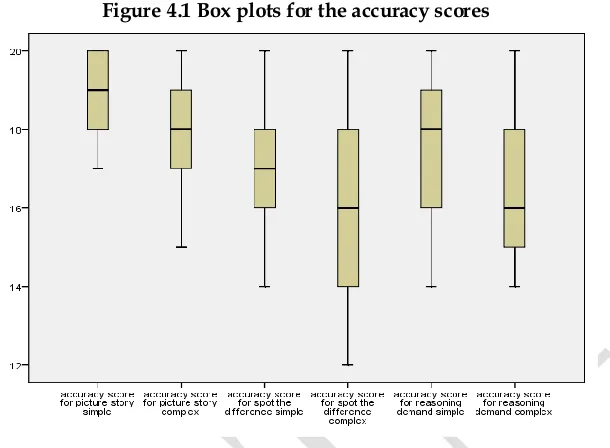
In order to check the research questions, the two-factor within subjects ANOVA was used for the accuracy and complexity. Before embarking on the ANOVA test, it was necessary to check the data for outliers and anomalies. Therefore, the box plots were checked for the accuracy scores.
Vol.4, Issue 2, June 2014
Figure 4.1 Box plots for the accuracy scores
The box plots of the scores show that there were neither signs of extreme cases nor of extremely skewed distributions. The following table shows the descriptive statistics for accuracy scores.
Table 1. Descriptive statisticsfor accuracy
Mean Std. Deviation N
accuracy score for picture story simple
19.04 .89 25
accuracy score for picture story complex
18.00 1.32 25
accuracy score for spot the difference simple
16.96 1.72 25
accuracy score for spot the
difference complex 16.12 2.28 25
accuracy score for reasoning demand simple
17.56 1.87 25
accuracy score for reasoning
demand complex 16.76 1.90 25
Table 1 illustrates the descriptive statistics for accuracy scores and shows that the accuracy means scores that are the highest for the picture story task (19.04 for the simple and 18 for the complex one) and the simple reasoning demand task (17.56).
Vol.4, Issue 2, June 2014
According to the accuracy scores’ analysis, it can be claimed that there is not extreme difference between the accuracy scores of simple and complex tasks. Therefore, the results are in agreement with Robinsons’ cognition hypothesis which suggests that greater complexity will lead to greater accuracy. In both simple and complex tasks, participants had the best performance in the picture story task, followed by reasoning demand task and finally, in the spot the difference task.
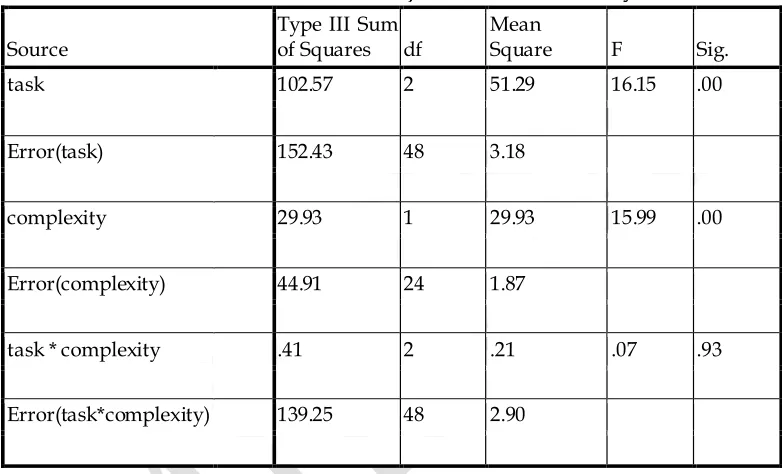
Table 2 shows the results of the ANOVA for the within subjects factors of tasks with three types (picture story, spot the difference, and reasoning demand) and complexity with two levels (simple and complex), and their interaction. The results of the table can be summarized as follow. The factor task (picture story, spot the difference, and reasoning demand) was significant with the p-value of less than 0.05. In other words: F (2, 48) = 16.15; P < 0.05. The factor complexity (simple and complex) was significant since the p-value for F was less than 0.05 or: F (1, 24) = 15.99; p < 0.05.The interaction between task and complexity (task*complexity) was not significant because its p-value was more than 0.05. In other words, F (2, 48) = 0.07; p > 0.05. Therefore, with regard to accuracy, there was a significant main effect for task and complexity, but there was not a significant interaction between these two variables. In other words, task type and complexity of the task both influence accuracy in writing. This means that with more complex tasks participants were able to use more complex structures accurately. The profile plot is shown in figure2. An interaction occurs when the lines cross one another, diverge, converge or have very different profiles.
Table 2. Tests of within-subjects effectsfor accuracy
Source
Type III Sum
of Squares df
Mean
Square F Sig.
task 102.57 2 51.29 16.15 .00
Error(task) 152.43 48 3.18
complexity 29.93 1 29.93 15.99 .00
Error(complexity) 44.91 24 1.87
task * complexity .41 2 .21 .07 .93
Error(task*complexity) 139.25 48 2.90
Vol.4, Issue 2, June 2014
Figure 2. Profile plots for accuracy
In order to check the effects of task complexity on complexity of production, the two-factor within subjects ANOVA was used. Before embarking on the ANOVA test, it was necessary to check the data for outliers and anomalies. Therefore, the box plots were checked for the complexity scores.
Figure 3. Box plots for the complexity scores
Vol.4, Issue 2, June 2014
Figure2 shows that there were neither outliers nor extreme values in the data.
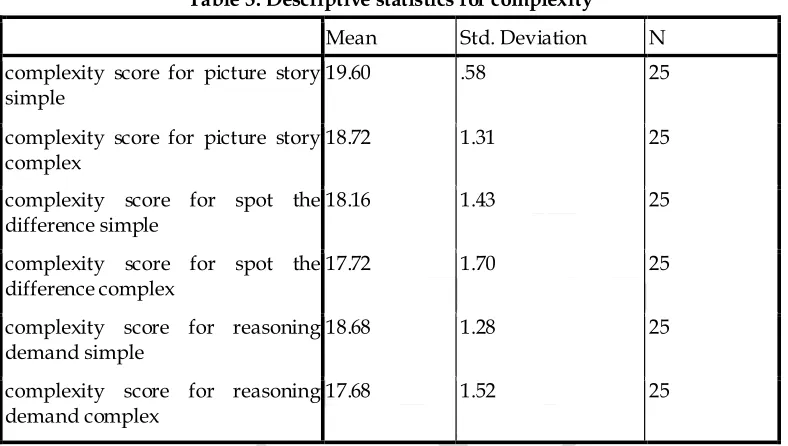
Table 3. Descriptive statistics for complexity
Mean Std. Deviation N
complexity score for picture story simple
19.60 .58 25
complexity score for picture story complex
18.72 1.31 25
complexity score for spot the difference simple
18.16 1.43 25
complexity score for spot the difference complex
17.72 1.70 25
complexity score for reasoning demand simple
18.68 1.28 25
complexity score for reasoning demand complex
17.68 1.52 25
Table3 shows the results of the descriptive statistics for the complexity scores. The highest mean scores for complexity are related to picture story (19.60 for simple and 18.72 for complex), simple reasoning demand (18.68), and simple spot the difference (18.16). In the simple task, the participants performed the best on the picture story task, followed by the descriptive picture task and finally, in the spot the difference task. Although in the complex version of the task they performed the best in the picture story task, but their performances were very close to each other in the spot the difference and reasoning demand tasks. Based on the above analysis, participants had difficulty in performing the complex form of the reasoning demand tasks and picture story tasks. In other words, an increase in the level of the complexity of the task decreases participants’ allocation of attention in using more complex required structures. Table 4 shows the results of the ANOVA analysis. The results of the table can be summarized as follow:
Table 4. Tests of within-subjects effects for complexity
Source
Type III
Sum of
Squares df Mean Square F Sig.
task 41.77 2 20.89 12.60 .00
Error(task) 79.56 48 1.66
complexity 22.43 1 22.43 14.20 .00
Vol.4, Issue 2, June 2014
Error(complexity) 37.91 24 1.58
task * complexity 2.17 2 1.09 .53 .59
Error(task*complexity) 98.49 48 2.05
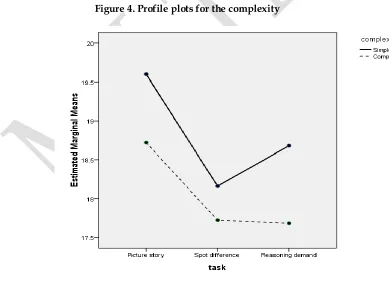
The factor task was significant since the p-value for F was less than 0.05, i.e. F (2, 48) = 12.60; p < 0.05. The factor complexity was significant with the p-value of less than 0.05. In other words, F (1, 24) = 14.20; p < 0.05. Finally, the interaction between task and complexity (task*complexity) was not significant since the p-value for F was more than 0.05 i.e. F (2, 48) = 0.53; p > 0.05. Therefore, there was a significant main effect for the task type and the complexity of the task, but the interaction between the two was not significant. Overall, theses results for complexity indicate that the factor complexity was affected in performing both simple and complex forms of the tasks. This means that most of the participants were not able to use the required structures appropriately according to the complexity level of the task. In other words, task type and complexity both influence the complexity scores at p-value less than 0.05. Figure 4 shows the profile plots for the complexity scores.
Figure 4. Profile plots for the complexity
Vol.4, Issue 2, June 2014
5. Discussion
The results of the study revealed that task complexity affects accuracy and syntactic complexity of participants’ written performance differently with regard to each task. The first research question addressed the effects of task complexity on the accuracy of EFL learners’ essays. Participants showed increases in accuracy to different degrees according to each task type. The second research question concerned the effects of task complexity on syntactic complexity of EFL learners’ essays. Results showed that there is a negative relation between task complexity and complexity of participants’ written essays. As the complexity of the task increases, participants’ allocation of attention to complexity factors decreases. Therefore, we can not claim that the results of the following study are in line with Skehan and Foster's [10] model of task complexity claiming that, in case of increasing task complexity, participants prioritize between complexity factors because they cannot pay attention to both of the factors at the same time. On the other hand, there is similarity between the results of the following study and Robinson’s (2001, 2005) model of task complexity. According to the findings of this model, participants have access to multiple resources during task performance and do not have to prioritize between complexity factors.
The findings of the present study provide useful insights for researchers and syllabus designers regarding task instruction and task sequencing. It is obvious that one of the most important problems employing tasks in classroom setting is the selection of unsuitable tasks for inappropriate contexts. So, the findings of the current study can help task instructors or maybe syllabus designers in selecting, grading, and designing tasks for classroom context.
6. Conclusion
The results of the following study revealed that there is not any significant effect regarding complexity factor, but the accuracy was affected. Considering the results of the study and the claims of two models related to task complexity which was proposed by Skehan & Robinson, the results of the following study neither give full support to the claims put forward by Skehan & Foster's limited attentional capacity model, nor to the findings of Robinson's multiple attentional resource model because participants did not exactly prioritize between task complexity factors, and they did not use all the available resources to focus their attention on both of the factors, too. Both of these cases were observed during essay evaluations. It is worth mentioning that the results of the following study cannot be generalized because it just examined two of the three factors in the discussion of task complexity. To make a more comprehensive conclusion, all of the three factors must be examined.
References
Ellis, R.2003. Ttask-based language learning and teaching.Oxford: Oxford University Press
Kargozari, H. and H. Ghaemi. 2011. Reappraisal perspective on written task types and Vocabulary acquisition and retention of EFL learners. World Applied Science Journal, 12: 1653-1661.
Robinson, P. 1995. Task complexity & second language narrative discourse.
Vol.4, Issue 2, June 2014
Language Learning, 45: 99-140.
Robinson, P. 2001. Task complexity, task difficulty, and task production: exploring interactions in a componential framework. Applied Linguistics, 22: 27-57.
Robinson, P. 2005. Cognitive complexity and task sequencing: Studies in a componential framework for second language task design.IRAL, International Review of Applied Linguistics in Language Teaching, 43: 1-32.
Rouhi, A. and A. Hassanpour. 2010. On time and Immediate Recast, Aptitude, and L2 accuracy. World Applied Science Journal, 11: 136-141.
Skehan, P. 1998. A cognitive approach to language learning. Oxford: Oxford University Press.
Skehan, P. and P. Foster. 1997. Task type and task processing conditions as Influences on foreign language performance. Language Teaching Research, 1: 185 211.
Skehan, P. and P. Foster. 1999. The influence of task structure and processing conditions on Narrative retellings. Language Learning, 49: 93-120.
Skehan, P. and P. Foster. 2001. Cognition and tasks. In P. Robinson (Eds.), cognition and second language instruction (pp. 183-205). Cambridge: Cambridge University Press.
Vol.4, Issue 2, June 2014
EMP STUDENTS’ USE OF READING
STRATEGIES AND THE IMPACT OF STRATEGY
INSTRUCTION ON MEDICAL TEXT
COMPREHENSION
Maryam Khoshbouie (corresponding author)
Department of English, Abadeh Branch, Islamic Azad University, Abadeh, Iran [email protected]
Seyed Jamal Abdorrahimzadeh
Department of English, Abadeh Branch, Islamic Azad University, Abadeh, Iran [email protected]
Mohammad Amin Sorahi
Department of English, Abadeh Branch, Islamic Azad University, Abadeh, Iran aminsorah