
Faculty of Forestry, University of Zagreb and Department of Forest Engineering in the Bologna Process
14
0
0
Full text
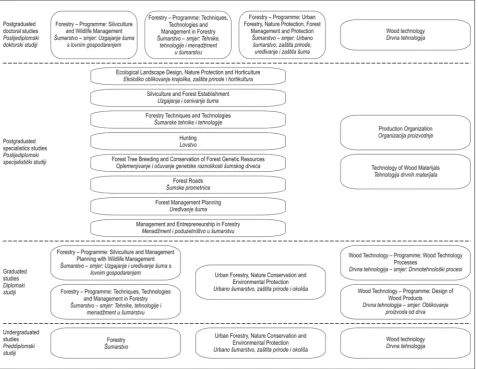
(2) A. P. B. KRPAN. Faculty of Forestry, University of Zagreb and Department of Forest Engineering ... (123–136). and dynamic knowledge-based economy in the world capable of sustainable economic growth with more and better jobs and greater social cohesion«). The strategy has been elaborated in a number of recommendations, communications and action plans, which served as a basis for the issue of key guidelines at the highest political level: Towards a European Research Area, The European Research Charter, The Code of Conduct for the Recruitment of Researchers, Action Mobility Plan, Science and Society Action Plan, and Action Plan 3%. The reform of the higher educational system on the Bologna principles in Croatia was regulated at the national level by the 2003 Act on Scientific Activity and Higher Education and by subsequent amendments and other University documents. The National Institute of Science, Higher Education and Technological Development of the Republic of Croatia took part in the reform of doctoral studies by issuing ten core principles for the organisation of doctoral studies. The National Council for Higher Education of the Republic of Croatia passed the Principles for the Organisation of Postgraduate Doctoral Studies on July 14, 2006, consisting of General Principles, Principles of Study, and Organisational and Financial Principles. The Faculty of Forestry in Zagreb is the oldest institution of higher specialist education in south-eastern Europe. It dates back to 1860, when the High School of Agriculture and Forestry was established in Kri`evci and to 1898, when the Forestry Academy was founded in Zagreb. From 1920 to 1960 it was part of the Faculty of Agriculture and Forestry of Zagreb University and later became an independent faculty within the University of Zagreb. Overall, 4,580 students of forestry and 1,647 students of wood technology have graduated from the Faculty to date. The academic titles of Master of Science and Master Specialist have been acquired by 343 students, of which 246 titles account for the scientific field of forestry and 97 for the scientific field of wood technology. A total of 190 doctoral theses have been defended, with 139 titles in the scientific field of forestry and 51 titles in the scientific field of wood technology. According to the Faculty’s historical documents, all the changes in teaching plans have been undertaken with the view of coordinating the educational profile and the necessary knowledge with the increasing demands of the profession and growing specialist and scientific insights. Immediately prior to the Bologna Declaration (2000) and in response to growing demands for differentiated knowledge within the profession, the Faculty conducted a reform by introducing a module educational system. All the teachers at the Faculty of Forestry contributed to the. 124. latest reform of the educational system with debates and proposals at the department level. In order to achieve compatibility as a basic prerequisite for free subject mobility in the European educational system, the commissions preparing the proposals drew upon the previously mentioned principles and upon their own and other experience, in particular the experience of forestry faculties in Germany, Austria, the Czech Republic, Slovakia, Hungary, Slovenia and other EU member countries. Apart from experts at the Faculty of Forestry, the reform has also attracted the participation of experts in the Ministry of Agriculture, Forestry and Water Management of the Republic of Croatia, the Academy of Forest Sciences and the Forestry Institute of Jastrebarsko, who have organized a number of workshops. The forestry operative has taken part via the Croatian Forestry Society, as well as via the management and specialist services of the company Hrvatske [ume Zagreb. Members of the Department of Forest Engineering have also taken an active interest in the reform. The higher educational system at the Faculty of Forestry of the University of Zagreb has been reformed according to the system of three educational cycles based on a 3 + 2 + 3 (2) scheme, or 180 + 120 + 180 (120) ECTS points.. 2. The reformed study structure at the Faculty of Forestry – Struktura reformiranoga studija na [umarskom fakultetu Up to the Bologna reform, the four-year study programme at the Faculty of Forestry put forth two profiles of experts with Bachelor degrees in forestry and in wood technology. The postgraduate study system led to the degrees of Master of Science, Master Specialist and Doctor of Science. A three-tier system of higher education was adopted with the Bologna reform: undergraduate, graduate and postgraduate. The scheme is given in Figure 1.. 2.1 Undergraduate study – Preddiplomski studiji According to Figure 1, three undergraduate study programmes have been devised at the Faculty of Forestry and adopted by the University of Zagreb: a) Forestry, b) Urban Forestry, Nature Conservation and Environmental Protection and c) Wood Technology. Educational undergraduate study programmes last for three years (6 semesters). Students are required to collect 30 ECTS points or 180 ECTS points Croatian Journal of Forest Engineering 28(2007)1.
(3) Faculty of Forestry, University of Zagreb and Department of Forest Engineering ... (123–136). A. P. B. KRPAN. Fig. 1 Structure of the higher educational system at the Faculty of Forestry, University of Zagreb Slika 1. Struktura visokoobrazovnoga sustava na [umarskom fakultetu Sveu~ili{ta u Zagrebu throughout the duration of the study. The courses are compulsory and optional, lasting for one semester with additional values of ECTS points. By completing the undergraduate study students obtain the title of baccalaureate (BSc.), acquire competences for individual and team work in private entrepreneurship and specialist jobs in forestry, urban forestry, nature conservation and environment protection, wood processing and manufacture, as well as competences for the enrolment into graduate studies. Enrolment into the programme and programme course is defined by the Faculty Statute and by other acts. Student mobility in the undergraduate programme is expressed by their ability to choose optional courses at three levels: from other undergraduate programmes at the Faculty of Forestry in Zagreb, from biotechnology studies in Croatia and from studies at other faculties and polytechnics in the country and abroad. Croatian Journal of Forest Engineering 28(2007)1. 2.2. Graduate study – Diplomski studiji The Faculty offers graduate study programmes for the educational profile in Forestry, Urban Forestry, Nature Conservation and Environmental Protection, as well as programmes for the study of Wood Technology Processes and Design of Wood Products. The graduate Forestry study has two programmes: Silviculture and Management Planning with Wildlife Management and Techniques, Technologies and Management in Forestry. The study lasts for two years or four semesters and requires 120 ECTS points in all. By completing the study, students acquire the academic title of Master according to the completed study (e.g. master of forestry – technique, technology and management). The number of optional courses per semester is significantly greater compared to the undergraduate study and offers wider possibilities for forming an individual educational profile. The study also provi-. 125.
(4) A. P. B. KRPAN. Faculty of Forestry, University of Zagreb and Department of Forest Engineering ... (123–136). des better possibilities for horizontal and vertical student mobility across domicile and foreign educational institutions. Candidates in the study programmes develop managing competences and the ability to make independent and team business decisions, take part in developmental professional courses, as well as continue education in doctoral studies. By completing graduate studies, students obtain the necessary knowledge and skills for complex forestry tasks, ranging from the lowest forest structural units such as forest offices and districts to the highest ones on a vertical scale, such as county and republican institutions with jurisdiction over forestry. The scope of employment also includes inspection services, businesses and tasks in forest entrepreneurship, jobs and tasks in developmental, scientific and educational institutions, trade with forest products at home and foreign markets, trade with equipment, tasks in professional publishing and forestry-related media; complex jobs in urban forestry and forest and nature protection, as well as sawmilling and wood processing.. 2.3 Postgraduate study – Poslijediplomski studiji The Faculty of Forestry of the University of Zagreb has a long tradition of postgraduate education, first through the writing and defence of doctoral theses, and in later periods through the establishment of master’s scientific and specialist study programmes. The first doctorate at the Faculty (Agricultural-Forestry Faculty) was defended on 4 June 1923. Before that, doctoral theses had been submitted to and defended at foreign faculties or at the Faculty of Philosophy of Zagreb University, whose constituent part was the Forestry Academy from 1898 to 1918. So far a total of 190 doctoral theses have been defended at the Faculty of Forestry, University of Zagreb. Postgraduate study of forestry and wood technology (leading to a master’s and master specialist degrees, as well as doctoral studies) in several scientific fields were established in 1960 after the Faculty of Forestry became an independent institution. The first master’s degree was defended on 31 August 1964. A total of 343 masters of sciences and master specialists theses have since been submitted at both Faculty departments, of which 246 in the Forestry department. Postgraduate study programmes are regarded as a component of lifelong learning, especially in the sense of new knowledge transfer during high-quality research and professional training and during its application in practice.. 126. According to past experience, the following partners have expressed interest in postgraduate studies: the public economic sector, in the first place the state company for the management with state-owned forests (79% of all forests in Croatia) whose 9,500 and more employees work in over 170 regionally distributed organisational units; state administration (management and inspection services of the Ministry of Agriculture, Forestry and Water Management and state administration offices in counties); the private sector represented by a broad scope of forestry entrepreneurs employed in forestry services (operational work, trade, promotion, etc.); interest associations of private forest owners; the scientific-research sector and all those who seek to benefit from such training by achieving increased competitiveness and improving their company businesses. 2.3.1 Doctoral study – Doktorski studiji Although doctoral studies were discussed at earlier ministerial conferences (Bologna 1999, Prague 2001), ministers of 33 European countries met in Berlin in 2003 to determine the priorities needed to accelerate the establishment of stronger links between the European Higher Education Area (EHEA) and the European Research Area (EHA), as well as introduce the third cycle of higher education (doctoral study) within the Bologna Process. The most important criteria that were highlighted included interdisciplinarity, a systematic approach to quality assurance in higher education, student and research mobility and excellence networking. »Doctoral studies are third-cycle studies which require original research for the acquisition of the academic degree of doctor of science (PhD.). Doctoral programmes are essential for the development of EHEA and ERA and represent a link between these two processes. The main responsibility for the training of researchers at different stages of their career is borne by universities. They must respond to the challenges of training young researchers not only to meet the needs of the academic market but also the needs of other sectors and labour markets such as industry, entrepreneurship, trade, public institutions and organisations, research organisations, etc.« The Rectors of European universities met in Graz in 2003 and issued a declaration on the Europe of Knowledge and the central role of universities in research and research-based higher education. They emphasised that competitiveness and excellence should be balanced with social cohesion and inclusion of growing numbers of people into higher education. The basic principles were set down stating that European universities will build their research Croatian Journal of Forest Engineering 28(2007)1.
(5) Faculty of Forestry, University of Zagreb and Department of Forest Engineering ... (123–136). and innovative strategies in the spirit of the Europe of Knowledge. In June 2003 the European Commission passed, and the European Council and the European Parliament adopted a Communication addressing the need to develop research professions and research criteria. Care for the creation of a research career is a constituent part of a doctoral programme. The Communication provides basic guidelines to be realized by a doctoral programme: increase researcher employability through the development of general competences and skills needed for employment; restructure and reorganize doctoral programmes and include them in the Bologna Process; provide better organized training through a doctoral programme; systematically develop supervision and mentorship; fully integrate doctoral students in research, but also open the path to additional profiling of their careers outside the research area; ensure financing and adequate social rights for doctoral students, as well as organized approach to mobility. In 2004 the European University Association (EUA) initiated a project of doctoral programmes and attracted the participation of 49 European universities from 22 countries – EU members. The 2004 EUA conference in Maastricht devised a framework of institutional policy in the field of doctoral training. The 2005 Conference in Salzburg elaborated the EUA Doctoral Project recommendations and the Maastricht conclusions by putting forth a set of ten basic principles for the organisation of doctoral studies: doctoral study should be based on the advancement of knowledge through original research; doctoral study and the development of research careers should be imbedded in institutional strategies and policies; the rich diversity of doctoral programmes in Europe should be preserved; doctorate candidates should be recognized as early stage researchers or professionals with commensurate rights; supervision and assessment of candidates should be based on a transparent contractual framework of shared responsibilities that clearly define rights and obligations; doctoral programmes should seek to achieve critical mass of expertise through the creation of doctoral schools or excellence network; as a rule, doctoral training should last for 3 – 4 years full-time; the innovative programme structure and the development of general competences should be realized through interdisciplinarity; mobility should be increased, a number of obstacles removed and adequate financial instruments for its implementation ensured; appropriate funding and a system of developing quality doctoral programmes should be ensured. The conference held in Vienna in 2006 discussed the Charter and the Code and developed instruments for supporting doctoral candidates; clearly defined goals and projects of doctoral research; training plans and supervision plans for each individual doctoral Croatian Journal of Forest Engineering 28(2007)1. A. P. B. KRPAN. candidate; a compulsory part of the programme through courses and modules; research-based colloquia and workshops; training for the acquisition of general skills; institutionalized monitoring and guidance through a candidate’s career; participation in the organisation of scientific events and taking responsibility for a part of the work (poster sections); participation in decision-making bodies. Programmes of postgraduate doctoral studies and postgraduate specialist studies have been set down at the Faculty of Forestry within the postgraduate study reform: doctoral Forestry study (two programmes) and doctoral Wood Technology study, as well as eight programmes of specialist forestry studies and two programmes of specialist wood technology studies (Figure 1). A temporary license was issued for the above programmes, which currently serve as the basis for the third higher educational cycle. Taking into consideration the reviewers’ and reporters’ comments related to the doctoral study programme of Forestry and the Principles for the Establishment of Postgraduate Doctoral Studies issued by the National Higher Education Council of the Republic of Croatia on 14 July 2006, as well as other domicile and European guidelines, we undertook to make an in-depth revision of the doctoral study programme with a view to meeting the European requirements and principles of doctoral training. The revision envisages one doctoral study of Forestry with three programmes: Þ Silviculture and Wildlife Management, Þ Techniques, Technologies and Management in Forestry, Þ Urban Forestry, Nature Protection, Forest Management and Protection. Doctoral studies last for three years. Students acquire ECTS points from three point groups. The first two point groups relate to teaching, from which a doctoral candidate collects 60 ECTS points or 20 points per semester, while the third group relates to extra-curricular activities, from which the candidate is required to collect 120 ECTS points. The first point group is made up of compulsory courses for all doctoral students. The second point group consists of optional courses in dependence of a study programme. The first semester in the field of doctoral study consists of courses that are compulsory for all study programmes. In the second and third semester all the courses are optional. Students are required to collect 20 ECTS points/semester or 60 ECTS points in all from the teaching part of the study. Instruction is held in the form of lectures (contributing to a maximum of 25% of the timetable), field/laboratory work and seminars. Focus is on the candidate’s inde-. 127.
(6) A. P. B. KRPAN. Faculty of Forestry, University of Zagreb and Department of Forest Engineering ... (123–136). pendent work based on seminar papers. In the fourth, fifth and sixth semester students are required to collect 40 ECTS points/semester or a total of 120 ECTS points in extracurricular activities from the Third point group. Immediately upon enrolment, the candidate takes part in scientific-research work on projects and is required to publish his/her research results in leading professional and scientific journals. In the fourth, fifth and sixth semester a doctoral candidate spends some time abroad, publishes papers, prepares and defends a dissertation. A mentor is selected after the first semester. A candidate is obliged to enrol a minimum of 51% of optional courses from the programme of doctoral study, while the remaining 49% may be elected from other programmes or doctoral studies at domicile and other faculties and universities with bilateral contracts (after consultations with their mentors). The proposal of the doctoral study programme outlined above is currently being evaluated at the University of Zagreb. The high quality of doctoral study programmes will be ensured by the employment of competent mentors and teachers, the inclusion of candidates in scientific-research activities in home and international projects, suitable facilities and equipment, maximal profiling according to the candidate’s individual desires reflected in the choice of optional courses, as well as by mobility within postgraduate studies at domicile and foreign educational institutions. The doctoral study reform will allow doctoral candidates to become an organic component in educational and research processes and will enable accelerated acquisition and quality of their individual competences. Foreign institutions with which the Faculty of Forestry in Zagreb or the University of Zagreb have signed contracts on cooperation include BOKU, Vienna, Austria; University of Silesia in Katovice, Poland; Mendel University of Agriculture and Forestry, Brno; Biotechnological Faculty of the University of Ljubljana, Slovenia, and the Faculty of Forestry of the University of Sarajevo, Bosnia and Herzegovina. By obtaining the academic title of doctor of science, doctoral candidates acquire competences for independent and original scientific-research work, as well as develop the ability to objectively and critically evaluate other scientific projects, make scientific and academic advancements and promote their careers. The purposefulness of doctoral studies at the Faculty of Forestry of Zagreb University is reflected in the need of the Croatian forestry for doctors of science, particularly for purposes of sustaining and promoting scientific-research and educational components in the educational and scientific-research framework (Faculty of Forestry Zagreb, Forestry Ins-. 128. titute Jastrebarsko, polytechnics and secondary forestry schools), and their activities in productive and developmental services of forestry companies and affiliated activities. The researchers of the Faculty of Forestry in Zagreb and the Forestry Institute have for the past 35 years been firmly integrated in the technological development of forestry in Croatia (seven mid-term research programmes), thus ensuring high-educational and scientific basis for forest management and integration in global developmental trends. Full-time study organisation is based on an 8hour working day of students at the Faculty of Forestry, within which they attend lectures, participate in scientific-research work on scientific projects and teach in undergraduate and graduate study courses. Part-time study organisation entails attending lectures within doctoral study and participating in scientific projects at the Faculty of Forestry or the related faculties and scientific institutions in the country and abroad in the status of cooperator-researcher. 2.3.2. Specialist study – Specijalisti~ki studiji Specialist studies are intended for further training of operative experts. The purposefulness of postgraduate specialist study is reflected in the needs of Croatian forestry for such an educational profile, and particularly for their work in production and developmental services of forestry companies and affiliated activities, as well as in the increasingly developing private sector. The study, based on scientific developments, promotes basic skills and the ability to solve complex production and developmental tasks individually or in a team. According to Figure 1, ten specialist study programmes in all have been proposed for evaluation, of which eight are from the field of forestry and two from the field of wood technology. Specialist studies last for two years or four semesters. A study candidate is required to collect a total of 120 ECTS points or 30 ECTS points per semester during the length of study. The weekly load may be maximally 12 hours (180 hours/semester). The first semester consists of compulsory courses of general importance for the study. In the second semester and the first half of the third semester all the courses are optional. Candidates are required to enrol 51% of the optional courses from the study programme, whereas the remaining 49% are elected from other studies at domicile and other faculties and universities (in consultation with mentors). A mentor is selected after the first semester. In the middle of the third and in the fourth semester the candidate writes and publishes papers, writes and defends his specialist work. During the Croatian Journal of Forest Engineering 28(2007)1.
(7) Faculty of Forestry, University of Zagreb and Department of Forest Engineering ... (123–136). A. P. B. KRPAN. Table 1 Graduate study of Forestry, programme: Technique, Technology and Management in Forestry Tablica 1. Program diplomskoga studija [umarstvo, smjer: Tehnike, tehnologije i menad`ment u {umarstvu Lectures Laboratory Field work Predavanja Vje`be Teren classes – sati days – dana 1st semester I. semestar. Compulsory courses Obvezni predmeti. Logging II Pridobivanje drva II Mechanisation of Timber Logging Mehanizacija pridobivanja drva Management and Entrepreneurship in Forestry Menad`ment i poduzetni{tvo u {umarstvu Forestry Policy and Legislation [umarska politika i zakonodavstvo Optional course 1 Izborni predmet 1 Optional course 2 Izborni predmet 2 Optional course 3 Izborni predmet 3 Total Ukupno. ECTS. 3. 2. 3. 7. 3. 2. 3. 7. 2. 2. 2. 6. 2. –. –. 4. 1. –. –. 2. 1. –. –. 2. 1. –. –. 2. 13. 6. 8. 30. Obligatory optional courses Obvezni izborni predmeti. Torrent Control Ure|ivanje bujica Sociology of Organization in Forestry Sociologija organizacije u {umarstvu Physical and Mechanical Properties of Wood Osnove tehnologije drva Humanisation of Work in Forestry Humanizacija rada u {umarstvu. 2nd semester II. semestar Planning of Forest Road Network Otvaranje {uma Forest Products [umski proizvodi Integrated Forest Protection Integrirana za{tita {uma Silviculture Silvikultura Graduate paper Diplomski rad Optional course 1 Izborni predmet 1 Optional course 2 Izborni predmet 2 Optional course 3 Izborni predmet 3 Total Ukupno. 2. 2. 2. 6. 2. 1. 2. 4. 2. 1. 2. 4. 2. 2. 3. 5. –. –. –. 5. 1. –. –. 2. 1. –. –. 2. 1. –. –. 2. 11. 6. 9. 30. Forest Product Trade Trgovina {umskim proizvodima Ergonomics of Forest Machines Ergonomija {umskih strojeva Mechanical Technologies of Wood Osnove mehani~ke preradbe drva Forest Fires [umski po`ari Forest Fire-Prevention Infrastructure [umska protupo`arna infrastruktura. rd. 3 . semester III. semestar Design of Forest Roads Projektiranje {umskih prometnica Forestry Firm Economics Ekonomika {umarske tvrtke Marketing in Forestry Marketing u {umarstvu Digital Cartography in Forestry Digitalna kartografija u {umarstvu. 2. 2. 4. 6. 2. 1. 1. 5. 2. 1. –. 3. 2. 1. –. 3. Croatian Journal of Forest Engineering 28(2007)1. Technology of Forest Road Construction Tehnologije gradnje {umskih prometnica Evaluation of Forest Resources Vrednovanje {umskih resursa Forest Biomass for Energy [umska biomasa za energiju Planning of Technological Operations Planiranje tehnolo{kih operacija. 129.
(8) A. P. B. KRPAN. Faculty of Forestry, University of Zagreb and Department of Forest Engineering ... (123–136). Lectures Laboratory Field work Predavanja Vje`be Teren classes – sati days – dana 4th semester IV. semestar. Compulsory courses Obvezni predmeti. Enviromentaly sound Technologies Okoli{no prihvatljive tehnologije Organization of Production in Forestry Organizacija proizvodnje u {umarstvu Forest Regulation and Planning Ure|ivanje {uma Graduate paper Diplomski rad Total Ukupno. Obligatory optional courses Obvezni izborni predmeti. ECTS. 2. 2. 3. 4. 2. 2. 3. 5. 2. 1. 2. 3. –. –. –. 18. 6. 5. 8. 30. Table 2 Doctoral study in Forestry, programme: Techniques, Technologies and Management in Forestry – the first point group – Methodological (compulsory) courses Tablica 2. Doktorski studij [umarstvo, smjer: Tehnike, tehnologije i menad`ment u {umarstvu – Prva bodovna skupina – Metodolo{ki (obvezni) kolegiji Courses Predmeti. Total Ukupno. Methods and Techniques of Scientific-Research Work Metode i tehnike znanstvenoistra`iva~kog rada Design of Experiments and Statistical Modelling Planiranje pokusa i statisti~ko modeliranje Remote Sensing and GIS in Forestry Daljinska istra`ivanja i GIS u {umarstvu. Seminars Seminar. ECTS. 20. 5. 10. 5. 4. 20. 5. 10. 5. 4. 24. 10. 10. 4. 5. study candidates are involved in scientific-research work (projects). The study is organized in such as way as to ensure horizontal and vertical student mobility. Horizontal mobility refers to studies within biotechnology and other studies at Croatian universities and abroad. Vertical mobility refers to the transition to doctoral studies. By completing the studies the candidate acquires competences for providing independent and team solutions to complex and very complex production and developmental professional tasks on scientific principles.. 3. The position of the Department of Forest Engineering in the Bologna Process – Polo`aj Zavoda za {umarske tehnike i tehnologije u bolonjskom procesu As mentioned before, members of the Department were actively involved in the Bologna reform. 130. Load, hours – Optere}enje, sati Lectures Laboratory Predavanja Vje`be. and contributed greatly to a successful presentation of programme proposals for undergraduate, graduate and postgraduate studies at the Faculty. The Department teachers hold courses on all educational programmes of the reformed study. They teach a large number of compulsory and optional courses in undergraduate studies. Of particular importance is the fact that forestry engineering has been highlighted through the creation of special educational programmes led by the Department members. Thus a special educational programme in the graduate study of Forestry, entitled Forestry – programme: Technique, Technology and Management in Forestry, whose programme is given in Table 1. Within the doctoral study in Forestry the Department also proposed and developed a programme of doctoral study entitled Techniques, Technologies and Management in Forestry. The programme consists of lectures (Tables 2 and 3) and extra-curricular activities (Table 4). The focus is placed on extracurricular Croatian Journal of Forest Engineering 28(2007)1.
(9) Faculty of Forestry, University of Zagreb and Department of Forest Engineering ... (123–136). A. P. B. KRPAN. Table 3 Doctoral study in Forestry, programme: Techniques, Technologies and Management in Forestry – the second point group – Optional courses Tablica 3. Doktorski studij [umarstvo, smjer: Tehnike, tehnologije i menad`ment u {umarstvu – Druga bodovna skupina – Izborni predmeti Courses Predmeti. Total Ukupno. Work and Time Study Studij rada i vremena Rationalisation of Wood Harvesting Operations Racionalizacija radova pridobivanja drva Forest Operations Management Upravljanje {umskim operacijama Cost Calculations of Harvesting Operations Kalkulacije tro{kova pridobivanja drva High-tech in Forest Harvesting Vrhunske tehnologije pridobivanja drva Marketing and Forest Products Trade Marketing i trgovina {umskih proizvoda Commercial Law Trgova~ko pravo Forest Harvesting and Enviroment Pridobivanje drva i {umski okoli{ Optimisation of Forest Road Infrastructure Optimizacija {umske prometne infrastrukture Primary and Secondary Forest Opening Primarno i sekundarno otvaranje {uma Computer Forest Road Design Ra~unalno projektiranje {umskih cesta Techniques and Technologies of Forest Road Building Tehnike i tehnologije izgradnje {umskih prometnica Prominent Properties of Wood Prominentne zna~ajke drva Management in Forestry Menad`ment u {umarstvu Corporation Management Korporacijsko upravljanje Business Ethics Poslovna etika Measurement Techniques on Forest Machines Tehnike mjerenja na {umskim strojevima Technical and Enviromental Suitability of Forest Machines Tehni~ka i okoli{na pogodnost strojeva Ergonomy in Forestry Ergonomija u {umarstvu. Seminars Seminar. ECTS. 24. 6. 8. 10. 5. 24. 6. 6. 12. 5. 24. 6. 4. 14. 5. 24. 6. 6. 12. 5. 24. 6. 6. 12. 5. 12. 2. 4. 6. 3. 12. 4. –. 8. 3. 12. 4. 2. 6. 3. 24. 8. 6. 10. 5. 24. 6. 8. 10. 5. 24. 8. 8. 8. 5. 24. 8. 6. 10. 5. 12. 4. 6. 2. 3. 24. 8. 6. 10. 5. 12. 4. –. 8. 3. 12. 4. –. 8. 3. 24. 6. 8. 10. 5. 24. 6. 6. 12. 5. 24. 6. 8. 10. 5. activities from which a doctoral candidate must collect 120 of a total of 180 ECTS points. Three proposals for a specialist study programme have been devised at the Department, of which two have passed the evaluation criteria while the third is currently being evaluated. The study programmes Forest Techniques and Technologies and Forest Roads Croatian Journal of Forest Engineering 28(2007)1. Load, hours – Optere}enje, sati Lectures Laboratory Predavanja Vje`be. have been approved. The third study programme is Management and Entrepreneurship in Forestry. Tables 5 and 6 present educational programmes of two specialist studies developed within the Department. As the evaluation of the specialist study programme Management and Entrepreneurship in Forestry is still under way, it is not given here.. 131.
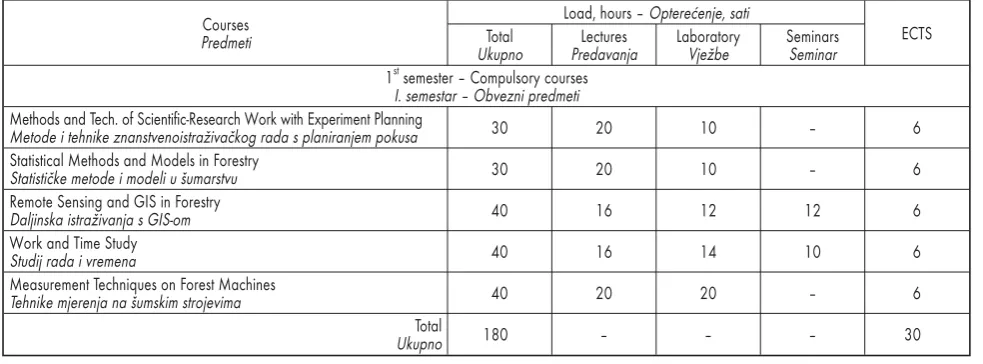
(10) A. P. B. KRPAN. Faculty of Forestry, University of Zagreb and Department of Forest Engineering ... (123–136). Table 4 Doctoral study in Forestry, programme: Techniques, Technologies and Management in Forestry – the third point group – Extracurricular activities (120 ECTS) Tablica 4. Doktorski studij [umarstvo, smjer: Tehnike, tehnologije i menad`ment u {umarstvu – Tre}a bodovna skupina – izvannastavne aktivnosti (120 ECTS) Scientific Ativity and Scientific Articles Znanstvena aktivnost i znanstveni radovi Conducting a scientific project (for young scientists) Vo|enje znanstvenog projekta (za mlade znanstvenike) Participation in a domicile scientific project Sudjelovanje na doma}em znanstvenom projektu Participation in an international scientific project Sudjelovanje na me|unarodnom znanstvenom projektu Scientific work published in a journal cited in 1st group databases (CC, SCI,...) Objavljen znanstveni rad u ~asopisu a1 skupine Scientific work published in a journal cited in 2nd group databases (CAB, Agricola,...) Objavljen znanstveni rad u ~asopisu a2 skupine Presentation at an international scientific meeting Prezentacija na me|unarodnom znanstvenom skupu (a3 skupina) Poster at an international scientific meeting Poster na me|unarodnom znanstvenom skupu Presentation at a domicile scientific meeting Izlaganje na doma}em znanstvenom skupu Poster at a domicile scientific meeting Poster na doma}em znanstvenom skupu Other articles (evaluated by the study’s organizer) Ostali ~lanci (prema ocjeni voditelja studija) Defending doctoral thesis Obrana teme doktorske disertacije Patents, books and parts of books (evaluated by the study’s organizer) Patenti, knjige i dijelovi knjiga (prema ocjeni voditelja studija) Awards, certificates and similar (evaluated by the study’s organizer) Nagrade, priznanja i sl. (prema ocjeni voditelja studija) Scientific training abroad (up to 1 month) Znanstveno usavr{avanje u inozemstvu (do 1 mj.) Scientific training abroad (from 1 to 3 months) Znanstveno usavr{avanje u inozemstvu (od 1 do 3 mj.) Scientific training abroad (more than 3 months) Znanstveno usavr{avanje u inozemstvu (vi{e od 3 mj.). No. of ECTS points Broj ECTS bodova 15 5 5 30 (A*), 15 (K*) 20 (A), 10 (K) 15 (A), 5 (K) 10(A), 4 (K) 8 (A), 3 (K) 6 (A), 2 (K) 0–10 10 0–15 0–10 10 20 30. * A – first author – prvi autor, K – co-author – suautor. Table 5 of Specialist study programme in Forestry Techniques and Technologies Tablica 5. Program specijalisti~koga studija [umarske tehnike i tehnologije Load, hours – Optere}enje, sati Total Lectures Laboratory Ukupno Predavanja Vje`be 1st semester – Compulsory courses I. semestar – Obvezni predmeti Methods and Tech. of Scientific-Research Work with Experiment Planning 30 20 10 Metode i tehnike znanstvenoistra`iva~kog rada s planiranjem pokusa Statistical Methods and Models in Forestry 30 20 10 Statisti~ke metode i modeli u {umarstvu Remote Sensing and GIS in Forestry 40 16 12 Daljinska istra`ivanja s GIS-om Work and Time Study 40 16 14 Studij rada i vremena Measurement Techniques on Forest Machines 40 20 20 Tehnike mjerenja na {umskim strojevima Total 180 – – Ukupno Courses Predmeti. 132. Seminars Seminar. ECTS. –. 6. –. 6. 12. 6. 10. 6. –. 6. –. 30. Croatian Journal of Forest Engineering 28(2007)1.
(11) Faculty of Forestry, University of Zagreb and Department of Forest Engineering ... (123–136). Courses Predmeti. Load, hours – Optere}enje, sati Total Lectures Laboratory Ukupno Predavanja Vje`be 2nd semester –Optional courses II. semestar – Izborni predmeti. Forest Wood Products [umski drvni proizvodi Forest Non-Wood Products [umski nedrvni proizvodi Felling and Processing of Trees Sje~a i izradba drva Ground-based Timber Extraction Privla~enje drva po tlu Marketing of Forest Products Marketing {umskih proizvoda Cable Yarding and Aerial Logging @i~are i zra~ni transport drva Further Timber Transport Daljinski transport drva Technical Suitability of Forest Machines Tehni~ka pogodnost {umskih strojeva Abnormalities and Defects of Wood Nepravilnosti drva. A. P. B. KRPAN. Seminars Seminar. ECTS. 18. 7. 6. 5. 3. 18. 7. 6. 5. 3. 18. 10. 8. –. 3. 36. 16. 10. 10. 6. 18. 8. 5. 5. 3. 36. 16. 10. 10. 6. 36. 20. 10. 6. 6. 36. 18. 18. –. 6. 18. 10. 8. –. 3. Total 180 – Ukupno rd ½ 3 semester – Optional courses ½ III. semestar – Izborni predmeti. –. –. 30. 18. 10. 6. 2. 3. 18. 10. 6. 2. 3. 18. 8. 10. –. 3. 18. 8. 10. –. 3. 18. 8. 10. –. 3. 18. 10. 8. –. 3. 18. 12. –. 6. 3. 18. 6. 12. –. 3. –. –. –. 15. 270. –. –. –. 45. 270. –. –. –. 45. –. –. –. –. 120. High-tech in Forest Harvesting Vrhunske tehnologije pridobivanja drva Logistics in Forest Operations Logistika {umskih operacija Cost Calculations of Harvesting Operations Kalkulacije tro{kova {umskih operacija Anisotropy of Physical and Mechanical Properties of Wood Anizotropnost fizikalnih i mehani~kih zna~ajki drva Water in Trees and Wood Voda u drvetu i drvu Environmental suitability of Forest Machines Okoli{na pogodnost {umskih strojeva Entrepreneurship and Innovation in Forestry Poduzetni{tvo i inovacije Ergonomic in Forestry Ergonomija u {umarstvu. Total 90 Ukupno rd ½ 3 and 4th semester ½ III. semestar i IV. semestar Writing articles and preparation of thesis Pisanje ~lanaka, izrada specijalisti~kog rada Total Ukupno Overall Sveukupno. *In 2nd and 3rd semester students choose a minimum of 51 % of the listed subjects, and the rest from other programmes. *u 2. i 3. semestru studenti biraju najmanje 51% od navedenih predmeta, a ostatak iz drugih programa.. 4. Conclusion – Zaklju~ak The Faculty of Forestry of the University of Zagreb is successfully addressing the compulsory postuCroatian Journal of Forest Engineering 28(2007)1. lates of the higher educational reform stemming from the Bologna principles. The majority of the designed educational programmes for undergraduate, graduate and postgraduate (doctoral and specialist) studies. 133.
(12) A. P. B. KRPAN. Faculty of Forestry, University of Zagreb and Department of Forest Engineering ... (123–136). Table 6 Specialist study programme in Forest Roads Tablica 6. Program specijalisti~koga studija [umske prometnice Load, hours – Optere}enje, sati Total Lectures Laboratory Ukupno Predavanja Vje`be 1st semester – Compulsory courses I. semestar – Obvezni predmeti Methods and Tech. of Scientific-Research Work with Experiment Planning 30 20 10 Metode i tehnike znanstvenoistra`iva~kog rada s planiranjem pokusa Statistical Methods and Models in Forestry 30 20 10 Statisti~ke metode i modeli u {umarstvu Remote Sensing and GIS in Forestry 40 16 12 Daljinska istra`ivanja s GIS-om Work and Time Study 40 16 14 Studij rada i vremena Measurement Techniques on Forest Machines 40 20 20 Tehnike mjerenja na {umskim strojevima Total 180 – – Ukupno nd 2 semester – Optional courses II. semestar – Izborni predmeti Primary Forest Opening 36 18 18 Primarno otvaranje {uma Secondary Forest Opening 36 18 18 Sekundarno otvaranje {uma Methodologies of Forest Road Measurement 18 8 10 Metodologije izmjere {umskih cesta Computer Design of Forest Roads 36 14 22 Ra~unalno projektiranje {umskih cesta Technology of Forest Road Building 36 26 10 Tehnologije izgradnje {umskih prometnica High-tech in Forest Harvesting 18 10 6 Vrhunske tehnologije pridobivanja drva Bases of Forestry Business 18 12 6 Osnove poslovanja u {umarstvu Total 180 – – Ukupno rd ½ 3 semester – Optional courses ½ III. semestar – Izborni predmeti Legal Foundations of Planning, Design and Building Forest Roads 36 30 6 Zakonske osnove planiranja, projektiranja i izgradnje {umskih cesta Making a Forest Opening Study 36 14 22 Izrada studije otvaranja {uma Cable Yarding and Aerial Logging 18 9 9 @i~are i zra~ni transport Machines for Building Forest Roads 36 18 18 Strojevi za izgradnju {umskih prometnica Management in Forestry 18 10 8 Menad`ment poduze}a u {umarstvu Total 90 – – Ukupno rd th ½ 3 and 4 semester ½ III. semestar i IV. semestar Writing papers and preparation of thesis 270 – – Pisanje ~lanaka, izrada specijalisti~kog rada Total 270 – – Ukupno Overall – – – Sveukupno Courses Predmeti. Seminars Seminar. ECTS. –. 6. –. 6. 12. 6. 10. 6. –. 6. –. 30. –. 6. –. 6. –. 3. –. 6. –. 6. 2. 3. –. 3. –. 30. –. 6. –. 6. –. 3. –. 6. –. 3. –. 15. –. 45. –. 45. –. 120. *In 2nd and 3rd semester students choose a minimum of 51 % of the listed subjects, and the rest from other programms. *u 2. i 3. semestru studenti biraju najmanje 51% od navedenih predmeta, a ostatak iz drugih programa.. 134. Croatian Journal of Forest Engineering 28(2007)1.
(13) Faculty of Forestry, University of Zagreb and Department of Forest Engineering ... (123–136). have passed the process of evaluation and are currently being implemented. However, we must constantly bear in mind that every educational system is in continuous transition. Although during the preparation of the programme we adhered to the principles of responsibility and conscience, it is more than certain that the programmes of all educational degrees at the Faculty of Forestry will have to be permanently polished and improved in order to meet the reform objectives; provide young experts, competent promoters of the development of the profession and economy in the European framework, with rapid and successful training of the highest quality. The Department of Forest Engineering of the Faculty of Forestry in Zagreb has been entrusted with the honourable and responsible duty to develop and design special educational programmes related to forest engineering in the second and third educational cycle.. 5. References – Literatura Anon, 2007: Doktorski studij [umarstvo – smjer: uzgajanje {uma i lovno gospodarenje; smjer: Tehnike, tehnologije i menad`ment u {umarstvu; smjer: Urbano {umarstvo, za{tita prirode, ure|ivanje i za{tita {uma. Rukopis, [umarski fakultet Sveu~ili{ta u Zagrebu (ur. A. P. B. Krpan, J. Vukeli}, B. Hra{ovec), 1–369. Anon, 2006: Preddiplomski i diplomski studij [umarstvo. [umarski fakultet Sveu~ili{ta u Zagrebu (ur. R. Pernar), 1–155. Anon, 2006: Prediplomski i diplomski studij Urbano {umarstvo, za{tita prirode i okoli{a. [umarski fakultet Sveu~ili{ta u Zagrebu (ur. M. Id`ojti}), 1–93.. A. P. B. KRPAN. Anon, 2006: Doktorski studij Drvna tehnologija. Rukopis, [umarski fakultet Sveu~ili{ta u Zagrebu (ur. M. Figuri}), 1–103. Anon, 2006: Specijalisti~ki studij [umarske tehnike i tehnologije. Rukopis. [umarski fakultet Sveu~ili{ta u Zagrebu (ur. A. P. B. Krpan), 1–73. Anon, 2006: Specijalisti~ki studij Management and Entrepreneurship in Forestry. Rukopis, [umarski fakultet Sveu~ili{ta u Zagrebu (ur. I. Martini}), 1–52. Anon, 2006: Specijalisti~ki studij [umske prometnice. Rukopis, [umarski fakultet Sveu~ili{ta u Zagrebu (ur. D. Pi~man), 1–49. Anon, 2006: Specijalisti~ki studij Organizacija proizvodnje. Rukopis, [umarski fakultet Sveu~ili{ta u Zagrebu (ur. M. Figuri}), 1– 23. Anon, 2006: Specijalisti~ki studij Tehnologija drvnih materijala. Rukopis, [umarski fakultet Sveu~ili{ta u Zagrebu (ur. V. Jambrekovi}), 1–25. Anon, 2006: Doktorski studiji. Nacionalna zaklada za znanost, visoko {kolstvo i tehnologijski razvoj Republike Hrvatske (ur. P. Lu~in), Trg J. J. Strossmayera 4, Zagreb, 1–168. Anon; 2004: Biomedicina i zdravstvo. Medicinska naklada, Zagreb, listopad 2004 (ur. Z. Lackovi}), 1–383. Anon, 1998: Sveu~ili{na {umarska nastava u hrvatskoj 1898–1998. Knjiga tre}a [umarski fakultet Sveu~ili{ta u Zagrebu – Pola stolje}a drvnotehnolo{ke nastave. [umarski fakultet Sveu~ili{ta u Zagrebu 1998 (ur. B. Ljuljka), 1–364. Anon, 1998: Sveu~ili{na {umarska nastava u hrvatskoj 1898–1998. Knjiga druga – Sto godina sveu~ili{ne nastave u Hrvatskoj. [umarski fakultet Sveu~ili{ta u Zagrebu 1998 (ur. S. Mati}), 1–709.. Anon, 2006: Studijski programi Drvnotehnolo{kog odsjeka. [umarski fakultet Sveu~ili{ta u Zagrebu (ur. R. Beljo Lu~i}), 1–110.. Sa`etak. [umarski fakultet Sveu~ili{ta u Zagrebu i Zavod za {umarske tehnike i tehnologije u bolonjskom procesu Reforma visoko{kolskoga obrazovnoga sustava potaknuta je na Ministarskoj konferenciji u Bolonji 1999. godine dono{enjem tzv. Bolonjske deklaracije, koja je razra|ivana na kasnijim konferencijama ministara Europske unije, koje se odr`avaju svake dvije godine. Bolonjska je deklaracija temeljni dokument za reformu visokoobrazovnoga sustava u Europskom prostoru visokoga obrazovanja (EHEA). Potpisali su je ministri obrazovanja 29 europskih zemalja na Ministarskoj konferenciji u Bolonji 19. lipnja 1999. Hrvatska je prihvatila i potpisala dokument 2001. na Ministarskoj konferenciji u Pragu. Time se Hrvatska opredijelila za europski visoko{kolski obrazovni sustav preddiplomskoga i diplomskoga studija, a prihva}anjem preporuka Berlinske ministarske konferencije iz 2003. godine o doktorskom studiju zaokru`en je trostupanjski ciklus visokoga obrazovanja – preddiplomski,. Croatian Journal of Forest Engineering 28(2007)1. 135.
(14) A. P. B. KRPAN. Faculty of Forestry, University of Zagreb and Department of Forest Engineering ... (123–136). diplomski i doktorski. Visoko{kolski se obrazovni sustav reformira radi svrhovitijega obrazovanja i br`ega uklju~ivanja kompetentnih i vje{tih mladih stru~njaka u gospodarske tokove i stvaranje vlastite karijere. Pri tome se u prvi plan stavljaju kriteriji izvrsnosti, kompetentnosti i pokretljivosti. Ministri iz 33 europske zemlje 2003. godine u Berlinu utvr|uju prioritete za ubrzano stvaranje ja~ih veza izme|u Europskoga prostora visokoga obrazovanja (EHEA) i Europskoga istra`iva~koga prostora (ERA) te nu`nost uspostave tre}ega ciklusa visokoga obrazovanja (doktorskoga studija) u okviru Bolonjskoga procesa. Pri tome su kao najva`niji prioriteti istaknuti: interdisciplinarnost, sustavan pristup osiguranju i unapre|ivanju kakvo}e visokoga obrazovanja, mobilnost studenata i istra`iva~a te povezivanje u mre`e izvrsnosti. Bolonjska reforma visokoobrazovnoga sustava u Hrvatskoj na dr`avnoj je razini odre|ena Zakonom o znanstvenoj djelatnosti i visokom obrazovanju iz 2003. godine te usmjerena podzakonskim aktima i drugim dokumentima Sveu~ili{ta. U reformu doktorskih studija uklju~uje se Nacionalna zaklada za znanost, visoko {kolstvo i tehnologijski razvoj Republike Hrvatske, koja donosi deset temeljnih na~ela za organizaciju doktorskih studija. Nacionalno vije}e za visoko obrazovanje Republike Hrvatske 14. srpnja 2006. donosi Na~ela za uspostavu poslijediplomskih doktorskih studija koja sadr`e Op}a na~ela, Na~ela studiranja i Organizacijska i financijska na~ela. [umarski fakultet u Zagrebu najstarija je visokoobrazovna strukovna ustanova jugoisto~ne Europe, koja korijene vu~e iz Visokoga gospodarsko-{umarskoga u~ili{ta osnovanoga 1860. godine u Kri`evcima i [umarske akademije utemeljene 1898. u Zagrebu. Od 1920. do 1960. godine djeluje u sklopu Poljoprivredno-{umarskoga fakulteta Sveu~ili{ta u Zagrebu, a potom kao samostalni fakultet u okviru Zagreba~koga sveu~ili{ta. Do danas je na Fakultetu diplomiralo 4580 studenata {umarstva i 1647 studenata drvne tehnologije. Akademske titule magistra znanosti i magistra specijalista stekla su 343 studenta, od kojih 246 u znanstvenom polju {umarstvo, a 97 u znanstvenom polju drvna tehnologija. Obranjeno je ukupno 190 doktorata, 139 u znanstvenom polju {umarstvo i 51 u znanstvenom polju drvna tehnologija. Slijede}i platforme, upute i zacrtane ciljeve te vlastita i strana iskustva, na [umarskom je fakultetu uspje{no provedena prva faza reforme obrazovnoga sustava. Prihva}en je trostupanjski obrazovni sustav te su izra|eni obrazovni programi za preddiplomske, diplomske i poslijediplomske studije po shemi 3 + 2 + 3 (2) odnosno 180 + 120 + 180 (120) ECTS bodova. Uspostavljena su tri preddiplomska studija: [umarstvo, Urbano {umarstvo i Drvna tehnologija, po kojim se programima obrazuju ve} dvije generacije studenata. Razvijeni su programi diplomskih studija [umarstvo i Urbano {umarstvo, za{tita prirode i okoli{a te programi Drvnotehnolo{ki procesi i Oblikovanje proizvoda od drva. Diplomski studij [umarstvo ima dva smjera: Uzgajanje i ure|ivanje {uma s lovnim gospodarenjem i Tehnike, tehnologije i menad`ment u {umarstvu. Nadalje, razvijen je pobolj{ani prijedlog doktorskoga studija [umarstvo s tri smjera (Uzgajanje {uma i lovno gospodarenje,Tehnike, tehnologije i menad`ment u {umarstvu te Urbano {umarstvo, za{tita prirode, ure|ivanje i za{tita {uma) te program doktorskoga studija Drvna tehnologija. Specijalisti~ki poslijediplomski studiji razra|eni su u deset programa i zami{ljeni su kao sastavnica cjelo`ivotnoga obrazovanja stru~njaka iz prakse. [umarskomu je in`enjerstvu poklonjena zna~ajna pa`nja kreiranjem obrazovnih programa, ~iji su nositelji ~lanovi Zavoda za {umarske tehnike i tehnologije. Tako je ostvaren poseban obrazovni program u diplomskom studiju [umarstvo, koji nosi naslov [umarstvo – smjer: tehnike, tehnologije i menad`ment u {umarstvu. U okviru doktorskoga studija [umarstvo Zavod je razvio program smjera doktorskoga studija pod nazivom Tehnike, tehnologije i menad`ment u {umarstvu. Na Zavodu su razvijena tri prijedloga programa specijalisti~kih studija, od kojih su programi [umarske tehnike i tehnologije i [umske prometnice pro{li evaluaciju, a tre}i, Menad`ment i poduzetni{tvo u {umarstu, nalazi se u postupku predlaganja. Programi svih stupnjeva obrazovanja na [umarskom fakultetu u vremenu sada{njem i budu}em moraju se stalno pobolj{avati i na taj na~in pribli`avati zadanim ciljevima reforme, tj. da visokoobrazovne institucije brzo, uspje{no i kvalitetno obrazuju mlade stru~njake, kompetentne nositelje razvoja struke i ekonomije na doma}im i europskim prostorima. Klju~ne rije~i: [umarski fakultet u Zagrebu, reforma visokoobrazovnoga sustava. Author’s address – Autorova adresa:. Received (Primljeno): January 18, 2007 Accepted (Prihva}eno): March 22, 2007. 136. Prof. Ante P. B. Krpan, PhD. e-mail: [email protected] Forestry Faculty of Zagreb University Department of Forest Engineering Sveto{imunska 25 HR-10 000 Zagreb CROATIA Croatian Journal of Forest Engineering 28(2007)1.
(15)
Figure


+2
Related documents